Background Verification (BGV) Taking Too Long: What It Means and What to Do
You accepted the offer, submitted your documents, and now the status on the HR portal has said "In Progress" for what feels like forever. If you're wondering what a background verification taking too long what does it mean situation actually signals, the short version is: it usually means very little on its own. Verification agencies deal with dozens of moving parts outside your control — a previous HR department that's slow to respond, a university records office that takes its time, an address verifier who couldn't find anyone home on the first visit. Here's what's genuinely normal, what's worth flagging, and what actually happens if things don't clear cleanly.

What Is Actually Checked During Background Verification?
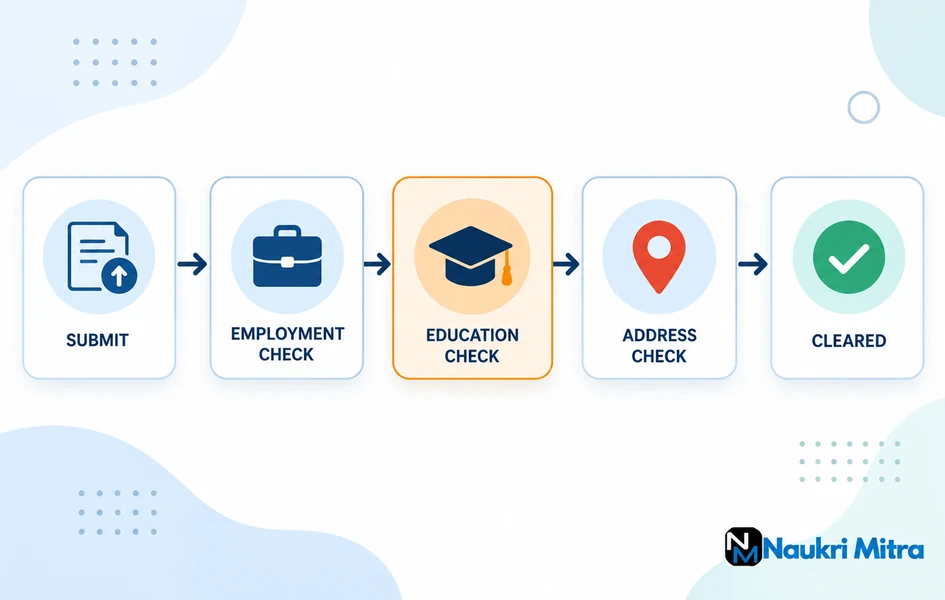
A standard Indian BGV is really several smaller checks bundled together, and the mix depends on the role and the employer's policy. Employment verification confirms your past job titles, dates, and salary directly with previous employers' HR teams, sometimes cross-checked against PF or UAN contribution records. Education verification confirms degrees and certificates directly with the issuing college or university, which is often the slowest single step since many Indian institutions still handle these requests manually rather than through an online records portal. A criminal background check is typically run through digitised court record databases and, for some roles, local police verification at your current and previous addresses. Address verification, identity document checks, and sometimes a direct reference call round out the process. Higher-responsibility roles — finance, senior management, anything client-facing at a regulated company — usually add credit checks or additional reference rounds on top of this standard set.
Most large Indian companies don't run these checks in-house; they outsource the process to a specialised third party verification agency. Firms like AuthBridge and IDfy are among the largest names in this space, together handling millions of checks a month across India, and their own published data gives a useful sense of realistic timelines. AuthBridge, for instance, describes standard checks typically completing in a few business days once automated workflows are used, while IDfy's own reporting distinguishes between a faster pre-onboarding check and a slower, more thorough comprehensive check that covers employment, education, and criminal records together.
One thing candidates often don't realise is that this process isn't a free-for-all on your personal information. Under India's Digital Personal Data Protection Act, 2023, verification agencies and employers are expected to collect your consent before processing personal data like ID documents, past salary details, and address history, and to use it only for the stated purpose of the check itself. In practice this shows up as the consent form you sign at the start of onboarding, which is worth actually reading rather than skimming, since it usually spells out exactly which checks will be run and which third parties will be contacted on your behalf.
How Long Does Background Verification Take for IT Companies?
There's no single fixed number for how long does background verification take for IT companies, because it depends heavily on which checks are included and how responsive your previous employers and institutions are. Industry-wide data on pre-employment screening puts the typical median turnaround for a basic, pre-onboarding check at around 3 days, while a full, comprehensive check commonly runs closer to a three-week median across the industry as a whole. Individual verification providers using more automated workflows report doing considerably better than that industry median for straightforward cases — some publish figures of a day or two for basic checks and under a week for comprehensive ones when previous employers and institutions respond promptly. In practice, most Indian IT and services companies complete standard BGV within 7 to 20 working days from the date you submit documents, and it's fairly common for larger companies to let new hires join and start training while verification is still being finalised in parallel, rather than making everyone wait it out before their start date. You can see how two of India's larger verification providers describe their own process and typical timelines on AuthBridge's background verification page and IDfy's verification solutions page.
My BGV Has Been Pending for 3 Weeks — Should I Worry?
If your BGV pending for 3 weeks should I worry question is starting to feel urgent, the honest answer depends on what's actually causing the delay, and most of the time it's genuinely nothing to do with you. The most frequent culprits are a previous employer's HR department sitting on a verification email, a university taking its usual few weeks to respond to a degree confirmation request, or an address verification visit that needs to be rescheduled because nobody was home. Three weeks is longer than the fastest cases but still well within a normal range for a comprehensive check, especially if you worked at a smaller company with no dedicated HR verification process, or if your college is a smaller regional institution rather than a large university with a streamlined records office.
That said, it's completely reasonable to check in. Send HR or the verification team a polite email asking for a status update rather than sitting in silence — most companies are used to this question and will tell you honestly whether they're waiting on a document from your side or a response from a third party. If three weeks has passed with zero communication at all, that's a fair point to escalate a little more directly, and asking your recruiter for a rough completion estimate rather than a vague "we're checking" is a reasonable thing to push for.
Background Verification Delay After Offer Letter: Common Causes
A background verification delay after offer letter India situation usually traces back to one of a handful of recurring issues rather than anything unusual about your file specifically. A previous employer that has since shut down, merged, or restructured its HR team can genuinely take weeks to respond to a verification request, since there may be no one left who knows how the old records are organised. A gap in your employment history — a career break, freelancing period, or time spent studying — sometimes needs additional documentation to satisfy the verifier, which adds a round-trip or two to the process. Address changes, especially if you've moved cities since your last job, can also slow down the physical verification step, since the agency may need to schedule a fresh visit at the new location. None of these, on their own, typically indicate a problem with your candidacy; they're closer to administrative friction than red flags, and they resolve themselves once the missing piece of information finally comes through.
What Happens If BGV Fails After Joining?
The more serious question is BGV failed after joining what happens to your employment. Indian labour practice generally requires employers to follow a fair process rather than terminating someone the moment a discrepancy surfaces — this typically means a show-cause notice explaining the specific issue, a reasonable window for you to respond or provide clarifying documents, and only then a decision on next steps, broadly in line with natural-justice principles that Indian courts have consistently applied to workplace disciplinary action and dismissal.
What happens next depends heavily on the severity of the discrepancy. A minor clerical mismatch — a slightly wrong employment date, a title that was listed informally rather than exactly as it appears on your relieving letter — is usually resolved through a conversation and updated documentation, with termination unlikely in genuinely minor cases. Genuinely misrepresented experience, like claiming a role, seniority, or tenure you didn't actually hold, is treated far more seriously and can lead to termination once confirmed. Fraudulent documents — a fabricated degree certificate or a fake relieving letter — are typically grounds for immediate termination and, in serious cases, further legal consequences, since submitting forged documents can itself amount to a separate offence beyond the employment dispute.
Can I Resign From My Current Job Before BGV Clears?
This is one of the riskier timing decisions candidates face, and the general advice from most placement consultants is to wait until BGV has at least substantially cleared before formally resigning from your current role. If a discrepancy does surface — even an honest one, like an old employer confirming slightly different dates than what you remembered — you want the flexibility of still being employed while it gets sorted out, rather than having already burned that bridge with nowhere to fall back on. If your new employer is comfortable extending your joining date to accommodate your notice period plus a verification buffer, that's generally the safer sequence, even if it means a slightly later start date than originally planned.
Frequently Asked Questions
1. Is background verification usually done before or after joining in most Indian companies?
Both patterns exist. Many large IT and services companies let candidates join and begin work or training while verification finishes in parallel, treating the offer as conditional until BGV clears. Smaller companies and highly regulated sectors like banking and finance more often complete verification fully before the joining date.
2. Can I ask HR directly for a background verification status update?
Yes, and you should. A short, polite email asking whether the delay is on the verifier's side or waiting on something from you is a completely normal question that HR teams field regularly, and most will give you a straightforward answer rather than leaving you guessing.
3. Do certain companies run stricter background checks than others?
Yes. Banking, financial services, healthcare, and roles handling sensitive data or large sums of money typically run more thorough checks, including credit history and additional reference rounds, compared to a standard employment and education check for a general corporate role.
4. Does an employment gap automatically hurt my background verification outcome?
No. A documented gap for study, family reasons, freelancing, or a genuine career break is not treated as a red flag by itself. It's undisclosed or misrepresented gaps — claiming you were employed somewhere you weren't — that create real problems during verification.
5. What documents are typically needed for a background verification check?
Standard requirements include your last few salary slips or offer and relieving letters, degree certificates and mark sheets, government ID proof, address proof, and sometimes PF or UAN details to independently confirm past employment dates.
6. Can a previous employer give a negative reference during BGV?
Most Indian companies' verification processes stick to confirming factual details — dates, designation, and eligibility for rehire — rather than subjective opinions, largely to avoid legal exposure for the previous employer. Genuinely negative, opinion-based references are uncommon in formal BGV checks for this reason.
7. What if my previous company isn't responding to verification requests at all?
This is common with smaller companies, startups that have shut down, or firms with high HR turnover. Providing alternate proof — salary slips, Form 16, PF statements, or a direct former manager's contact details — usually lets the verification agency confirm your employment through other means.
8. Can background verification reveal my exact salary to the new employer?
Sometimes. Employment verification checks often confirm designation and dates, and depending on the employer's policy, may also request salary confirmation as part of the standard check, particularly for roles where compensation benchmarking is part of the hiring process.
.png)
.png)
.png)
Comments
Post a Comment