How to Verify If a Job Offer Is Genuine Before Accepting
An offer letter lands in your inbox, the salary looks good, and the instinct is to celebrate immediately — but a few minutes of verification before you resign from your current job or turn down other options can save you from a genuinely damaging mistake. Here's a practical, sourced walkthrough of how to verify job offer letter is genuine before you commit to anything.

How to Check if a Company Is Real Before Joining
The most reliable starting point for confirming an employer's legitimacy is official company registration data rather than anything the recruiter themselves provides. The Ministry of Corporate Affairs runs the official portal at mca.gov.in, where the "View Company/LLP Master Data" service lets you search by company name or directly by the 21-digit Corporate Identification Number if you have it. A successful search returns the registered legal name, incorporation date, company category, registered office address, and — critically — the current status: Active, Dormant, or Struck Off. A struck-off or dormant status for a company that's supposedly actively hiring you is a serious warning sign worth pausing over.
How to Verify Company on MCA Before Accepting Job
Understanding exactly what the MCA search shows you, and what it doesn't, matters before you rely on it as your primary check. Beyond basic registration status, the MCA database also lists current directors and their Director Identification Numbers, along with their appointment dates — a genuinely useful cross-check if you want to see whether the person who signed your offer letter is actually listed as an authorised director or officer of the company. It's worth noting that very early-stage startups, or foreign entities operating in India without a locally registered subsidiary, may not show a CIN at all, so absence of a result isn't automatically damning on its own — but for any established Indian company, a completely missing or struck-off MCA record combined with other red flags is a genuine cause for concern.
What Should a Genuine Offer Letter Always Include?
It's worth being upfront that there's no single Indian law mandating a specific offer letter format — this is standard HR practice rather than a statutory requirement, so don't expect to find a legal citation for "what an offer letter must contain." That said, consistent professional practice across Indian employers typically includes: company letterhead with the registered name and address, your specific job title and designation, a CTC breakup rather than just a single headline number, the date of joining and work location, your reporting manager or reporting structure, the employment type and probation terms if applicable, and the signature of an identifiable, named HR representative along with a company seal or stamp in many cases. An offer letter missing most or all of these specifics, or one sent from a personal email address rather than a verifiable company domain, is worth treating with real caution.
Fake Offer Letter Warning Signs India Employers Rarely Show
The most consistent fake offer letter warning signs india cyber cells and consumer advisories flag all converge on one theme: money moving in the wrong direction. Every official source reviewed — Delhi Police's Cyber Cell, West Bengal Police's Cyber Crime Wing, and a UCO Bank security advisory on job fraud — states plainly that legitimate recruiters do not ask candidates to pay money for registration, training kits, document verification, or "refundable" security deposits before or in order to join. Other consistent warning signs include unusually generous compensation with vague or minimal job responsibilities described, urgency or pressure to accept and pay quickly without time to verify, and communication exclusively through informal channels like WhatsApp or Telegram rather than official company email or a verifiable phone line.
Steps to Confirm Job Offer Authenticity, In Order
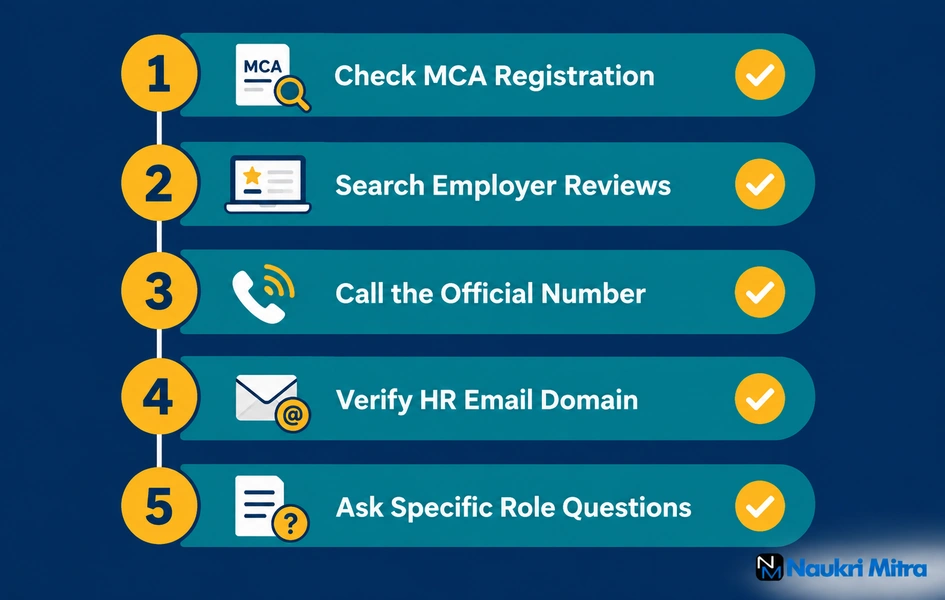
A practical set of steps to confirm job offer authenticity, and the closest thing to a structured set of offer letter verification steps, works best done roughly in this sequence: first, verify the company's registration status on the MCA portal; second, search the exact company name on Glassdoor and AmbitionBox for recent reviews specifically describing payment demands or non-payment issues rather than general workplace complaints; third, call the company's official number — found independently through their own website, not a number the recruiter gave you — to confirm the role and the person who contacted you actually exist there; fourth, check that the HR representative's email address matches the company's actual domain rather than a generic Gmail or Yahoo address; and fifth, ask direct, specific questions about the role, team, and reporting structure that a genuine recruiter would answer easily and a fraudulent one would deflect or answer vaguely.
Due Diligence Before Joining: Is It Overkill for a Small Company?
Reasonable due diligence before joining a company is worth doing regardless of company size — smaller and lesser-known companies genuinely warrant more verification effort, not less, precisely because there's less publicly available information and social proof to rely on compared to a large, well-known employer. This doesn't mean assuming every small company is fraudulent; it means the burden of proof for legitimacy is naturally higher when there's less existing public trail to check against.
Company Registration Check: What a CIN Actually Tells You
A Corporate Identification Number is a unique, 21-character alphanumeric identifier assigned to every company registered in India under the Companies Act, and a proper company registration check using it confirms the company legally exists, when it was incorporated, whether it's currently active, and its registered address — genuinely useful facts that a scam operation, by definition, either can't produce or won't survive scrutiny on.
Is It Normal to Be Asked for Money Before Joining?
No, and this deserves to be stated without hedging: it is not normal, and every official cyber-safety and consumer-protection source reviewed treats a pre-joining payment demand as one of the clearest possible fraud indicators, not a grey area worth debating. If you're asked for any payment — framed as a security deposit, training fee, uniform cost, or "processing charge" — before you've actually started working and receiving verified pay, that's sufficient reason on its own to stop and verify everything else about the offer before proceeding further.
What Do Employee Reviews on Glassdoor/AmbitionBox Reveal?
AmbitionBox is genuinely worth knowing has been owned by Info Edge (India) Ltd — the same parent company behind Naukri.com — since 2017, which makes it a well-established, India-focused source for company reviews, salary data, and interview experiences specifically. Glassdoor offers a similar function with a more global footprint and an active India-specific section. Searching the exact company name on both, and specifically looking for a cluster of very recent, overwhelmingly negative reviews describing unpaid salaries or upfront fee demands — rather than general complaints about workload or management — is a strong, fast verification signal.
HR Email Domain Check: A Simple but Effective Habit
A genuine HR email domain check means confirming the sender's email address matches the company's actual website domain rather than a free email service. While no specific government advisory formally mandates checking this, it follows directly from the broader official guidance to verify a job offer independently through the company's own official channels rather than trusting whatever contact information the recruiter provides — an HR representative genuinely employed by a real company should be emailing from that company's own domain, not a generic Gmail address.
Can I Ask for a Video Call Before Accepting a Remote Offer?
Yes, and a legitimate employer should have no issue with this request. Asking to speak with your reporting manager or a member of the HR team over video, particularly for a fully remote role where you'll never meet anyone in person otherwise, is a completely reasonable verification step, and reluctance or repeated deflection on this specific request is itself worth treating as a warning sign.
How to Check if a Company Has a Genuine Physical Office Address?
Cross-check the address listed in the MCA registration data and on the company's own website against Google Maps and, where feasible, look for other independent confirmation like the address appearing in news coverage, other job listings, or business directories — a registered address that doesn't correspond to any identifiable real location is a meaningful red flag worth investigating further.
What to Do If I Suspect a Job Offer Is Fraudulent After Accepting
If you've already accepted, and especially if you've made any payment, stop all further communication and payments immediately, and report the matter through India's official National Cyber Crime Reporting Portal at cybercrime.gov.in, or by calling the dedicated financial fraud helpline, 1930, without delay — reporting speed genuinely matters for any possibility of fund recovery, and there's no benefit to waiting out of embarrassment.
Does a Formal Employer Background Check Work Both Ways?
It's easy to forget that verification isn't one-directional. Just as an employer runs an employer background check on you before finalising a hire, you're entitled to do the reverse — confirming the company's registration, reputation, and the identity of the people you're dealing with before you commit your own notice period and future to them. Treating this as a mutual, reasonable step rather than something awkward to bring up puts the relationship on honest footing from the very start.
Frequently Asked Questions
1. Should I verify via current employees on LinkedIn?
Yes — genuine current employees with consistent, plausible profiles and reasonable posting histories are a useful corroborating signal, though this works best combined with the other verification steps rather than relied on alone.
2. What should I ask HR to confirm legitimacy?
Ask specific, concrete questions about the team, reporting structure, and day-to-day responsibilities — a genuine recruiter answers these easily and specifically, while a fraudulent one tends to give vague or deflecting responses.
3. How to confirm salary and role match what was discussed?
Insist on getting the final, agreed compensation and role details in writing in the formal offer letter itself, and flag any discrepancy from earlier verbal discussion before signing or accepting anything.
4. What red flags appear in unusually generous offer letters?
Compensation significantly above market rate for the stated role and experience level, paired with vague job responsibilities, is a classic combination worth treating with real skepticism rather than pure excitement.
5. Is it normal to be asked for money before joining?
No — this is consistently flagged as one of the clearest fraud indicators across every official cyber-safety advisory, not a normal or negotiable part of a legitimate hiring process.
6. Can I ask for a video call before accepting a remote offer?
Yes, this is a completely reasonable request for any legitimate employer to accommodate, and reluctance to do so is itself worth treating as a warning sign.
7. How to verify the reporting manager actually exists?
Search their name on LinkedIn against the company, and where possible, ask for a brief introductory call — a genuine reporting manager will generally be willing to have a short conversation before your joining date.
Verified your offer and ready to compare it against other genuine opportunities? Browse current listings on naukrimitra.in.


Comments
Post a Comment