Affidavits You Need for Government Job Forms | Naukri Mitra
A candidate I know — call her Priya, close enough to her real name that she'd recognise herself — reached document verification for a state PSC clerk post with every original certificate in a neat folder. What she didn't have was a one-page, signed, stamped paper explaining why her 10th certificate said "Priya Sharma" and her Aadhaar said "Priya Devi Sharma." The DV officer didn't reject her outright, but he sent her out of the queue, and a day disappeared between a notary's table and a stamp vendor for what should have been a formality. That one missing paper is what this piece is about.
Affidavits are the quiet, unglamorous underlay of Indian government recruitment. Nobody studies for them, yet at document verification — the stage where years of preparation can be undone by a clerical mismatch — they decide whether a file moves forward or gets parked. This piece covers the affidavits that come up again and again: name mismatches, education or employment gaps, date-of-birth discrepancies, single names, caste-certificate spelling errors, and a few declarations that aren't about mismatches at all — along with the mechanics of stamp paper, notarisation, cost, and timing that most recruitment advice skips over.
The paper trail nobody warns you about
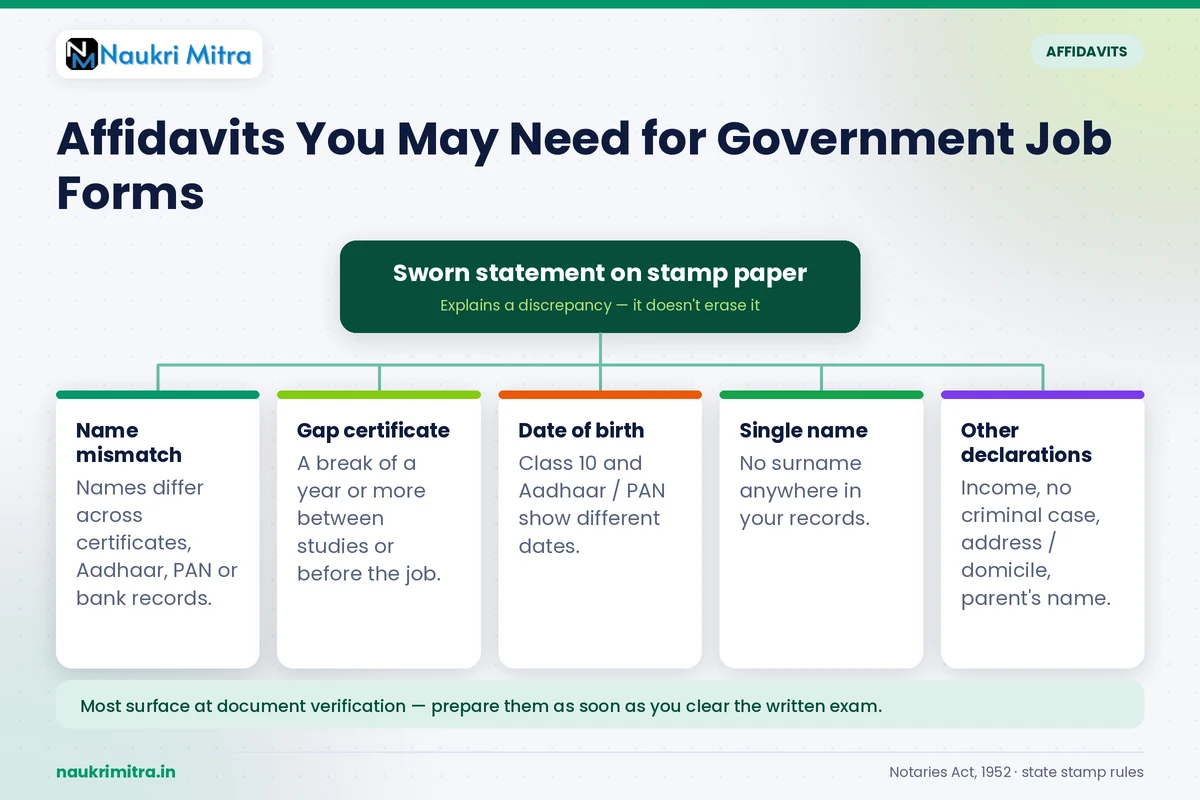
Most recruiting bodies — SSC, state PSCs, Railway Recruitment Boards, banking institutions, and individual PSUs — publish a document checklist with the exam notification, but the affidavit requirement is usually buried in a footnote or only becomes clear when the DV call letter arrives. In practice, the affidavit format for government job application needs falls into a handful of recurring categories, and knowing them in advance saves a frantic scramble before verification.
The common ones: a name-mismatch affidavit (spelled or structured differently across documents), a gap certificate for unexplained years between qualifications or before joining, a date-of-birth clarification affidavit, a single-name affidavit for candidates whose records carry no surname, an address or domicile mismatch affidavit, a parent's-name correction, and occasionally a "no criminal case pending" or "non-availability of income certificate" declaration. Caste certificates bring their own variant — a self-attested affidavit for caste category job application purposes, needed when the certificate spells the candidate's name or native village differently from the form. None of this is exotic; it recurs because Indian documentation was never standardised across the Registrar of Births and Deaths, school boards, Aadhaar, PAN, and revenue records.
Worth internalising early: an affidavit is not proof by itself. It's a sworn, legally binding statement where the deponent takes personal responsibility for the facts, liable for perjury if false. Recruiters accept it because it shifts legal responsibility onto the candidate — it doesn't erase a discrepancy, it formally explains it.
When your name doesn't match itself: the name-mismatch affidavit
This is, without question, the single most frequently demanded affidavit in Indian government recruitment. A name mismatch affidavit for govt job documents is typically required when any two of the following disagree: school/board certificates, Aadhaar, PAN, caste certificate, bank passbook, or the application form itself. Common triggers include a missing middle name, a surname that appears in some documents and not others, initials expanded differently, or — very commonly for women — a maiden name on educational certificates against a married name on Aadhaar. Married women run into this at almost every recruitment cycle: 10th and 12th certificates usually carry the maiden name (certificates aren't reissued after marriage), while Aadhaar, PAN, and bank accounts get updated post-marriage. The standard fix isn't a fresh certificate — it's an affidavit stating both names belong to the same person, alongside the marriage certificate as proof. A genuine legal name change, as opposed to a simple mismatch, runs through a formal gazette-published notice, and the name change affidavit documents required there are far more involved than the one-page affidavit most DV mismatches need.
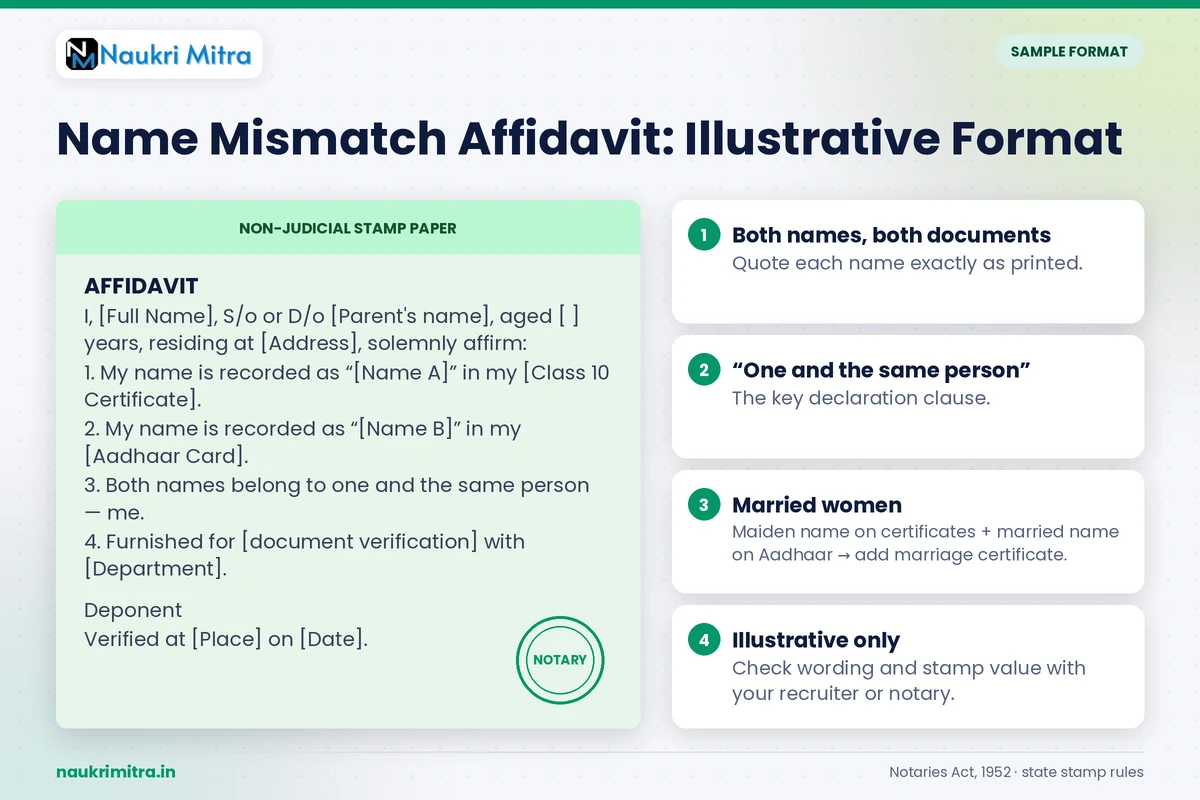
Below is an illustrative structure — not a legal template to copy verbatim, but representative of what most states and recruiting bodies expect on a non-judicial stamp paper:
Illustrative only — verify the exact wording and stamp value your recruiting authority or local notary requires.
I, [Full Name], S/o or D/o [Father's/Mother's Name], aged [Age] years, residing at [Address], do hereby solemnly affirm and declare as under:
1. That my name is recorded as "[Name as in Document A]" in my [document, e.g., Class 10 Certificate issued by XYZ Board].
2. That my name is recorded as "[Name as in Document B]" in my [document, e.g., Aadhaar Card].
3. That both the above names belong to one and the same person, i.e., me, and there is no other person by either of the said names.
4. That this affidavit is being furnished for the purpose of [document verification / employment application] with [Department/Organisation Name].
Deponent
Verified at [Place] on this [Date] that the contents of the above affidavit are true and correct to the best of my knowledge and belief.
Where a caste certificate spells the candidate's name or native village differently from the application form — a routine clerical variance given how many revenue-department records were handwritten decades ago — the same name-mismatch logic applies, drafted to address that specific certificate and field.
The gap certificate: explaining the years in between
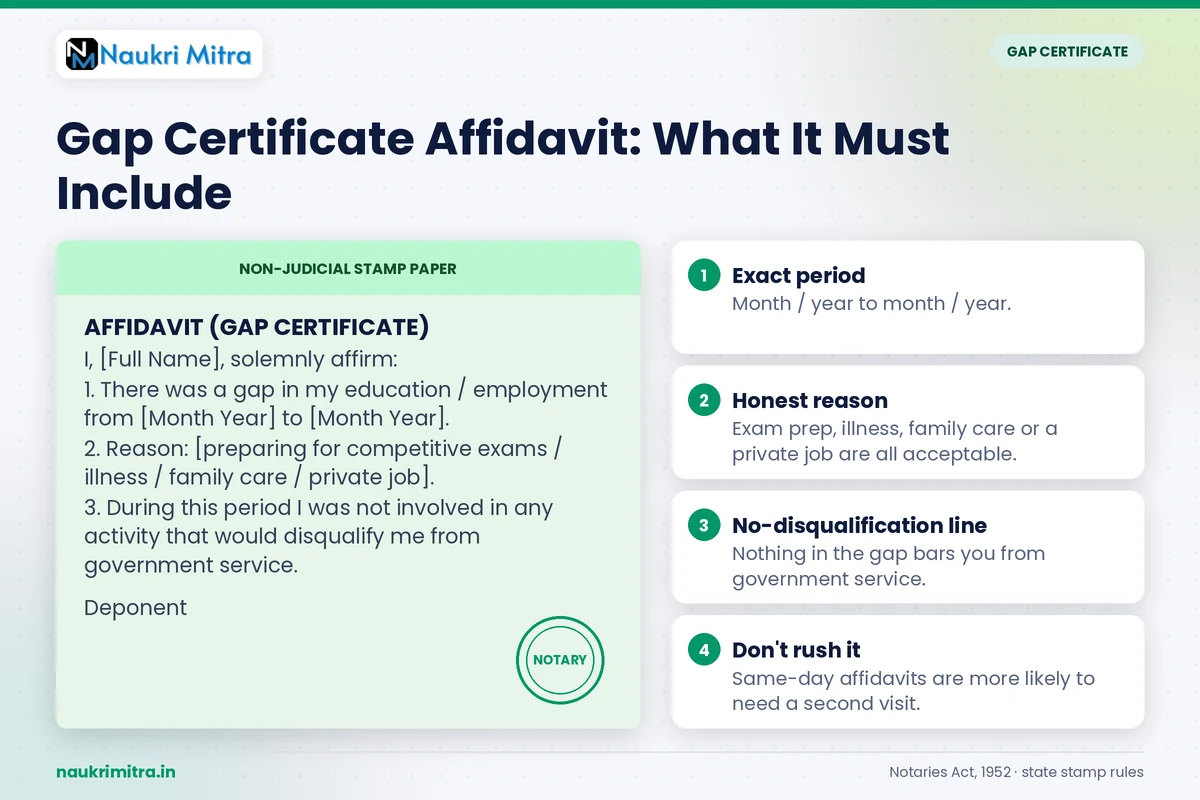
If there's a visible break of a year or more between your last qualifying exam and the next one, or between your last qualification and the job, most recruiters want it explained rather than left silent. This is where a gap certificate affidavit format for job purposes comes in, and it's commonly misunderstood — candidates assume only "bad" reasons need explaining. In reality, ordinary reasons (preparing for competitive exams, a medical issue, caring for family, a private job before this one, or simply a year spent deciding a direction) are all acceptable as an education gap affidavit sample would show, as long as they're stated truthfully. The affidavit needs the exact gap period (month/year to month/year), the reason in a sentence or two, and a declaration that nothing during that period would disqualify the candidate from government service. Some institutes issue gap certificates on letterhead for a break mid-course, but for the period after your last qualification, a self-made affidavit on stamp paper is what recruiters expect. Prepare it well before DV — rushed, same-day affidavits are far more likely to carry an error that then needs a second visit to fix.
Date of birth: why one wrong digit can stall your verification
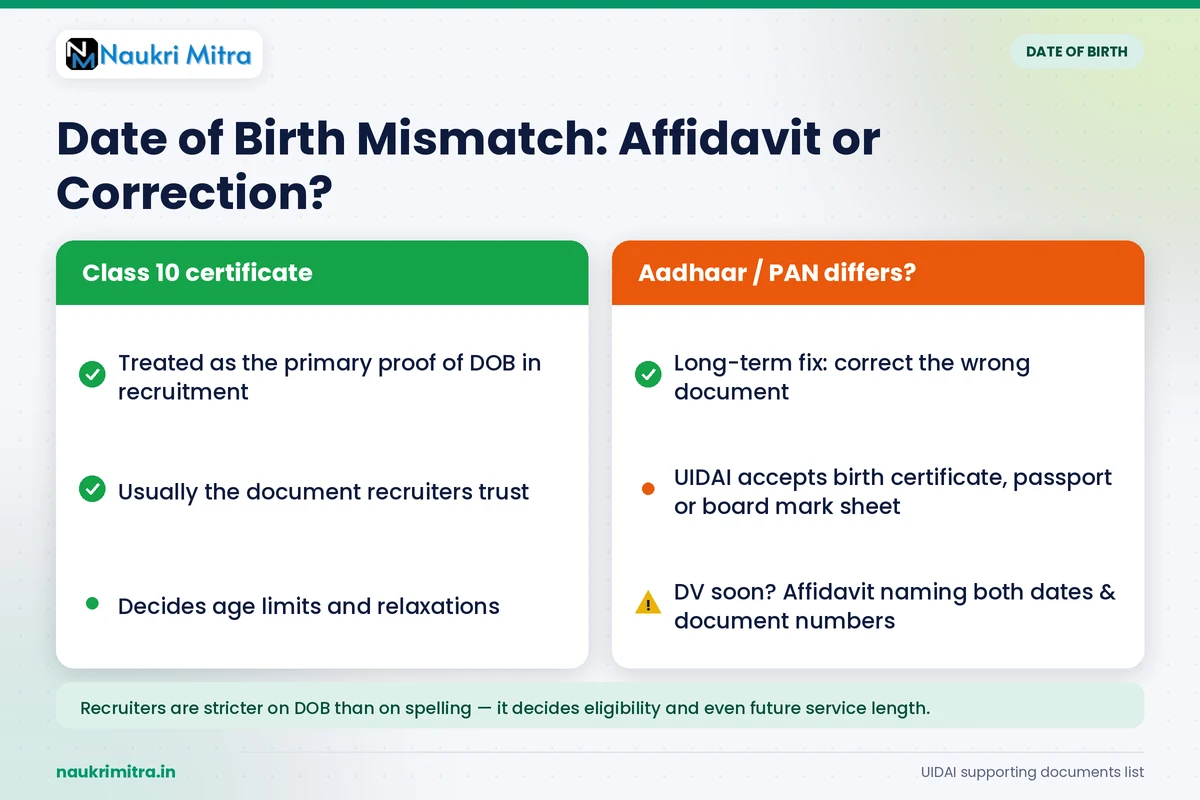
Date of birth discrepancies are a special category because DOB calculates exact eligibility — age limits, relaxations, and sometimes pension-linked service length decades later — so recruiters are stricter here than with a spelling variation. A typical scenario: the Class 10 certificate (treated as the primary, authoritative proof of DOB for Indian government recruitment) shows one date, while Aadhaar or PAN shows another, often because Aadhaar enrolment years ago used a self-declared or estimated date rather than a verified document. A date of birth discrepancy affidavit is how this is formally reconciled for the application. Where the Class 10 certificate is correct and another document is wrong, the cleaner long-term fix is to correct the wrong document rather than paper over it at every recruitment cycle. UIDAI accepts a defined list of documents for a DOB update on Aadhaar — including the birth certificate issued under the Registration of Births and Deaths Act, a valid passport, and the mark sheet issued by a recognised board — and UIDAI's official list of supporting documents is worth checking before assuming an affidavit is the only option. That said, correcting Aadhaar takes time, so if DV is close, an affidavit explaining the discrepancy and affirming which document is correct (almost always the Class 10 certificate, by recruiter convention) is the practical stopgap, referencing both dates and documents by number.
Stamp paper, notary, or just self-declaration?
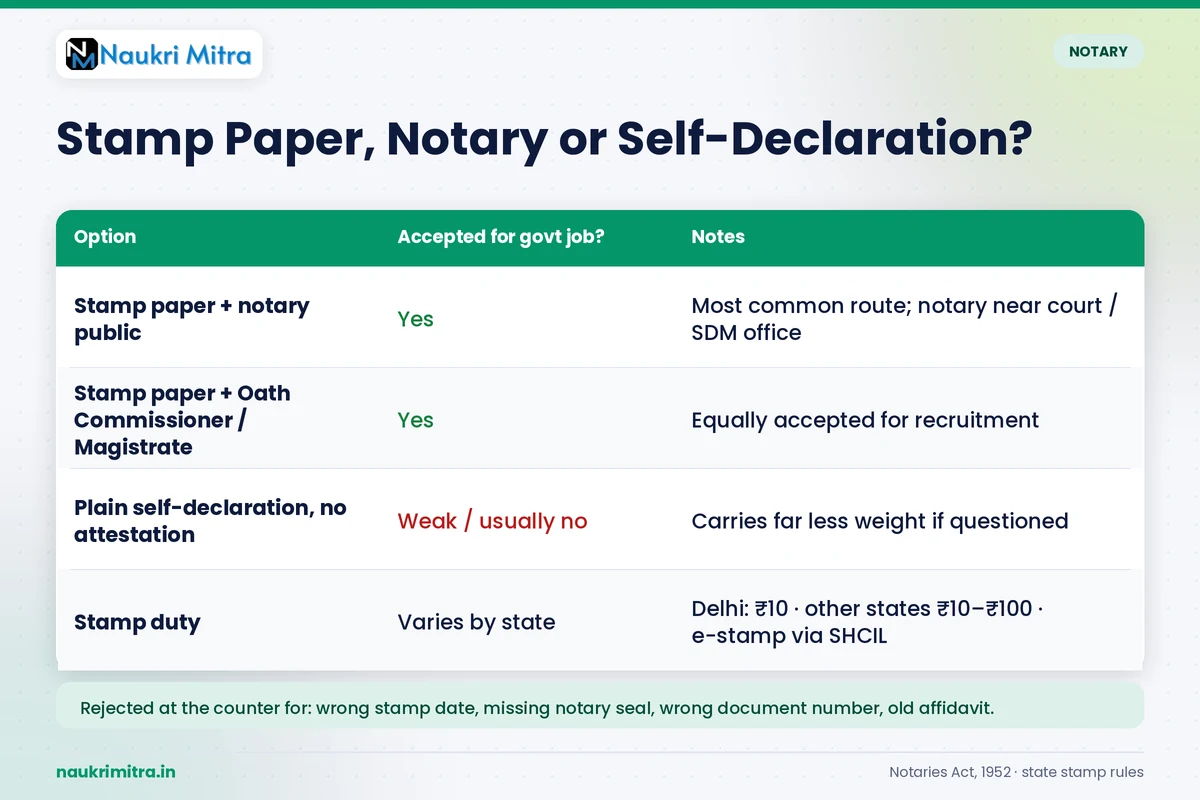
This is the part candidates get wrong most often, and it genuinely varies by state, so a one-size-fits-all number would be misleading. An affidavit intended for a government authority needs to be executed on non-judicial stamp paper and then either notarised by a notary public or sworn before an Executive Magistrate/Oath Commissioner at a local court. A plain, unstamped, unattested "self-declaration" typed on letterhead is not legally the same thing as a notarized affidavit government job applicants are usually asked for, even though portals loosely use the words interchangeably — a self-declaration carries far less weight if a discrepancy is questioned later. Stamp duty for affidavits is a state subject, so the value differs: Delhi's revenue department prescribes affidavits on a non-judicial stamp paper of ₹10, while other states price general-purpose affidavits anywhere between ₹10 and ₹100. A stamp paper affidavit sample for sarkari naukri documents is best sourced locally — from a notary near the court or SDM office who already knows what that state's exam authority expects, rather than copying an online format meant for a different state. Who can administer the oath matters too, under the framework governing affidavits and sworn statements in the Code of Civil Procedure read with the Notaries Act, 1952 — a notary public, an Oath Commissioner, or a Magistrate can attest, each under a slightly different mandate, a distinction this comparison of notary versus Oath Commissioner powers lays out well. For government job purposes, either attestation is almost always accepted; a document merely signed by the candidate, with no independent attestation, is not.
The single-name affidavit
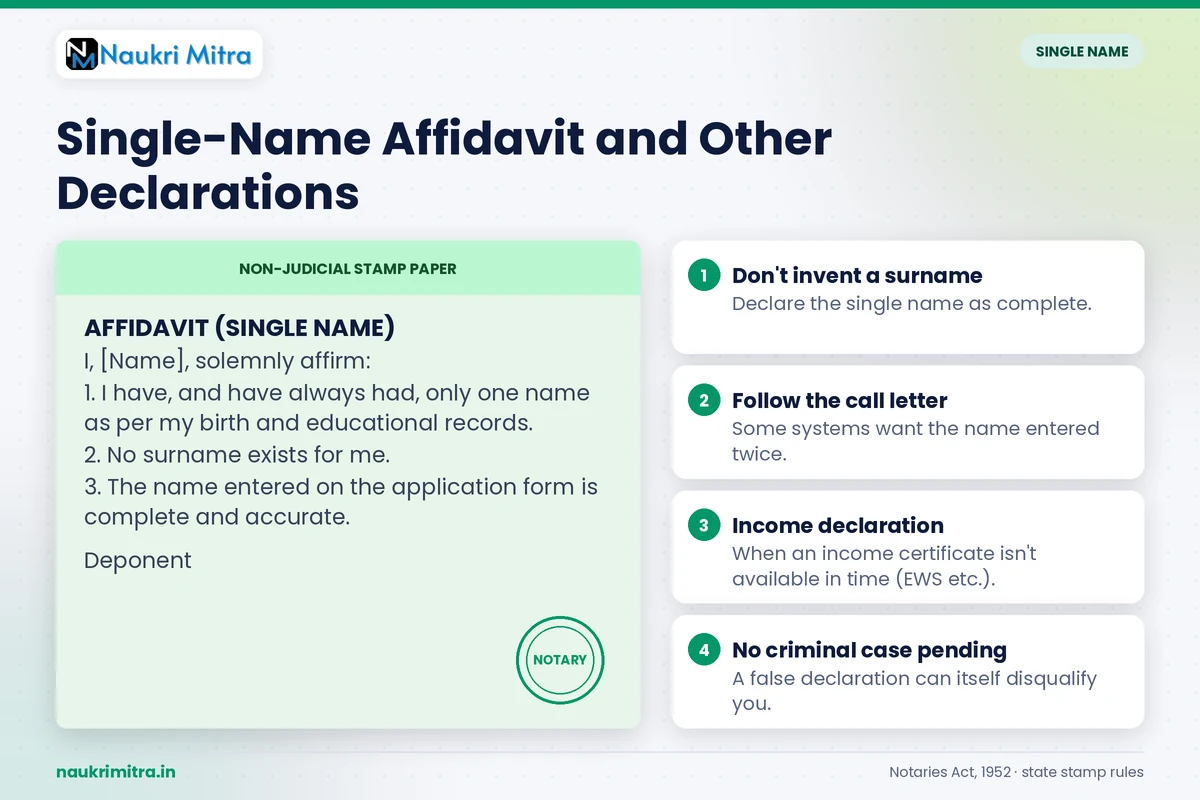
A meaningful number of candidates, particularly from parts of South India, the Northeast, and several rural communities, have only a single name on their official records — no surname, nothing beyond the one word. Forms and verification systems built around a "first name + surname" structure don't always accommodate this, and candidates get asked to "clarify" why the form shows one word where the system expected two. The fix isn't to invent a surname. It's a single name affidavit format stating that the candidate has, and has always had, only one name as per birth and educational records, that no surname exists for the candidate, and that the name entered on the form is complete and accurate as is. Some recruiting bodies and even passport authorities ask single-name candidates to enter the same name twice (as both given name and surname) purely to satisfy form validation — if your call letter says this, follow that guidance rather than guessing, since it varies by system.
Declarations beyond mismatches: income, conduct, and address
Not every affidavit fixes a discrepancy between documents. A "non-availability of income certificate" affidavit is asked for — usually by EWS or state-specific reservation candidates — when the revenue authority can't issue a formal income certificate in time, and the candidate self-declares family income on stamp paper instead. A "no criminal case pending" declaration is a separate, simpler document most departments require at application or joining stage — a plain statement submitted alongside, not instead of, the formal police verification that follows. It carries real weight: a false declaration here can itself become grounds for later disqualification. Address and domicile affidavits come up when a candidate's current address doesn't match the permanent or domicile address used to claim a state-specific quota — common for candidates applying to their home state from outside it. And a parent's-name correction affidavit is needed whenever a father's or mother's name is spelled differently across certificates, following the same drafting logic as the name-mismatch affidavit, just for the parent's name field.
Application stage or DV stage — when should you actually prepare these?
Some affidavits are asked for right at the online application stage — usually category declarations or a general undertaking about the correctness of submitted information. The bulk of the discrepancy-related affidavits above, though, surface at document verification, because that's where a human being physically compares original certificates and actually notices the mismatch. The safer approach is not to wait for the DV call letter to discover a problem. If you already know your documents don't agree — most people do, once they sit and compare them — get the relevant affidavit prepared and notarised well in advance, ideally as soon as you clear the written exam. Preparing it 24–48 hours before the DV slot is possible but needlessly stressful, especially if the local notary's format differs from what that authority wants.
Why affidavits get rejected at the counter
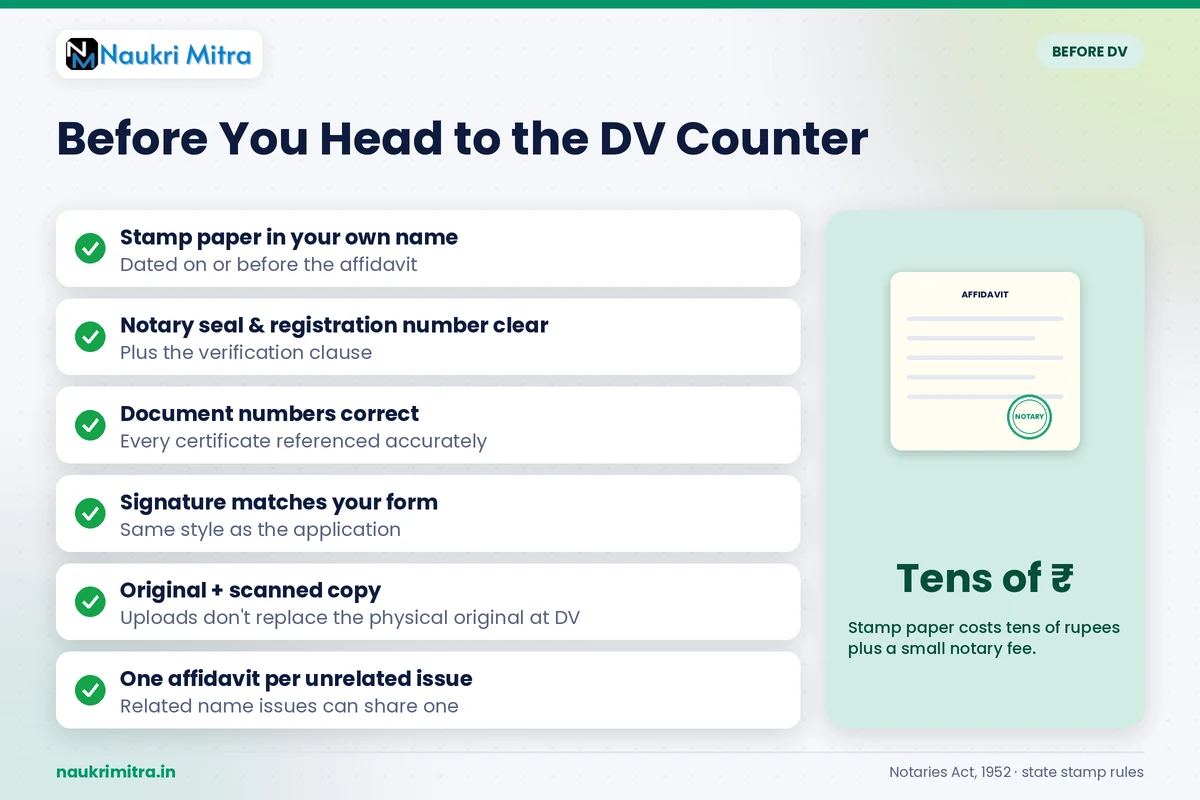
A properly notarised affidavit can still be turned away, and the reasons are predictable once you've seen a few DV rounds: stamp paper dated after the affidavit's content date, or bought in someone else's name rather than the deponent's; a notary seal or registration number that's missing or illegible; a document referenced by the wrong number; a missing verification clause; a signature that doesn't visually match the application form; or simply an affidavit that's out of date, since many bodies want it executed within a set number of days before DV. The single most avoidable error is drafting the affidavit from a template meant for a different state or purpose and swapping in personal details without adjusting the clauses to what this specific verification needs.
A few practical notes before you head to the notary
Cost is modest almost everywhere — the stamp paper itself typically runs in the tens of rupees, and notary or Oath Commissioner attestation on top is usually a small, fixed local fee. Any notary's office near a district court, SDM office, or Tehsildar office can issue one, and e-stamping via the Stock Holding Corporation of India is increasingly available where states have moved online.
On uploads versus physical copies, this varies by recruiter. Several portals now accept a scanned copy of the signed, notarised affidavit uploaded during the application window, but it's common for the same body to still insist on the physical original at the in-person DV stage — treat an online upload as step one, not the end of the requirement, unless told otherwise.
Can one affidavit cover more than one discrepancy? Generally yes, if the issues share the same underlying fact pattern — a name spelling difference and a related initial-expansion difference, say. Unrelated issues, like a name mismatch and a separate gap-certificate explanation, are better kept as two affidavits.
If all this paperwork has made you curious about the administrative side of recruitment rather than just the candidate side, NaukriMitra regularly lists roles built around exactly this kind of work — a work-from-home document verification job for freshers, a verification reviewer role supporting a government benefits program, and openings for a legal documentation specialist.
Frequently asked questions
Do I need an affidavit for every small spelling difference between documents?
Not necessarily — many recruiters accept an obvious minor variation ("Mohd." versus "Mohammad") without a formal affidavit if the rest lines up. But anything a DV officer flags, or anything you already know is a genuine mismatch, should be covered on paper, not argued verbally.
Is a notarised affidavit the same as a self-declaration?
No. A self-declaration is just your own signed statement with no independent attestation, while a notarised affidavit is executed on stamp paper and sworn before a notary or Oath Commissioner. Recruiters almost always want the notarised version for anything affecting eligibility, category, or identity.
How much does an affidavit typically cost?
Expect the stamp paper to run roughly ₹10 to ₹100 depending on the state, plus a modest fixed attestation fee — usually well under a few hundred rupees in total.
Can I use the same affidavit format for a central exam and a state PSC exam?
The underlying structure stays broadly similar, but specific wording some states expect — particularly for caste or domicile affidavits — can differ. Check the format in the recruiting notification rather than assuming one state's format works for another.
What happens if I don't disclose a gap honestly in my gap certificate affidavit?
A false statement in a sworn affidavit can expose you to perjury consequences separate from any recruitment-specific disqualification, and if it surfaces later it can be grounds for terminating the appointment. An honest, ordinary reason is almost always accepted without issue.
Do I need a fresh affidavit for each government exam I apply to in the same year?
Generally yes. Most authorities want the affidavit dated close to that specific DV date, so reusing a year-old one from a different exam is risky even if the facts haven't changed.
Is an affidavit required if my married name differs only because I added my husband's surname?
Yes, in most cases — even a one-word addition counts as a mismatch between educational certificates and post-marriage documents like Aadhaar. A short affidavit stating both names belong to the same person, alongside the marriage certificate, is the standard fix.
Can an affidavit be rejected even if it's notarised correctly?
Yes — notarisation confirms the document was properly sworn, not that its content satisfies the recruiter's requirements. It can be sent back for the wrong document numbers, a missing clause, or not addressing the exact discrepancy flagged.
Where should I get an affidavit drafted and notarised?
Any notary's office near a district court, SDM office, or Tehsildar's office can draft and attest one, usually in a single visit, and such offices typically already know the formats local recruiters expect.
None of this is complicated once laid out — the affidavits that trip candidates up are almost always the same half-dozen types, and nearly all can be prepared calmly in the weeks before document verification rather than scrambled together the morning of. Compare your documents against each other early, get the relevant affidavit notarised before the call letter even arrives if you already suspect a mismatch, and DV becomes what it's supposed to be — a formality, not a hurdle. For ongoing government and PSU recruitment notifications and process guides like this one, NaukriMitra is a reasonable place to keep checking.
Sources: UIDAI List of Supporting Documents, iPleaders: Affidavit and the Law in India, Legal Service India: Notary vs. Oath Commissioner.
.png)
.png)
.png)
Comments
Post a Comment