Compassionate Appointment: Who Qualifies | Naukri Mitra
When a government employee dies while still in service, the family left behind is usually dealing with two things at once: grief, and the sudden collapse of a household income they had planned their whole life around. It is in this narrow, painful window that India's compassionate appointment scheme exists — not as a reward, not as an inheritance of the deceased's job, but as a one-time cushion meant to stop a family from sliding into financial distress. A lot of people misunderstand what it actually offers, who can use it, and how strict the eligibility really is. This piece walks through that, plainly and without the bureaucratic fog that usually surrounds it.
If you are reading this because someone in your family has just passed away in service, please take your time. Nothing here needs to be acted on in the next 48 hours — one of the few merciful things about this scheme is that there is no fixed deadline that expires within days or weeks. Think of what follows as a plain-language guide to the compassionate ground job after employee death rules, written the way a knowledgeable relative might explain it to you over tea, not the way a circular would.
What Compassionate Appointment Actually Means
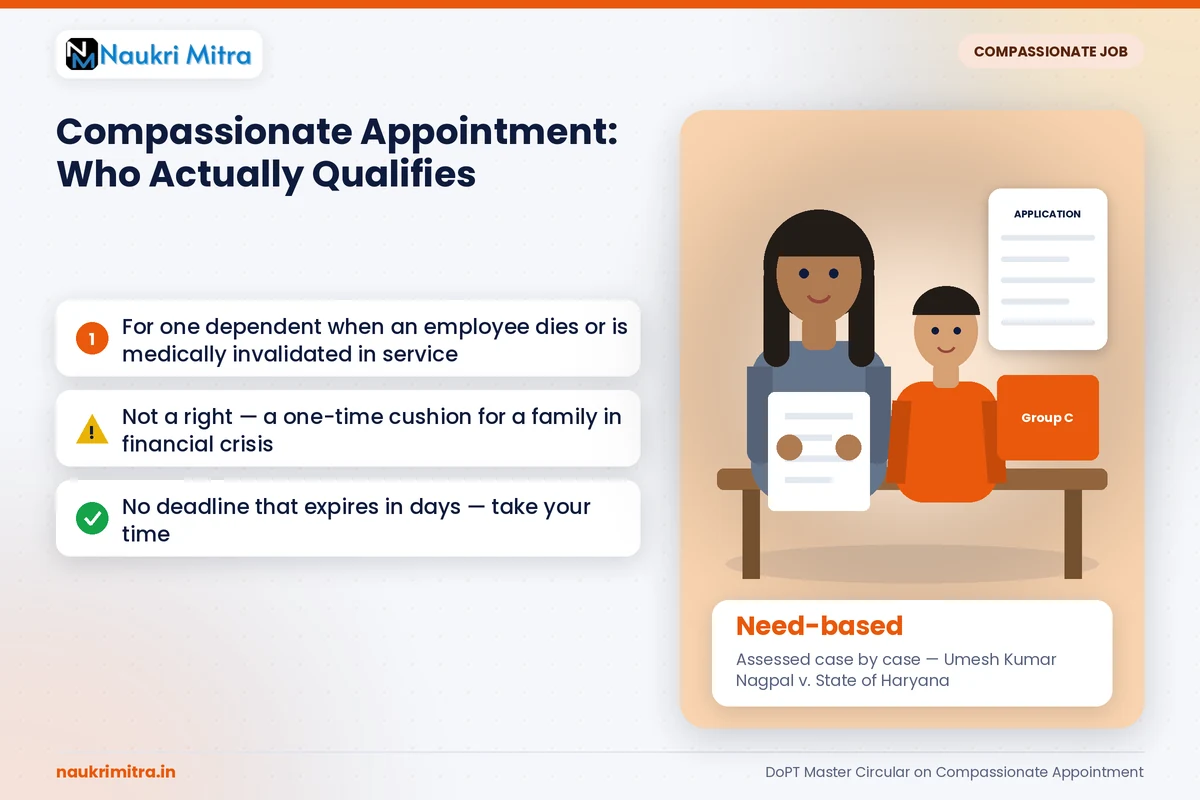
Compassionate appointment is a provision under which one dependent family member of a government employee who dies while in service — or is medically invalidated before retirement — may be considered for a government post outside the normal recruitment process. It bypasses the usual exam, the usual advertised vacancy cycle, and the usual competition, but only for a narrowly defined purpose: to give an indigent family a way to support itself quickly. It is worth being direct about something most explainers gloss over. This is not a right. The Supreme Court settled this decades ago in Umesh Kumar Nagpal v. State of Haryana, where the Court held that compassionate appointment exists to tide a family over an emergency, not to provide a career opportunity or a "status" job for a dependent. The judgment is still cited in almost every tribunal and High Court ruling on the subject today, and it shapes how every government department — central, state, or PSU — writes its own version of the policy.
So when people search for compassionate appointment government job eligibility, the honest answer is: eligibility is assessed case by case, against financial need, not simply against a checklist of who the deceased employee was related to.
Who Counts as an Eligible Dependent
Under the consolidated central government scheme, the following categories may apply:
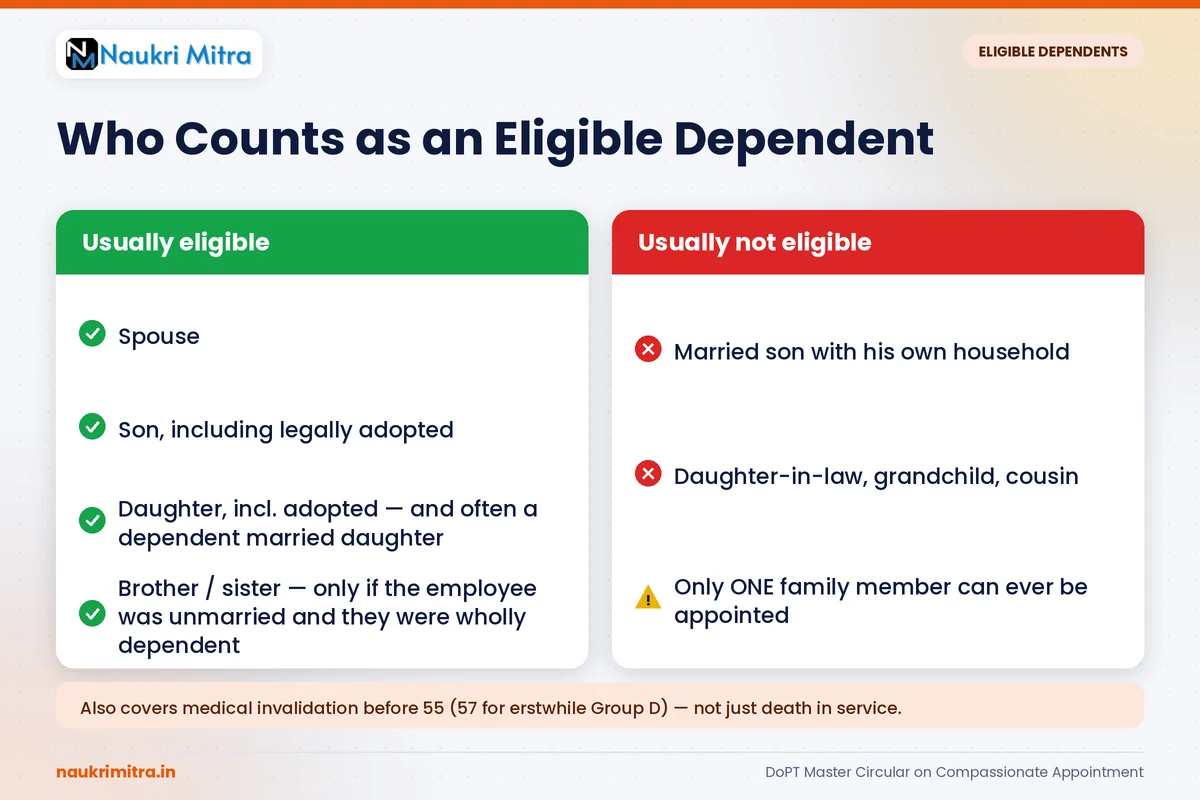
- The spouse of the deceased or medically invalidated employee
- A son, including a legally adopted son
- A daughter, including a legally adopted daughter, and in many cases a married daughter if she was wholly dependent on the employee and is now supporting the rest of the family
- A brother or sister, but only where the employee was unmarried and the sibling was wholly dependent
A married son is generally not considered a dependent for this purpose, on the assumption that he has his own independent household — though individual circumstances are occasionally argued on appeal. The core idea behind dependent family member appointment rules is dependency at the time of death, not bloodline alone. A daughter-in-law, a grandchild, or a cousin — however close the relationship felt in daily life — does not ordinarily qualify unless local rules specifically extend coverage. One detail families often miss: only one member of the family can be appointed under this scheme. Once that appointment is made, no other relative can reopen the claim later, even if circumstances change.
Beyond Death in Service — When Medical Invalidation Also Applies
The scheme is not limited to death. It also covers an employee who is forced into medical retirement before the normal retirement age because of a disability or illness that makes them permanently unfit for further service. In the central government scheme, this typically means invalidation before age 55 (57 for employees who were in the erstwhile Group D category). The logic is the same as with death — the household has lost its primary earner suddenly and without the years of preparation a planned retirement would have allowed. Armed forces personnel killed or disabled in action, or those medically boarded out as unfit for further service, fall under a parallel but related framework administered through their respective services, with the same underlying intent.
The Income Test: How Need Is Actually Assessed
This is the part people ask about most, and the part that is least like a simple yes/no form. There is no published, uniform income ceiling that automatically disqualifies a family nationwide — different departments and some states do use indicative thresholds — but the underlying test across the DoPT compassionate appointment guidelines is indigence: whether the family, without this appointment, genuinely cannot meet its basic needs. A welfare officer or the appointing committee typically looks at:
- Family pension and gratuity already being received, and whether it is enough to cover basic monthly needs
- Any other earning member already employed in the family
- Assets such as property, savings, or investments
- Outstanding liabilities, including loans taken by the deceased employee
- Number of dependents still being supported, including school-going children or elderly parents
A useful clarification from the official circular: an application cannot be rejected purely because the family has received some benefit under a welfare scheme, insurance payout, or ex-gratia amount. The test is whether, taken as a whole, the family's financial condition still qualifies as a crisis. That is the heart of what people are really asking when they search for compassionate appointment scheme income limit — it is less a fixed number and more a holistic financial picture that a committee reviews.
Central Government, State Government, and PSU — The Differences That Matter
The broad philosophy is identical everywhere, but the fine print changes depending on who the employer was.
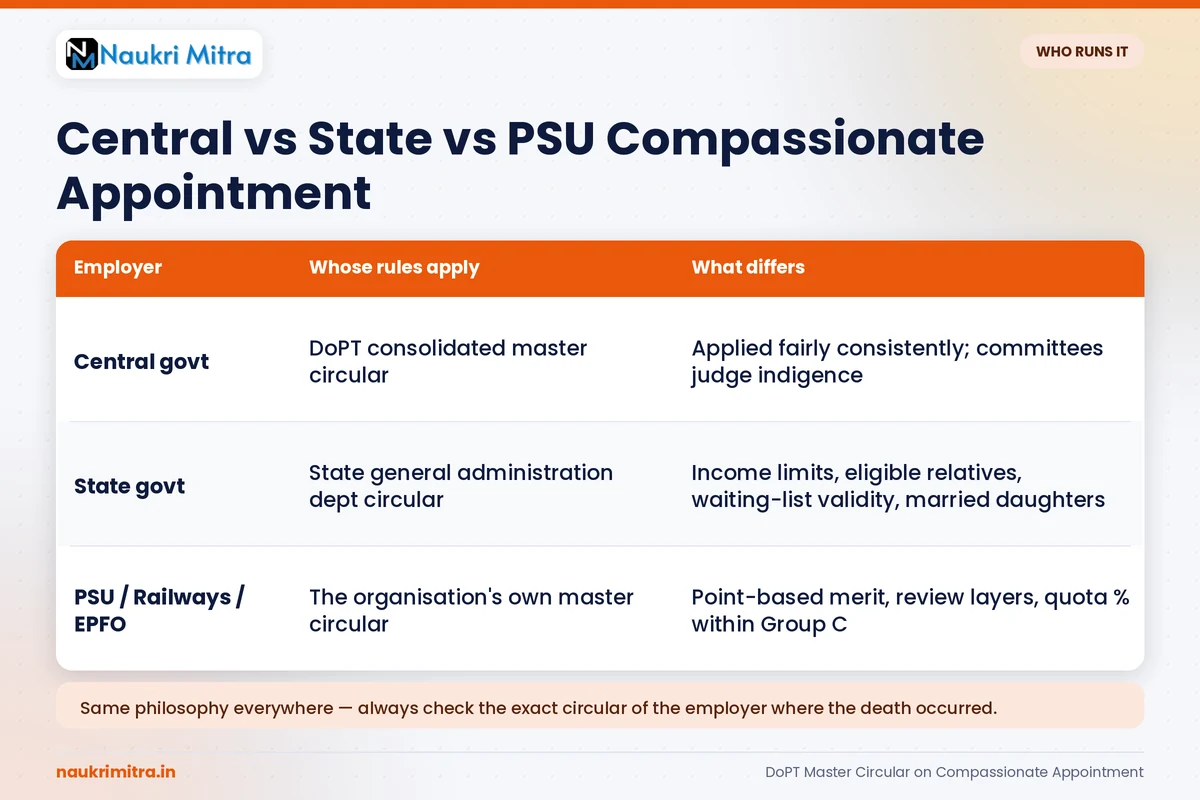
Central government departments follow the consolidated Department of Personnel and Training framework, most recently restated through a master circular that compiles decades of individual office memoranda into one reference document. Ministries and attached offices apply this fairly consistently, though internal committees still exercise judgement on indigence.
State governments each run their own version, and the details — income thresholds (where they exist), which relatives qualify, how long the waiting list stays valid, whether a married daughter is eligible — can differ meaningfully from one state to the next. A family should always check their specific state's general administration department circular rather than assume the central rules apply.
Public Sector Undertakings generally mirror the central scheme in spirit, since most PSUs operate under DoPT-aligned HR policy, but individual PSUs like the Railways, EPFO, or various central public sector enterprises issue their own master circulars with PSU-specific procedural variations — different point-based merit systems, different internal review layers, sometimes different vacancy-reservation percentages within the Group C quota. If your family member worked for a PSU, the compassionate appointment PSU rules dependent relatives should request will usually come from that organisation's own establishment or welfare department, not a generic central government office.
Documents, the Application Process, and How Long It Takes
The exact paperwork varies slightly by department, but a family should generally be ready with:
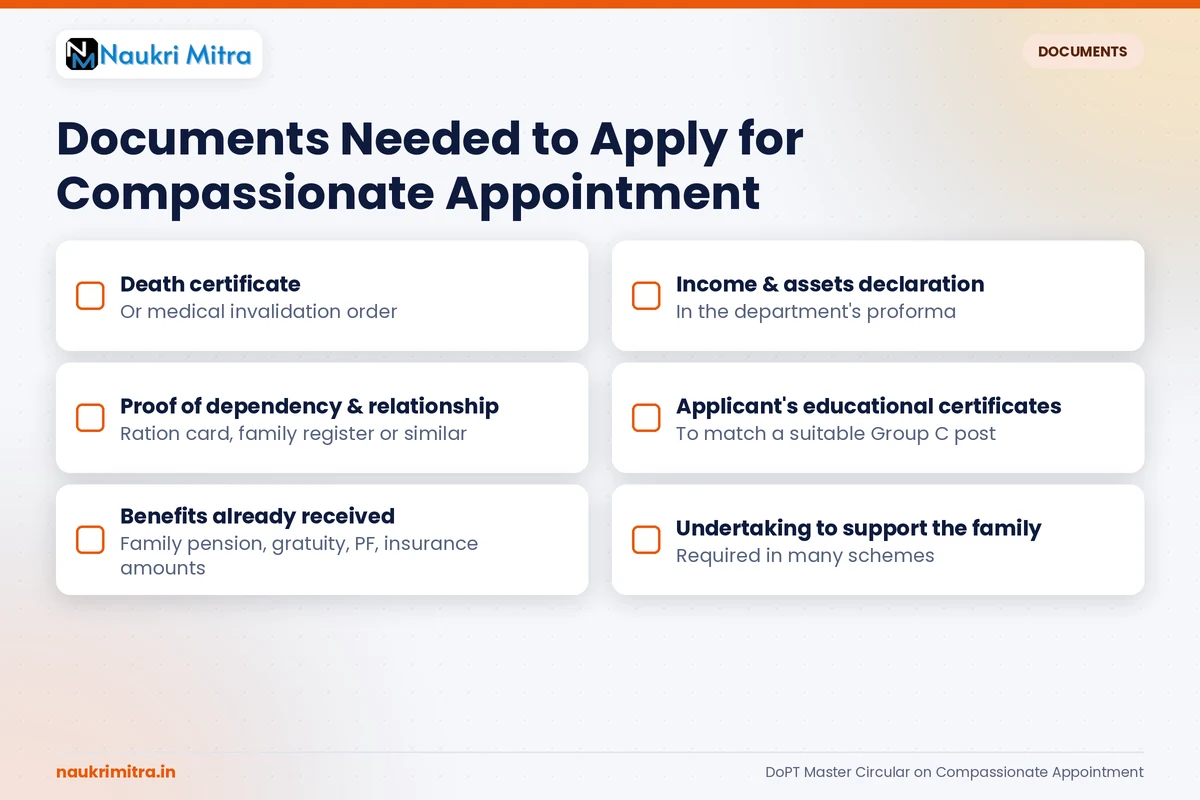
- Death certificate (or medical invalidation order, where applicable)
- Proof of dependency and relationship — ration card, family register, or similar records
- Details of family pension, gratuity, and any provident fund or insurance amount already sanctioned or received
- An income or assets declaration, in the proforma the department provides
- Educational certificates of the applicant
- A written undertaking, in many schemes, to support the remaining dependents of the family
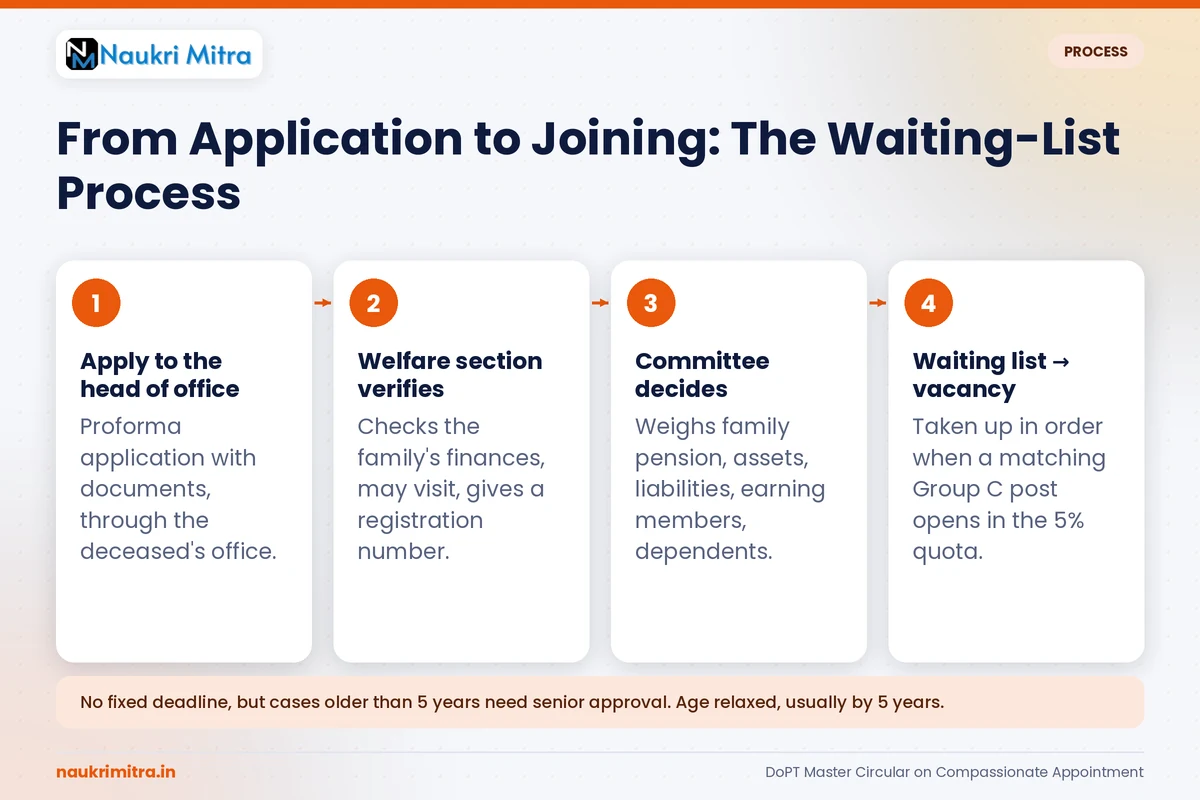
On how to apply compassionate appointment central government posts, the practical route is usually this: the family writes to the head of the deceased employee's office or department, submitting the proforma application along with supporting documents. The office's welfare section verifies the details, often visits or cross-checks the family's declared financial position, assigns the case a registration number, and places it before a departmental committee. If approved in principle, the case joins an internal waiting list until a suitable Group C vacancy within the compassionate-appointment quota becomes available. There is genuinely no fixed statutory deadline for filing — the official position allows consideration "without time limit," decided on the merits of each case. That said, departments apply much closer scrutiny to applications filed many years after the event, and cases pending beyond five years typically require approval from a more senior authority before being processed further. Practically speaking, filing within a reasonable period — ideally within a year or two — keeps the case simpler and avoids the family having to re-justify an old claim against a since-changed financial picture. As for how long the whole process takes from application to an actual joining letter, there is no single answer. Where a vacancy is immediately available and documentation is complete, some cases move in a matter of months. Where the quota is already full for the year, or the paperwork needs correction, or the committee needs more information, it can stretch well beyond a year. Persistence through written follow-up, rather than repeated personal visits, tends to be the more effective approach.
Which Posts Are Offered, and the 5% Quota
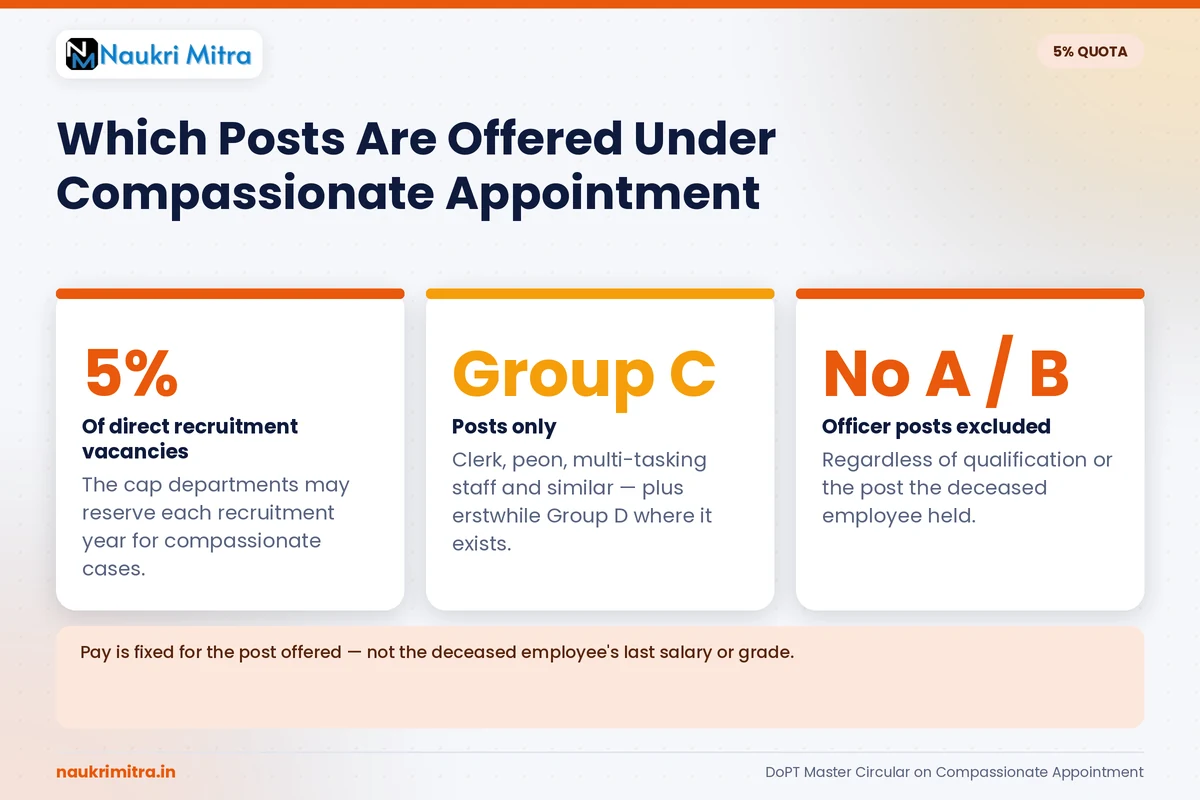
Compassionate appointments are made only against Group C posts (and, where the erstwhile Group D category still exists in a department's structure, those posts too) filled through direct recruitment. Group A and Group B posts — the officer-level positions — are excluded entirely, regardless of how qualified the applicant might be or what post the deceased employee actually held. This is one of the more emotionally difficult parts of the scheme for families: a dependent cannot be appointed to anything resembling the status or pay level the deceased parent or spouse had reached, even informally. The minimum educational qualification is whatever the recruitment rules prescribe for that specific Group C post — commonly a Secondary or Senior Secondary pass for posts like clerk, peon, or multi-tasking staff, though some technical or semi-skilled posts may ask for an ITI certificate or equivalent. The appointing authority tries, where feasible, to match the post to the applicant's actual qualification and the vacancies genuinely available, rather than offering a fixed single post type. Departments are permitted to reserve up to 5% of direct recruitment vacancies in a given recruitment year for compassionate appointment cases. This cap exists precisely so the scheme does not quietly become a parallel, unregulated recruitment channel that crowds out open competitive selection — which is also why cases sometimes wait a while even after approval in principle. Taken together, this is what most Group C/D compassionate appointment policy across central ministries, state cadres, and PSUs ultimately boils down to: a narrow, capped, need-based route into a lower-rung government post, never a general-purpose employment guarantee.
The Waiting List, Family Pension, and Other Overlapping Benefits
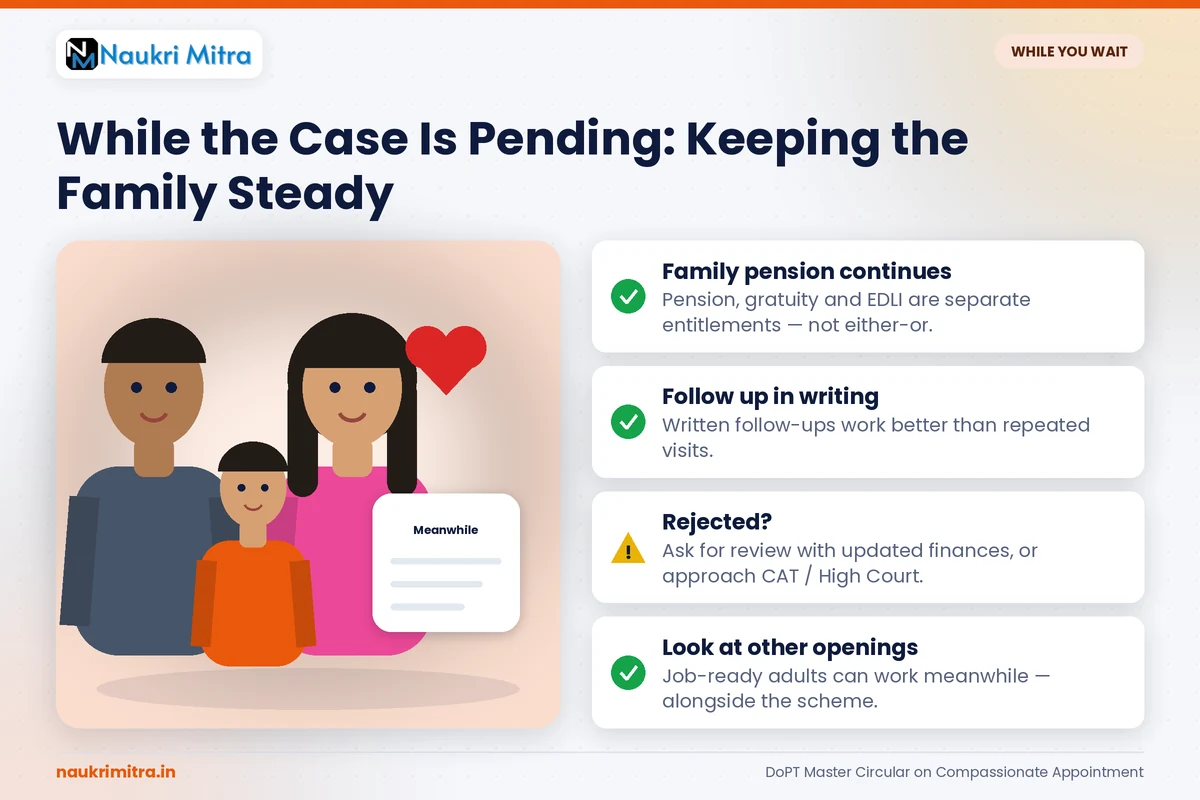
Once a case clears the committee's scrutiny but no matching vacancy exists immediately, it is placed on a departmental register — commonly referred to informally as the compassionate appointment waiting list. Names are generally taken up in order of approval, though departments retain some discretion in how they sequence cases against available posts and qualifications. Families are usually expected to periodically confirm their continued interest and update their financial circumstances, since an improved financial position later on can, in principle, affect how urgently a case is treated. A separate and common worry is whether receiving family pension disqualifies a family from compassionate appointment, or the reverse — whether accepting the appointment means losing family pension. It does not work that way. Family pension vs compassionate appointment is not an either-or choice; family pension, death-cum-retirement gratuity, and any Employees' Deposit Linked Insurance payout (for EPFO-covered employees) continue as separate statutory entitlements. What the committee does weigh is whether the family pension amount, combined with other resources, is already sufficient to meet the family's basic needs — because if it clearly is, the "financial destitution" test that justifies a compassionate appointment becomes harder to establish.
Special Situations Families Often Ask About
A few recurring questions deserve direct answers.
Can a married daughter apply on behalf of her deceased father? In many central and state schemes, yes — provided she was dependent on the father and is now effectively the one supporting the remaining family, though some older state rules still exclude married daughters and this is genuinely worth checking locally, since it has also been contested in court in several states. Does it matter if another family member already holds a government job? Generally, yes, it weighs against the application. If another earning member of the immediate family already has secure government or equivalent employment, departments often treat the "crisis" test as not met, since the household is not without an income source. It is not always an automatic disqualification, but it is a significant factor the committee considers. What age limit applies? The applicant must usually meet the minimum and maximum age limits prescribed for the post, with the maximum age relaxed — typically by five years, sometimes more depending on the department — in recognition of the applicant's circumstances. A minor dependent cannot be appointed immediately; the case is usually kept pending (sometimes with an interim ex-gratia or compassionate financial assistance) until the dependent turns eighteen or the applicable minimum age. Can the candidate choose their posting location? Not as a matter of right. The appointing authority allocates the post based on where the vacancy exists within the department, though many offices do try, informally, to keep the appointee near the family's existing residence given the circumstances.
If the Application Is Rejected
A rejected case is not necessarily the end of the road. Families can request a review from the same department, present updated financial documentation if circumstances have worsened, or, if the rejection appears procedurally unfair or contrary to the department's own policy, approach the relevant Central Administrative Tribunal or High Court. Courts have repeatedly held that while they cannot direct a department to make an appointment outright — since that remains a matter of administrative discretion within policy — they can direct a department to reconsider a claim that was dismissed without proper application of the indigence test. A careful reading of how the consolidated scheme guidelines define financial destitution is often the strongest basis for such a review, since rejections sometimes rest on a narrower reading of "income" than the policy actually requires. For families who want a plain-language walkthrough of how this has played out in real disputes — including how courts have treated delayed applications and what "wholly dependent" has been interpreted to mean — this legal explainer on compassionate appointment is a reasonably thorough starting point before deciding whether to escalate a rejected case.
While the Case Is Pending — What Else Is Worth Considering
Because the process can take time, and because the quota is genuinely limited, it is sensible for a family not to put every plan on hold waiting for one outcome. Siblings, spouses, or other adult dependents who are job-ready sometimes look at private-sector openings in the meantime, simply to keep the household stable while the compassionate case moves through committee review — not as a substitute for the scheme, but alongside it. If that applies to your situation, a general job search platform like Naukri Mitra can be a reasonably low-effort place to look at nearby openings without the pressure of committing to anything long-term.
Frequently Asked Questions
Is compassionate appointment guaranteed if we apply?
No. It is priority consideration against a limited quota, subject to an indigence assessment and vacancy availability — not an automatic entitlement.
Does the scheme apply if the employee resigned shortly before dying, rather than dying while actually in service?
Generally no — the scheme is tied to death or medical invalidation while still in active service. A family should check the exact service status recorded at the time of death with the department.
Can we apply if the family already received the EDLI insurance payout or gratuity?
Yes, receiving these does not automatically disqualify the family; the committee weighs the total financial picture rather than rejecting on one payout alone.
What if the deceased employee held multiple jobs or a PSU plus a side government role?
The claim is assessed against the specific employer where the death or invalidation occurred in service; other engagements are generally not relevant unless they affected dependency status.
Can a stepson or stepdaughter apply?
This varies by department and needs documentary proof of dependency; it is best clarified directly with the welfare section handling the case.
Is there a separate rule for employees who die by suicide while in service?
Most current guidelines treat this the same as any other death in service for eligibility purposes, though departments may examine the circumstances.
Can two children from the same family both apply?
No — only one dependent per family can be appointed, decided among eligible applicants by the family or by the department if there is a dispute.
Does the appointed dependent get the same pay scale the deceased employee was drawing?
No. Pay is fixed according to the Group C post actually offered, not the deceased employee's last-drawn salary or grade.
If we are on the waiting list, can we check status online?
Some departments and PSUs now allow status checks through their official portals or by written RTI request; for most state government cases, a written follow-up to the welfare officer handling the file remains the more reliable route.
Can the appointment be challenged by someone outside the family, like another candidate who wanted the post?
This has happened in some cases, usually on grounds that the scheme's income or dependency criteria were not correctly applied — another reason departments keep thorough documentation at every stage.
Sources: Master Circular on Scheme of Compassionate Appointment, DoP&T, Umesh Kumar Nagpal v. State of Haryana, Supreme Court of India, Compassionate Appointment: Legal Overview, Bhandari Law Firm.
.png)
.png)
.png)
Comments
Post a Comment