How to Get Your Employer to Add NPS to CTC | Naukri Mitra
A colleague in accounts once showed me her payslip and asked why her tax outgo had dropped by nearly ₹4,000 a month without her salary going up. The answer was sitting in one new line item: employer NPS contribution. Nobody in HR had announced it with any fanfare. She'd simply asked for it, in writing, about six weeks earlier.
Most employees never make that ask, mainly because they assume it's something only large corporates or government offices offer. It isn't. If you've been wondering how to ask employer for NPS contribution and whether it's even worth the effort, the short version is: it usually is, and it takes one email. Getting your employer to add NPS to CTC under Section 80CCD(2) is one of the few tax moves left where a short conversation with HR can genuinely change your take-home tax bill, year after year, without you writing a single extra cheque. This piece walks through why it works, how much you can actually claim, who to talk to, and what commonly goes wrong.
What "Employer NPS" Actually Means — And Why It's Not the Same as Your Own NPS
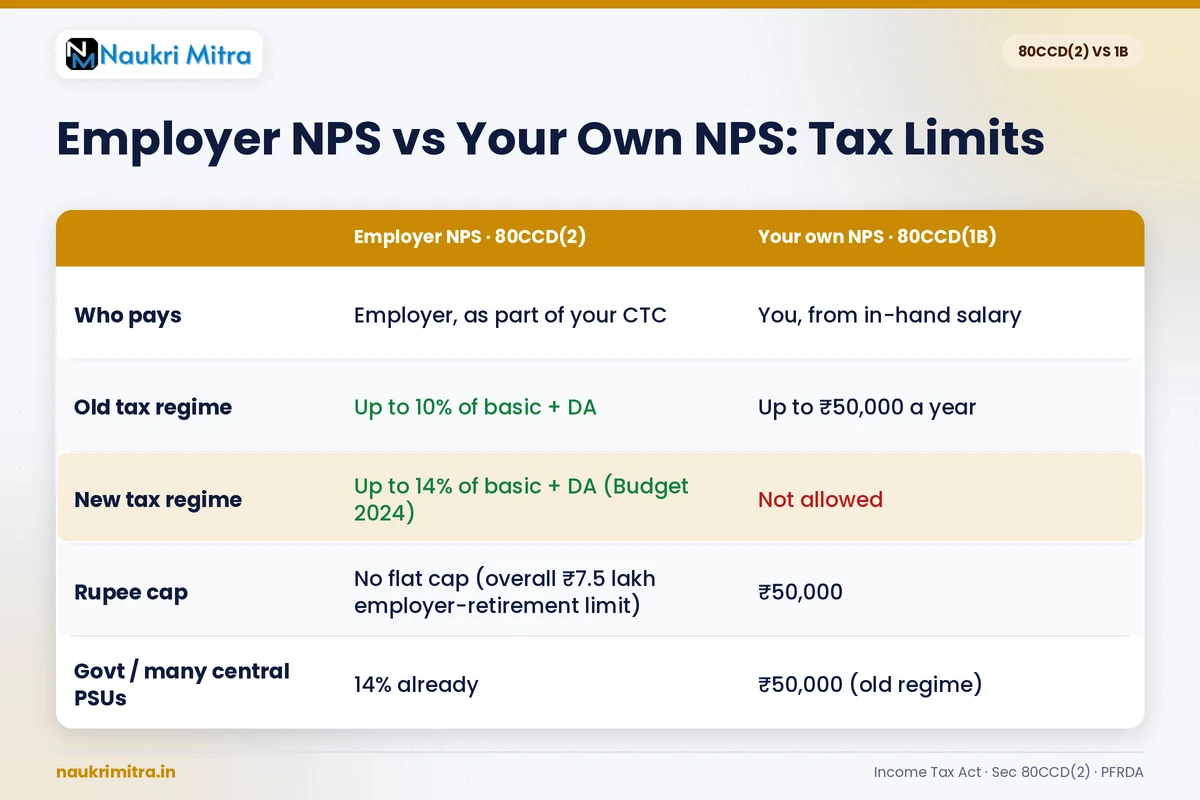
Employer NPS 80CCD2: how to apply starts with understanding that there are two separate doors into the National Pension System, and people mix them up constantly. The first is the one most salaried people already know: you open an NPS Tier 1 account yourself, put in up to ₹50,000 a year, and claim it under Section 80CCD(1B). That money comes out of your own pocket — it reduces your in-hand salary directly, rupee for rupee, and it only helps if you're still on the old tax regime, because the new regime doesn't recognise that deduction at all.
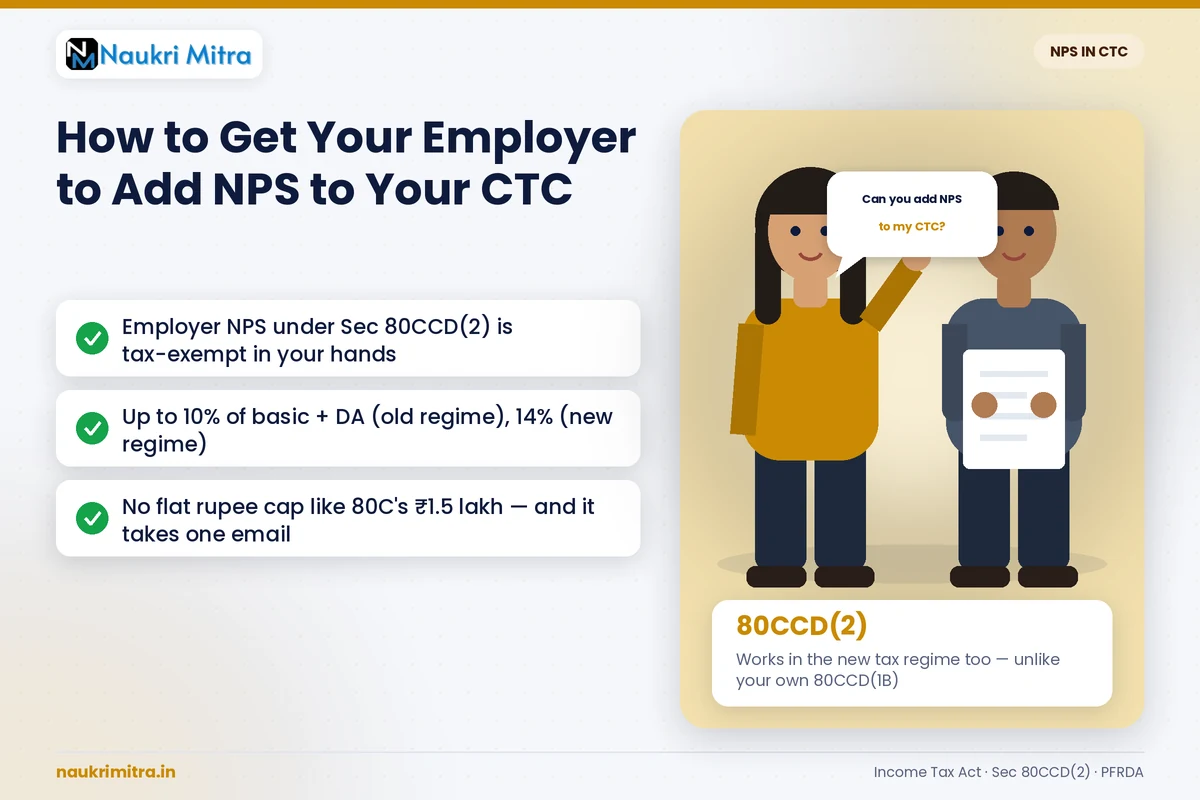
The second door is different, and it's the one this article is about. Under Section 80CCD(2), your employer contributes to your NPS account as part of your CTC, not as a separate deduction from your pay. That contribution is treated as a business expense for the company, and — this is the useful part — it is exempt from tax in your hands up to a defined percentage of salary, with no flat rupee ceiling the way 80C has its ₹1.5 lakh cap. This single distinction — employer NPS vs employee NPS 80CCD1B — is why the request is worth making even if you've already maxed out your own Tier 1 contribution.
How much can the employer actually put in without it becoming taxable to you? For private-sector employees, the exempt limit is 10% of salary (basic pay plus dearness allowance) under the old tax regime. Under the new tax regime, Budget 2024 raised that ceiling to 14% of salary for private-sector employees — effectively the one meaningful deduction still standing for people who've moved to the new regime. Central and state government employees, along with many central PSUs, already get the 14% limit regardless of regime, a rate that's been in place for government staff since 2019. So yes — add NPS to CTC new tax regime questions have a clear answer: it still works, and it works well, because 80CCD(2) sits outside the old-regime-only deductions the new regime otherwise strips away, as Cleartax's explainer on Section 80CCD lays out by employer type and regime.
Does Your Company Need a Formal Corporate NPS Setup First?
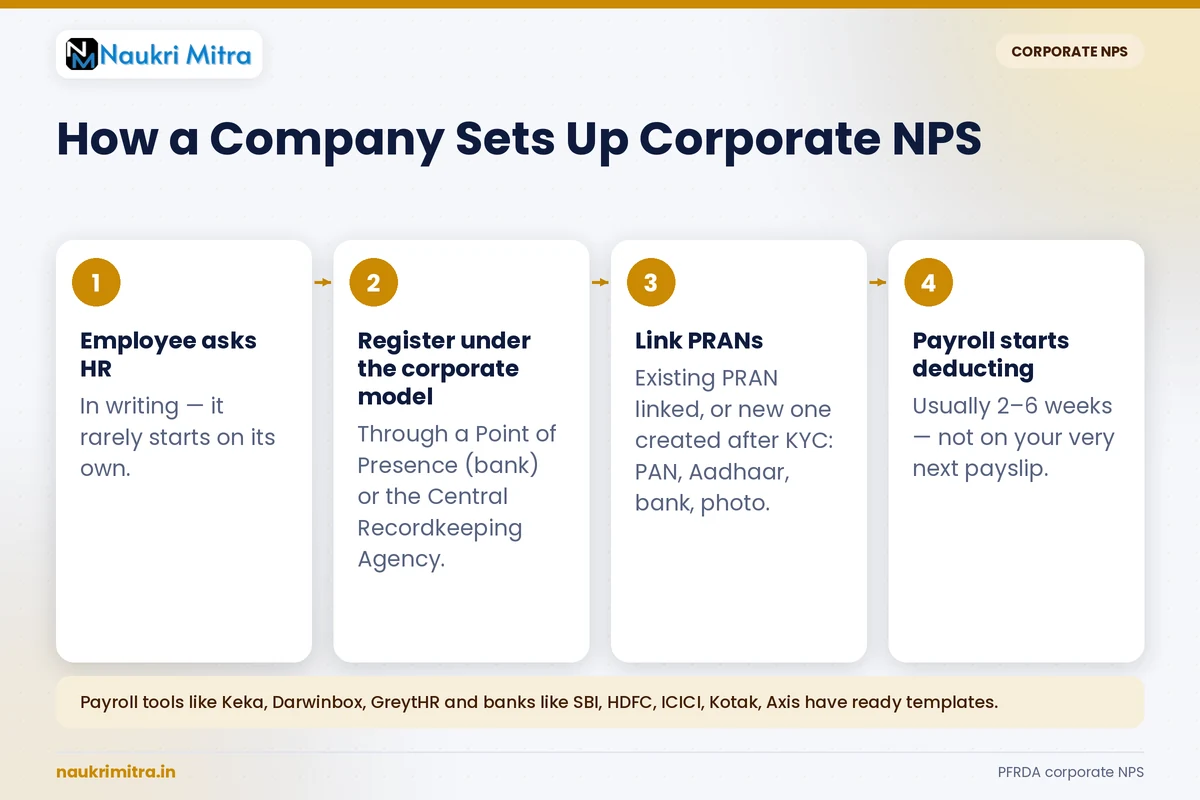
Yes, mechanically, before any money can move, the company needs to be registered as a corporate entity under the NPS corporate model — this is distinct from an employee opening an individual account. The employer signs up through a registered Point of Presence (a bank or NPS intermediary) or works with the Central Recordkeeping Agency, and once that corporate NPS registration process is done, individual employees under that corporate account get a PRAN (Permanent Retirement Account Number) linked to the company's scheme. PFRDA's own corporate-NPS page describes this employer registration step clearly, and it's genuinely not an elaborate undertaking — most mid-sized and large companies that already run EPF and gratuity can set this up through their existing payroll or HR-benefits vendor within a few weeks.
If your company has never done this before, you're not stuck. Plenty of HR teams have simply never had an employee ask. Payroll vendors like Keka, Darwinbox, GreytHR and the big POPs (SBI, HDFC, ICICI, Kotak, Axis among them) all have ready templates for onboarding a new corporate NPS account, and many will do it even for a company with a modest headcount. The honest answer to "if my company has no NPS policy, can I still route contributions through payroll" is: yes, but someone — usually you — has to be the one who starts the paperwork conversation, because it very rarely happens on its own.
In terms of timeline, once HR agrees in principle, the actual corporate registration and PRAN generation for employees typically takes anywhere from two to six weeks, depending on how quickly the company's chosen bank or POP processes the onboarding forms and how fast your own KYC (PAN, Aadhaar, bank details) gets verified. It's not instant, so don't expect your very next payslip to reflect it.
Do the Math Before You Walk Into HR's Cabin
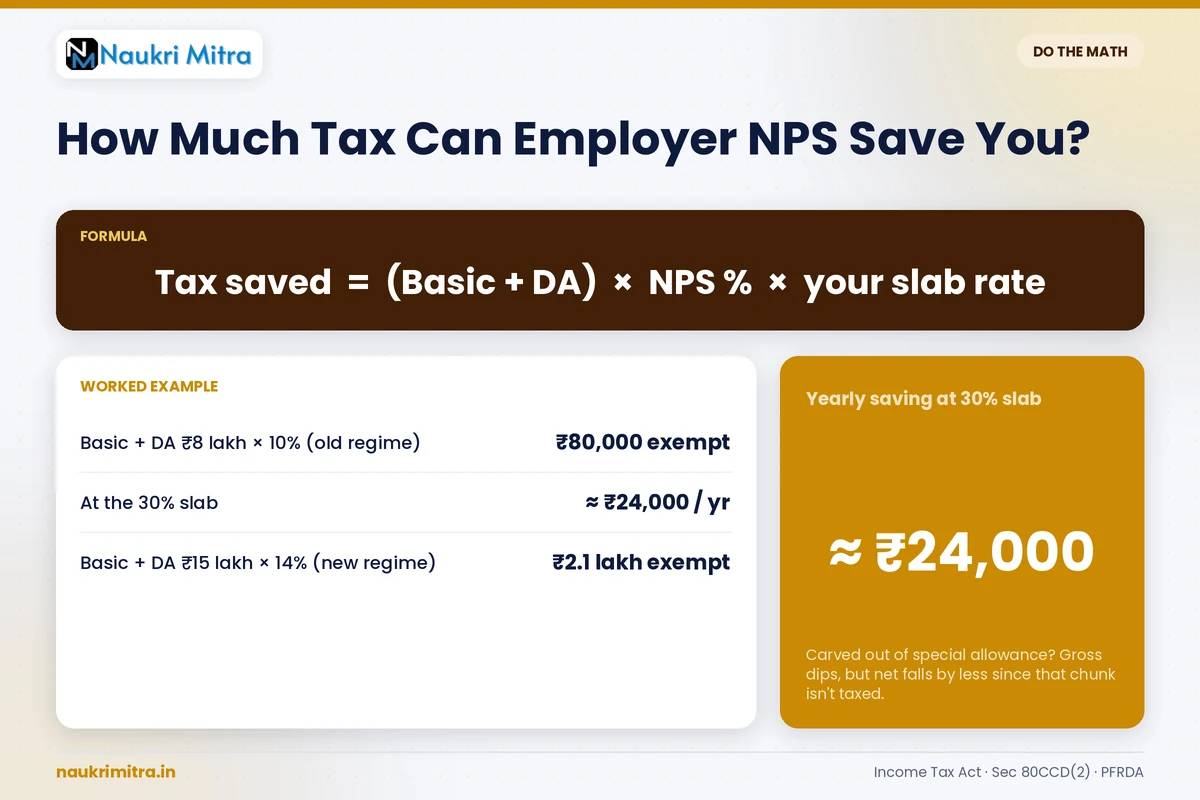
Before you draft a formal NPS employer contribution tax saving request, work out whether this is worth the friction for you specifically. The benefit scales with basic salary, so it matters more as your pay grows. A simple example: if your basic + DA is ₹8 lakh a year and your employer contributes 10% of that (₹80,000) into NPS instead of paying it as a taxable allowance, you avoid tax on that ₹80,000 at your slab rate — someone in the 30% bracket saves roughly ₹24,000 a year, every year, for as long as the arrangement runs. At ₹15 lakh basic with a 14% new-regime contribution, the exempt amount jumps to ₹2.1 lakh. Is there a salary level below which this isn't worth pursuing? Not a hard cutoff, but if 10-14% of your basic pay comes to a few thousand rupees, the back-and-forth with HR may outweigh the saving — still worth asking, just don't expect it to be transformative at entry-level pay.
One honest caveat about any salary restructuring tax saving move like this: whether it reduces your current in-hand salary depends entirely on how the restructuring is done. If your employer adds NPS as a genuinely new benefit on top of your existing CTC, your take-home doesn't change and you simply gain a tax exemption. If instead the company carves the NPS contribution out of an existing taxable allowance (special allowance is the usual victim), your gross in-hand drops by that amount before tax — but because that chunk is no longer taxed, your net take-home typically falls by less than the full contribution amount, and sometimes barely moves at all. Always ask HR to show you a before-and-after CTC breakup on paper before agreeing to anything.
The Actual Ask: What to Say to HR, and a Template You Can Adapt
This is less intimidating than it sounds. You're not asking for a new perk invented from scratch — you're asking HR to apply a benefit the Income Tax Act already permits, through a mechanism most mid-sized companies can plug into without inventing new policy. Think of it as a corporate NPS request, HR salary restructuring that costs the company nothing extra: position it as tax-neutral, a reallocation within your existing CTC rather than a cost increase. Keep the ask specific: name the section, name the percentage you're hoping for, and ask what the process looks like on their end. Can you request a specific contribution percentage, or is it fixed by company policy? Many companies peg it to a standard 10%, but some let employees opt for a lower percentage if they'd rather not touch take-home pay — worth asking rather than assuming.
Here's roughly how I'd write that email:
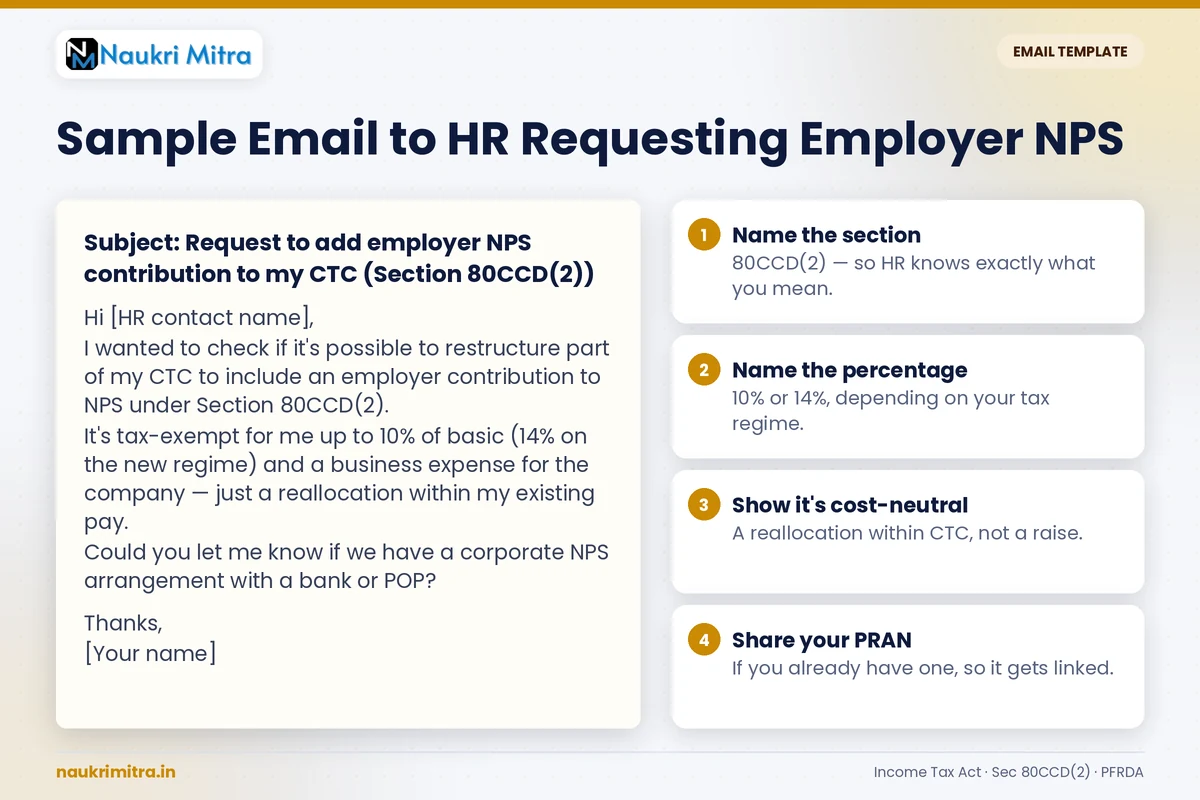
Subject: Request to add employer NPS contribution to my CTC (Section 80CCD(2))
Hi [HR contact name],
I wanted to check if it's possible to restructure part of my CTC to include an employer contribution to NPS under Section 80CCD(2). I understand this is tax-exempt for me up to 10% of basic salary (14% if we're on the new tax regime), and it's treated as a regular business expense for the company, so it shouldn't add to overall cost — just a reallocation within my existing pay structure.
Could you let me know whether we already have a corporate NPS arrangement set up with a bank or POP, and if not, what it would take to get one going? I'm happy to share my PAN, Aadhaar and bank details whenever needed, and to open a Tier 1 NPS account if I don't already have one. Would also appreciate knowing the usual turnaround time so I can plan around it for this financial year.
Thanks, and happy to hop on a call if that's easier to discuss.
[Your name]
As for documents: if you already hold a PRAN from a previous employer or a self-opened account, give HR that number so they link your existing Tier 1 account instead of opening a fresh one. If you don't have one, you'll typically need PAN, Aadhaar, a cancelled cheque or bank statement, and a passport-size photo — standard KYC, nothing unusual.
If HR Says "We Don't Offer That"
This happens more often at smaller companies and startups than at large ones, and it's rarely a hard no — it's usually "we've never set this up." A few things worth trying before giving up: First, ask whether the refusal is about policy or about effort. If it's effort, offer to share the onboarding links from a POP (most major banks have a one-page corporate NPS enrolment form on their website) so HR doesn't have to research it from scratch. Second, check if a minimum tenure requirement is the real blocker — some companies prefer to extend CTC restructuring requests only after probation or a year on the job, to avoid repeated paperwork for people who might leave soon. If that's the reason, it's worth simply waiting out. Third, if the company genuinely won't budge, remember you still have the fallback that doesn't need employer involvement: open your own NPS Tier 1 account and claim up to ₹50,000 under 80CCD(1B) — smaller than what 80CCD(2) could offer you, and only available on the old regime, but it's entirely in your control and needs no HR sign-off at all.
How does this compare to asking for a higher EPF contribution instead? EPF is simpler to request since every company already runs it, but the mechanics differ — employer EPF contribution beyond ₹7.5 lakh a year (combined across EPF, NPS and superannuation) becomes taxable, and EPF returns are fixed, whereas NPS is market-linked. They're not true substitutes; NPS generally gives a cleaner incremental tax benefit at mid-career salary levels, while EPF keeps compounding at a steady guaranteed rate.
Negotiating This Into a New Job Offer
If you're job-hunting, this is actually the easier moment to raise it — before your CTC is locked, not after. When you're reviewing an offer letter, ask the recruiter or HR point of contact directly whether the company runs a corporate NPS scheme, and if it does, whether you can have part of your CTC structured as employer NPS contribution from day one. Companies are generally far more willing to accommodate this at the offer stage because it costs them nothing extra — it's just how the same CTC number gets sliced, and doing it upfront avoids a mid-year restructuring request later. If you're eyeing roles in finance, HR or payroll functions where this kind of structuring is part of daily work, browsing current HR manager openings or payroll specialist roles on Naukri Mitra can also give you a practical sense of how different companies structure these benefits in their job descriptions and compensation notes.
Switching Jobs or Leaving: What Happens to the Money
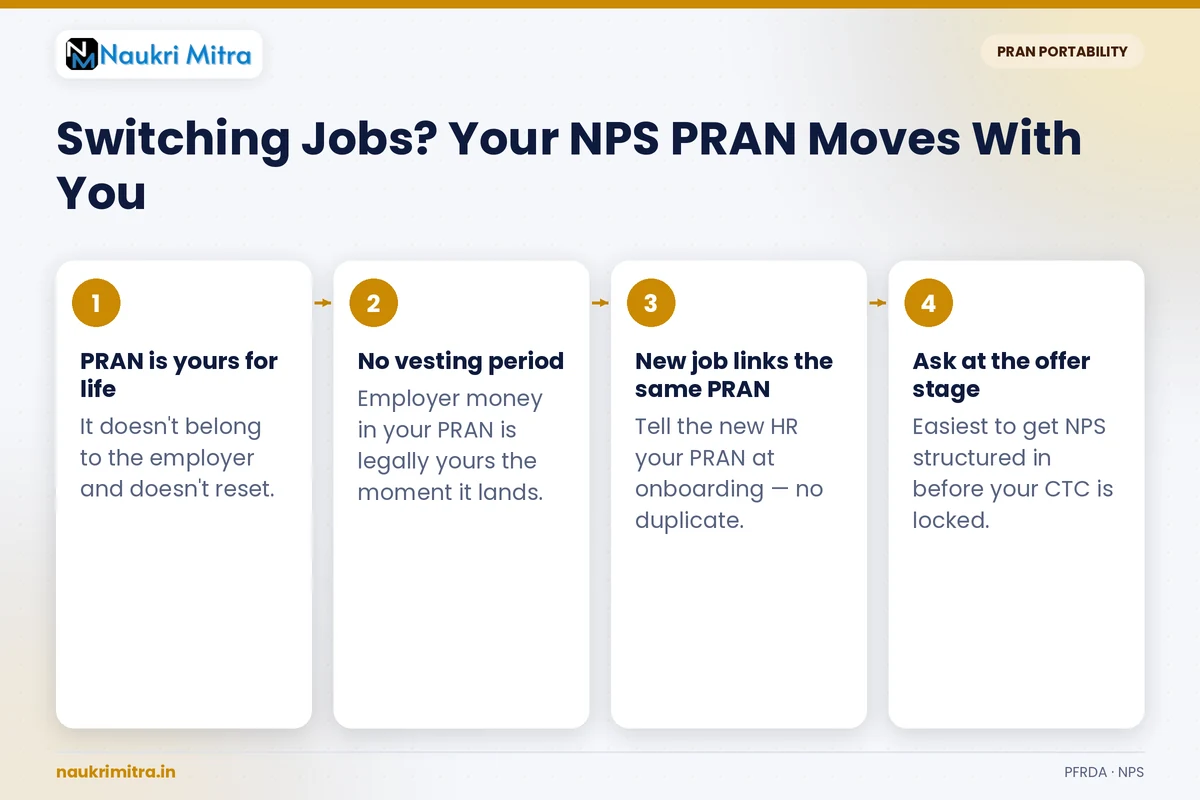
Your PRAN is yours for life — it doesn't belong to the employer, and it doesn't reset when you change jobs. Does switching jobs affect your existing corporate NPS account, or do you need a new PRAN? In almost every case, no new PRAN is needed; your new employer simply links their scheme to your existing number, and contributions continue flowing into what remains your NPS Tier 1 employer linked account. Just inform the new HR team of your PRAN during onboarding so they don't accidentally start a duplicate registration. What happens to the employer-contributed NPS amount if you leave the company? Because NPS is a personal, portable retirement account rather than a company-held fund, there's no vesting period to worry about the way there sometimes is with gratuity. The moment an employer's contribution lands in your PRAN, it's legally yours — it stays invested and keeps growing, it doesn't get clawed back, and you don't lose it by resigning, getting laid off, or taking a career break. You simply won't get fresh employer contributions until your next job also sets one up (or until you top it up yourself under 80CCD(1B) in the meantime).
Mistakes People Make When Restructuring CTC for NPS
A few recurring errors worth avoiding. People agree to restructuring without asking HR for a clear before-and-after salary breakup, then are surprised when in-hand pay dips more than expected. Others forget to check which tax regime they're actually filing under before assuming the 14% ceiling applies to them — on the old regime, the private-sector cap is still 10%, so pushing for more can backfire into partial taxability. Some don't realise NPS, once structured into CTC, stays largely illiquid until retirement, so committing too large a slice without keeping other liquid savings isn't ideal. And many never check whether a new employer actually continued the arrangement after a job switch — it doesn't carry over automatically just because your PRAN exists; someone still has to actively link it.
What About Freelancers and the Self-Employed?
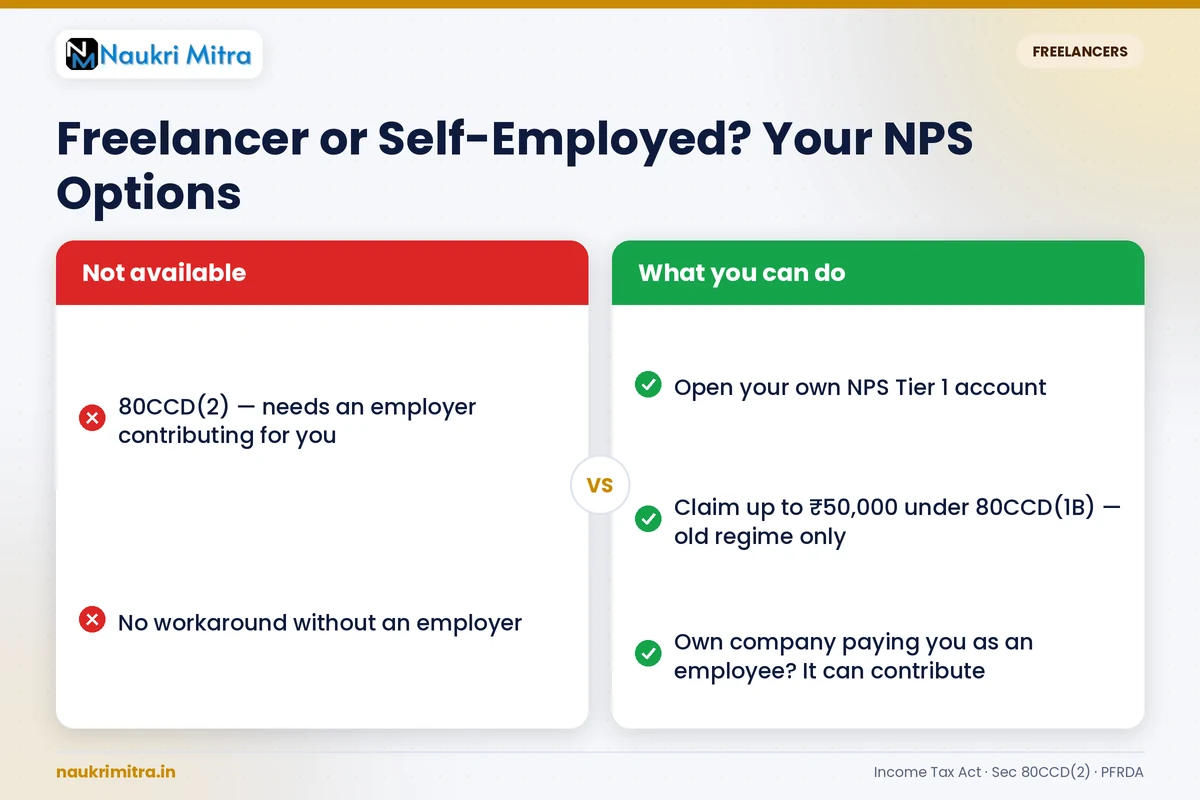
Section 80CCD(2) is explicitly an employer-contribution benefit, so self-employed professionals and freelancers without an employer can't access it at all — there's no structural workaround, since the deduction requires a contribution from an employer on the employee's behalf. The closest option is opening a personal NPS Tier 1 account and claiming up to ₹50,000 under Section 80CCD(1B), available to self-employed taxpayers too, though only on the old tax regime. Those who eventually take up a salaried role, or run their own small company and pay themselves as an employee, can explore structuring an employer contribution to themselves through that entity.
Frequently Asked Questions
Is there a minimum tenure before I can ask for this?
No law sets one, but many companies informally prefer you clear probation first, simply to avoid paperwork for someone who might not stay. It doesn't hurt to ask early anyway — worst case, they ask you to wait a few months.
Can I choose Tier 1 only, or does employer NPS include Tier 2?
Employer contributions under 80CCD(2) always go into your Tier 1 account — the retirement-locked one. Tier 2 is a separate, voluntary, withdrawable account that employers don't contribute to under this section.
Does the employer's NPS contribution show up as taxable salary in Form 16?
It appears in your salary structure, but the exempt portion is deducted before taxable income is computed, so it won't inflate your tax liability as long as it stays within the cap.
What if my contribution exceeds the 10% or 14% cap?
Anything beyond the applicable limit becomes taxable as a perquisite in your hands, so there's no benefit in pushing your employer to contribute more than the exempt percentage — it just adds to your taxable salary beyond that point.
Do central PSU employees get a different rate?
Yes — many central PSUs, following government norms, already extend the 14% NPS contribution central PSU benchmark to employees regardless of which tax regime they've chosen, a rate private-sector employees only recently got access to (and only under the new regime).
Can I withdraw this money before retirement if I need it?
Partial withdrawal from Tier 1 is allowed only under specific conditions (after three years, for purposes like higher education, medical treatment, or a first home), capped at 25% of your own contributions, not the employer's share. It isn't an emergency fund.
Does this affect my gratuity or EPF calculations?
No — NPS sits outside EPF and gratuity computations entirely. Restructuring CTC to include employer NPS doesn't change your basic pay used for EPF or gratuity unless your company separately decides to alter your basic salary itself.
Is the employer's NPS contribution shown as a cost increase to the company?
Generally no, if it's structured as a reallocation of existing CTC (typically carved from a taxable allowance). It only increases company cost if it's added as a fresh benefit over and above your current package, which is a separate negotiation.
Who do I talk to if my company is large and HR seems unresponsive?
Try the compensation and benefits team specifically, rather than a generalist HR executive — most mid-to-large companies have someone dedicated to CTC structuring questions, and they'll typically know within minutes whether a corporate NPS scheme already exists.
Employer NPS contribution under 80CCD(2) isn't a loophole or a one-time trick — it's a standard, government-recognised tax provision that simply depends on someone initiating the paperwork. If you're earning enough that a few thousand rupees in annual tax saved is worth one email and a short follow-up conversation, there's very little reason not to ask. Worst case, HR says it'll take time to set up; best case, your next payslip quietly starts looking a little better. If you're currently weighing a job change and want to compare how companies structure compensation and tax-saving benefits, Naukri Mitra's listings across accountant and finance roles can be a useful starting point, or you can browse openings directly at naukrimitra.in.
Sources: PFRDA – NPS for Corporates, Cleartax – Deductions Under Section 80CCD, Business Standard – Budget 2024 NPS Employer Contribution Hike.
.png)
.png)
.png)
Comments
Post a Comment