Why ESI Deduction Continues After a Raise | Naukri Mitra
Rohit's appraisal letter landed in his inbox on a Friday. Basic plus allowances had moved from ₹19,400 to ₹23,100 a month, and for the first time in his working life he felt genuinely pleased with a number on paper. Then the November payslip arrived, and there it was again — a small line item, "ESI Employee Contribution," quietly taking its usual 0.75% bite out of his salary. He re-read his offer letter, checked the ESIC wage ceiling on Google, confirmed he was well past ₹21,000, and still the deduction sat there, unmoved. He wasn't imagining it. He wasn't being cheated by payroll either. What he'd run into is one of the more misunderstood corners of the Employees' State Insurance scheme — the gap between the day your salary crosses the ceiling and the day your ESI coverage actually ends.
If you've just had a raise and your payslip still shows ESIC being cut, this is for you. The short version is that ESI deduction continues after salary increase above 21000 because the scheme doesn't track you month to month — it tracks you in six-month blocks, and once you're in a block, you stay in it. The long version, including exactly when the cutoff happens, what you're still entitled to in the meantime, and what to do next, is below.
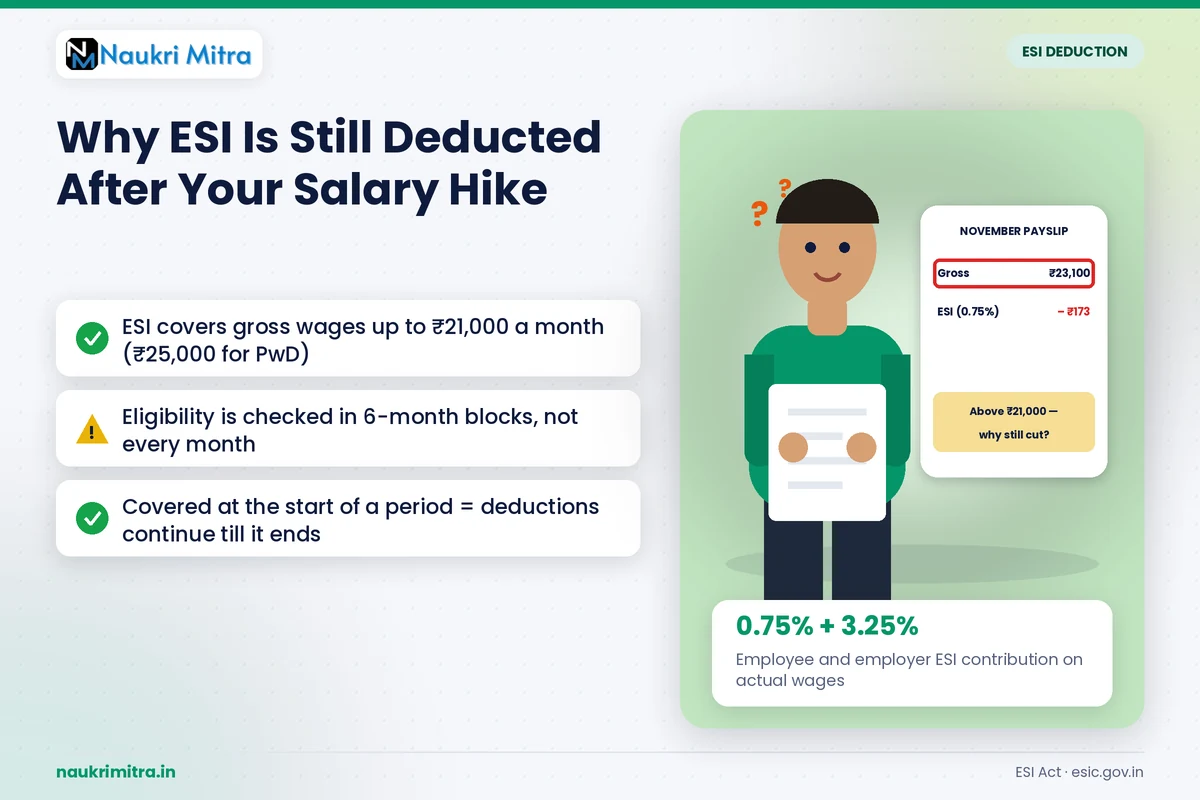
Why Is ESIC Still Cut From My Salary After I Crossed ₹21,000?
The Employees' State Insurance Act covers employees drawing a gross monthly wage up to ₹21,000 (₹25,000 for persons with disability), a limit that has stood since January 2017 and is applied at the point an employee first comes under the scheme. What trips people up is assuming that coverage is reassessed every single month, like a tax slab. It isn't. ESIC runs on fixed half-yearly cycles called contribution periods, and the rule — confirmed on ESIC's own coverage page — is that once you're covered at the start of a contribution period, you remain covered, and your employer keeps deducting and depositing contributions, for the whole of that period, regardless of what happens to your pay in between.
So the deduction you're seeing isn't a payroll glitch. It's the scheme working exactly as designed. The confusion almost always comes from expecting ESI to behave like income tax, which recalculates with every payslip. ESI doesn't work that way, and that single difference explains nearly every version of "why is ESIC still cut from my salary" that lands in HR inboxes after appraisal season. If you remember one number from this entire piece, make it this: wage ceiling 21000 ESIC per month, reviewed only twice a year — never mid-cycle.
The ESI Contribution Period Rule Explained
Here's the mechanic itself. ESIC divides the year into two contribution periods: 1 April to 30 September, and 1 October to 31 March. Whichever period you're sitting in when your wage goes up, that's the period your employer is obligated to keep deducting and remitting contributions for — at the usual rate of 0.75% from your side and 3.25% from the employer's, on your actual wages, even if those wages have crossed ₹21,000. Razorpay's payroll documentation lays this out clearly with worked examples, and it matches what most compliance consultants will tell you if you ask directly.
Put differently: the ESI contribution period rule explained in one line is this — your eligibility is locked in at the start of each six-month window and reviewed again only when the next window begins. A hike that lands in May doesn't change anything until the window that started on 1 April finishes on 30 September. A hike that lands in November behaves the same way, just anchored to the October–March window instead. This is precisely why a salary bump rarely produces an instant change on the payslip, and why ESIC wage limit crossed mid year situations are so common — almost every appraisal cycle in India falls squarely inside one of these windows rather than neatly at the edge of one. Whichever half you land in, the ESI contribution period April-September October-March structure is the only calendar that actually governs your deduction — your increment letter's date doesn't.
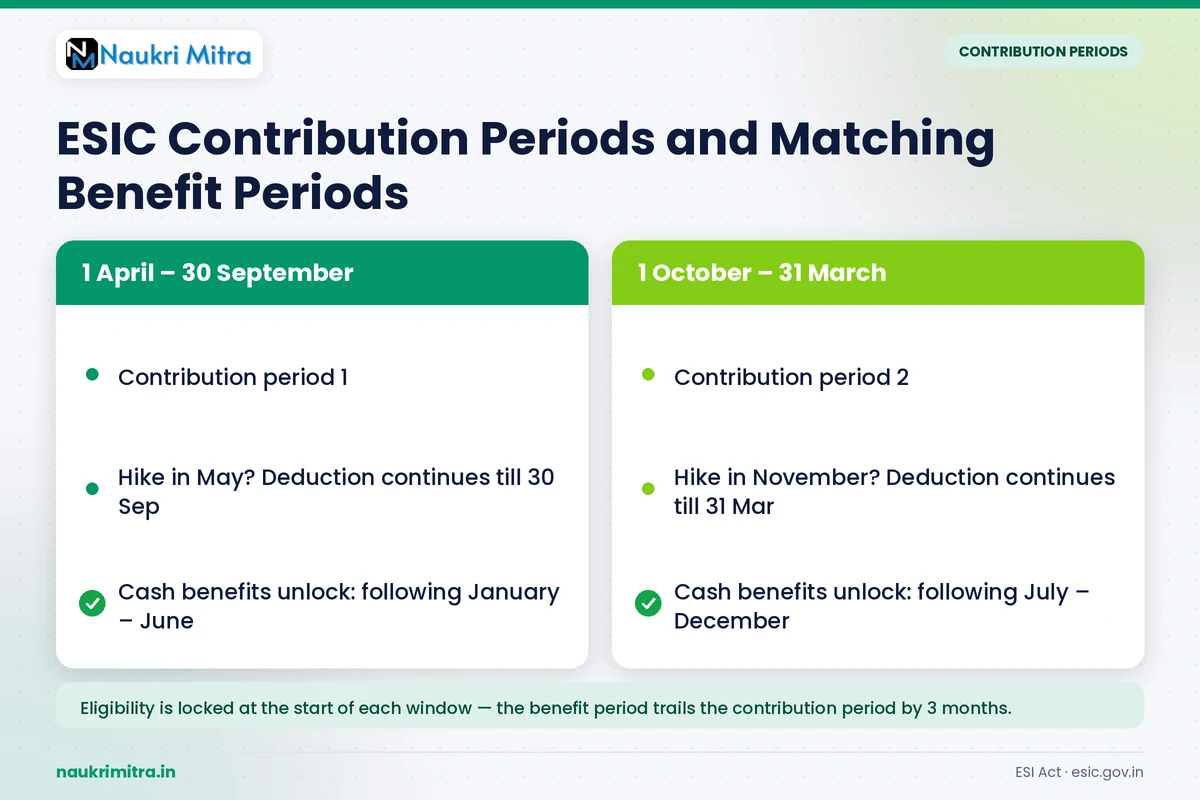
ESI Benefit Period vs Contribution Period: What's the Difference?
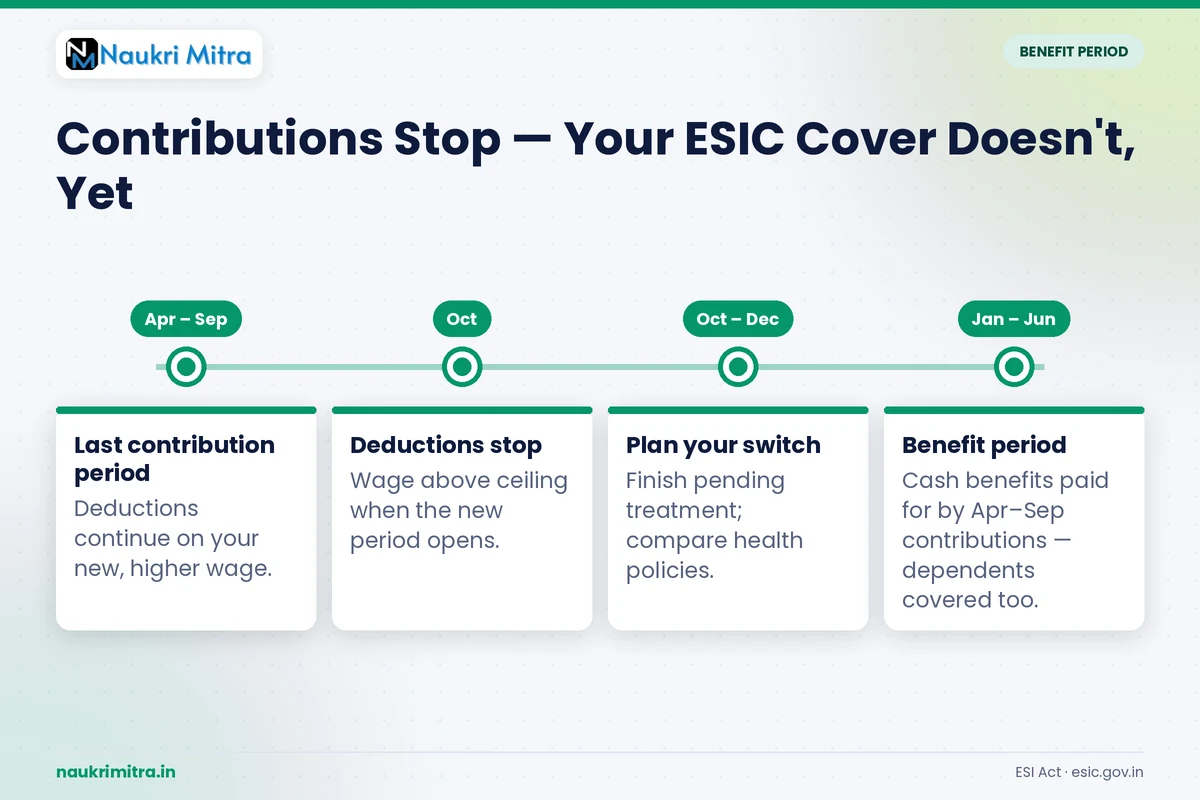
This is where most explanations get muddled, so it's worth slowing down. A contribution period is when money goes in — the six months during which contributions are deducted and deposited. A benefit period is a separate, later six-month window during which you can actually use the cash benefits (sickness benefit, maternity benefit, disablement benefit) that your earlier contributions paid for. The two don't overlap; the benefit period always trails the contribution period by three months. Contributions made between April and September unlock cash benefits for the following January to June. Contributions made between October and March unlock benefits for the following July to December. This ESI benefit period vs contribution period structure is the scheme's built-in way of pooling money before paying it out, similar in spirit to how an insurance premium funds a policy year rather than the exact week it's paid.
What this means for someone in Rohit's position is that medical treatment at ESIC hospitals and dispensaries works differently from cash benefits — as long as your ESIC card is active, in-patient and out-patient treatment generally continues to be available, but the cash benefits tied to a contribution period are what actually get locked in for the matching benefit period months later. So "continuing ESIC after appraisal" for a few months isn't wasted money; it's quietly banking entitlements you can draw on well into the following year, even after your salary has moved past the ceiling.
When Does ESI Deduction Stop After a Raise?
Given all of the above, the practical answer to when does ESI deduction stop after raise is: at the end of the contribution period in which the raise happened, not the month the raise was credited. If your salary crossed ₹21,000 in June, deductions continue through September, and your employer stops them from the October payroll cycle onward, since you were above the ceiling when the new contribution period began. If the hike happened in November instead, deductions run through March, with the first deduction-free payslip arriving in April.
There's no partial-month proration and no mid-period exit, no matter how far above ₹21,000 the new salary sits. A jump from ₹20,500 to ₹45,000 is treated exactly the same as a jump to ₹22,000 for this purpose — the contribution period is what matters, not the size of the increase.
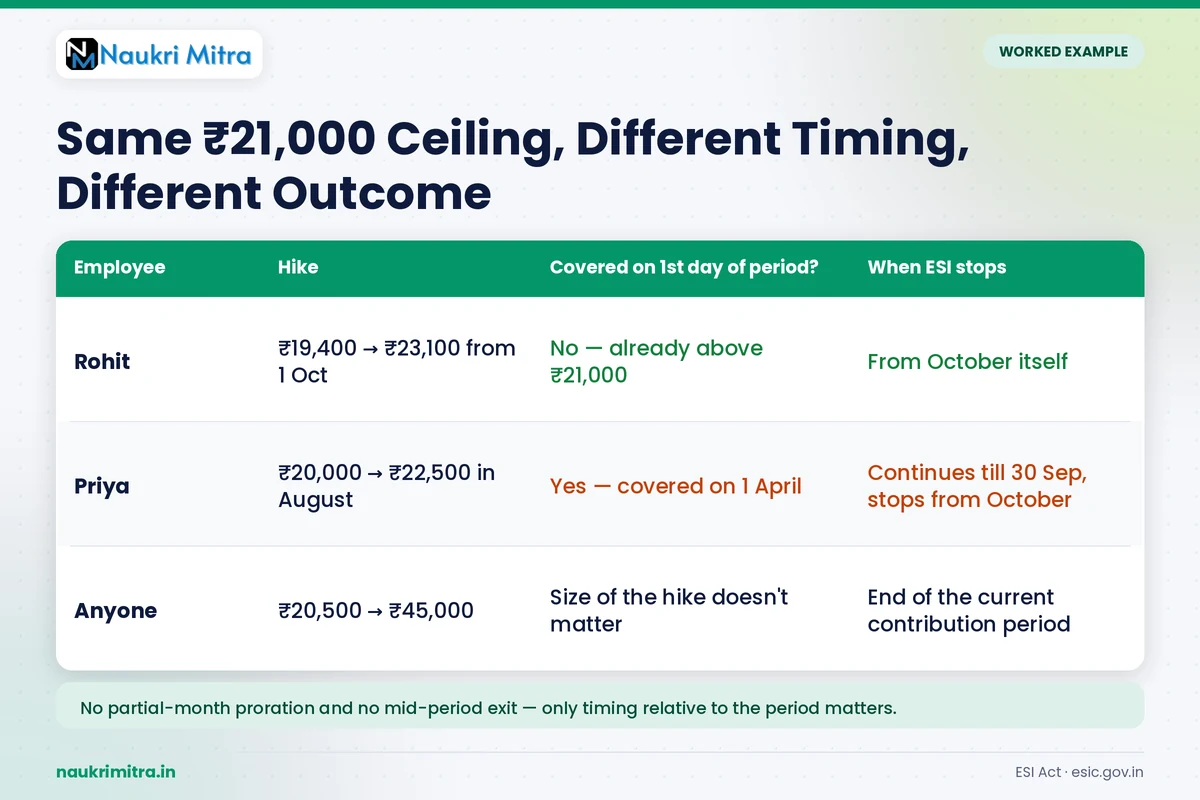
A Worked Example With Real Numbers
Back to Rohit. His hike was effective from 1 October — the very first day of a new contribution period — with his revised salary of ₹23,100 already above ₹21,000. Because the increase landed exactly at the boundary, ESIC rules allowed his employer to stop deducting from that same month, since he wasn't covered under the scheme on the first day of the new contribution period at all. Compare that with a colleague, Priya, whose hike to ₹22,500 came through in August, mid-way through the April–September contribution period. She was covered under ESIC on 1 April (her salary was still ₹20,000 then), so despite crossing ₹21,000 in August, her employer correctly continued deducting ESI right through September. Only from October, when the next contribution period opened and her wage was already above the ceiling, did the deduction actually stop.
Same company, same wage ceiling, two completely different outcomes — purely because of timing relative to the contribution period, not the amount of the raise. This is the exact scenario behind most "my payslip is wrong" tickets that payroll teams field every appraisal season, and it's worth asking your own HR or payroll contact which scenario applies to you before assuming an error.
A third, less obvious case shows up in companies that revise salaries retrospectively — announcing in October that a hike is "effective from July." Payroll usually calculates the arrears correctly, but ESIC eligibility still follows the wage that was actually payable on the first day of the contribution period, not the backdated figure applied months later. If your July wage on record was below ₹21,000 when April's contribution period opened, the retrospective bump doesn't retroactively pull you out of coverage for that period — it only affects the following one. It's a small distinction, but it's exactly the kind of detail that causes a second round of confusion once the first one is cleared up.
Special Cases: Mid-Month Hikes, Disability Ceiling, and Multiple Jumps
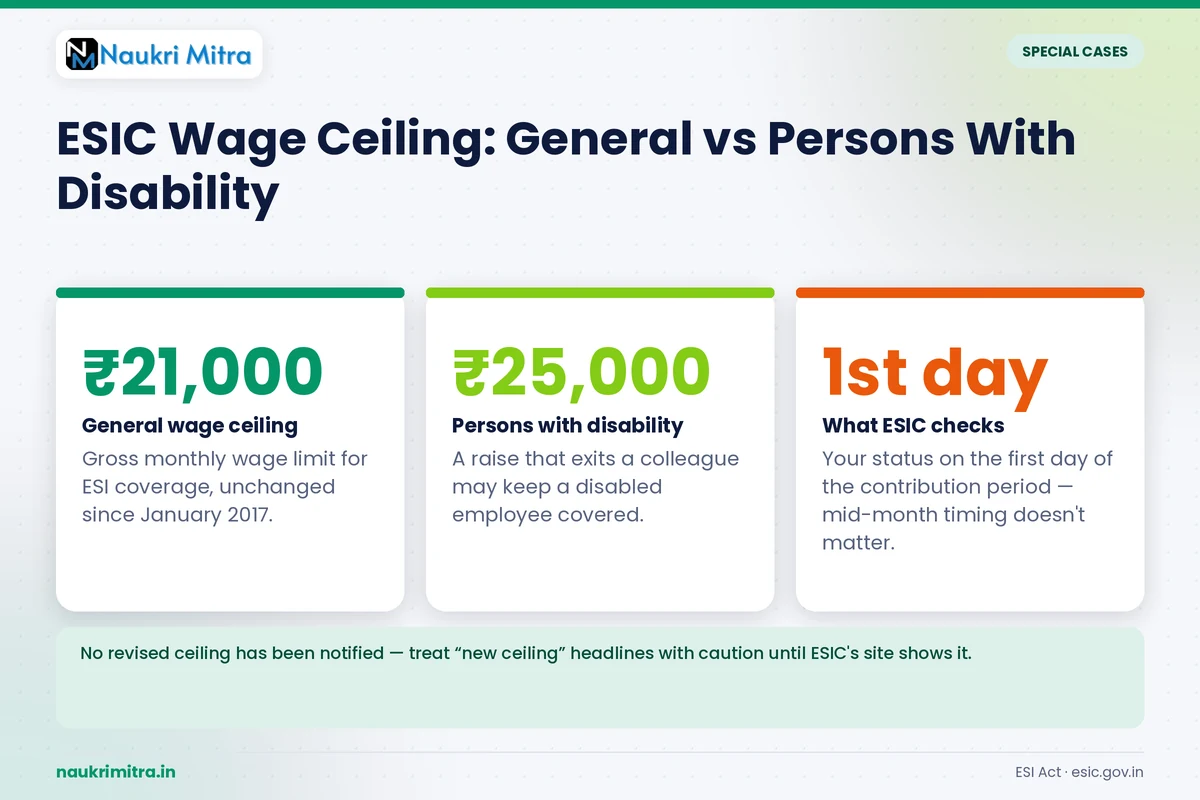
A few variations worth knowing. First, mid-month timing genuinely doesn't matter — ESIC looks at your status on the first day of the contribution period, not the exact date your hike was processed within a month. Second, employees with disabilities have a separate, higher wage ceiling of ₹25,000 per month rather than ₹21,000, so a raise that would exit a non-disabled colleague from the scheme may keep a disabled employee comfortably covered. Third, if you get two increments inside the same contribution period — say one in May and another in August — neither changes anything mid-stream; what matters is only your wage status on the day the period began and, separately, on the day the next one begins.
There's also been periodic talk in payroll and HR circles about the government eventually raising the ₹21,000 ceiling itself, discussed in outlets covering social-security reform, but as of now it remains unchanged at ₹21,000 (₹25,000 for persons with disability), and nothing has been formally notified to revise it. Treat any "new ceiling" headline you come across with caution until it's reflected on ESIC's own site.
Can You Ask Payroll to Stop the Deduction Early — And What If They Get It Wrong?
No, and this is worth being direct about. Employers don't have discretion here; continuing contributions for the full contribution period isn't a courtesy, it's a statutory obligation under the ESI Act, and stopping early — even at the employee's own request — would put the company out of compliance. If your payroll team tells you "we have to keep deducting till the contribution period ends," they're not fobbing you off; they're following the rule correctly. The reverse mistake happens too, more often than you'd think. Some payroll systems, especially ones that aren't configured with the contribution-period logic, stop ESI deduction the instant a salary crosses ₹21,000 in the system, rather than waiting for the period to end. That's a compliance error on the employer's side, not a benefit to the employee — if ESIC's inspection flags it later, the company may have to pay the shortfall with interest and damages. If you notice deductions stopping unusually early relative to the April–September or October–March calendar, it's worth flagging to HR rather than assuming you got lucky.
Switching Jobs or Taking a Salary Cut Mid-Period
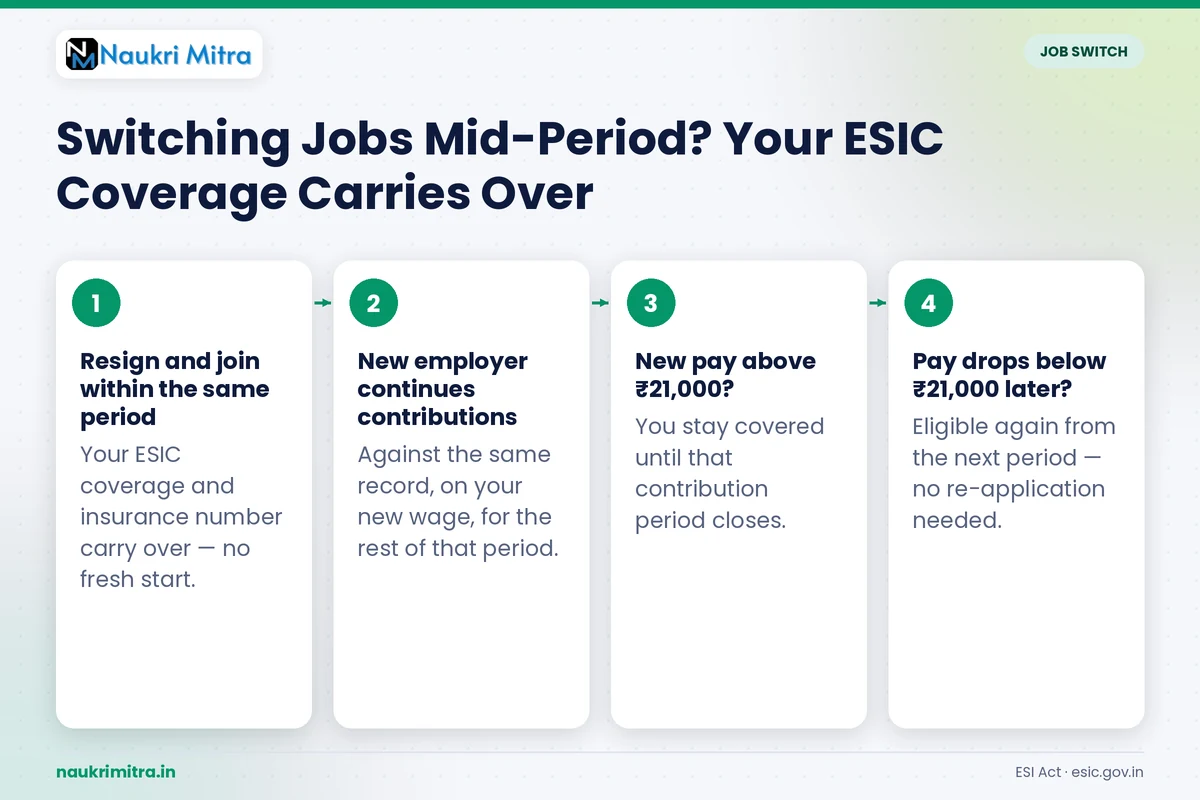
Job changes complicate things slightly. If you resign and join a new employer within the same contribution period, your ESIC coverage and insurance number carry over — you're not starting from zero, and the new employer continues contributions against the same record for the rest of that period, based on your wage with them. If your new role happens to pay above ₹21,000, the same end-of-period logic applies: you stay covered, and contributions continue, until that contribution period closes. This is especially relevant for employees moving between roles like data entry, telecalling, and back-office support, where salaries often sit right around the ESIC ceiling. If you're currently job-hunting in that bracket, it's worth checking listings for data entry jobs in Delhi, telecaller jobs in Amravati, or back-office executive jobs in Adilabad to see how the offered CTC sits relative to the ceiling before you accept — it affects your ESI status from day one at the new company.
Salary cuts work the same way in reverse. If your pay drops back below ₹21,000 — say, after a role change or a pay freeze reversal — you simply become eligible again from the start of the next contribution period in which your lower wage applies. There's no formal "re-application"; it's handled through the same wage-ceiling check employers already run every half-year.
Planning the Transition Once You Actually Exit ESIC
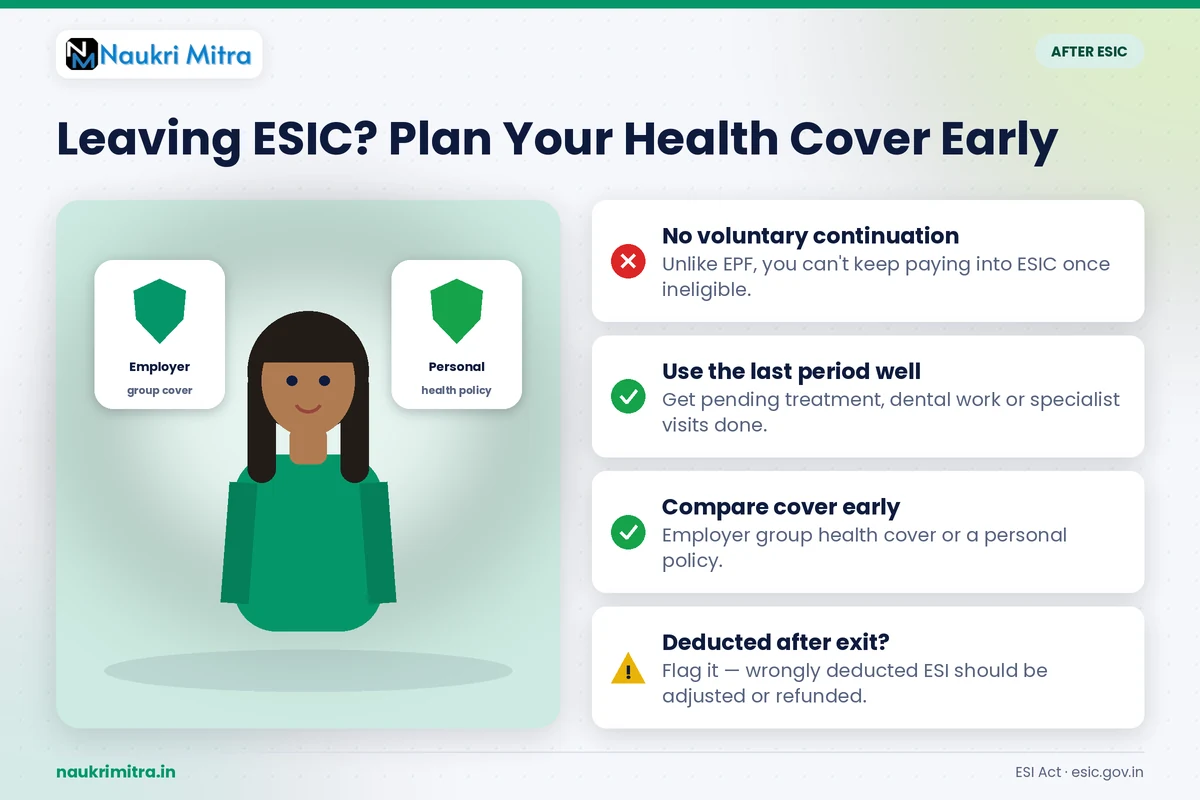
Once your contribution period genuinely ends and your wage is confirmed above the ceiling, your exit from ESIC scheme coverage is final for that stretch of employment — there's no option to voluntarily keep contributing after that point, unlike, say, EPF, which allows continuation above its own wage threshold if both parties agree. ESIC coverage is tied strictly to eligibility, not personal preference. That makes the lead-up genuinely useful planning time rather than dead weight on your payslip. Use the last contribution period before you exit to get any pending treatment, dental work, or specialist consultations done through ESIC facilities, and start comparing employer-provided group health cover or a personal health insurance policy well before the benefit period runs out — remember, your benefit period (and the cover that comes with it) continues for a few months even after contributions stop, so you're not left without a safety net overnight. Many employees find it smoother to onboard a private policy during that cushion rather than scrambling after the fact.
Frequently Asked Questions
When does ESI deduction stop after raise?
At the end of the contribution period — 30 September or 31 March, whichever comes next after your wage first crossed ₹21,000 — not the month the raise itself was credited.
Can I get a refund of the extra ESI deducted after I crossed ₹21,000?
No. Contributions correctly deducted for the rest of a contribution period aren't refundable; they're treated as valid payments that fund your benefit period entitlements a few months later, so the money isn't lost, just deferred into cover you can use.
Do I need to tell ESIC myself that my salary increased, or is that my employer's job?
It's entirely the employer's responsibility to track wage changes, apply the ceiling correctly, and file accurate monthly contributions. You don't need to inform ESIC directly, though it's reasonable to confirm with payroll that your record reflects the change.
What happens to my dependents' ESIC coverage when my contribution stops?
Dependents covered under your insurance number retain access through your active benefit period in exactly the same way you do — their cover isn't cut off earlier or treated separately from yours.
Can I check my ESIC contribution and eligibility status online?
Yes, through the ESIC employee portal using your Insurance Number or UAN-linked login, where contribution history and eligibility status for each period are visible once your employer has filed returns.
Is there a grace period to use ESIC hospitals after I exit the scheme?
Effectively yes, in the form of the benefit period — since benefits run three months behind contributions, you typically retain access for several months after deductions stop, which functions like a built-in grace period even though ESIC doesn't label it that way.
Can I voluntarily continue ESIC coverage even after crossing the wage limit?
No, there's no voluntary-continuation option once you're genuinely above the ceiling at the start of a new contribution period; coverage ends by rule, not by choice.
If my salary gets cut later, can I rejoin ESIC?
Yes. If your wage drops back to ₹21,000 or below, you become eligible again from the next applicable contribution period, with no separate rejoining procedure beyond your employer's routine wage-ceiling check.
What if my employer keeps deducting ESIC even after my eligibility should have ended?
Flag it immediately — this can happen when the exit isn't processed in payroll on time. You're entitled to have it corrected, and any excess wrongly deducted after genuine ineligibility should be adjusted or refunded.
Is there a different ceiling for employees with disabilities?
Yes — ₹25,000 per month instead of the standard ₹21,000, which is why a raise that exits a general employee from ESIC may not exit an employee with disability at the same wage level.
Getting a raise shouldn't feel like it comes with payroll mysteries attached, but the ESI contribution-period rule is one of those quiet bits of statutory design that only becomes visible the first time it affects you personally. Once you know the calendar — April to September, October to March, benefits trailing three months behind — the line item on your payslip stops looking like an error and starts looking like exactly what it is: a scheme finishing out the half-year it already started with you. Whether you're negotiating your next appraisal or hunting for a role with a cleaner salary structure from day one, it helps to check listings and openings on Naukri Mitra with this wage-ceiling math already in mind, so there are no payslip surprises a few months into the new job.
Sources: ESIC — Coverage, Razorpay Payroll — ESI Calculation Explained, ClearTax — ESI Contribution Rate.
.png)
.png)
.png)
Comments
Post a Comment