Caste Certificate Valid in Another State? | Naukri Mitra
Rakesh grew up in Gorakhpur, finished his B.Com from a Lucknow college, and moved to Pune four years ago when his father got transferred. He cleared a state-level recruitment exam in Maharashtra last month, and the moment the result came out, his father asked him a question that stopped him cold: can I use UP caste certificate for Maharashtra government job forms, or do I need something fresh before document verification? Nobody in the family had an answer, and a quick scroll through WhatsApp forwards only made things murkier — one cousin said "it works everywhere," another swore his friend lost a selection over exactly this.
This is not a rare situation. Lakhs of families move across state lines every decade for work, marriage, or education, and sooner or later someone applies for a government job carrying a caste certificate issued somewhere else entirely. The panic behind the question of a caste certificate valid in another state for government job applications is real, and the honest answer is: it depends — on whether the post is central or state, on whether your community is recognised the same way in both states, and on what the courts have already ruled when people tried to stretch this exact gap.
Does the State Actually Matter, or Is a Caste Certificate "National"?
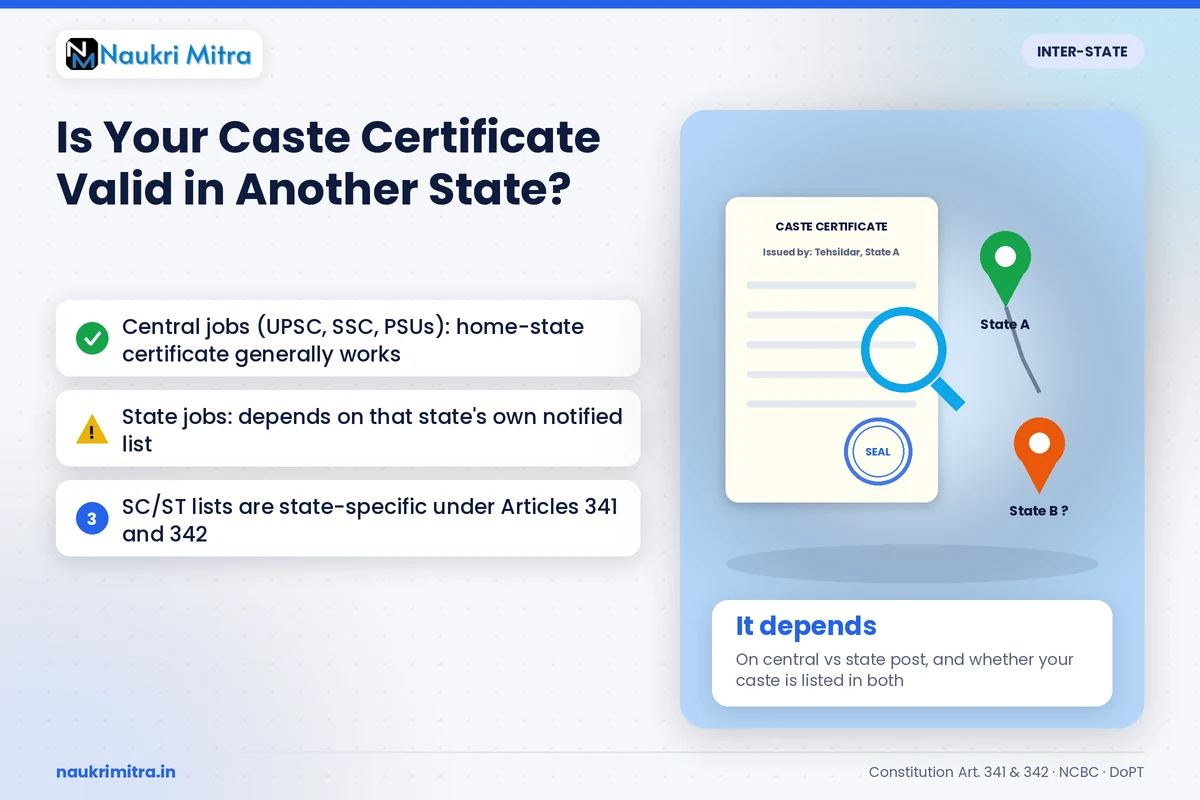
Unlike your Aadhaar or PAN, a caste certificate is not a uniform, pan-India document that automatically travels with you. It's issued by a state authority — usually a Tehsildar, Sub-Divisional Magistrate, or District Magistrate — certifying that a community is recognised as Scheduled Caste, Scheduled Tribe, or Other Backward Class within that state's own notified list. The Constitution treats SC and ST status as state-specific: Articles 341 and 342 empower the President to notify, state by state, which castes and tribes qualify as Scheduled Castes and Scheduled Tribes in that particular state or Union Territory. A community can be Scheduled Caste in Bihar and simply absent from the list in Karnataka, even if that family has lived there for two generations.
So the short version: your certificate is valid proof of your caste, but whether that caste qualifies for reservation depends on the notified list of the state where you're applying, and that list isn't uniform. For central recruitment through UPSC, SSC, or central PSUs, SC/ST reservation runs off the Presidential notification for your state of origin, so geography matters less, as long as the certificate correctly reflects where your family originally belongs. For state-government posts, the rules tighten considerably, because many states restrict reservation benefits to people with roots in that very state.
Central List OBC vs State List OBC: Where the Real Confusion Starts
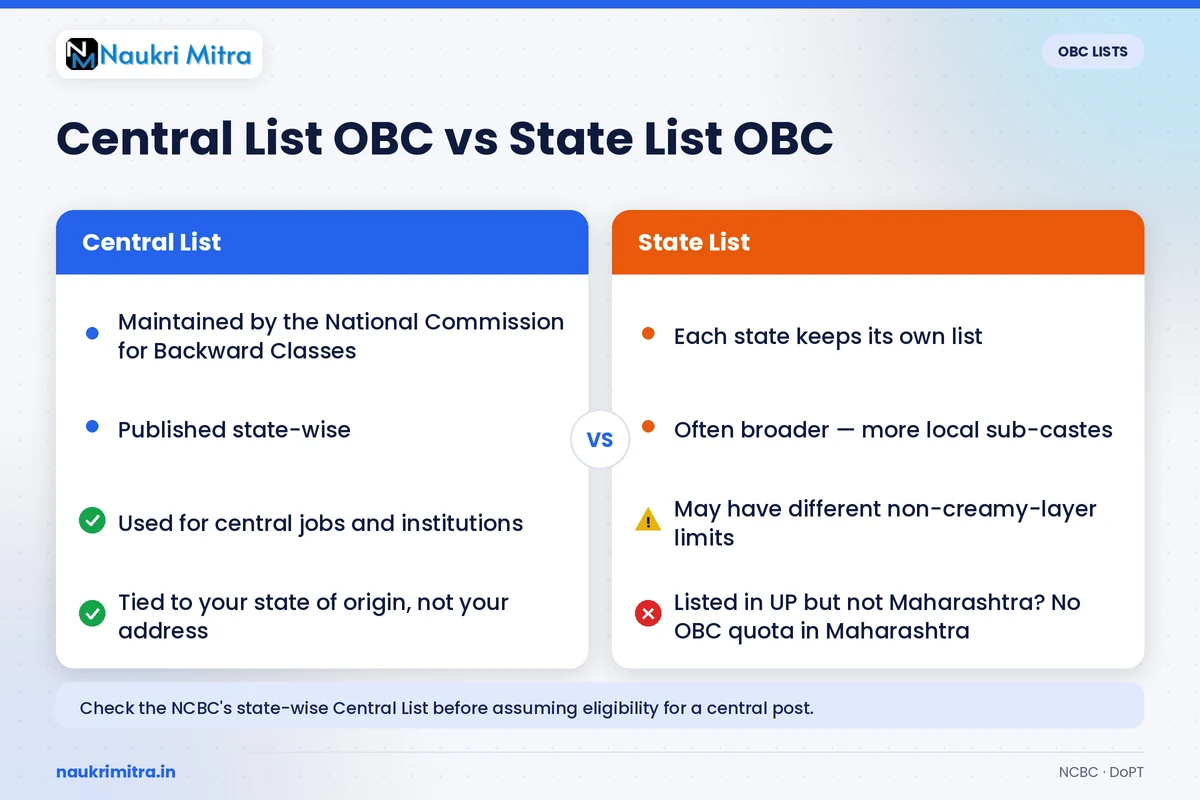
OBC reservation runs on a dual-list system, and it trips up more candidates than SC/ST rules do. The Central List of OBCs, maintained by the National Commission for Backward Classes, applies to central jobs and central institutions, and it's published state-wise, so a caste can appear differently — or not at all — for different states within that one list. Separately, every state maintains its own State List for its own recruitment and admissions, and state lists are often broader, include more local sub-castes, and sometimes carry different non-creamy-layer income ceilings.
Strip away the confusion and you're left with one plain question — the one about a caste certificate issued in one state used in another state job, and whether it survives scrutiny. For a central post, a genuine certificate from your home state generally works wherever the posting is, since central recruitment runs off the Central List tied to your state of origin, not your current address. For a state post in a different state, your community sitting comfortably on Uttar Pradesh's OBC list counts for nothing if it's absent from Maharashtra's own list — you simply wouldn't be eligible for OBC reservation there, however valid your UP certificate is back home. This is also why forums repeat some version of the same worry — SC ST OBC certificate not valid outside state for job — and the truth sits somewhere between "always" and "never," depending on category and which list applies.
What the Courts Have Actually Said
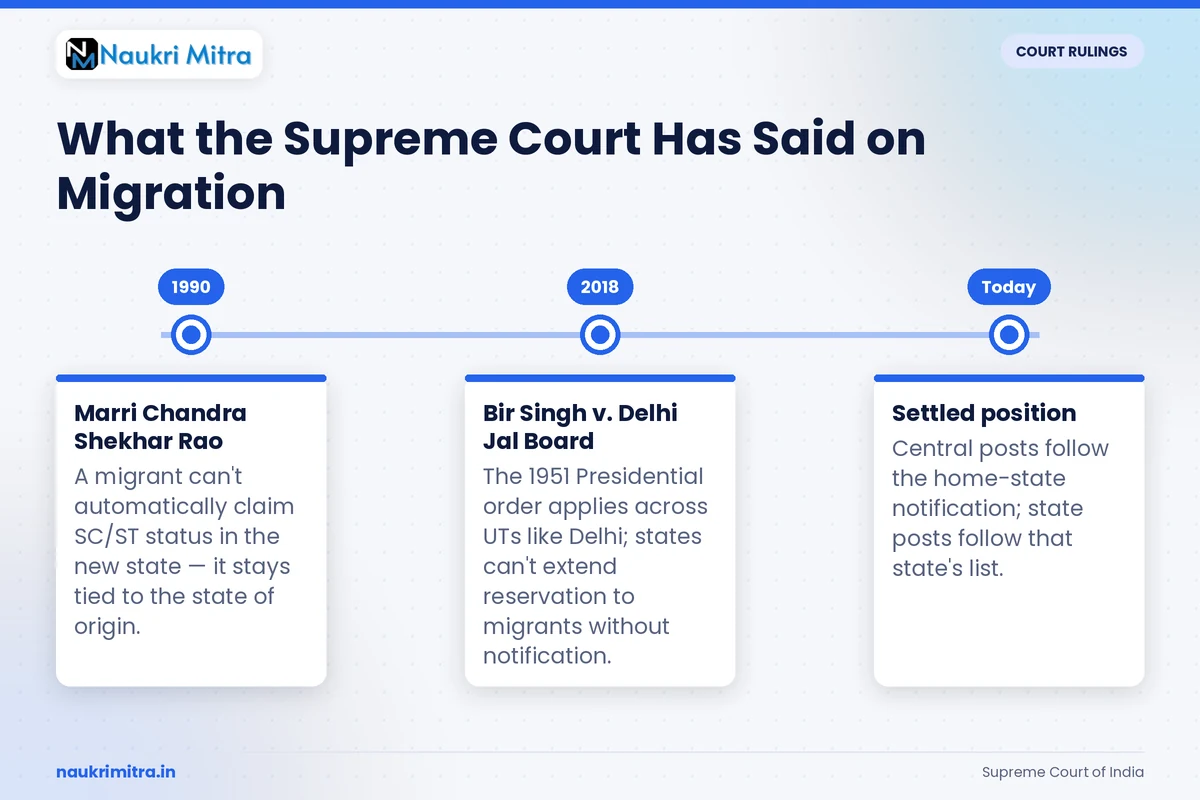
This question of caste certificate validity across states has gone to the Supreme Court more than once, and the law is fairly settled, even if it still surprises first-time applicants. In Marri Chandra Shekhar Rao v. Dean, Seth G.S. Medical College (1990), the Court held that a person migrating from one state to another cannot automatically claim SC/ST status in the new state merely because the same community is listed there too — caste status stays tied to the Presidential notification for the state of origin. The Court has reiterated this since, including in a more recent matter where it held that a Scheduled Tribe member who relocates to another state or Union Territory cannot claim ST status there unless the tribe is separately notified as ST in that state or UT.
A related question arose in Bir Singh v. Delhi Jal Board (2018), involving a Haryana Scheduled Caste member claiming SC reservation in Delhi. The Court held that the pan-India 1951 Presidential order extending reservation across Union Territories applied to Delhi, but also clarified that individual states can't unilaterally extend their own reservation to SC/ST members migrating in from elsewhere without a specific notification. That's why Delhi and other UTs often behave differently from ordinary states here, and the inter-state caste reservation rules that followed are stricter than most candidates expect — "my caste is reserved back home" is never, by itself, a safe assumption to carry into another state's job application.
Migration Certificate Is Not the Same Thing as a Caste Certificate
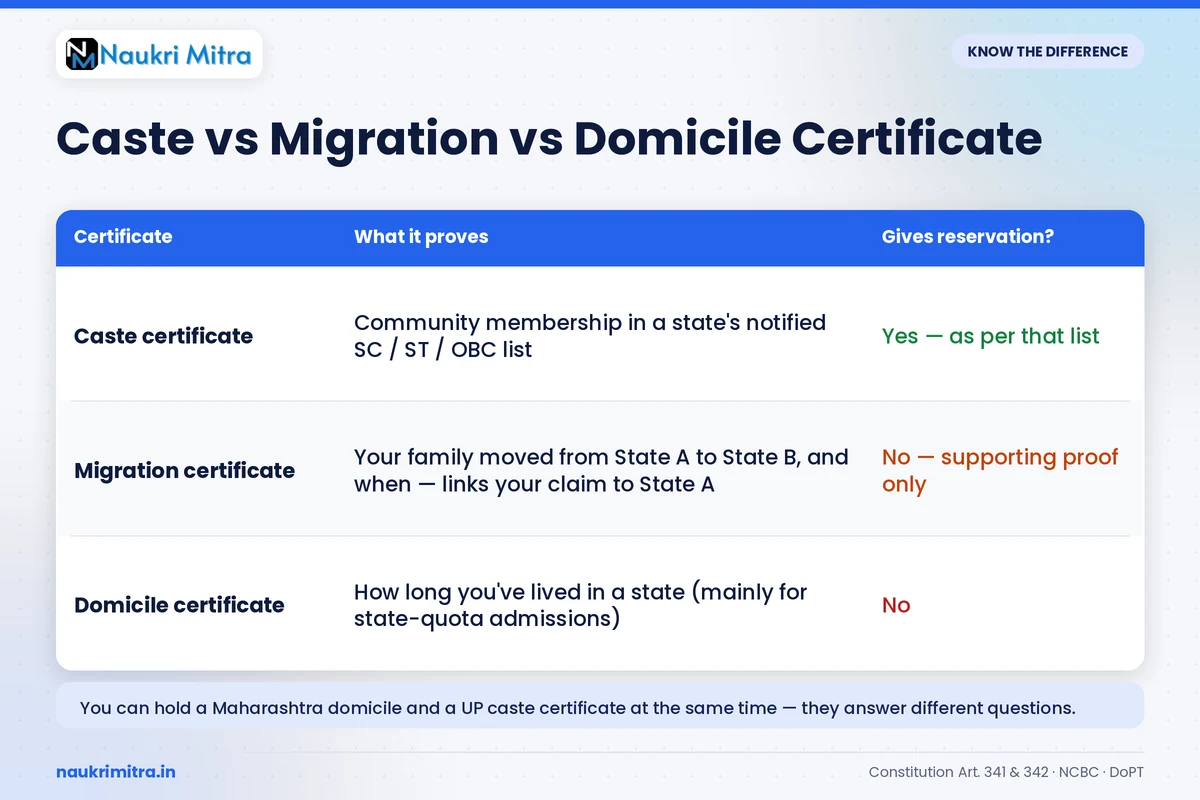
A lot of candidates genuinely get confused here, partly because the terminology overlaps. What official literature calls a migratory caste certificate, or simply a migration certificate, is not a replacement for your caste certificate — it's a supporting document establishing that you or your family moved from State A to State B, when that happened, and that your caste claim traces back to State A's own notified list. It confers no reservation status by itself; it only helps a scrutiny committee connect the dots when your current address and your certificate's issuing state don't match.
People also conflate domicile vs caste certificate as though one substitutes for the other. It doesn't. A domicile certificate proves how long you've resided in a state and is typically used for state-quota admissions; a caste certificate proves community membership and reservation status. You can hold a Maharashtra domicile certificate and still carry a Uttar Pradesh caste certificate if that's genuinely where your family's caste lineage is recorded — the two documents answer different questions and are checked separately.
If Your Family Migrated Generations Ago, Which State's Certificate Applies?
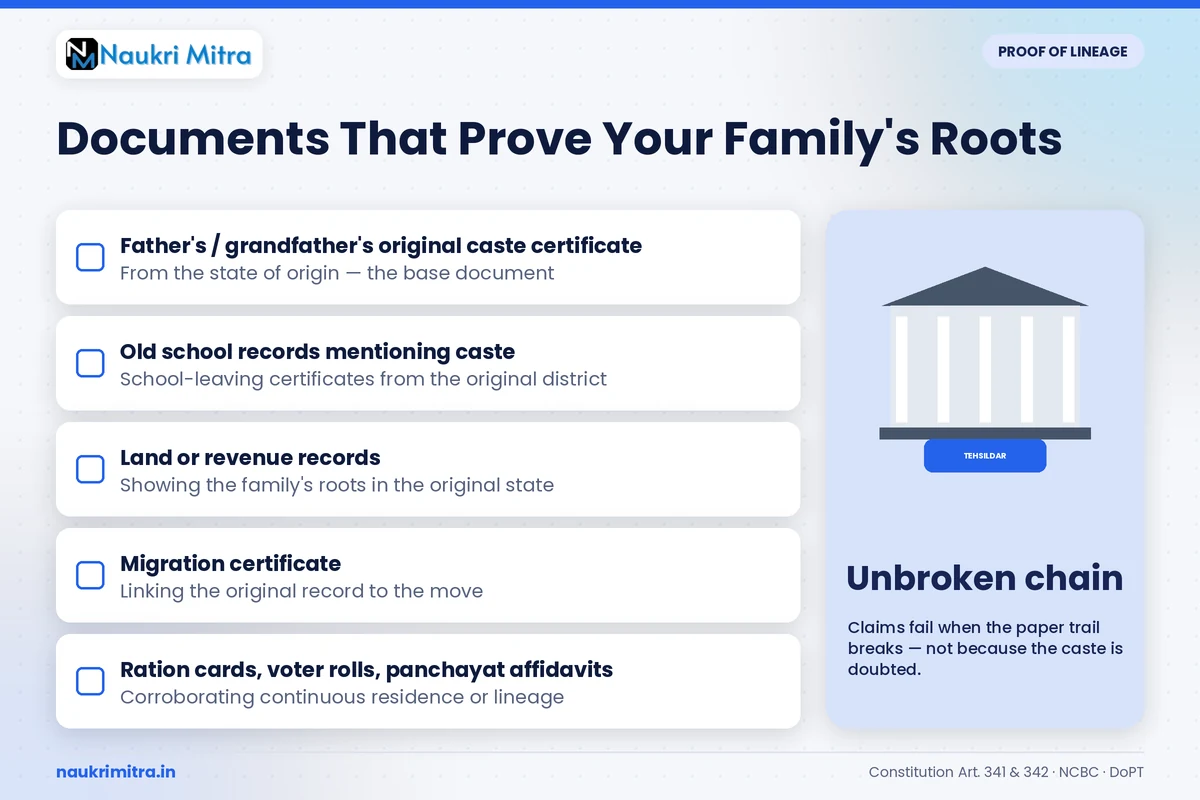
For families that moved one, two, or three generations back, the general rule courts have applied is that caste status follows the paternal line to the original state of belonging, not the state of current residence — unless the family has formally established eligibility under the new state's own list (some states do allow this for OBC claims through local verification, since OBC status isn't frozen by Article 341/342 the way SC/ST is). Second and third-generation migrants typically need an unbroken documentary chain: a grandfather's or father's original caste certificate or school records from the state of origin, land or revenue records showing the family's roots there, and a migration certificate linking that record to the eventual move. Without that chain, a scrutiny committee has nothing concrete to verify, and claims get rejected not because the caste is doubted, but because the paper trail is broken.
What actually proves continuous residence or lineage includes old ration cards, school-leaving certificates mentioning caste, voter rolls from the original district, and sometimes gram panchayat affidavits corroborating the family's history there. A father's original certificate from State A can be used as the base document to apply in State B, provided the genealogical link is shown — routine, though it often takes several weeks longer than a same-state application.
Women Who Marry Into a Different State
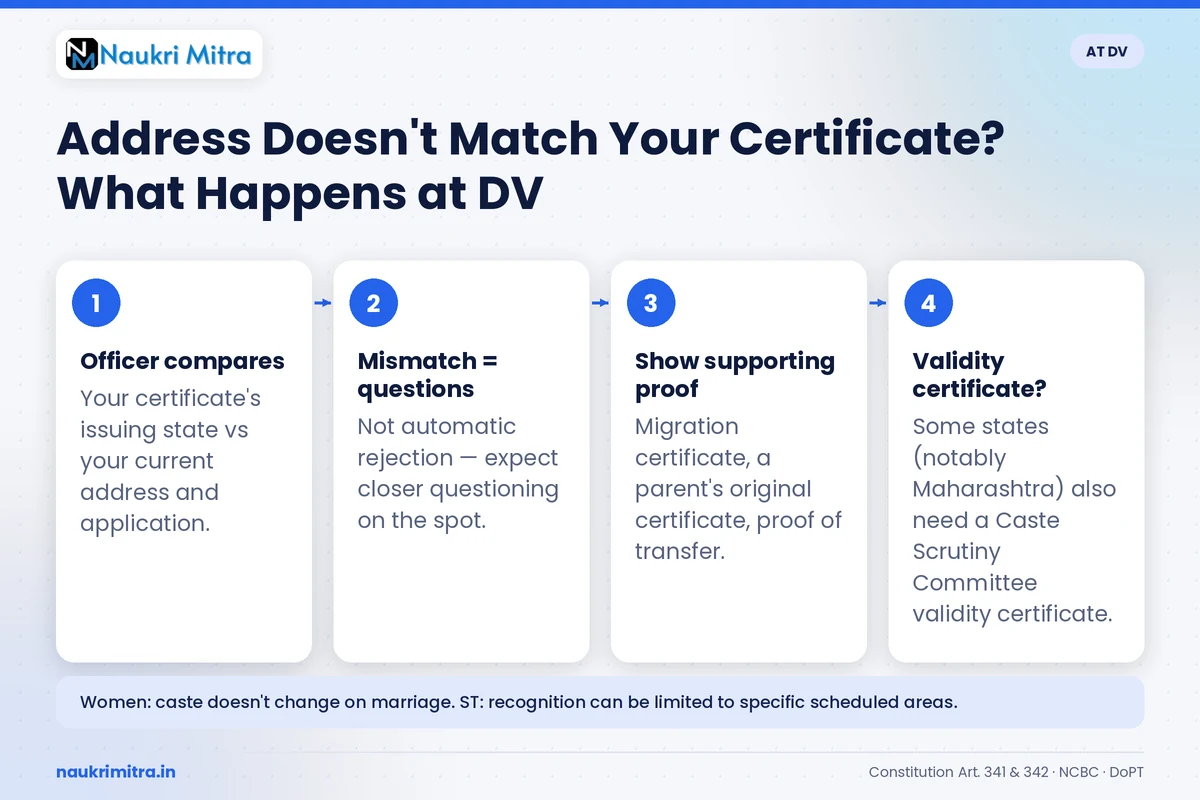
Marriage adds another layer, and it trips up more women candidates than expected. The settled legal position is that a woman's caste doesn't automatically change on marriage into a different caste or state — her birth caste continues to govern her reservation eligibility. Several High Courts have reinforced this in rulings involving women who relocated after marriage and tried claiming benefits under the destination state's list instead of their own birth-state status; the general finding is that marriage alone doesn't transfer caste eligibility to the husband's state unless the woman's own family already belonged to a recognised community there. In practice, a woman should apply using her own pre-marriage caste certificate traceable to her birth family, updating only name and address through the standard affidavit process if there's a mismatch.
ST Candidates Relocating to a Non-Scheduled Area
Scheduled Tribe status carries an extra wrinkle SC and OBC status don't: many ST notifications are restricted not just to a state but to specific scheduled areas or districts within it. An ST candidate relocating to a different state — or even a non-scheduled district within the same state — may find their tribe simply isn't recognised for reservation there, however genuine their tribal identity back home. The practical move is to keep the certificate from the state and area of origin as the primary document for central recruitment, since central ST reservation ties back to the Presidential order for the home state, and to be cautious about assuming a new state's list will recognise the same tribe — it frequently doesn't.
Getting a Caste Certificate Reissued After You've Relocated
If you've genuinely moved and need a fresh certificate from your current state of residence (common for OBC claims, where state lists allow new verification), the process runs through the same Tehsildar, Revenue Divisional Officer, or SDM office that handles any first-time application, with extra document checking. You'll typically need your own school records, a parent's original caste certificate from the state of origin, proof of migration (ration card transfer, old address proof, a migration certificate if one was issued), and current residence proof. A certificate issued by a Tehsildar or SDM in one state can absolutely be verified by another state's revenue authorities — standard practice, done through a formal reference between district offices or, increasingly, state e-governance portals. It takes longer than a routine application, often four to eight weeks, so start the paperwork well before a recruitment notification drops, not after.
What Happens at Document Verification If the Address Doesn't Match
This is the moment most candidates worry about — where Rakesh's situation would actually get tested. At DV, the scrutiny officer compares your certificate's issuing state against your current address and application details. A mismatch alone isn't automatically disqualifying; it's a trigger for closer questioning. You'll usually be asked to explain it on the spot and may need to produce supporting documents — a migration certificate, a parent's original certificate, proof of transfer — right there or within a short window. What genuinely causes rejection isn't the mismatch itself but the absence of a credible explanation or paperwork for it. Candidates carrying the full documentary chain rarely get stuck for long; those who show up with just the certificate and no explanation often end up in prolonged correspondence that can run past the joining deadline.
Caste Certificate vs Caste Validity Certificate — a Quick Distinction
Worth flagging briefly: a caste certificate and a caste validity certificate aren't interchangeable, though people use the terms loosely. A caste certificate is the basic document certifying your community; a caste validity certificate is a separate, more rigorous verification issued by a state-level Caste Scrutiny Committee (mandatory in several states, notably Maharashtra, for government appointments) after checking historical records, often across generations. If your new state requires a validity certificate too — not every state does — that process runs independently, and after, getting your basic certificate sorted.
Can a Certificate Be Cancelled After You've Already Joined?
Yes, and this is the part candidates underestimate most. If a caste certificate is later found to rest on an incorrect address, a fabricated migration claim, or any false representation, it can be invalidated even after selection and joining — appointment orders don't grant automatic immunity. Scrutiny committees and vigilance cells have cancelled appointments years into service once an original certificate didn't hold up, and such terminations have, in multiple cases, been upheld by courts because the appointment itself rested on a false claim. The safer approach is applying strictly on facts you can document, even if that means a longer process or, sometimes, accepting that your current state simply doesn't recognise your community for reservation.
And despite what agents near certificate-issuing offices sometimes imply for a fee, there's no formal caste certificate transfer to another state process — no single application converting a UP certificate into a Maharashtra one. Each state's revenue administration verifies and issues its own certificate independently, through the documentary chain described above. Anyone promising a quick "transfer" is either describing the standard reissue-with-migration-proof process in simpler words, or isn't being entirely straight with you.
Frequently Asked Questions
Do UPSC and SSC accept a caste certificate from any state, or only my home state?
For central recruitment, what matters is that the certificate correctly reflects your state of origin under the Central List — it doesn't need to be issued by your current state of residence, provided it's in the prescribed central format.
Can I use my father's old certificate from our original state to apply for a new one where we live now?
Yes — it becomes the base document, and you additionally establish the genealogical link and migration history.
I'm ST, and my tribe isn't on the list in the state I live in now — what should I do?
Keep using your original state's certificate for central recruitment. For a state-government post in your new state, you likely won't qualify for ST reservation there unless your tribe is separately notified in that state too.
Does every state require a separate caste validity certificate?
No — most states accept the basic certificate for recruitment, while a smaller number, Maharashtra being the best-known example, additionally require validity from a Caste Scrutiny Committee.
Can two siblings end up with certificates issued by two different states?
Yes, if the family relocated between their births. As long as both trace back to the same documented lineage, this on its own isn't disqualifying.
What documents actually convince a scrutiny committee a migration is genuine?
Old school records, land or revenue records from the original district, ration card history, and ideally a formally issued migration certificate. Affidavits alone, without backing documents, rarely satisfy a committee.
If my certificate is challenged after I've already joined, can I lose the job?
Yes. Appointments based on a caste claim later found false or unverifiable can be, and have been, cancelled even years into service, with courts upholding such terminations.
Is there one all-India format for caste certificates every state follows?
There's a common format prescribed for central recruitment (SC/ST and OBC-NCL formats are standardised by the Department of Personnel and Training), but states use their own formats for state-level recruitment.
How do I check whether my caste is on the Central List for my home state?
The National Commission for Backward Classes publishes state-wise Central Lists on its website — verify there before assuming eligibility for a central post. A 2014 Department of Personnel and Training office memorandum also explains how the Central List is meant to be applied in recruitment.
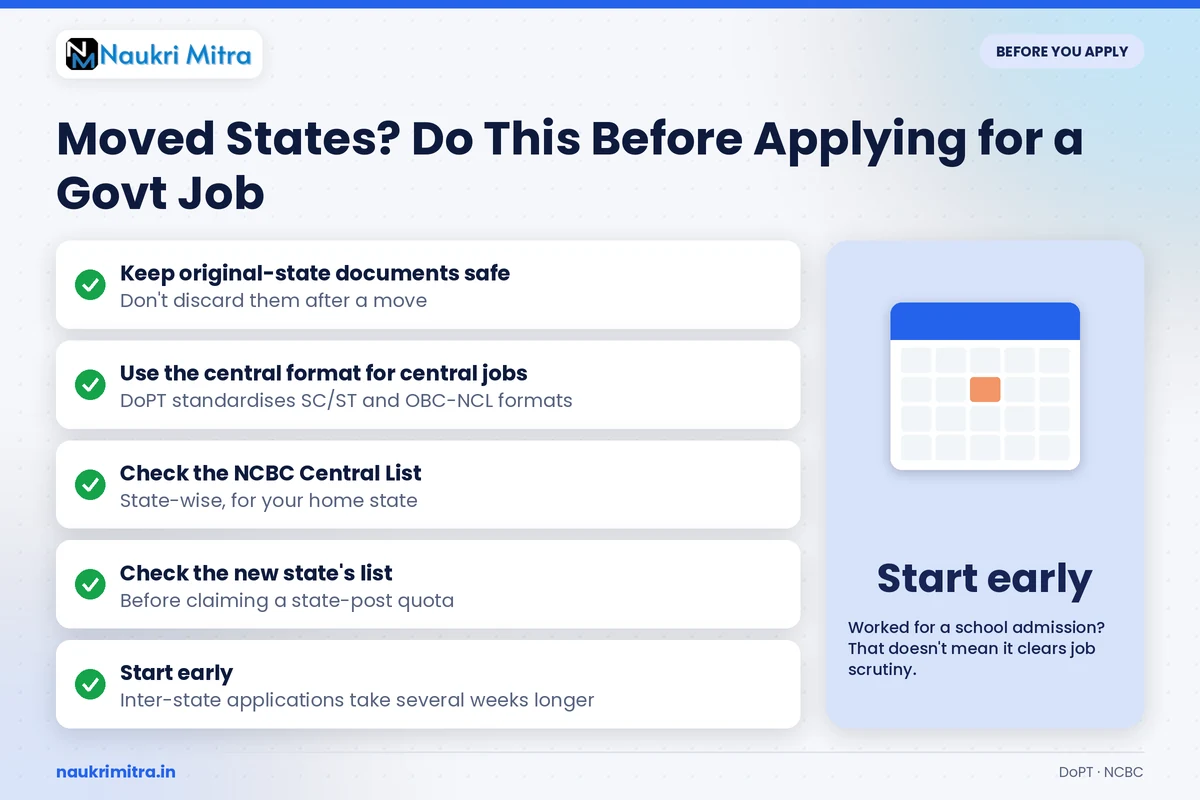
None of this means a family that has moved across states is stuck. It means doing the paperwork early, keeping the original documents from the state of origin safe rather than discarding them after a move, and not assuming that because a certificate "worked" for a school admission, it will automatically clear scrutiny for a government job in a new state. If you're weighing your options while this gets sorted out, it's also worth keeping an eye on openings beyond government postings — you can browse current listings on Naukri Mitra while your certificate situation is being resolved, so a few weeks of document verification don't have to mean a few weeks of standing still.
Sources: LiveLaw — Supreme Court on ST status after inter-state migration, LiveLaw — Bir Singh v. Delhi Jal Board judgment summary, DoPT Office Memorandum on the Central List of OBCs.


Comments
Post a Comment