Anganwadi & ASHA Jobs: The Pay Reality | Naukri Mitra
A woman in a small town in Madhya Pradesh once told a local reporter that she'd been an anganwadi worker for eleven years and still didn't know whether to call it a "job" or "service she did for the government." That confusion isn't hers alone. Anganwadi workers, ASHA workers, and gram rozgar sahayaks together form one of India's largest community workforces — several million people, overwhelmingly women — yet almost nobody outside the system can explain clearly how they're hired, what they're paid, or whether any of it counts as a real government job the way a clerk's post or a teacher's post does. This piece lays that out plainly: state by state where the numbers are known, and honestly where they're murky.
How these roles are actually recruited — not an exam hall in sight
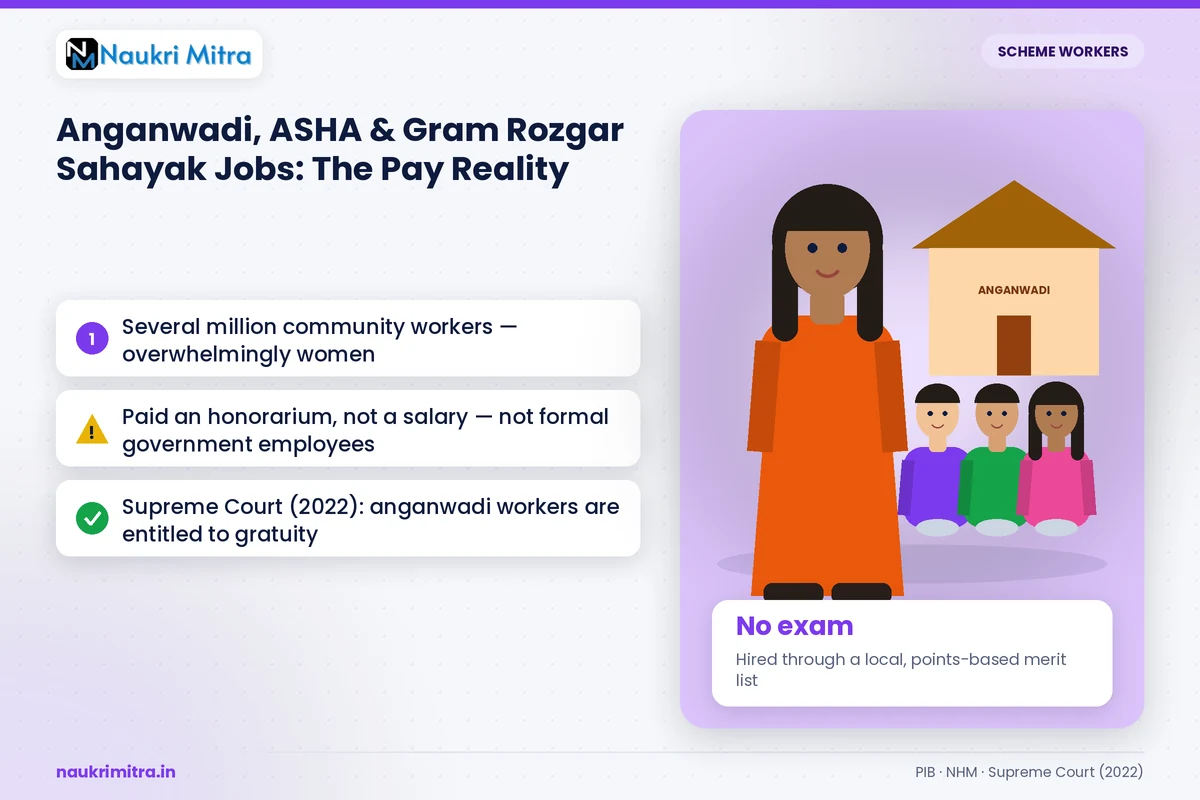
If you're picturing a written exam with a hall ticket and a cut-off list like SSC or a bank PO test, drop that image. The anganwadi worker recruitment process and salary structure both run through a completely different pipeline. Vacancies, including any anganwadi helper vacancy, are notified by the district Child Development Project Officer (CDPO) or the ICDS (Integrated Child Development Services) project office, and selection happens through a points-based merit list — qualification, age, marital status, number of children, income category, and residence within the anganwadi's catchment area all carry weightage. There's typically no written test, though a handful of states have added a basic screening interview in recent cycles. The committee is usually chaired by the CDPO along with local panchayat or municipal representatives, and the final list is often displayed at the gram panchayat office itself rather than on a national portal.
ASHA (Accredited Social Health Activist) selection works on similar logic, but under the Ministry of Health's National Health Mission (NHM) rather than Women and Child Development. A village health, sanitation and nutrition committee or the gram sabha typically recommends names, with final selection cleared at the block or district health office. So on the ASHA worker job how to apply eligibility question, the honest answer is: there's rarely a centralised "apply online" portal the way there is for a government exam. You watch for a notice at your Primary Health Centre, anganwadi centre, or panchayat board, or ask the current ASHA facilitator when the next vacancy is expected.
Is this actually a "government job"? Honorarium, wages, and the confusion around both
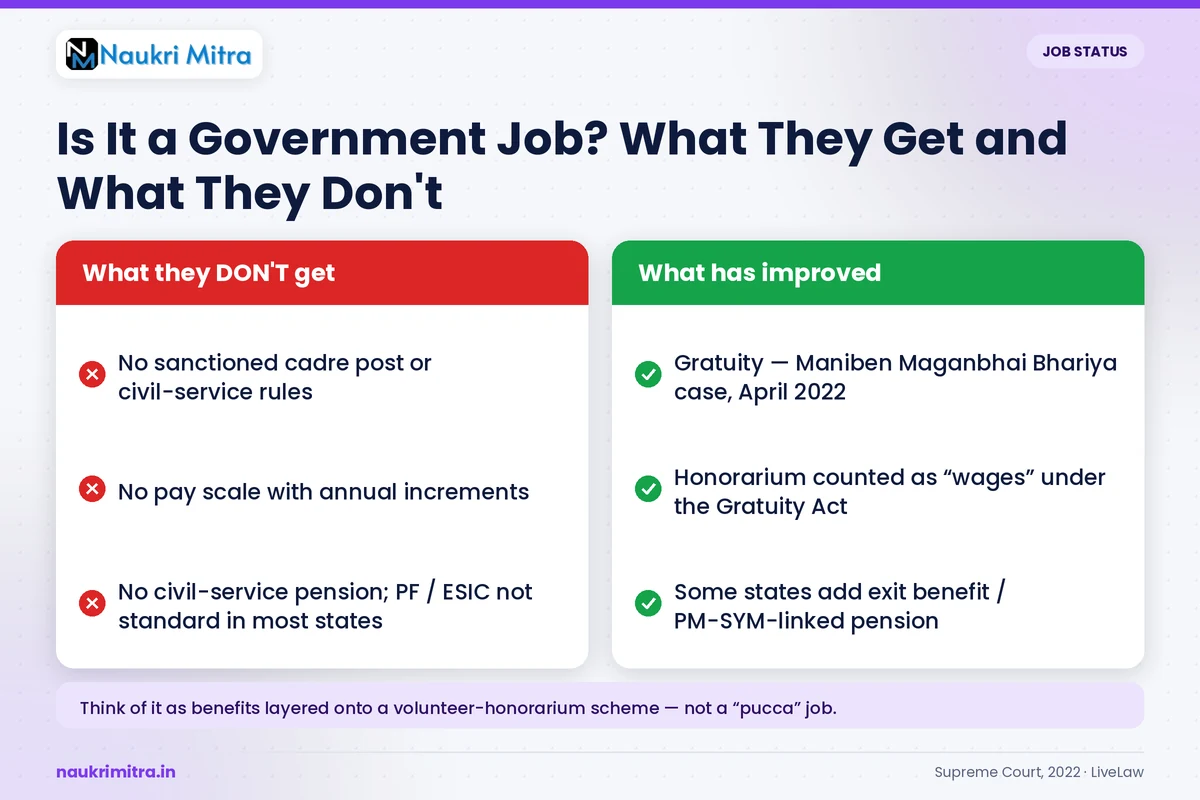
This is the question that trips up almost everyone, including many workers themselves. Anganwadi workers, helpers, and ASHAs are not, in the formal service-rules sense, government employees. They don't hold a sanctioned cadre post, aren't covered by central or state civil service rules, and historically weren't treated as workers entitled to minimum wages at all — they were classified as "honorary," volunteer-style community workers receiving an honorarium rather than a salary. No pay scale with annual increments, no transfer postings, and for decades, no clear entitlement to retirement benefits.
That's been shifting, slowly and unevenly. In April 2022, the Supreme Court, in Maniben Maganbhai Bhariya v. District Development Officer Dahod, held that anganwadi centres qualify as "establishments" under the Payment of Gratuity Act, 1972, and that the honorarium paid to workers and helpers amounts to "wages" under that law — meaning they're entitled to gratuity on completion of the qualifying service period, as LiveLaw's coverage of the ruling lays out. It's genuinely significant — the first time a top court pushed back on the "they're just volunteers" framing governments relied on to avoid statutory obligations. But a gratuity ruling isn't the same as being declared a regular employee — still no civil-service pension, no PF contribution from the state as employer in most states, no guaranteed annual pay revision. Think of it as contractual government worker benefits layered gradually onto a volunteer-honorarium scheme, not a transformation into a "pucca" job.
What anganwadi workers and helpers actually take home, state by state
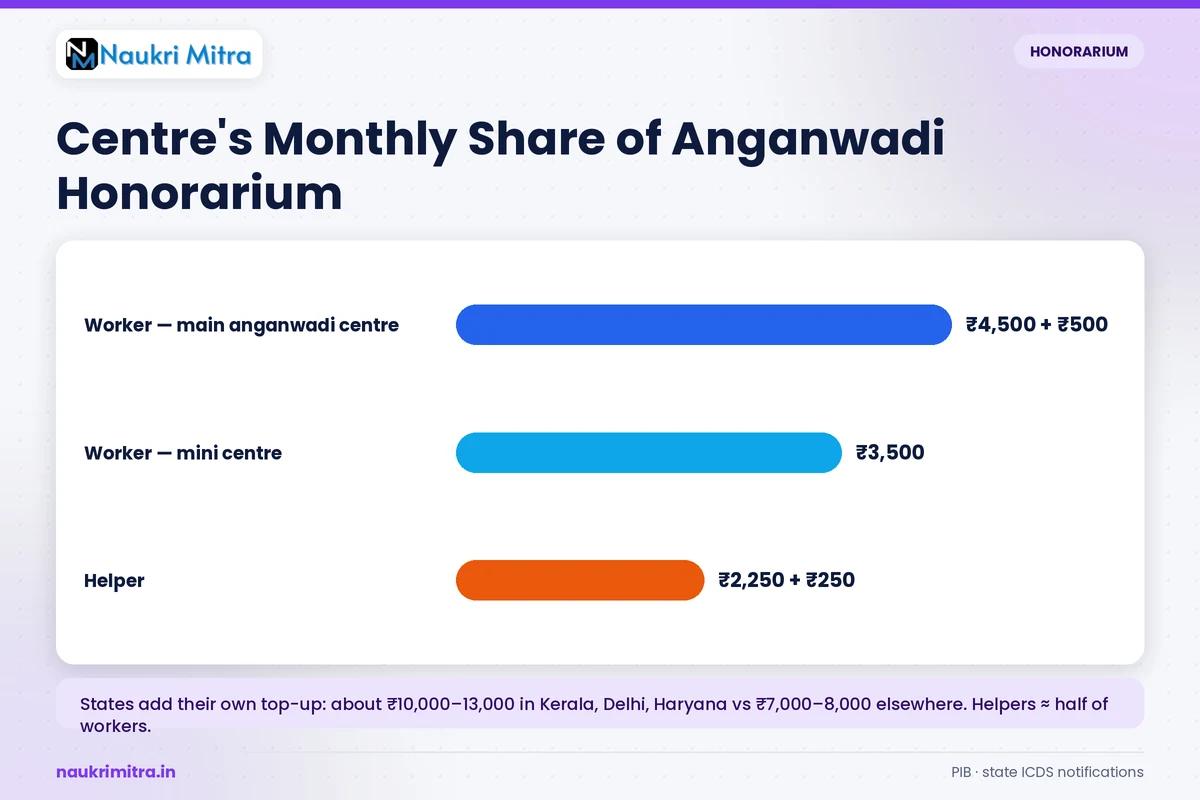
The central government fixes a base honorarium that it shares with states, and states top it up from their own budgets — exactly why pay varies so much by location. Per the most recent central figures reported by the Press Information Bureau, the Centre's own contribution is roughly ₹4,500 a month for a worker at a main anganwadi centre, ₹3,500 for a worker at a mini-centre, and ₹2,250 for a helper, with a performance-linked incentive of ₹500 and ₹250 respectively on top — figures the PIB press release on anganwadi honorarium lays out explicitly, while noting states add their own supplementary amounts.
Those state top-ups are what make the real-world number so different place to place. Workers in states like Kerala, Delhi, and Haryana have, at various points, reported combined monthly figures above ₹10,000–13,000 once state contributions are added, while workers in less fiscally flush states report totals closer to ₹7,000–8,000. Helpers almost everywhere earn roughly half of what workers earn, and supervisors — the next rung up, usually requiring prior worker experience or a degree — are paid meaningfully more, often on a defined pay scale rather than a flat honorarium. As of recent reporting, these figures are revised periodically and inconsistently, so treat any specific number as a snapshot — always check your state's ICDS or Women and Child Development department notification for the current figure.
What ASHA workers actually earn — and why it isn't really a "salary" at all
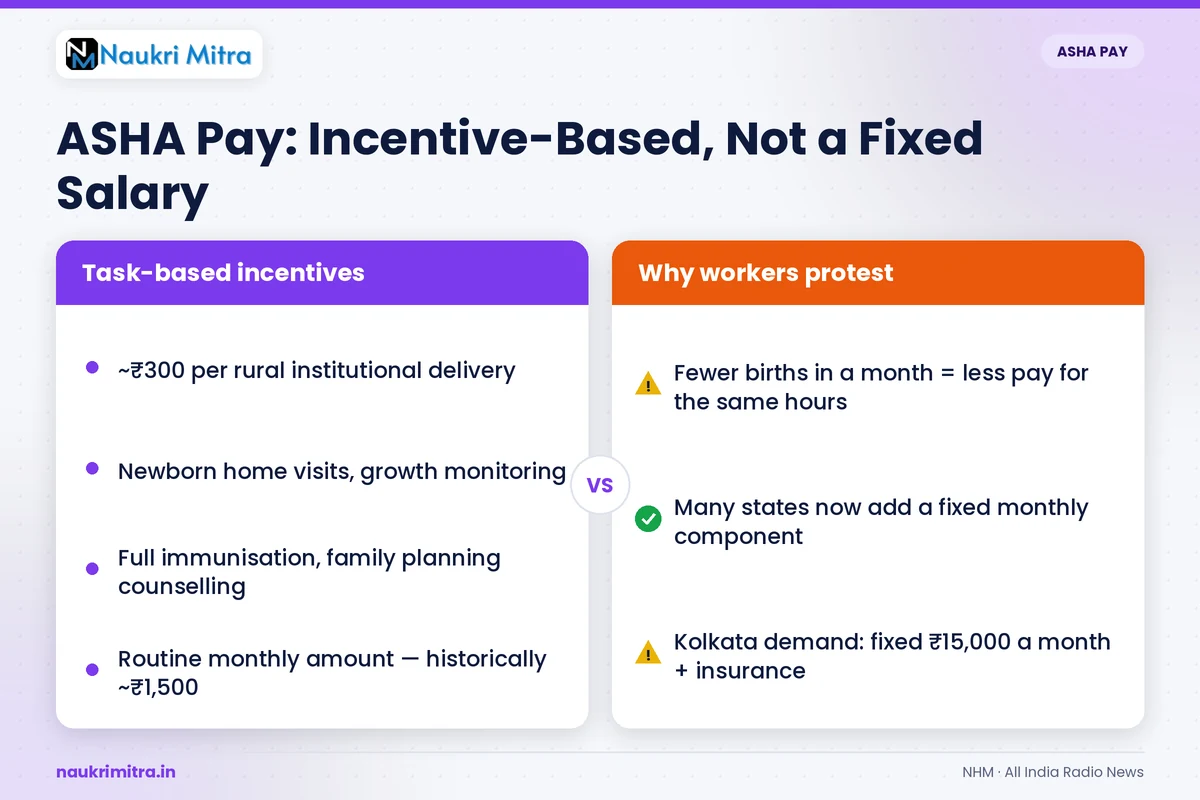
If anganwadi pay is a confusing patchwork, ASHA pay is a different animal, designed from the outset as task-based incentive payment rather than a fixed monthly figure. Official NHM documentation lists dozens of separate incentive items: roughly ₹300 for facilitating an institutional delivery in a rural area (lower in urban areas), amounts for each newborn home visit, per-visit incentives for growth monitoring, payments tied to full immunisation coverage, family planning counselling incentives, and a routine monthly amount — historically around ₹1,500 — for maintaining records and attending the village health and nutrition day. Add it up across a typical month's births, immunisations, and TB or NCD referrals, and an active ASHA in a high-need area might clear a reasonable sum; one in an area with fewer births that month earns considerably less for the same hours on call.
That's the heart of the ASHA worker honorarium vs salary difference: a salary is predictable because it's tied to time worked, while an incentive-built honorarium is tied to outcomes an individual worker doesn't fully control. Many states have added a fixed monthly component on top precisely because workers kept flagging that zero floor income isn't sustainable — the core demand behind repeated ASHA strikes. Most recently, demonstrators in Kolkata pressed for a fixed monthly honorarium of ₹15,000 along with better insurance and maternity leave, a protest covered by All India Radio's news service. Similar demands for a guaranteed minimum wage over piecemeal incentives have surfaced in Karnataka, Kerala, and Jammu & Kashmir over the last two years.
Gram Rozgar Sahayak: the MGNREGA cousin in this family of roles
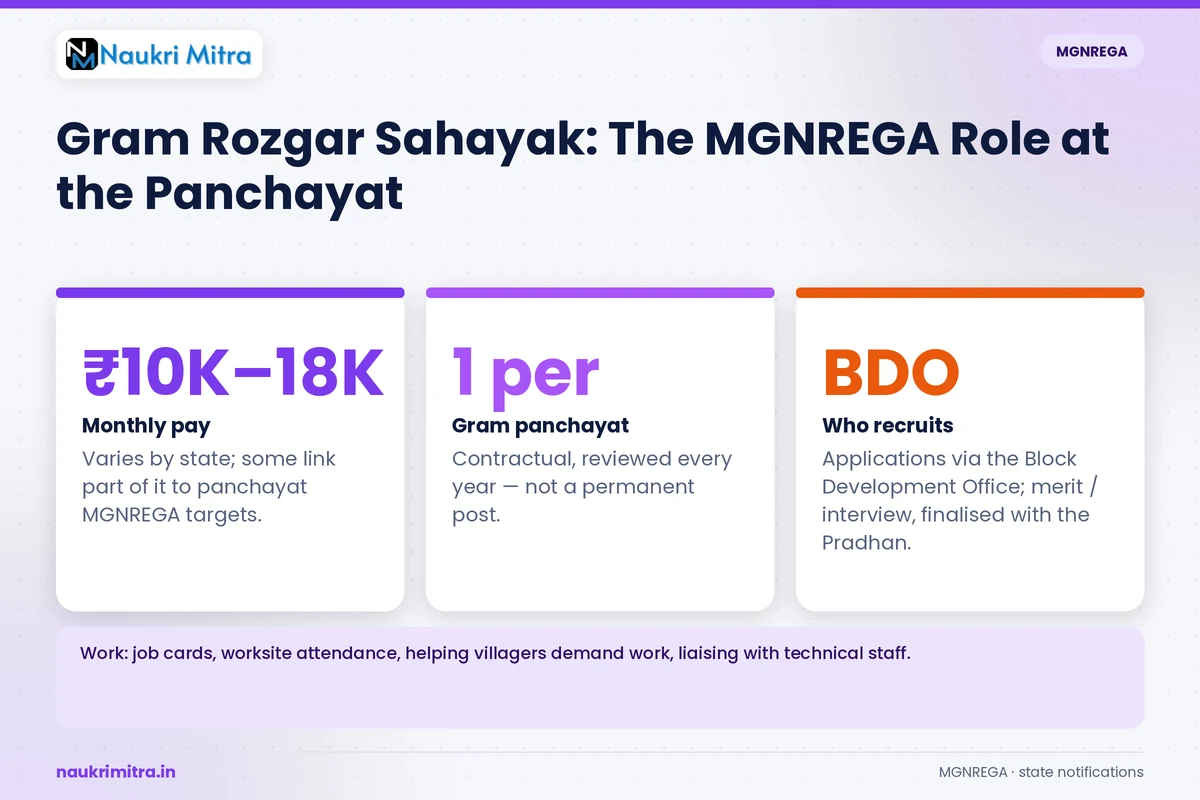
Thrown into the same conversation, often because the hiring feels similarly local and informal, is the gram rozgar sahayak — sometimes called gram rojgar sevak depending on the state. This panchayat-level post supports implementation of MGNREGA, India's rural employment guarantee scheme: maintaining job cards, recording worksite attendance, helping villagers demand work under the scheme, and liaising with technical staff (like the Nirman Sahayak or junior engineer) who measure and approve completed work.
The gram rozgar sahayak vacancy recruitment process typically runs through the Block Development Office, with the BDO inviting applications and selection — again merit/interview based rather than a written exam — finalised with the gram panchayat's elected Pradhan. It's explicitly contractual, usually one appointment per panchayat, reviewed annually rather than permanent, and pay varies by state from roughly ₹10,000 to ₹18,000 a month depending on local budgets and whether the state links part of it to panchayat performance on MGNREGA targets. Like anganwadi and ASHA roles: no central exam, no all-India merit list, no guarantee that years of good work converts it into a permanent district-cadre post.
Eligibility, age limits, and what actually moves you up the merit list
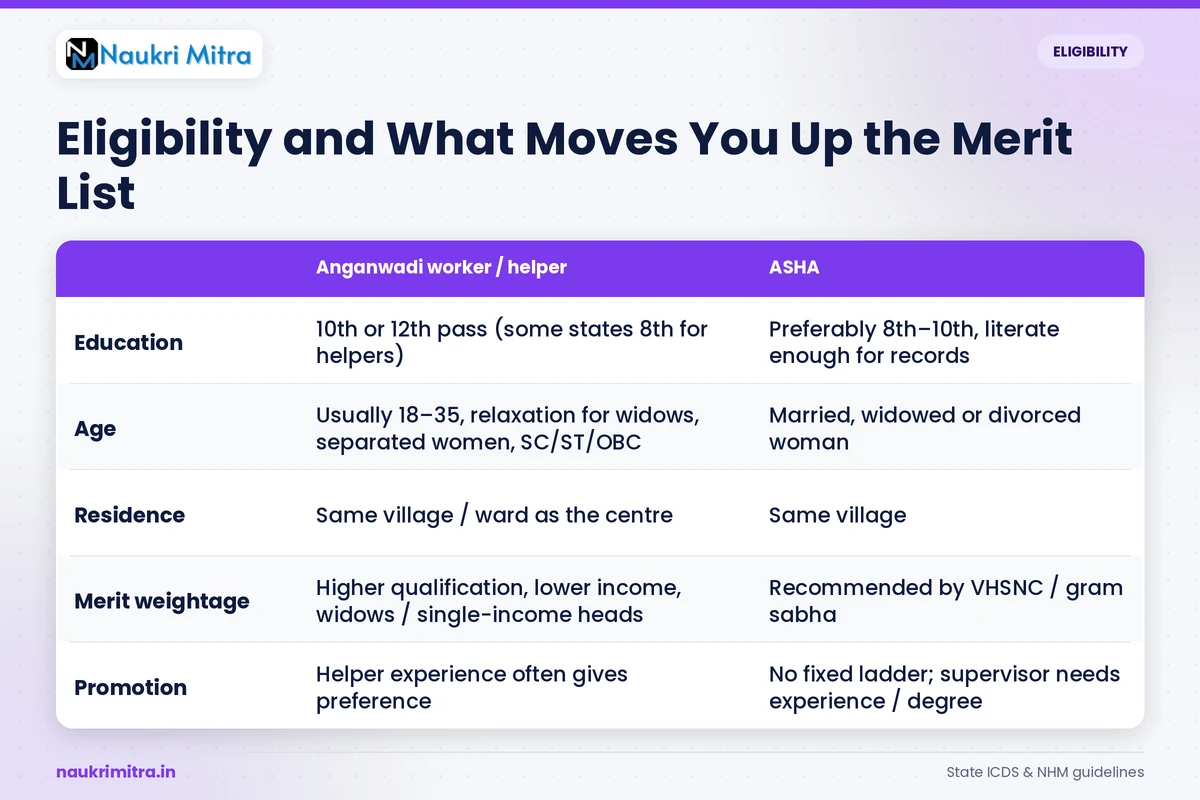
Qualification requirements are kept deliberately modest compared to most government recruitment, since these posts are meant to draw from the local community rather than import outside talent. For an anganwadi worker, most states ask for a minimum of 10th or 12th pass (some still accept 8th pass for helper posts, needing little beyond basic literacy), plus residence in the same village or ward as the centre being filled. Age limits commonly sit between 18 and 35 at entry, with relaxation for widows, divorced or separated women, and sometimes SC/ST/OBC candidates. Weightage in the merit list usually rewards higher qualification, lower family income, and — in many states — explicit preference for widows or women heading single-income households, since ICDS design philosophy leans toward using these posts as livelihood support for vulnerable local women, not purely a competitive hiring exercise.
For ASHA selection, criteria typically require a resident married, widowed, or divorced woman of the same village, preferably with 8th to 10th standard schooling and literate enough to maintain basic records. There's usually no fixed promotion ladder from ASHA to anganwadi worker or vice versa, though prior experience as an anganwadi helper is frequently treated as a genuine advantage — sometimes a formal eligibility requirement — when a worker-level vacancy opens at the same centre, since helpers already understand its day-to-day running.
Can you ever become "pucca"? Regularization, and what the courts have actually said
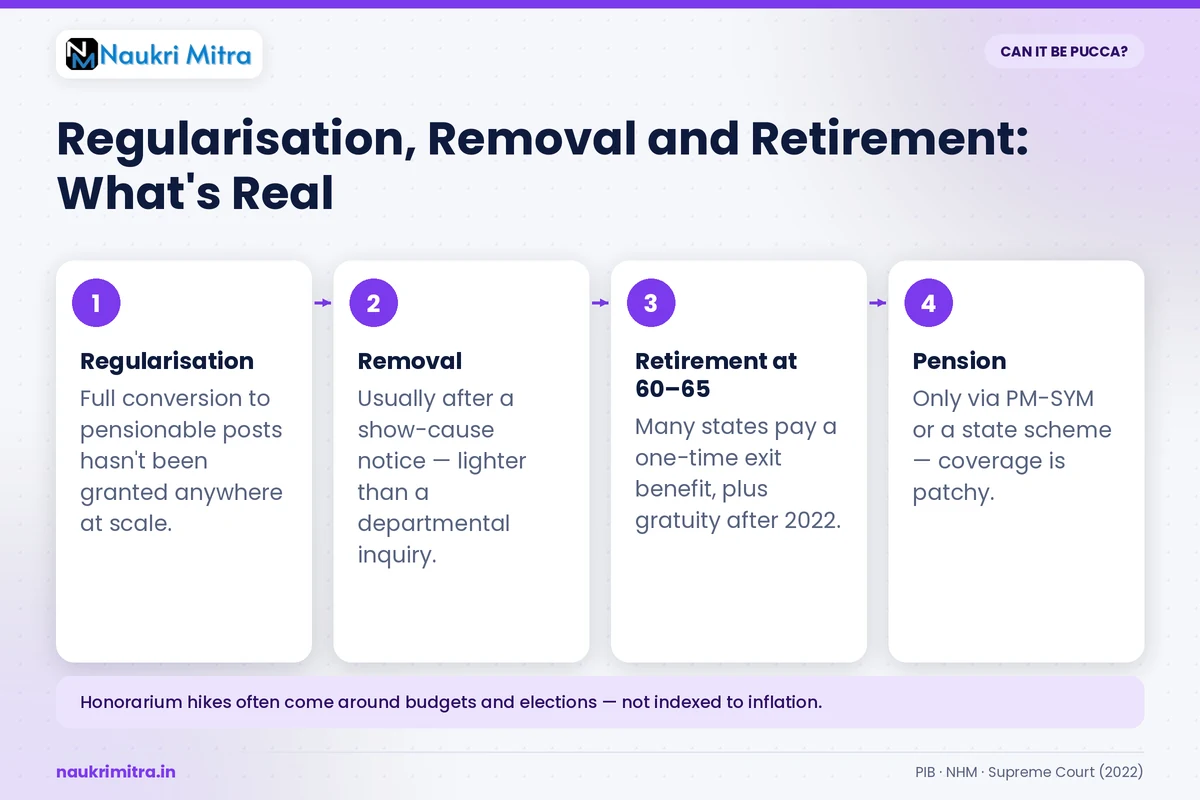
Regularization is the single most emotionally loaded word in this ecosystem, worth being precise about. Anganwadi worker regularization pucca job demands have been raised by unions for decades — asking for conversion into regular, pensionable posts with the same protections as any Group C or D state employee. That full demand hasn't been granted anywhere at scale. What's happened instead is a series of partial, hard-won wins: the 2022 Supreme Court gratuity ruling discussed above, several states agreeing to pay gratuity and a retirement lump sum after prescribed service years, and a handful extending limited pension-like schemes (often linked to PM-SYM, the pension-cum-life-insurance scheme for unorganised workers, to which the Centre also contributes) rather than a civil-service pension. None of this makes the scheme worker pension and gratuity package look anything like what a regularly recruited state employee receives.
It's worth being honest that court rulings here haven't all gone one way. Different High Courts have taken varying positions on whether specific state-level regularization demands are enforceable, and the central government's consistent legal stance is that these are "honorarium-based scheme workers" under a centrally sponsored scheme, not cadre employees — which limits how far courts will order blanket regularization even while extending protections like gratuity. The realistic picture today: meaningfully more legal protection than a decade ago, genuinely improved honorarium in several states, but still not a "pucca," pensionable government job in the way the phrase is commonly understood.
What happens when you're removed, and what retirement actually looks like
Because these aren't regular service posts, removal is generally lighter-touch than the elaborate departmental inquiry a government employee gets — though most states require a show-cause notice and a chance to respond before termination, following natural justice even without formal service rules. Performance issues, serious misconduct, unauthorised absence, or (in some flagged cases) local political interference have all been cited in actual removal cases over the years, and unions have long argued this makes the job insecure relative to its workload.
Most states set a retirement age for workers and helpers around 60 to 65, after which a one-time "exit" benefit is paid in many states, on top of any gratuity now owed following the Supreme Court ruling. There's no monthly pension in the civil-service sense for most anganwadi or ASHA workers unless they've separately enrolled in a contributory scheme like PM-SYM, or a state has introduced its own scheme-worker pension on top of the central framework — coverage of such state schemes is patchy and worth checking directly with your local CDPO or district health office.
Why these jobs keep making news for protests and revisions
If you follow state politics even loosely, you'll have noticed anganwadi and ASHA worker protests are now a near-annual feature in several states, usually around budget season or ahead of elections, when honorarium hikes are announced as a political gesture. That pattern — bumps timed to elections rather than a predictable, legislated annual revision — is itself one of the biggest complaints from unions, since it means increases aren't guaranteed or indexed to inflation the way a pay commission revision would be. Several states have announced hikes in just the last couple of years, sometimes doubling specific incentive components, and ASHA facilitator recruitment (the supervisory layer overseeing a cluster of roughly 20 ASHAs) has also expanded in a few states as the programme matured and needed more structured field supervision.
The net effect for anyone considering one of these roles today: pay is genuinely higher than five or ten years ago in most states, legal recognition is stronger after the 2022 ruling, but the job remains fundamentally a scheme-based, honorarium-driven engagement rather than a salaried government post with automatic increments.
Where to actually track vacancies, since none of this is on SSC or UPSC
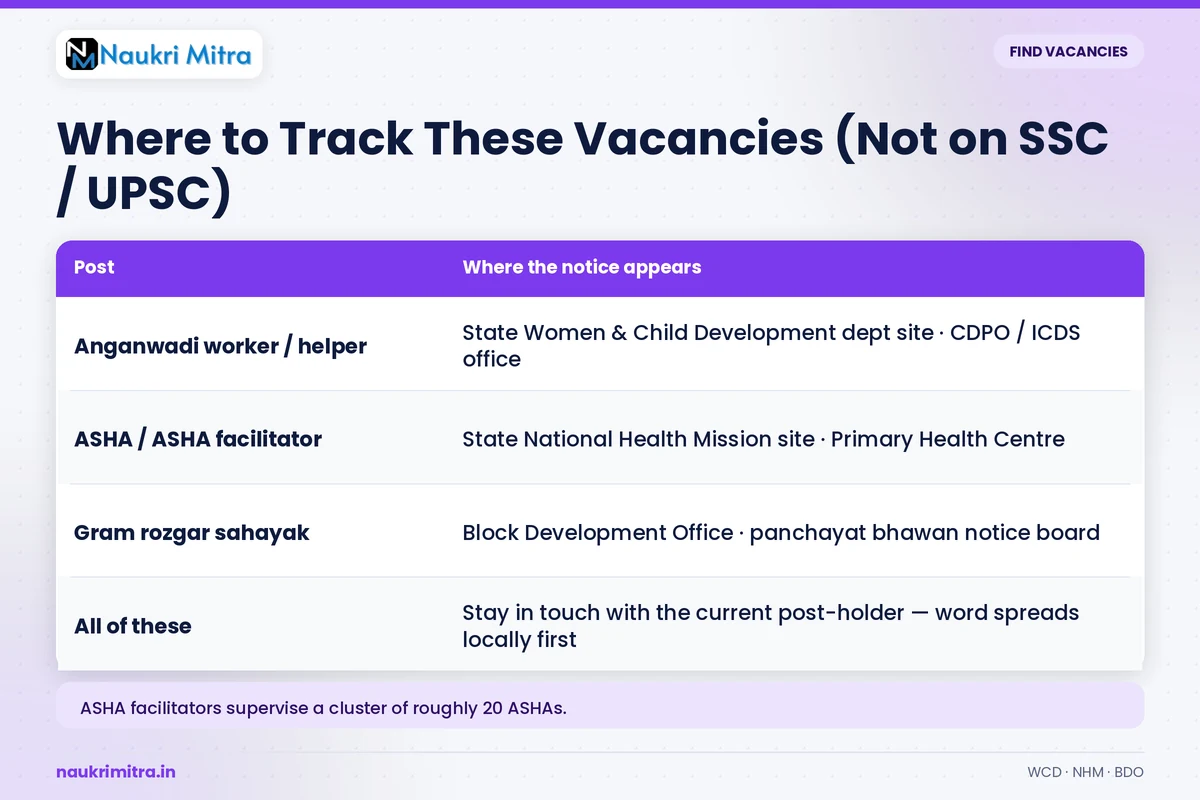
This is probably the most useful thing to internalise: these vacancies are hyper-local and almost never appear on national recruitment portals. Your best sources are your state's Women and Child Development department website (anganwadi worker/helper posts), your state's National Health Mission website (ASHA and ASHA facilitator posts), the notice board at your block development office or panchayat bhawan (gram rozgar sahayak posts), and simply staying in touch with the current post-holder, since word of a vacancy often circulates locally before a formal notification goes up. While you're building that habit of checking local boards, it helps to broaden the search a little — a portal like naukrimitra.in lists openings across both government-adjacent and private-sector categories in smaller towns, useful if you'd rather not wait on a single scheme's recruitment cycle alone.
It's also worth considering what else suits the same skill set while you wait for a notification. If caregiving interests you more than preschool education, roles like home nurse jobs in Adoni or the broader domestic help and home-nurse listings in Sasaram draw on similar community-care instincts. If it's childcare specifically that draws you to anganwadi work, a part-time babysitter job in Amritsar is a flexible, local listing that can tide you over between vacancy cycles.
Frequently asked questions
Are anganwadi, ASHA and gram rozgar sahayak posts recruited through a written exam?
Almost never. Selection is overwhelmingly through a local, points-based merit list weighing qualification, age, income and residence, finalised by a committee involving the CDPO, block or district health officials, and local panchayat representatives — not a competitive written test like SSC or a state PSC exam.
Do anganwadi workers and ASHAs get PF, ESI or gratuity?
Gratuity is now legally recognised for anganwadi workers and helpers following the Supreme Court's 2022 ruling. Routine employer PF and ESIC contributions, however, are not standard in most states, since these roles remain scheme-based honorarium engagements rather than formal employment under those labour codes.
What's the difference between a worker, a helper, and a supervisor in pay terms?
Helpers earn roughly half of what workers earn in most states' honorarium structures. Supervisors sit above both, generally on a more formal pay scale rather than a flat honorarium, and usually require either years of prior worker experience or a higher educational qualification to be eligible.
Is prior helper experience required to become an anganwadi worker?
It isn't a universal legal requirement, but many states give explicit preference or extra merit-list weightage to existing helpers when a worker vacancy opens at the same centre, since they already know the centre's routine.
Does this count as "government service" for pension or later government job applications?
Generally no — most recruiting bodies don't treat this tenure as equivalent to regular government service for seniority or pension purposes, though some states give limited age relaxation in specific scheme-related recruitment.
Can these workers be removed, and is there an appeal process?
Yes, for documented misconduct, serious performance issues or unauthorised absence, typically after a show-cause notice. With no formal service rulebook, the appeal process varies by state and is usually handled departmentally rather than through a service tribunal.
How much does an ASHA worker actually earn in a typical month?
It depends entirely on activity — number of deliveries facilitated, immunisations tracked, home visits made, plus a routine monthly component many states now add. There's no single "salary" figure; it genuinely varies month to month and state to state, which is exactly why many ASHAs have pushed for a fixed monthly floor instead.
What's a gram rozgar sahayak's actual job, in plain terms?
Think of it as the local administrative backbone of MGNREGA at the panchayat level — maintaining job cards, recording attendance at worksites, helping villagers demand work under the scheme, and coordinating with technical staff who verify completed work.
Have recent wage revisions actually closed the gap workers are demanding?
Partially, and unevenly. Several states have raised honorarium figures meaningfully in the last two to three years, often around budget announcements or elections, but demands for a uniform, inflation-indexed fixed monthly wage — as seen in recent ASHA protests — remain largely unmet across most states.
Where should I actually look for a current vacancy near me?
Check your state's Women and Child Development department site for anganwadi posts, the state NHM site for ASHA and ASHA facilitator posts, and your local block development office or panchayat notice board for gram rozgar sahayak openings — these rarely appear on centralised portals like SSC or UPSC.
Sources: Press Information Bureau, Government of India — Honorarium to Anganwadi Workers/Helpers, LiveLaw — Anganwadi Workers & Helpers Entitled to Gratuity: Supreme Court, All India Radio News — ASHA Workers Protest in Kolkata Seeking ₹15,000 Monthly Honorarium.
.png)
.png)
.png)
Comments
Post a Comment