EPF Nomination and Death Claim: Family Guide | Naukri Mitra
When someone you love dies while still working, the grief doesn't pause long enough for you to sort through forms, UAN numbers, and claim references — but the paperwork still needs sorting, because a family's financial safety net is sitting inside it. If your husband, wife, son, daughter, or parent was contributing to the Employees' Provident Fund when they passed away, there's usually more money waiting for the family than people realise: the PF balance itself, a separate insurance payout, and in many cases a monthly pension that continues for years. None of it arrives on its own. Someone in the family has to file for it, and this guide is meant to walk through that process calmly, in plain language, without assuming anyone already knows what a UAN or an EDLI claim even is.
Three Claims Hiding Inside One Case
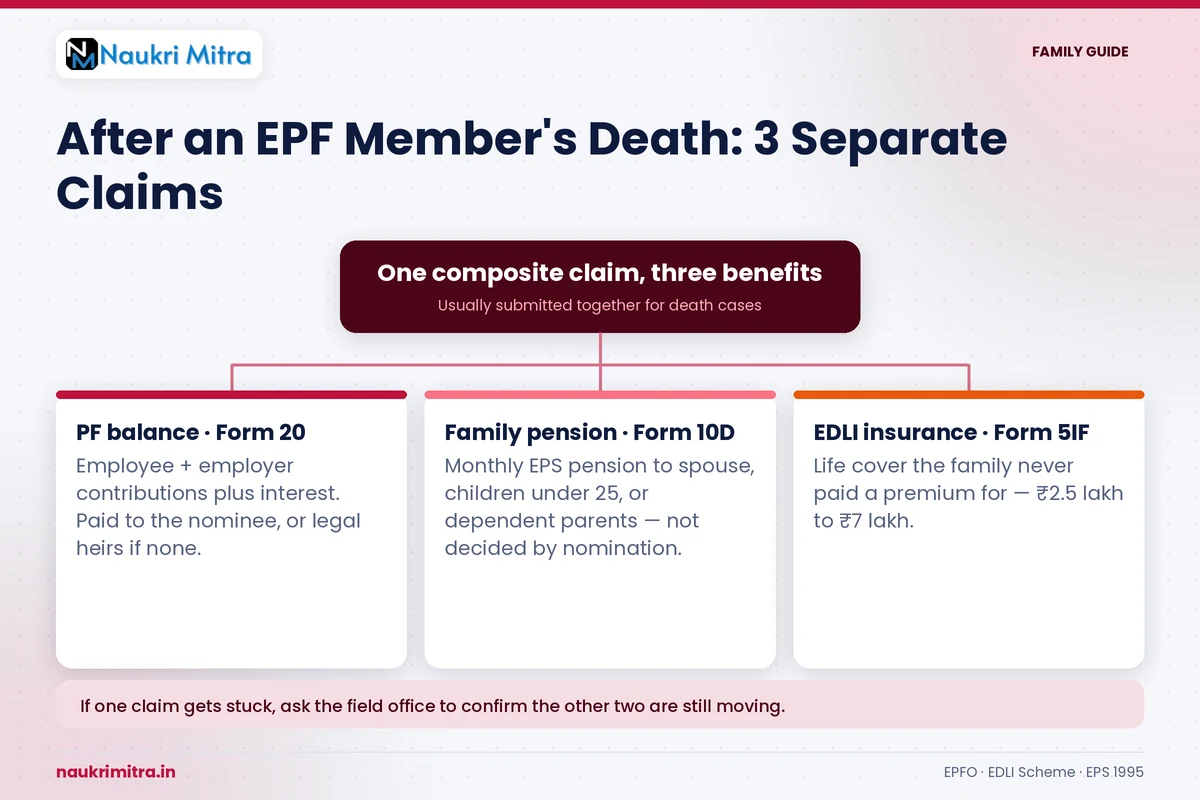
Most families assume there's a single "PF claim" to file after a death. In practice, EPFO treats it as three separate benefits, each with its own rules and its own form, even though they're usually submitted together on one combined claim form.
The first is the provident fund balance itself — whatever the deceased employee and their employer had contributed over the years, plus interest. This is settled using Form 20, and it's what most people mean when they search for how to claim PF after employee death. The second is the Employees' Pension Scheme (EPS) component, which doesn't come as a lump sum but as a monthly family pension, claimed through Form 10D. The third is a life insurance payout under the Employees' Deposit Linked Insurance scheme, claimed through Form 5IF, which exists purely because the employee was an EPF member — the family doesn't pay any separate premium for it.
Knowing these are three distinct claims matters practically: if one of them gets stuck — say, the pension paperwork needs an extra relationship document — it shouldn't automatically hold up the other two. It's reasonable to ask the EPFO field office or the employer's HR team to confirm whether all three are moving, or only one.
What a Nomination Actually Does, and Why EPFO Keeps Reminding You
If the employee had filed a nomination while they were alive, this entire process is considerably simpler, and it's worth understanding why.
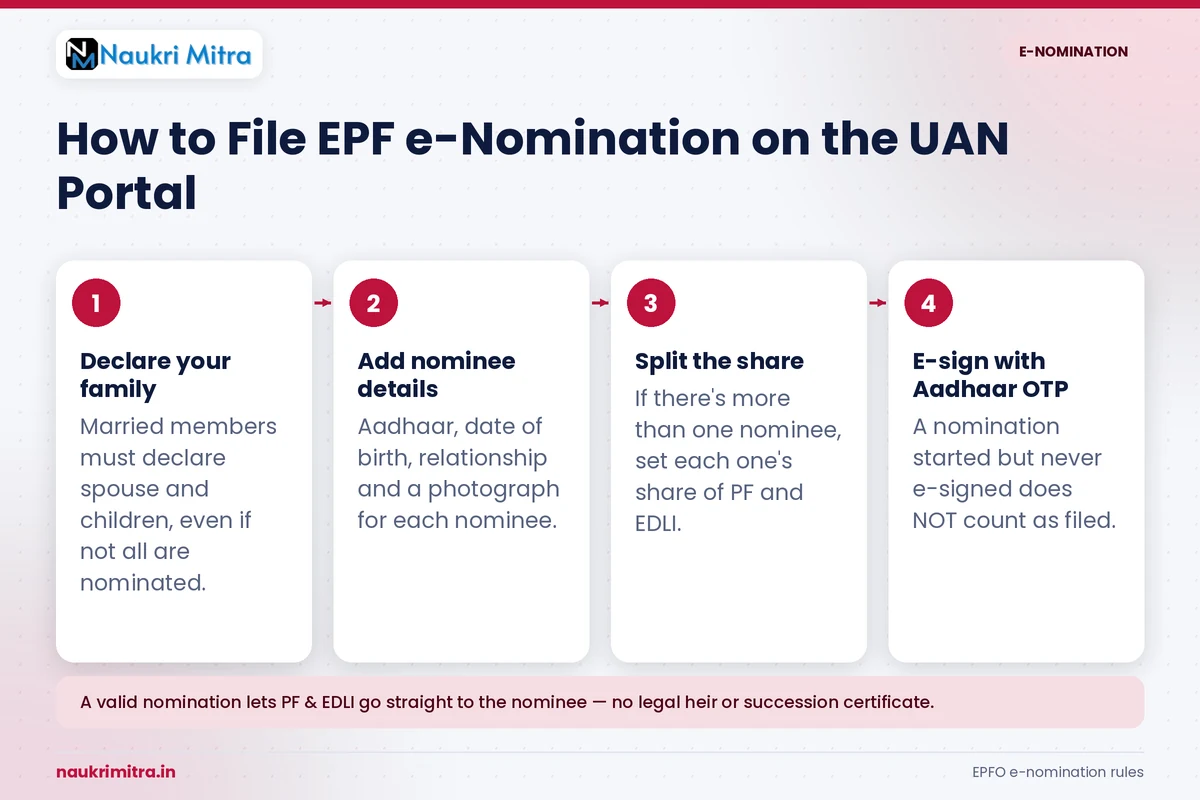
Every EPF member is expected to name one or more nominees for their account — historically through a paper Form 2, and in recent years through EPFO's e-nomination UAN portal system, which lets a working member name a nominee entirely online. During e-nomination, the member declares their family (spouse and children, if married), adds each person's Aadhaar details, date of birth, relationship, and a photograph, splits the share of PF and EDLI proceeds if there's more than one nominee, and confirms the whole thing with an Aadhaar OTP. That final step matters: a nomination that was started but never e-signed doesn't count as filed, which is a common reason families discover, to their shock, that no nomination actually exists even though their relative "definitely filled the form." That's what EPFO effectively calls an EPF nomination form online update — a short digital process that largely replaced the old paper Form 2.
You may also come across the term joint photo nominee EPF filing — this refers to the older paper process, where Form 2 required an actual joint photograph of the member and nominee pasted onto the form and attested by the employer. If your relative's nomination predates e-nomination, that paper record is still valid and the field office should have it on file.
Why does EPFO push so hard for this? Because, as EPFO's e-nomination rules explain, married members must declare their spouse and children as family even if they don't end up nominating all of them — and a valid nomination means the PF and EDLI amounts go straight to the named person without the family needing to prove who the legal heirs are. No succession certificate, no court involvement, just the claim form and a death certificate. It genuinely saves weeks.
If There Was No Nomination: Legal Heirs and What Changes
An EPFO death claim without nomination isn't rejected — it just takes a different, slower route through legal heirs, and this is far more common than people expect, since e-nomination compliance has historically been patchy across employers and industries.
Without a named nominee, the provident fund and insurance amounts are paid to whoever is legally entitled under succession law, based on the family's religion and applicable personal law (the Hindu Succession Act, Muslim personal law, the Indian Succession Act, and so on, depending on the family). EPFO staff sometimes refer to this informally as the legal heir certificate PF claim route, and it typically takes longer than a straightforward nominee claim, because the field office needs documentary proof of who the heirs actually are — usually a legal heir certificate from the local Tehsildar or revenue authority, and for larger or contested amounts, occasionally a succession certificate from a civil court.
Two things are worth knowing here. First, if there's more than one legal heir — a widow and adult children, say — EPFO generally wants all of them named on the claim with an agreed split, or one person authorised by the others through a notarised letter. Second, this slower route does not affect the EPS family pension at all, which brings us to a distinction many families miss entirely.
The Monthly Family Pension, Decided Separately From Nomination
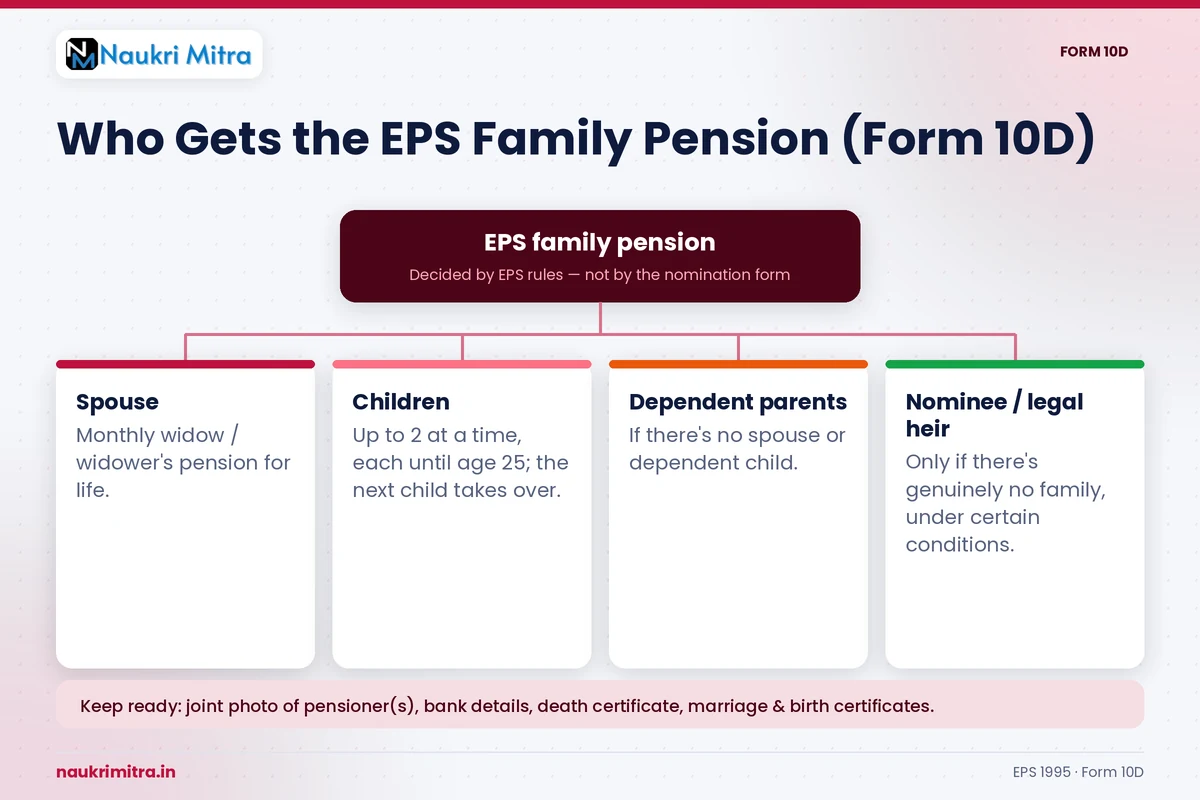
Here's the part that genuinely surprises a lot of families: the monthly EPS pension isn't decided by nomination at all. A Form 10D pension death claim is what gets the monthly family pension started, and EPFO pays it to whoever actually qualifies as "family" under the pension scheme's own rules — regardless of whether a nomination form was ever filled in.
In practice, that usually means the surviving spouse receives a monthly widow or widower's pension for life, and up to two children at a time receive a children's pension until each turns 25, with the next children in line taking over as the older ones age out. If the employee died without a spouse or dependent children, dependent parents can be eligible instead. If there's genuinely no family left, the nominee — or, failing that, a legal heir — can claim the pension under certain conditions, as laid out in general guidance on EPF Form 10D and family pension eligibility.
The pension amount itself is worked out from the deceased's pensionable salary and pensionable service, with a minimum pension built into the EPS-95 rules even where the service was relatively short. To get it started, the family typically needs a joint photograph of the eligible pensioner(s), bank account details, and the usual death certificate plus relationship proof — a marriage certificate, and children's birth certificates or school records.
The EDLI Insurance Payout: How Much, and How It's Worked Out
An EDLI death benefit claim is filed using Form 5IF and is entirely separate from the provident fund settlement — it's an insurance benefit, not a withdrawal of the employee's own savings.
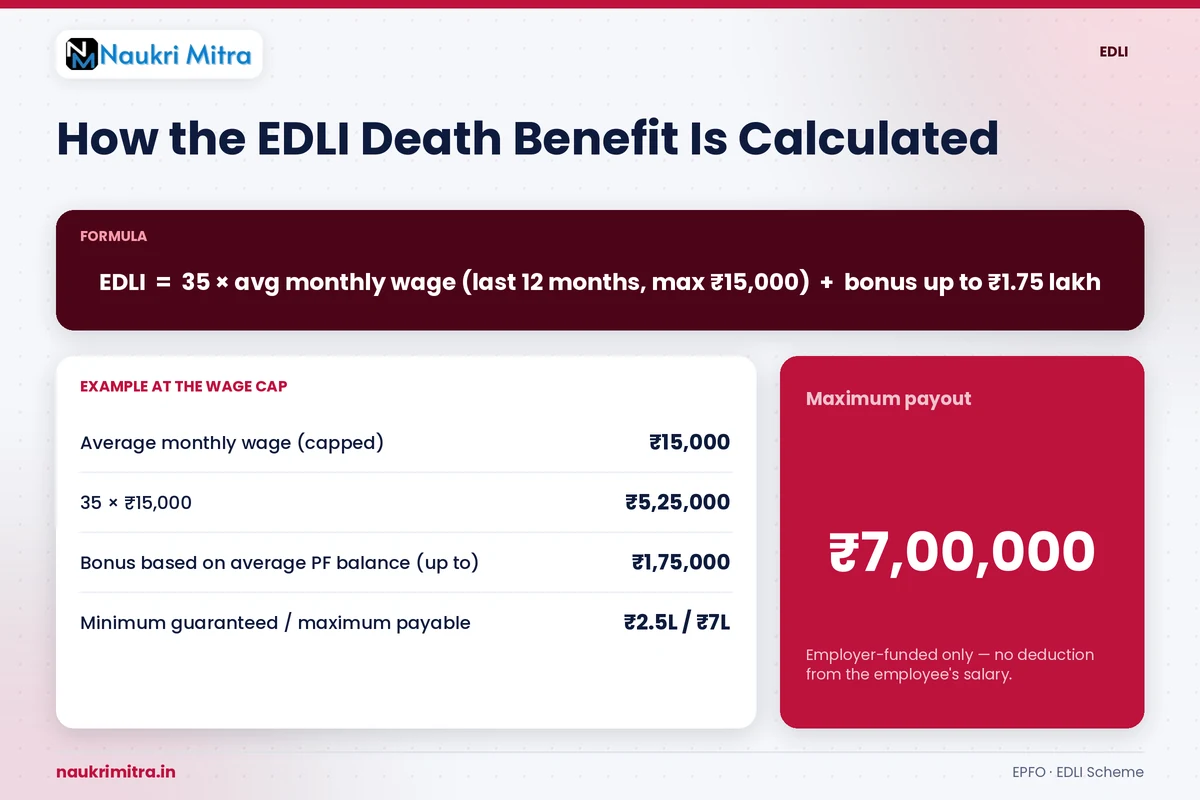
As explained on EPFO's own Insurance Scheme (EDLI) page, every active EPF member is automatically covered, with only the employer contributing toward it — there's no separate deduction from the employee's salary for this cover. Under the current rules, the payout works out to 35 times the member's average monthly wages over the preceding 12 months (wages capped at ₹15,000 for this specific calculation), plus a bonus of up to ₹1.75 lakh based on the average PF balance over the same period. The scheme guarantees a minimum payout of ₹2.5 lakh and caps the maximum at ₹7 lakh, however the formula works out for a particular family.
This amount goes to whoever was named as the EDLI nominee (usually the same person nominated for PF), or otherwise to the legal heirs, the same way the PF balance would be distributed. One detail families often miss: because the EDLI figure is calculated from recent wages and balance, it's worth asking the employer to confirm that the last 12 months of wages and contributions were correctly reported — errors there directly change the payout.
Documents the Family Will Actually Be Asked For
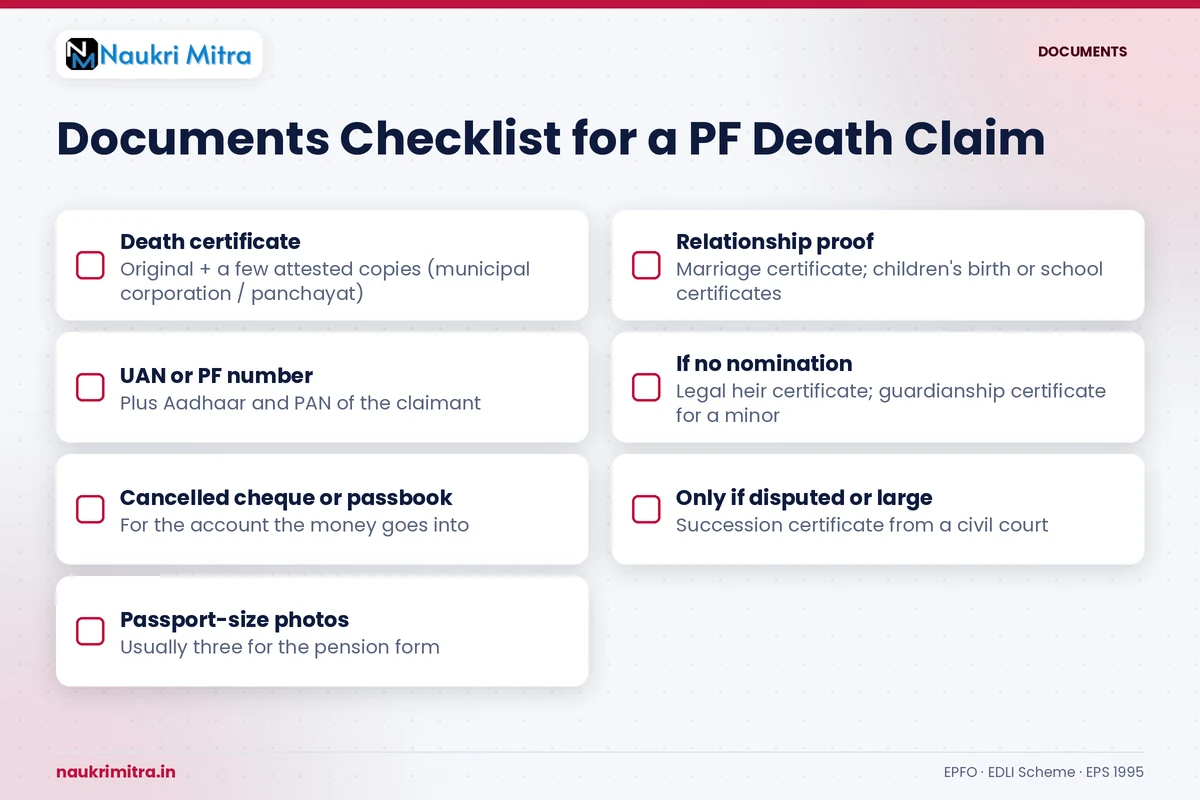
The PF nominee claim documents required are fewer than most families expect, particularly where a valid nomination already exists. At minimum, it helps to have these ready:
- The death certificate — the original, plus a few attested copies issued by the municipal corporation or panchayat
- The deceased's UAN or PF account number, and the Aadhaar and PAN of whoever is claiming
- A cancelled cheque or bank passbook copy for the account the money should be credited into
- Passport-size photographs of the claimant(s) — three is the usual requirement for the pension form
- If claiming as a legal heir without a nomination: a legal heir certificate, and for a minor's share, a guardianship certificate
- For the pension claim specifically: a marriage certificate and the children's birth certificates or school leaving certificates as proof of relationship
- A succession certificate, but typically only where the amount is substantial or there's a genuine dispute among the heirs
Most of these are documents families end up gathering for other purposes anyway after a death — closing bank accounts, filing other insurance claims, transferring property — so it's worth making several attested copies in one visit to the notary rather than going back repeatedly.
Filing the Claim: Online, Offline, and the Employer's Part
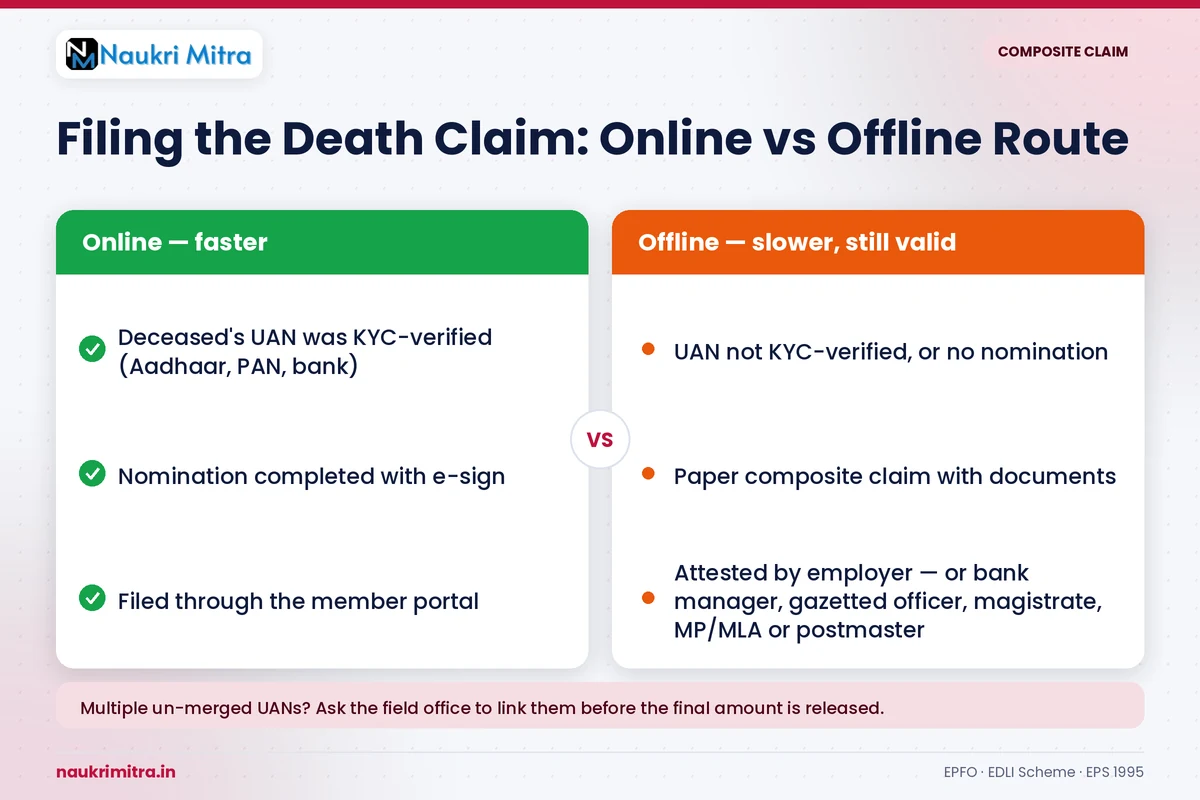
The Form 20 EPF death claim process, along with Form 10D and Form 5IF, is usually filed together on what EPFO calls the Composite Claim Form for death cases, rather than as three separate submissions.
If the deceased's UAN was KYC-verified — meaning Aadhaar, PAN, and bank details were linked and verified while they were alive — and a nomination with a completed e-sign exists, the claim can often be filed online through the member portal, which tends to move faster. Without a verified UAN, or without a completed nomination, the family files on paper: the composite claim form goes in along with the supporting documents, attested either by the employer or, where the employer isn't available or isn't cooperating — the company has shut down, for instance — by an alternative authority such as a bank manager, a gazetted officer, a magistrate, an MP or MLA, or a postmaster.
One practical snag worth asking about upfront: if the employee worked at more than one company over their career and ended up with multiple UAN numbers that were never properly merged, the field office may need to link those accounts before releasing the final amount. This is a common, entirely avoidable delay, so it's worth asking the regional office directly whether the deceased's UAN history is clean before assuming the claim is simple.
Minors, Disagreements, and Other Complications
If the nominee or an eligible pension recipient is a minor, the money isn't handed directly to a child — it's paid to a guardian on the minor's behalf, usually the surviving parent acting as natural guardian, or a court-appointed guardian with a guardianship certificate where both parents are no longer alive. EPFO's claim forms have a dedicated section for guardian details for exactly this reason, so there's nothing unusual about filling it in.
Disagreements between family members are, unfortunately, not rare — a second marriage, an estranged sibling, or a dispute over who should act as guardian for a minor's share can all stall a claim for months. EPFO generally won't referee a family dispute; where claimants can't agree, the matter typically has to go through a civil court for a succession certificate or guardianship order, which the field office then acts on. It genuinely helps to settle disagreements within the family before filing, wherever that's possible, since a contested claim takes considerably longer than an uncontested one.
And if the UAN wasn't KYC-verified at the time of death, that alone doesn't block the claim — it simply means the physical, attested route applies instead of the faster online one, with the employer's certification carrying more weight in confirming identity and service history.
Timeline, Tax, and Tracking the Claim
EPFO's own service standard is to settle a death claim within 20 days of receiving a complete application, and straightforward claims with a clear nominee, filed online, often move close to that pace. Claims through the legal heir route, or ones that need document corrections, understandably take longer — it's sensible for families to budget for anywhere from a few weeks to a couple of months, and to follow up proactively rather than assuming it's progressing unattended.
There's no fixed deadline by which a family must file after a death, but there's also no real benefit to waiting. An account left completely untouched for an extended period can eventually get routed into a separate inactive-accounts process, which just adds extra steps later. It's better to file once the family has the documents together, rather than delaying out of uncertainty about the process.
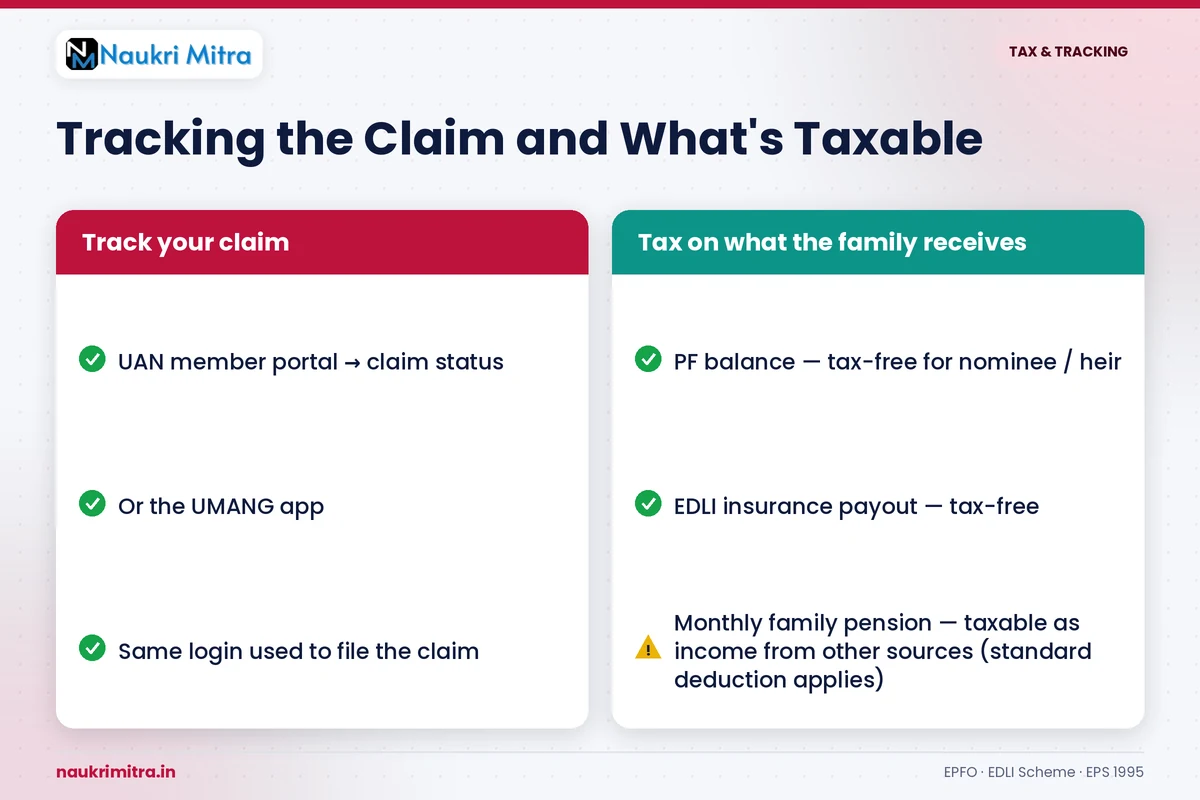
On tax: the PF balance and the EDLI insurance payout received by a nominee or legal heir on an employee's death are not taxable, regardless of how long the employee had been contributing — this differs from the five-year service condition that applies when an employee withdraws their own PF while still working. The monthly family pension, however, is taxed as "income from other sources" in the recipient's hands, though a standard deduction currently applies against it, so it's worth flagging to whoever eventually files the family's income tax return.
Once a claim is filed, its status can be tracked through the UAN member portal's claim status section, or the UMANG app, using the same login credentials used to submit it — no need to keep calling the field office for an update.
A Short FAQ
What if the deceased had more than one UAN from earlier jobs?
Flag it to the EPFO field office as early as possible. They can merge the UANs, but it needs to happen before the final amount is released, and it's one of the more common reasons a claim takes longer than expected.
Can the whole claim be filed online, or is physical submission unavoidable?
It can be filed online if the UAN was KYC-verified and the nomination was properly e-signed. Otherwise, it goes through the physical, attested route — not a rejection, just a different path.
Can a nominee be someone other than a spouse or children, like a parent or sibling?
Only if the member had no family (spouse or children) at the time of nominating. Once a member marries or has children, a nomination made earlier in favour of someone outside that family becomes invalid by rule, even if it was never formally updated.
Is the PF death claim amount taxable for the family?
No. Both the PF settlement and the EDLI insurance payout are tax-free in the hands of the nominee or legal heir. Only the ongoing monthly family pension is taxable as regular income.
Can the family claim if the employee died soon after joining a new job?
Generally yes, as long as there's continuous EPF membership — even across employers — in the period leading up to death. The EDLI minimum guarantee of ₹2.5 lakh exists partly to cover situations where recent service was short.
What if the UAN wasn't KYC-verified when the employee died?
It doesn't block the claim. It just means the family uses the physical submission route, with employer attestation (or an alternative authorised signatory) instead of the faster online path.
Is there a time limit to file the claim after death?
There's no hard deadline, but filing promptly, once documents are ready, avoids an account sitting inactive and avoids the extra steps that come with reviving a long-dormant one later.
How does the family check the claim status after submitting it?
Through the UAN member portal's claim status page or the UMANG app, using the deceased's UAN login details. It updates as the claim moves through processing and disbursement.
Does the employer have to help with the claim?
Yes — the employer is expected to certify service details and wages, and either attest the claim form or confirm the last employment details that EPFO needs to process it. Families shouldn't hesitate to ask HR directly for this.
There's no making this process painless, but it is, at least, a known one, with set forms and set rules, rather than something a family has to improvise from scratch. Lean on the employer's HR team for attestations and wage certificates, since they're expected to help, and visit the EPFO field office in person if the online portal feels like one more thing to figure out during an already difficult stretch.
If, somewhere down the line, a family member — a spouse re-entering paid work after a gap, for instance — is ready to start looking again, naukrimitra.in lists openings across cities, including flexible options like this remote data-entry role, along with its broader career resources for whenever that time comes. There's no rush on that front.
Sources: EPFO — Insurance Scheme (EDLI), Business Standard — EPFO e-nomination rules and filing steps, Scripbox — EPF Form 10D guide.
.png)
.png)
.png)
Comments
Post a Comment