Medical Fitness Certificate for Govt Jobs | Naukri Mitra
Rohit had cleared the written exam, survived two rounds of document scrutiny, and was already mentally arranging furniture in his new government quarters. Then came one line on the SSC call letter: "Report for medical examination at the designated hospital." Three weeks later he was still drafting an appeal letter, because an ophthalmologist at a government hospital had measured his corrected vision a fraction below the cutoff listed for his post. Stories like his are far more common than most aspirants expect. The medical test comes right at the end of a long selection process, and for a meaningful slice of final-stage candidates, it's also the first moment anyone spells out that clearing a written exam and being certified "fit for government service" are two completely different exercises.
This isn't meant to alarm you. Most candidates walk through the medical test for government job joining standards without incident. But knowing what actually gets checked, who is allowed to check it, and why the bar moves so much between a desk-based clerical post and a Railway technician or a CAPF Sub-Inspector role can save weeks of confusion later — and occasionally, an avoidable rejection.
Two different medical checkpoints, not one
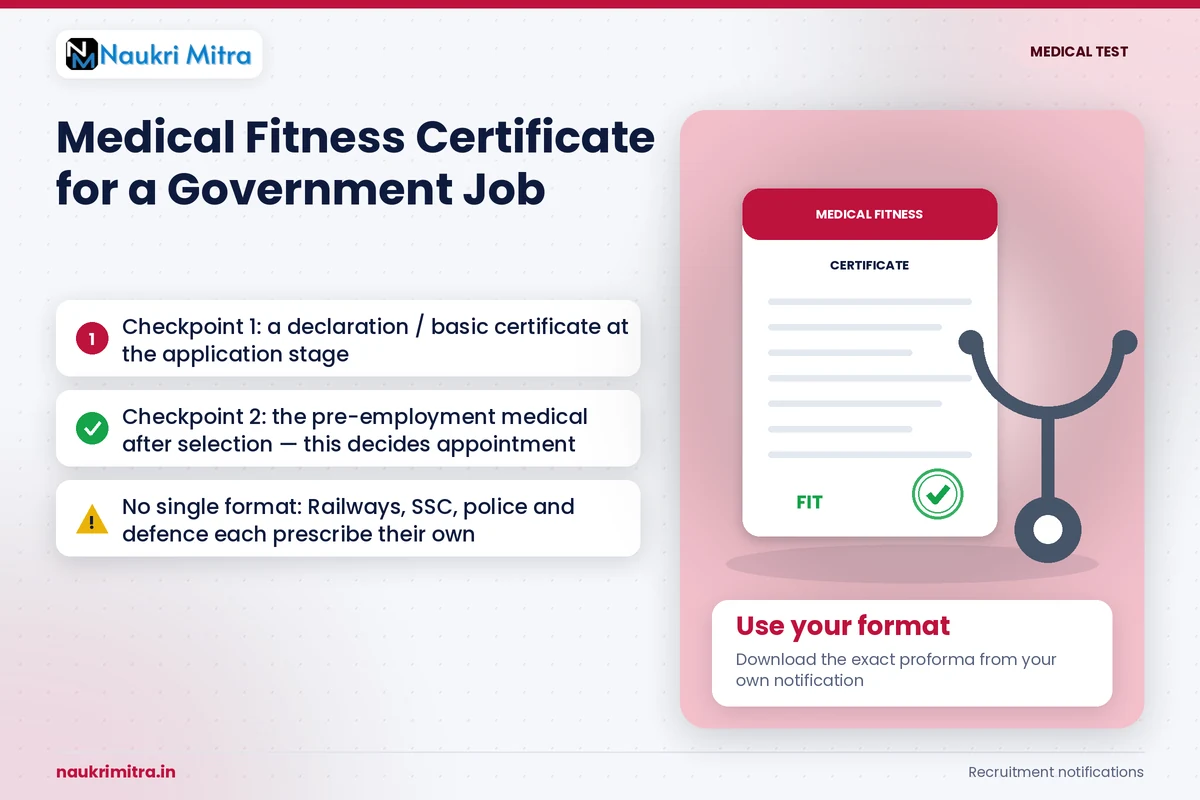
A lot of confusion starts because candidates assume there's a single "medical certificate" moment. In practice there are usually two separate checkpoints, and they're not interchangeable. The first is at the application stage for certain exams — a self-declaration or a basic certificate confirming you don't have an obviously disqualifying condition, sometimes needed just to sit for a physical efficiency test. The second, and far more consequential one, is the actual pre-employment medical examination conducted after you're shortlisted or provisionally selected. This is the one that decides whether your appointment goes through at all.
The pre-employment medical examination is deliberately thorough because, unlike a private employer, the government is certifying that you can perform a specific category of duties — desk work, operating machinery, standing guard for long hours, or physically demanding field postings — for a career that could run 30-plus years. That's also why the medical fitness certificate format for government job India recruiting bodies use isn't one standard document — Railways, SSC-recruited departments, state police, and the defence services each prescribe their own proforma, usually attached as an annexure. Always download the exact format from your own notification rather than reusing one a friend used for a different post — mismatched formats are a common, avoidable reason for a repeat hospital visit.
Who's actually allowed to examine you and sign the paper
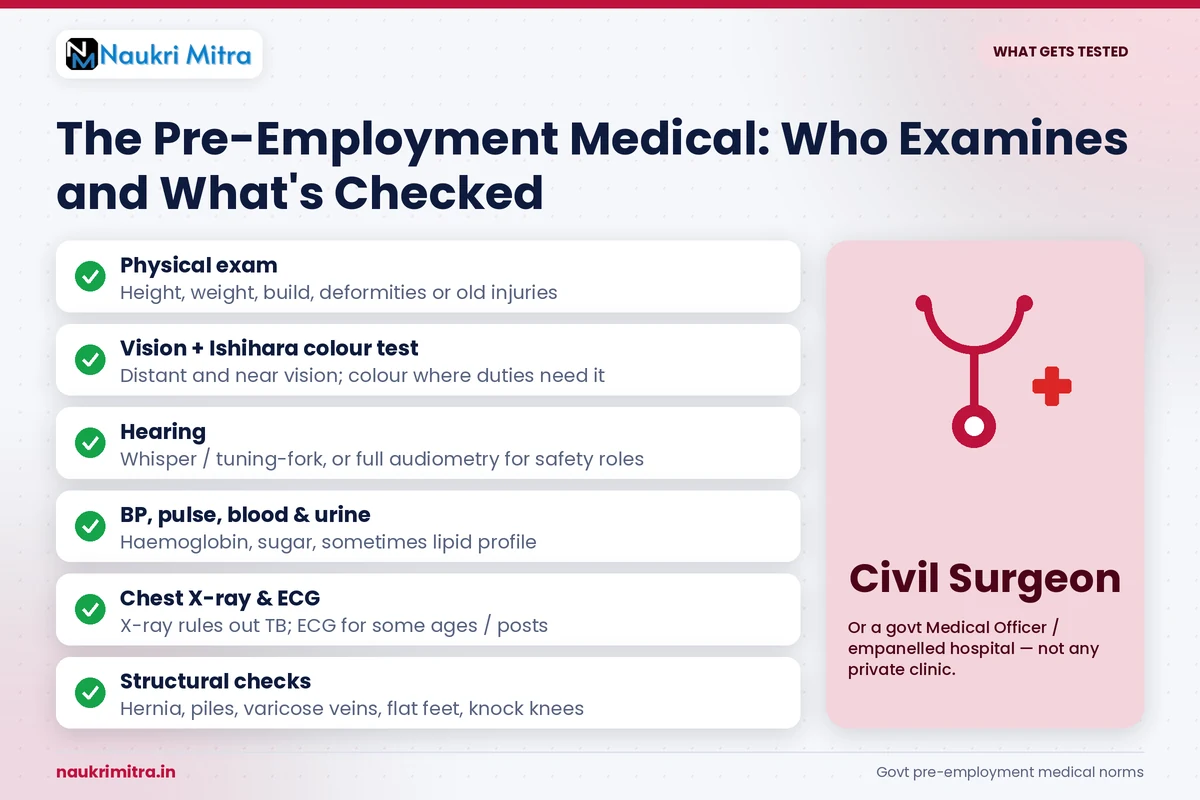
One of the most searched versions of this question is simply which doctor can issue medical fitness certificate for govt job, and the short answer is: not just any doctor, however convenient. For most central government recruitments, the examining authority has to be a government-appointed Medical Officer, a Civil Surgeon, or a doctor at a hospital specifically empanelled or recognised by the recruiting department — not any registered medical practitioner. A civil surgeon medical certificate carries weight precisely because it comes from a government-appointed authority whose signature the recruiting board can verify, rather than a private clinic with no official standing with that department.
That said, the rules aren't identical everywhere. Some state PSCs and PSU recruitments accept a certificate from a private hospital, provided it's on the prescribed format and signed by a doctor of a specified qualification (commonly an MBBS with a relevant postgraduate specialisation for categories like ophthalmology or cardiology). The safest approach is to read your own advertisement's instructions rather than assume last year's rule still applies — recruiting bodies revise empanelled-hospital lists and documentation requirements fairly often.
The actual checklist: what gets tested
A standard government pre-employment medical exam usually covers a fairly predictable set of checks, though the depth varies by post:
- General physical examination — height, weight, build, and visible deformities or old injuries
- Vision testing, including distant and near vision, and a colour vision check using the Ishihara chart for posts where colour discrimination matters
- Hearing assessment, sometimes just a whisper or tuning-fork test, sometimes a full audiometry for safety-critical roles
- Blood pressure and pulse
- Basic blood work — haemoglobin, blood sugar, sometimes a lipid profile
- Urine analysis
- Chest X-ray, mainly to rule out tuberculosis or structural issues
- ECG for certain age groups or physically demanding categories
- A check for hernia, piles, varicose veins, flat feet, knock knees, and similar structural conditions that matter more for standing or marching duties than for desk work
For uniformed and safety-critical posts, you'll often also see a psychological screening and, for a handful of roles, a substance test. None of this is punitive — it exists because certain duties demand a baseline of physical capability, and the government has to insure and pension you for decades.
Desk job versus Railways, Police and Defence: why the bar keeps moving
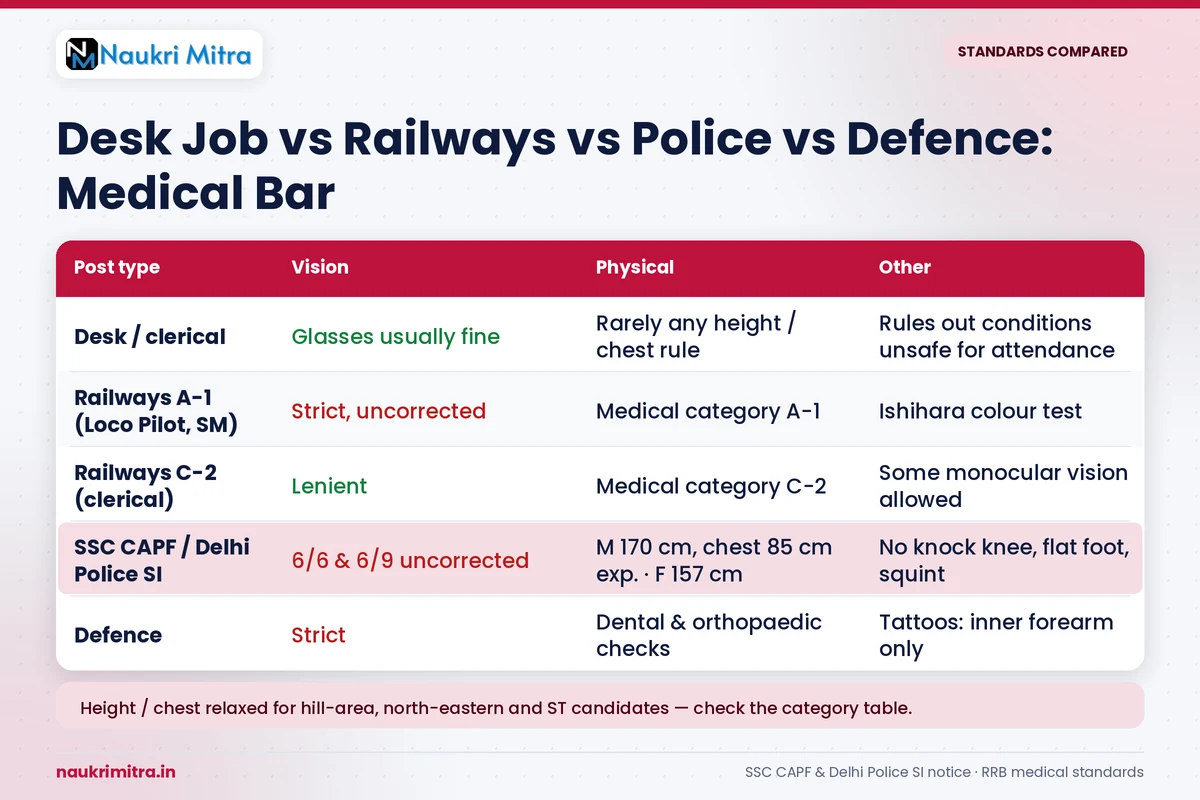
If there's one thing that surprises candidates most, it's realising there's no single national medical standard. The physical standards medical test railway police government job criteria genuinely diverge, often by a wide margin, from what's expected for a clerical or administrative post.
Indian Railways, for instance, groups its posts into medical categories roughly labelled A-1 through C-2, with A-1 reserved for safety-critical running staff like Loco Pilots and Station Masters, and C-category covering largely clerical or less safety-sensitive work. The vision bar for A-1 posts is notably strict, while C-2 roles allow considerably more latitude, including some degree of monocular vision in certain cases. The logic is straightforward: a Loco Pilot's eyesight failure has very different consequences than a ticket clerk's.
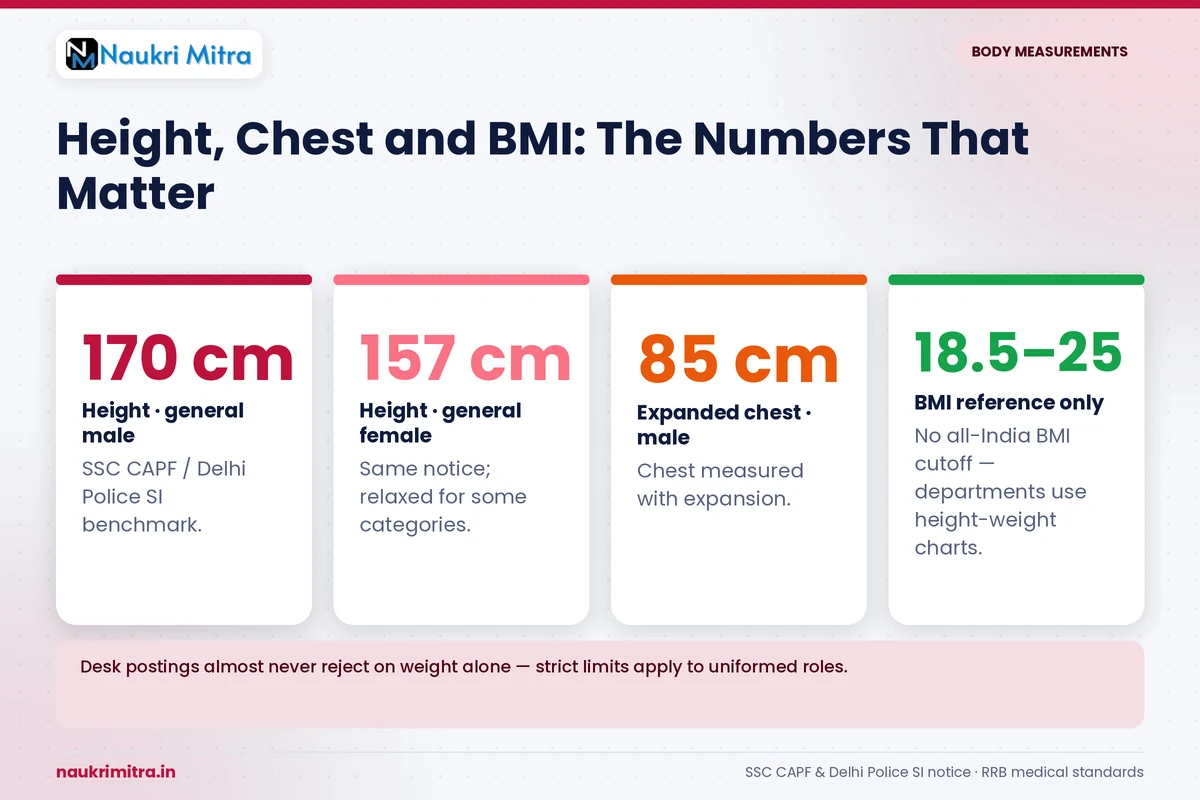
Police recruitment adds height, chest measurement, and endurance requirements on top of the medical checklist. SSC's own notice for CAPF and Delhi Police Sub-Inspector recruitment lays out specific physical and vision numbers — a general-category male candidate needs to be around 170 cm tall with an expanded chest of 85 cm, while general-category women need to be around 157 cm, and the prescribed vision standard is 6/6 in the better eye and 6/9 in the worse eye without correction, along with "high" colour vision and no knock knee, flat foot, varicose vein, or squint. These figures shift for hill-area, northeastern, and Scheduled Tribe candidates, so always check the category-specific table.
Defence recruitment goes further still, layering in SSB-style medical boards, detailed dental and orthopaedic checks, and tattoo policies revised more than once in recent years — most forces now permit small permanent tattoos only on areas like the inner forearm, while barring them elsewhere on visible skin. State police and central forces have broadly similar, though not identical, tattoo rules, and an old tribal, religious, or family-tradition tattoo is usually examined case by case rather than rejected automatically, something courts have weighed in on more than once. Desk-based posts, by contrast, rarely apply height, chest, or tattoo criteria at all — the exam there is mostly about ruling out conditions unsafe for regular attendance, not physical build.
BMI, height and chest: how much do they really matter?
There's no single all-India BMI cutoff that applies across every recruiting body, and it's worth being wary of any blog or coaching centre that quotes one as if it's universal. The commonly referenced normal BMI range globally is 18.5 to 25, but individual recruiting departments combine that reference point with height-for-weight charts, chest expansion, or the examining doctor's clinical judgment — BMI height chest standards recruitment criteria genuinely differ across uniformed services, with defence and paramilitary roles applying them far more strictly than civilian desk postings, where weight is almost never disqualifying on its own.
The eye test trips up more people than anything else
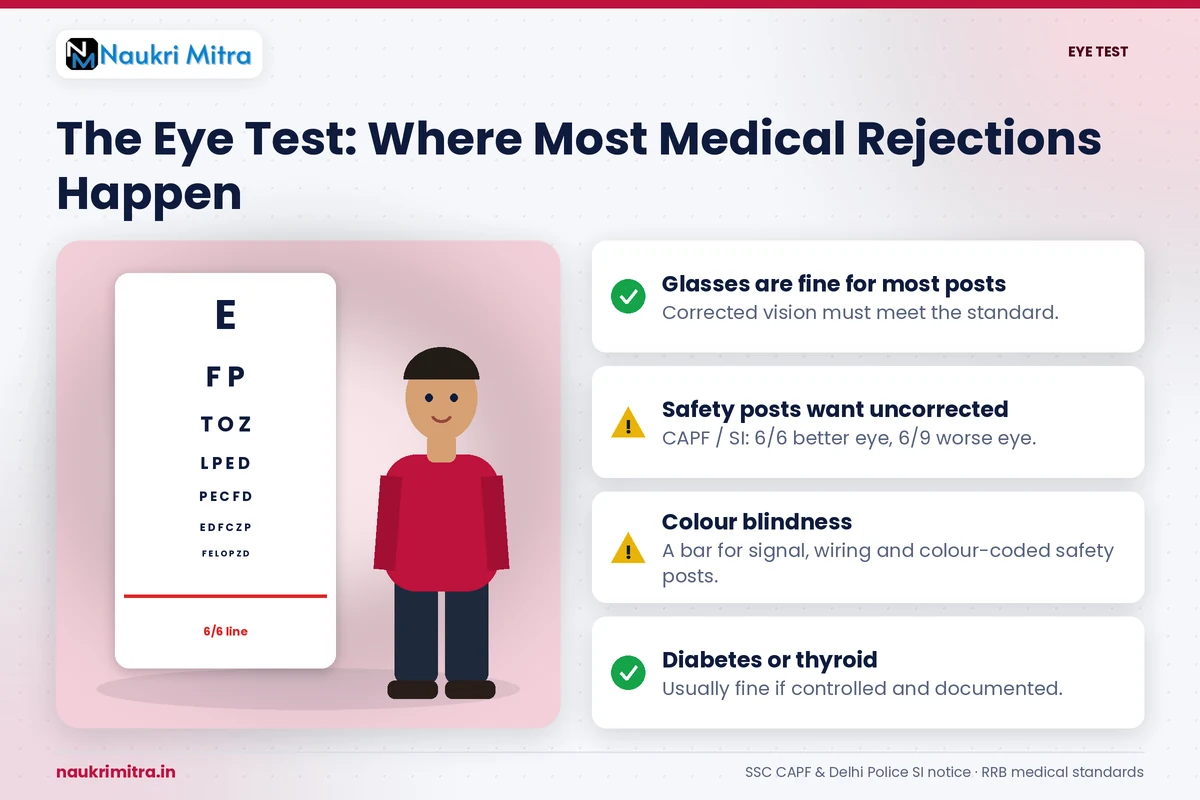
If you ask recruitment coaching centres which single test causes the most last-minute medical rejections, vision comes up constantly. Vision and hearing standards govt job notifications are usually the most detailed and least forgiving part of the medical annexure, and for good reason — a large share of government posts, from control-room operators to drivers to field staff, depend on reliable eyesight.
The good news: wearing spectacles doesn't automatically disqualify you for most posts. Many roles accept corrected vision, meaning your eyesight with glasses or lenses just needs to meet the prescribed standard, and some categories specify a maximum permissible "power" rather than banning glasses outright. It gets stricter for safety-critical roles — certain Railway running categories, pilots, and some police and defence postings require a stronger uncorrected baseline, since the duty involves split-second visual judgment where reaching for glasses isn't realistic.
Colour blindness is a separate, often misunderstood issue. Mild colour vision deficiency doesn't disqualify someone from every government job — plenty of desk and administrative roles don't test for it at all — but it's frequently a hard bar for posts involving signal reading, wiring, or colour-coded safety information, which is why Railway running staff are tested rigorously using the Ishihara method. Similarly, diabetes or a treated thyroid disorder rarely disqualifies by itself; what usually matters is whether the condition is well-controlled, documented, and unlikely to interfere with the specific duties of the post. A desk-based role will typically take a far more lenient view of controlled diabetes than one requiring extended fieldwork in remote postings.
Women candidates, pregnancy, and PwD candidates: where the rules bend
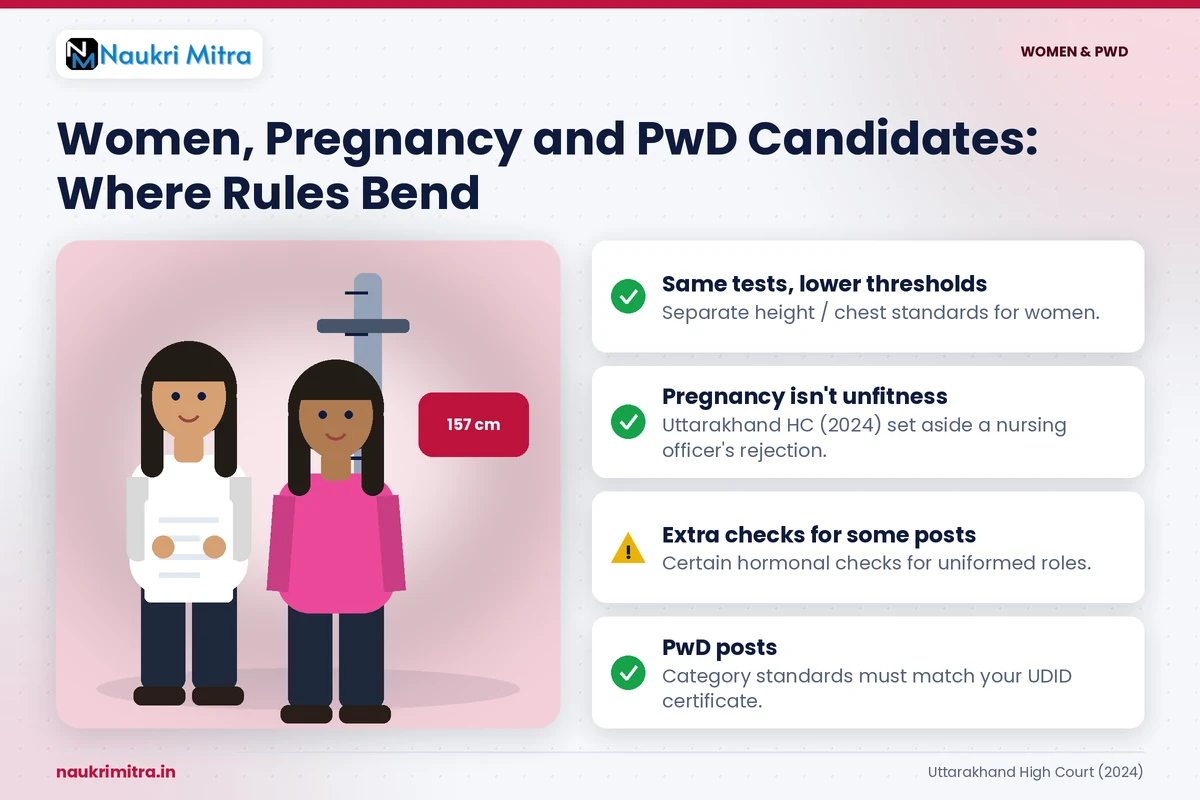
Medical standards for women largely mirror the general criteria, though posts with height and chest requirements set separate, lower thresholds, and certain hormonal checks may be added for specific uniformed roles. Where this area has genuinely evolved is pregnancy. For years, some recruiting departments and hospitals treated pregnancy itself as grounds for a "temporarily unfit" finding, effectively blocking joining altogether. That's been pushed back firmly by the courts — in one widely reported 2024 case, the Uttarakhand High Court set aside a hospital's rejection of a selected nursing officer solely on grounds of pregnancy, holding that such a blanket classification was discriminatory and inconsistent with a woman's right to employment, directing her joining to proceed with a later fitness review after delivery instead. It's a useful precedent, though outcomes can still depend on the specific post and state service rules.
For candidates with disabilities, reserved posts under the PwD quota generally come with relaxed or category-specific medical standards rather than the general physical criteria — a locomotor disability that would disqualify someone from a general-category post is, by definition, the basis for eligibility under a PwD-identified post instead. The relevant disability percentage and category need to match what the specific vacancy has earmarked, and it's worth confirming this against your UDID documentation well before the medical exam so there's no mismatch at verification.
Declared unfit? Here's what actually happens next
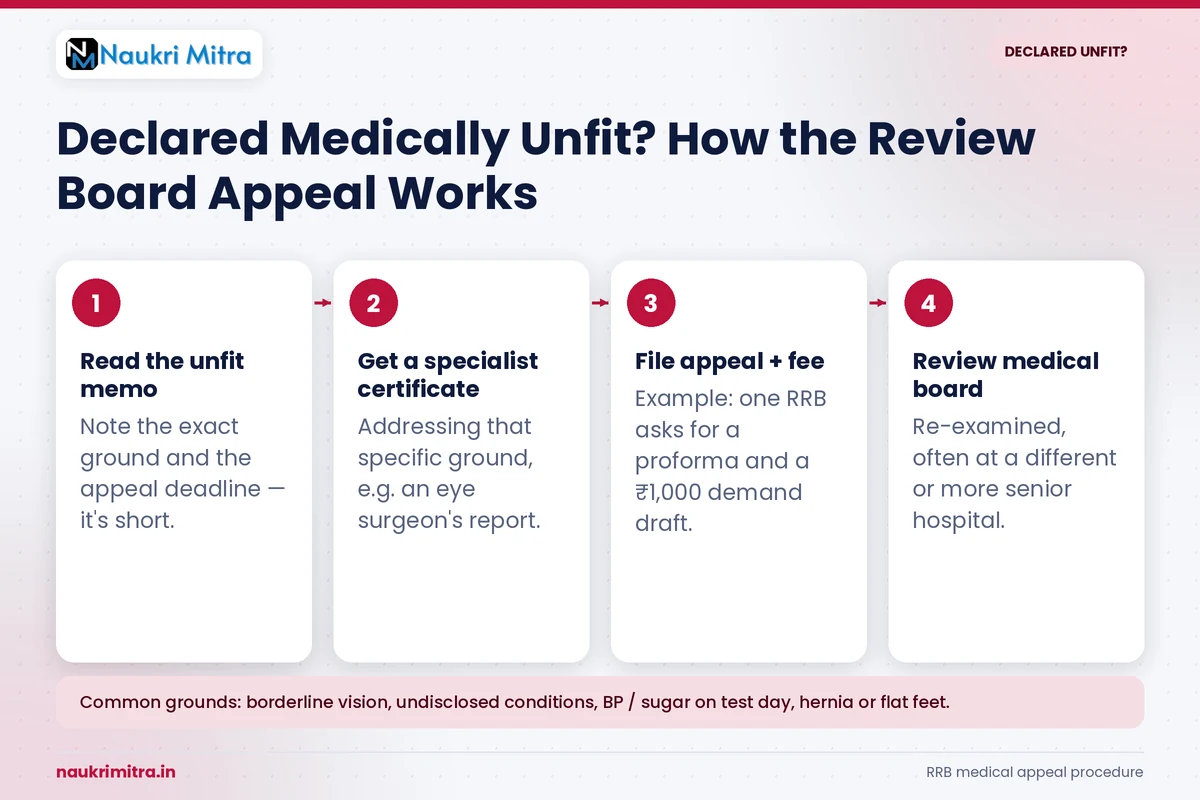
Getting an "unfit" result isn't automatically the end of the road, though the process to contest it needs to be followed carefully and usually within a tight window. If you believe the first test result is wrong — maybe a vision reading that seemed off, or a condition you can show is well-controlled — most recruiting bodies allow an appeal for re-examination, commonly before what's informally called a review medical board or a second-level medical committee, often convened at a different or more senior hospital than the first exam.
The exact process differs by organisation, but the pattern is fairly consistent: you submit a formal appeal within a specified number of days of the unfit intimation, attach a supporting certificate from a specialist addressing the specific ground, and pay a prescribed fee. As an illustration, one zonal Railway Recruitment Board's published medical appeal procedure requires a completed appeal proforma, a specialist's certificate, and a demand draft of ₹1,000 in favour of the zonal railway's medical authority, submitted by a strict deadline — a reminder that these aren't informal requests but governed procedures with real paperwork. A medical unfitness appeal government job process like this typically ends in an upheld rejection, a reversal, or, in borderline cases, redeployment to a less physically demanding post within the same cadre.
If you search for common medical certificate government job rejected reasons, the list is short and repetitive: borderline vision readings, undisclosed pre-existing conditions found on blood work or X-ray, uncontrolled blood pressure or sugar on test day, and structural issues like hernia or flat feet for demanding posts. Many of these are reversible on appeal once properly documented by a specialist, which is exactly why the appeal window matters.
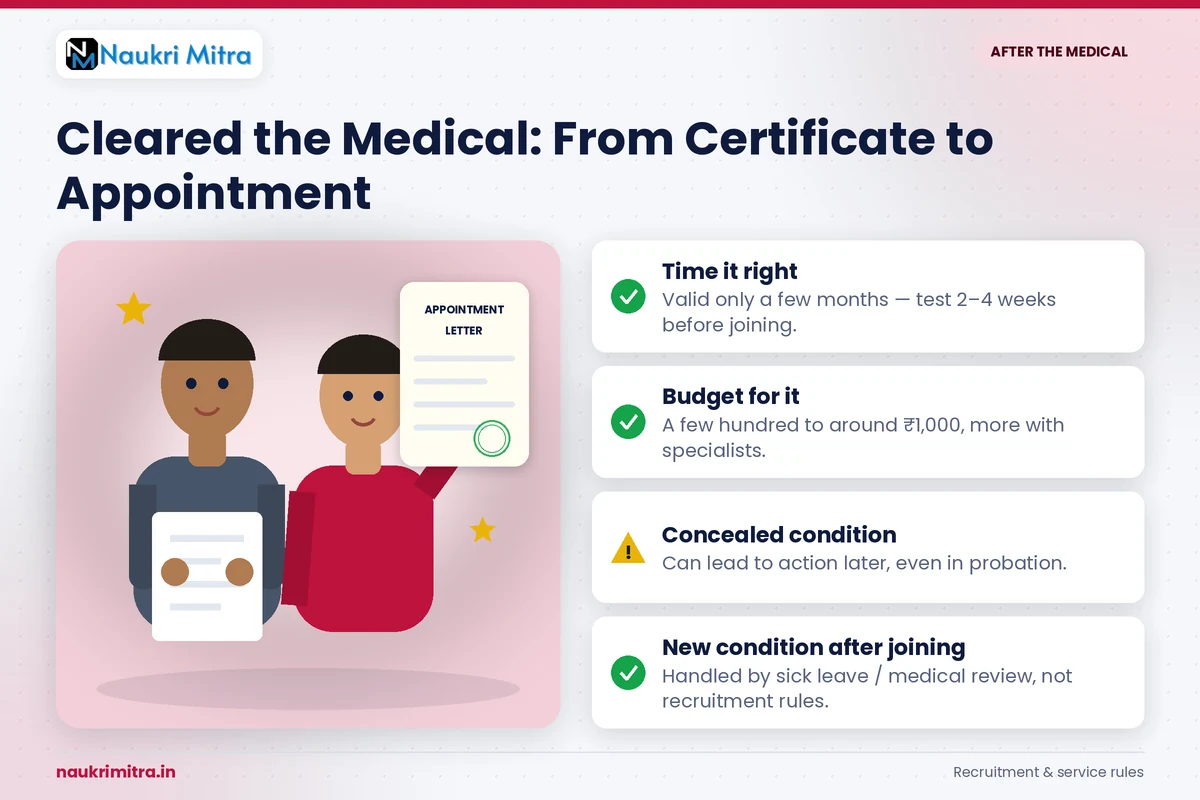
Two things worth knowing going in: the certificate is typically valid for a limited period, commonly a few months, so testing too early relative to your joining date can mean redoing it; and certificates aren't free — fees commonly run from a few hundred to around a thousand rupees, more if specialist opinions are needed. Getting it done close to, but comfortably before, your indicated joining window is the safest approach.
What if a condition turns up after you've already joined?
This question comes up more often than you'd expect, and the honest answer is: it depends heavily on timing and nature of the condition. A condition that existed and was concealed at the time of the exam — say, a pre-existing cardiac issue not disclosed — can be grounds for later action if discovered during probation, because service rules treat the original certificate as a declaration of fitness as of that date. A condition that genuinely develops afterward is usually handled under the department's regular sick-leave or medical-review provisions rather than treated as a recruitment-stage failure, particularly once you're confirmed rather than on probation. If something is flagged during probation, the sensible step is to get it documented by a specialist early and be transparent with your reporting officer, rather than letting it surface through an unrelated check later.
For broader context on how different recruiting bodies structure their selection and verification stages beyond the medical round, candidates often find it useful to track live vacancy details and notification PDFs directly — Naukri Mitra lists current openings where you can cross-check a post's specific eligibility and medical annexure before you even apply, which is a far better use of time than guessing based on a different exam's rules.
Frequently asked questions
How long is a medical fitness certificate valid, and what does it cost?
Validity is usually limited to a few months from the date of issue — exact duration depends on the recruiting body, so check your notification rather than assuming a standard period. Cost varies by hospital and city, typically ranging from a few hundred rupees for a basic civil hospital panel to somewhat more at private empanelled hospitals or when specialist opinions are required.
How early before joining should I get the certificate done?
Close enough that it's still valid on your joining date, but not so early that it expires before then. Many candidates aim for a window of two to four weeks before the expected joining date, adjusted once the recruiting body confirms the actual medical examination schedule.
I wear glasses — can I still qualify for a government job?
Yes, for the large majority of posts. Most roles accept corrected vision through spectacles or lenses as long as it meets the prescribed standard; only a smaller set of safety-critical roles (certain Railway running staff, some police and defence postings) require a stricter uncorrected baseline.
What if I'm declared unfit but I think the test result is wrong?
Most recruiting bodies allow a formal appeal within a set deadline, usually requiring a specialist's supporting certificate and a prescribed fee, reviewed by a second, often more senior, medical panel. Missing the appeal window is one of the most common and avoidable reasons a reversible decision ends up final.
Is a certificate from a private hospital acceptable, or must it be government-approved?
It depends on the recruiting body. Several require the examination at a government hospital, civil surgeon's office, or a specifically empanelled centre; others accept a private hospital certificate on the prescribed format from a doctor of a specified qualification. Always confirm against your specific notification.
Will diabetes or a thyroid condition automatically disqualify me?
Not usually, especially if the condition is well-controlled and documented, and particularly for desk-based roles. Medical boards generally assess whether the condition would interfere with the specific duties of the post rather than disqualifying on diagnosis alone.
What happens if a health issue is discovered after I've already joined, during probation?
A condition that was concealed at the time of the original exam can be grounds for action later. A condition that develops genuinely after joining is usually handled through standard medical-leave and review provisions rather than treated as a selection failure — documentation and transparency with your reporting officer matter a great deal here.
Can a pregnant candidate be denied a government job on medical grounds?
This has been specifically challenged in court, with at least one High Court ruling that blanket "unfit due to pregnancy" classifications are discriminatory and inconsistent with a woman's right to employment, directing joining to proceed with a later fitness review instead. Outcomes can still vary by state and post, so specific legal advice is worth seeking if this comes up.
Are there separate medical standards for PwD candidates?
Yes — posts reserved under the PwD quota are evaluated against category-specific criteria tied to the nature and percentage of disability recorded in the candidate's UDID documentation, rather than the general physical standards applied to unreserved posts.
Do tattoos really affect the medical or physical result?
For uniformed and defence postings, often yes, though policies have been revised in recent years to allow small permanent tattoos in specific locations like the inner forearm while restricting more visible placements. Desk-based civilian posts generally don't factor tattoos into the medical assessment at all. Where it's relevant, check the latest notification rather than an older policy version.
Sources: SSC Notice for CAPF/Delhi Police SI Recruitment (Physical & Medical Standards), RRB Secunderabad Medical Appeal Procedure, Business Standard: Uttarakhand HC on Pregnancy and Government Jobs.
.png)
.png)
.png)
Comments
Post a Comment