Do You Need NOC for a New Government Job? | Naukri Mitra
A Group B officer in a state irrigation department once told me she found out about the NOC requirement the hard way — three days before her interview call letter for an RBI Grade B post, when her section officer casually mentioned that "you'll need a no-objection letter before you can even think about resigning here." She had assumed that clearing the written exam was the hard part. It wasn't. The paperwork was.
If you already work for the government — central, state, or a PSU — and you're eyeing a different government post, the question of whether you need a No Objection Certificate isn't a minor footnote. So is an NOC required for applying another government job? In most cases, yes, though not always at the moment you expect, and it depends on where you are in the process, which organisation you currently serve, and which one you're trying to join.
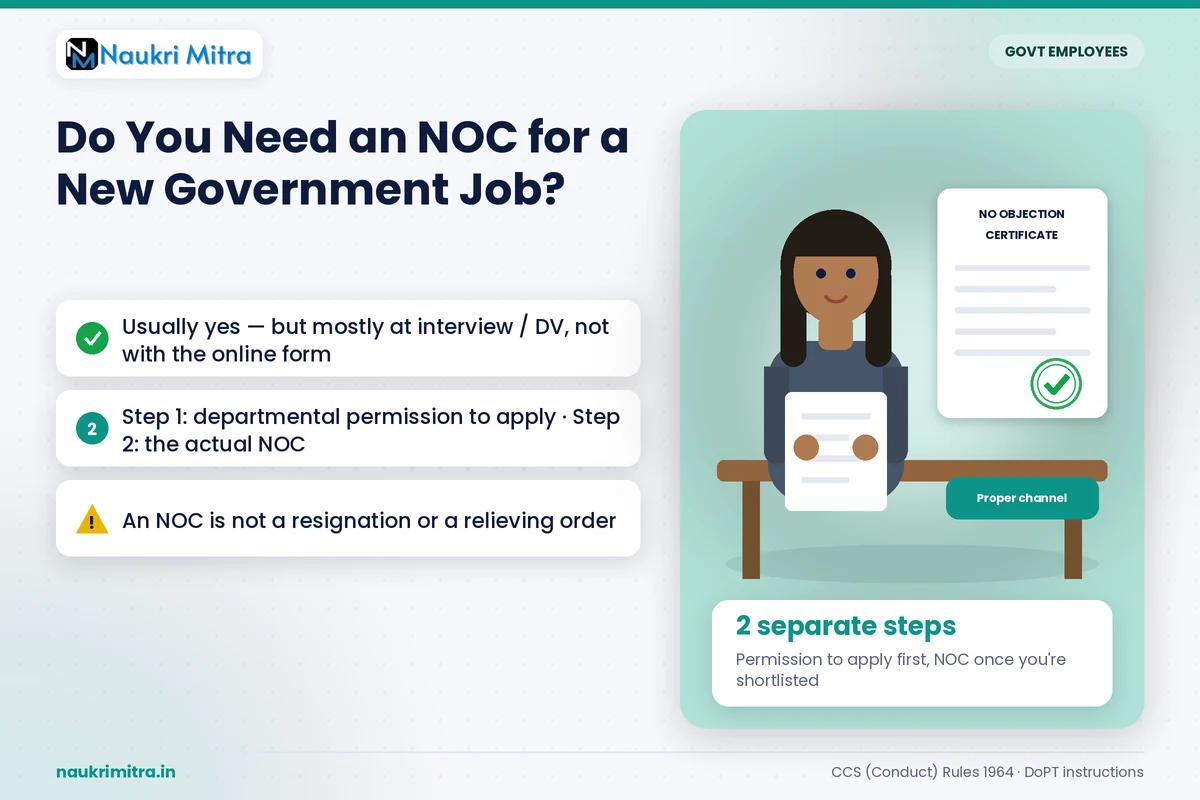
What an NOC Actually Is — and What It Isn't
A No Objection Certificate, in this context, is a written statement from your current employer saying it has no objection to you applying for, appearing in the selection process of, or ultimately joining another post. Type "no objection certificate government employee" into any search engine and you'll land on a dozen slightly different explanations, most of them outdated or state-specific. It is not a resignation, not a relieving order, and not quite the same thing as "permission to apply," even though the two get used interchangeably around office canteens and WhatsApp groups. Most central government departments and PSUs actually separate the process into two steps. The first is departmental permission for job application — your administrative head acknowledging you're allowed to submit the form through proper channel. The second, issued later, is the actual NOC, which typically becomes relevant only once you're shortlisted for an interview or document verification. A PSU employee applying against an SSC or UPSC advertisement, for instance, usually forwards the application through the department, and a separate no-objection letter is asked for only when a call letter actually arrives. Conflating the two is one of the most common reasons candidates panic unnecessarily at the application stage, when nothing has actually been asked of them yet.
Where This Requirement Actually Comes From
There's no single, neatly numbered rule that says "thou shalt not apply for another government job without an NOC." What exists instead is a layered framework built on the general conduct and integrity obligations under the Central Civil Services (Conduct) Rules, 1964, read together with decades of Department of Personnel and Training instructions on forwarding applications "through proper channel." The underlying logic is administrative housekeeping, not an attempt to trap anyone: a department needs advance notice that a staff member might leave, both to plan succession and to confirm there's no pending disciplinary or vigilance issue that should stop the move. This is essentially what people mean when they search variations of "conduct rules job change government servant" — there's no single clause with that exact heading, but the obligation is real. This framework is also why departments almost always insist that applications be routed through the administrative hierarchy rather than sent directly to the recruiting body. An application submitted "otherwise than through proper channel" can, in theory, be summarily rejected by the recruiting organisation, regardless of how well a candidate performs. It sounds harsh, but it rarely bites employees who follow the standard route — fill the form, inform your reporting officer or establishment section, and let the paperwork move alongside your candidature rather than instead of it.
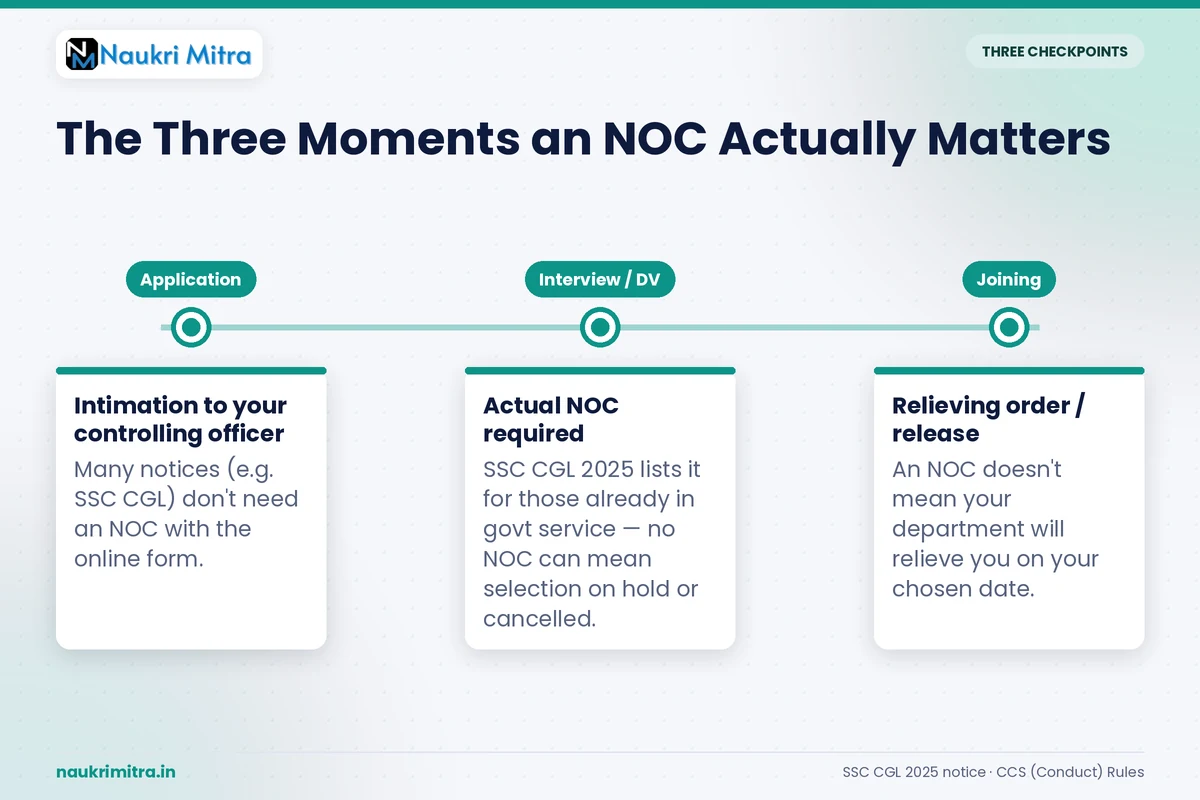
The Three Moments Where NOC Actually Matters
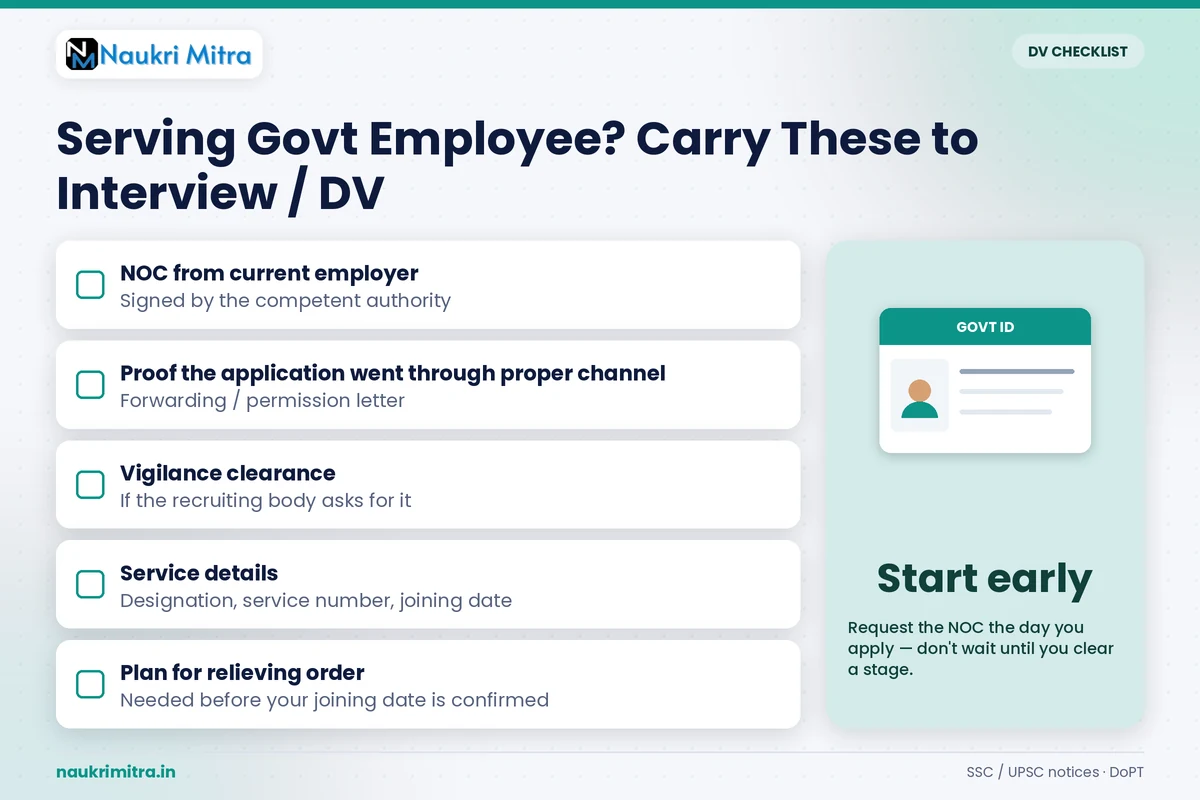
Most of the anxiety around this topic comes from not knowing exactly when the certificate gets demanded. There are really three checkpoints, and they don't all require the same document. At the application stage, what's generally expected is intimation to your controlling officer, not a formal NOC. Many recruitment notifications — the SSC CGL cycle is a good example — don't ask departmental candidates to attach an NOC with the online form itself. At the interview or document verification stage, things tighten considerably, and this is the stage most people actually mean when they ask about a no objection certificate for govt job interview requirements. Here, recruiting bodies routinely insist on actual proof. The SSC's own CGL 2025 recruitment notice, for instance, lists submission of a "No Objection Certificate, in case already employed in Government/Government undertakings" as a specific document-verification requirement under its candidate-document checklist. If you can't produce it at that point, your selection can be put on hold or cancelled outright, no matter how well you scored. The third moment is joining. Even after DV clearance, the appointing organisation will usually ask for a relieving order or a formal release from your current employer before confirming your joining date, and this is where the gap between "I have an NOC" and "I have actually been relieved" trips people up. An NOC tells the new employer you were allowed to apply and interview. It does not automatically mean your current department will let you go on the date you want, especially if a successor hasn't been arranged for your post.
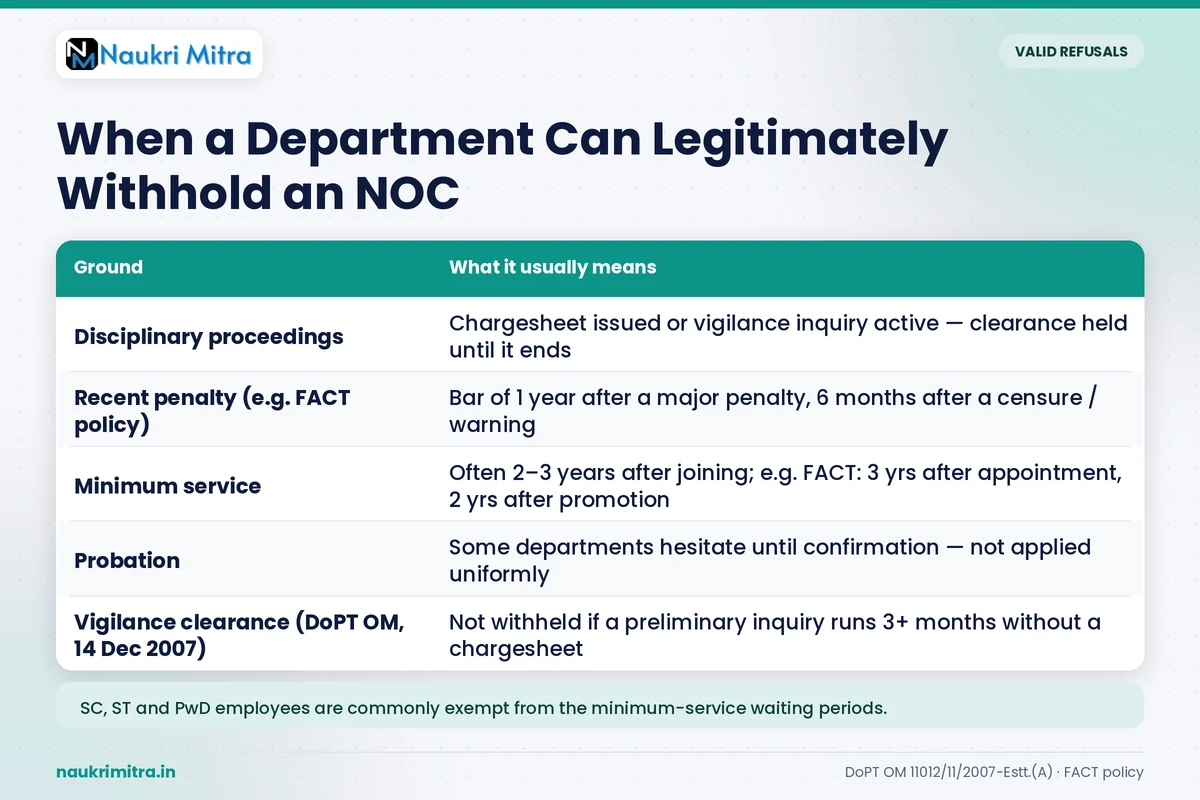
When a Department Can Legitimately Say No
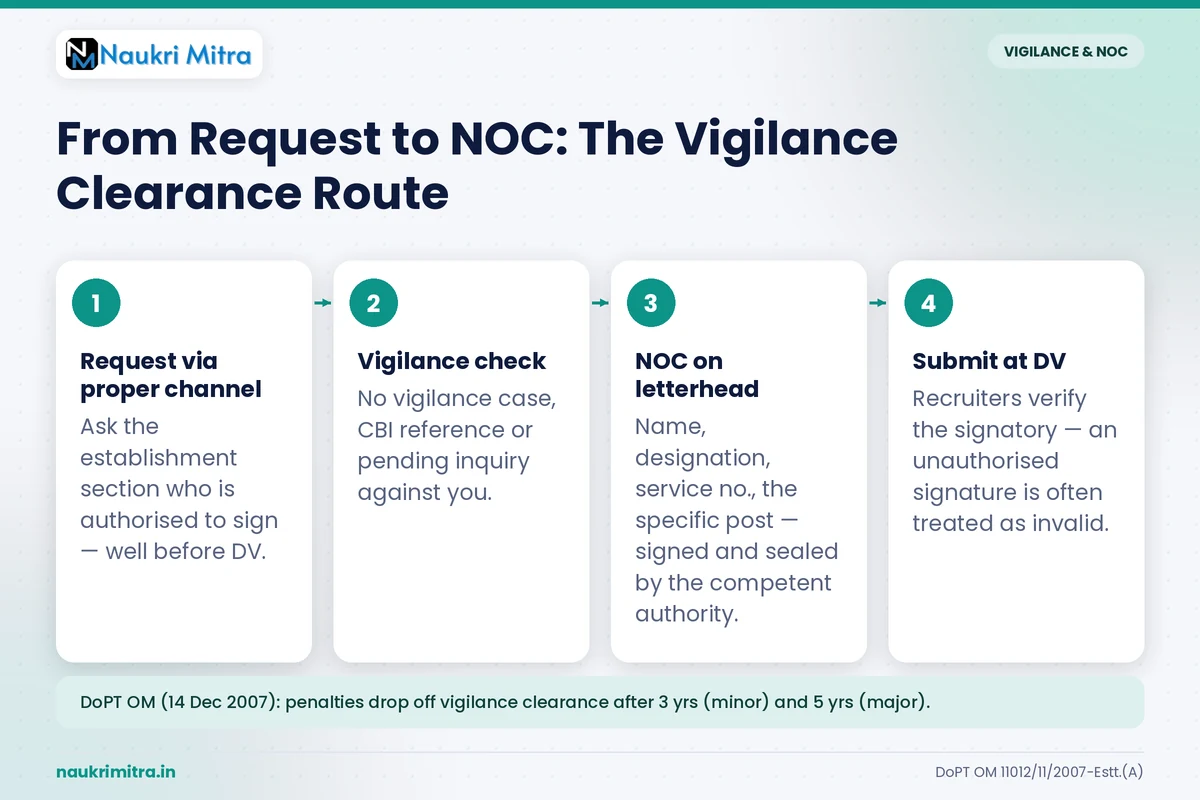
Departments can't refuse an NOC arbitrarily, but there are recognised grounds on which they routinely do, and it helps to know them before you assume the worst. Pending disciplinary proceedings are the most common blocker. If a chargesheet has already been issued, or a vigilance inquiry is active, most administrations will withhold clearance until that matter concludes — sometimes for a year or more after a penalty is actually awarded. A useful real-world example comes from the published outside-employment and NOC policy of Fertilizers and Chemicals Travancore Limited (FACT), a central public sector undertaking, which bars applications during suspension or active disciplinary proceedings, and imposes a further restriction period after a penalty — one year for a major penalty, six months for a censure or warning. It isn't a rule that applies identically everywhere, but it reflects the structure most PSUs and government offices use. Minimum service conditions are the second common ground. Many departments won't entertain an application to move elsewhere within the first two or three years of joining, or within a shorter window right after a promotion, reasoning that training costs and institutional continuity deserve some protection. The same FACT policy sets a three-year bar after initial appointment and a two-year bar after promotion, while explicitly exempting SC, ST and PwD employees from these waiting periods — an exemption that's fairly standard across public-sector HR policies. Probationary status is treated cautiously too; some departments are reluctant to let a probationer apply elsewhere until confirmation, though this varies and isn't as rigid as the disciplinary-case rule. Vigilance clearance for new government job candidates is a related but separate check — a formal statement that no vigilance case, CBI reference, or pending inquiry exists against you. The DoPT's own Office Memorandum No. 11012/11/2007-Estt.(A) dated 14 December 2007 lays down fairly specific timelines for this: clearance generally shouldn't be withheld if a preliminary inquiry has dragged on beyond three months without a chargesheet, and penalties fall off the vigilance-clearance radar after three years for a minor penalty and five years for a major one. An overcautious administrative office will sometimes sit on a request far longer than the rules actually require.
What If the Department Simply Refuses, or Just Sits on It?
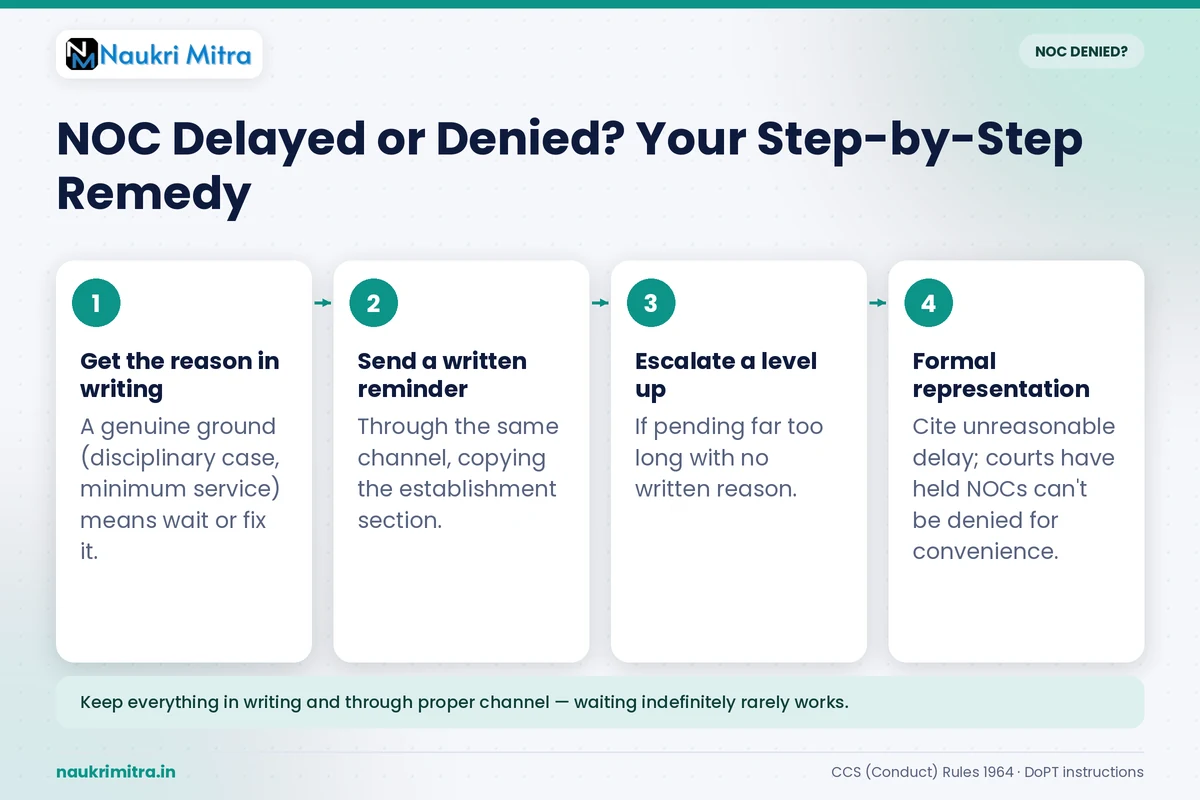
This is where most of the genuine stress lives, and understandably so. There's no single statutory deadline binding every department to issue an NOC within a fixed number of days — most clear requests move within a few weeks when nothing is pending, but there's no enforceable turnaround time the way there is, say, for vigilance clearance under the DoPT timelines mentioned earlier. A department that doesn't want to lose a good employee has every incentive to drag its feet, and "the file is under process" can stretch for months if nobody pushes it. Search "NOC not given by department for new job govt" on any forum and you'll find no shortage of frustrated posts — but comparatively few clear next steps, which is really the gap this section tries to close. The first practical step is always a written reminder, addressed through the same administrative channel the original request went through, copying the establishment or personnel section. Written requests create a paper trail that matters later, whether you're escalating internally or, in rare cases, approaching the courts. Indian courts have on several occasions held that an NOC cannot be denied purely out of administrative convenience — it has to be tied to a genuine, recorded reason such as a pending disciplinary matter or an unmet minimum-service condition. If a request has been pending well beyond what's reasonable with no ground communicated in writing, escalating to the next administrative level, or filing a formal representation citing unreasonable delay, is the legitimate recourse. What rarely works is simply waiting indefinitely. There's also a quieter risk worth naming: the fear that asking for an NOC marks you as someone planning to leave, inviting subtle retaliation — a bad appraisal, a sudden transfer, extra scrutiny. This happens in some offices, though it's neither universal nor, strictly speaking, lawful. The safest posture is to keep every communication in writing and route everything through proper channel exactly as the rules prescribe.
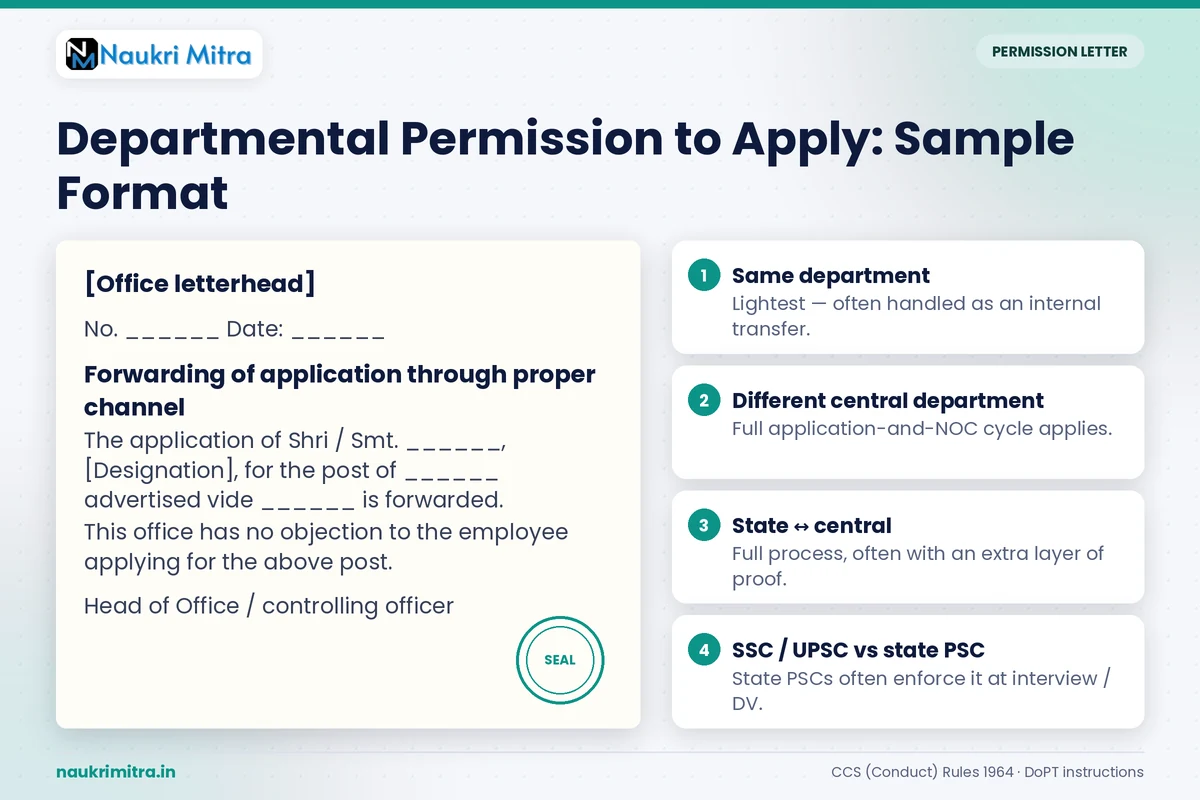
Same Department, Different State, Different Government — Does Scope Change the Answer?
The rules shift depending on whether you're staying within the same organisation or crossing a bigger boundary, and this trips up a lot of candidates who assume one blanket answer covers every scenario. Moving within the same department — say, from one wing of a ministry to a sister office under the same cadre controlling authority — is usually the lightest-touch scenario, often handled as an internal transfer request rather than a full external NOC process. Moving to a different central government department is heavier: here the full application-and-NOC cycle applies, because you're effectively leaving one cadre for another. A state government employee applying for a central post, or vice versa, faces the same full process, and frequently an additional layer, since state and central administrative rules aren't identical and the receiving organisation will want documentary proof that the sending state government has no objection. People often type exactly this into Google: can state govt employee apply without NOC for central job openings — and the honest answer is that they can apply, but completing the move without one is a different matter entirely. This is also where the gap between SSC, UPSC and state Public Service Commission advertisements shows up. Central recruiting bodies like SSC and UPSC tend to spell out the NOC requirement explicitly in their notification's document checklist, precisely because they recruit from a national pool that regularly includes serving government employees. Several state PSCs are less explicit in the notification text itself but still enforce the same expectation informally at the interview or DV stage, which is exactly why a quiet word with the department's establishment section before applying saves far more trouble than discovering the requirement after you've already cleared the written exam.
PSU Employees: A Slightly Different Playbook
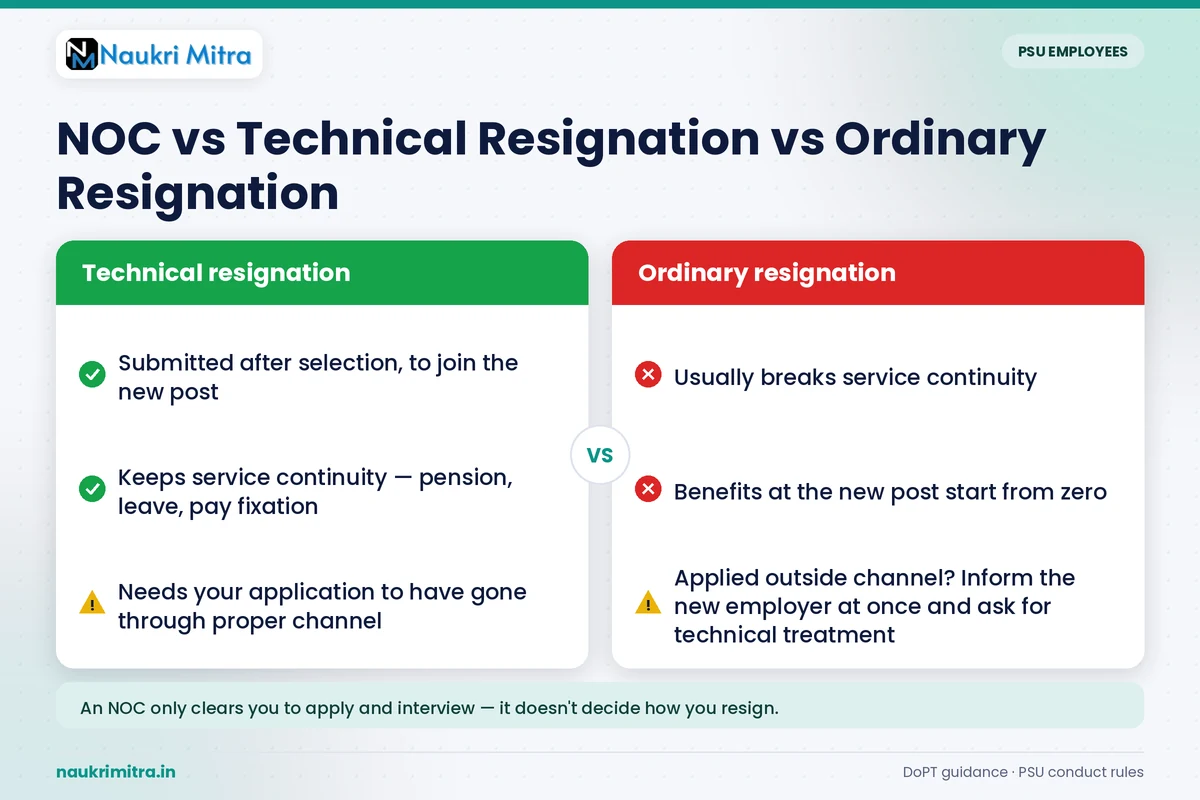
Public sector employees sit in an interesting middle zone. PSUs aren't bound by the Central Civil Services Conduct Rules directly, but most have modelled their own conduct and discipline regulations closely on them, including a similar permission-to-apply and NOC structure. What differs more is the resignation mechanism once you're selected. This is where the relieving vs NOC difference becomes genuinely important rather than a semantic distinction. An NOC only clears you to apply and interview. If selected, what you typically submit to your current employer isn't an ordinary resignation but a technical resignation — distinct because it preserves continuity of service for pension, leave encashment and pay-fixation purposes, provided the original application went through proper channel. An ordinary resignation usually breaks that continuity entirely, meaning your new post's benefits calculations start from zero. Several PSUs and departments, reflecting DoPT guidance, allow a technical resignation to be converted retroactively if an employee who applied without proper channel still informs the new employer immediately on joining and formally requests that treatment — it isn't automatically lost, but it has to be asked for. A PSU employee, then, shouldn't treat "I have my NOC" and "I'm free to resign without losing anything" as the same statement. They answer different questions, and getting the second one wrong can cost years of counted service.
What Goes Into an NOC Letter
There's no single national template, but the accepted format follows a predictable pattern: issued on official letterhead, it references the employee's name, designation and service number, names the specific post applied for, states clearly that the department has no objection to the employee appearing for selection (and, where relevant, subsequent joining), and carries the signature and seal of a competent authority — usually the Head of Office or an authorised HR signatory, not just any supervisor. Recruiting organisations check this closely; an NOC signed by someone without delegated authority is often treated as invalid at verification. It's worth asking your establishment section, well before DV, exactly who is authorised to sign it.
Exceptions: Walk-Ins, Short Contracts, and Grey Areas
Not every government engagement triggers this entire machinery. Purely contractual, honorarium-based, or short-term consultancy assignments — ones that don't create a pension or service-continuity relationship — are usually treated more loosely, and many don't formally demand an NOC at all, though informing your current office remains good practice. Walk-in interviews for genuinely temporary or project-based roles sometimes skip the formal requirement too, simply because the recruiting body isn't treating the hire as a transfer between permanent cadres. That said, "sometimes skipped" isn't "guaranteed exempt," and assuming an exception applies without confirming it in writing is an avoidable mistake — if in doubt, ask the recruiting organisation directly rather than guessing.
Strip away the jargon and every government employee applying for new government job NOC rules question eventually boils down to the handful below.
Frequently Asked Questions
Do all government employees need an NOC to apply for another government job?
Not strictly at the application stage in every case, but almost universally by the time of interview or document verification, especially for central recruitment through SSC, UPSC, or similar bodies. Treat it as required unless your specific notification says otherwise.
Can I sit for an interview without an NOC and arrange it only after I'm selected?
Some organisations allow this and ask for the certificate only at DV, after the interview outcome is known. Others want proof of at least a "permission to apply" earlier. Since this varies by recruiting body, the safer approach is to start the request with your department the moment you apply, not after you clear a stage.
What happens if my current department simply refuses to issue one?
First, get the reason in writing. If it cites a genuine ground — an active disciplinary case, an unmet minimum-service clause — there's little to do but wait it out or address the underlying issue. If no valid reason is given, a written escalation through the proper channel, and in persistent cases a formal representation, is the standard recourse.
Is NOC needed for a transfer within the same department versus a move to a different one?
Internal movements within the same cadre-controlling authority are typically handled as transfers, which is a lighter process. A move to a genuinely different department or organisation needs the full external NOC treatment.
Do state government employees need an NOC for central government jobs, and the other way round?
Yes, generally. Moving between a state cadre and a central one is treated as leaving one employer for another, so the full permission-and-NOC cycle applies in both directions.
Can a pending disciplinary inquiry block my NOC?
Yes, this is one of the most common and legitimate grounds for withholding clearance, and it can extend for a defined period even after a penalty is actually imposed.
Does my probation status affect whether I can get an NOC?
It can. Some departments are hesitant to approve outside applications before confirmation, though this isn't a rule applied as consistently as the disciplinary-case restriction.
Can PSU employees apply elsewhere without resigning from their current post first?
Yes — that's the entire point of the permission-and-NOC process. You apply, interview, and get selected while still employed, and only then decide whether to submit a technical resignation to join the new post.
What if a selected candidate joins the new organisation without ever producing an NOC?
Most appointing authorities treat this as grounds to withhold or cancel the appointment, since the NOC and the subsequent relieving formality are usually verified before a joining date is confirmed. It's a risk not worth taking.
Does the new organisation actually verify that an NOC is genuine?
Yes, typically by checking the signing authority's designation and sometimes contacting the issuing office directly, particularly for central government and PSU postings where document fraud carries serious consequences.
None of this paperwork is designed to make switching government jobs impossible — it exists mainly so that two public employers aren't left guessing about each other's claim on the same employee at the same time. Start the conversation with your own establishment section early, keep every request in writing, and treat the NOC and the eventual relieving or technical-resignation process as two separate steps rather than one. If you're tracking fresh central, state, and PSU recruitment notifications to plan your next move, the listings on Naukri Mitra are a reasonable place to keep an eye on upcoming vacancies as they're announced.
Sources: SSC CGL 2025 Notification, DoPT Office Memorandum No. 11012/11/2007-Estt.(A), FACT Policy for Granting Permission and NOC.
.png)
.png)
.png)
Comments
Post a Comment