EPS Scheme Certificate vs Withdrawal Benefit | Naukri Mitra
Here's a scene that plays out in HR offices across the country every single day. Someone resigns, serves their notice, collects the full and final settlement documents, and somewhere in that stack is a line about "EPS" and a form called 10C. Most people sign wherever they're told to sign and move on. A smaller number pause and actually read what they're agreeing to — and that's usually when the confusion starts. Do you take the money now, or do you let EPFO hold onto a certificate that promises something later? If you've got less than 10 years of pensionable service and you're walking out the door, this is the one decision in your full-and-final paperwork that actually has long-term consequences, and it genuinely surprises people how different the two paths are.
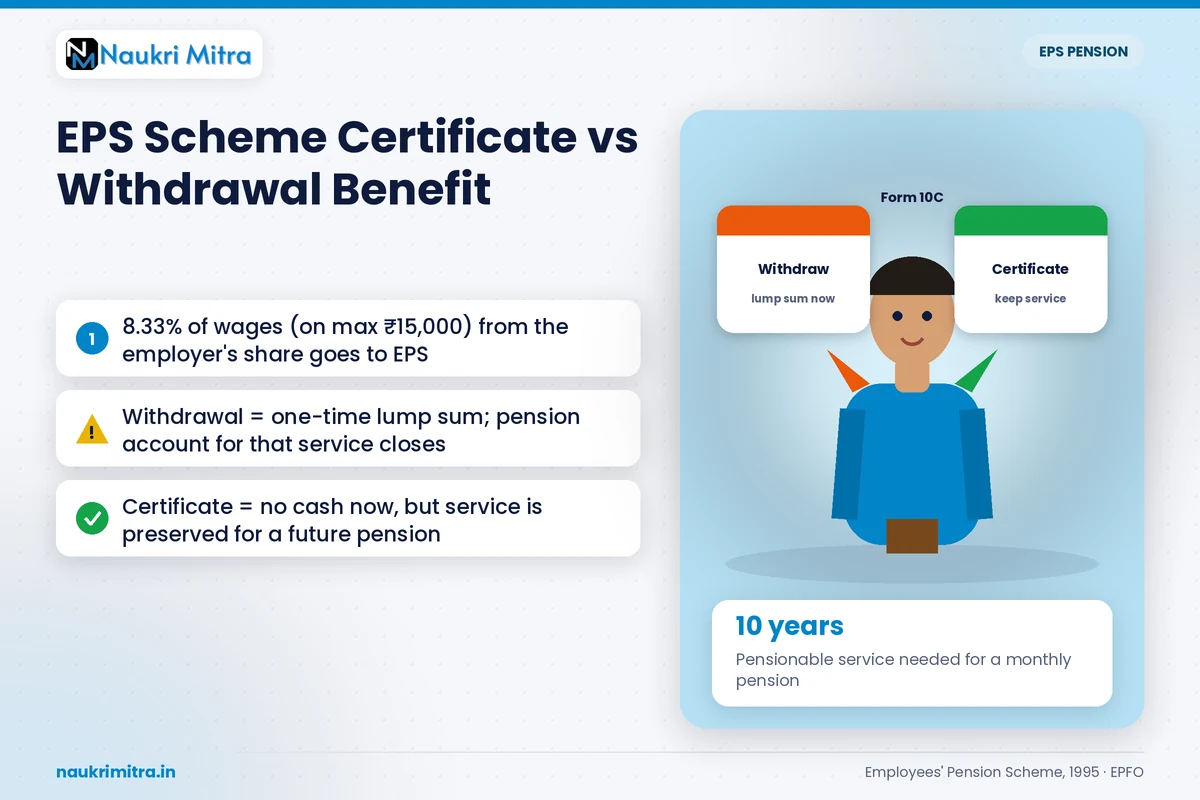
Let's get the basic plumbing straight first, because a lot of the confusion comes from mixing up EPF and EPS. Every month, a slice of your employer's contribution — currently 8.33% of wages, capped at a wage ceiling of ₹15,000 — doesn't go into your EPF account at all. It goes into the Employees' Pension Scheme, a separate pool meant to fund a monthly pension after retirement, not a lump-sum payout like your PF balance. Your EPF money is yours to withdraw more or less freely when you leave a job. Your EPS money works on entirely different rules, and that's precisely why EPFO built two separate exits for it: the withdrawal benefit and the scheme certificate.
EPS scheme certificate vs withdrawal benefit: the core difference
When people search for "EPS scheme certificate vs withdrawal benefit which is better," what they're really asking is this: should I cash out now, or should I preserve a record that might pay off decades from now? The withdrawal benefit is a one-time payment. EPFO calculates it using a formula tied to your average monthly pay and your completed years of service, pays it out, and your pension account for that employment is closed. There's no partial pension, no future claim, nothing left pending — the chapter is over.
A scheme certificate does the opposite. Instead of paying you anything immediately, EPFO issues a document that freezes and preserves your pensionable service record — essentially a receipt that says "this many years of service exist on file, and here's the family it's attached to." It doesn't expire, it doesn't lapse because you're unemployed for a while, and the moment your cumulative service across jobs touches 10 years, that frozen record starts counting toward a real, monthly pension at retirement. In plain terms: the EPF pension scheme certificate meaning is continuity, not cash.
A side-by-side look before you decide
Numbers and comparisons tend to make this clearer than paragraphs alone, so here's how the two stack up on the things that actually matter when you're the one filling out the form.
| Factor | Withdrawal Benefit | Scheme Certificate |
|---|---|---|
| What you get | A lump sum paid immediately, based on Table D | No immediate money — only a preserved service record |
| Eligibility | Less than 10 years of pensionable service | Less than 10 years (optional), mandatory beyond 10 years if you want continuity instead of pension now |
| Effect on pension rights | Ends your EPS membership for that stretch of service permanently | Keeps the service alive, combinable with future employment |
| If you rejoin an EPF job later | You start counting pensionable service from zero again | Your new employer's service simply adds onto the certificate |
| Validity period | N/A — it's a closed transaction | No expiry; stays valid whether or not you take another job |
| Best suited for | Short stints, genuine need for funds, no plan to stay in organized sector | Career still in progress, likely to rejoin EPF-covered employment |
Notice the row about rejoining — that single line is usually what tips the decision. If you take the withdrawal benefit and land a new job six months later, EPFO doesn't remember your old service. You're back to year zero on the 10-year pension clock. A scheme certificate, on the other hand, just waits.
How EPS withdrawal benefit calculation actually works
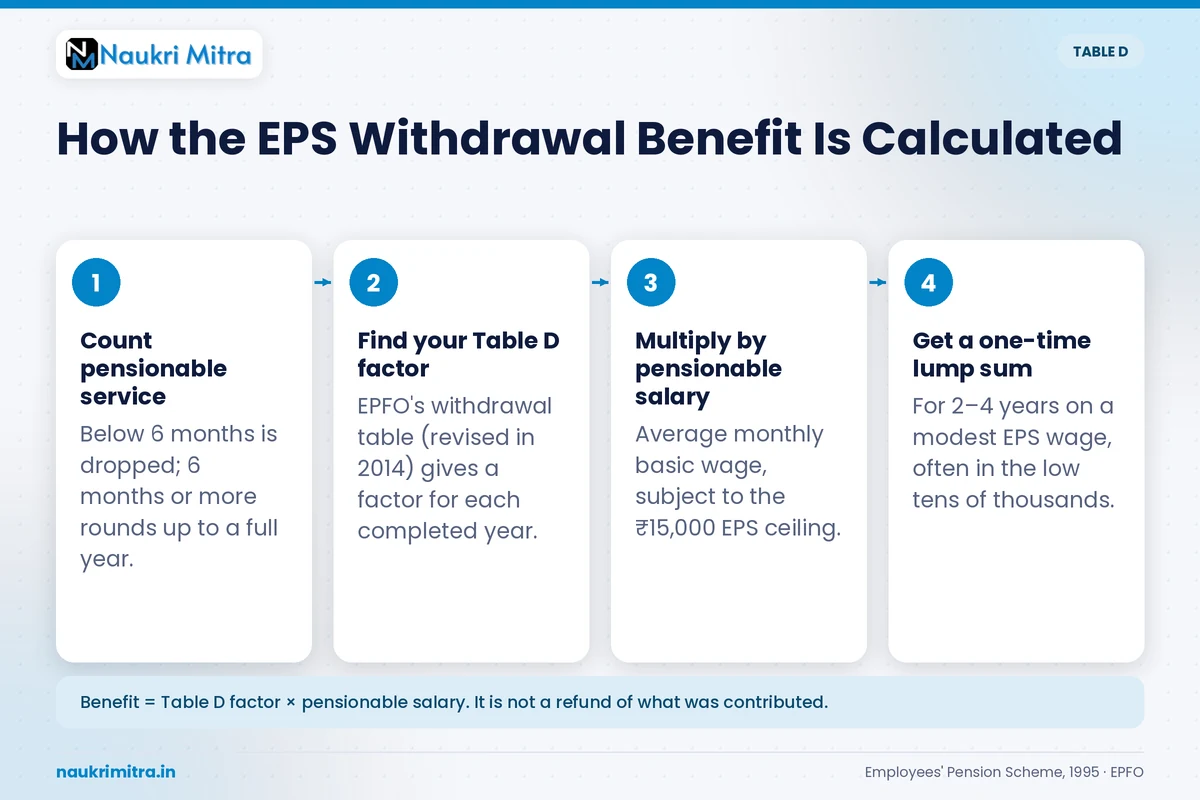
This is the part people get most wrong. The EPS withdrawal benefit calculation isn't a simple refund of whatever percentage landed in your pension account — it's a formula-driven amount read off a published withdrawal benefit table, commonly referred to as Table D, that EPFO revised in 2014 and still uses. The table assigns a factor based on your completed years of pensionable service, and that factor is multiplied against your pensionable salary (your average monthly basic wage, subject to the EPS ceiling, over roughly the last several months of service). Service below six months is dropped, and six months or more is rounded up to a full year — a detail that matters more than people realize, which we'll come back to.
So two people with the identical monthly contribution history but one extra year of service won't get proportionally the same withdrawal amount — the table's factor jumps are deliberately front-loaded to encourage people to stay in the system longer rather than cash out early. In practice, for someone in the two-to-four-year service range on a modest EPS wage, the withdrawal benefit often comes out to somewhere in the low tens of thousands of rupees — not nothing, but rarely a sum that changes your financial picture the way people sometimes expect. And no, there's no partial monthly pension option under 10 years; with under 10 years of service, you either take the Table D lump sum or you preserve the record via scheme certificate. A reduced monthly pension only becomes available once you've crossed the 10-year mark and are at least 50 years old.
Check your actual pensionable service before you pick anything
Before you decide between the two, confirm the number you're actually working with. Your EPF passbook on the member e-SEWA portal shows your service history employer-wise, but the pensionable service figure that matters for this decision is the rounded, cumulative count — not the raw calendar gap between your joining and leaving dates. Because of the rounding rule mentioned above, someone with 9 years and 7 months of service is treated as having completed a full 10 years, which changes the entire decision: at that point you're no longer choosing between withdrawal and certificate at all, you're pension-eligible outright, and a scheme certificate (or, past age 50, an actual pension via Form 10D) becomes your only real option. This is exactly why it's worth logging into the EPFO portal and checking your service break-up before assuming you're under the threshold.
EPS less than 10 years service options: what should you actually pick
If you've confirmed you're genuinely under 10 years, here's how to think about it rather than just defaulting to "take the cash." Among the EPS less than 10 years service options, the honest answer depends less on the amount of money and more on how likely you are to keep working in EPF-covered employment.
If you're in your late 20s or early 30s and switching from one organized-sector job to another — which describes a large share of the people asking should I withdraw EPS or take scheme certificate in the first place — the scheme certificate is usually the financially smarter call. The withdrawal amount at that stage of a career is typically small relative to what continuity is worth over a 25-30 year runway to retirement. You're not losing access to a meaningful sum today; you're preserving the ability to eventually draw a monthly pension instead of a one-time payout. If, on the other hand, you're leaving the formal workforce altogether — moving to a business of your own, relocating abroad long-term, or stepping away from salaried work for other reasons — the withdrawal benefit at least converts a dormant entitlement into usable money now, since a certificate sitting unused for decades has limited practical value to you.
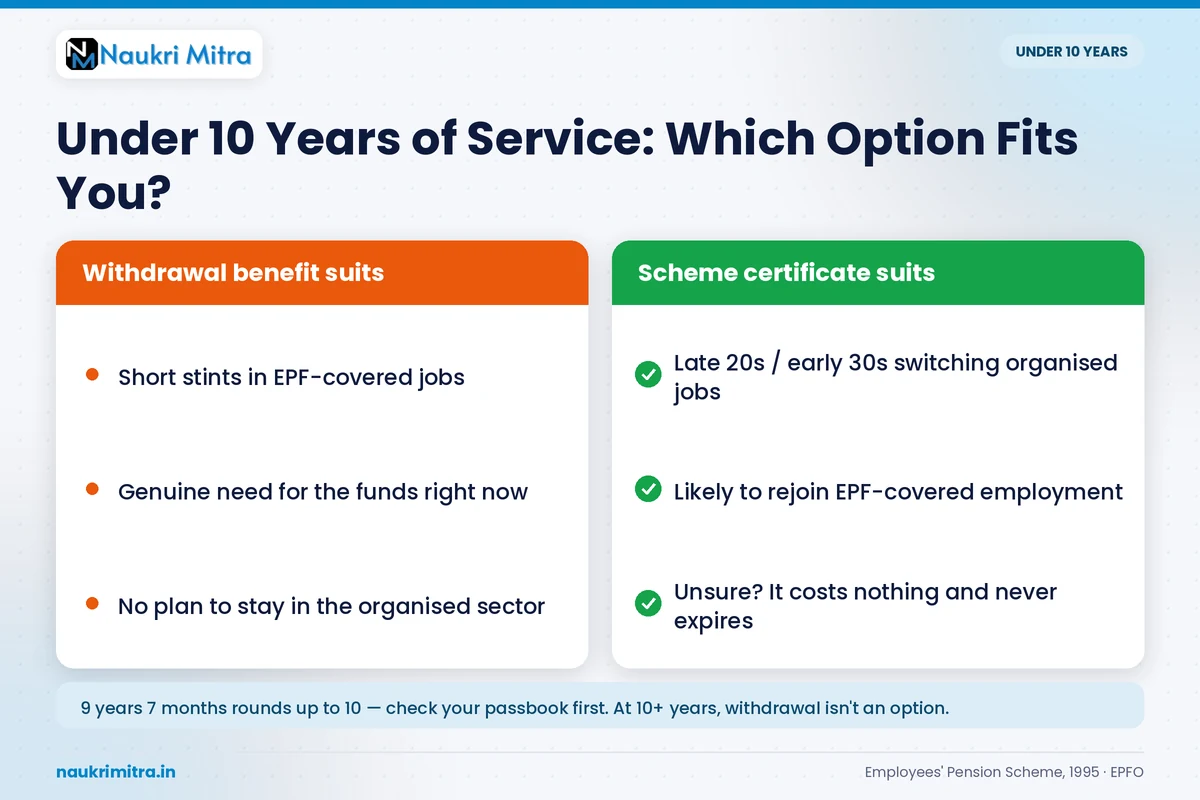
There's a middle case worth naming too: people who aren't sure whether their next job will even be EPF-covered — small firms, certain gig or contract arrangements, or roles below the establishment threshold. Scheme certificates cost nothing to hold onto and never expire, so when in doubt, the lower-risk move is almost always to preserve rather than cash out. You can always decide to withdraw years from now if it turns out you genuinely need the money and have no intention of rejoining the EPF system — that door stays open from the certificate side. It does not stay open the other way around.
Combining EPS service across multiple employers
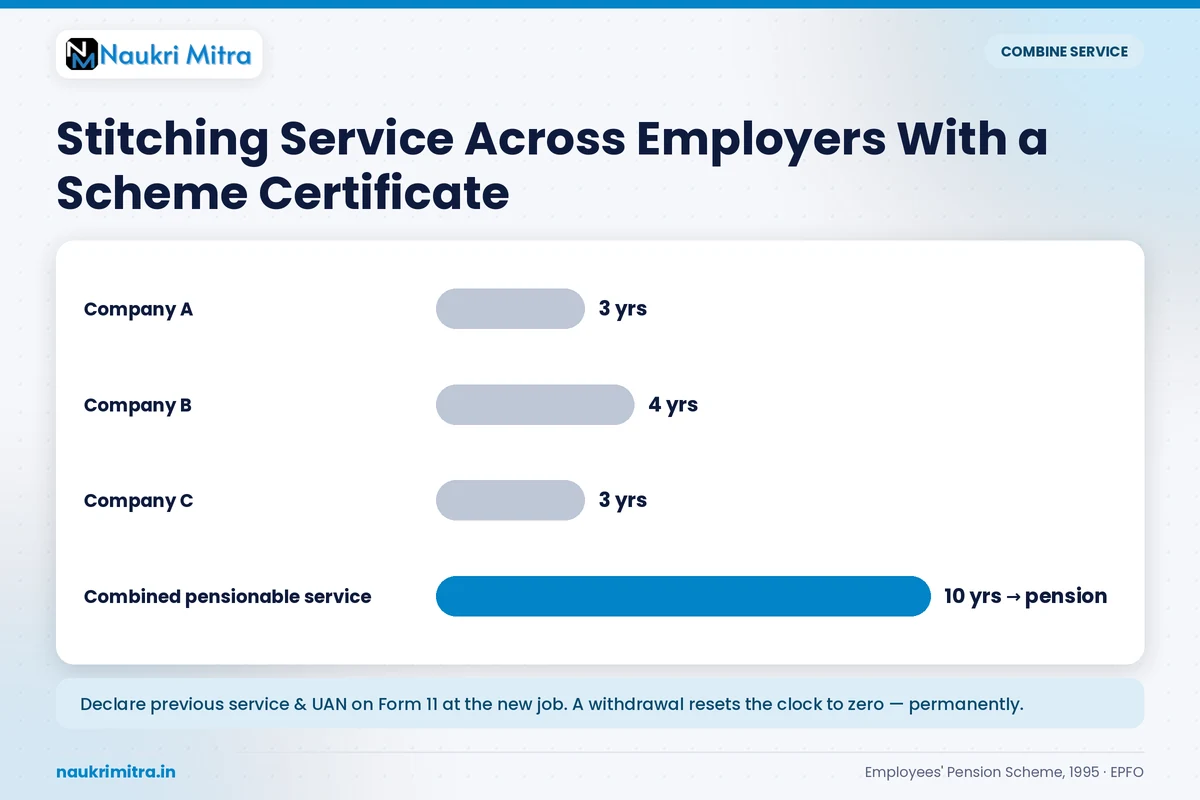
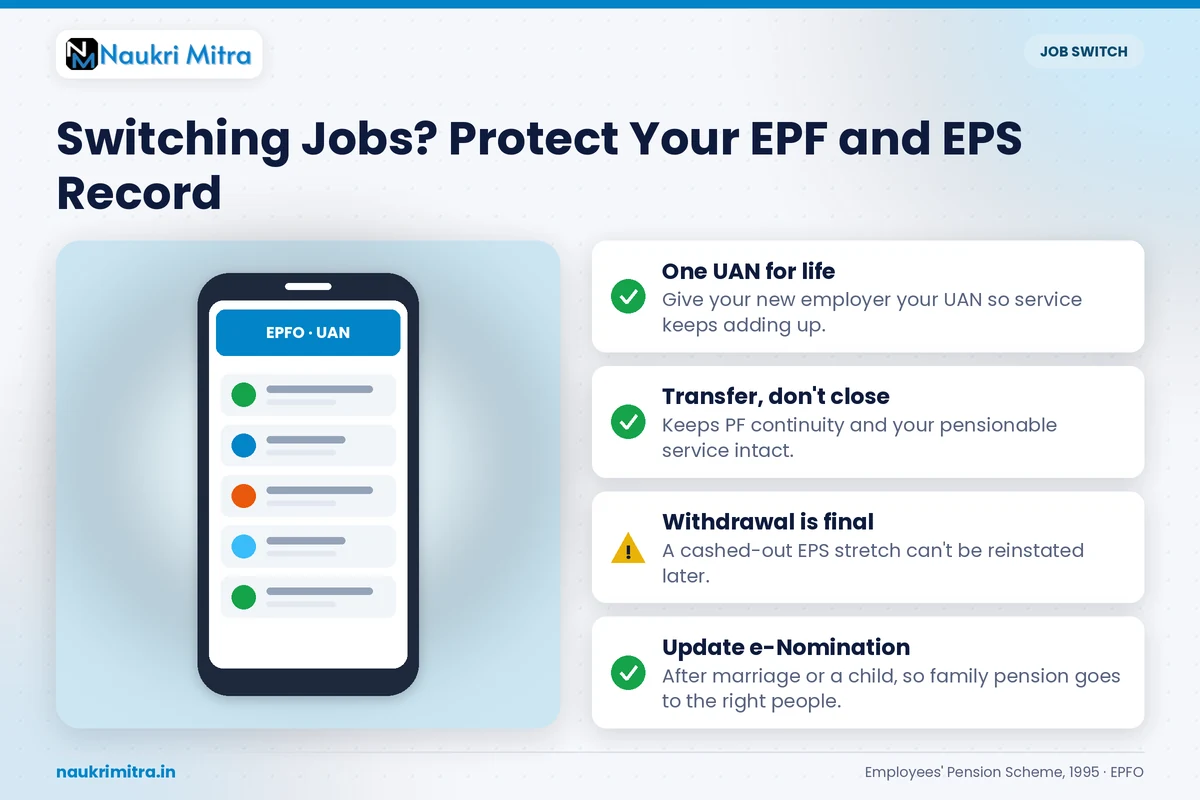
This is where the scheme certificate earns its keep. If you've worked at three different companies for three and four years each, none of those stints individually crosses 10 years — but combining EPS service across multiple employers through a scheme certificate is exactly how EPFO lets you stitch them together. People often phrase it informally as combining EPS service multiple employers in one go, though EPFO's own paperwork simply calls it transfer and continuation of pensionable service. When you join a new EPF-covered employer, you declare your previous service and UAN details through Form 11, and if a scheme certificate is on file from an earlier employer, EPFO links the new employment's pensionable service onto it rather than starting a fresh count. Your pensionable service continuity survives the job change entirely, provided you didn't close it out with a withdrawal benefit claim somewhere along the way.
Once your combined, rounded service crosses the 10-year line — across however many employers it took — you've hit EPS 10 years eligibility pension status. At that point the certificate effectively converts: instead of cashing anything out, you eventually apply with Form 10D at retirement (or from age 50 with a reduced pension, full amount from 58) and your monthly pension gets calculated using your full combined service history, not just your most recent job. People sometimes ask how to "activate" an accumulated certificate — there's no separate activation step; it stays dormant on EPFO's records until the member either adds more service to it through fresh employment or becomes eligible to claim pension, whichever comes first.
Career gaps, unemployment, and moving abroad
A reasonable worry: does a gap between jobs invalidate the certificate? It doesn't. A scheme certificate has no time limit and no continuous-employment requirement — EPFO isn't checking whether you were working every single month in between, only whether the service you eventually add is genuine EPF-covered employment. A six-month job search, a year spent caregiving, or a longer career break doesn't reset or cancel anything sitting on a scheme certificate.
Moving abroad is a slightly different question. If you relocate for work and your new employment isn't under India's EPF/EPS framework, your certificate simply stays parked exactly as it was — no contributions are added, but nothing is lost either. It resumes accumulating the moment you're back in EPF-covered employment in India, and you remain eligible to claim pension benefits from it once you meet the age and service conditions, regardless of how many years passed in between.
Can you reverse a withdrawal once it's done?
No, and this is the part people regret most. Once EPFO processes a withdrawal benefit claim and pays it out, that stretch of pensionable service is permanently closed — there's no procedure to pay the money back and reinstate the service record. If you later rejoin an EPF-covered job, your EPS membership and the 10-year pension clock start over from scratch, completely independent of the service you already cashed out. This is precisely why it's worth pausing on this decision rather than ticking the withdrawal box reflexively because it's the first option listed on the form.
Is the withdrawal benefit taxable?
This question comes up constantly, and it deserves a straight answer: unlike your EPF balance — where withdrawing before five years of continuous service can trigger TDS under the Income Tax Act — the EPS withdrawal benefit is a different pot of money governed by its own scheme rules, and most tax guidance treats it separately from EPF taxability provisions. That said, tax treatment can depend on your specific service history and overall income for the year, so if the withdrawal amount is meaningful to you, it's worth a five-minute check with a tax professional or a current, authoritative source like the Income Tax Department's own guidance before you file your return, rather than assuming either way.
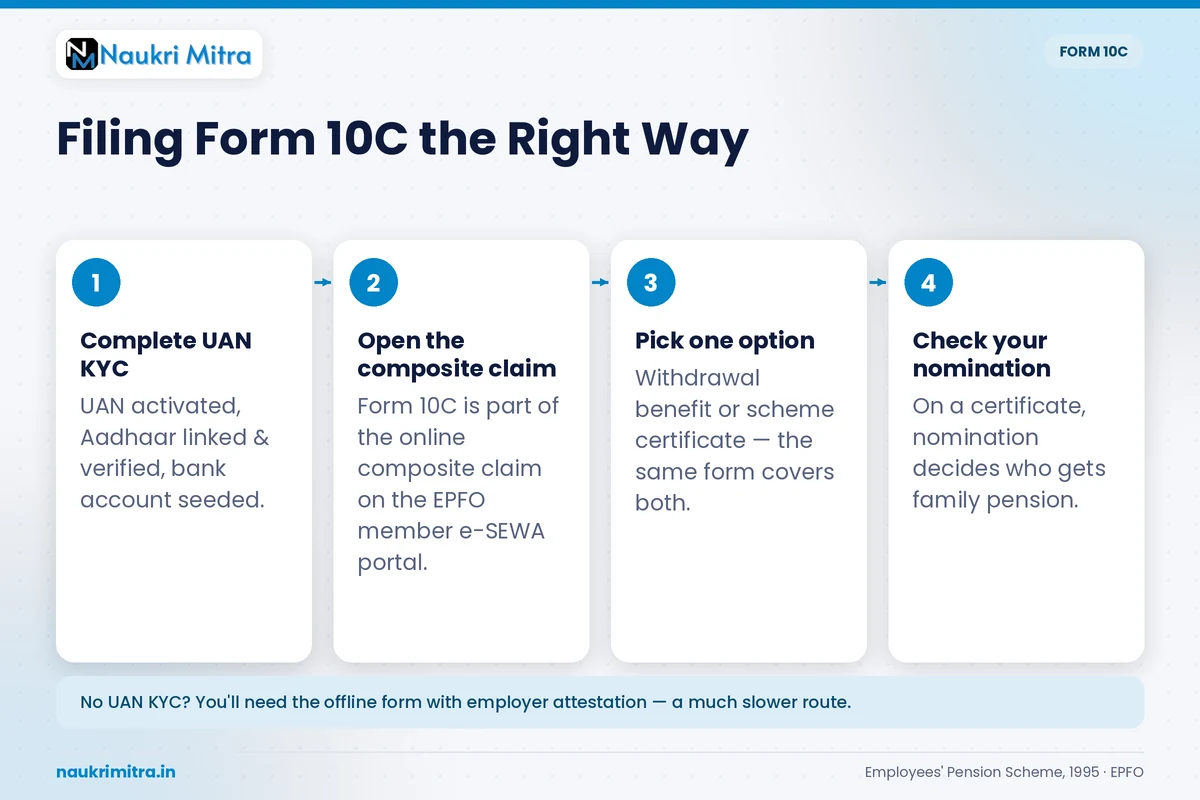
Filing Form 10C the right way
Whichever option you choose, the mechanism is the same: Form 10C EPS is the single form that covers both a withdrawal benefit claim and a scheme certificate request — you simply indicate which one you want in the relevant section. For most members today, this isn't even a separate physical form anymore; it's filed as part of the online composite claim through the EPFO member e-SEWA portal, provided your UAN is activated, your Aadhaar is linked and verified, and your bank account is seeded with your UAN. You'll typically need your bank account details and KYC documents in order, and if you're applying for a scheme certificate specifically, family and nominee details on record matter because that's what gets preserved on the certificate for future family pension purposes. Once submitted correctly with employer digital signature where still required, EPFO's standard settlement window for these claims runs around 20 days, though actual processing can vary by regional office and how clean your KYC details are. Offline submission through your employer is still technically possible if your UAN isn't fully KYC-compliant, but the online route is faster and is what EPFO actively pushes members toward now.
If you're between jobs right now and sorting through this paperwork, it's also a reasonable moment to think about what's next — whether that's an accountant job in Mumbai, an HR manager role in Hyderabad, or a payroll specialist position if you're staying in the HR and compliance side of things. Landing your next EPF-covered role sooner rather than later is also, incidentally, the single best way to make a scheme certificate pay off.
Nomination, family pension, and the certificate you leave behind
One thing a lot of younger employees skip past is the nomination section — and on a scheme certificate, it isn't a formality. If something were to happen to you before you ever draw a pension from it, the certificate's nomination determines who receives family pension: typically your spouse and children under 25, with provisions extending to dependent parents if there's no spouse or child on record. Keeping this updated after marriage or the birth of a child isn't optional paperwork — it's the entire point of preserving the certificate instead of cashing out, so it's worth double-checking your e-Nomination on the EPFO portal whenever your family situation changes, not just at the point of resignation.
Frequently asked questions
What if I never take another EPF-covered job after getting a scheme certificate?
The certificate simply stays on record indefinitely. It doesn't expire or get cancelled for inactivity. If your service never crosses 10 years, you remain eligible to convert it to a withdrawal benefit claim later, calculated on the same service and salary basis it was issued on.
Is there a minimum age to claim the withdrawal benefit?
No separate minimum age applies beyond the general service conditions — you can claim it once you've left EPF-covered employment with under 10 years of pensionable service, regardless of how young you are, subject to the standard waiting period EPFO applies after the last contribution.
Does taking a scheme certificate mean I can't touch that money for years?
Essentially yes — a scheme certificate has no cash value you can draw against. It only becomes "money" in the form of a monthly pension once you meet the 10-year combined service and age conditions, or you later decide to formally convert it to a withdrawal benefit claim.
How is the EPS withdrawal benefit table different from a simple refund of my contributions?
It isn't a refund at all — it's a scaled amount from Table D based on your pensionable salary and rounded years of service, which is why two people with similar contributions but different tenures can receive noticeably different amounts.
Can my employer refuse to process a scheme certificate request?
No — if you're eligible, your employer's role is limited to digitally attesting your claim where required; they can't deny you the choice between withdrawal benefit and scheme certificate once you qualify.
If my combined service eventually crosses 10 years, do I need to do anything to activate the certificate?
Not really — there's no separate activation request. It stays linked to your UAN, and once your cumulative pensionable service crosses 10 years, you become eligible to eventually claim a monthly pension through Form 10D using the full combined history.
Will a short gap of a few months between jobs cancel my scheme certificate?
No. There's no continuous-employment requirement attached to a scheme certificate. Gaps of any length don't affect its validity.
What documents does EPFO actually need for a scheme certificate request?
Alongside Form 10C filed through the portal, you'll typically need bank account proof, your UAN and KYC details in order, and updated family/nominee details, since those get recorded on the certificate itself.
Is the withdrawal benefit a monthly amount or a one-time payment?
Always a one-time lump sum under 10 years of service. There's no pro-rated monthly pension option below the 10-year threshold under any circumstances.
Whichever way you lean, this isn't a decision to make purely on autopilot while you're rushing through exit paperwork. Pull up your actual service numbers, run the comparison honestly against your own career plans, and if you're still unsure, a scheme certificate costs you nothing to hold onto while you figure out your next move. For more on navigating job transitions, settlements, and what comes next in your career, resources like Naukri Mitra are a reasonable place to start browsing your next opportunity while your EPFO paperwork sorts itself out in the background.
Sources: ClearTax – EPS 95 Pension Scheme Guide, ClearTax – Form 10C Guide, Paisabazaar – EPF Form 10C.
.png)
.png)
.png)
Comments
Post a Comment