Why Caste Validity Can Cancel Your Govt Job | Naukri Mitra
A selection letter from a state public service commission feels like the finish line. For a meaningful number of candidates who get into government service through a reserved category, it isn't. The real test — the one nobody mentions during the interview or the document verification counter — often arrives months, sometimes years, after the first salary has already been credited. It is called caste validity, and getting it wrong can end a career that otherwise had nothing wrong with it.
Most job applicants understand the caste certificate requirement reasonably well. Far fewer understand that in several states, that certificate is only the first of two documents. The second is a separate paper altogether — a caste validity certificate for government job eligibility, issued not by a Tehsildar or a revenue officer but by a dedicated, quasi-judicial body called the caste scrutiny committee. The distance between these two documents is exactly where careers quietly unravel, sometimes decades into service.
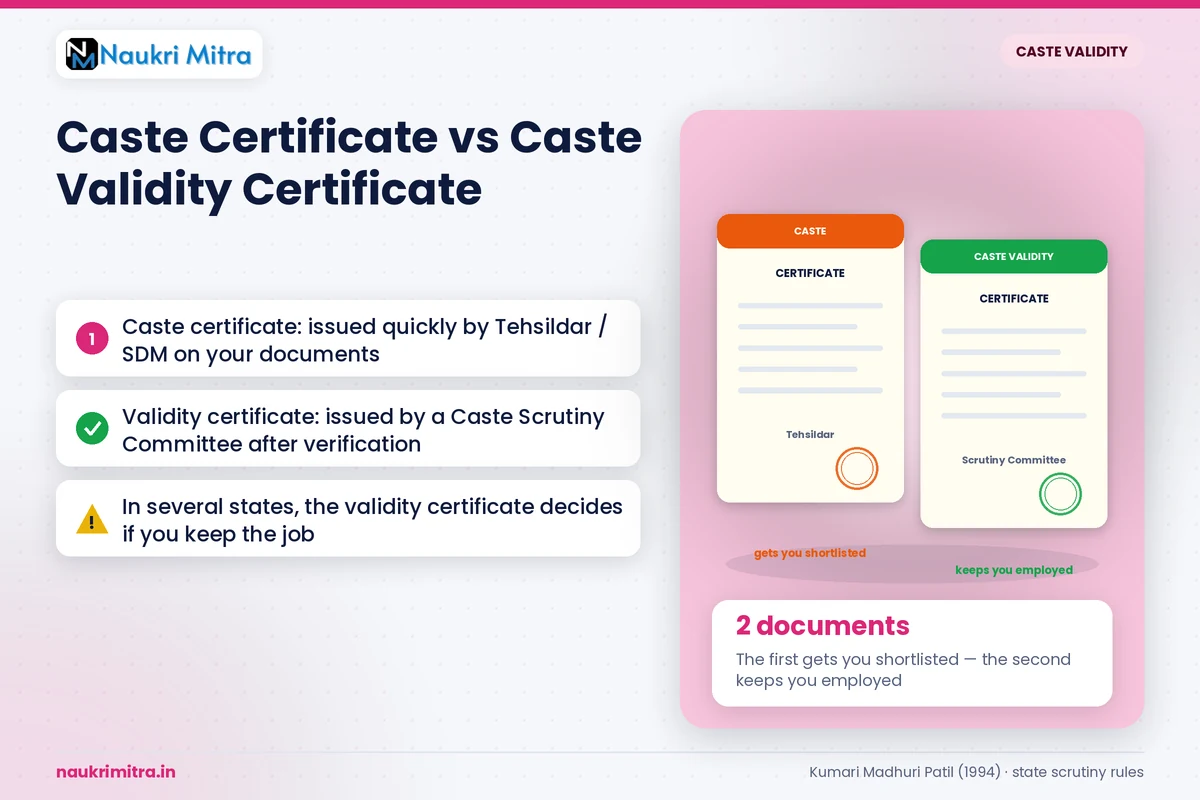
The Certificate That Gets You Shortlisted Isn't the One That Keeps You Employed
A caste certificate is issued fairly quickly, usually by a Sub-Divisional Magistrate, Tehsildar, or Executive Magistrate, based on the applicant's declaration, the family's residence history, and a handful of supporting documents. It is meant to establish, on paper, that a candidate belongs to a Scheduled Caste, Scheduled Tribe, or Other Backward Class community recognised for reservation. It is accepted at the application stage and often at document verification too.
A caste validity certificate is a different animal. It is issued only after a scrutiny committee has independently examined the caste claim — cross-checking school records, land revenue entries, old family documents, sometimes going back to pre-Independence registers — and concluded that the claim stands up to scrutiny. In plain terms: the certificate gets you shortlisted; the validity certificate is what lets the government keep you. This is precisely the difference between caste certificate and caste validity certificate that trips up so many first-generation government employees, because the two documents look similar, sound similar, and are issued by entirely different authorities under entirely different standards of proof.
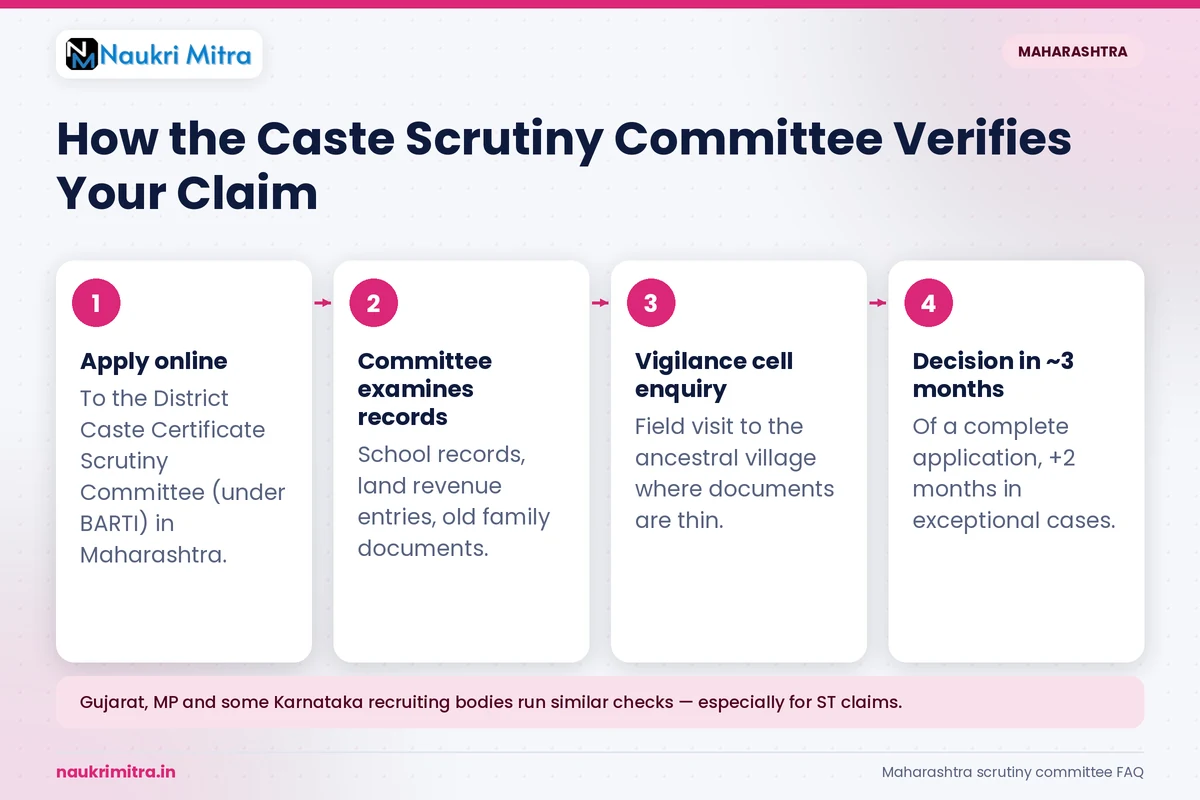
Maharashtra is the state where this distinction is most rigorously enforced. Its District Caste Certificate Scrutiny Committees, functioning under the administrative umbrella of BARTI (the Dr. Babasaheb Ambedkar Research and Training Institute), process validity applications through an online portal and are expected to decide within three months of a complete application, with a possible two-month extension in exceptional cases, according to the official scrutiny committee's own published FAQ. Gujarat runs a comparable system under its Scheduled Castes, Scheduled Tribes and Other Backward Classes (Regulation of Issuance and Verification of Caste Certificates) Act, which specifically mandates verification of Scheduled Tribe claims before they can be relied upon for employment and education benefits. Several other states, including Madhya Pradesh and parts of Karnataka's recruiting bodies, run similar scrutiny mechanisms for ST claims in particular, because tribal status has historically been the category most contested at the verification stage.
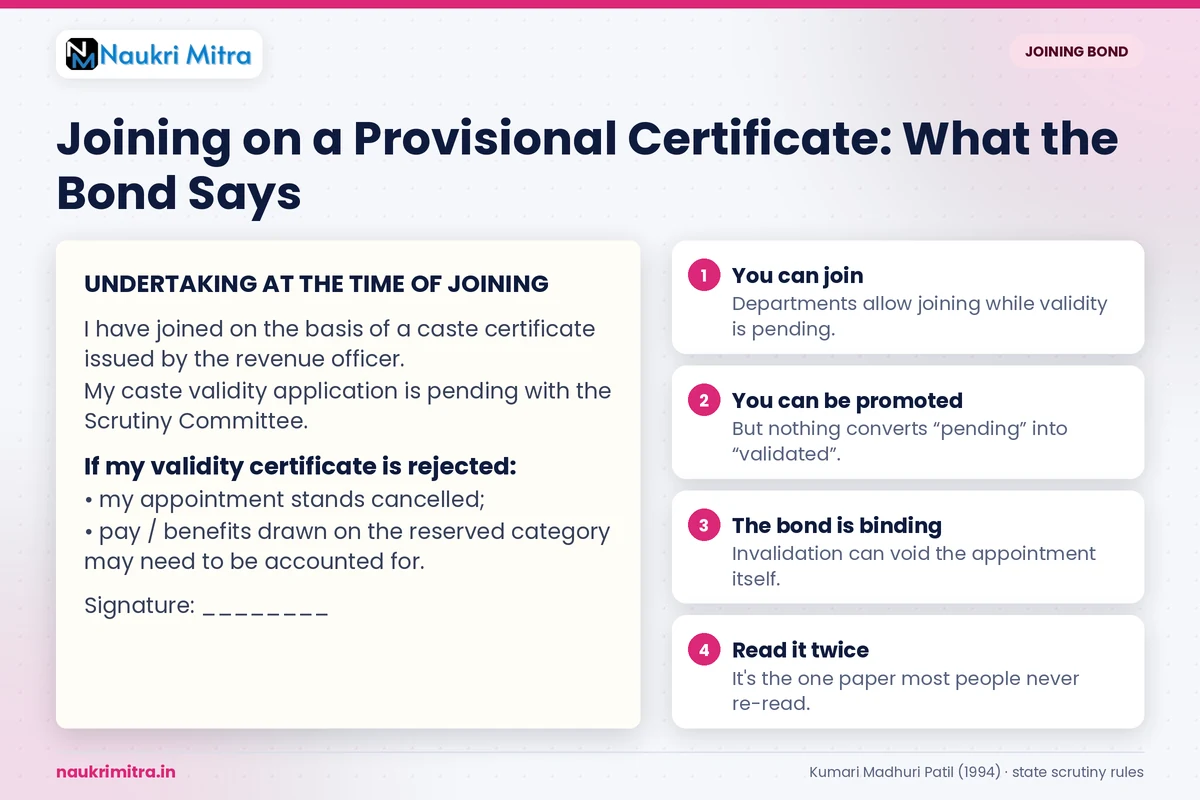
Joining on a Provisional Certificate: Read What You're Actually Signing
Here is the part that catches candidates off guard. Scrutiny committees routinely take several months to years to clear a backlog of applications, and recruitment timelines rarely wait that long. So most departments allow a candidate to join on a provisional caste certificate — the basic one from the revenue officer — while the validity application is pending with the scrutiny committee. That sounds like a reasonable workaround, and for most candidates it is. But it comes with a condition that candidates sign and then forget about: a bond or undertaking stating that if the validity certificate is eventually rejected, the appointment stands cancelled, any pay or benefits drawn on the strength of the reserved category may need to be accounted for, and in some service rules, the candidate's continued employment itself becomes void from the date of invalidation, not just from the date of the order.
This provisional caste certificate job arrangement works for most people, but it is still worth knowing exactly what you agreed to. This is why the question "can you join on a provisional certificate" has a yes-but answer. You can join. You can draw a salary. You can even get promoted. None of that converts a pending validity application into a validated one. The provisional certificate is a bridge, not a destination, and the bond you sign at joining is the one document in the entire recruitment file that most people never read twice.
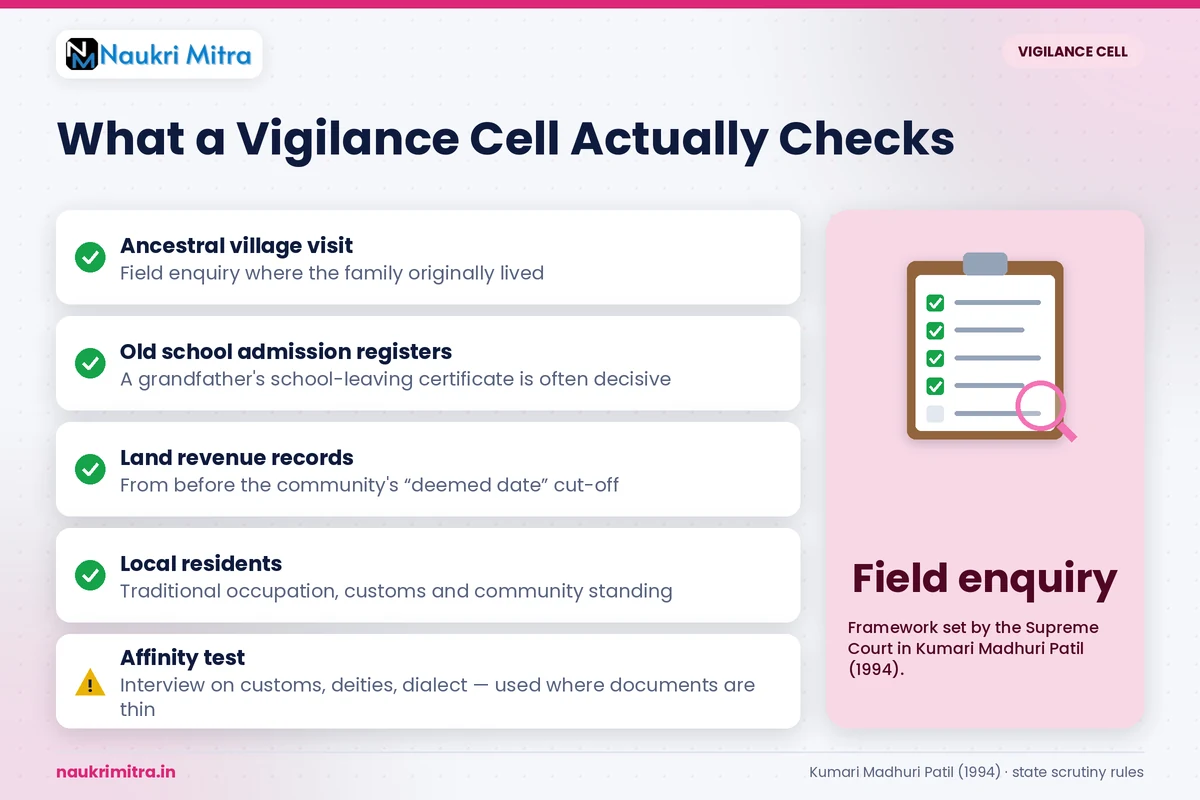
Inside the Scrutiny Committee: What a Vigilance Cell Actually Checks
The procedure most scrutiny committees in India follow today traces back to the Supreme Court's 1994 ruling in Kumari Madhuri Patil v. Additional Commissioner, Tribal Development, which laid down the framework that every state has since adapted into its own rules: a scrutiny committee headed by an Additional Commissioner-rank officer, supported by a vigilance cell empowered to conduct field enquiries, and a summary procedure where the candidate gets a chance to produce evidence before any adverse order.
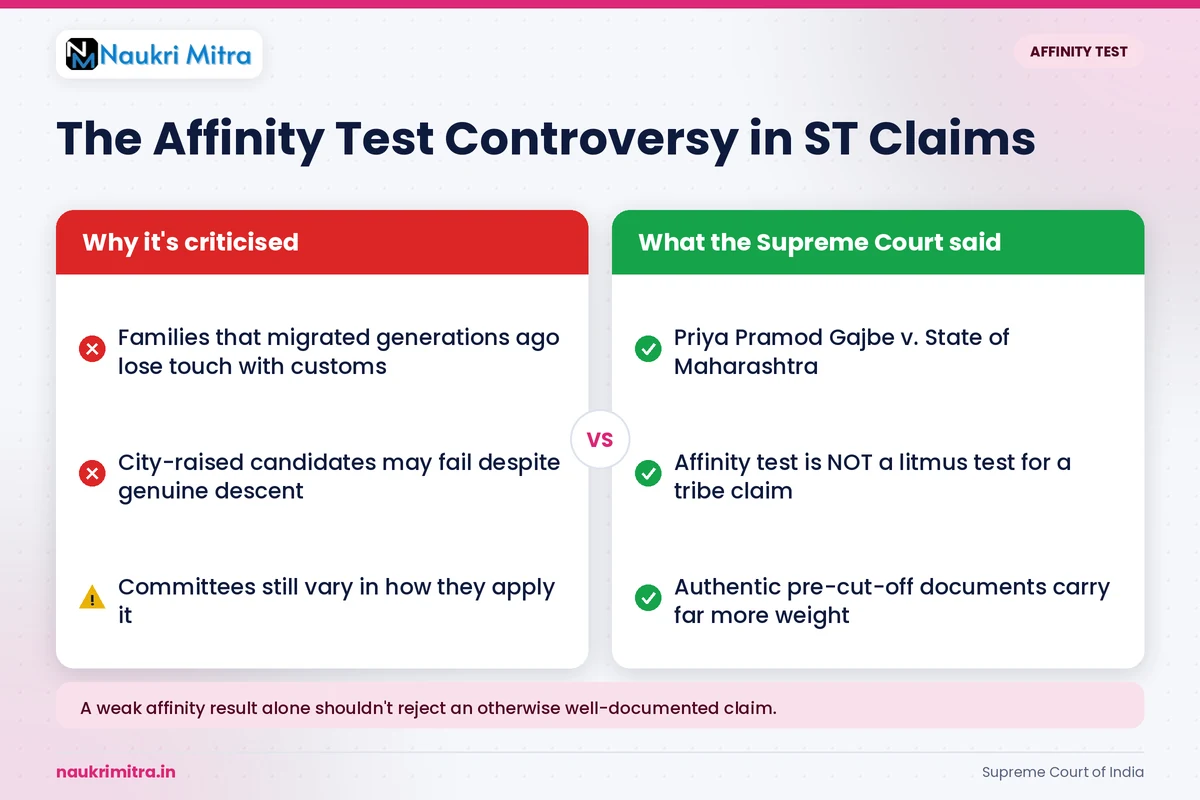
This vigilance cell caste verification work is what actually separates a scrutiny committee from a simple desk review of paperwork. In practice, it means a vigilance officer may visit the candidate's ancestral village, examine old school admission registers (the "school leaving certificate" of a grandfather or great-uncle is often the single most decisive document), check land revenue records from before the relevant "deemed date" cut-off for that community, and interview local residents about the family's traditional occupation, social customs, and community standing. Where documentary evidence is thin, committees have historically leaned on what is called an affinity test — essentially an interview-style assessment of the candidate's familiarity with the customs, deities, dialect, and social practices traditionally associated with the claimed Scheduled Tribe.
Affinity test caste verification has drawn sustained criticism, and for good reason. Families that migrated generations ago, were raised in cities, or simply assimilated into the mainstream may have lost touch with specific tribal customs despite having an entirely legitimate claim by descent. The Supreme Court addressed this directly in Priya Pramod Gajbe v. State of Maharashtra, holding that an affinity test cannot be treated as a litmus test for deciding a tribe claim, and that authentic documents from before the relevant cut-off date carry far greater evidentiary weight than a candidate's performance in a cultural-knowledge interview. That ruling matters enormously for anyone currently facing scrutiny, because it means a weak affinity-test result, on its own, should not be grounds for rejecting an otherwise well-documented claim — though in practice, committees still vary in how closely they follow that guidance.
When the Claim Is Invalidated After You've Already Built a Career on It
This is the scenario that keeps serving government employees awake at night, and it is not hypothetical. A caste claim invalidated after appointment does not automatically mean the department forgives and moves on; service rules in most states treat the appointment itself as void from the point the validity certificate is cancelled, because the reserved-category vacancy was never legitimately filled. Whether you frame it as a caste certificate cancelled after selection government job case or simply a rejected validity application, the legal mechanics are identical.
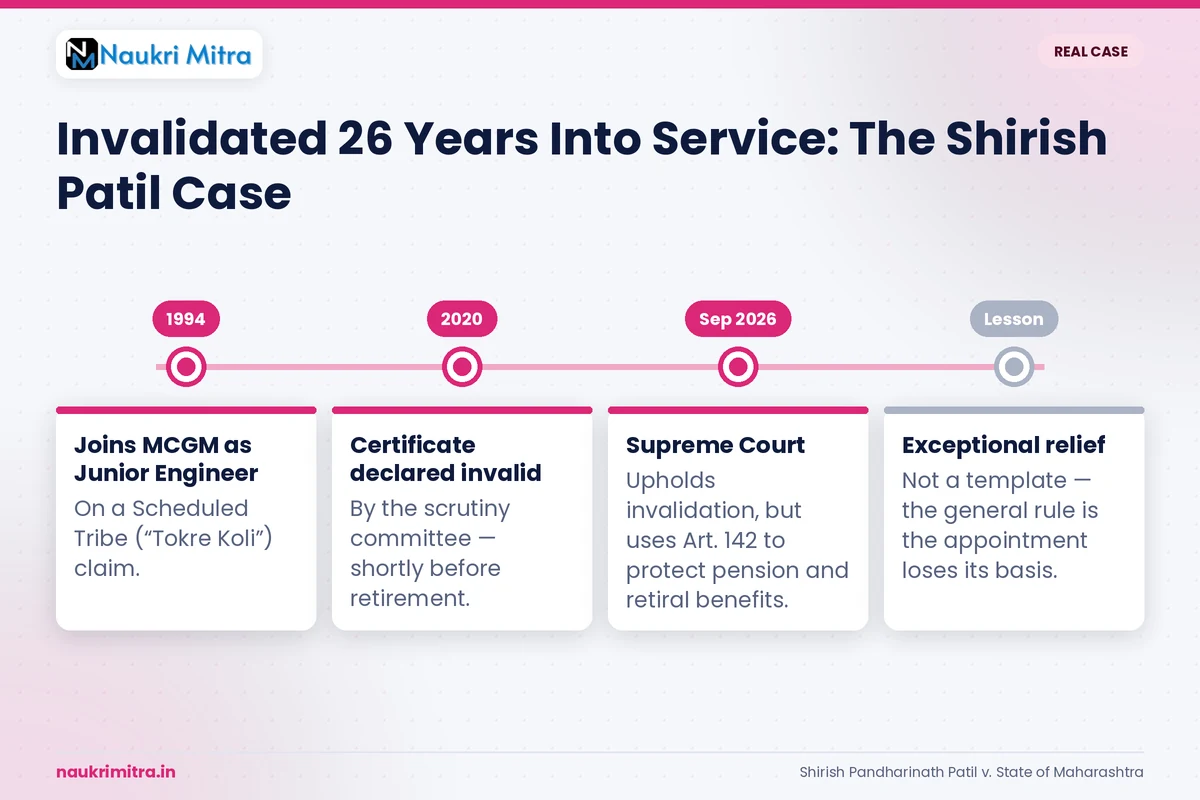
A recent Supreme Court decision illustrates exactly how harsh — and how narrowly mitigated — this can get. In Shirish Pandharinath Patil v. State of Maharashtra, decided in September 2026, a Junior Engineer with the Municipal Corporation of Greater Mumbai, who had joined service in 1994 on a Scheduled Tribe ("Tokre Koli") claim, had his caste certificate declared invalid by the scrutiny committee only in 2020 — twenty-six years into his career, and shortly before his retirement. The Supreme Court upheld the invalidation of the certificate itself, but used its special powers under Article 142 of the Constitution to protect the pension and retiral benefits he had earned over more than two decades of otherwise unblemished service, while making clear that this was an exceptional, one-off equitable relief and did not validate the original caste claim or restore the reserved-category appointment.
That outcome is as good as it gets for an employee caught in this situation, and it required the highest court in the country to step in using an extraordinary constitutional power rarely invoked for individual relief. It is not a template anyone should plan around. The general rule remains that caste certificate cancellation after selection for a government job strips away the legal basis of the appointment, and departments are well within their rights to act on that — including years after the person has been drawing a salary, getting annual increments, and perhaps even being promoted on the strength of a claim nobody had actually verified yet.
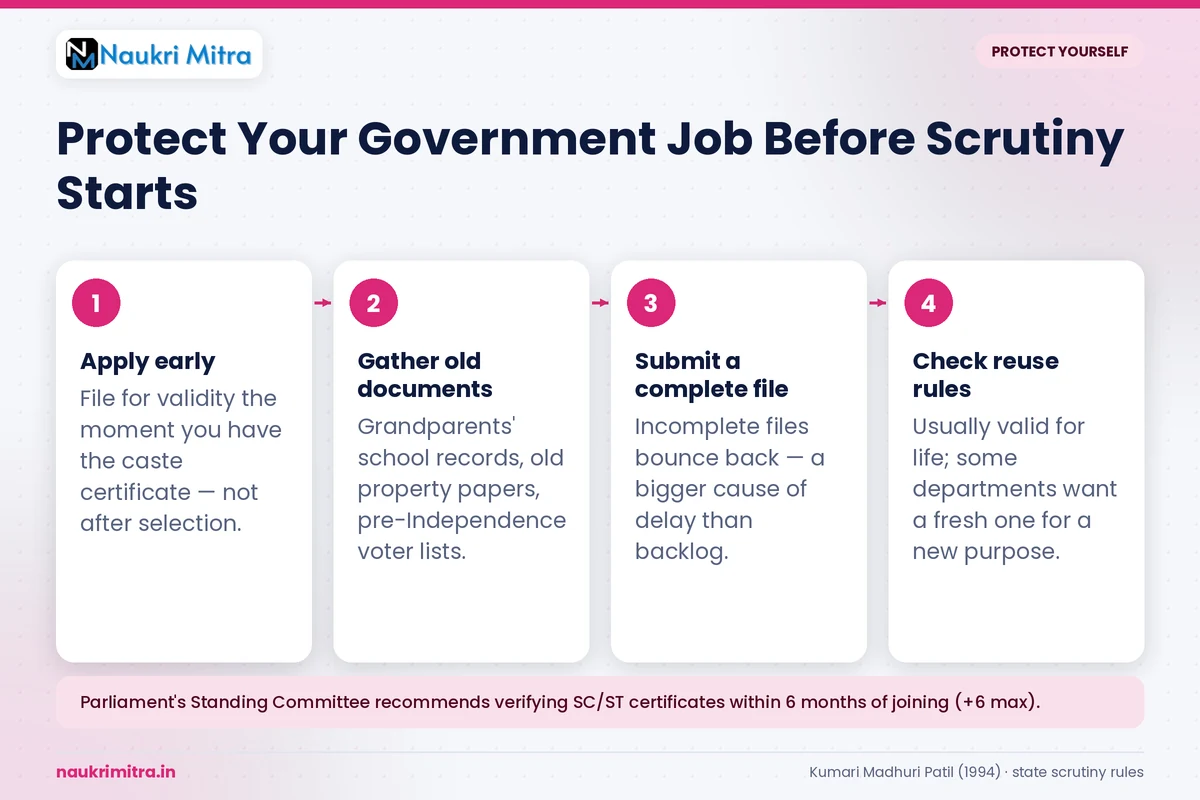
Parliament's own Standing Committee has flagged how badly delayed this verification routinely is. It recommended that departments verify SC/ST certificates within six months of an employee joining service, extendable by at most another six months in genuinely difficult cases, specifically because long delays mean records go missing, the officials who issued the original certificate retire or get transferred, and employees end up fighting decades-old paperwork battles with no one left who remembers the original facts. That recommendation is sound policy, but it is not binding law in every department, which is exactly why candidates cannot assume a validity certificate pending for years will simply resolve itself favourably through inaction.
Appealing a Rejection — and What the Committee Can Still Ask For
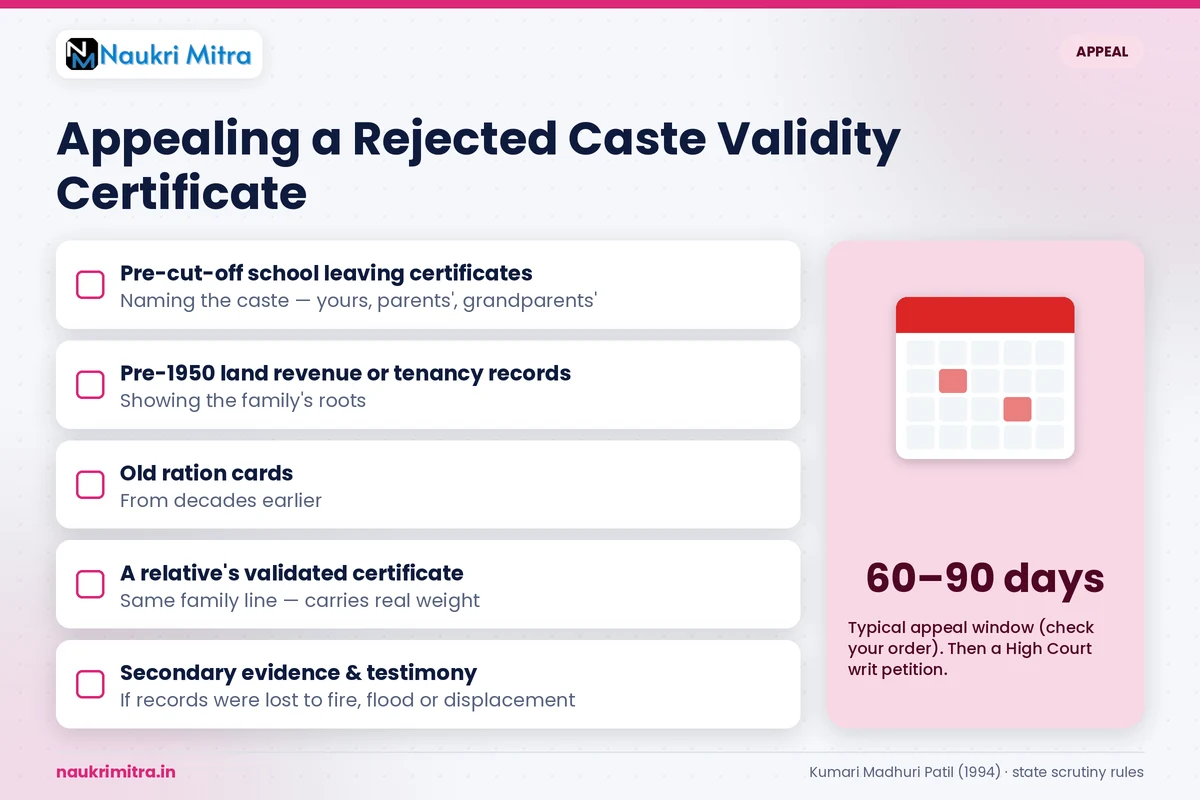
A rejected validity application is not automatically the end of the road. Most state rules allow an appeal, usually to a Divisional Commissioner-level appellate authority or, in some states, a dedicated caste scrutiny appellate tribunal, within a fixed window — commonly 60 to 90 days from the rejection order, though the exact period varies by state and should always be checked against the specific order received, since it is printed on the rejection letter itself. Beyond that, a writ petition to the jurisdictional High Court remains available, and a fair volume of the case law on this subject exists precisely because candidates have gone to court after an adverse scrutiny committee order.
What strengthens an appeal, and ideally what should go into the original application long before rejection becomes a risk, is documentary evidence that predates the relevant cut-off date for that state and community — old school leaving certificates naming caste, pre-1950 land revenue or tenancy records, ration cards from decades earlier, and crucially, a sibling's or close relative's already-validated certificate from the same family line. A validated certificate belonging to a blood relative carries real weight, because it establishes that the same scrutiny process has already accepted the family's claim once. Where the family genuinely no longer possesses old records — common after fires, floods, Partition-era displacement, or simple loss over generations — committees are supposed to allow secondary evidence and testimony, but in practice the burden still falls heavily on the applicant to produce something.
Protecting Yourself Before the Scrutiny Letter Ever Arrives
The single most useful thing a candidate can do is stop treating the validity certificate as paperwork to deal with after joining. Apply the moment the caste certificate is in hand, not after receiving the selection letter. Gather every pre-cut-off-date document the family has — school records of grandparents, old property papers, pre-Independence voter lists where available, and certified copies of any relative's validity certificate — and keep certified copies in a dedicated folder. What candidates usually experience as a caste scrutiny committee verification delay job problem is often caused less by committee backlog and more by applicants submitting incomplete files that bounce back for resubmission.
It also helps to know that a validity certificate, once issued, is generally treated as valid for life and does not need to be repeated for every subsequent government job or promotion in most states — though a few departments still insist on a fresh application if the earlier one was issued for a different purpose (education versus employment, for instance) or by a committee outside the state of current employment. Checking this specific rule with the recruiting department, rather than assuming, avoids an unpleasant surprise at a later promotion review. Candidates preparing for recruitment exams and tracking the latest openings can follow verified government and PSU vacancy updates on Naukri Mitra, which is also a reasonable habit for staying current on which departments have tightened their document and validity requirements in recent recruitment cycles.
Frequently Asked Questions
What's the real difference between a caste certificate and a caste validity certificate?
A caste certificate is issued on the basis of the applicant's declaration and basic supporting documents by a revenue officer like a Tehsildar or SDM. A caste validity certificate for government job purposes is issued only after an independent scrutiny committee verifies the claim through document checks and, where needed, a vigilance enquiry. The certificate gets you through the application stage; the validity certificate is what makes the reserved-category appointment legally secure.
Which states actually require a separate validity certificate for government jobs?
Maharashtra runs the most structured and widely used system, through District Caste Certificate Scrutiny Committees under BARTI. Gujarat has its own statutory scrutiny mechanism, particularly for Scheduled Tribe claims, under a dedicated 2018 Act. Several other states apply scrutiny requirements more selectively, often focused on ST claims given how frequently those have been contested historically.
How long does the scrutiny committee take to issue a validity certificate?
In Maharashtra, the committee is expected to decide within three months of receiving a complete application, extendable by up to two more months in difficult cases, per the committee's own published procedure. In practice, incomplete applications, missing old records, or a heavy backlog can push this well beyond the stated timeline.
Is there a fixed answer to caste validity certificate required within how many days of joining?
Not a single uniform number across India. Maharashtra's scrutiny committee aims to decide a complete application within three months, extendable by two more, but that is a processing timeline for the committee, not a submission deadline for the candidate. Individual recruiting departments set their own submission windows in the appointment order or service rules — commonly somewhere between a few months and a year of joining — so candidates should get this specific deadline in writing rather than assume it matches the committee's own internal timeline.
Can you join a government job on a provisional caste certificate while validity is pending?
Yes, most recruiting departments allow this, since scrutiny can take far longer than a recruitment process can wait. But joining is conditional on a signed bond or undertaking: if the validity certificate is later rejected, the appointment is treated as void, often retroactively, and the candidate may need to account for salary or benefits drawn in the reserved category.
What actually happens if the caste claim is invalidated after someone has already joined and worked for years?
Service rules generally treat the appointment as void from the point of invalidation, because the post was never legitimately filled by a validated reserved-category candidate. Courts have, in rare and specific circumstances, protected pension or retiral benefits already earned — as the Supreme Court did in Shirish Pandharinath Patil v. State of Maharashtra after twenty-six years of service — but this kind of relief is exceptional, not guaranteed, and does not revive the original appointment or validate the caste claim.
What is an affinity test, and why is it controversial?
It's an interview-style assessment, used mainly for Scheduled Tribe claims, checking a candidate's familiarity with the customs, dialect, and traditions associated with the claimed community. It's controversial because urbanisation and generations of migration mean genuine descendants can fail it despite having a legitimate claim. The Supreme Court has held that an affinity test cannot be used as the sole or decisive basis for rejecting a claim when solid documentary evidence exists.
What documents actually strengthen a validity application?
Anything predating the relevant cut-off date for that state and community carries the most weight: old school leaving certificates mentioning caste, pre-cut-off land or tenancy records, and especially a close relative's already-validated certificate from the same family. Committees are supposed to accept secondary evidence where original records are genuinely unavailable, but applicants still carry the burden of producing something credible.
Can you appeal a rejected validity certificate, and where?
Yes. Most states provide an appellate authority, typically at the Divisional Commissioner level or a dedicated appellate body, with a fixed filing window stated on the rejection order itself. Beyond that administrative appeal, approaching the jurisdictional High Court through a writ petition remains an option, and a substantial body of case law exists from candidates who have done exactly that.
Is a validity certificate valid for life, or needed again for a later job or promotion?
Generally it is treated as a lifetime document and doesn't need to be repeated for later government jobs or promotions in the same state. Some departments, however, insist on a fresh application if the original was obtained for a different purpose, such as education rather than employment, or issued by a scrutiny committee outside the state of current posting — so it's worth confirming the exact position with the specific recruiting department.
Why does verification sometimes drag on for years instead of months?
Parliament's own Standing Committee has acknowledged the problem, recommending verification be completed within six months of joining, extendable by at most another six. Delays usually stem from old records being hard to trace, the original issuing officials having retired or transferred, and a general backlog across departments and PSUs — which is exactly why the Committee pushed for a firm, time-bound process rather than leaving it open-ended.
Sources: LiveLaw – Supreme Court Allows Retiral Benefits To Employee Whose ST Certificate Was Found Invalid After 25 Years' Service, LiveLaw – Affinity Test Cannot Be Applied As Litmus Test For Scrutinizing Caste Claims, BARTI CCVIS – Caste Certificate Scrutiny Committee FAQ, Government of Maharashtra.
.png)
.png)
.png)
Comments
Post a Comment