EPF Withdrawal Rules During Unemployment | Naukri Mitra
If you have just resigned, been let go, or are sitting between two offers wondering what to do with the provident fund sitting quietly in your old employer's account, you are not alone — this is one of the most searched EPF questions in India, and also one of the most misunderstood. Somewhere along the way, a lot of well-meaning blog posts turned a fairly simple rule into something that sounds like it adds up to more money than it actually does. It doesn't. There is no scenario where a 75% PF withdrawal after 1 month unemployment adds up to another full 100% on top of it later. Once you understand how the two withdrawal stages actually fit together, the whole thing stops feeling like a maze.
This piece walks through exactly when you can touch your PF after leaving a job, what counts as "unemployed" in EPFO's eyes, what happens to your pension portion, what it costs you in tax, and — maybe the more important question — whether withdrawing is even the smart move compared to simply transferring the balance into your next job's account.
The two stages, and why they are not additive
EPFO built two separate provisions for people who are out of work, added at different points in time, and that is exactly why the confusion exists.
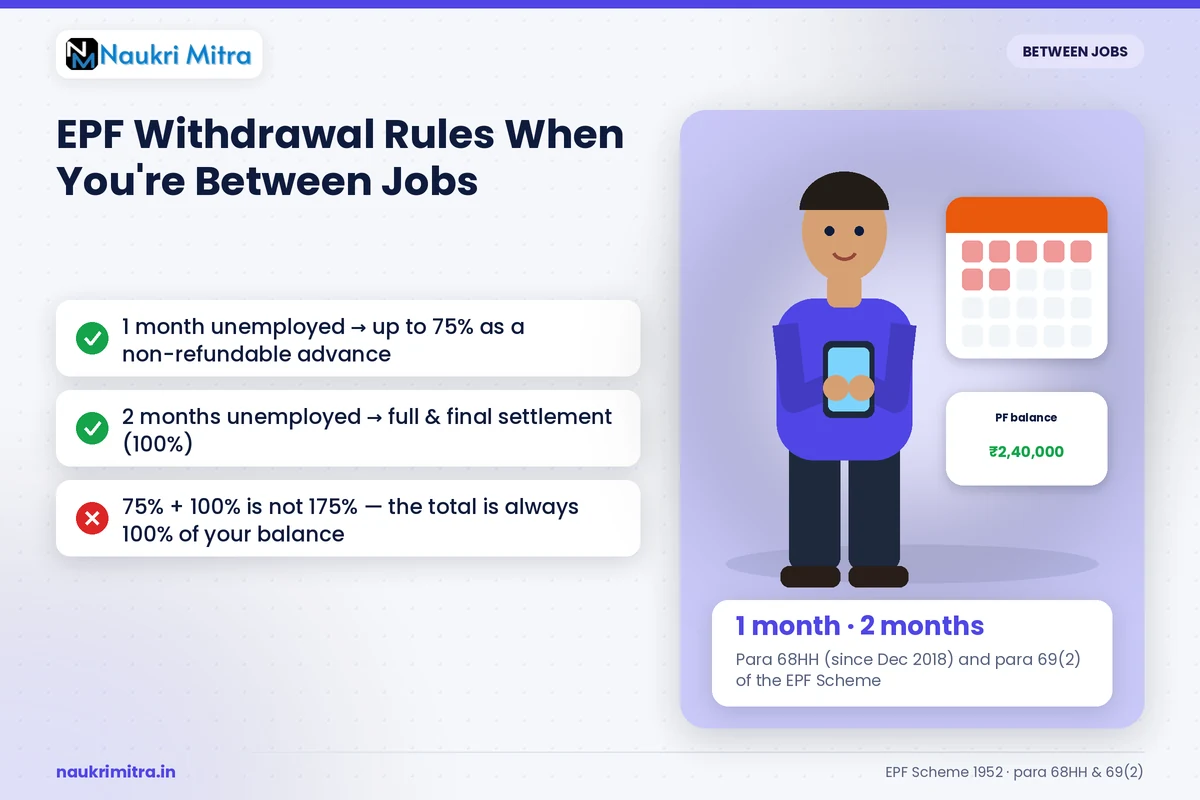
The older rule, under paragraph 69(2) of the Employees' Provident Fund Scheme, 1952, lets a member apply for a full and final settlement of their PF account once they have been continuously unemployed for two months. This closes the account and pays out the entire employee and employer share.
The newer rule, paragraph 68HH, was inserted in December 2018 specifically so people did not have to wait the full two months if they needed money sooner. It allows a non-refundable advance PF withdrawal of up to 75% of the balance after just one continuous month without a job, while leaving your PF account open and your EPFO membership intact.
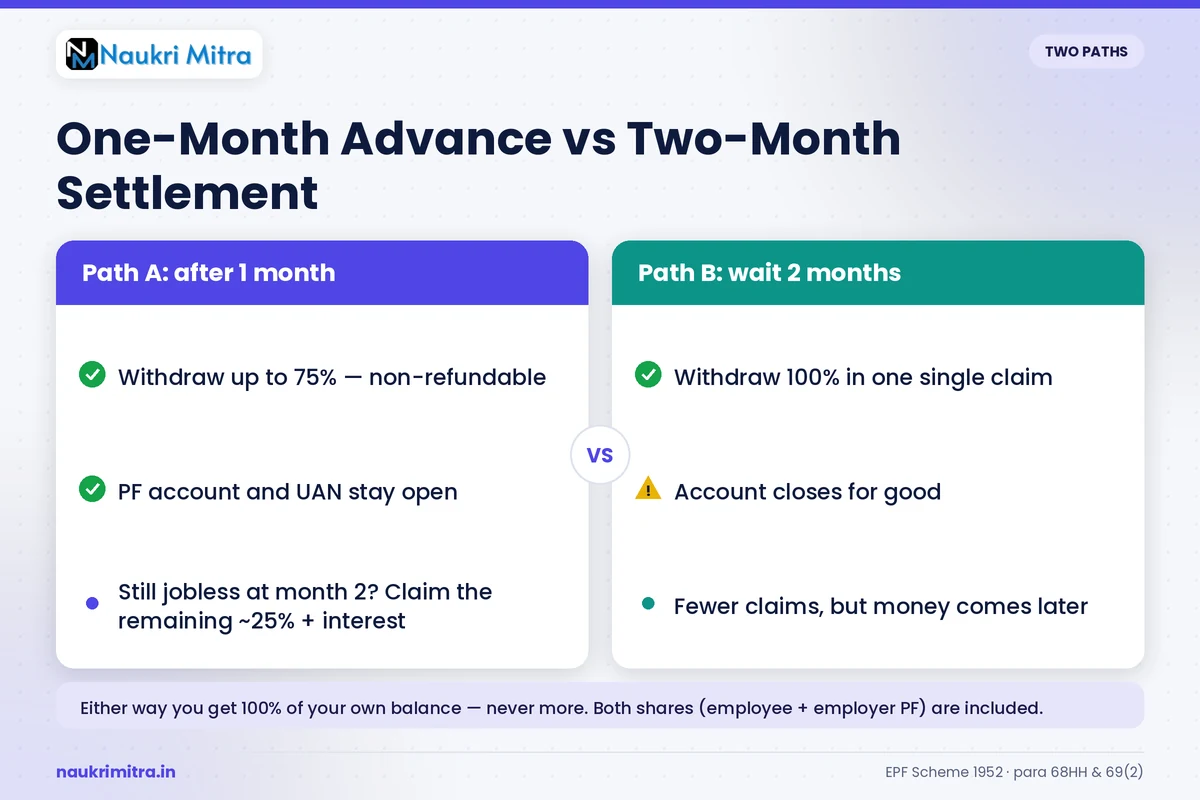
Here is the part people get wrong: if you take the 75% after one month, you have not used up a separate quota. You have simply withdrawn most of your own money early. If you are still unemployed when the second month arrives, you can then apply for the remaining balance — roughly the last 25%, plus any interest it earned in the meantime — and that closes the account for good. Add it up and you still land at 100% of what was sitting there, never more. The alternative path is to skip the one-month option entirely and wait for two months, at which point you can withdraw the full 100% in one single claim instead of two.
| Path | When | What you get | What happens to the account |
|---|---|---|---|
| Para 68HH advance | After 1 full month unemployed | Up to 75% of PF balance | Stays open; membership continues |
| Para 69(2) final settlement | After 2 full months unemployed | Remaining balance (or full 100% if you hadn't claimed the 75%) | Account closes |
So when someone asks what the EPF 1 month vs 2 month withdrawal rule actually means in practice, this is the honest answer: it is a choice between taking some money sooner while keeping the account open, or waiting a bit longer and taking everything at once and shutting it down. Both the employee's own contribution and the employer's PF contribution (the portion that is not diverted to pension) are included in whichever amount you claim — EPFO does not let you cherry-pick only your own share.
What EPFO actually means by "unemployed"
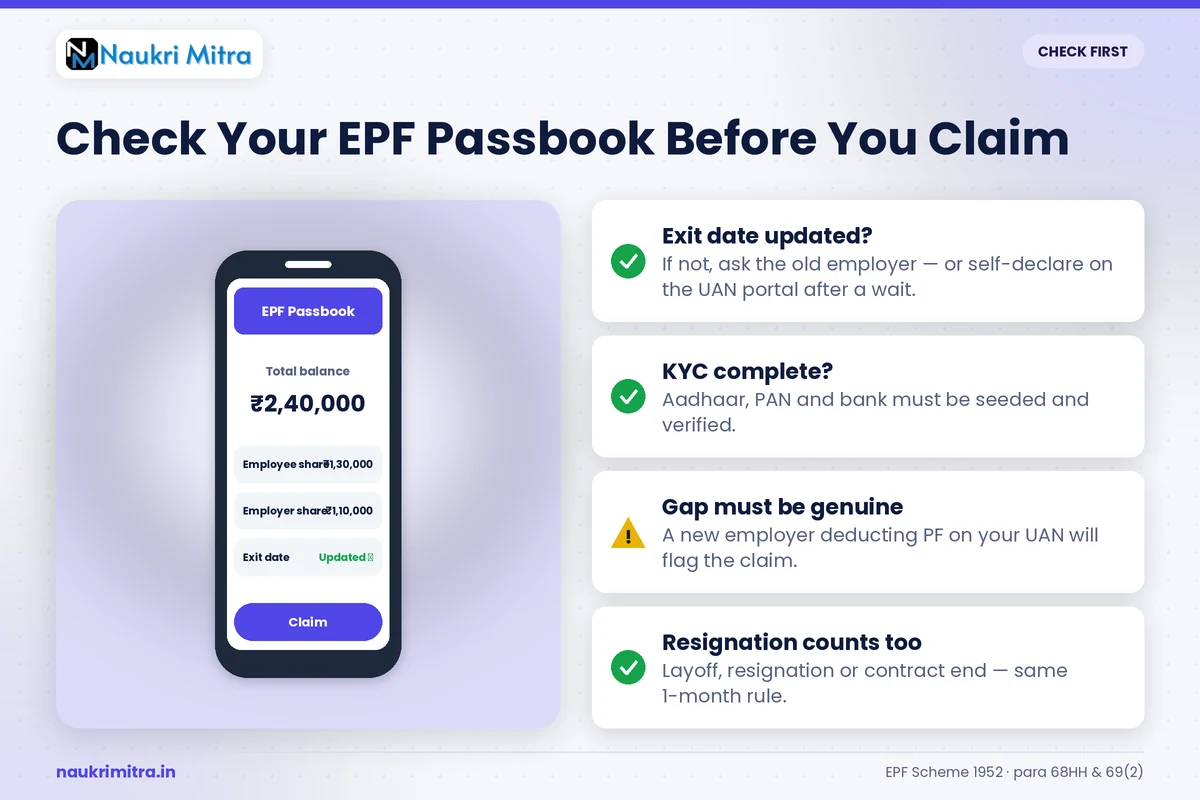
This is where a lot of job seekers trip up. The rule does not care why your last job ended — resignation, layoff, contract ending, or a company shutting down all count the same way. What matters is a continuous gap with no EPF-covered employer marking contributions against your UAN. A genuine EPF withdrawal after resignation before new job offer is exactly what this provision was designed for; you do not need to have been fired or retrenched to qualify. A partial PF withdrawal, job loss or voluntary resignation alike, follows the same one-month rule regardless of why you actually left. That said, the gap has to be real and continuous. If you resign on a Friday and join a new EPF-covered employer the following Monday, you were never "unemployed" in the sense the scheme means, and there is nothing to withdraw against. Short notice-period overlaps, a quick switch within the same corporate group where PF contributions never actually stopped, or an internal transfer that keeps your UAN active all fall outside this provision, because the underlying test is whether contributions genuinely paused for a full calendar month or two — not whether you personally felt "between jobs." If your new employer is already deducting PF under the same UAN, EPFO's system will usually flag the claim rather than process it.
It is also worth separating this from EPFO's other partial-withdrawal provisions — the ones for medical emergencies, a child's education or wedding, or buying a house. Those have their own service-tenure conditions and caps, and they do not require you to be unemployed at all. The 75%/100% unemployment route is the only one tied purely to a gap in your job status.
Do you have to prove it, or is it just self-declared?
When you file the claim online, you are not asked to upload an unemployment certificate, a job-loss letter, or anything from a previous HR department. The declaration itself, made while filling the claim, is the formal statement that you meet the gap requirement. In practice, EPFO's verification leans heavily on the data already in the system: specifically, whether your previous employer has marked your "date of exit" against your UAN on the EPFO portal, and whether any new employer has started a fresh contribution since. The system cross-checks the gap electronically rather than asking you to produce paperwork proving where you weren't working. That is precisely why claims most often get stuck not because someone doubts you were jobless, but because the former employer simply never logged an exit date. Without that date on record, EPFO's system cannot calculate your unemployment period at all, and the claim gets auto-rejected regardless of how genuinely unemployed you are.
Your pension portion runs on a different clock
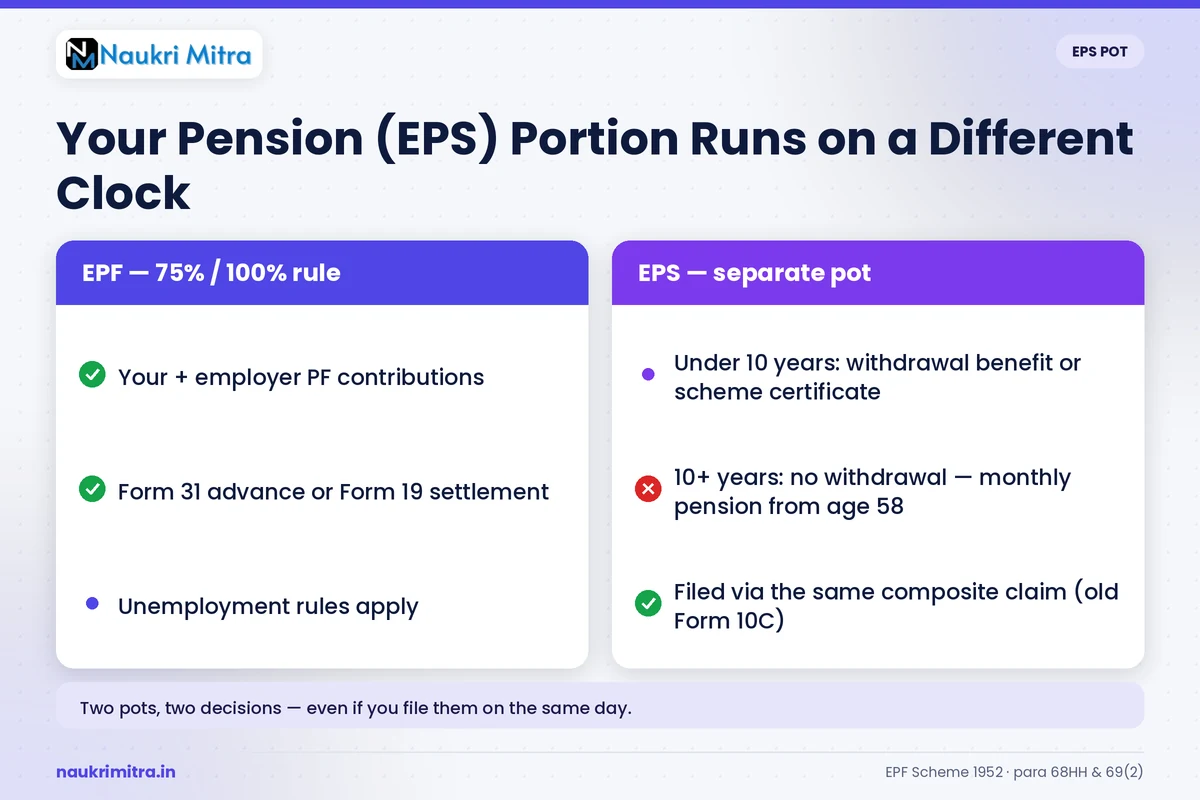
One detail that trips up almost everyone: the 75%/100% rule covers your EPF — the provident fund corpus made up of your own and your employer's contributions. It does not touch the Employees' Pension Scheme (EPS) share, which your employer routes separately (up to the statutory wage ceiling) every month. That money lives in its own pot and follows its own rules. If your total pensionable service is under 10 years, you have two choices for that EPS balance once you've left a job: take the EPS withdrawal benefit as a lump sum (filed, in practice, through the same composite claim form that used to be the standalone Form 10C), or opt for a scheme certificate that preserves your pensionable service so it can be added to a future employer's tenure later. Cross 10 years of combined pensionable service and withdrawal is no longer an option — the EPS corpus instead converts into a monthly pension payable from age 58. In short: your 75% or 100% PF withdrawal and your EPS decision are two separate forms, two separate pots of money, and two separate questions, even though many people file them together on the same day because the composite claim form bundles the options on one screen.
Filing the claim: Form 31, your UAN, and the composite claim form
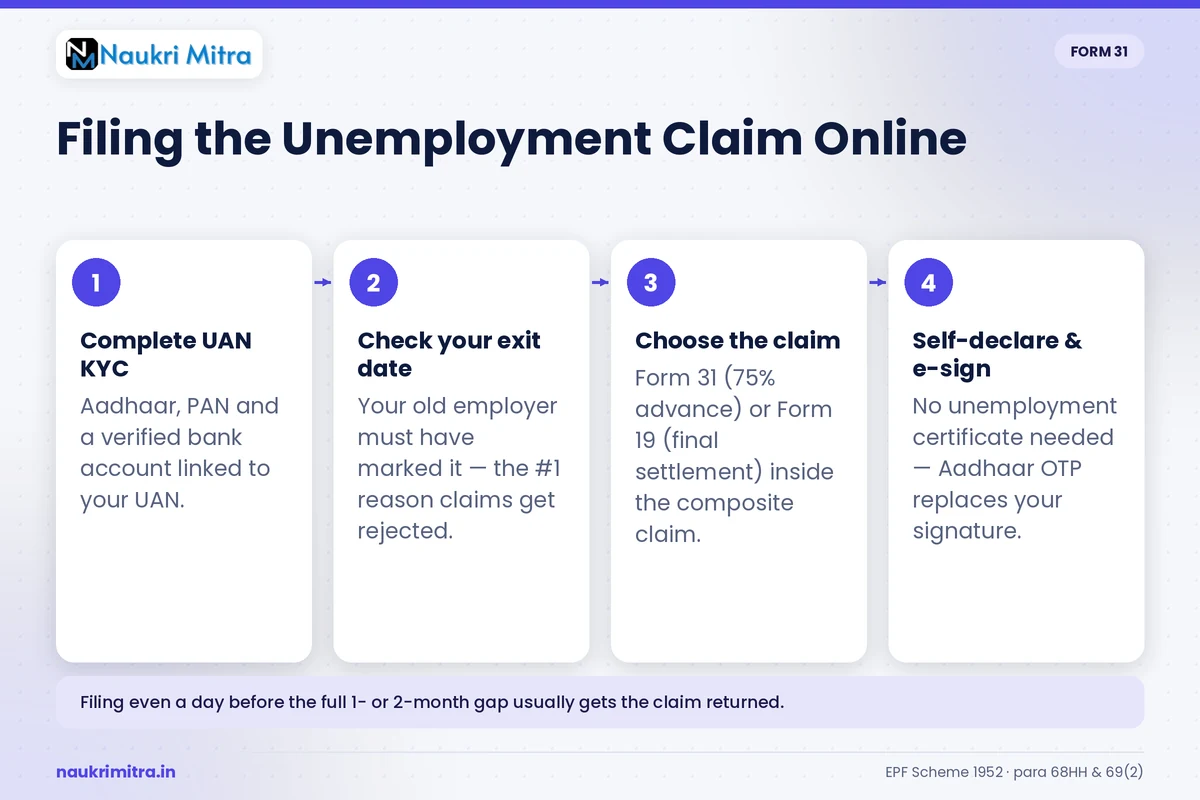
Both the one-month advance and the two-month final settlement are filed using what EPFO still internally labels Form 31 for the partial advance and Form 19 for final settlement, though in the member portal you will mostly just see them as options inside the single online Composite Claim Form. This is really what people mean by a Form 31 unemployment withdrawal — it's the same underlying form EPFO uses for other advances like medical or housing, just with the unemployment reason selected and the relevant gap period entered. Your UAN KYC withdrawal eligibility really comes down to three linked details: Aadhaar, PAN, and a verified bank account. If your UAN is fully KYC-linked — meaning all three are seeded and verified against it — you can file the entire claim online yourself, with your Aadhaar-based e-signature standing in for a physical signature, and no attestation needed from your old employer. This is effectively how most people manage a PF withdrawal without resignation letter or any other paperwork from their previous company changing hands: EPFO doesn't ask for the resignation letter itself, only for the exit date your employer logs in its system. If your UAN KYC is incomplete, the online route isn't available, and you will need the offline composite claim form with your previous employer's physical attestation — a much slower path, which is one more reason to get your Aadhaar, PAN, and bank details updated and verified on the UAN portal well before you plan to file. A few practical snags worth knowing in advance:
- There is effectively a short cooling-off period built into the math itself — EPFO's system calculates the gap from your recorded exit date, so filing even a day before you hit the full one- or two-month mark will usually see the claim rejected or returned for correction, not approved early.
- The single most common rejection reason is "employer has not updated exit date." If this happens, you (or your previous employer, if they're cooperative) need to update the date of exit on the EPFO employer portal before resubmitting; if the employer is unresponsive, EPFO also allows the member to self-declare the exit date on the UAN portal after a waiting period, as a fallback.
- If you already used the 75% advance and come back for the remaining balance at the two-month mark, you generally do not need to redo your KYC from scratch — the same verified UAN carries over, provided nothing on your Aadhaar, PAN, or bank details has changed in between.
Is the money taxable?
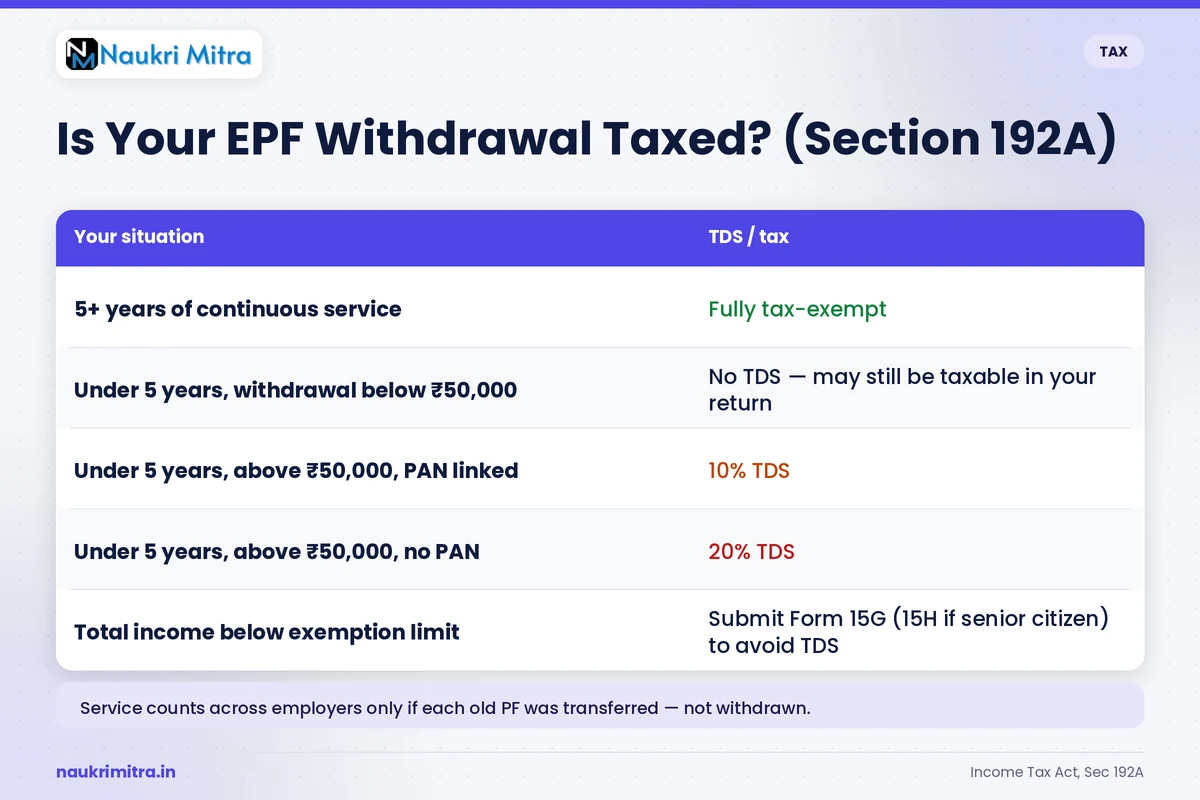
This is the part that genuinely changes the arithmetic, so it is worth being precise. If you withdraw your PF — whether as the 75% advance or the full settlement — before completing five years of continuous service, the withdrawal becomes taxable as income in the year you receive it, under the head "profits in lieu of salary" for the employer's contribution and interest portions. "Continuous service" here is counted cumulatively across employers as long as each PF account was transferred, not withdrawn, when you moved jobs; a transferred PF carries its original start date forward. Tax deducted at source applies specifically under Section 192A: if the withdrawal exceeds ₹50,000 and you haven't completed five years of service, EPFO deducts 10% TDS when your PAN is linked to your UAN, or a flat 20% when it isn't. If your total income for the year, including this withdrawal, falls below the basic exemption limit, you can submit Form 15G (or Form 15H if you are a senior citizen) at the time of filing the claim to avoid the TDS deduction altogether — though the withdrawal still needs to be reported correctly in your income tax return either way. Withdrawals below ₹50,000 skip TDS regardless of your service length, but the income may still be taxable depending on your overall tax bracket. Cross the five-year continuous-service mark, and the entire withdrawal — both stages of it — becomes fully tax-exempt.
Should you actually withdraw, or just transfer it into your next job?
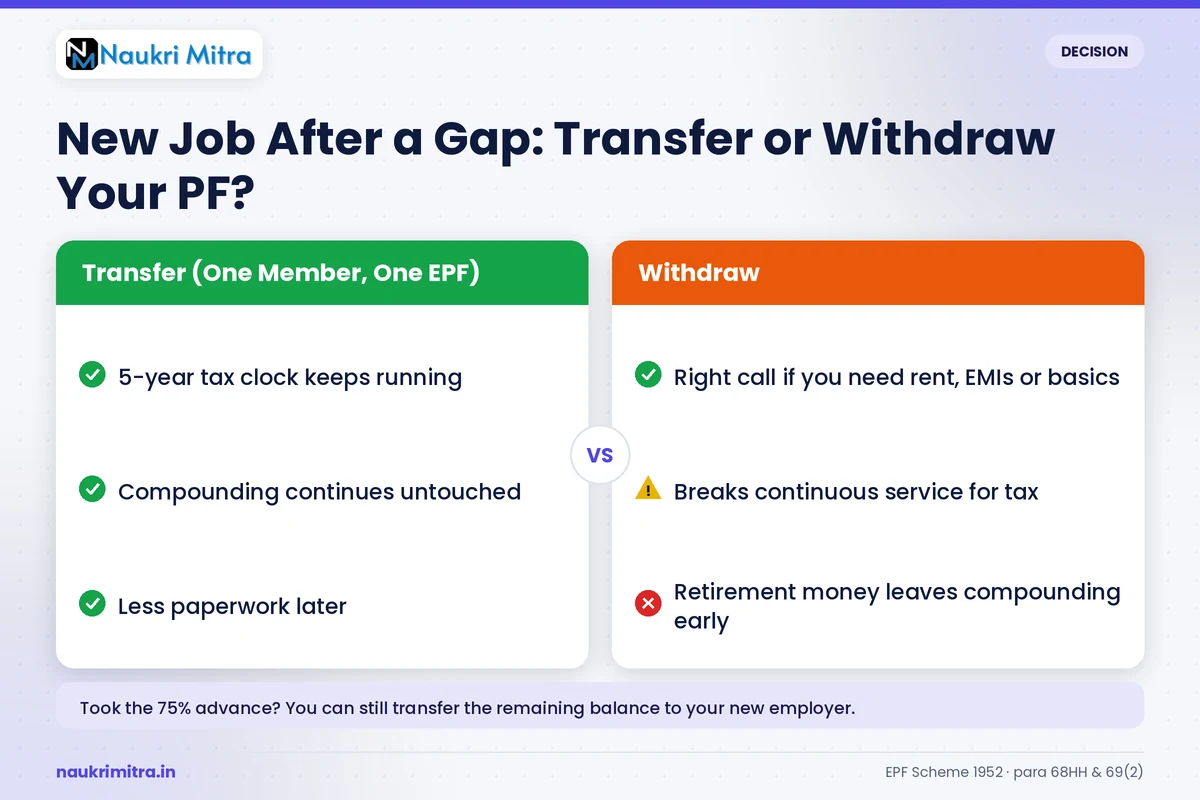
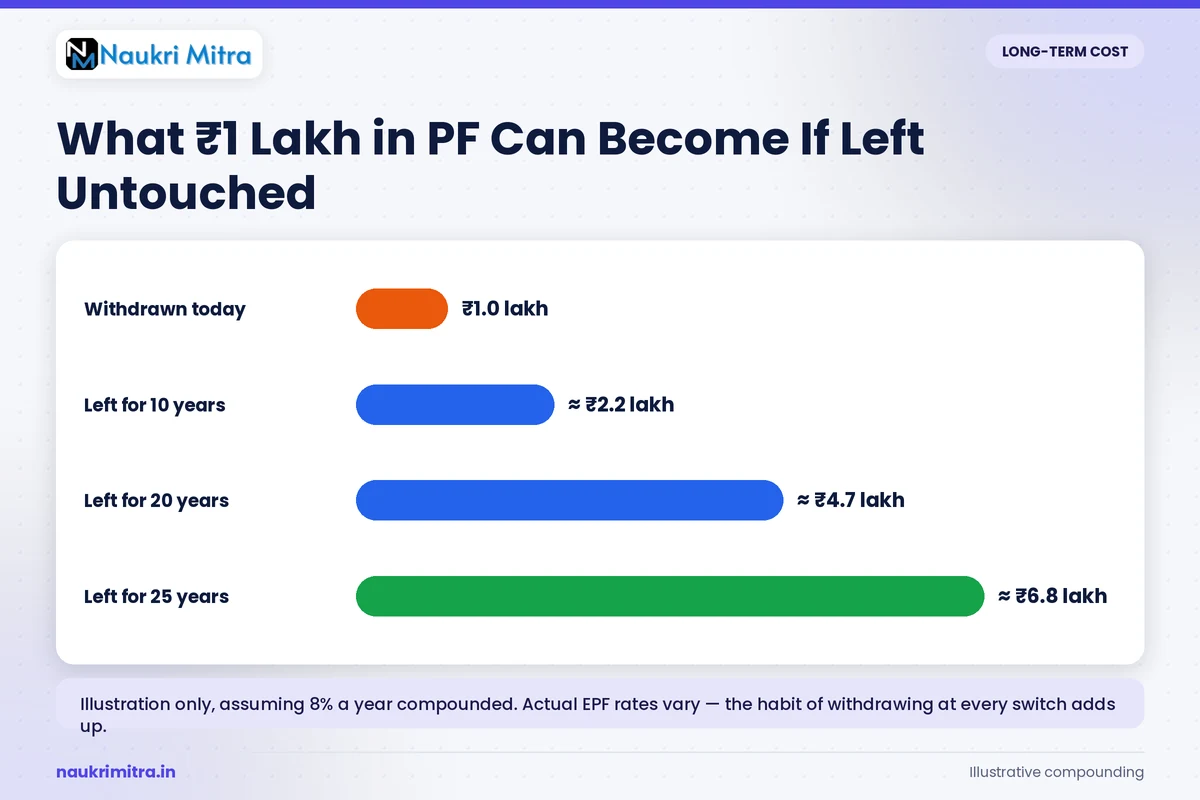
This is genuinely the more useful question than the mechanics above, and it's one worth sitting with before you click submit. PF withdrawal rules between jobs exist because EPFO recognises that people sometimes need the money to cover rent, EMIs, or basic expenses during a gap — and if that's your situation, using the 75% advance is exactly what it's there for; there's no shame or penalty in using a safety net designed for precisely this moment. But if you can manage the gap without touching it, transferring your old PF balance into your new employer's account through the "One Member, One EPF Account" online transfer is usually the stronger long-term move, for three concrete reasons: it keeps your five-year continuous-service clock running uninterrupted (protecting future withdrawals from tax), it keeps the compounding going on a corpus that is otherwise sitting untouched, and it avoids the paperwork of opening a fresh claim with a new employer later. Many people treat withdrawal as the "default" simply because it feels like closure on the old job, when a transfer takes barely more effort and preserves far more value. If you do decide to withdraw now, it's worth remembering this is still your retirement money, pulled out of compounding years before it was meant to be touched. People who habitually withdraw PF every time they change jobs — rather than transferring — quietly lose one of the few disciplined, compounding retirement pools most salaried Indians have, often without noticing the gap until they are much closer to actually needing it. A single withdrawal during a genuinely tough stretch between jobs is nothing to feel guilty about; make it a recurring habit across every job change, though, and the retirement shortfall compounds the same way the interest would have. And while you weigh that decision, it doesn't hurt to actively shorten the gap itself — a focused job search makes both the tax question and the "should I withdraw" question disappear faster than any EPFO form will. If you're currently between roles, you can browse current openings across cities and functions on naukrimitra.in while you sort out the PF side of things — whether that's accountant jobs in Delhi, sales executive jobs in Mumbai, or HR manager jobs in Hyderabad.
Frequently asked questions
If I withdraw 75% after one month and land a new job the following week, do I have to return the money?
No. It's called a non-refundable advance for exactly this reason — once paid, it's yours, and there's no obligation or mechanism to pay it back even if your unemployment ends almost immediately afterward.
Can I withdraw PF if unemployed for 2 months, even though I plan to join a new job within the next few weeks?
Yes. EPFO looks at whether you have already completed two continuous months without EPF-covered employment at the time of filing, not what you plan to do afterward. Once you meet the gap, you're eligible to file, even if you expect to start a new job soon after.
If I take the 75% advance, does my UAN or PF account close?
No — the account stays fully active, and so does your UAN and your EPFO membership, including your pensionable service record. Only the two-month final settlement under paragraph 69(2) closes the account.
If my new employer wants to transfer my old PF, can I still do that after a partial withdrawal?
Yes. Since the account remains open after a 75% advance, whatever balance remains can still be transferred into your new employer's PF account through the standard online transfer request — you are not locked out of transferring just because you took an advance.
Does switching jobs within the same group of companies count as being "unemployed" for this rule?
Generally no, if your PF contributions continued without a break under the same or a linked UAN. The provision is meant for an actual gap in EPF-covered employment, not an internal transfer or a group-company switch where contributions never really stopped.
My claim got rejected for "employer has not marked exit date" — what now?
Reach out to your former employer's HR or payroll team and ask them to update your date of exit on the EPFO employer portal; that single field is what lets the system calculate your unemployment period. If the employer is unresponsive, the UAN portal also allows members to self-declare their date of exit after a waiting period, as a built-in fallback for exactly this situation.
Does the two-month, 100% withdrawal need fresh KYC if I already completed KYC for the 75% advance?
No, it carries over. As long as your Aadhaar, PAN, and bank details linked to your UAN haven't changed, the same verified KYC applies to the second claim without needing to be redone.
Am I withdrawing just my own contribution, or the employer's share too?
Both. Whether you take the 75% advance or the full 100% settlement, the payout includes your own contribution and the employer's PF contribution together (the pension portion is handled separately through EPS, as covered above).
How is this different from PF withdrawal for a medical emergency or buying a house?
Those are entirely separate provisions with their own minimum service-tenure requirements and withdrawal caps, and none of them require you to be unemployed. The 75%/100% rule discussed here is the only EPFO withdrawal route that is specifically triggered by a continuous gap in employment.
Is there a minimum amount of time I need to wait before EPFO will even accept my claim?
EPFO calculates eligibility strictly from your recorded exit date, so filing before you've genuinely completed the full one- or two-month gap typically results in rejection or a request to refile later — there's no way to file early and have it simply sit in a queue until you qualify.
Sources: EPFO circular on insertion of paragraph 68HH, ClearTax: Income Tax on EPF Withdrawal, Paisabazaar: EPF Form 10C guide.
.png)
.png)
.png)
Comments
Post a Comment