Gratuity in 1 Year for Fixed-Term Employees | Naukri Mitra
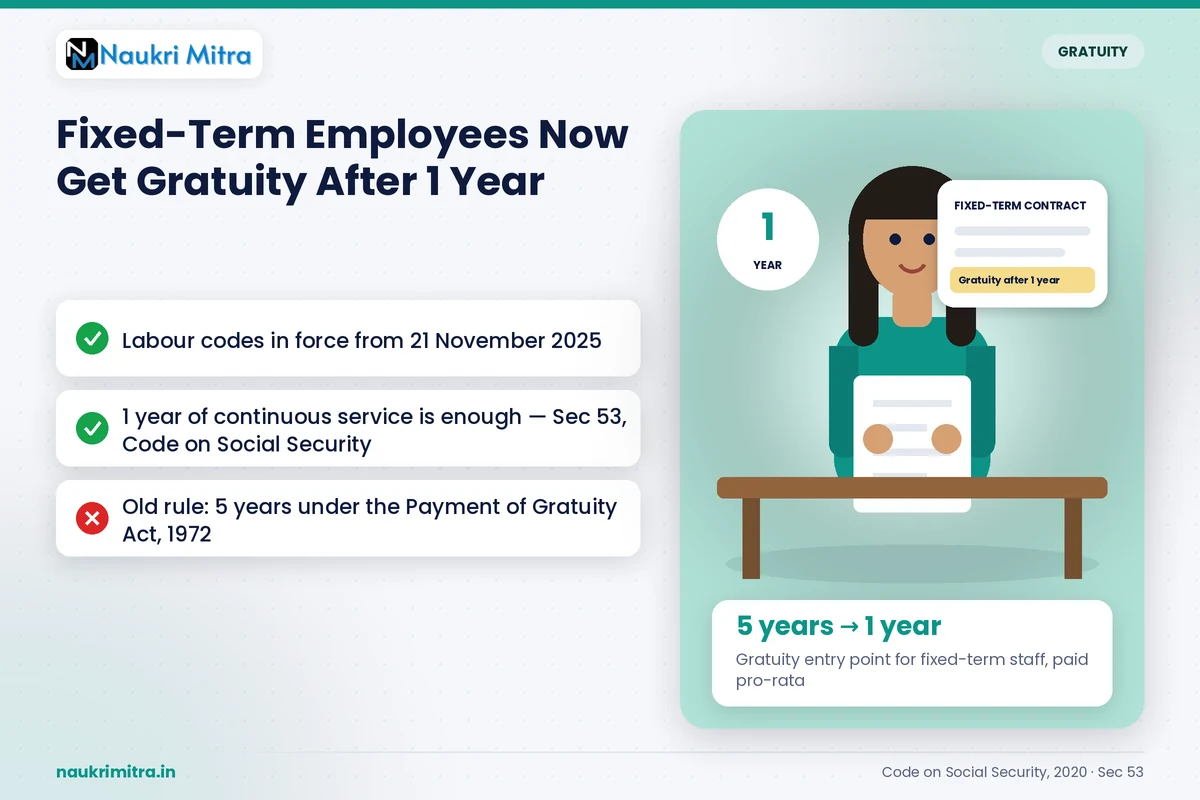
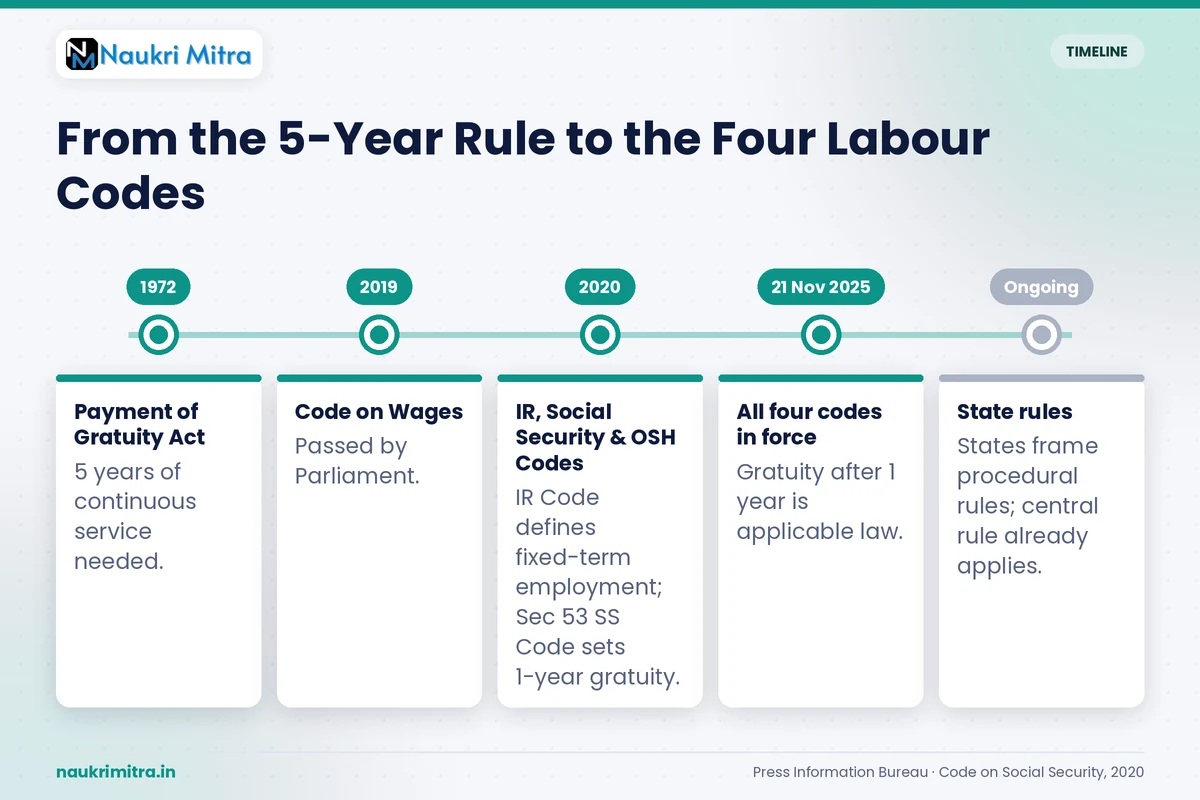
Aditi had eighteen months left on her fixed-term contract with a Bangalore product company when the news broke that gratuity rules had changed. Her first reaction was the same as everyone else's in her WhatsApp group of fellow contract hires: "Does this actually mean anything for me, or is it another headline that quietly applies to someone else?" It turns out it means quite a lot. Under the labour codes that came into force on 21 November 2025, a fixed-term employee no longer has to wait five years to earn gratuity — one year of continuous service is now enough, and the payout is worked out on a pro-rata basis tied to however long the contract actually ran.
That single change rewires a decades-old assumption, and it's been widely reported in the financial press since the codes took effect. Under the Payment of Gratuity Act, 1972, five years of continuous service was the non-negotiable entry ticket — miss it by a month and you walked away with nothing, however productive you'd been. Fixed-term and project-based hires, who rarely stayed anywhere near five years by design, were effectively locked out. The new provision, tucked into Section 53 of the Code on Social Security, 2020, is essentially the gratuity without 5 years new rule that's been doing the rounds in HR forwards, and it closes that old gap specifically around fixed term employment gratuity eligibility. This piece walks through what the rule actually says, how the math works, who's genuinely covered, and what to check in your own offer letter before assuming it applies to you.
What "Fixed-Term Employment" Actually Means
Before the gratuity question, it helps to be precise about who this is for. Fixed-term employment was formally defined and brought into the mainstream of Indian labour law through the Industrial Relations Code, 2020 — a worker engaged directly by a company, on its payroll, through a written contract for a fixed period, with no intermediary in between. If you're invoicing a company, filing your own GST returns, and nobody deducts TDS under employee-salary provisions, you're a consultant, not a fixed-term employee, and this change doesn't reach you. That's the heart of the fixed-term employment vs permanent employee comparison this whole rule is built around: a fixed-term worker gets an appointment letter, defined start and end dates, and — on paper — the same core entitlements as a permanent colleague in a comparable role, scaled proportionally to tenure.
Employers aren't supposed to quietly disguise genuinely fixed-term work as something else to dodge these obligations, nor dress up permanent, ongoing roles as endless "fixed-term" renewals to keep dodging continuous-service math. Labour compliance commentary has already flagged repeated back-to-back renewals that never actually end as a red flag inviting the same scrutiny fake "contractor" arrangements have long attracted.
The Pro-Rata Math: What 14, 18, or 20 Months Actually Gets You
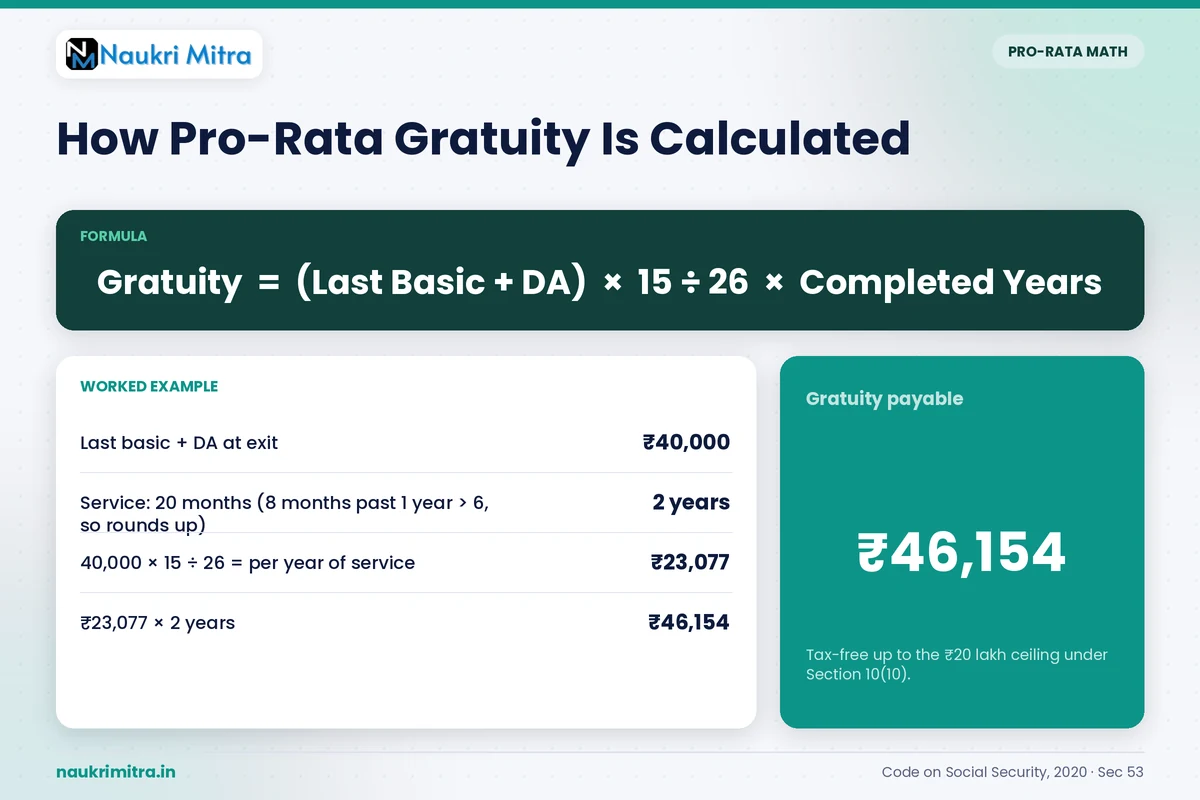
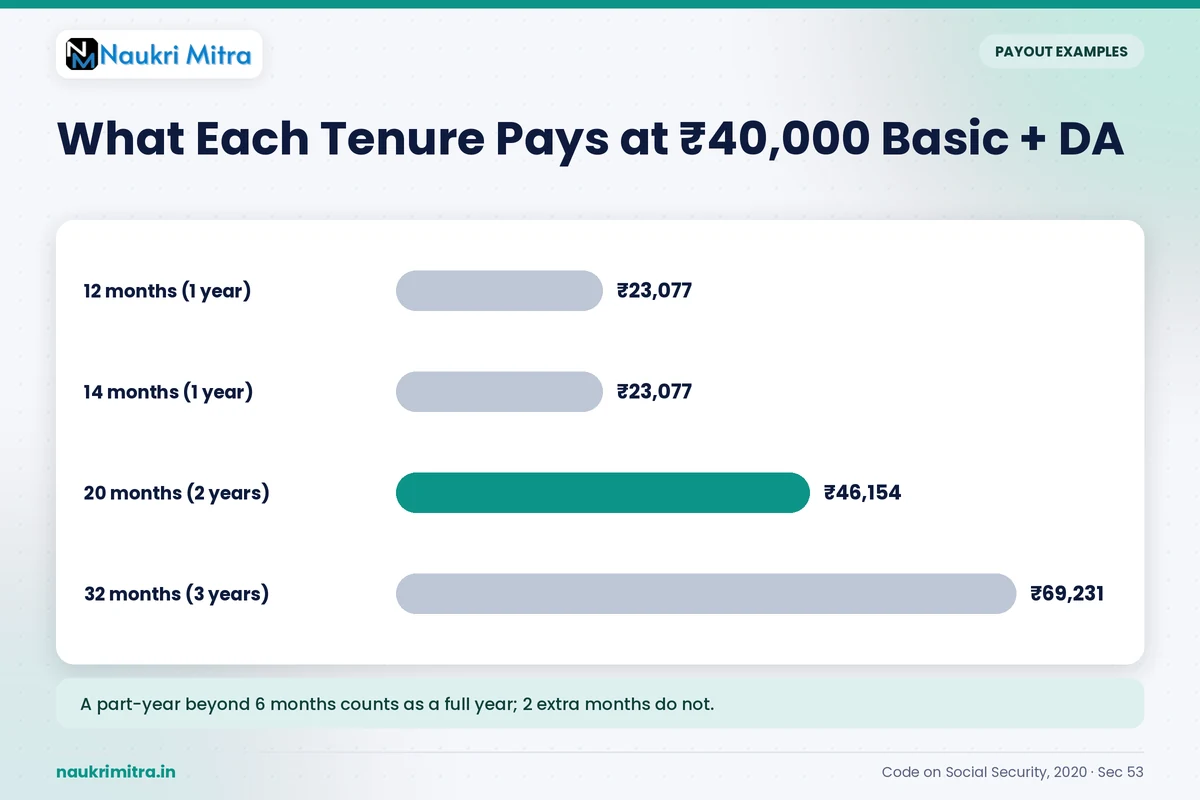
The underlying formula hasn't been reinvented — fifteen days' wages for every completed year of service, based on last-drawn basic plus dearness allowance, divided by 26 working days a month, with any part-year beyond six months rounded up to a full year. What's new is that fixed-term staff don't need five of those years stacked up first. Complete roughly one year under the contract, and the formula switches on instead of staying dark for another four — that's the entire pro-rata gratuity 1 year labour code story in one line. In other words, pro-rata gratuity calculation for fixed-term staff now kicks in on a one-year trigger instead of a five-year one. A 14-month contract that runs its course gets gratuity calculated proportionally for that tenure, not zero and not a full five-year equivalent.
A rough illustration: basic-plus-DA of ₹40,000 at exit, with 20 months completed (treated as 2 years, since the extra 8 months past one year exceeds the six-month rounding threshold) — 40,000 × 15/26 × 2 comes to roughly ₹46,154. Not a windfall, but real money where there used to be none. The statutory ceiling currently stands at ₹20 lakh, paid tax-free up to that cap under Section 10(10) of the Income Tax Act, the same protection permanent employees have always had. One more wrinkle: the Code's wage definition now requires basic pay to form at least 50% of CTC, which for allowance-heavy IT salary structures often pushes the gratuity-bearing base higher than the old breakup did.
Who's Actually Covered, and Who Isn't
Not every short-tenure worker benefits equally. The rule applies to establishments with ten or more employees — the same threshold the old Act used — so a very small startup technically sits outside it for now. Apprentices engaged under a formal apprenticeship scheme are treated as a distinct category and generally fall outside standard gratuity coverage, since their engagement isn't "employment" in the usual sense. Interns usually sit in a grey zone too, unless the offer letter genuinely structures the role as fixed-term employment rather than an internship — the label, and how closely the real arrangement matches it, tends to decide the outcome if ever disputed.
Probationers present a different wrinkle. If your letter frames the entire engagement — probation included — as one fixed-term contract, the service clock should run from your joining date. Where things get murkier is a letter that's silent on how probation interacts with overall duration; that ambiguity is worth clarifying with HR in writing rather than assuming either way.
Renewals and the "Does My Clock Reset" Question
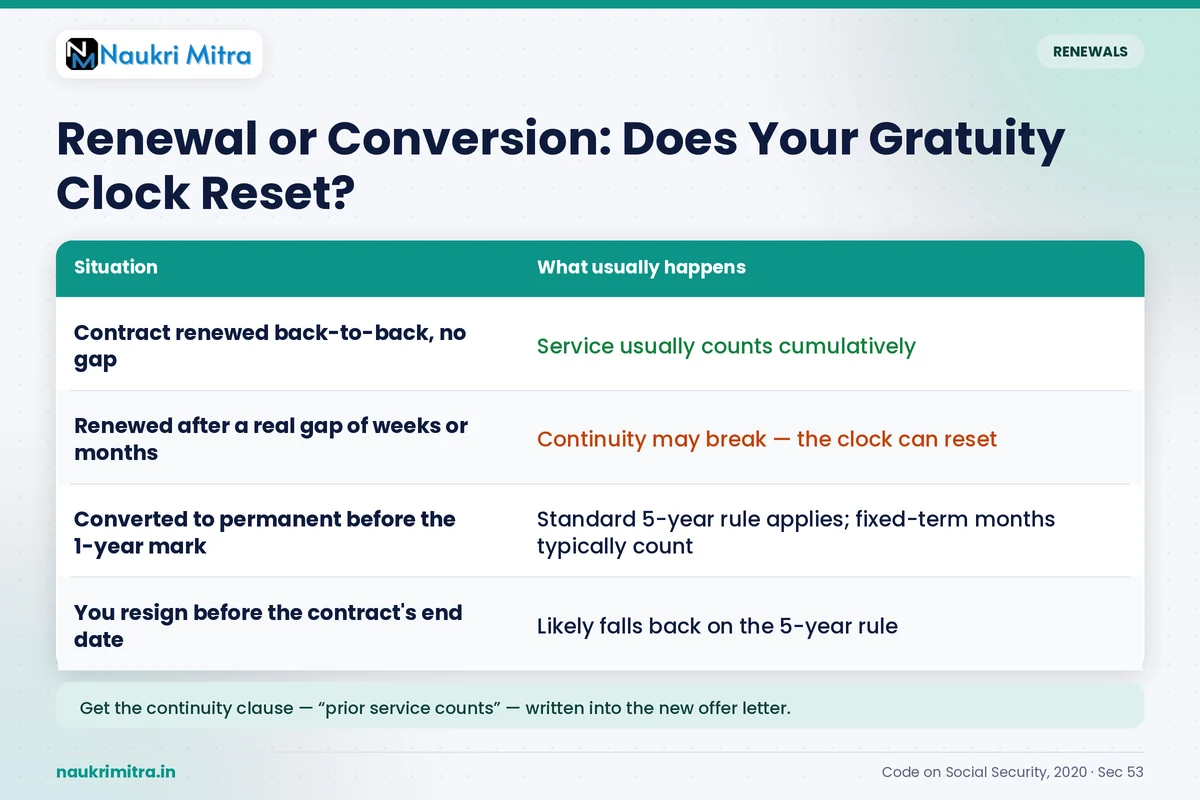
A question that comes up constantly in fixed term contract employee benefits India discussions is what happens when a contract is renewed, extended, or converted mid-stream. This is one of the least settled corners of the new framework. If your fixed-term contract renews with the same employer and no real gap in between, the reading most compliance commentary leans toward is that continuous service should count cumulatively rather than restarting from zero each time. A genuine, unexplained gap of weeks or months between two stints is more likely to break continuity and trigger a contract renewal gratuity reset, where the clock effectively starts over.
If your role is converted to permanent before you hit the one-year fixed-term mark, you'd then fall under the standard five-year rule, with your fixed-term months typically counting toward that tally rather than being discarded. None of this is spelled out clause-by-clause yet, so if a renewal or conversion is on the table, get the continuity language — specifically whether prior service counts — written into the new offer letter rather than relying on a verbal assurance.
Is This Actually Live Right Now?
The four labour codes, including the Code on Social Security that houses this gratuity provision, were notified nationally from 21 November 2025 — so the rule is applicable law today, not a future promise. That said, "in force nationally" and "fully operational on the ground everywhere" aren't always identical in Indian labour administration; states still frame their own supplementary rules for procedural details, and some employers have been slower than others to update payroll systems. Searches for Industrial Relations Code gratuity rules often point people in the wrong direction, since gratuity itself sits in the Code on Social Security, 2020 — the IR Code is simply where "fixed-term employment" was formally defined as a category. If HR tells you the rule "hasn't been notified yet" months after November 2025, ask for the actual Gazette notification.
On retroactivity: the provision applies prospectively, so a fixed-term contract that concluded before November 2025 generally wouldn't be reopened under it, though your own contract terms could still entitle you to something separately. For anyone whose contract straddled that date, the gratuity without 5 years new rule applies to whatever continuous service falls after the code took effect.
What to Check Before You Sign a Fixed-Term Offer
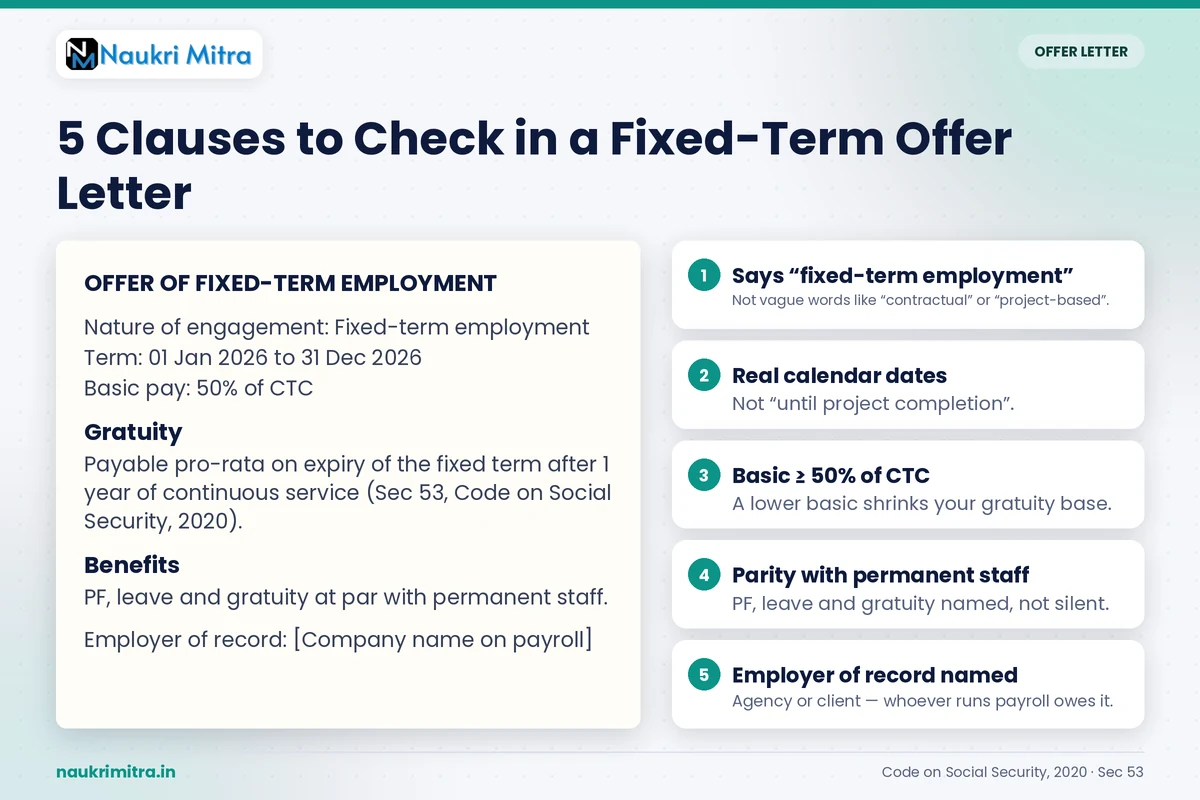
A few things deserve a second read. Does the letter explicitly say "fixed-term employment," or does it use vaguer terms like "contractual" or "project-based" — the label genuinely changes your legal position. Are start and end dates actual calendar dates rather than "until project completion," since a vague end date makes continuous service harder to prove later. Does basic pay sit at roughly half or more of CTC, in line with the new wage definition, or is it still loaded with allowances the old way, which would understate your eventual gratuity base.
HR and legal compliance teams on the employer side are already being advised to review workforce classifications against this change, so it's fair to expect your own employer to have looked at this already. Also check whether the letter acknowledges statutory parity with permanent staff — PF, leave, gratuity — rather than staying silent. And if you're hired through a staffing agency rather than directly, confirm which entity is legally your employer of record, since the obligation usually sits with whoever issues your appointment letter, not the brand on your ID badge. Taken together, these checks define what real fixed term contract employee benefits India now guarantees on paper, and they're the fastest way to gauge your own fixed term employment gratuity eligibility before signing anything.
When an Employer Says No
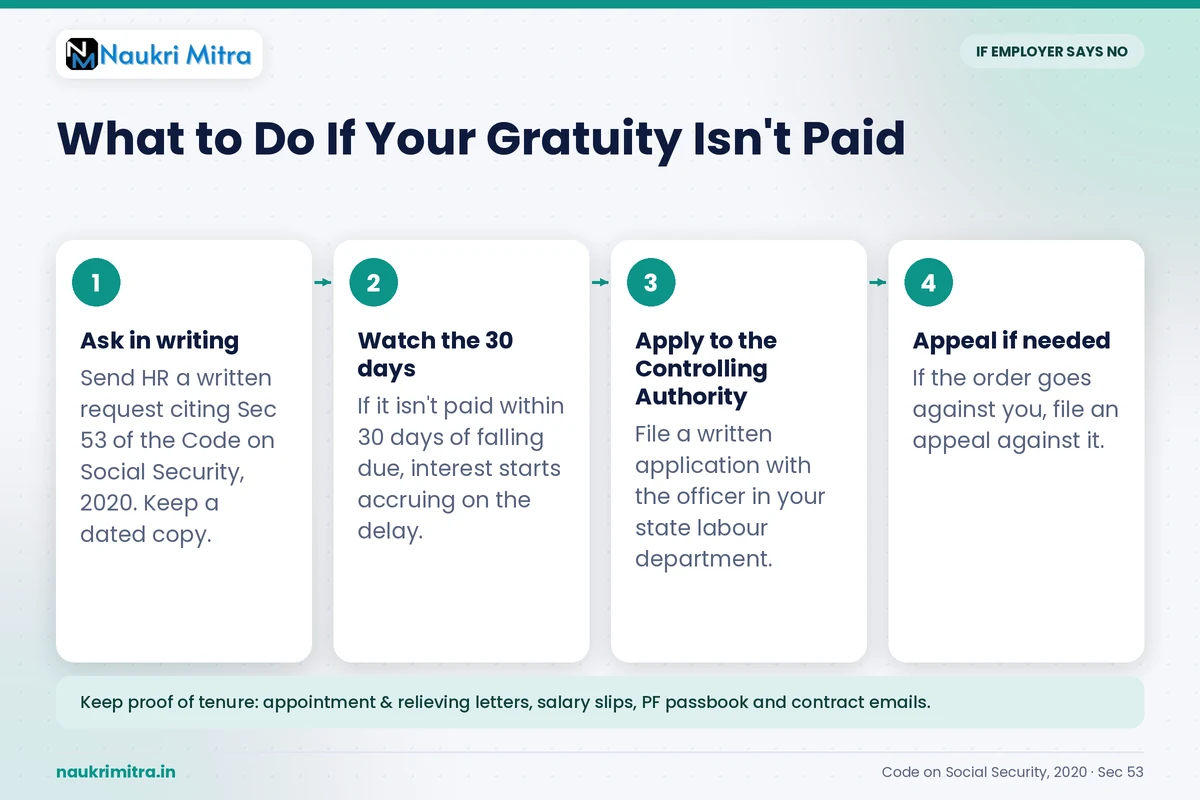
Some employers will resist paying, either from genuine confusion about a provision that's still new, or because it's cheaper to stall until someone pushes back. "Company policy doesn't allow it" or "our state hasn't notified this" are not valid reasons to withhold a statutory entitlement once the central code is in force — policy cannot override a legal right, and central notification applies regardless of state-level follow-up rules. If gratuity isn't paid within thirty days of becoming due, interest starts accruing on the delay, which is useful leverage in a conversation with HR.
If an employer flatly denies the claim, the standard route is a written application to the Controlling Authority under the Code on Social Security — typically an officer in the state labour department — followed by an appeal if the order goes against you. Keep every document establishing your actual tenure: appointment letter, relieving letter, salary slips, and any email trail about contract dates, since disputes usually come down to whoever has the clearer paper trail.
Tax Treatment and the Leave Encashment Mix-Up
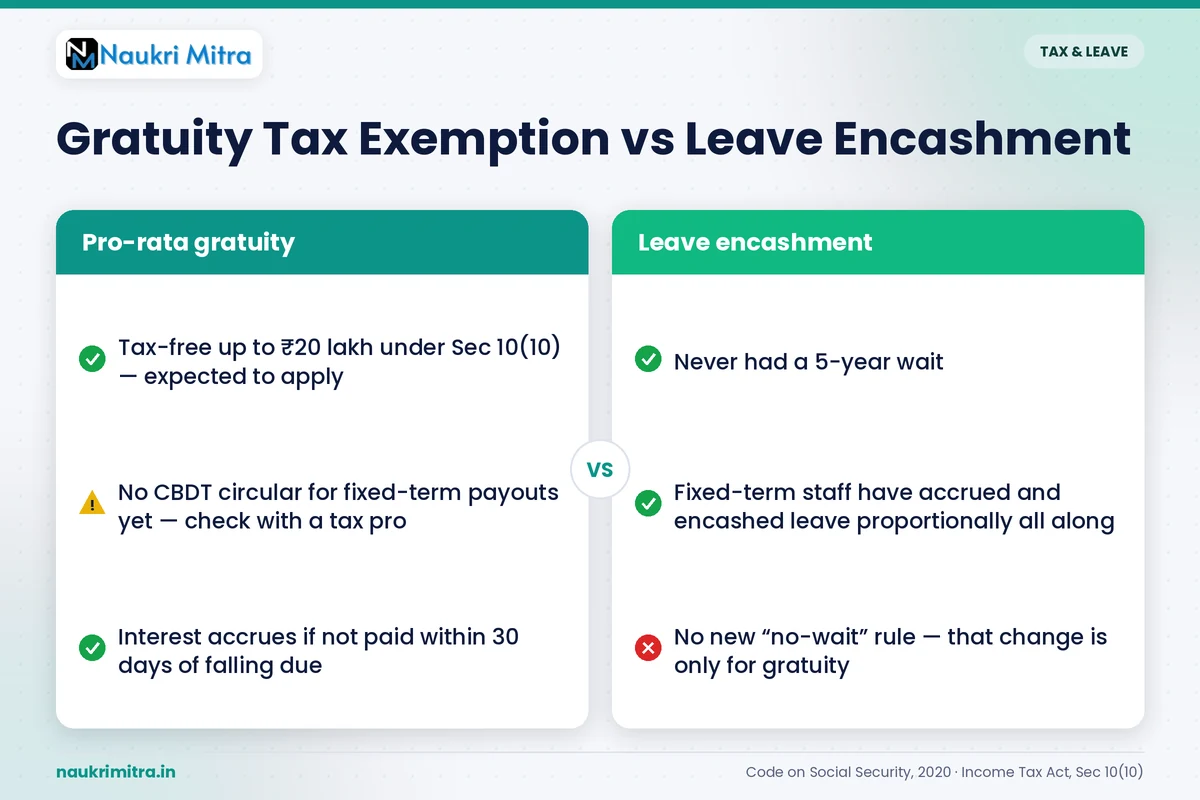
Because this pro-rata payout is made under the same statutory gratuity provision that has always applied to permanent staff, the reasonable expectation — shared by most tax practitioners commenting on the new code — is that it should qualify for the same Section 10(10) exemption up to ₹20 lakh. A formal CBDT circular spelling this out specifically for fixed-term payouts hasn't been issued as of this writing, so around a large gratuity receipt soon after rollout, a quick check with a tax professional is worth it.
On leave encashment: there's a common mix-up worth clearing up. Encashing unused leave was never subject to a five-year wait — that was always specific to gratuity under the old Act. Fixed-term employees have generally accrued and encashed leave proportionally all along, so there isn't really a parallel "no-wait" rule being newly granted for leave the way there is for gratuity.
Notice Period, Contract Expiry, and How They Interact
The end of a fixed-term contract isn't the same as a resignation or termination. When a contract simply runs its course on the agreed date, it isn't a termination requiring notice or severance the way an early exit would be — it lapses on its own terms, and gratuity becomes payable precisely because the Code treats "expiry of fixed-term employment" as one of the events covered by the continuous service exemption, alongside death and disablement. Early termination by either party, before the agreed end date, is different and typically follows whatever notice or cause clauses sit inside the contract itself — one more reason to actually read that clause before signing.
Frequently Asked Questions
If my offer letter is vague about exact dates, how do I prove my tenure later?
Lean on secondary evidence: your first salary slip, relieving letter, PF contribution records tied to your UAN, and onboarding or exit emails. PF passbook entries tend to carry dated, employer-verified records that hold up well in a dispute.
I'm hired through a staffing agency for a client company — who owes me gratuity?
Generally whichever entity is named as your employer on the appointment letter and runs your payroll, usually the agency, not the client. Confirm this in writing before you start.
Does this apply to IT companies that call hires "project-based" instead of "fixed-term"?
What matters is substance, not the label. A direct employment relationship with defined dates and payroll deductions is very likely fixed-term employment regardless of internal HR terminology.
Is fixed term employee eligible for gratuity if they're classed as an intern?
Usually not, unless the internship is actually structured as fixed-term employment with statutory deductions and a proper appointment letter rather than a stipend-only internship agreement.
What if my company has fewer than ten employees?
Gratuity provisions under the Code on Social Security apply to establishments with ten or more employees on the rolls at any point in the preceding twelve months, so very small employers currently sit outside the mandatory requirement.
Can I combine service across two fixed-term contracts with the same employer?
If the contracts run back-to-back with no real gap, service is generally treated as continuous. An unexplained break weakens that, so get any gap addressed in writing during renewal talks.
Does resigning early, before the contract's end date, still qualify me?
The provision is framed around expiry of the fixed term. Resigning before that date is treated more like a voluntary exit and would likely fall back on the standard five-year rule, unless you'd already crossed five years anyway.
Will anything extra be deducted from my salary to fund this?
No. Gratuity has always been an employer cost, paid out at exit or funded through an approved insurance scheme or trust — it isn't deducted from your monthly pay the way PF or ESI contributions are.
Before Your Next Fixed-Term Conversation with HR
Ask directly whether your appointment is classified as fixed-term employment or something else. Ask what basic pay is as a share of CTC, since that sets your gratuity base. Ask what happens to your service record if the contract is renewed. And if you're already past one year on a contract that's ending, don't wait for HR to raise gratuity on your behalf — put in a written request referencing Section 53 of the Code on Social Security, 2020, and keep a dated copy.
If you're weighing a fixed-term offer against a permanent one, it helps to compare live postings rather than theorize in the abstract — browsing software engineer jobs in Bangalore shows how many listings mention contract length and benefits upfront, a reasonable proxy for how seriously an employer treats this compliance shift. HR professionals managing these transitions might find it useful to see how peer roles are structured, such as current HR manager openings in Hyderabad, while recruiters who specifically staff fixed-term and project roles can check active contract recruiter positions to see how the market is pricing this kind of hiring right now.
None of this changes the basic arithmetic of your career, but it changes what you're owed if a fixed-term stint doesn't turn into something longer. Is fixed term employee eligible for gratuity the same way a permanent one is? Not identically — the ceiling, the tax treatment, and the underlying formula are shared, but the one-year entry point and the pro-rata math belong specifically to this category of worker, and neither existed before November 2025. Worth knowing before you sign the next contract, and worth asking about before the current one ends.
For anyone navigating an upcoming contract decision, comparing openings, salary structures, and employers side by side on a platform built for Indian job seekers can make the choice easier — start with Naukri Mitra before you decide what to sign next.
Sources: Press Information Bureau – Code on Social Security, 2020, Fisher Phillips – India's New Labor Codes Expand Gratuity Payment Rules, Business Today – Who Will Now Qualify for Gratuity After One Year of Service.
.png)
.png)
.png)
Comments
Post a Comment