Police Verification for Govt Jobs: Timeline | Naukri Mitra
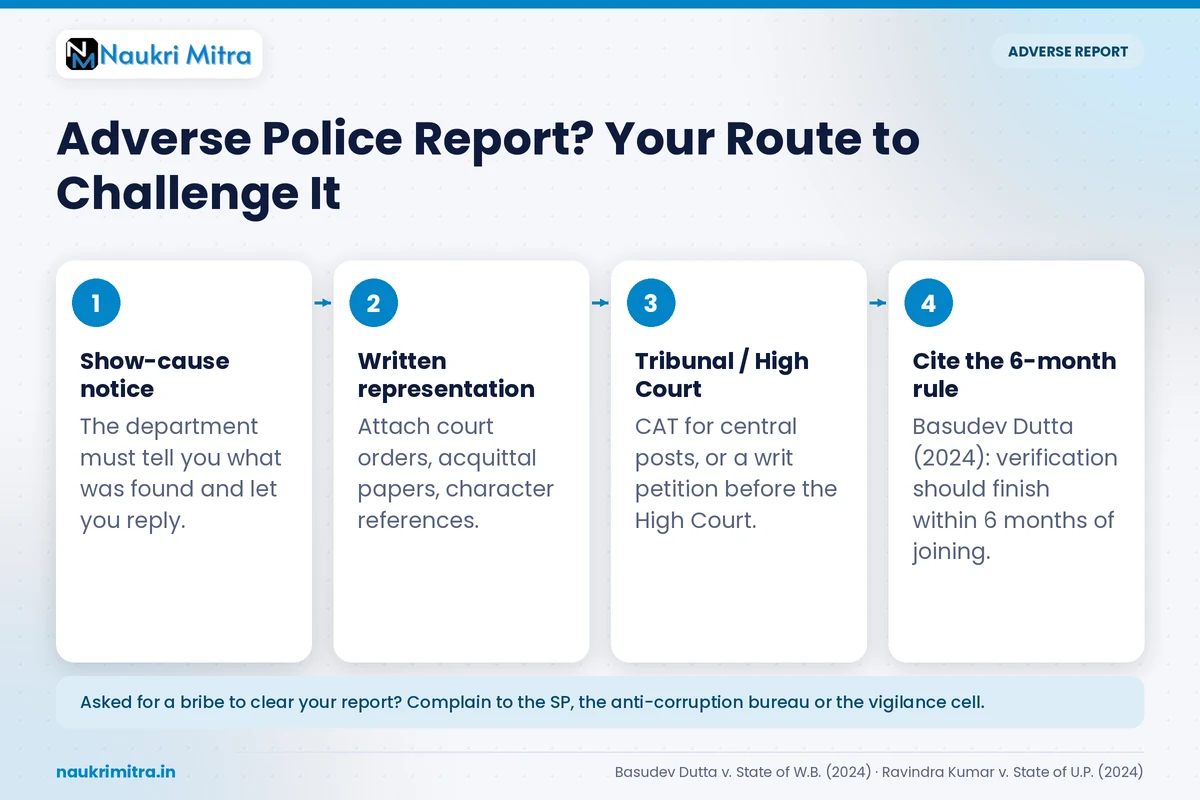
In December 2024, the Supreme Court sat with a file that had been open for 36 years. A man named Basudev Dutta had joined as a Para Medical Ophthalmic Assistant in West Bengal back in 1985. His police verification report — meant to take a few months — did not land on anyone's desk until 2011, twenty-five years later, after he'd already served the department for over two and a half decades. It was used to terminate him anyway, costing him the pension he had spent his working life earning. The Court called the delay "arbitrary, illegal and in violation of the principles of natural justice," and did something more useful than scold the state: it ordered that police verification for every selected government candidate, going forward, must be completed within six months of appointment, not whenever a station finds the time.
That case is an extreme outlier, but the anxiety behind it is not. Anyone who has cleared an SSC, UPSC, state PSC, railway, banking, or PSU exam and is now waiting for a joining letter knows the particular, low-grade dread of police verification. You've done the hard part — the exam, the interview, the document scrutiny — and now your appointment hinges on a constable somewhere visiting your old neighbourhood and asking your neighbours whether you're a decent human being. Type "police verification process for government job how long" into a search bar at midnight and you'll find yourself in good company, right alongside everyone typing "police verification delay government job joining" and "how to check police verification status for govt job," none of whom are getting a straight answer. It's opaque, it moves at its own pace, and almost nobody explains it properly. This piece tries to.
Where It Sits in the Hiring Timeline
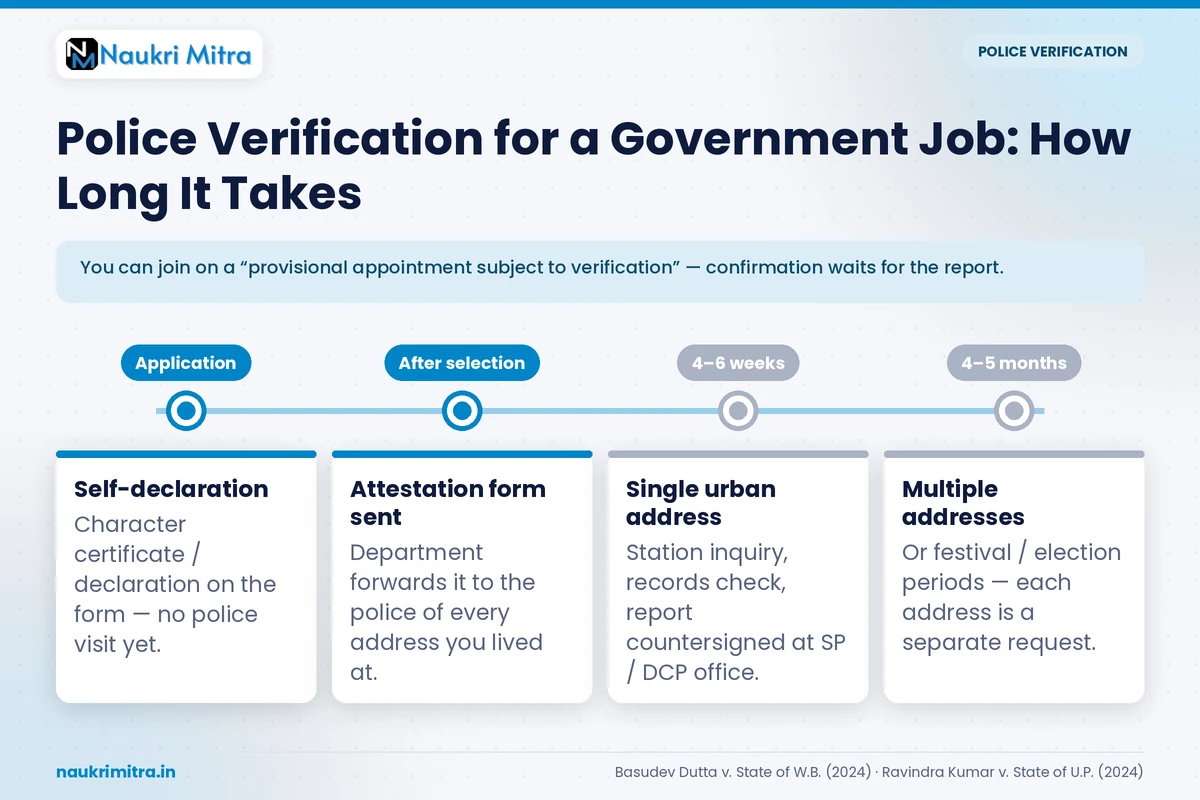
Police verification isn't a one-time event bolted onto the start of your application; it arrives in two layers, and people conflate them constantly. At the application or interview stage, many recruiters ask you to sign a self-declaration or submit a character certificate — a document you obtain yourself, usually from a gazetted officer or notary, stating you have no known criminal record. That's a paper promise. The actual police verification process for government job candidates go through — a station-level inquiry, a home visit, a report sent up the chain — almost always happens after selection, once you've been issued a provisional offer, and runs in parallel with your joining formalities rather than strictly before them.
This is why recruitment rule books so often use the phrase "provisional appointment subject to verification." You're allowed to join, draw a salary, and start probation while the file is still moving. Confirmation of service, not the act of joining, is usually what waits on the final report.
What the Local Station Actually Checks
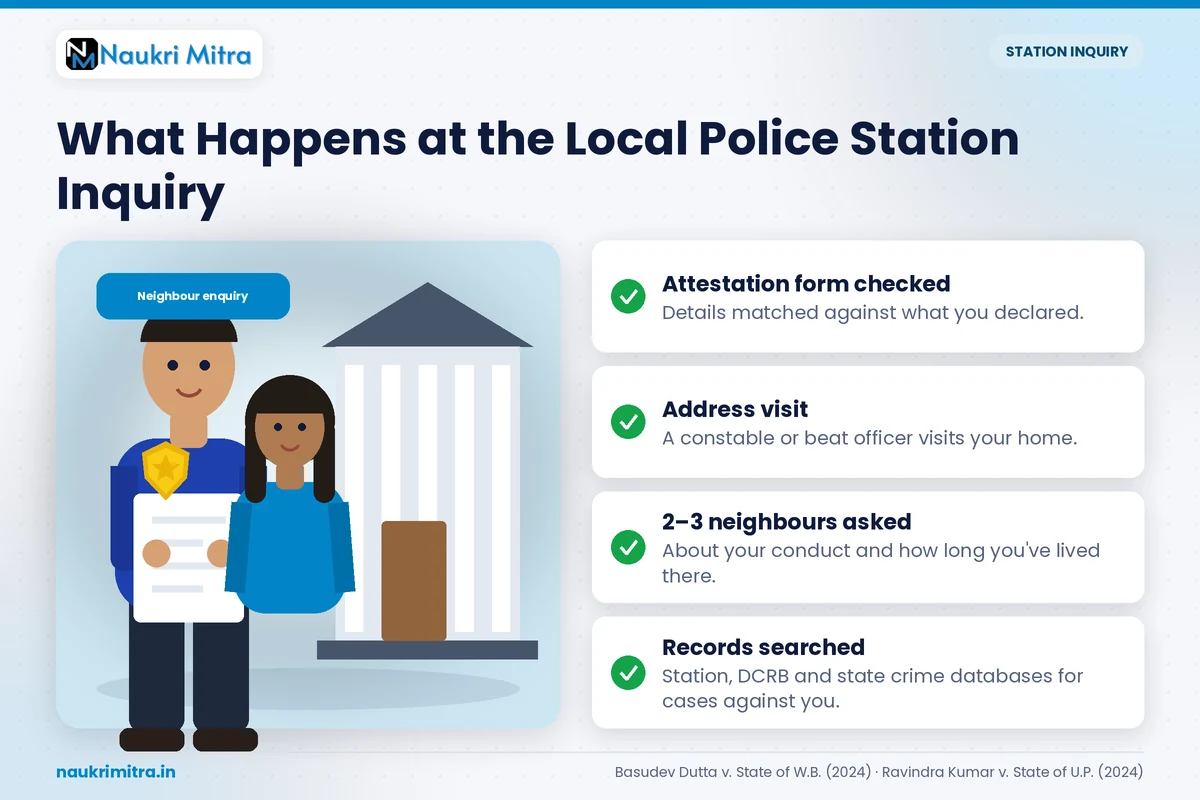
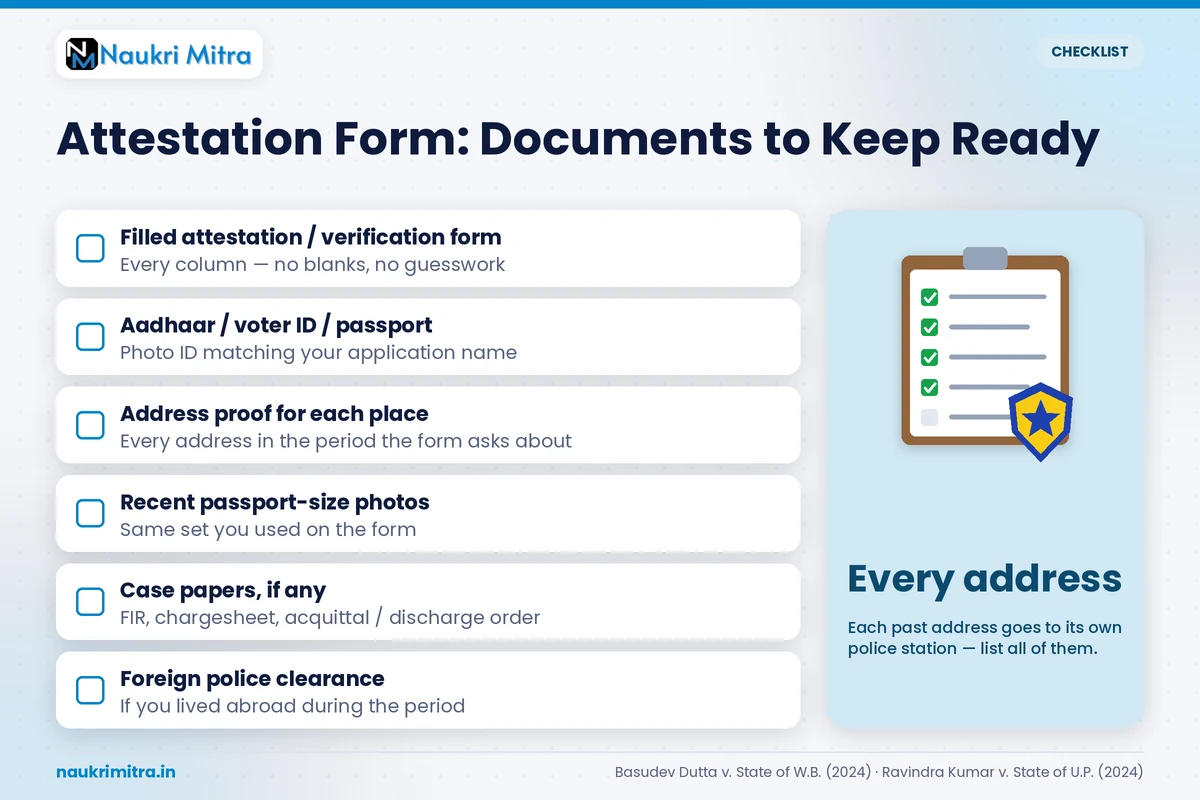
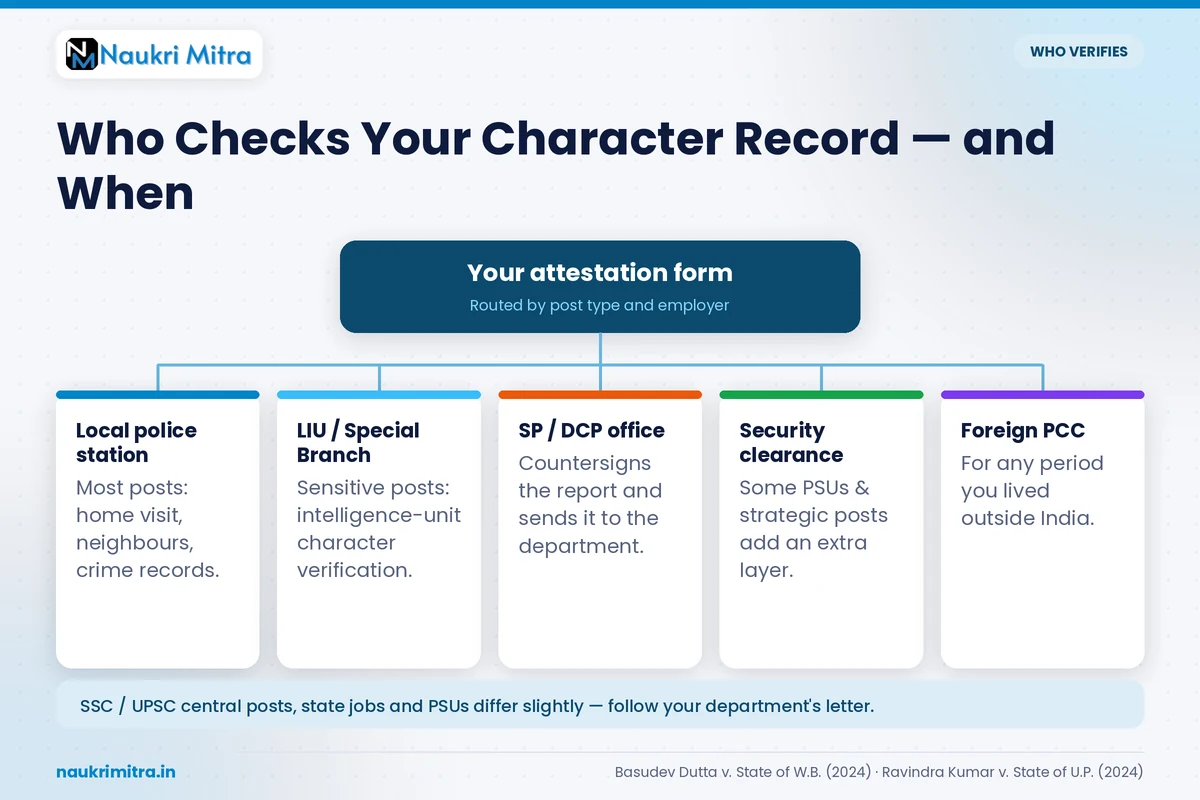
The inquiry, as background-check practitioners describe it, is built around the attestation form, a dense document listing every address you've lived at since childhood, your family details, your educational institutions, and a direct question about whether you've ever been arrested, prosecuted, convicted, fined, or involved in any criminal case. Once your department forwards this to the jurisdictional police station — usually the one covering your current or permanent address — an officer runs what is formally called the character and antecedent verification police process: a check into your conduct, reputation, and any brush with the law.
In practice a constable or head constable visits your listed address, speaks to you or your family, and separately talks to two or three neighbours or a local ward member who can vouch for you — an antecedent verification police station visit that, for most straightforward candidates, takes no more than twenty minutes. Your name is also cross-checked against records held at the station, the district crime record bureau, and sometimes a state-level database. If you've lived in a different city for college or a previous job, that address gets its own separate verification request — a major reason the whole process stretches out, since it now depends on two or three stations instead of one, and some are far more responsive than others.
Who's Actually Doing the Work — Station, SP Office, or LIU
The people involved aren't always the same, and who handles your case depends on the post and the state. For most government jobs, the field verification is done by the local police station under the jurisdiction of your address, and the report is then routed through the Superintendent of Police's (or DCP's, in cities) office for countersignature before it returns to your appointing department. For sensitive posts — defence establishments, intelligence-adjacent roles, certain central positions, and jobs needing security clearance — a separate wing, commonly called the local intelligence unit or special branch, runs a parallel check that goes beyond the basic criminal-record screen into a broader look at associations and reliability. This is the LIU most people have vaguely heard of but rarely interact with directly.
So, Realistically, How Long Does This Take?
Before the Supreme Court's December 2024 order in Basudev Dutta v. State of West Bengal, there was no hard national ceiling, and states ran on their own, often unenforced, internal timelines — commonly three to six months on paper. In reality, candidates routinely waited far longer, and extreme cases like the one above happened because nobody was accountable for missing the deadline. The directive now requires every state to complete the inquiry and file the report "within a stipulated time provided in the statute or government order, or in any event, not later than six months from the date of appointment." That's the number to hold onto if you're gauging whether your own wait is reasonable: under six months is within bounds; well past it, you have legitimate grounds to escalate.
Within that window, the actual experience varies a lot by state and department. A single-address verification in a well-staffed urban station can be done in four to six weeks. A case involving three previous addresses across two states, during a festival season or an election period when police bandwidth gets diverted to law-and-order duty, can eat four to five months. Police verification delay government job joining is rarely caused by one dramatic problem — it's usually an accumulation of small ones: an incomplete address on the form, a short-staffed station, a report sitting in an SP office tray waiting for a signature, or a candidate who never follows up and assumes silence means nothing is happening.
Can You Join and Start Working While It's Still Pending?
Yes, in the large majority of cases, and this is the detail that calms down most anxious candidates once they hear it. Appointment letters for government posts are almost universally issued as provisional, stating the offer is "subject to satisfactory verification of character and antecedents." You report for duty, you're put on probation, you draw your salary, and the file keeps moving in the background. What a pending report typically holds up is not your joining but your confirmation at the end of probation — the order converting you from a provisional appointee into a regularly confirmed employee. It's exactly the kind of character verification delay joining candidates dread most, because some departments tie increments or certain allowances to confirmation rather than to your joining date itself — one more reason not to let the file go cold without checking on it periodically.
The FIR Question: What You Must Disclose, and What Actually Disqualifies You
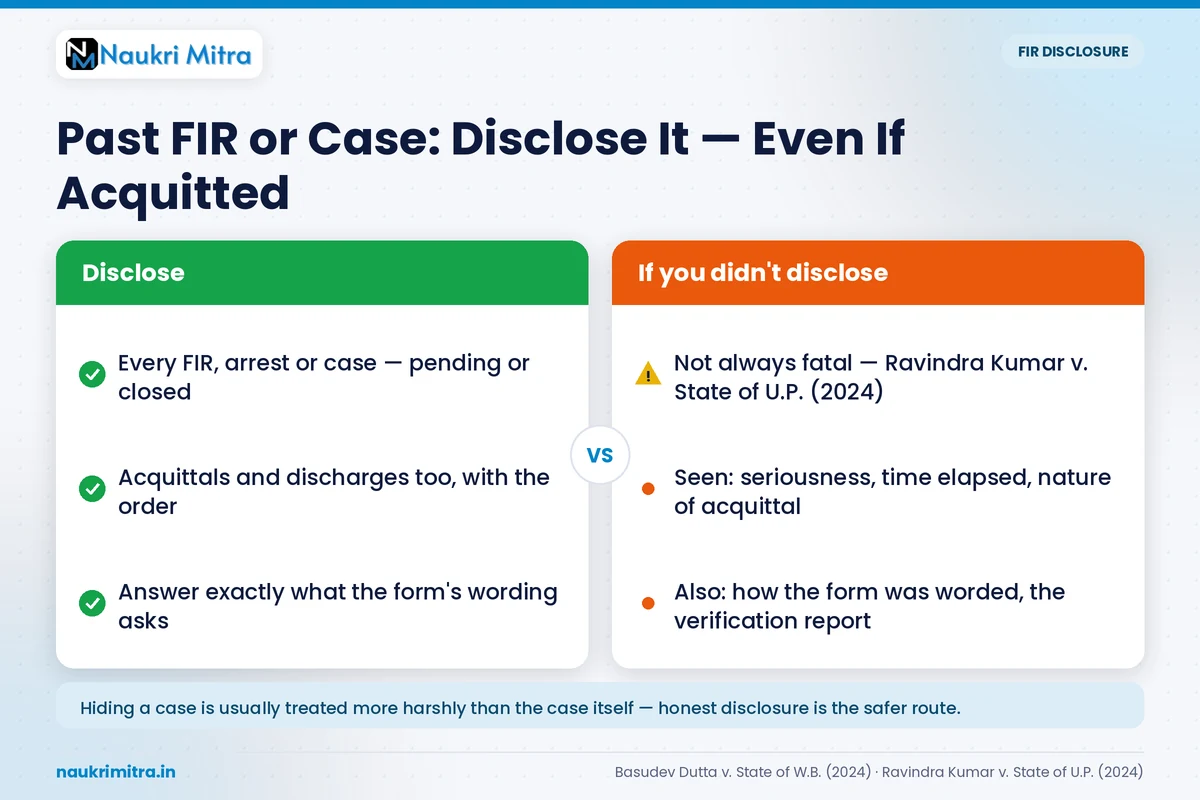
FIR disclosure government job questions generate more frantic forum posts than any other part of this process, and it deserves a straight answer rather than a vague one. The attestation form will ask, in plain language, whether you have ever been arrested, prosecuted, kept in detention, fined, convicted, or debarred or disqualified by any public service commission. The honest answer is not "only if it's serious" — it's yes if any of those things happened to you, including a case later closed, quashed, or ended in acquittal.
Here's the part people get wrong most often: disclosing a past case does not automatically sink your candidature, but failing to disclose one — even a minor, decades-old, acquitted one — very often does, because the problem authorities react to is the concealment, not necessarily the original incident. In Ravindra Kumar v. State of U.P. (2024 INSC 131), the Supreme Court held that non-disclosure of a criminal case ending in acquittal is "not always fatal" to employment, and laid out factors that matter: how serious the case was, how long ago it happened, what the acquittal actually said, how specifically the form's question was worded, and what the verification report itself found about the person's character. The Court directed the candidate's appointment as a police constable because, acquittal aside, his overall verification came back clean. But other benches have gone the other way on similar facts, especially where the suppressed case was recent or serious, or the candidate's conduct during hiring suggested deliberate concealment rather than a misreading of the form. The safest, and really the only defensible, approach is full disclosure with a brief factual explanation, letting the recruiting authority make an informed call rather than discovering the case independently later and concluding you lied.
That last scenario — discovery years after joining — isn't hypothetical. Courts have repeatedly upheld terminations of employees whose suppressed criminal history surfaced long after confirmation, sometimes after a decade or more of clean service, reasoning that the original appointment was obtained through material misrepresentation and is therefore voidable whenever found out. A short-term fear of disclosure is almost always smaller than the long-term risk of discovered concealment.
When the Report Comes Back Adverse
An adverse police verification report is not automatically a death sentence for your appointment, though it's treated that way far too casually by candidates who panic at the word "adverse." If you search police verification report government job rejected reasons, the list that actually turns up in practice is fairly short: an undisclosed FIR, a neighbour's negative comment during the local inquiry, or a clerical mismatch between your declared address history and what the station found. Before finalising a rejection, most departments must issue a show-cause notice giving you a chance to respond — this is the point to submit certified court orders, a written explanation, or evidence correcting any factual error. If the department cancels your candidature anyway, you generally have the option to represent to the appointing authority, and failing that, to approach the relevant service tribunal or the High Court through a writ petition — precisely the route that produced both the Ravindra Kumar and Basudev Dutta judgments discussed above, ordinary candidates who pushed back and won.
Does the Process Differ Across Central Jobs, State Jobs, and PSUs?
The broad mechanics stay the same everywhere — attestation form, local station inquiry, SP-level countersignature — but strictness and speed shift by employer type. Central recruitment through agencies like SSC and UPSC tends to follow a standardised attestation format and often routes the request directly through state police headquarters, which can actually make it faster in well-administered states. State departments are the most variable; some states have digitised the workflow and clear verifications in under two months, while others still run it almost entirely on paper. PSU recruitment (railways, banking, central public sector undertakings) generally mirrors the central process, though PSUs in sensitive sectors — defence production, atomic energy, telecom infrastructure — layer on an additional security clearance that can add several extra weeks.
Multiple Addresses, Multiple States, Time Abroad
If you've lived in more than one city — college in one state, a first job in another, your family home in a third — expect separate verification requests to go out to each jurisdiction, since no single station can vouch for a period you spent elsewhere. This is the single biggest multiplier of delay for candidates with a mobile history, because the overall timeline is only as fast as the slowest station in the chain. If you've spent time abroad, some departments will additionally require a police clearance certificate from that country, obtained through its police authority or the relevant Indian mission — candidates routinely underestimate the lead time for this, so it's worth starting early rather than waiting for the department to ask.
If Someone at the Station Asks You for Money
It happens, and candidates are often too intimidated to push back, assuming a stuck verification is leverage the officer genuinely holds over them. It isn't. Police verification is an official departmental process with no legitimate fee at the candidate's end; if a constable or intermediary hints that things will "move faster" with cash, that's a bribe solicitation, not a procedural requirement, and it's reportable to the Superintendent of Police directly, the state's anti-corruption bureau, or your department's vigilance cell, which exists precisely for this. Most delays are bureaucratic, not extortionate — but don't pay either way.
Tracking a Delayed Verification
If your wait has crossed a couple of months with no update, start simple: write a formal, dated follow-up to your department's establishment section asking for the current status and, if possible, the station it's pending with. Keep a copy. If that gets nowhere, filing a Right to Information application with the police station or department is a legitimate and often effective escalation — RTI requests carry a statutory response window, which puts a clock on an otherwise indefinite wait. Several states have also begun offering online tracking for verification requests tied to your application number, through state police portals, though coverage still varies between states.
None of this is unique to government recruitment, by the way. Private employers run their own version of the same check before letting anyone through the door, particularly for roles involving cash handling, sensitive premises, or direct client contact — security personnel being the clearest example, where a security guard role will almost always carry its own local police or antecedent check before the offer is confirmed. Entire teams now exist purely to run this kind of screening at scale: roles like a background screening specialist on a government vendor project or an application verification reviewer for a government benefits program exist precisely because verification has become specialised work in its own right. If you're navigating a joining delay right now, it helps to remember you're going through a widely-used system, not a uniquely unlucky one, and that jobs across sectors on platforms like Naukri Mitra list roles where this same background-check rhythm applies well beyond government recruitment alone.
Frequently Asked Questions
Does police verification happen before or after you join a government job?
Almost always after selection and alongside joining, not as a precondition to starting work. You're typically issued a provisional appointment letter that lets you join and begin probation while the field inquiry runs in parallel; it's your confirmation at the end of probation, not your joining date, that generally waits on a clean report.
How can I check my police verification status for a govt job if I haven't heard anything?
Start with a written follow-up to your appointing department's establishment office, keep a dated copy, and if weeks pass with no response, file an RTI application with the police station or department handling the case. Some states also offer online status tracking through their police department portals, though this isn't universal yet.
Will an old arrest or FIR automatically disqualify me?
Not automatically. Authorities weigh how serious the case was, how it concluded, how long ago it happened, and whether your character report is otherwise sound. What damages a candidature far more than the original case is failing to mention it on the attestation form.
Do I need to disclose a case I was acquitted in?
Yes. The attestation form typically asks about any arrest, prosecution, or conviction regardless of the final outcome, and courts have repeatedly treated non-disclosure of even an acquitted case as a serious issue distinct from the case itself, since it raises a separate question about honesty on the form.
What's the real difference between a character certificate and police verification?
A character certificate is a self-arranged document, often from a gazetted officer or notary, submitted early in the hiring process as a basic declaration. Police verification is the department-initiated, station-conducted inquiry that happens after selection and carries far more weight, since it's based on an independent field check rather than your own paperwork.
What does the Police Verification Form actually ask for?
It covers your full address history since childhood, parents' and family details, educational background, and a direct question on any arrest, prosecution, conviction, fine, or disqualification you've faced, along with space to explain any "yes" answer in detail.
Can a delayed verification be expedited?
Yes, through a formal written request and, if that stalls, an RTI application to the concerned police authority. Following the Supreme Court's six-month directive, a candidate whose case has dragged well past that period has stronger grounds to push for action.
Does pending verification affect my salary or probation confirmation?
You're usually paid as a provisional employee from your joining date regardless of status, but formal confirmation — and sometimes increments tied to it — can be held back until the report comes in clean.
What should I do if someone at the police station asks for money to process my verification?
Don't pay. Report it to the Superintendent of Police's office, the state anti-corruption bureau, or your appointing department's vigilance cell. There is no legitimate fee for a candidate to pay during this process.
Does the verification check social media, or only police records?
The formal inquiry is built around criminal records and local reputation — station records, neighbourhood inquiries, and cross-state address checks. It isn't a routine social media audit, though for certain sensitive postings handled by a local intelligence unit, a broader background and associations review can go further than a standard check.
Sources: LiveLaw — Supreme Court's six-month verification directive, Verdictum — Ravindra Kumar v. State of U.P. on non-disclosure, SpringVerify — Police verification rules for government jobs.
.png)
.png)
.png)
Comments
Post a Comment