Advance Tax Guide for Freelancers | Naukri Mitra
Rohan, a freelance UI designer in Pune, opened his bank statement in January and found an email from his CA with one line that ruined his evening: "You owe interest under Section 234B and 234C." He had paid his taxes — just not on time, and not in the right installments. His income had jumped from ₹40,000 a month to ₹2.5 lakh in a single quarter after landing a SaaS client, and nobody had told him that freelancers are expected to predict that jump and pay tax on it before the financial year even ends. This is what advance tax for freelancers India comes down to: unlike a salaried employee whose employer deducts tax monthly, a freelancer must estimate, pay, and defend their own numbers to the department — four times a year.
What Is Advance Tax and Why Does It Work Differently for Freelancers?
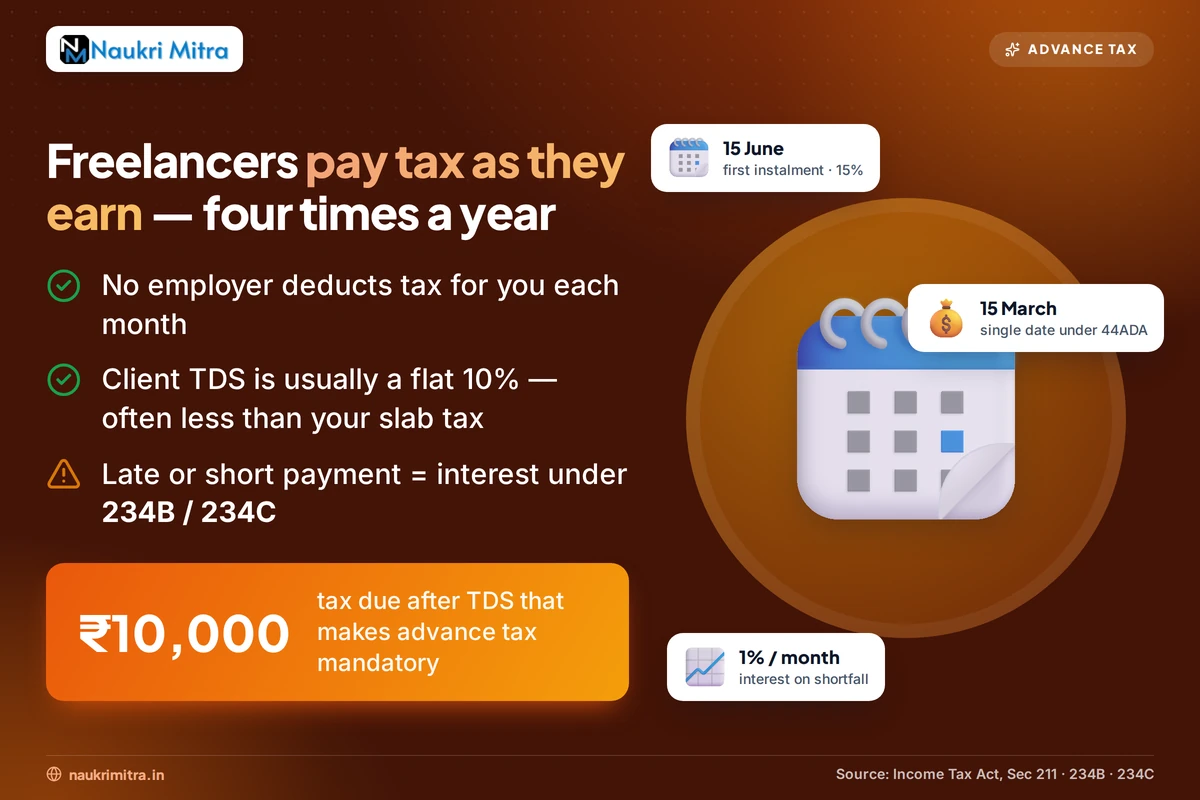
Advance tax is exactly what it sounds like — income tax paid in advance, in instalments, during the same financial year in which you earn the income, rather than as one lump sum after the year closes. The "pay as you earn" scheme exists so that the government doesn't wait twelve to eighteen months to collect revenue, and so that taxpayers aren't hit with one enormous bill at filing time.
For a salaried employee, this happens automatically — the employer deducts TDS from every month's salary based on declared investments and expected annual income, and by March most of the liability is covered. A freelancer has no employer withholding tax this way. Clients may deduct TDS under Section 194J on professional fees, but that's usually a flat 10%, which rarely matches actual slab-rate liability once income crosses ₹10–15 lakh a year. The gap between what gets deducted and what's actually owed is exactly what advance tax closes, and the responsibility sits entirely with the freelancer, not any client or platform.
Who Actually Has to Pay — The ₹10,000 Threshold
Not every freelancer needs to worry about quarterly payments. Advance tax becomes mandatory only when your estimated tax liability for the financial year, after subtracting any TDS already deducted by clients, exceeds ₹10,000. For most people doing freelance work as a side income this threshold is crossed quickly, because ₹10,000 in tax liability corresponds to a fairly modest annual taxable income once you're outside the basic exemption limit.
There is one notable carve-out: a resident senior citizen (60 years or older) with no income from business or profession is not required to pay advance tax, and can settle the full liability through self-assessment tax at filing time instead. The catch is that this exemption specifically excludes people with business or professional income — and freelance earnings are classified exactly that way, so a senior citizen who still freelances or consults generally cannot claim it.
Advance Tax Due Dates and the Percentage Schedule
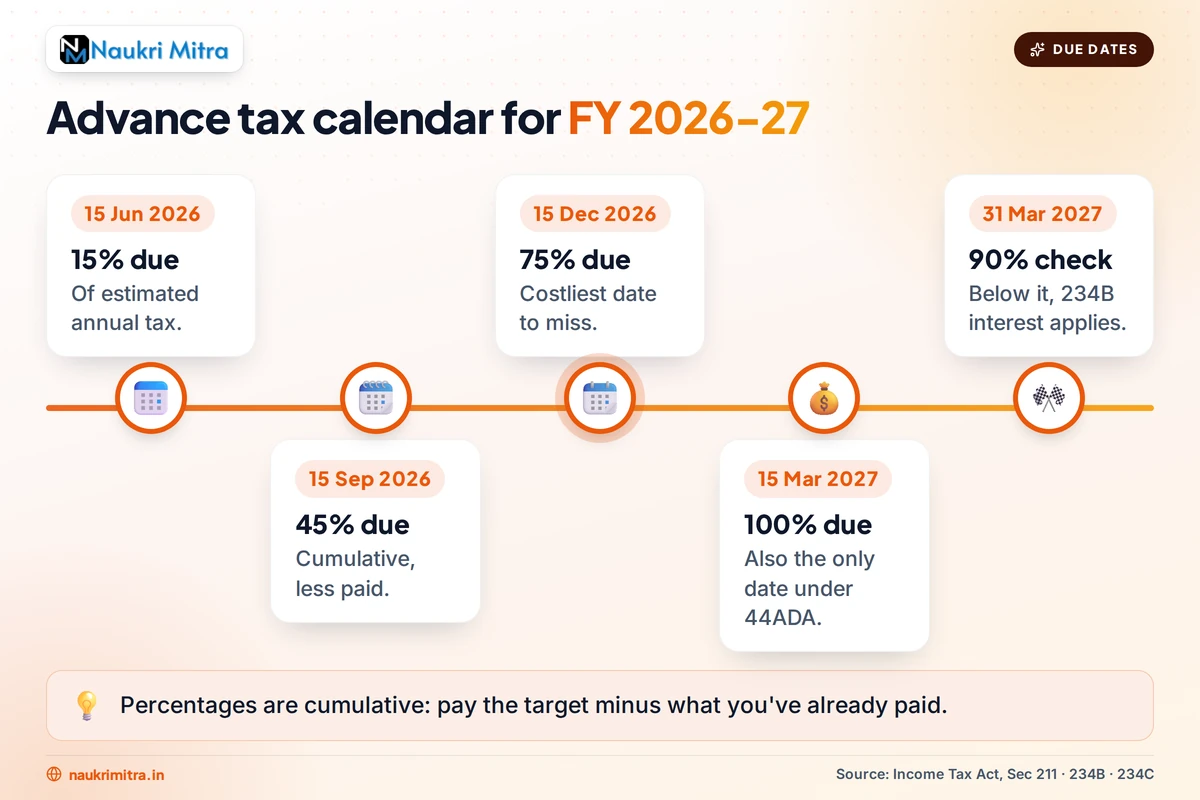
The Income Tax Act lays out four checkpoints across the financial year, each requiring a cumulative percentage of your total estimated tax liability to be paid by that date. For regular taxpayers (including most freelancers who maintain books of accounts rather than using presumptive taxation), the schedule under Section 211 is:
- On or before 15th June — at least 15% of the estimated annual tax liability
- On or before 15th September — at least 45% of the liability, less what's already been paid
- On or before 15th December — at least 75% of the liability, less what's already been paid
- On or before 15th March — 100% of the liability, less what's already been paid
Missing the mid-December checkpoint is particularly costly, since it's where interest calculations start to bite hardest if your cumulative payment falls short. As a recent explainer on the deadline published by Business Standard put it, a delay in paying advance tax "results in interest for deferment and shortfall and can also lead to a heavy lump-sum outgo" at return-filing time. These four quarterly tax installments are the exact advance tax due dates freelancer taxpayers need to mark on their calendar every year, regardless of how irregular their income is.
Advance Tax Calculation for Irregular Income
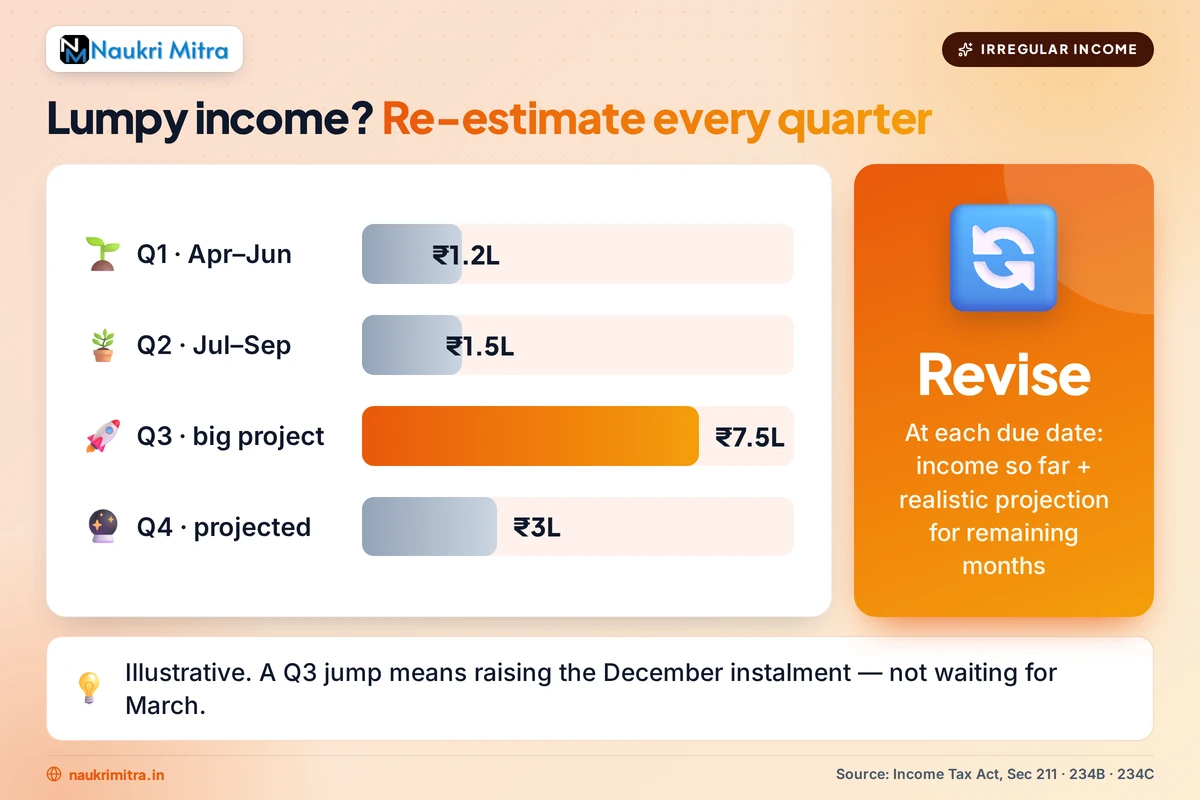
This is the part that genuinely trips up freelancers, because the law doesn't ask what you earned last quarter — it asks what you expect to earn for the full year, estimated honestly at each due date. For someone with a steady retainer client, that's simple arithmetic. For a freelancer whose income swings between a quiet ₹30,000 month and a ₹3 lakh project month, advance tax calculation irregular income work becomes closer to forecasting than bookkeeping.
A practical approach most chartered accountants recommend is a running estimate rather than a fixed one: at each instalment date, add up actual income earned so far, add a realistic projection for the remaining months, and recalculate tax on that total. Your June payment rests on the thinnest information you'll have all year, while December and March payments should track much closer to your real numbers. Seasonal spikes — festive e-commerce design work, January–March bookkeeping season — can genuinely throw off an early estimate; the fix is to revise upward aggressively once the pattern becomes visible, rather than waiting until March to true everything up.
Underestimating in Q1 and Getting a Big Project in Q4
This is the single most common scenario freelancers write in about, and it's exactly what happened to Rohan. If you paid advance tax in June and September based on a conservative estimate and a large project lands in November, you are not locked into your earlier estimate — you're expected to revise it. Each instalment is assessed against the cumulative percentage due by that date, so your December payment should reflect the updated, larger annual figure, not the original June one.
The risk is that most freelancers don't revise in December either, and instead wait until the March 15th final instalment to "true up." Waiting that long means the shortfall for the earlier checkpoints has already accrued interest under Section 234C, and that interest doesn't disappear just because the full amount is eventually paid before the year closes. Whenever your income picture materially changes, recalculate the full-year estimate and adjust the very next instalment upward to cover both the new liability and the catch-up.
Section 234B Interest Explained
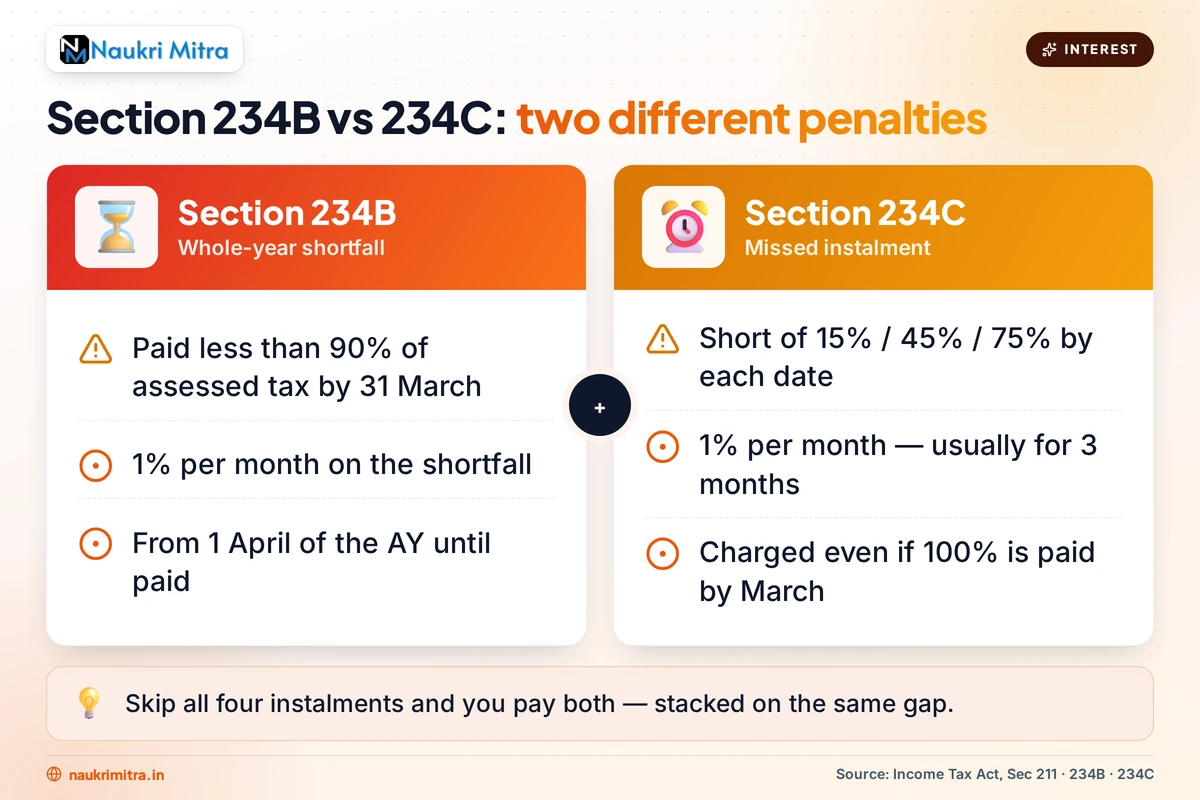
Section 234B penalises simply not paying enough advance tax overall during the year. It applies when total advance tax paid by 31st March is less than 90% of your assessed tax liability for that year (assessed tax being total tax minus TDS credit). If that 90% threshold isn't met, interest is charged at 1% per month, or part of a month, on the shortfall, calculated from 1st April of the assessment year until the balance is actually paid — whether through a later advance tax payment or self-assessment tax at filing.
234B is a blunt, whole-year measure checking only whether cumulative payment by year-end cleared the 90% bar — unlike 234C below, which checks each instalment deadline individually.
Section 234C — How It's Different from 234B
Where 234B looks at the full-year shortfall, Section 234C penalises missing the percentage due at each individual checkpoint, even if you eventually catch up and pay 100% by March. Falling short of 15% by June 15, 45% by September 15, or 75% by December 15 (relative to eventual tax liability) triggers interest at 1% per month on that shortfall — generally for three months for the June, September, and December gaps, and one month for March. This is the mechanism behind what most freelancers call interest on late advance tax, calculated automatically when the return is filed, even without any prior notice.
The combined effect of Section 234B 234C penalty freelancer calculations can look like double interest on the same gap — and in a sense it is, since 234C penalises instalment-by-instalment delay while 234B separately penalises the overall year-end shortfall beyond 10%. Paying close to real liability by each quarterly date is the only reliable way to avoid stacking both.
Advance Tax Under Section 44ADA Presumptive Taxation
Many freelancers in specified professions — including IT consulting, design, writing, legal, medical, engineering, and accounting work — opt into the presumptive taxation scheme under Section 44ADA, which lets them declare 50% of gross receipts as taxable profit without maintaining detailed books of accounts, provided gross receipts stay within the prescribed limit (₹50 lakh generally, or ₹75 lakh where cash receipts are 5% or less of total receipts). This scheme changes the advance tax calculation meaningfully. As ClearTax's guide to presumptive taxation for freelancers explains, taxpayers who opt for Section 44ADA (or the equivalent 44AD for small businesses) are permitted to pay their entire advance tax liability in a single instalment, on or before 15th March of the financial year, instead of following the four-instalment schedule that applies to everyone else.
This is a genuine relief for freelancers with unpredictable income, since it gives you until near year-end to finalise your estimate — though the exemption is only from the quarterly schedule, not the obligation itself, and 234B still applies if the March payment falls short of 90%.
TDS Credit and Combining Salary With Freelance Income
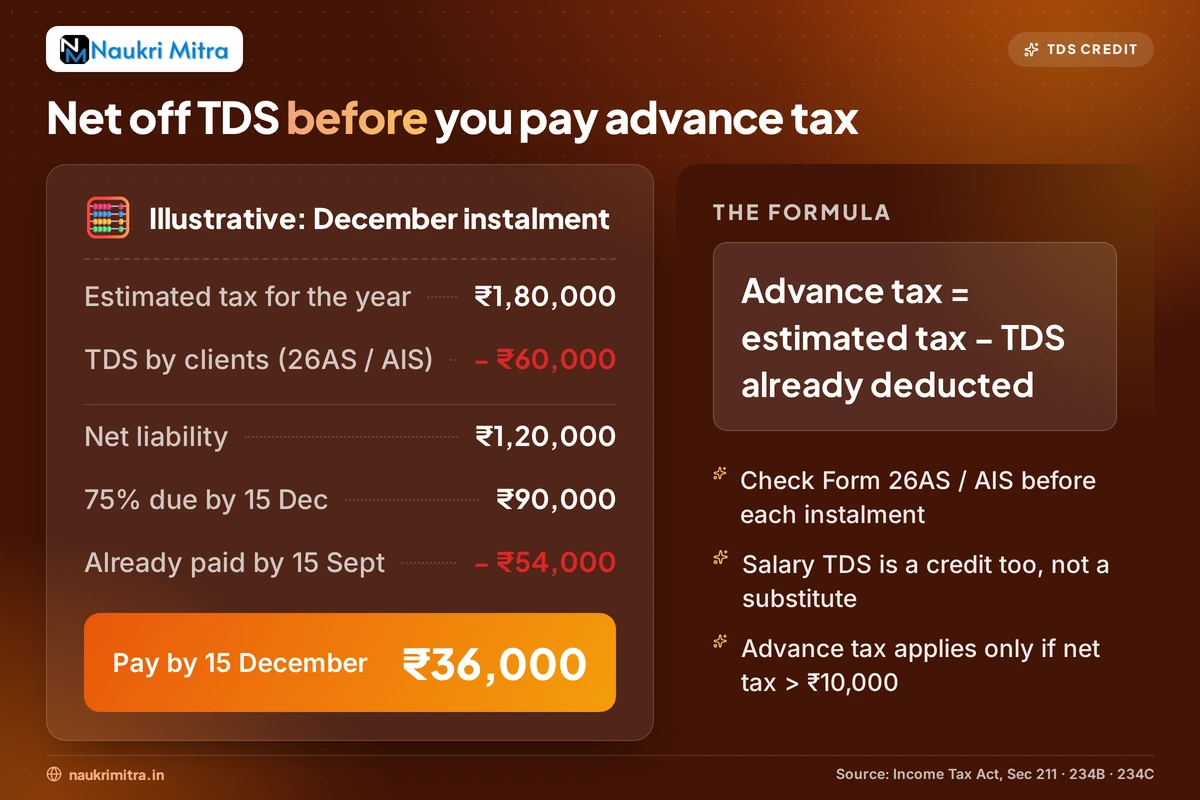
If clients deduct TDS under Section 194J (typically 10% on professional or technical fees) before paying you, that TDS is not a separate tax — it's a credit against your total tax liability for the year, advance tax included. When calculating what you still owe at each instalment date, subtract TDS already deducted (visible in Form 26AS/AIS) from your estimated annual liability, and pay advance tax only on the remaining gap. Many freelancers over-pay simply because they forget to net out TDS already withheld, so checking Form 26AS before each instalment is worth the five minutes it takes.
The same logic applies to freelancers who also hold a salaried job. An employer's TDS is calculated only on the salary paid unless freelance income is declared on Form 12BB, which most don't do — so the freelancer remains independently responsible for advance tax on the freelance portion, treating salary TDS as a credit against the combined liability, not a substitute for it.
How to Pay Advance Tax Online Using Challan 280
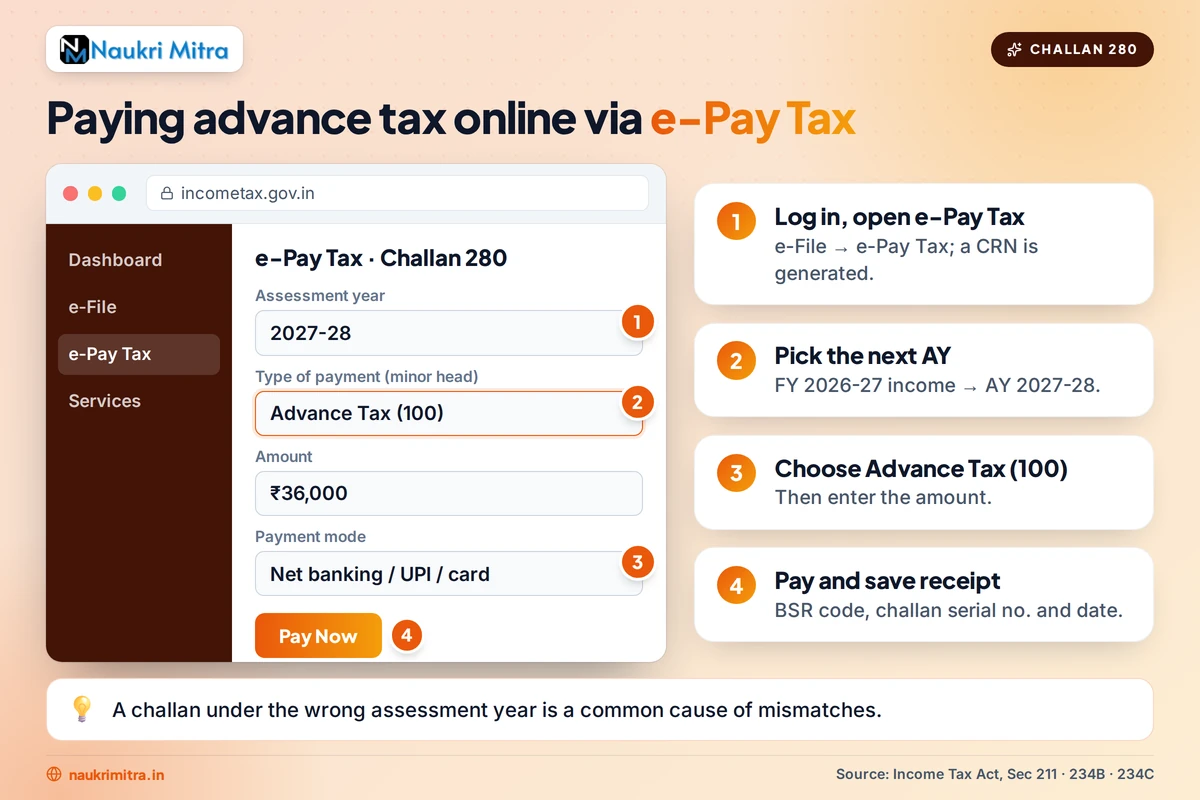
The process for how to pay advance tax online freelance income generates is now almost entirely digital through the income tax e-filing portal's e-Pay Tax service, which has replaced the older standalone Challan 280 (ITNS 280) form, though the term "Challan 280" is still widely used since the underlying challan type and fields remain the same. The broad steps are:
- Log in to the e-filing portal (incometax.gov.in) and navigate to e-File → e-Pay Tax.
- Select the applicable challan — for individuals this is typically Challan No. 280 / ITNS 280 (now generated as a CRN — Challan Reference Number — within the portal).
- Choose "Advance Tax (100)" as the type of payment under the minor head options.
- Select the correct assessment year (one year ahead of the financial year you're paying for).
- Enter your estimated tax amount and any applicable cess/surcharge.
- Pay via net banking, debit card, UPI, RTGS/NEFT, or by generating the challan and paying at an authorised bank branch.
- Save the generated receipt (BSR code, challan serial number, and date) — you'll need these details when filing your ITR to claim credit for the tax already paid.
The official e-Pay Tax FAQ page on the income tax department's portal covers the technical details of CRN generation, payment modes, and challan validity periods if you run into issues mid-payment. Freelancers who find the process confusing often engage a professional rather than DIY it, and Naukri Mitra's listings for virtual tax consultant roles and virtual tax preparer positions show how much freelance demand exists for exactly this kind of support.
Records to Keep and How Expenses Affect Your Estimate
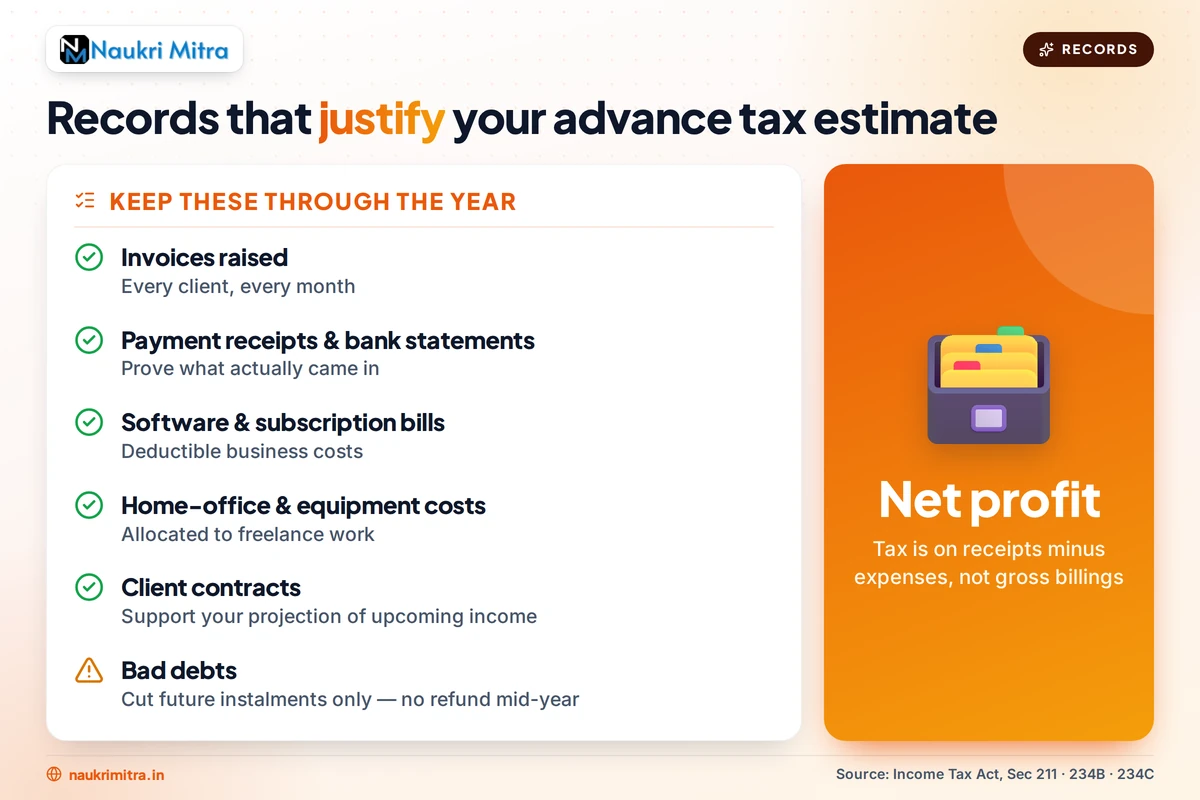
Because freelance income is professional income, advance tax should be calculated on net profit — gross receipts minus legitimate business expenses — not on gross billings. Keep invoices raised, payment receipts, bank statements, software and subscription bills, home-office cost allocations, equipment purchases, and client contracts confirming upcoming income. These records justify the deductions that bring down taxable profit, and in turn advance tax liability, at each checkpoint.
A client who never pays (a bad debt) or an unexpected equipment expense can legitimately reduce your remaining liability — but only going forward. A bad debt written off in Q3 lowers the estimate for September and December instalments; it doesn't retroactively reduce the June instalment already paid on the original, higher estimate, since there's no mid-year refund mechanism. This is one more reason to revise the estimate at every checkpoint rather than setting it once in June.
The Cost of Skipping Advance Tax Entirely
Some freelancers decide to simply skip quarterly payments and settle everything as self-assessment tax while filing their return. This is legal — the Income Tax Act doesn't jail anyone for this — but it is financially the worst option available. Skipping all four instalments means you accrue 234C interest for every missed checkpoint across the year, plus 234B interest on the full shortfall from 1st April of the assessment year until you finally pay. On a meaningful tax liability, this adds up to real extra cost simply for timing, on top of a large, unplanned cash outflow in July instead of four manageable payments spread across the year.
Reconciling Advance Tax With Final ITR Liability
At filing time, your ITR effectively does the final reconciliation: total tax liability for the year, minus TDS credited (visible in Form 26AS/AIS), minus advance tax instalments you've already paid, equals either a remaining balance payable as self-assessment tax, or a refund if you've overpaid. Any 234B/234C interest the system calculates based on your instalment history is added automatically before this final number is struck, which is why it's worth reviewing your Form 26AS and your own instalment records before filing, rather than being surprised by an interest line you didn't expect. Most e-filing utilities and ITR forms now pre-fill advance tax payments based on your PAN, but mismatches do happen, especially if a challan was filed under the wrong assessment year.
Frequently Asked Questions
Can you revise your advance tax estimate in a later quarter if income changes?
Yes. There is no formal "revision filing" — you simply recalculate your estimated annual income at the next instalment date and pay the updated cumulative percentage due. The law expects a reasonable estimate at each checkpoint, not a fixed figure locked in at the start of the year.
Are senior citizen freelancers without business income exempt from advance tax?
The exemption for residents aged 60+ applies only when they have no income from business or profession. Since freelance earnings are classified as professional/business income, most senior citizen freelancers do not qualify for this exemption and must still pay advance tax if their liability crosses ₹10,000.
What records should you keep to justify your advance tax estimate?
Invoices raised, payment receipts, bank statements, expense bills, and any signed contracts for upcoming work. These support both your profit calculation and your income projection if the estimate is ever questioned.
Can unexpected expenses or bad debts reduce the advance tax already paid?
They reduce your estimate for future instalments, not instalments already paid. There's no mid-year refund mechanism — any correction flows through at the next checkpoint or at final assessment.
How does seasonal or festive-season income complicate estimation?
A freelancer earning a large share of annual income in a festive or peak-season quarter may legitimately under-forecast early in the year. The practical fix is to revise the estimate aggressively once the seasonal pattern becomes visible, rather than waiting until March.
Is there a safe-harbor way to estimate tax using last year's income as a base?
There's no formal statutory safe harbor for freelancers the way some other jurisdictions offer. In practice, using last year's income adjusted for known changes (new clients, rate increases, lost clients) is a commonly used starting point, refined at each quarterly checkpoint with actual year-to-date figures.
What tools or calculators help estimate quarterly advance tax for variable income?
The income tax portal's e-Pay Tax utility, and most ITR-filing platforms, offer built-in advance tax calculators where you enter income earned so far plus projected income for the rest of the year to get an instant instalment figure.
What if a freelancer has both salary with TDS and freelance income — how do you net it out?
Add your salary income and freelance income together for your total estimated annual tax. Subtract TDS already deducted by your employer and by freelance clients from this total; whatever remains above ₹10,000 is your advance tax obligation, due in the regular quarterly instalments.
Is TDS already deducted by clients adjusted against advance tax liability?
Yes. TDS deducted under Section 194J (or any other applicable section) is a credit against your total tax liability for the year. You calculate advance tax only on the estimated liability remaining after subtracting TDS already withheld.
What's the penalty if you skip advance tax entirely and pay everything at filing time?
You'll owe 234C interest for every missed quarterly checkpoint, plus 234B interest on the full-year shortfall from April 1st of the assessment year onward, both calculated at 1% per month until the balance is paid — a meaningfully higher total cost than paying on schedule.
Advance tax rewards freelancers who treat their income like a business, even an irregular one — tracking receipts, revisiting projections every quarter, and setting aside a percentage of every big payment the moment it lands rather than at tax time. Building that estimate-and-revise habit, alongside keeping clean invoices through platforms like Naukri Mitra where freelancers find consistent client work, makes the whole quarterly cycle far less stressful than Rohan's December surprise. If the calculation ever feels genuinely out of your depth, freelancers listed under freelance bookkeeper roles on the platform are increasingly the people other freelancers turn to for exactly this kind of quarterly tax tracking.
Sources: Income Tax Department – e-Pay Tax FAQs; Business Standard – Advance tax: who must pay now and what missing the deadline can cost; ClearTax – Presumptive Taxation for Freelance, Professional and Business Income.
.png)
.png)
.png)
Comments
Post a Comment