Do Freelancers Need GST Registration? | Naukri Mitra
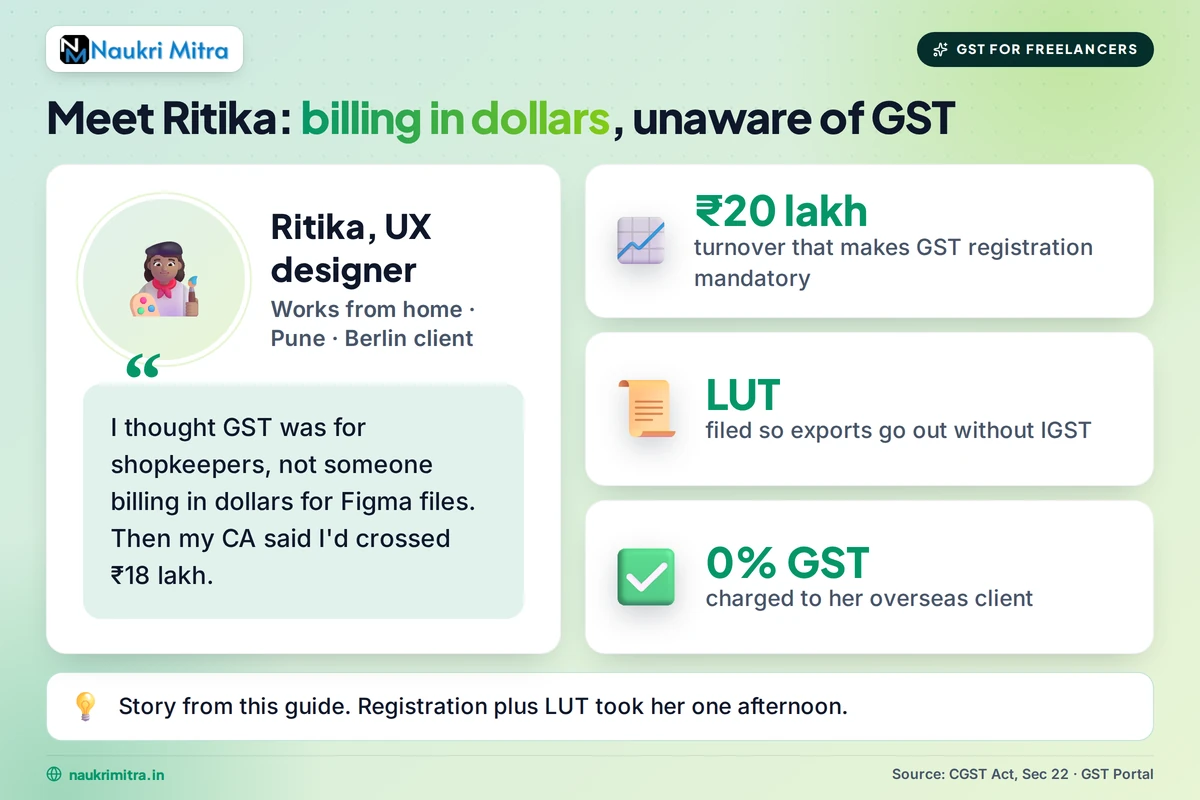
Ritika, a UX designer working out of a one-bedroom apartment in Pune, had just wrapped her fourth consecutive project for a startup in Berlin. The payment landed in her account through Wise, no TDS deducted, nothing that looked like a "business transaction" in the way her salaried friends understood the term. Then her chartered accountant asked a question that stopped her cold: "You've crossed eighteen lakh this year. Have you even thought about GST?" Ritika hadn't. Like most Indian freelancers, she assumed GST was something shopkeepers and manufacturers dealt with, not someone billing in dollars for Figma files. She was wrong, and the confusion she felt is shared by thousands of writers, developers, designers and consultants who build entire careers without ever being told, clearly, when the tax office actually expects them to register.
This guide walks through exactly when GST registration becomes mandatory for a freelancer, when it's optional but useful, and what changes once you have that fifteen-digit GSTIN sitting on your invoices. We'll also deal with the question that trips up almost everyone working with international clients: if your buyer is in London or Toronto, does Indian GST even apply to you?
What Triggers Mandatory GST Registration for a Freelancer
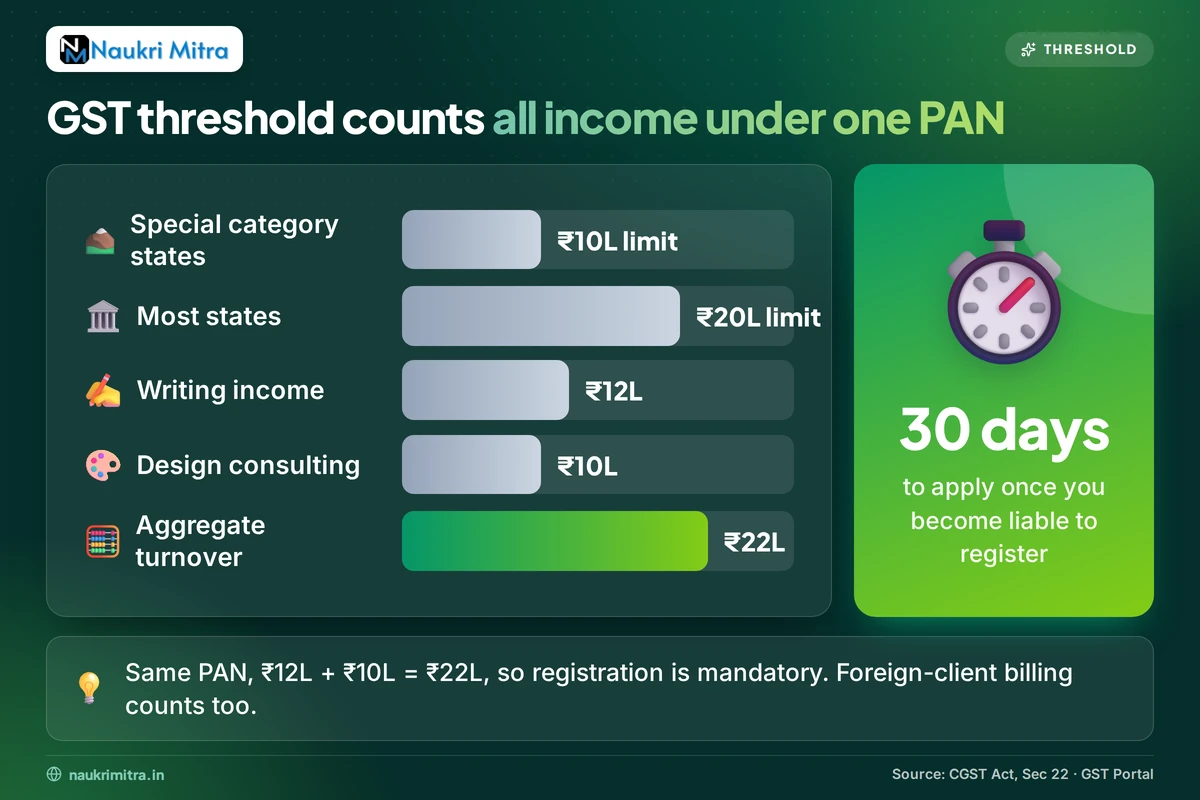
The GST registration limit for freelancers in India is tied to something called aggregate turnover, not just the money you see in your bank statement from one client. Aggregate turnover means the total value of all taxable supplies, exempt supplies, exports and inter-state supplies you've made in a financial year, computed on an all-India basis using the same PAN. It is not calculated per client or per project — every rupee you've billed across every client, platform and contract in that financial year gets added together.
For most Indian states, a freelancer providing services must register once aggregate turnover crosses ₹20 lakh in a financial year. This is explicitly laid out under Section 22 of the Central Goods and Services Tax Act, which also carves out a lower threshold of ₹10 lakh for suppliers operating from special category states — Jammu & Kashmir, Himachal Pradesh, Uttarakhand, Assam, Meghalaya, Sikkim and Arunachal Pradesh among them. If your registered place of business falls in one of these states, the freelancer GST threshold 20 lakh figure most people quote doesn't apply to you; you cross into mandatory territory at half that amount.
So does a freelancer need GST number the moment income crosses this line? Yes — and the obligation is triggered the day the threshold is breached, not at the end of the financial year. If you cross ₹20 lakh in October, the clock for applying starts immediately; the law gives you thirty days from the date you become liable to register. Freelancers who keep billing past the threshold without applying are technically operating without registration despite being liable, and that exposes them to real penalties — typically 10% of the tax due (subject to a minimum amount) for a genuine oversight, rising to a much steeper penalty equal to the tax evaded where the department concludes the non-registration was deliberate, plus interest on the unpaid tax from the date it became due. In practice, most freelancers who get flagged are caught through AIS and 26AS mismatches rather than active enforcement raids, but the exposure is real and compounds the longer registration is delayed.
Freelancing for Foreign Clients: Do You Still Need to Register?
This is where most of the confusion lives, and it's worth separating two different questions: whether GST law applies to you, and whether you actually pay GST on that income. A freelancer earning exclusively from clients outside India is still a supplier of services under Indian law, and that income still counts toward aggregate turnover for threshold purposes. In other words, GST for freelancers working with foreign clients is not automatically out of scope just because the invoice is in dollars or euros. If your total billings, foreign plus domestic, cross ₹20 lakh, registration becomes mandatory exactly as it would for a freelancer serving only Indian clients.
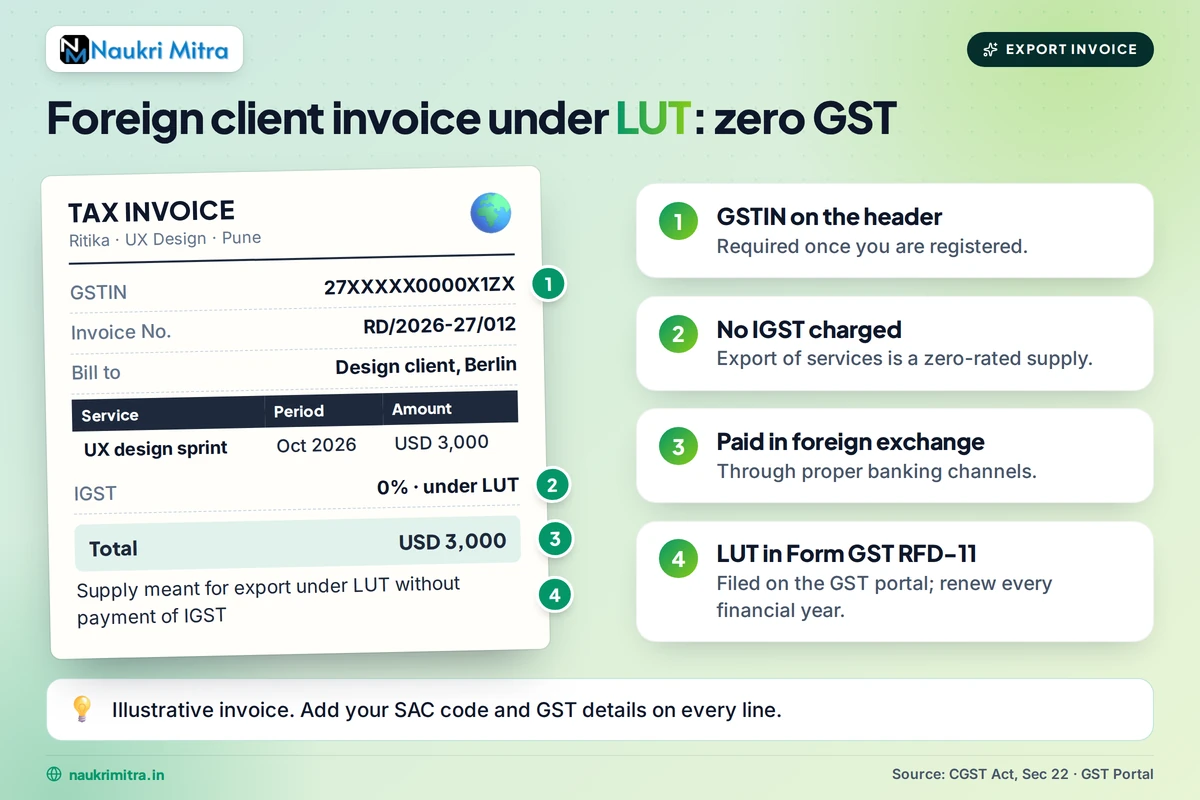
What does change is whether you actually owe tax once registered. Export of services — broadly, services supplied to a recipient located outside India, paid for in convertible foreign exchange, where the supplier and recipient aren't merely establishments of the same entity — is treated as a zero-rated supply under GST. That's the practical GST exemption for export of services freelancer arrangement most people are really asking about: you register, you file returns, but you don't charge GST to the overseas client, and you aren't out of pocket for tax you'd otherwise have to pay yourself. There are two routes to achieve this. You can pay IGST on the export and then claim it back as a refund, which ties up cash and takes time, or you can furnish a Letter of Undertaking and supply without paying tax upfront at all. Almost every freelancer who exports services chooses the LUT route. A LUT for export of services is filed in Form GST RFD-11 directly on the GST portal under Services, then User Services, then Furnish Letter of Undertaking — the form auto-populates your registration details, asks you to select the financial year and add witness information, and once signed digitally it generates an acknowledgment number almost instantly. It needs to be renewed every financial year, and the official GST portal's own filing guide walks through each field if you want to see the process before you sit down to do it yourself.
It also genuinely matters whether the client paying you is Indian or foreign. Payments from platforms like Upwork or Fiverr, where the contracting entity is typically based outside India and pays in foreign currency, generally qualify for export treatment provided the payment comes through proper banking channels and the other export conditions are met. An invoice raised on an Indian company, even for the exact same kind of work, is a domestic supply — GST applies in the ordinary way once you're registered, and the client may deduct tax at source separately under the Income Tax Act regardless of your GST status.
GST Rates and SAC Codes for Different Freelance Services
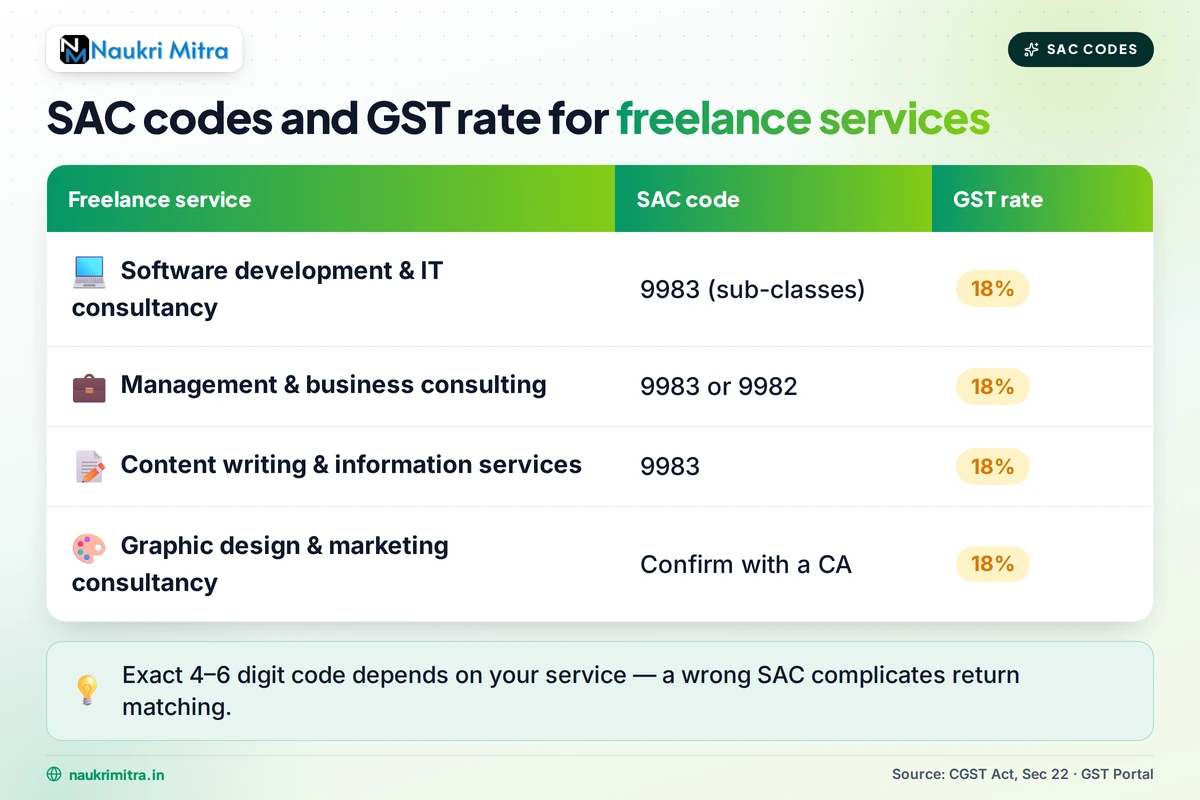
Once registered, you need to know what rate to charge and which code identifies your service on invoices and returns. Most professional and technical services that freelancers provide — writing, graphic design, software development, marketing consultancy, business consulting — fall under the standard GST rate of 18%. This covers the vast majority of knowledge-work freelancing in India; there is no special concessional rate carved out just because the supplier is an individual rather than a company. GST on consulting services, whether it's a one-person management consultant or a two-person design studio, is charged at the same 18% that applies to a large consulting firm.
Alongside the rate, every invoice needs a Services Accounting Code, commonly called a SAC code for freelancers, which categorises exactly what kind of service you're billing for. Software development and related IT consultancy typically falls under SAC 9983 or its sub-classifications; management, business and other consulting services generally sit under SAC 9983 or 9982 depending on the specific nature of the advice; content writing and other information services fall under SAC 9983 as well. The exact four-to-six digit code depends on turnover-based disclosure requirements and the specific nature of what you're billing, so it's worth confirming the precise code with a tax professional or your invoicing software rather than guessing, since an incorrect SAC code can complicate return matching later.
Should You Register Voluntarily Below the Threshold?
Registration isn't only something that gets forced on you past ₹20 lakh. A freelancer under the threshold can register voluntarily, and for some, it's a genuinely good decision rather than unnecessary paperwork. Voluntary registration lets you claim input tax credit on GST paid for laptops, software subscriptions, coworking memberships and other business expenses, which can meaningfully lower your effective cost base. It also signals a level of formality that larger Indian corporate clients sometimes expect before they'll onboard a vendor, and it lets you issue a GSTIN-backed invoice that some procurement departments require as a matter of internal policy, even for fairly small engagements.
The trade-off is compliance overhead — regular return filing, invoice-level reporting and the discipline of reconciling input credits even when your income is modest. Once you opt in voluntarily, you're held to the same filing obligations as someone who crossed the threshold involuntarily; there's no lighter-touch version of compliance just because you chose it rather than being forced into it.
There's also a composition scheme under GST, but it's worth knowing upfront that it isn't really built for most freelancers. The composition scheme for service providers caps eligibility at a relatively low turnover and restricts the scheme largely to a narrow set of service categories, with most professional and consulting freelancers falling outside its scope entirely. In practice, almost every freelancer who registers ends up on the regular scheme rather than composition.
Reverse Charge Mechanism and How GST Affects TDS
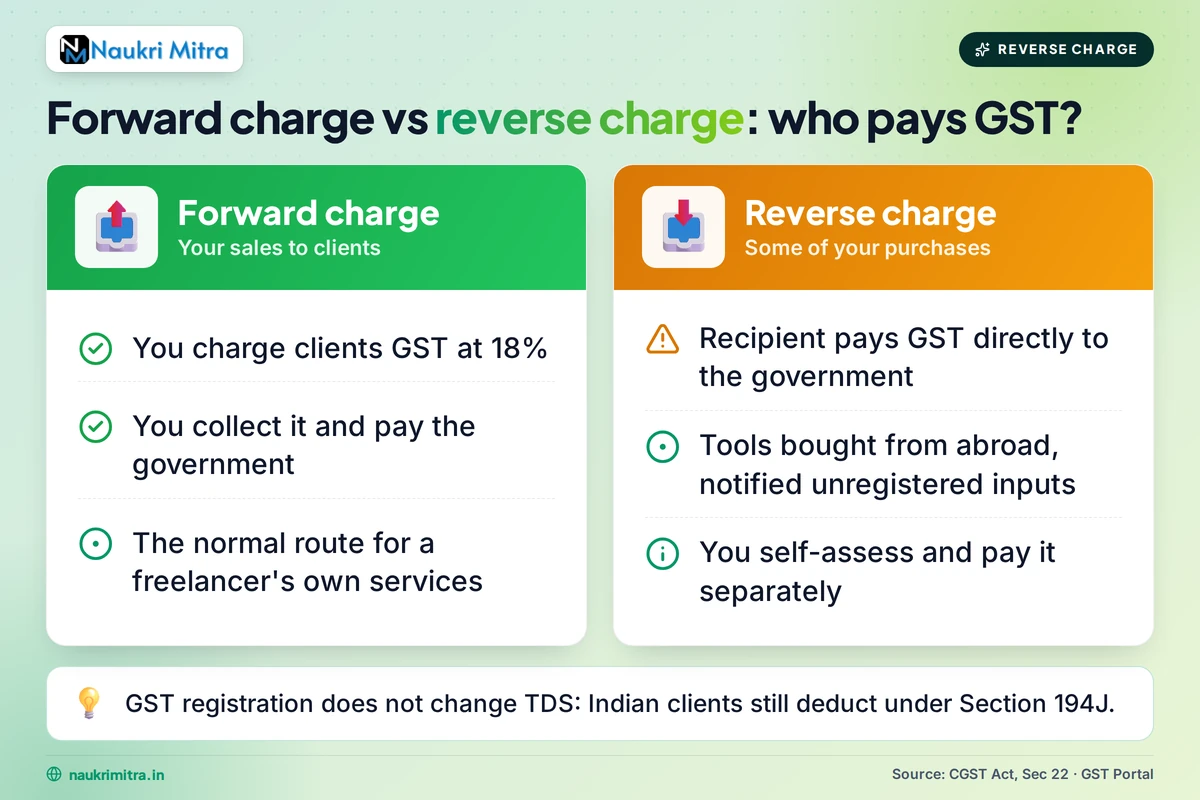
Two mechanics confuse freelancers more than almost anything else in this topic: reverse charge, and the interaction between GST and income tax TDS. They are unrelated taxes governed by different laws, and registering for GST doesn't change your TDS exposure under Section 194J one way or another — an Indian client still deducts income tax at source on professional fees regardless of whether you're GST-registered, and that deduction is adjusted against your final income tax liability, not your GST liability.
The reverse charge mechanism works differently and rarely applies to a typical freelancer providing output services, but it's worth understanding because it can quietly affect you on the input side. Under reverse charge, the recipient of certain notified goods or services pays GST directly to the government instead of the supplier collecting and remitting it — this applies, for instance, when a registered person buys specified goods or services from an unregistered supplier in particular notified categories, or receives certain services from outside India. A freelancer who imports a paid tool or service from an overseas vendor, or engages certain categories of unregistered local suppliers for specified inputs, may find themselves liable to self-assess and pay GST under reverse charge on that purchase, separate from whatever GST they charge their own clients. ClearTax's explainer on the reverse charge mechanism breaks down the specific notified categories in more detail, which is useful reading before you assume reverse charge simply doesn't concern you.
Invoicing, Returns and Input Tax Credit After Registration
Registration changes the shape of your paperwork noticeably. Every invoice must now carry your GSTIN, the recipient's GSTIN where applicable, the applicable SAC code, the GST rate and amount split by CGST/SGST for intra-state supply or IGST for inter-state and export supply, along with a sequential invoice number for the financial year. This is a meaningfully more rigid format than the simple invoice a non-registered freelancer typically uses.
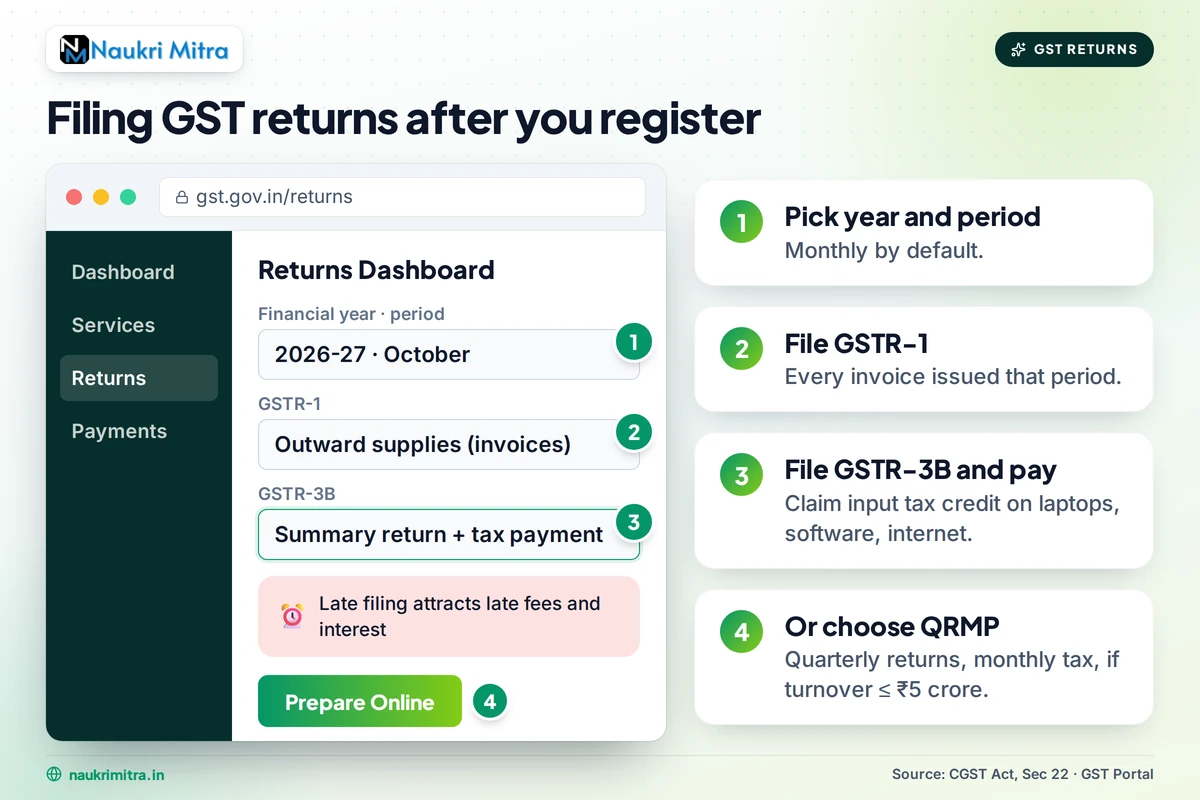
On the filing side, most small and mid-sized freelancers file GSTR-1 (outward supplies) and GSTR-3B (summary return with tax payment) on a monthly basis, though freelancers with turnover up to ₹5 crore can opt into the Quarterly Return Monthly Payment scheme, which reduces return filing to once a quarter while tax is still paid monthly based on a fixed or self-assessed estimate. Missing these deadlines attracts late fees and interest, so most freelancers who register end up either learning the GST portal properly or outsourcing filing to an accountant on a monthly retainer.
The upside of registration, beyond simply being compliant, is input tax credit. A registered freelancer can claim credit for GST paid on laptops, monitors, software subscriptions, internet and phone bills used for the business, professional memberships and similar inputs, provided proper tax invoices are retained and the expense is genuinely attributable to the freelance work. For someone investing heavily in equipment or paid software tools, this credit can offset a meaningful chunk of the GST collected from clients, effectively lowering the net tax actually remitted.
GST Registration and 44ADA: How the Two Interact
GST and income tax run on entirely separate tracks, and freelancers often assume registering for one automatically changes the other — it doesn't. A freelancer who opts for presumptive taxation under Section 44ADA, declaring 50% of gross receipts as taxable profit, can still be required to register for GST if aggregate turnover crosses the threshold; GST registration has no bearing on whether 44ADA remains available for income tax purposes, and vice versa. The two compliances simply run in parallel, each governed by its own law, its own forms and its own deadlines.
Multiple income sources complicate the turnover calculation more than people expect. If you freelance under your own PAN while also running a side consulting gig, both streams are aggregated together for GST threshold purposes because the threshold is computed per PAN across all business activities, not per individual client, platform or line of work. A freelancer earning ₹12 lakh from writing and ₹10 lakh from separate design consulting under the same PAN has crossed ₹20 lakh in aggregate turnover and is liable to register, even though neither activity alone touched the threshold.
Documents Needed to Register for GST as a Freelancer
The registration application itself is filed online through the GST portal and typically needs PAN, Aadhaar, a passport-size photograph, proof of business address — a rent agreement and NOC from the landlord, or a recent utility bill if you work from an owned property — and bank account details supported by a cancelled cheque or bank statement. Freelancers without a dedicated commercial address commonly register using their home address, which is entirely permitted, provided the supporting documents match. Most applications are processed within about a week once documents are in order, though verification queries can extend that timeline, so it's worth applying with some buffer before you actually cross the threshold rather than scrambling after the fact.
For freelancers who'd rather not navigate GST registration, LUT filing and monthly returns entirely on their own, a growing number of virtual tax consultant roles and GST-focused opportunities are listed on virtual tax consultant positions and GST executive roles on Naukri Mitra, useful either as a freelancer looking to hire help or as a professional building a career around exactly this kind of compliance work. Freelancers juggling invoices and receipts across clients may also find it worth browsing freelance bookkeeper opportunities, since a basic bookkeeping habit built early makes GST return filing considerably less painful later. For the full range of freelance and remote opportunities across categories, Naukri Mitra maintains an actively updated listing.
Getting the Paperwork Right the First Time
Most freelancers who run into trouble with GST aren't trying to evade anything — they simply never crossed the threshold deliberately and didn't notice when irregular, lumpy freelance income quietly added up over a financial year. The fix isn't complicated: track aggregate turnover across every client and platform as you go, not just at tax-filing time, and treat ₹20 lakh (or ₹10 lakh if you're based in a special category state) as a hard trigger rather than a vague milestone. If a large chunk of your income already comes from overseas clients, get comfortable with the LUT process early rather than after a big project pushes you over the line, since filing it in advance of invoicing is cleaner than retrofitting compliance after the fact.
Ritika, eventually, registered voluntarily a few weeks before she would have crossed the threshold anyway, filed her LUT the same week, and now invoices her Berlin client with a GSTIN on the header and zero GST charged, exactly as export-of-service rules intend. The paperwork took an afternoon. The confusion before that afternoon had lasted the better part of a year.
Frequently Asked Questions
Is GST registration mandatory for every freelancer, regardless of income?
No. Registration becomes mandatory only once aggregate turnover crosses ₹20 lakh in a financial year (₹10 lakh in special category states). Below that, registration is optional.
If all my clients are based outside India, do I still need to register?
Yes, if your total billings cross the threshold. Foreign-client income counts toward aggregate turnover even though the eventual supply may be zero-rated as an export of services.
What exactly is an LUT and do I need a tax consultant to file it?
A Letter of Undertaking, filed in Form GST RFD-11 on the GST portal, lets a registered exporter supply services without paying IGST upfront. It can be self-filed directly on the portal, though many freelancers prefer a consultant for the first filing.
What GST rate applies to writing, design or development work?
Most freelance professional and consulting services, across categories, are taxed at the standard 18% GST rate, identified on invoices using the relevant SAC code.
Can I voluntarily register for GST even if I'm well below ₹20 lakh?
Yes, and it can make sense if you want to claim input tax credit on equipment and software, or if corporate clients expect a GSTIN on your invoices.
Does GST registration change how much TDS a client deducts from my payments?
No. TDS under the Income Tax Act and GST are separate systems; registering for GST doesn't alter your TDS rate or obligation under Section 194J.
How often do I need to file GST returns once registered?
Most freelancers file GSTR-1 and GSTR-3B monthly, though those under ₹5 crore turnover can opt for quarterly filing under the QRMP scheme with monthly tax payment.
What happens if I cross the threshold and keep billing without registering?
You become liable for penalties (commonly a percentage of the tax due, higher if deliberate) plus interest on unpaid tax, and you may face difficulty claiming input credit retroactively.
Does registering for GST affect my eligibility for Section 44ADA presumptive taxation?
No. GST and income tax are independent; 44ADA eligibility depends on income tax rules, not GST registration status.
Sources: CBIC – CGST Act, Section 22 (registration threshold); GST Portal – Furnishing of Letter of Undertaking for Export of Services; ClearTax – Reverse Charge Mechanism (RCM) under GST.
.png)
.png)
.png)
Comments
Post a Comment