The Moonlighting Tax Trap in India | Naukri Mitra
Rahul had filed his income tax return the same way for six years straight: pull up Form 16, let the portal auto-fill the rest, click submit, move on with his week. This year was different. Alongside his salary at a Bengaluru product company, he had spent eight months writing technical documentation for two startups on the side, invoiced them directly, and never thought to mention it on his return — after all, it felt like "extra pocket money," not real income. In October, a message appeared on the income tax portal's compliance section asking him to explain a mismatch between the income he had reported and the income the department already knew about. That gap between what you earn quietly and what the system already sees is the moonlighting tax trap, and it catches far more salaried professionals than most people realize.

What Counts as Moonlighting Income — and Do You Have to Declare It?
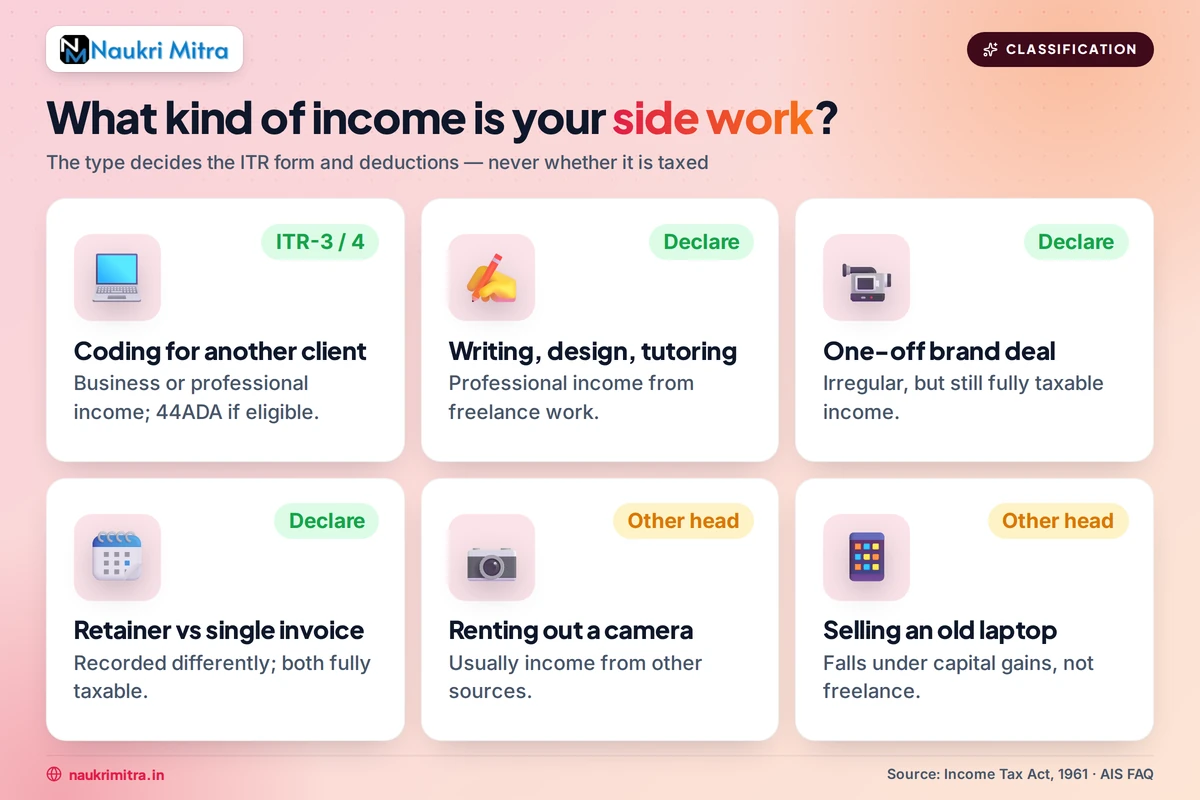
Moonlighting, for tax purposes, is simply any payment you receive for work done outside your primary job — freelance writing, coding for another client, design projects, online tutoring, consulting assignments, or even a one-off YouTube brand deal. The broader moonlighting tax implications India conversation usually starts with a basic misunderstanding: people assume that because the income is irregular, paid in cash, or routed through UPI from an individual rather than a company, it somehow sits outside the tax net. It does not. Under the Income Tax Act, 1961, "income" is taxed regardless of where it comes from, how often it arrives, or whether a formal contract exists. If money has been earned, it is taxable, and it must be reported in your return for that financial year.
What does change with the type of side work is how it gets classified, not whether it gets taxed. A salaried engineer who codes for a second client is typically earning income from a profession or business, which can be reported under presumptive taxation if eligible. The same person selling an old laptop or renting out a camera is dealing with capital gains or income from other sources. A single freelance invoice paid once a year is treated differently in record-keeping terms than a recurring monthly retainer, even though both are fully taxable. Knowing which bucket your side income falls into matters for which ITR form you use and which deductions you can claim — but it never changes the basic obligation to declare it.
How the Tax Department Already Knows About Your Side Income
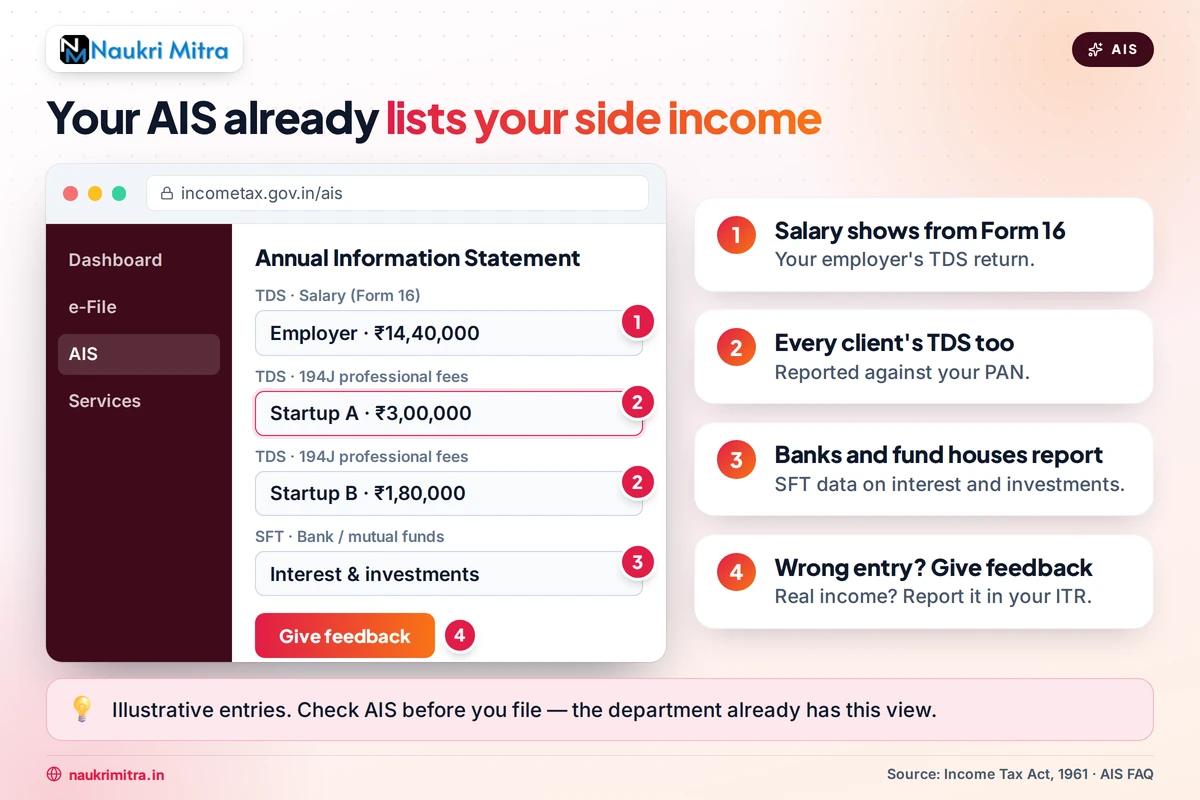
Many salaried professionals who skip reporting freelance earnings assume the department has no visibility into cash-adjacent, invoice-based side income. That assumption is increasingly outdated. The AIS annual information statement — a consolidated financial profile the department maintains against your PAN — pulls in data from banks, mutual fund houses, registrars, and every entity that deducts tax at source on a payment to you. When a client pays a freelancer and deducts TDS, that transaction shows up against the freelancer's PAN in the AIS almost automatically, well before the freelancer sits down to file a return. The Income Tax Department's official AIS FAQ page describes it as a comprehensive view of information meant to help taxpayers file accurately and to discourage non-compliance by making under-reporting easy to spot.
Alongside AIS sits Form 26AS, the older and still-relevant tax credit statement that lists every TDS and TCS entry linked to your PAN for the year. Together, these two documents mean that the moment a client deducts tax on a freelance payment — even a modest one — a digital trail already exists. The department does not need to audit your bank account to notice that income was earned; it already has a record, generated by someone else's compliance, sitting and waiting to be compared against what you declare.
The TDS Mismatch Trap: When Clients Deduct Tax But You Don't Report It
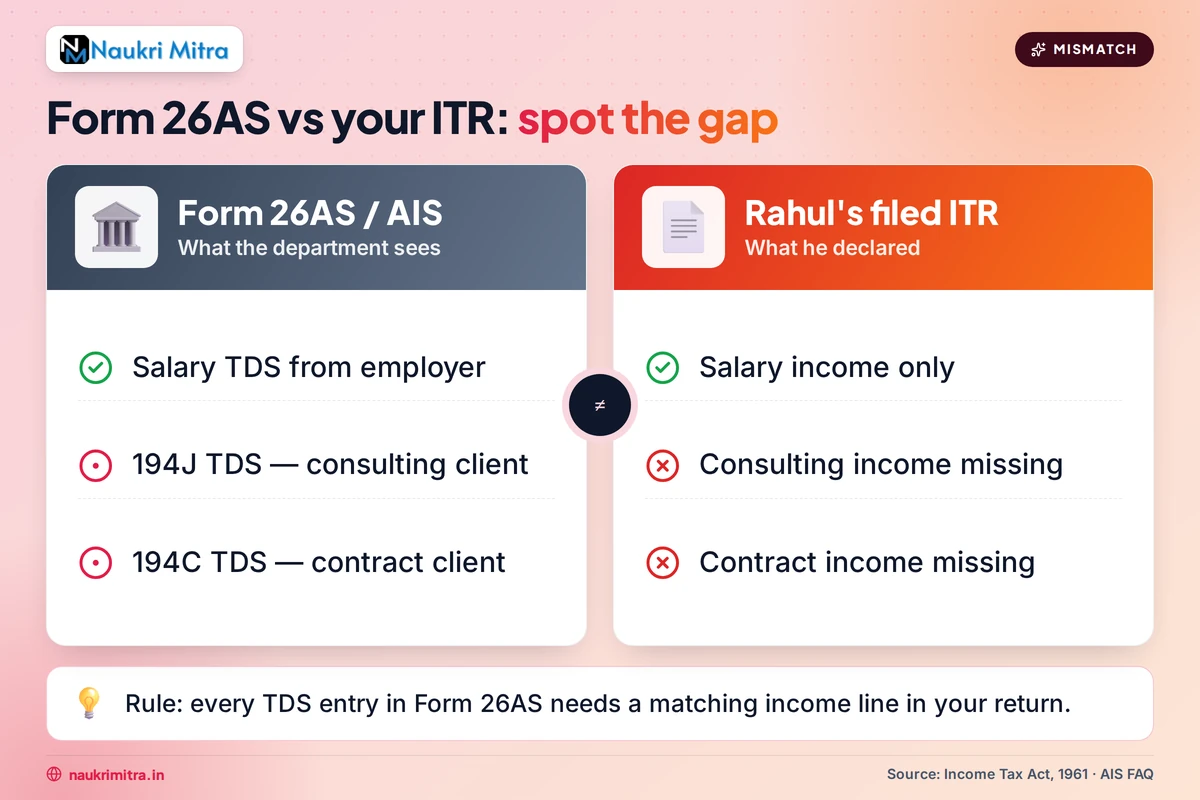
This is where most moonlighting tax trouble actually begins. A freelance client — particularly a company rather than an individual — is usually required to deduct tax at source before paying you, commonly under Section 194J for professional or technical fees, or under other sections depending on the nature of the engagement. That deduction is reported by the client in their TDS return using your PAN, regardless of whether you ever mention the income yourself. The result is a classic two income sources TDS mismatch: your salary slip and Form 16 show one number, your AIS and Form 26AS show TDS credit from a second payer, and your filed return shows only the first.
When different clients deduct tax under different sections — one under 194J for consulting, another under 194C if your work is structured as a contract, a third through an e-commerce or aggregator platform — reconciling it all can feel confusing. The practical approach is to treat Form 26AS as your master checklist: every TDS entry on it should correspond to an income line in your return, and every income line should ideally have a reason even if no TDS was deducted on it. A Form 26AS discrepancy second job situation — where the credit exists but the matching income doesn't appear anywhere in your filing — is one of the most common triggers for an automated compliance query. As a Business Standard explainer on aligning ITRs with TDS on freelance income notes, the department actively tracks TDS linked to side earnings, and any mismatch with your return can lead directly to a notice.
Filing ITR Correctly When You Have Salary Plus Freelance Income
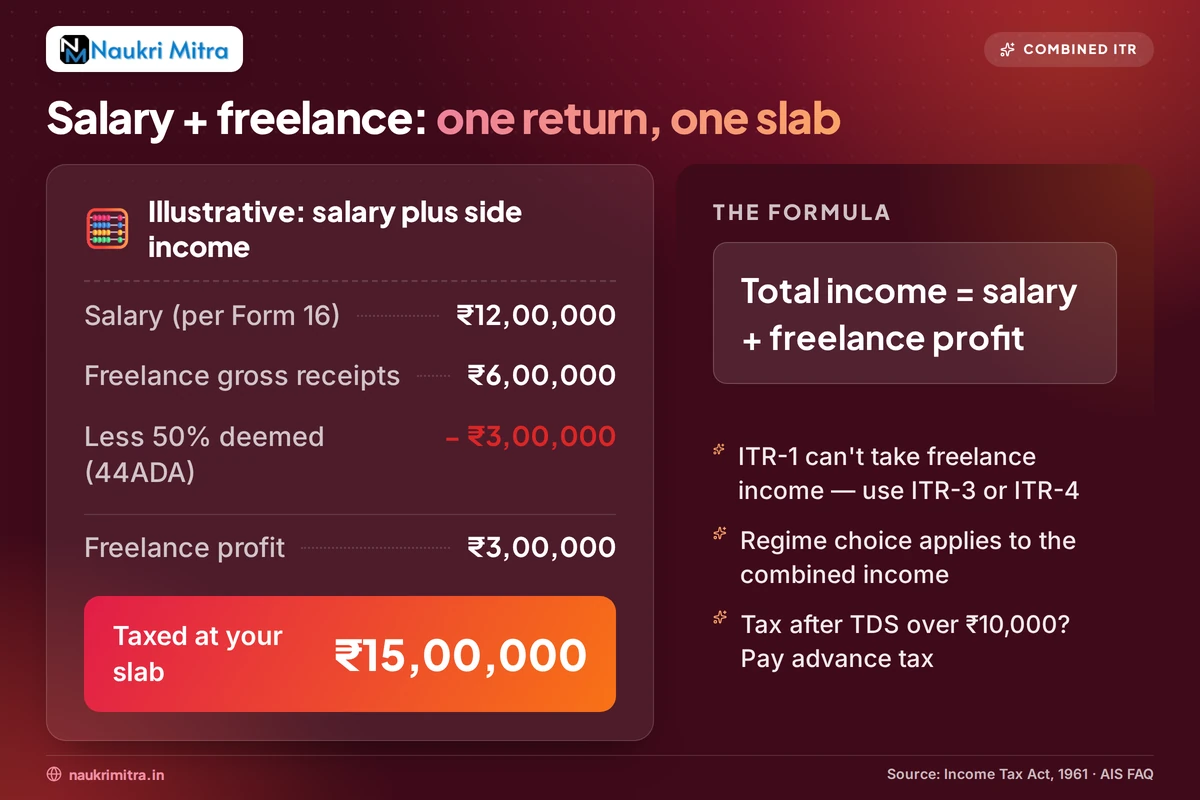
Once you accept that freelance income on top of salary tax obligations are non-negotiable, the next question is mechanical: which form, and how. A simple ITR-1 only works for salary and limited other income — it cannot accommodate business or professional earnings. Once you add freelance or consulting income, you typically move to ITR-3, or to ITR-4 if you opt for presumptive taxation under Section 44ADA, available to specified professionals (including IT, design, consulting, and similar fields) with gross receipts generally up to the prescribed threshold, where 50% of gross receipts can be declared as taxable profit without maintaining detailed books.
Both incomes — salary and freelance — go into the same return, combined, and taxed at your applicable slab based on total income for the year. This is also where multiple Form 16 reconciliation becomes relevant for anyone who changed jobs mid-year while also freelancing: each employer's Form 16 needs to be added together, then combined with freelance receipts, before arriving at total taxable income. The regime you choose — old or new — applies to this combined income, and once you have business or professional income in the mix, switching regimes year to year involves filing Form 10-IEA and comes with more restrictions than it does for pure salary-only filers. Separately, if your total tax liability after TDS crosses roughly ₹10,000 in a year, advance tax becomes due in quarterly instalments, because your employer's monthly TDS on salary was never designed to cover a second, independent income stream.
Will Your Employer Find Out? Tax Risk vs Employment Risk
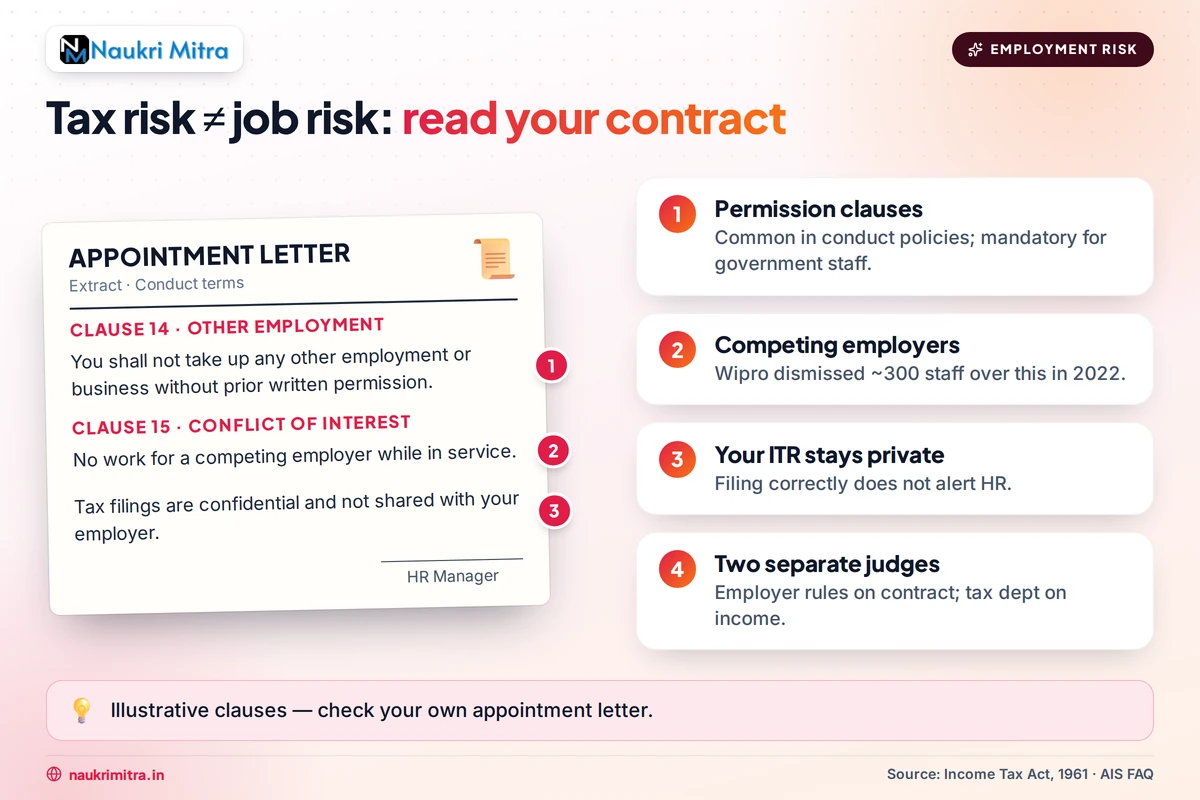
These are two separate problems that people frequently conflate. Your income tax return and PAN-linked financial data are confidential; the Income Tax Department does not routinely share an employee's filing details with their employer, and there is no automatic feed from the tax portal into a company's HR system. So filing correctly does not, by itself, expose moonlighting to your employer.
Employment risk is a different matter entirely, governed by your appointment letter, company conduct policy, or — for government employees — service conduct rules that typically require prior written permission before taking up any other employment or business activity. The tension became publicly visible in 2022 when several Indian IT companies took a hard line on the practice; Wipro's chairman, for instance, called working simultaneously for a competing employer an integrity violation, and the company dismissed roughly 300 employees over it, a move widely reported at the time, including by TechCrunch's coverage of Wipro's 2022 moonlighting dismissals. That episode is a useful reminder: a contract breach is adjudicated by your employer under your employment terms, while tax evasion freelance side income cases are adjudicated by the tax department under the Income Tax Act. Being compliant on one does not automatically protect you on the other, and vice versa.
On the question of whether side income is taxed at a punitive higher rate simply for being "extra" — it isn't, exactly. India's slab system is progressive: adding freelance income to your salary pushes the combined total higher, and the additional slice may well land in a higher slab than your salary alone would have, but that's the ordinary mechanics of a progressive system, not a special moonlighting penalty.
Notices, Penalties, and How Far Back the Department Can Reach
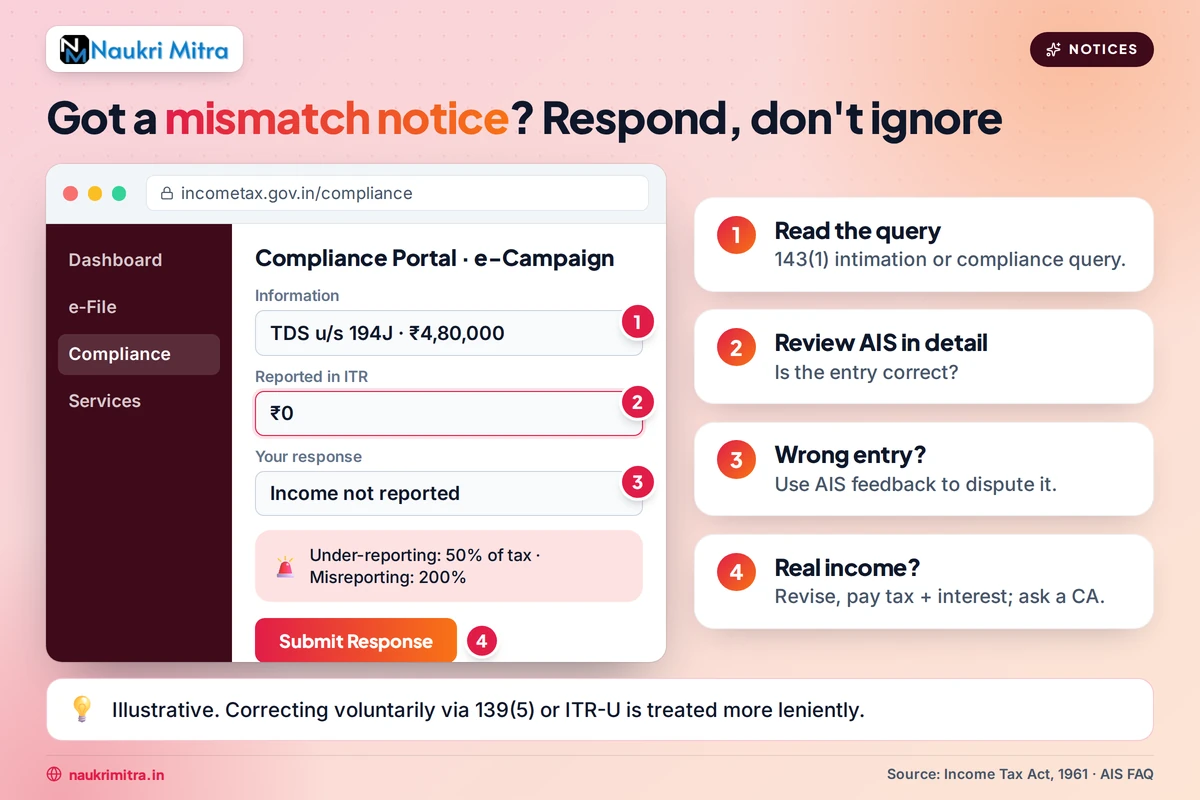
An income tax notice for undeclared freelance income usually arrives in one of a few recognisable forms: an automated intimation under Section 143(1) flagging a computation mismatch, a compliance portal query asking you to explain a difference between AIS/Form 26AS data and your filed return, or in more serious cases, a formal notice proposing reassessment. The underlying reason is almost always the same — an undisclosed income notice is triggered because TDS, SFT, or other third-party reporting data visible to the department doesn't reconcile with what you declared.
The financial consequences scale with intent. Under Section 270A, under-reporting of income can attract a penalty of 50% of the tax on the under-reported amount; where the department treats it as misreporting — involving suppression of facts or false entries — the penalty can rise to 200% of the tax due. In more extreme, deliberate cases, prosecution for wilful tax evasion is legally possible under the Act, though in practice this is reserved for larger, clearly intentional concealment rather than a salaried person who genuinely overlooked a small freelance invoice. Reassessment time limits have also been tightened and amended in recent Finance Acts, generally allowing the department to reopen a case within a few years of the end of the relevant assessment year, with longer windows for larger escaped income — the exact figures have shifted across recent budgets, so it's worth confirming the current limit with a tax professional rather than relying on an old reference.
If you do receive a mismatch notice, the safest response is to not ignore it and not guess. Log into the income tax portal, review the AIS information in detail, use the "Optional" feedback mechanism if any entry is genuinely wrong, and if the income is real but was missed, respond honestly and be prepared to pay the differential tax along with applicable interest. Engaging a chartered accountant for anything beyond a trivially small, clearly explainable mismatch is usually worth the cost relative to the risk of a drawn-out dispute.
Fixing Past Mistakes: Revised Returns and Voluntary Disclosure
If you've already filed your return and then realise freelance income was left out, Section 139(5) allows you to file a revised return correcting the omission, provided you do so within the window the law allows for that assessment year — a deadline that has been shortened in recent years, so check the current cut-off rather than assuming it mirrors an earlier cycle. For side income disclosure ITR situations discovered even later, after the revision window has closed, the updated return mechanism under Section 139(8A), commonly called ITR-U, allows you to voluntarily disclose previously unreported income within an extended multi-year window, though you pay additional tax on top of the regular dues, with the extra percentage rising the longer you wait to come forward.
The broader principle holds regardless of the exact numbers in force this year: voluntary correction, made before the department flags the gap itself, is consistently treated more leniently than a disclosure forced by a notice. If you suspect you have unreported freelance income sitting in a past return, addressing it proactively is almost always the lower-risk path.
Should You Register as a Freelancer? What Records to Keep
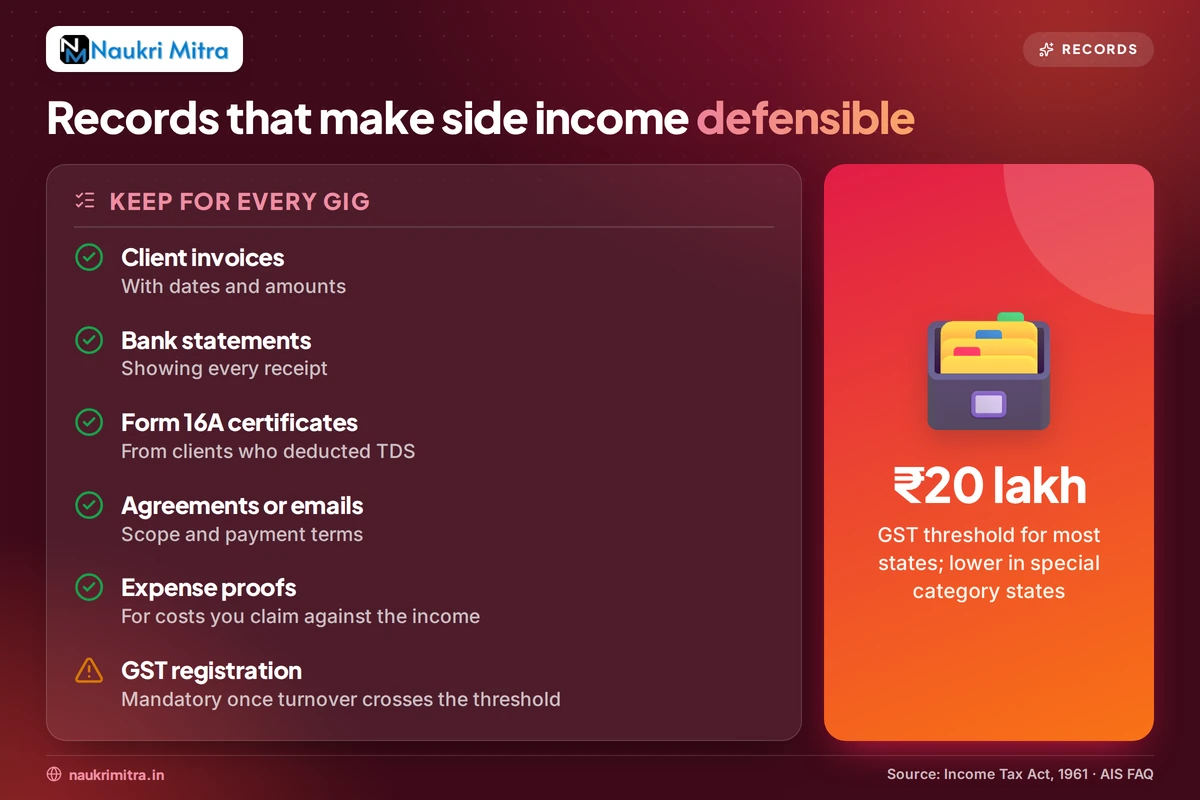
You don't need a formal business registration purely to file freelance income under the Income Tax Act — reporting it correctly under the right head is sufficient. What does matter is GST registration if your aggregate annual turnover from services crosses the prescribed threshold (currently ₹20 lakh for most states, lower for a handful of special category states), at which point registration becomes mandatory rather than optional, separate from income tax entirely.
What protects you far more than any registration is documentation: client invoices with dates and amounts, bank statements showing receipts, TDS certificates (Form 16A) issued by clients who deducted tax, written agreements or even email confirmations of scope and payment terms, and records of any genuine business expenses you want to claim against the income. Many professionals who take up such assignments find them through platforms that list freelance and remote opportunities alongside full-time roles — categories like remote freelance content writing, freelance bookkeeping assignments, and remote freelance copywriting projects are common entry points — and the same invoicing discipline that makes a freelance relationship professional also makes your tax filing defensible if ever questioned.
Moonlighting Income and Your Bigger Financial Picture
There's a practical irony worth flagging: lenders assessing eligibility for a home loan or a large personal loan look closely at your filed ITRs to gauge income stability. Declared, consistent freelance income — reported honestly over a couple of years — can actually strengthen a loan application by showing a higher total income. Underreporting to minimise tax, on the other hand, quietly works against you later, because the same lower figure you declared to avoid tax is the figure a bank will use to judge how much you can borrow. Treating freelance income on top of salary tax reporting as routine, rather than optional, tends to pay off in more places than just avoiding a notice.
Professionals exploring side opportunities — whether to build a portfolio, earn extra, or test a transition into full-time freelancing — can browse current listings on platforms such as Naukri Mitra, which carries part-time, remote, and freelance roles alongside full-time positions. Whatever you pick up, the tax rule stays constant: declare it, reconcile it against your TDS records, and file on time.
Frequently Asked Questions
Is freelance income alongside a full-time job legally required to be declared in India?
Yes. All income is taxable under the Income Tax Act regardless of its source, frequency, or how it is paid, and it must be reported in the relevant ITR for that financial year.
What usually triggers an income tax notice for undeclared side income?
Most commonly, a mismatch between TDS or other data recorded in your AIS and Form 26AS and the income actually reported in your filed return.
Will my employer find out about my freelance income because I filed my taxes correctly?
Not automatically. Your ITR and PAN data are confidential and are not routinely shared with employers; any employment-contract risk from moonlighting is a separate matter governed by your appointment terms, not your tax filing.
Can I file a revised return if I forgot to include freelance income?
Yes, Section 139(5) allows revision within the window prescribed for that assessment year, and beyond that, the ITR-U updated return mechanism allows later voluntary disclosure with additional tax.
What is the penalty for not disclosing freelance income?
Under-reporting can attract a penalty of up to 50% of the tax on the under-reported amount under Section 270A, rising to 200% where it is treated as misreporting; wilful evasion can, in serious cases, also attract prosecution.
How many years back can the tax department reopen an assessment for undisclosed income?
Reassessment time limits have been revised across recent Finance Acts and generally allow a window of a few years from the end of the relevant assessment year, longer for larger escaped income, so it is worth confirming the current limit directly rather than relying on older figures.
Do I need to pay advance tax once freelance income is added to my salary?
If your total tax liability after TDS credit exceeds roughly ₹10,000 in a financial year, advance tax is due in quarterly instalments, since salary TDS alone typically won't cover the freelance portion.
Should I register formally as a freelancer even if the income is small?
Formal business registration isn't mandatory just to report freelance income for tax purposes, but GST registration becomes mandatory once your aggregate service turnover crosses the prescribed threshold.
What records should I maintain to support freelance income if questioned?
Client invoices, bank statements showing receipts, TDS certificates (Form 16A), written scope or payment agreements, and proof of any expenses claimed against the income.
Does it matter whether my moonlighting work is in the same field as my job or something unrelated?
It changes how the income is classified — business/professional income versus income from other sources, for instance — which affects the ITR form and deductions available, but it does not change the basic requirement to declare it.
Sources: Income Tax Department — AIS FAQ (incometax.gov.in); Business Standard — Align your tax return with TDS on freelance income; TechCrunch — Wipro fires 300 employees for moonlighting.
.png)
.png)
.png)
Comments
Post a Comment