TDS on Freelance Income: 194J vs 194C | Naukri Mitra
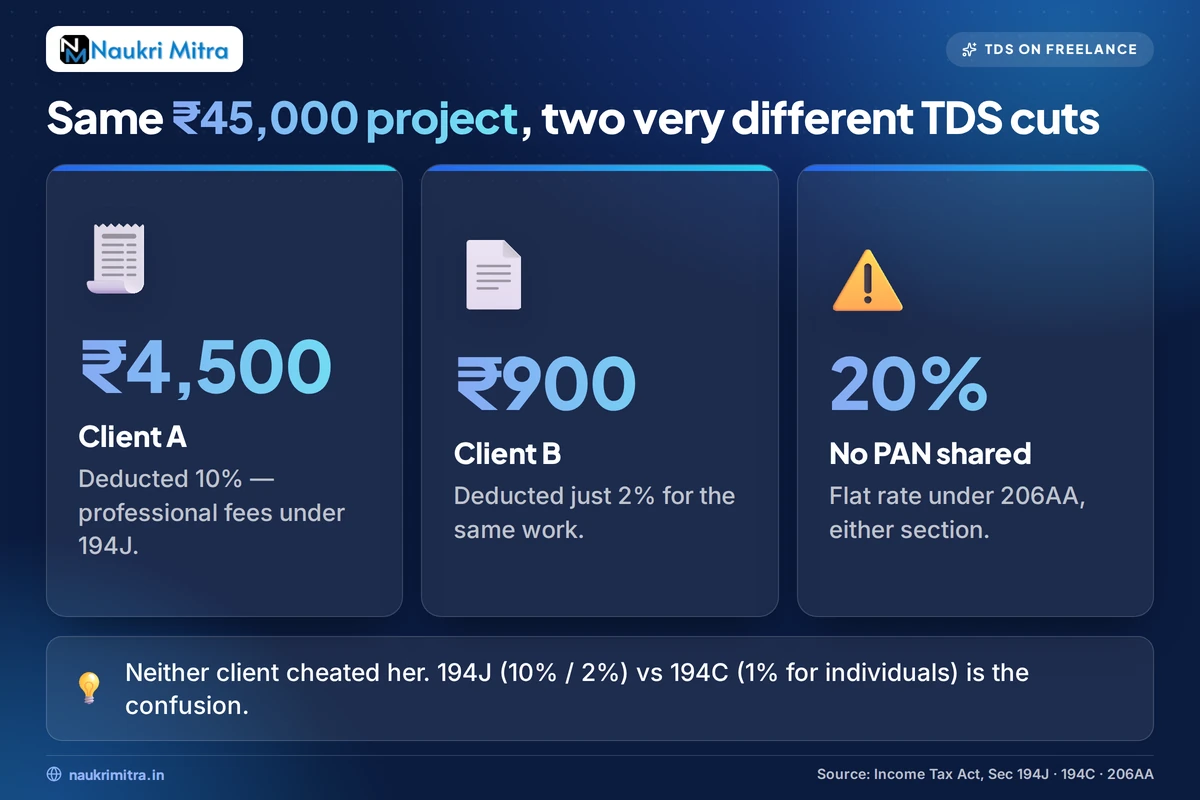
A freelance graphic designer in Pune once showed me two invoices for the same ₹45,000 project, raised a month apart for two different clients. One client deducted ₹4,500 as TDS. The other deducted ₹900. Same work, same freelancer, same financial year — two completely different tax outcomes. The designer wasn't being cheated by either client. She was simply running into the oldest point of confusion in India's freelance economy: nobody quite agrees on whether a freelancer's payment should be taxed under Section 194J or Section 194C of the Income Tax Act.
If you invoice clients for writing, design, development, consulting, or any other skilled service, this distinction isn't academic. It decides how much lands in your bank account today, how much paperwork you'll chase in March, and whether you're due a refund or owe the taxman more. This guide walks through TDS on freelance income India rules in plain language — what 194J and 194C actually mean, which one should apply to your work, and what to do when a client gets it wrong.
Section 194J vs 194C Difference: The Core Distinction
Both sections require a business paying you to withhold a slice of the payment and deposit it with the government on your behalf. That's where the similarity ends. The Section 194J vs 194C difference comes down to what kind of work is being paid for and how much gets withheld. Two linked ideas run through the rest of this piece: professional fees TDS under 194J, and the narrower technical services TDS carve-out that applies to most IT and consultancy freelancers specifically.
Section 194J covers "fees for professional services" and "fees for technical services" (often shortened to FTS). Professional services here means skills from a defined list — legal, medical, engineering, architectural, accountancy, technical consultancy, interior decoration, advertising, company secretary work, and information technology, among others listed under Section 44AA of the Act. Technical services is a broader, separate bucket covering managerial, technical, or consultancy services rendered using specialised knowledge. The deduction rate is 10% for professional fees and 2% for fees for technical services — a gap that genuinely matters when a client picks the wrong one.
Section 194C, by contrast, is the "contractor" provision. It applies to payment for carrying out any work under a contract — anything from catering and transport to advertising production, event execution, or simple outsourced labour that doesn't fit the specified-profession list. The rate here is far lower: 1% when the payee is an individual or HUF, and 2% for companies, firms, LLPs, and other entities.
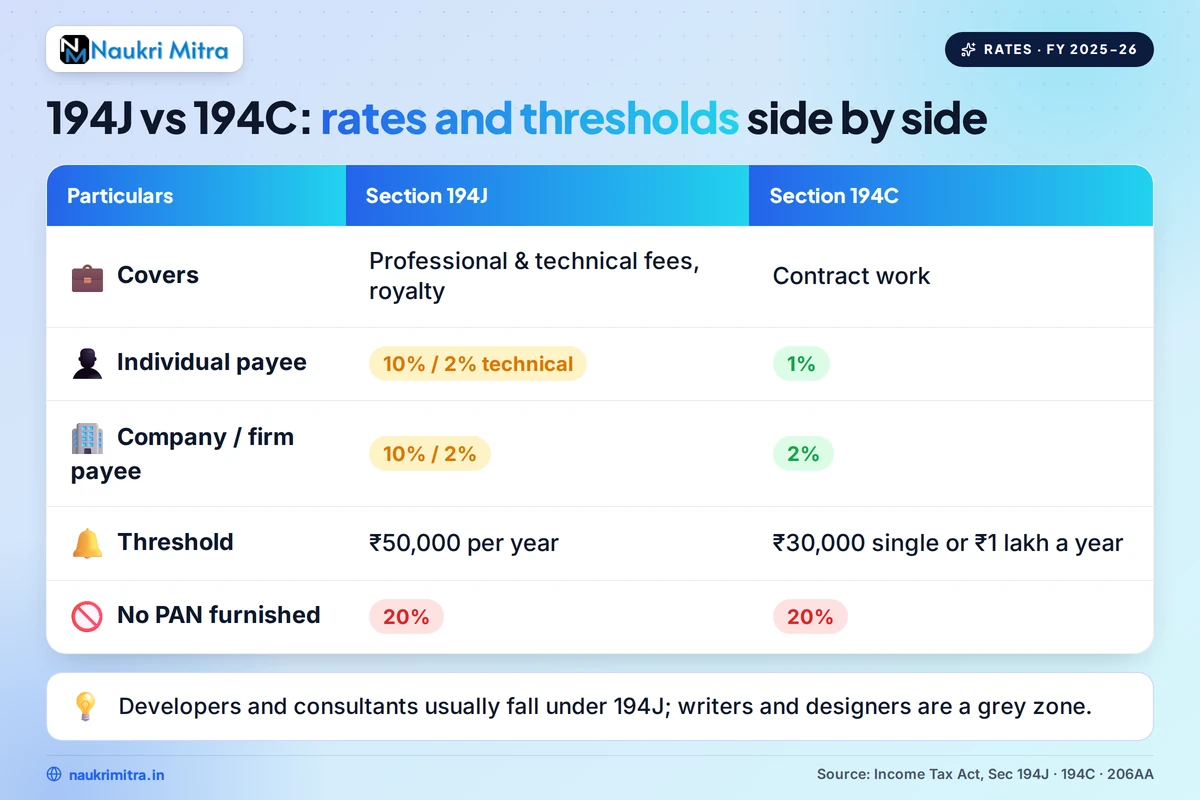
| Particulars | Section 194J | Section 194C |
|---|---|---|
| Covers | Professional fees, technical services, royalty | Payment for carrying out contract work |
| Rate (individual payee) | 10% (professional) / 2% (technical) | 1% |
| Rate (company/firm payee) | 10% / 2% | 2% |
| Threshold (FY 2025-26) | ₹50,000 per financial year | ₹30,000 single payment or ₹1,00,000 aggregate in a year |
| No PAN furnished | 20% | 20% |
Which Section Applies to a Writer, Designer, Developer, or Consultant?
In practice, most skilled freelance work slots into 194J, not 194C. A software developer, data analyst, or IT consultant delivering coded work or technical advice is almost always deducted under 194J as fees for technical services, since information technology appears directly in the specified-profession list. A management consultant, financial advisor, or HR consultant giving advisory output also falls under 194J.
Content writers and graphic designers sit in a genuine grey zone. Writing and design aren't explicitly named as "specified professions" under Section 44AA, so some finance teams treat these payments as 194C (treating the freelancer as executing a defined deliverable, like a contractor), while more cautious accounts teams apply 194J anyway, reasoning that creative and intellectual output counts as a professional service. Neither approach is clearly wrong, which is exactly why two clients can deduct differently for similar work. A one-off project — say, building a single WordPress plugin — is more likely to be treated as 194C-style contract work by a smaller business unfamiliar with the distinction, even when 194J would be the technically correct call.
If you're unsure which bucket your work falls into, ask the client's accounts team directly before invoicing. Confirming the correct TDS rate for freelance professional services upfront avoids the awkward back-and-forth of a wrongly issued TDS certificate Form 16A that doesn't match what you expected.
The Threshold Limits: When TDS Actually Kicks In
TDS isn't deducted from the very first rupee. Each section has its own trigger point, and Budget 2025 revised one of them.
Under Section 194J, a client is required to deduct tax only once total payments (or amounts credited, whichever is earlier) to you in a financial year cross ₹50,000. This limit was raised from the earlier ₹30,000 with effect from 1 April 2025, giving smaller freelancers more breathing room before any deduction applies. Importantly, this ₹50,000 ceiling is tracked separately for each category — professional fees, technical fees, and royalty are not added together to determine the trigger.
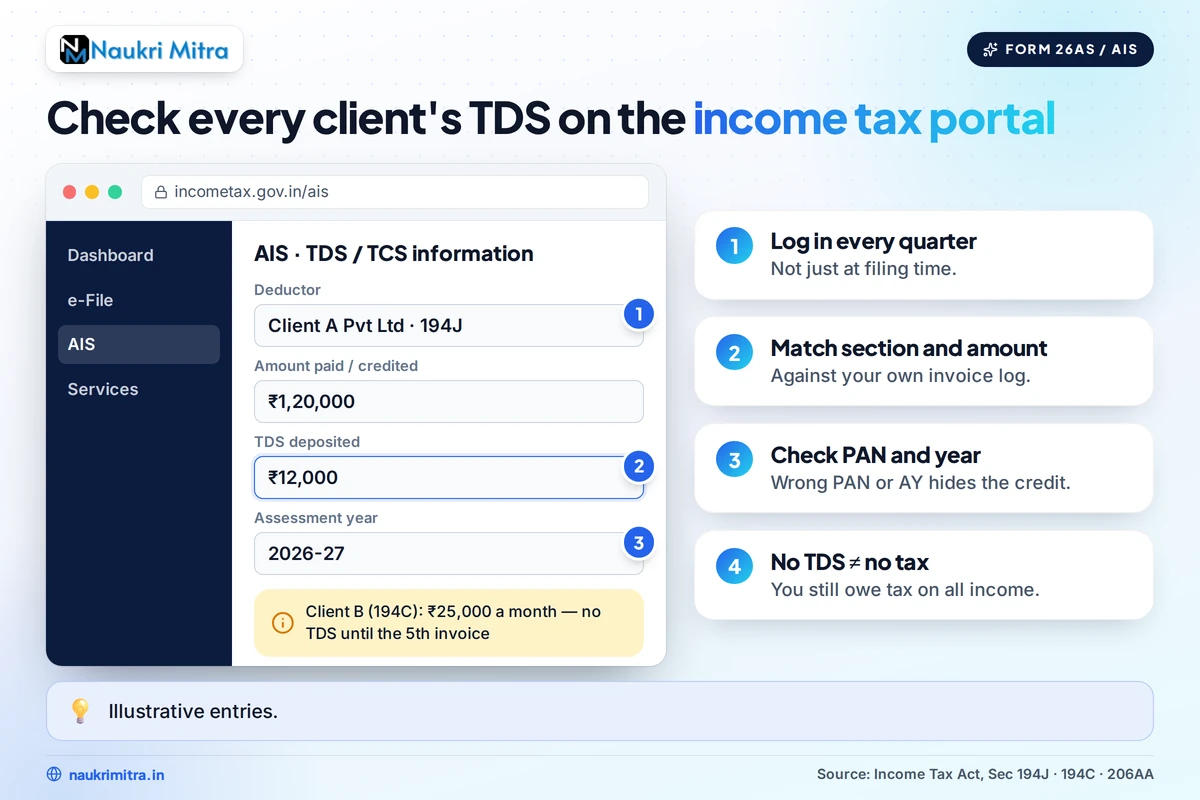
Under Section 194C, the threshold works differently: a client must deduct TDS if any single payment to you exceeds ₹30,000, or if the total paid to you during the financial year crosses ₹1,00,000 — whichever condition is met first. So a freelancer invoicing ₹25,000 a month to the same client would cross the aggregate limit by the fifth invoice, even though no single payment breached ₹30,000.
Many freelancers wrongly assume no TDS means no tax liability. It only means no withholding — you still owe tax on the full income when you file your return.
When a Client Deducts Under the Wrong Section
You can absolutely raise it if a client's accounts team deducts under what you believe is the wrong section — but you can't force the correction unilaterally. Share the nature of your service in writing, point to the relevant clause, and let their tax or compliance team make the final call, since the deductor carries the legal responsibility for correct classification, not you.
A wrongly deducted rate usually self-corrects at your end regardless. If a client over-deducts (say, 10% under 194J when 194C's 1% would have applied), the extra amount still shows as tax credit in your account and comes back to you as a refund when you file your return, provided your total tax liability is lower than the TDS already deducted. If a client under-deducts, you simply pay the balance tax yourself through advance tax or self-assessment tax — there's no penalty on you for a deductor's classification error, since Sections 194J and 194C place the deduction obligation on the payer, not the payee.
Form 16A, PAN, and the 20% Trap
Every time a client deducts TDS, they're legally obligated to issue you a TDS certificate Form 16A, generated through the TRACES portal, typically on a quarterly basis. It lists the amount paid, the section under which tax was deducted, the rate applied, and the date the deduction was deposited with the government. Keep every Form 16A you receive; it's your primary evidence when reconciling what clients report against what you declare in your return.
If a client doesn't issue Form 16A within a reasonable time after the quarter closes, ask for it in writing — it is a statutory obligation on their part, not a courtesy. In practice, the TDS entry usually appears in your Form 26AS or AIS even before the certificate is physically issued, so you aren't entirely dependent on the client's paperwork to know what's been deducted.
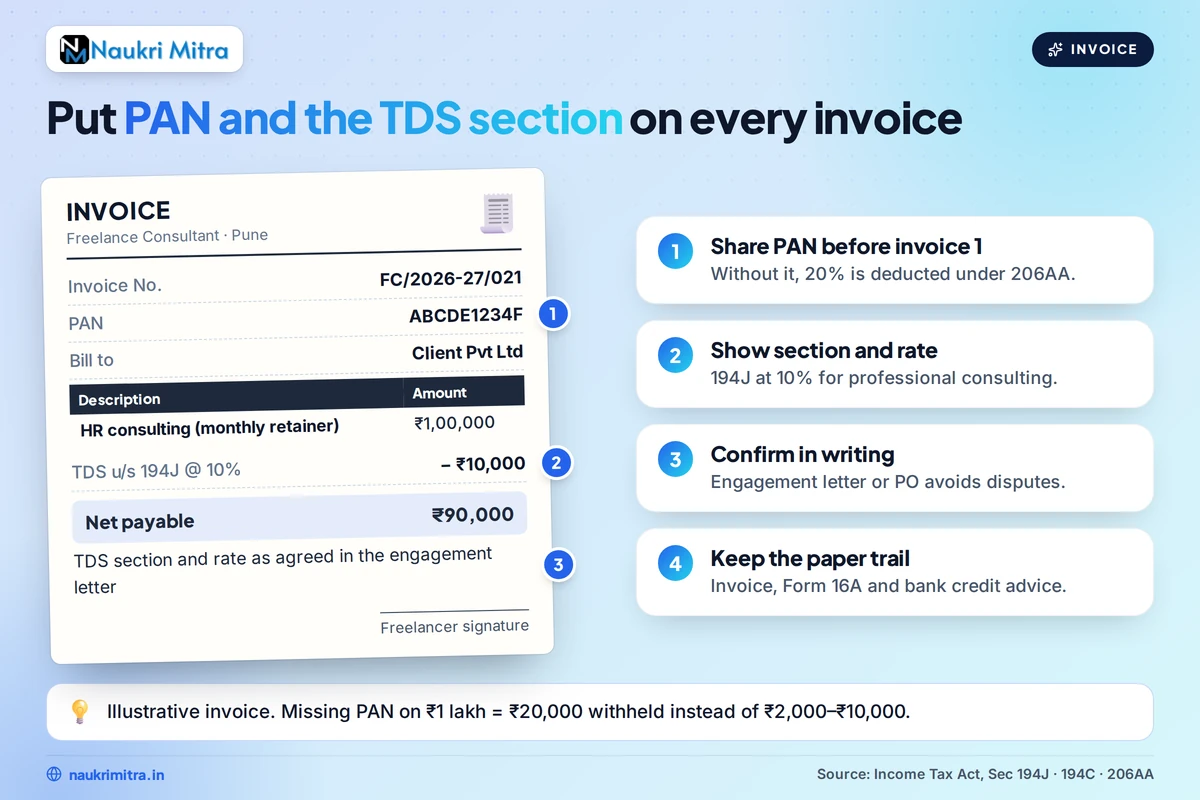
Separately, always share your PAN with every client before the first invoice. Under the PAN TDS higher rate rule in Section 206AA, a payer who doesn't have your PAN on file must deduct tax at 20%, regardless of whether the applicable rate under 194J or 194C would otherwise have been lower. This is one of the simplest, costliest mistakes a new freelancer can make — a missing PAN on a ₹1,00,000 invoice can mean ₹20,000 withheld instead of ₹2,000 to ₹10,000.
Tracking Your TDS Through Form 26AS and AIS
Form 26AS and the Annual Information Statement (AIS) are where every TDS entry reported by your clients eventually lands, visible through the income tax e-filing portal. AIS has gradually become the more complete record, pulling together TDS, GST turnover data, and other financial transactions reported against your PAN, while the older Form 26AS now mainly reflects tax credit. It's worth logging into the portal every quarter, not just at filing time, to confirm that freelancer TDS deducted by client matches what's actually been deposited and reported under your PAN.
Checking regularly also catches errors early — a client quoting your PAN incorrectly, or depositing TDS under the wrong assessment year, is far easier to fix in July than in the following March when you're racing a filing deadline.
Claiming Your TDS Refund as a Freelancer
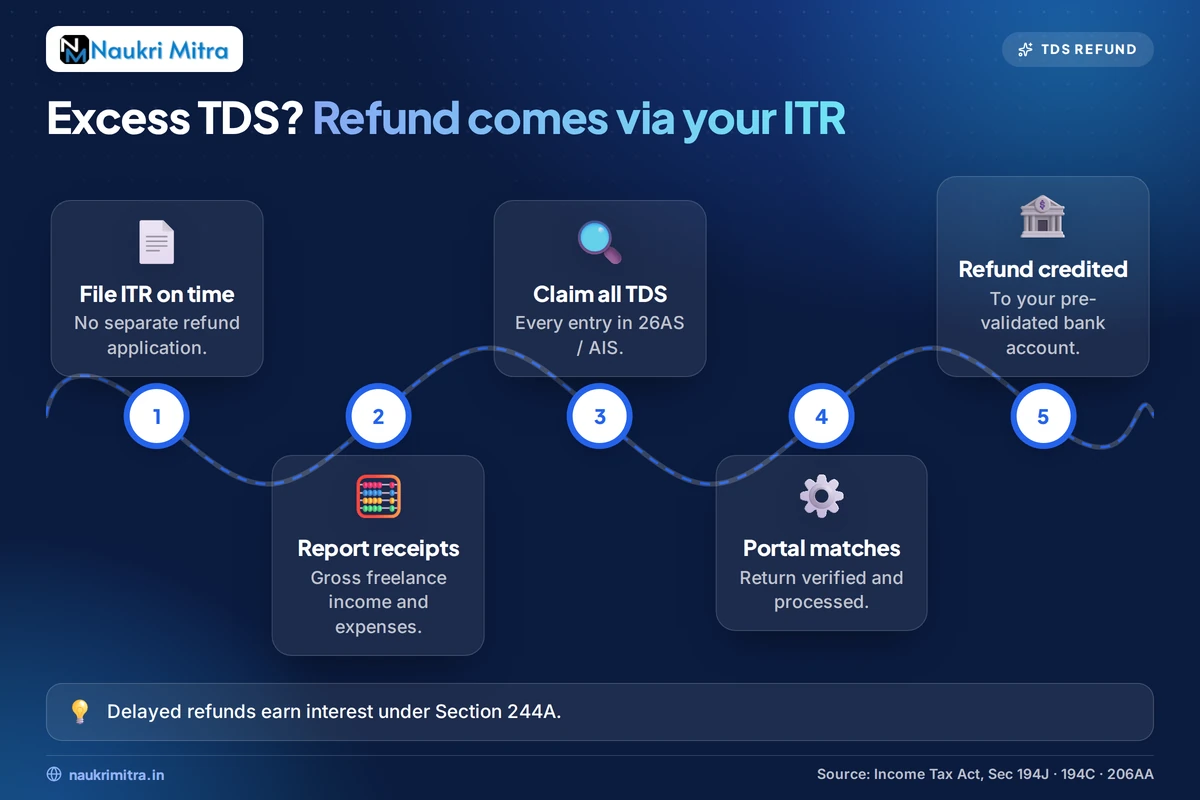
Freelance income is lumpy, and so is the TDS deducted from it. If your total TDS across all clients for the year is higher than your actual computed tax liability — common for freelancers who claim business expenses, use the presumptive scheme under Section 44ADA, or simply had a slower year — you're entitled to a refund.
Here's how to claim TDS refund freelancer status actually involves: file your income tax return by the due date, correctly report your gross freelance receipts and allowable expenses, and claim credit for every TDS entry that shows up in your Form 26AS or AIS against your PAN. The portal matches your claim with what's on record; any excess is processed as a refund directly to your pre-validated bank account, once your return is verified and processed. There's no separate "refund application" — it's embedded in the ITR filing process itself.
Refunds typically take a few weeks to a couple of months after processing, though timelines vary by filing season and the complexity of your return. If the department delays your refund beyond a certain point, you're entitled to interest under Section 244A, so a late refund isn't money lost outright, even though cash-flow timing still matters for a freelancer managing monthly expenses.
How TDS Interacts With Advance Tax
TDS deducted by your clients counts directly against your advance tax obligation for the year — it isn't a separate, parallel payment. When you estimate your quarterly advance tax liability, net off the TDS you expect clients to withhold over the year before calculating what you still owe by each due date. Freelancers who forget this often overpay advance tax on income that's already been partly taxed at source, then wait months to get the excess back as a refund instead of simply paying less upfront. If your clients are reliable about timely TDS deposit, checking AIS before each advance tax instalment date gives you a far more accurate running total than guessing.
When TDS Vanishes: Non-Deposit and Foreign Clients
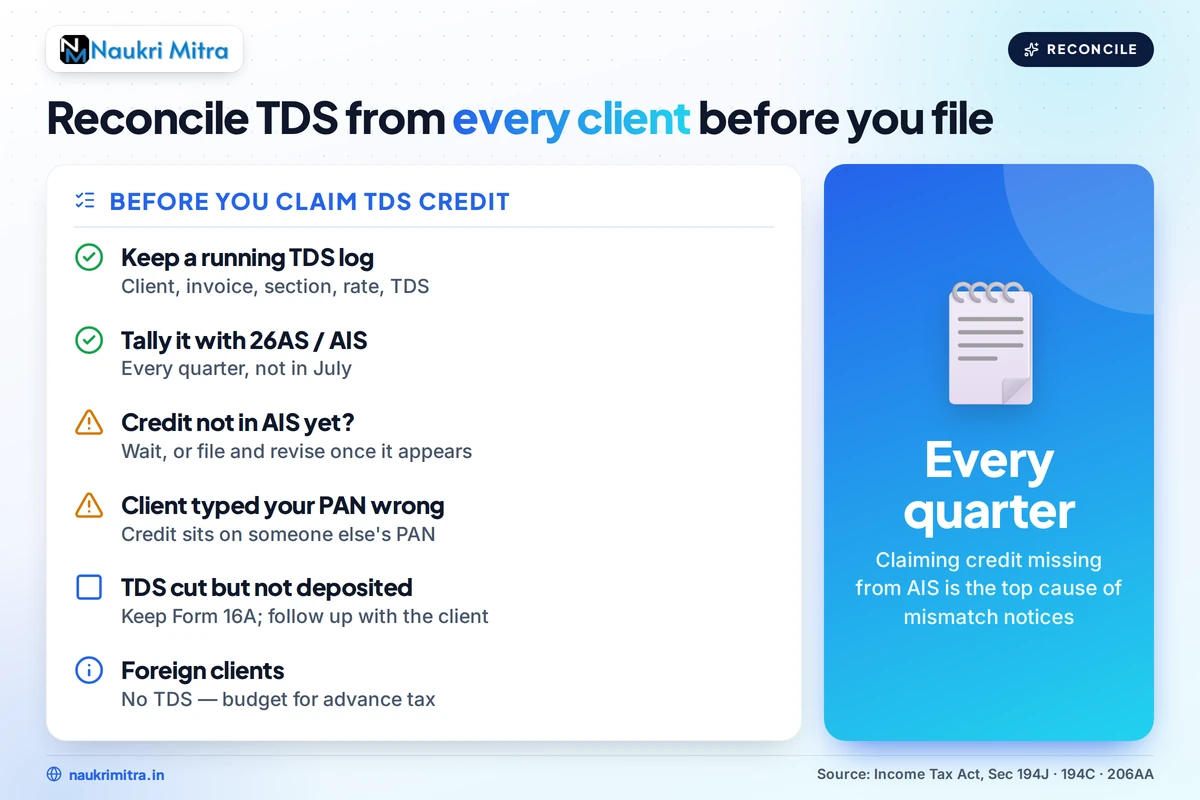
Occasionally a client deducts TDS but delays, or in rare cases never deposits, it with the government. Since the deduction and deposit obligations both sit with the payer, this is legally the client's default, not yours. Practically, though, it still affects you: the credit won't appear in 26AS/AIS until the client files their TDS return, so claiming it on your ITR before it reflects there can trigger a mismatch notice. Keep the Form 16A or payment advice as proof and follow up with the client's finance team if an expected entry hasn't shown up by the time you're ready to file.
International clients are a different story altogether. A foreign company with no business presence in India generally has no obligation to deduct TDS under Indian law when paying an Indian freelancer, since Sections 194J and 194C apply to persons responsible for paying who are themselves covered by Indian tax deduction rules. That income still needs to be declared and taxed in your hands in full — it just arrives without any TDS cushion already withheld, which means you'll likely need to budget for a larger advance tax outflow on that portion of your earnings rather than relying on deducted credit.
Section 197: Applying for Lower or Nil TDS
If your actual tax liability is consistently much lower than what clients would otherwise withhold — a common situation for freelancers with high deductible expenses or losses carried forward — you can apply to the Assessing Officer under Section 197 for a certificate authorising a lower or nil TDS deduction rate. Once issued, you share that certificate with clients, who are then permitted to deduct at the reduced rate specified rather than the standard 194J or 194C rate. It requires an application through the income tax portal with supporting income estimates, and it's worth considering only if the gap between TDS withheld and tax actually owed is large enough to justify the paperwork — for most freelancers in a straightforward situation, claiming the difference as a refund at filing time is simpler.
Invoicing, GST, and Contract-Type Nuances
Good documentation protects you on both sides. Insist that every client confirm, in the engagement letter or purchase order, which section they'll deduct under and at what rate — it prevents disputes later. Retain every invoice, Form 16A, and bank credit advice; these are what you'll need if your return ever gets picked up for scrutiny.
GST registration and income-tax TDS are separate systems that don't override each other — a GST-registered freelancer still has TDS deducted under 194J or 194C on the service value, while GST itself may separately attract its own tax-deducted-at-source in specific government-contract scenarios, a distinct and far less common situation for private-sector freelance work.
Contract type matters too, though not in the way many assume. A retainer client paying a fixed monthly fee and a one-off gig paying the same total are typically taxed under the same section and rate if the work is identical — what changes is how quickly you cross the threshold, since a retainer accumulates toward the annual limit faster.
Reconciling TDS Across Multiple Clients and Avoiding Mismatches
Freelancers juggling five or ten small clients face a reconciliation headache salaried employees never see. Each client deducts independently, deposits on its own schedule, and sometimes reports under a different section than expected. Build a simple running log — client name, invoice amount, section applied, rate, TDS amount — and tally it against Form 26AS/AIS every quarter rather than waiting until July.
The most common error that triggers a mismatch notice is claiming TDS credit that hasn't yet appeared in AIS, usually because a client filed their TDS return late. The safer fix is to wait until the credit reflects before claiming it, or file and revise later once it appears. A close second is a PAN-entry error by the client — one wrong digit means the deduction sits against someone else's PAN entirely, invisible until you go looking for it.
None of this is reason to avoid freelance or consulting work — it's simply the paperwork layer that comes with being your own payroll department. Freelancers who track invoices, PAN sharing, and TDS credit from the start spend far less time untangling notices later, and get their income tax refund freelancer claims processed with fewer hiccups. If you're weighing a move into full-time freelance consulting, tax prep, or accounting work, browsing current openings on the Naukri Mitra homepage is a good way to compare what independent and remote consulting roles actually pay before you commit.
For readers specifically looking to break into tax and accounting-adjacent freelance or remote roles, a few current listings worth a look include Virtual Tax Preparer, Virtual Financial Consultant, and Virtual Accounting Consultant — all roles where understanding 194J and 194C from the client side is as useful as understanding it from your own.
Frequently Asked Questions
Is 194J or 194C applicable to freelance software development work?
Software development is almost always deducted under 194J as fees for technical services, at 2%, since information technology is explicitly listed among specified professions.
What TDS rate applies to a freelance management or HR consultant?
Consulting of this kind is treated as professional services under 194J, attracting 10% TDS, rather than the lower 194C contractor rate.
Do I have to maintain books of accounts just because TDS was deducted?
No — TDS deduction and the requirement to maintain books are separate questions governed by different sections (such as 44AA and 44AB), based on your income level and whether you opt for presumptive taxation.
Can a client deduct TDS at a rate higher than what the section prescribes?
Not legally, except where PAN hasn't been furnished, which triggers the flat 20% rate under Section 206AA regardless of the section otherwise applicable.
How do I know if TDS already deducted covers my full tax liability?
Compute your tax on total freelance and other income for the year, then compare it against total TDS shown in your Form 26AS/AIS — the difference is either payable as self-assessment tax or refundable.
Does 194C ever apply to a freelancer doing purely creative or technical work?
It can, particularly for one-off execution-style work like video editing, event production, or print-ready design output that clients treat as a defined contracted deliverable rather than ongoing professional advice — the classification genuinely varies by client.
What happens if two different clients deduct TDS under different sections for similar work?
Both deductions are reported against your PAN and both count as credit toward your tax liability; the section only affects how much was withheld upfront by each client.
Is the ₹50,000 threshold under 194J a lifetime limit or per financial year?
It resets every financial year and applies separately to each client, not cumulatively across all your clients put together.
Can I get Form 16A before the quarter ends?
No — Form 16A is generated only after the deductor files their quarterly TDS return, so it's typically available a few weeks after each quarter closes, though the TDS entry itself may already be visible in AIS sooner.
Does opting for the new tax regime change how TDS under 194J or 194C is deducted?
No — the deduction rate and threshold under these sections stay the same regardless of which tax regime you eventually choose while filing; the regime only affects how your final liability is computed.
Sources: Income Tax Department — AIS FAQs; TaxGuru — Budget 2025 Section 194J Threshold Increase; ClearTax — TDS Refund Guide.
.png)
.png)
.png)
Comments
Post a Comment