Mudra Loan for Freelancers: Full Guide | Naukri Mitra
Rohan spent four years as someone else's employee before he decided to build a freelance video editing studio from his spare bedroom. The skills were ready. The camera gear, the editing workstation, and three months of rent while clients trickled in were not. Like thousands of Indian freelancers every year, he discovered that the hardest part of going independent isn't finding work — it's finding the few lakh rupees that bridge the gap between quitting a job and getting paid for the first project. This is exactly the gap the Pradhan Mantri Mudra Yojana was built to close, and yet most freelancers never apply because they assume government business loans are only for shopkeepers and manufacturers.
That assumption is outdated. Banks across India now routinely sanction a Mudra loan for freelancers India wide — covering consultants, designers, writers, photographers, developers, and other solo professionals who earn through client contracts rather than a fixed salary. This guide walks through everything a freelancer needs to know: eligibility, categories, documentation, the online application process, interest rates, and what to do if your income is irregular.
Understanding Pradhan Mantri Mudra Yojana for Freelancers
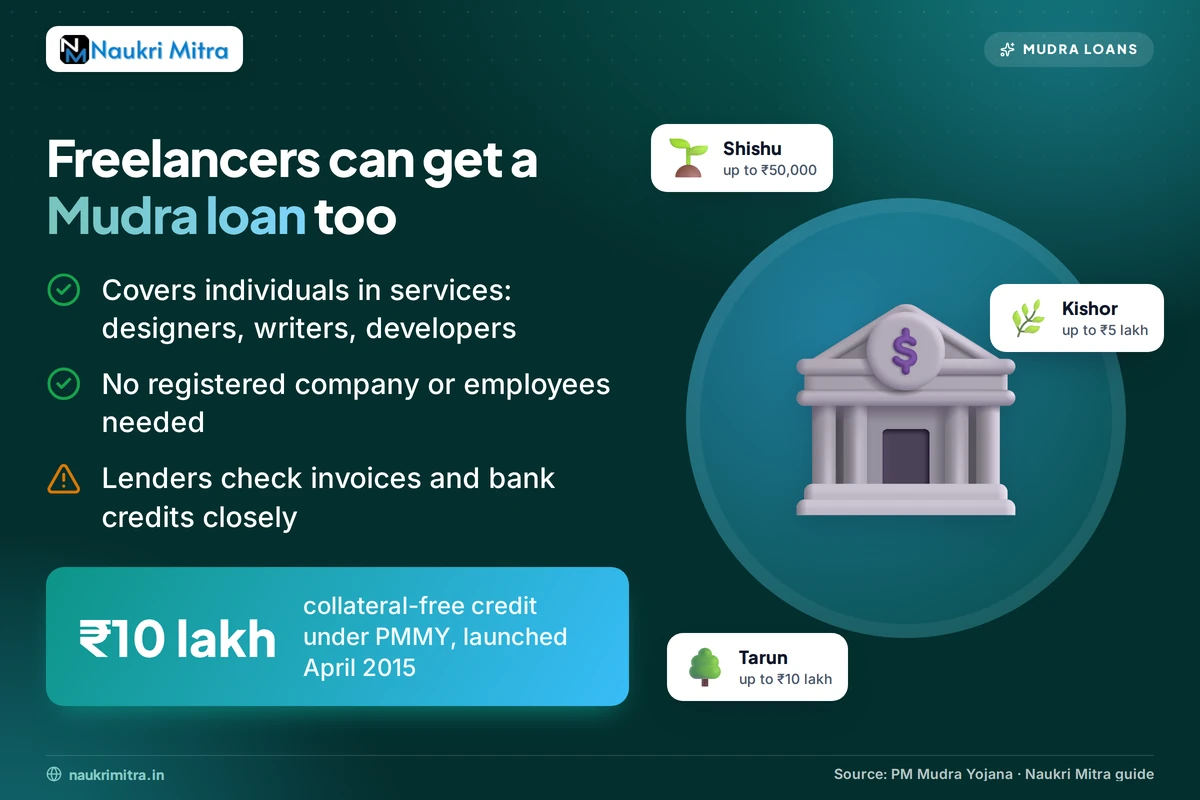
The Pradhan Mantri Mudra Yojana (PMMY) was launched in April 2015 to provide collateral-free credit to non-corporate, non-farm small and micro enterprises. In plain terms, it funds small businesses and self-employed individuals who don't have access to traditional corporate financing. Loans are disbursed through commercial banks, regional rural banks, small finance banks, NBFCs, and microfinance institutions, with MUDRA itself acting as a refinancing body rather than a direct lender.
So, what is the Mudra loan scheme and can an individual freelancer apply? Yes. The scheme explicitly covers individuals, proprietary concerns, and partnership firms engaged in income-generating activities in manufacturing, trading, or services — and freelance work falls squarely under services. You do not need to be running a registered company with employees; a single-person consulting practice, a freelance design studio, or an independent IT contractor all qualify as long as the activity is non-farm and income-generating. This is the core reason PM Mudra Yojana for consultants freelancers has become a practical funding route rather than a theoretical one — banks are increasingly comfortable underwriting individual applicants who can show consistent client income.
Shishu, Kishor and Tarun: Choosing the Right Loan Category
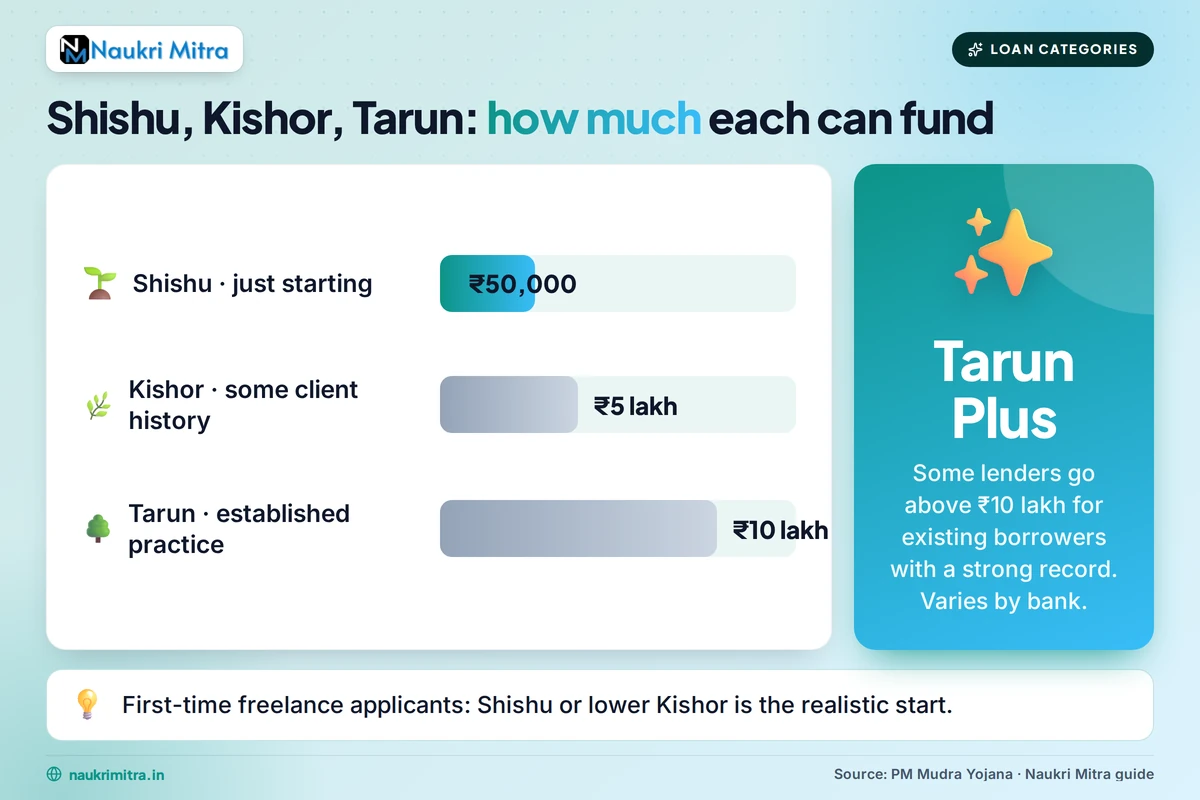
Every Mudra loan falls into one of three tiers based on the amount requested and the maturity of the business. Understanding the Shishu Kishor Tarun loan categories helps you apply for the right bracket instead of over- or under-asking.
- Shishu: Loans up to Rs 50,000, meant for very early-stage businesses — ideal for a freelancer just buying a laptop, a basic camera kit, or software licenses to start taking on clients.
- Kishor: Loans from Rs 50,001 up to Rs 5,00,000, suited to freelancers who already have some client history and need working capital or better equipment to scale.
- Tarun: Loans from Rs 5,00,001 up to Rs 10,00,000, aimed at more established solo practices — think a video production freelancer investing in a full studio setup, or a consultant expanding into a small team.
Some lenders have also started offering an enhanced Tarun Plus bracket for existing Mudra borrowers with a strong repayment track record, extending limits beyond Rs 10 lakh, though this varies by bank and is not available everywhere. For a first-time freelance applicant, Shishu or lower Kishor is the realistic starting point, since lenders tend to match loan size to documented income and business age.
Who Is Eligible: Self-Employed, Consultants and Soon-to-be Freelancers
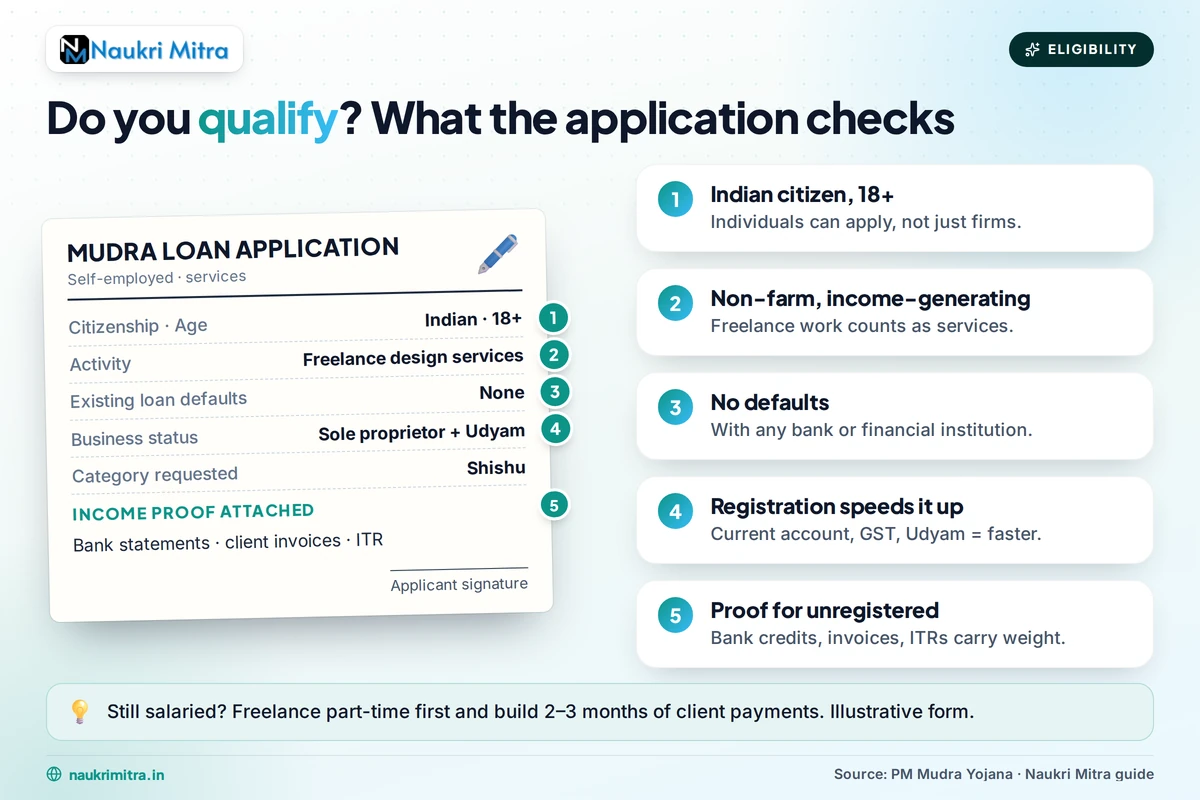
Mudra loan eligibility self employed applicants must satisfy includes being an Indian citizen above 18 years of age, having a viable business plan or ongoing freelance activity, and not being a loan defaulter with any bank or financial institution. You do not need a registered private limited company — a sole proprietorship, or even an informally run freelance practice with invoices and bank credits as proof of income, is generally acceptable for smaller loan amounts.
There is a meaningful difference between a sole proprietor and an unregistered freelancer in how smoothly the process moves. A sole proprietor with a current account, GST registration (where applicable), and Udyam/MSME registration usually gets faster processing, since the lender has more formal documentation to assess. An unregistered freelancer can still apply, but the bank will lean more heavily on bank statements, client invoices, and income tax returns to confirm the activity is genuine and ongoing. Registering as a sole proprietor or getting Udyam registration before applying is one of the simplest ways to smooth the process.
Can someone currently salaried but planning to freelance full-time apply for a Mudra loan? This is trickier. Most lenders want to see that the applicant is already self-employed or has a concrete, demonstrable transition plan — a resignation letter, signed client contracts, or a registered business entity. A salaried person with zero freelance income history will find it difficult to get approved purely on intent; it helps enormously to start freelancing part-time first, build two to three months of client payment records, and then apply once the self-employment status is clearer on paper.
Documents Checklist for a Mudra Loan Application
Getting your paperwork ready in advance is the single biggest factor in speeding up approval. PMMY eligibility documents typically requested by banks and NBFCs include:
- Duly filled application form with recent passport-size photographs
- KYC proof — Aadhaar card, PAN card, voter ID, or passport
- Proof of business address (utility bill, rent agreement, or Udyam certificate)
- Last six to twelve months of bank account statements
- Proof of business continuity for existing freelancers — client invoices, contracts, or income tax returns for the last one to two years
- A simple business plan or quotation, especially if the loan will fund specific equipment purchase
- Caste certificate, if applying under SC/ST/OBC category benefits (where applicable)
Freelancers without a long formal business history should not panic if they lack two years of ITRs — many banks will accept a shorter track record for Shishu-category loans, provided bank statements clearly show regular client payments coming in.
How to Apply for a Mudra Loan Online: Step by Step
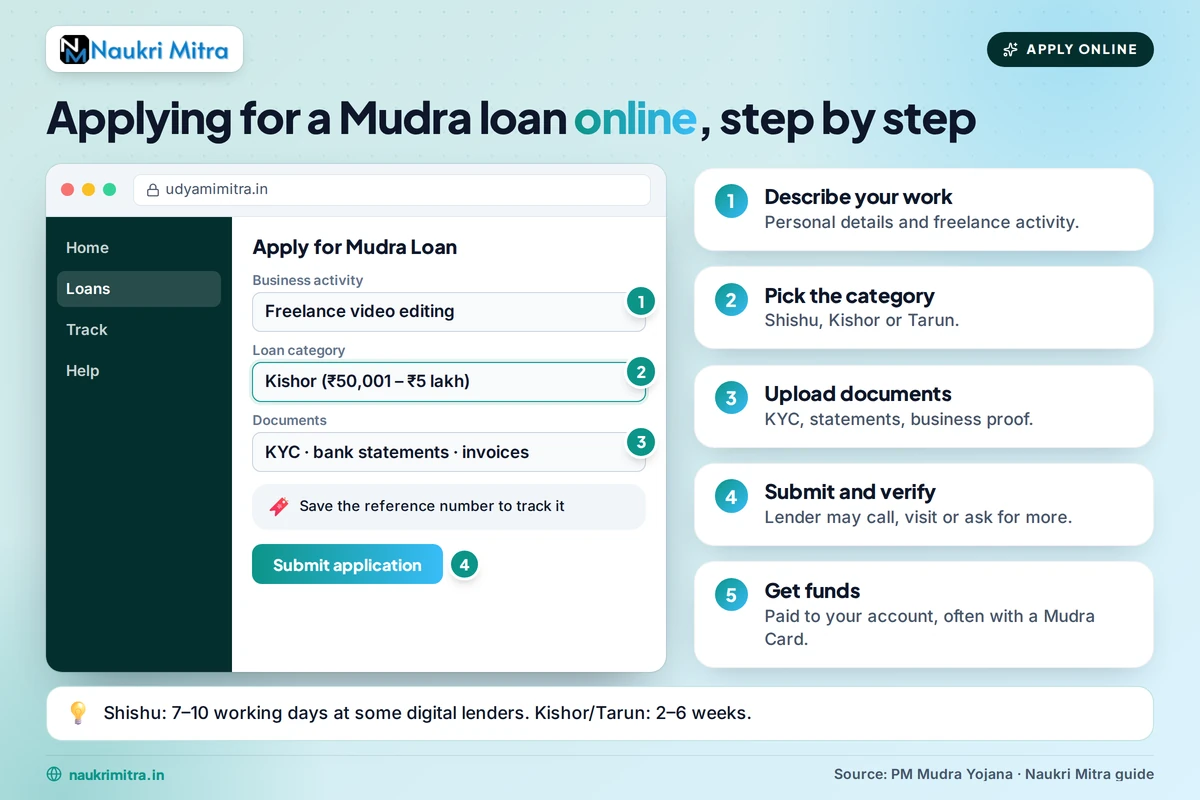
Knowing how to apply for Mudra loan online saves repeated branch visits. The process generally looks like this:
- Visit the official PMMY portal or your chosen bank's website and select the Mudra loan option, or use the Udyamimitra portal, which lets you compare offers across multiple lenders.
- Fill in personal details, business activity description, and the loan amount requested under the appropriate category (Shishu, Kishor, or Tarun).
- Upload scanned copies of your KYC documents, bank statements, and business proof.
- Submit the application and note the reference number for tracking.
- The bank or NBFC will contact you for verification, which may include a phone call, a visit, or a request for additional documents.
- Once verified and approved, funds are disbursed to your linked bank account, often along with a Mudra Card that works like a business credit line for working capital needs.
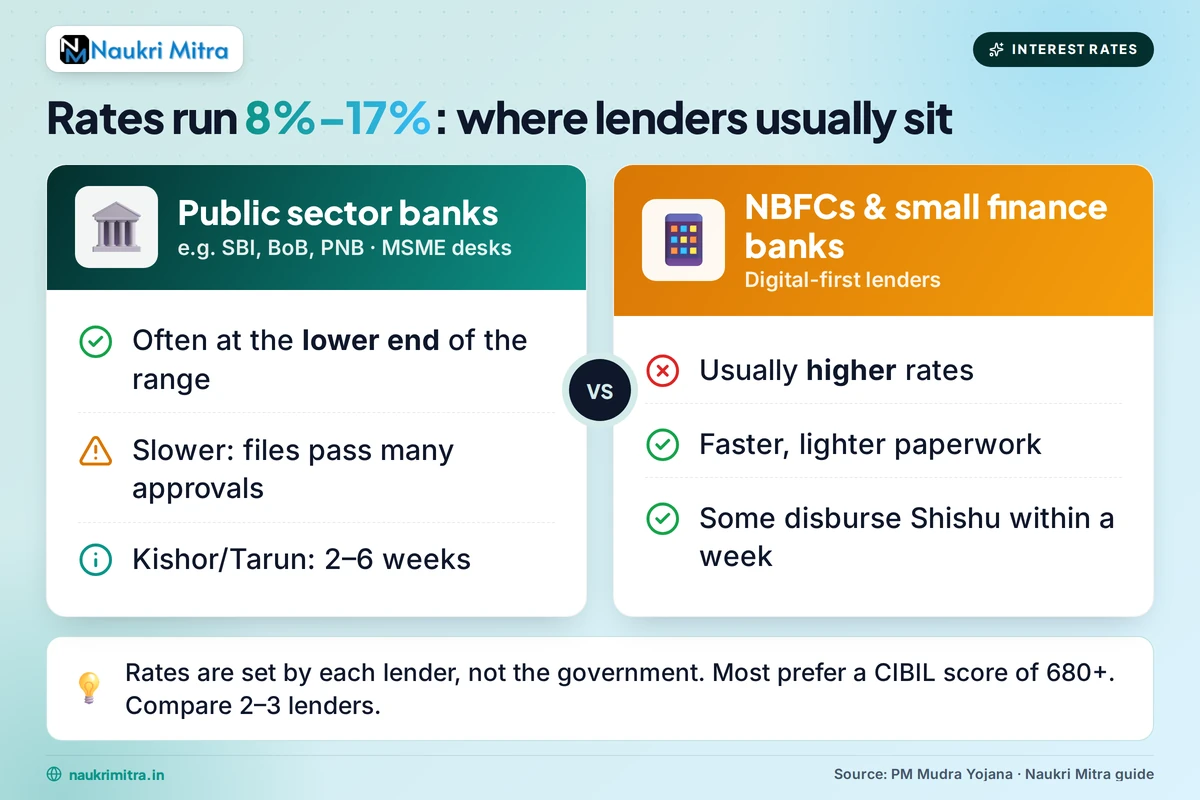
Applying at a physical branch follows the same documentation requirements but typically takes longer due to manual verification queues. Public sector banks such as SBI, Bank of Baroda, and Punjab National Bank process high volumes of Mudra applications through dedicated MSME desks, while several NBFCs and small finance banks run faster digital-first processes for self-employed and gig-economy applicants, sometimes disbursing smaller Shishu loans within a week. Processing speed varies by lender, so it's worth checking two or three banks before committing to one.
How long does approval and disbursement typically take? For Shishu loans with clean documentation, some digital lenders disburse within 7 to 10 working days. Kishor and Tarun loans, involving larger amounts and more scrutiny, can take anywhere from two to six weeks, particularly at public sector bank branches where files move through multiple approval layers.
Collateral, Interest Rates and Credit Score Explained
One of the biggest draws of this scheme is that it is a genuine collateral-free business loan for amounts up to Rs 10 lakh — no property, gold, or third-party guarantee is required. The "catch," if there is one, is that lenders compensate for the absence of collateral by scrutinising income proof, bank statement patterns, and credit history more carefully than they might for a secured loan. Approval isn't automatic just because collateral isn't needed.
Interest rates are not fixed centrally by the government; each participating bank or NBFC sets its own rate based on RBI guidelines, the applicant's risk profile, and the loan category. Rates commonly fall in roughly the 8% to 17% range depending on the lender and borrower profile, with public sector banks often at the lower end and NBFCs charging more for faster processing and lighter documentation. Always compare at least two or three lenders rather than assuming a flat number, since the spread between banks can be significant.
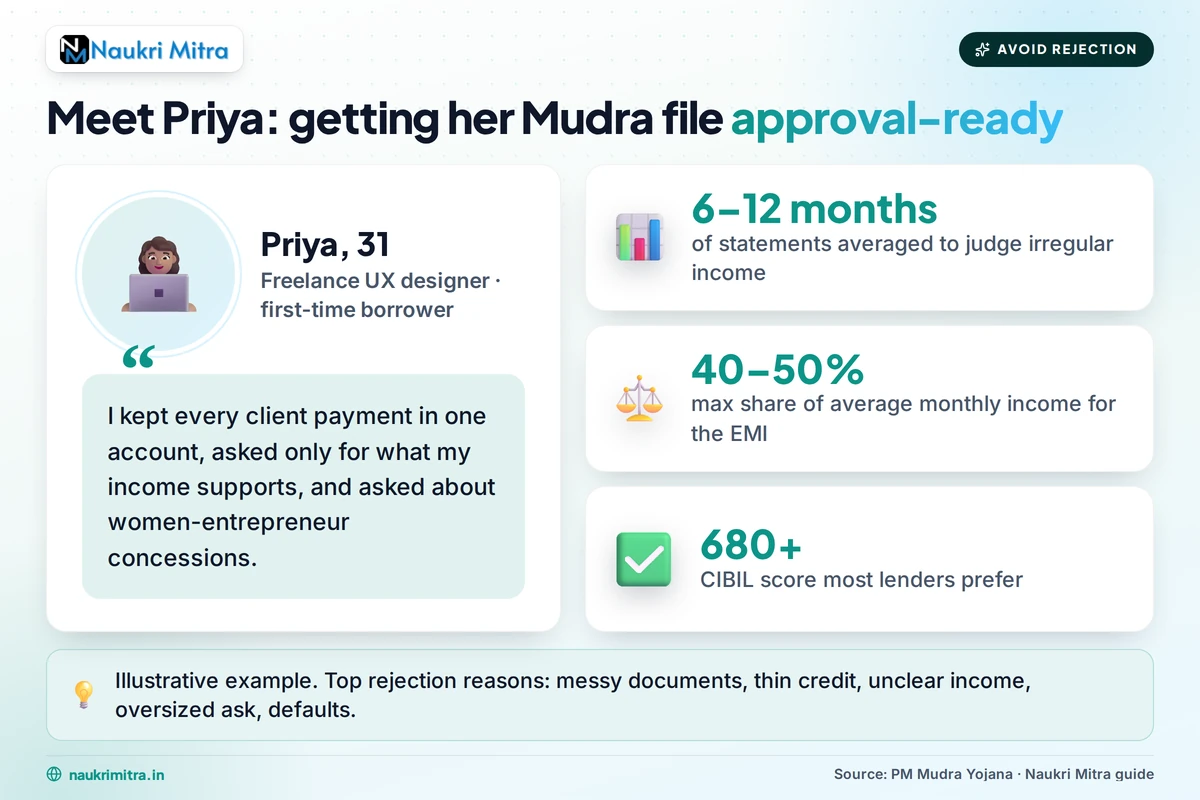
What credit score or credit history is needed to qualify? Most lenders prefer a CIBIL score of 680 or above, though some NBFCs accept slightly lower scores when other factors — steady bank credits, a clear repayment plan — are strong. Can a freelancer with no prior credit history get a Mudra loan? Yes, especially for Shishu-category amounts, since many first-time entrepreneurs genuinely have no loan history. Lenders then lean on bank statement analysis and sometimes a co-applicant's profile to assess risk, even though no collateral is required.
Calculating Loan Eligibility With Irregular Freelance Income
Freelance income rarely arrives as a neat monthly figure, which raises a fair question: how is loan eligibility amount calculated for someone with irregular freelance income? Lenders generally average income over the past six to twelve months of bank statements rather than looking at any single month in isolation. A freelancer who earned heavily in three months and little in others will usually still qualify, provided the average monthly inflow supports a reasonable EMI — most banks look for the proposed EMI to stay comfortably within 40-50% of average monthly income.
It helps to maintain all freelance income in one primary business-linked bank account rather than splitting receipts across multiple personal accounts, since a consolidated statement makes the income pattern far easier for an underwriter to read and approve quickly.
Putting the Mudra Loan to Work: Equipment and Working Capital
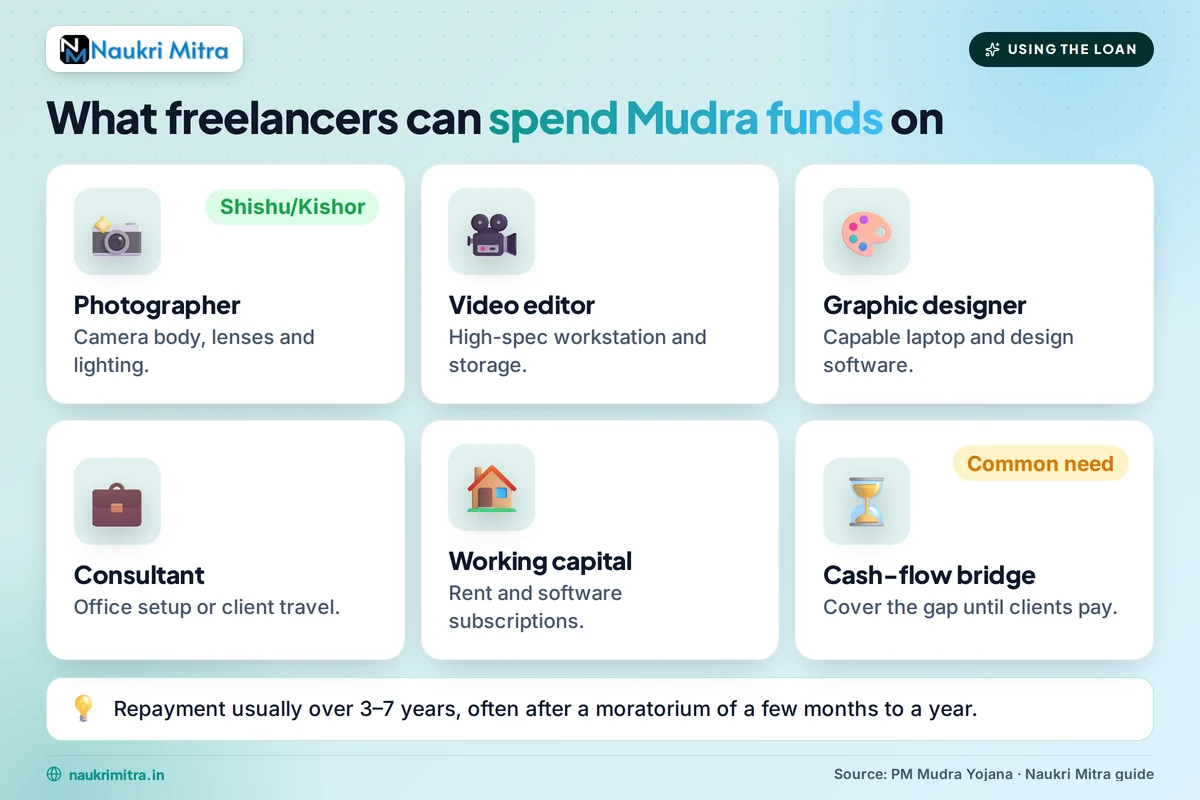
Can a Mudra loan be used to buy equipment for freelance work? Absolutely — this is one of the most common uses among independent professionals. A freelance photographer might use Shishu or Kishor funds for a camera body, lenses, and lighting; a video editor for a high-spec workstation and storage; a graphic designer for design software subscriptions and a capable laptop; and a consultant for office setup or travel costs tied to client work. The loan is just as valid for working capital for freelancers — covering rent, software subscriptions, or simply bridging cash flow between invoice submission and client payment, which is often the real reason freelance businesses struggle in their first year.
If you're exploring which freelance disciplines typically scale fastest once properly equipped, browsing live opportunities can be useful context — for instance, roles like freelance web designer and remote freelance graphic designer positions regularly list the exact software and hardware clients expect, which is a practical way to plan what a Mudra loan for starting freelance business funds should actually be spent on. Similarly, someone eyeing a freelance photographer career can use these postings to budget realistically for a Shishu or Kishor loan before investing in gear.
Repayment, Moratorium and What If You Can't Repay
What repayment tenure and moratorium options exist for Mudra loans? Tenure generally ranges from three to seven years depending on the loan category and lender, and many banks offer a short moratorium period, commonly a few months to a year, before EMI payments begin — useful breathing room for a freelancer still building a client base. Some lenders structure working-capital portions as a renewable credit line through the Mudra Card rather than a fixed EMI schedule, which suits the uneven cash flow typical of freelance work.
What happens if the freelance business doesn't generate enough income to repay the loan? As with any loan, missed EMIs affect your credit score and can lead to penalty charges, collection calls, and eventually loan classification as a non-performing asset if defaults continue. Because Mudra loans are collateral-free, the bank cannot seize personal property, but a damaged credit history makes future borrowing — for this business or any other purpose — considerably harder. If repayment genuinely becomes difficult, it is far better to approach the lender proactively to discuss restructuring, part-payment, or an extended tenure rather than letting the account slip into default silently.
Mudra Loan vs Personal Loan, Women Entrepreneurs, and Avoiding Rejection
How does a Mudra loan compare to a personal loan for funding a freelance transition? A personal loan is typically faster to get and comes with fewer business-specific document requirements, but it usually carries a higher interest rate and offers no structured support for business growth. A Mudra loan, by contrast, is purpose-built as an MSME loan for individuals and small businesses, generally offers better rates for genuine business use, and comes with the Mudra Card facility for ongoing working capital — but it demands more documentation upfront and a clearer business narrative. For a freelancer planning a serious, long-term practice rather than a one-off cash need, the Mudra route is usually the better fit despite the extra paperwork.
Are there Mudra loan schemes specifically targeted at women or first-generation entrepreneurs? Yes — several banks and the broader PMMY framework give preferential consideration, and sometimes marginally better terms, to women applicants and first-generation entrepreneurs, partly because the scheme's stated goals include widening access to formal credit among historically underserved groups. It's worth specifically asking your lender about any women-entrepreneur or first-time-borrower concessions when you apply, since these aren't always advertised upfront.
Finally, what common reasons cause Mudra loan applications to get rejected? The recurring ones include incomplete or inconsistent documentation, a poor or thin credit history with no compensating factors, bank statements that don't clearly show business-related income, an unrealistic loan amount relative to the stated business activity, and existing loan defaults elsewhere. Freelancers can avoid most of these simply by keeping clean, consolidated financial records, applying for an amount that matches their actual income trajectory, and being transparent about the nature of their freelance work rather than describing it vaguely.
A Mudra loan will not replace the hustle of landing clients, but it removes one of the biggest early barriers independent professionals face: the gap between having the skill and having the tools, workspace, or runway to use it. Whether you're a consultant formalising years of informal work, a creative professional buying your first proper equipment set, or someone methodically transitioning out of a salaried job, understanding the categories, documentation, and realistic timelines puts you in a far stronger position when you walk into a bank or open the online application. If you're also hunting for freelance or remote project leads to build the income history lenders want to see, exploring listings on Naukri Mitra alongside your loan application can help you build both sides of the picture at once — steady client work and the capital to support it.
Frequently Asked Questions
Can a freelancer apply for a Mudra loan without a registered company?
Yes. A sole proprietorship or an informally run freelance practice can apply, especially for Shishu and lower Kishor amounts, as long as bank statements and invoices demonstrate genuine, ongoing income-generating activity.
What is the maximum amount available under the Shishu, Kishor, and Tarun categories?
Shishu covers up to Rs 50,000, Kishor covers Rs 50,001 to Rs 5,00,000, and Tarun covers Rs 5,00,001 to Rs 10,00,000. Some lenders also offer an enhanced Tarun Plus bracket above Rs 10 lakh for existing borrowers with a strong track record.
Do I need collateral or a guarantor for a Mudra loan?
No collateral or third-party guarantee is required for Mudra loans up to Rs 10 lakh, which is one of the scheme's core features. Lenders instead assess income history and documentation more closely in place of security.
What documents should a self-employed freelancer keep ready?
KYC proof, business address proof, six to twelve months of bank statements, client invoices or contracts, and income tax returns where available. A short business plan or equipment quotation also strengthens the application.
Can someone with no credit history still get approved?
Yes, particularly for Shishu-category loans. Lenders often rely on consistent bank statement patterns and a co-applicant or guarantor's profile when the primary applicant has no prior credit record.
How long does it take to get a Mudra loan disbursed?
Shishu loans with clean documentation can be disbursed within roughly 7 to 10 working days through digital-first lenders, while Kishor and Tarun loans typically take two to six weeks depending on the bank and verification process.
Is a Mudra loan better than a personal loan for starting freelance work?
For a serious, ongoing freelance practice, a Mudra loan is usually better suited because it is structured for business use, often carries a more favourable rate, and includes the Mudra Card for working capital, though it requires more documentation than a personal loan.
What happens if I can't repay my Mudra loan on time?
Missed payments damage your credit score and can attract penalties, but since the loan is collateral-free, personal assets cannot be seized directly. Contacting the lender early to discuss restructuring is always better than letting the account default.
Are there special provisions for women entrepreneurs under this scheme?
Many banks give preferential consideration and sometimes better terms to women applicants and first-generation entrepreneurs under the broader PMMY framework, so it's worth asking your lender directly about any applicable concessions.
Sources: Pradhan Mantri Mudra Yojana – official scheme portal; Business Standard, "PM Mudra Yojana: How to get a collateral-free loan with this scheme"; ClearTax, "Mudra Yojana: Types, Interest Rates, Objectives, Eligibility".
.png)
.png)
.png)
Comments
Post a Comment