Professional Tax for Freelancers by State | Naukri Mitra
Riya had been freelancing as a graphic designer in Bengaluru for three years when a notice from the state commercial tax department landed in her inbox. She had filed her income tax returns on time every year, paid advance tax, even registered for GST once her billing crossed the threshold. Professional tax, however, was a line item she had never heard of. Her first reaction was panic; her second was confusion, because a friend in Noida doing the exact same kind of freelance work had never received anything similar. That contradiction is the whole story of professional tax in India — it is real, it is enforceable, and it is almost entirely dependent on which state and city you happen to be billing from.
This guide breaks down professional tax for freelancers India-wide, state by state, so you know exactly where you stand instead of guessing based on a friend's experience in a different city.
What Is Professional Tax and Is It Different From Income Tax?
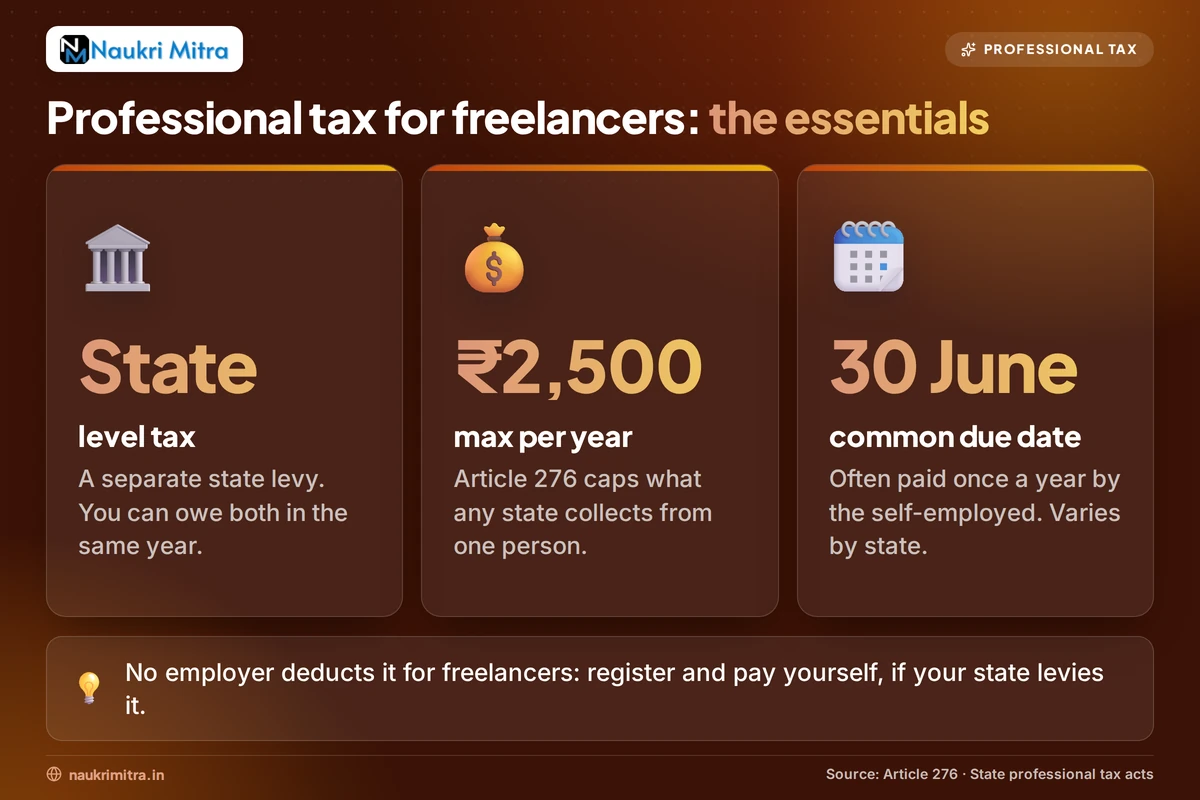
Professional tax is a small, state-level tax levied on income earned through a profession, trade, calling, or employment. Despite the name, it is not limited to doctors, lawyers, or chartered accountants — it applies broadly to salaried employees, self-employed individuals, consultants, shop owners, and, in many states, freelancers too. It is governed by Article 276 of the Constitution of India, which caps the total amount any state can collect from one person in a year at ₹2,500.
Income tax, by contrast, is a central government tax on your total annual income, calculated under slabs set by the Union Budget and collected by the Income Tax Department. Professional tax is a separate, much smaller state-level levy collected by each state's commercial tax or municipal authority. You can owe both simultaneously, and paying one does not exempt you from the other. A freelancer earning ₹8 lakh a year could easily owe income tax to the central government and a modest professional tax bill to their state government in the same financial year.
Which States Actually Levy Professional Tax — and Which Don't
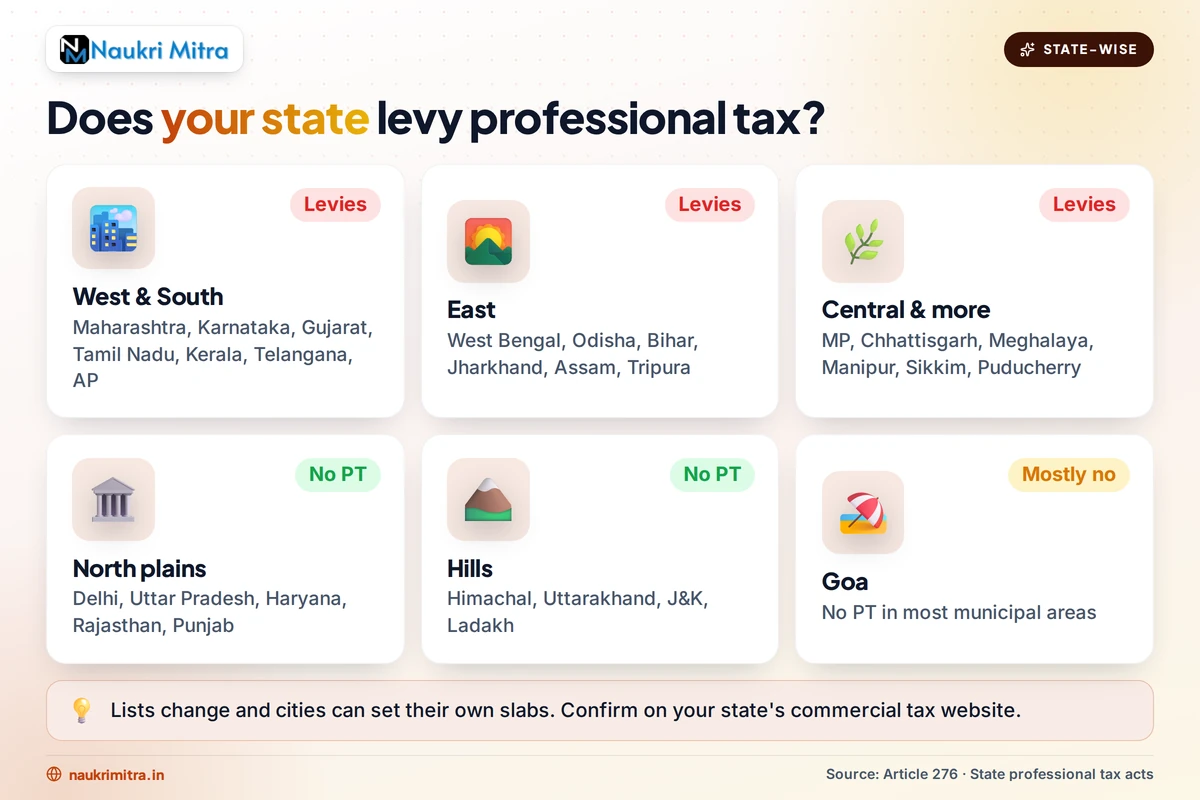
This is where most of the confusion starts. Professional tax is not a pan-India law; it exists only in states that have specifically enacted it under their own professional tax acts. States and union territories that currently levy professional tax rates state wise include Maharashtra, Karnataka, West Bengal, Telangana, Andhra Pradesh, Tamil Nadu, Gujarat, Madhya Pradesh, Kerala, Odisha, Assam, Bihar, Jharkhand, Tripura, Meghalaya, Manipur, Sikkim, Chhattisgarh, Mizoram, Nagaland, and Puducherry, among others.
States and union territories that do not currently levy professional tax include Delhi, Uttar Pradesh, Haryana, Rajasthan, Punjab, Himachal Pradesh, Uttarakhand, Jammu and Kashmir, Ladakh, Goa (in most municipal areas), and several northeastern states. This list genuinely does change over time — states have introduced or scrapped professional tax in the past, and municipal corporations within a state can sometimes set their own municipal professional tax slab within the limits fixed by the state act. The only reliable way to confirm your liability is to check your specific state's commercial tax department website or circular directly rather than relying on a general list, including this one.
Do Freelancers Legally Need to Register and Pay Professional Tax?
Yes — in any state where the professional tax act applies, the obligation is not limited to salaried employees. Most state laws explicitly cover "any person engaged in any profession, trade, calling or employment," a definition broad enough to include freelance writers, designers, developers, consultants, tutors, photographers, and social media managers. So the honest answer to "do freelancers need to pay professional tax" is: if you are based in a state that levies it, yes, you are legally required to register and pay, even though no employer is deducting it from a payslip on your behalf.
This is different from a registered proprietorship or private limited company, where the business entity itself may need a separate professional tax registration (often called PTRC, for deducting tax from any staff it employs) in addition to the individual owner's own liability (PTEC). A solo freelancer operating under their own name typically only needs the individual-level registration, while someone who has incorporated a firm and hired employees takes on the additional employer-side compliance.
Professional tax registration is also entirely separate from GST registration. Crossing the GST threshold and registering for GST does not automatically register you for professional tax, and vice versa — they are administered by different authorities (GST by the central and state GST departments, professional tax by the state's commercial tax or municipal department) and you may need to handle both independently depending on your state and turnover.
How Self-Employed Freelancers Register: PTEC and PTRC Explained
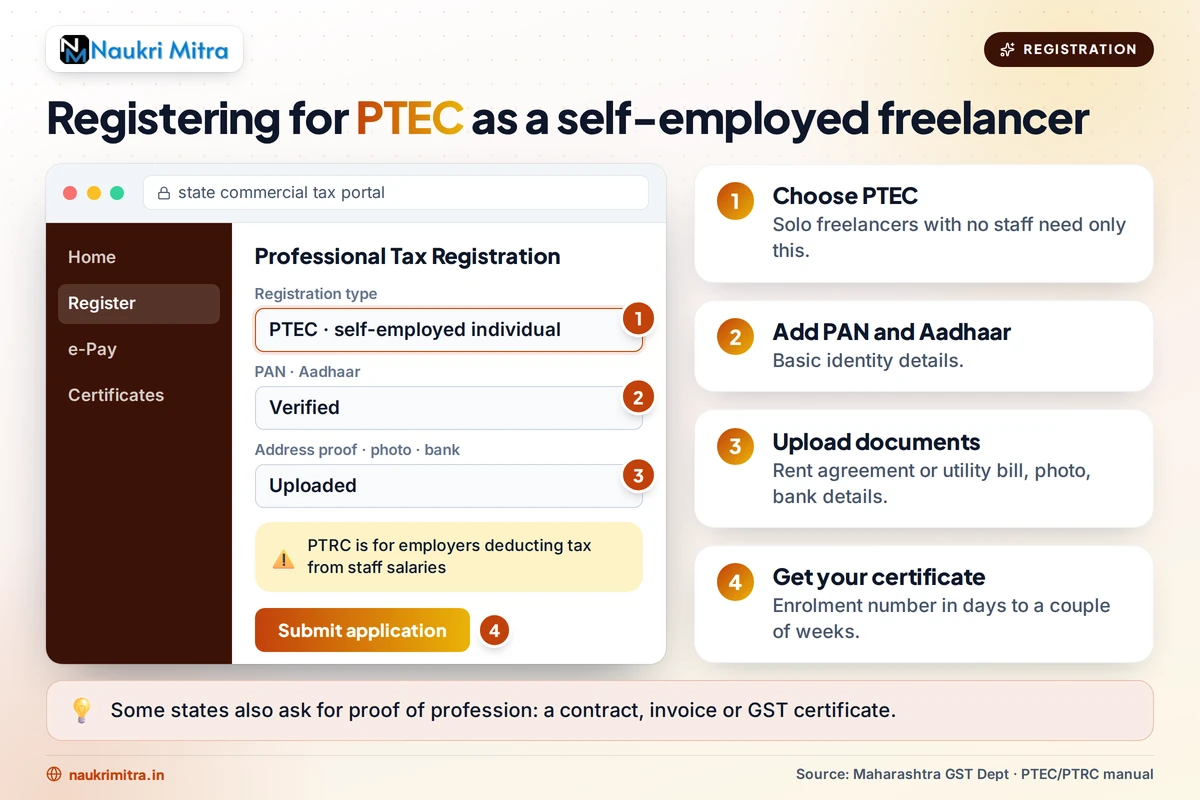
For a self-employed individual, professional tax registration self employed generally means applying for what Maharashtra calls a Professional Tax Enrolment Certificate (PTEC) — the certificate that allows an individual, including a freelancer or sole proprietor, to pay their own professional tax directly to the state. PTRC (Professional Tax Registration Certificate), by contrast, is meant for entities that employ staff and need to deduct professional tax from employee salaries and deposit it with the state. Most other states that levy professional tax follow a similar two-tier structure under different names, even where PTEC and PTRC terminology is specific to Maharashtra.
A typical PTEC PTRC registration process involves visiting the relevant state's commercial tax portal, filling an online application, and uploading basic documents: PAN, Aadhaar, proof of business address (rent agreement or utility bill), a passport-size photograph, and bank details. Some states also ask for proof of profession, such as a freelance contract, invoice sample, or GST certificate. Processing usually takes a few days to a couple of weeks, after which you receive a certificate and an enrolment number used for future payments.
Professional Tax Slab Rates in Maharashtra for Freelancers
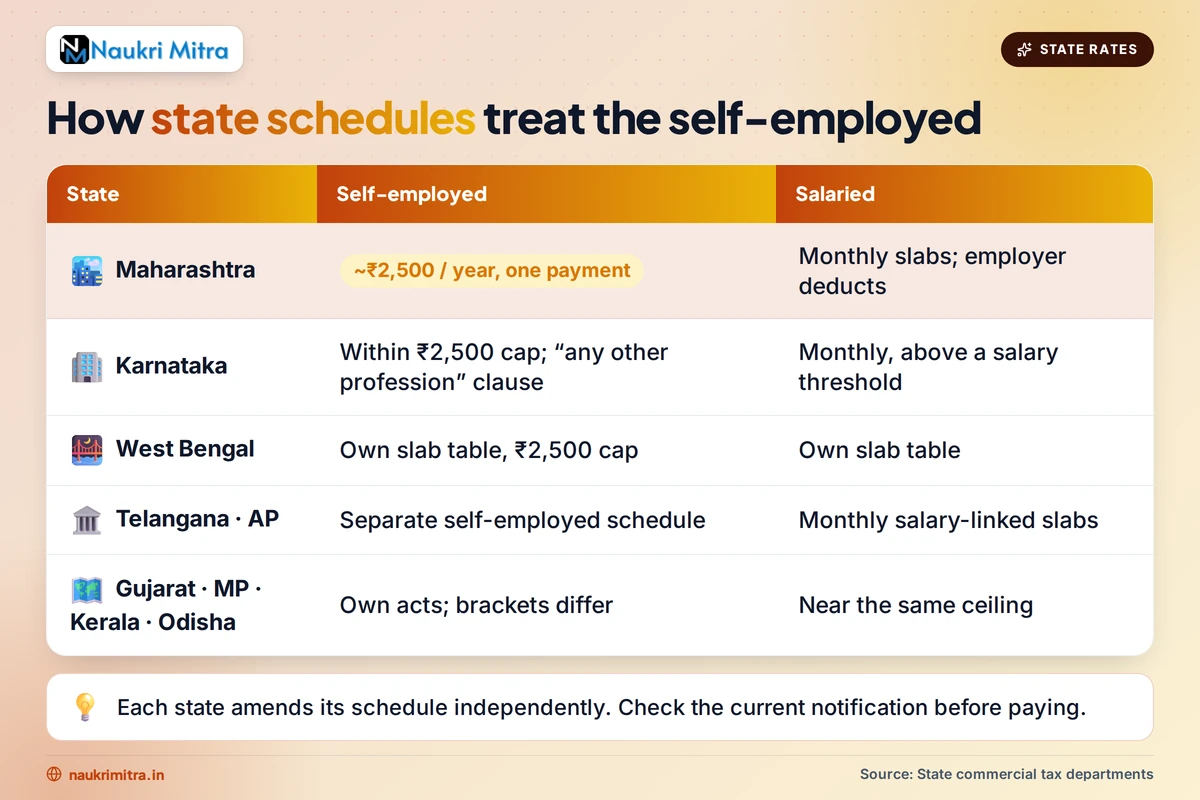
Maharashtra is one of the states with the most active enforcement of professional tax Maharashtra Karnataka freelancer compliance, partly because Mumbai and Pune host large freelance and consulting populations. Under the Maharashtra State Tax on Professions, Trades, Callings and Employments Act, a self-employed individual registered under PTEC typically pays a flat annual amount, commonly cited around ₹2,500 per year, paid as a single yearly payment rather than split monthly, though this can change through amendment and should always be confirmed on the official portal before you pay.
Salaried employees in Maharashtra are taxed on a monthly slab basis tied to gross salary, with the employer deducting and depositing PTRC on their behalf. For freelancers who also take up short-term salaried or retainer-based roles, it is worth clarifying with the paying entity whether they are deducting professional tax, since double registration (once as an individual, once indirectly through an employer) can occasionally cause confusion that is best resolved with a quick query to the Maharashtra GST Department.
Professional Tax Rates in Karnataka, West Bengal and Other High-Collection States
Karnataka is administered by its Commercial Taxes Department and is one of the more rigorously enforced states for professional tax. Self-employed professionals, consultants, and most trades in Karnataka fall under a schedule of rates that, like most states, is capped at the constitutional ceiling of ₹2,500 per year, with salaried employees taxed on a monthly basis once their gross salary crosses a specified threshold. Karnataka's professional tax schedule explicitly lists categories such as legal practitioners, medical professionals, engineers, management consultants, and "any other profession, trade, calling or employment," which is the catch-all clause freelancers typically fall under.
West Bengal follows a similar structure through its Directorate of Commercial Taxes, with its own slab table for salaried and self-employed persons, again subject to the ₹2,500 annual cap. Telangana and Andhra Pradesh, which inherited the same framework after bifurcation, apply monthly salary-linked slabs for employees and separate schedules for the self-employed. Gujarat, Madhya Pradesh, Kerala, and Odisha each maintain their own professional tax acts with brackets that differ in detail even though most converge near the same overall ceiling. Because every state schedule is amended independently, a freelancer should never assume Karnataka's exact bracket applies in West Bengal or Telangana — always pull the current schedule from that state's own notification.
The Maximum Annual Cap, Due Dates and Online Payment
Regardless of which state you are in, the Constitution caps total professional tax collected from any one individual at ₹2,500 in a financial year. States that levy it close to this ceiling usually structure salaried employees' tax as monthly deductions that add up across the year, while self-employed individuals and freelancers under schemes like PTEC are often asked to pay the full annual amount in one instalment, generally before a fixed date early in the financial year (commonly around 30 June in several states, though this date is set independently by each state and can shift).
Online payment has become the norm. Maharashtra's self-employed taxpayers pay through the Maharashtra GST Department's online portal using their PTEC number. Karnataka, Telangana, West Bengal, and most other states offer e-payment through their respective commercial tax websites, usually requiring the enrolment number, a linked bank account or payment gateway, and a challan-generation step before the amount is debited. Freelancers working across multiple cities within one state generally still pay through the single state portal, though a few states route payments through local municipal corporations instead.
Exemptions and Income Thresholds for Self-Employed Freelancers
Several states build in a self-employed professional tax exemption for individuals below a certain income or age threshold. Common exemption categories across different state acts include very low annual income earners, individuals above 65 years of age, persons with specified disabilities, and in some states, women earning below a defined monthly salary. These thresholds are set independently by each state legislature and are revised periodically, so a freelancer who assumes they qualify for an exemption because a blog post said so should verify the current threshold directly with their state's commercial tax department before skipping registration altogether.
Crossing a certain income level does not usually change which professional tax rates state wise bracket a self-employed person falls into in the way income tax slabs change with income, because most states apply a flat annual rate to self-employed professionals rather than a graduated structure. The graduated, income-linked slabs are far more common on the salaried-employee side of the same Act. Still, since the self-employed rate is generally fixed up to the ₹2,500 constitutional cap, higher freelance earnings do not typically translate into a materially higher professional tax bill the way they do with income tax.
Penalties for Non-Payment or Late Registration
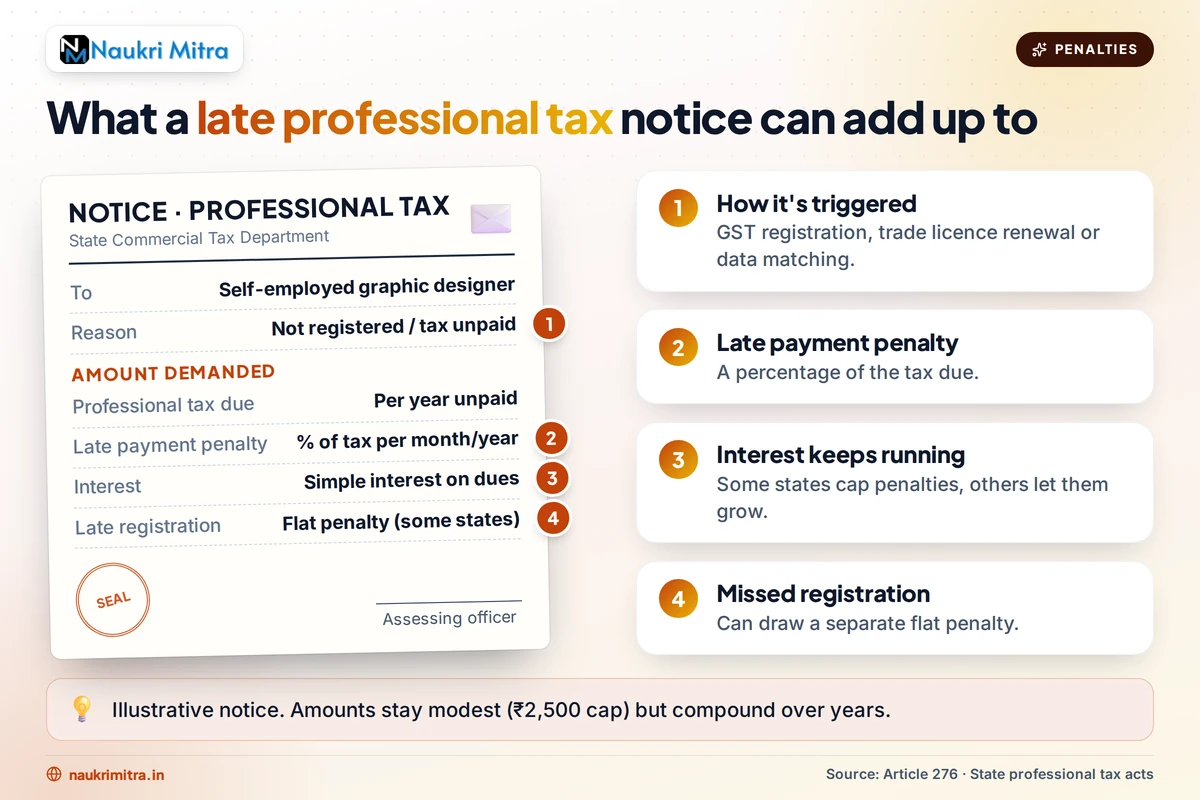
What happens if a freelancer never registers or pays? In practice, enforcement intensity varies sharply by state and by how actively the commercial tax department cross-checks GST, income tax, or municipal trade licence data against its own professional tax database. Where enforcement does catch up — often triggered by a GST registration, a municipal shop licence renewal, or a routine data-matching exercise — the consequences typically include a professional tax late payment penalty calculated as a percentage of the tax due per month or year of delay, plus simple interest on the outstanding amount, and in some states a flat penalty for failing to register within the prescribed period after starting a profession.
Interest and penalty provisions differ by state act; some cap the penalty at a multiple of the tax due, while others let it accumulate until settled. The amounts are usually modest given the ₹2,500 ceiling, but an unresolved default can complicate other compliance steps, such as a shop and establishment certificate, a trade licence renewal, or a notice bundling multiple state dues. The realistic risk for most freelancers is not dramatic enforcement but a small, compounding liability that surfaces as an unpleasant surprise years later, exactly as it did for Riya in Bengaluru.
Freelancers Who Work Remotely or Move Between States
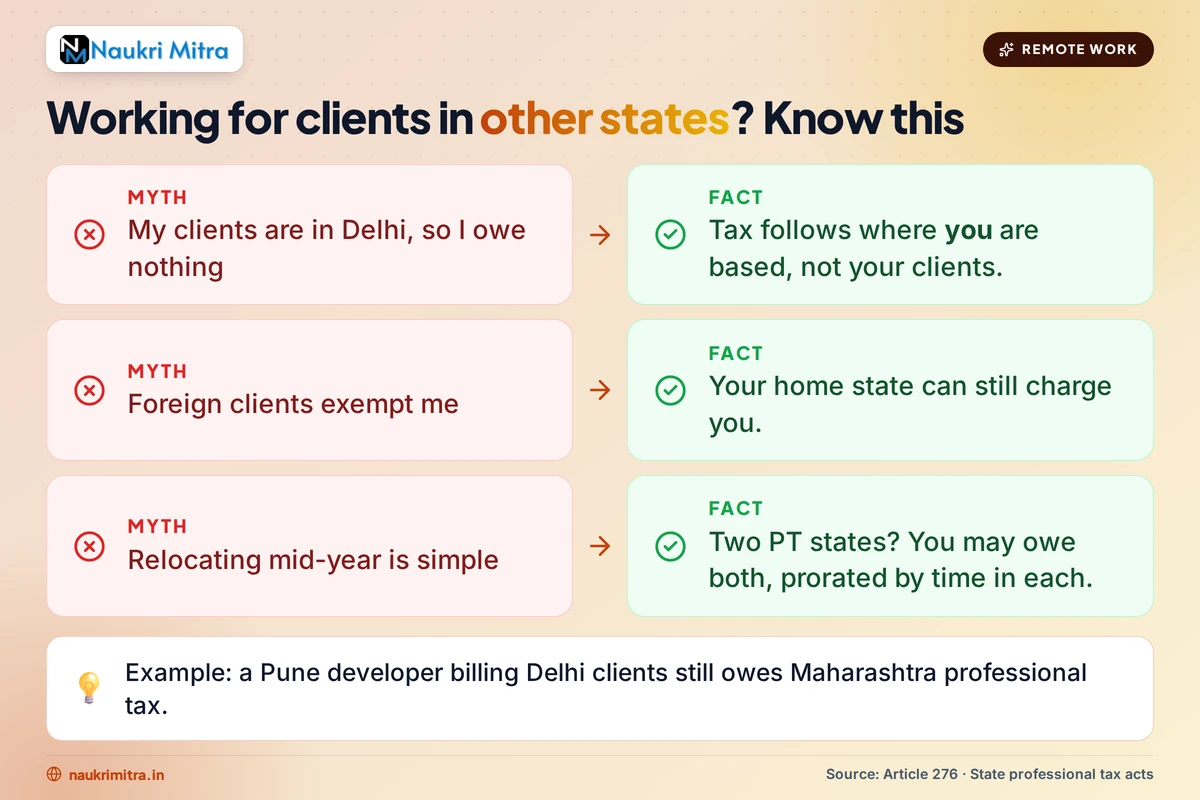
Professional tax liability is generally tied to where you are based or where your "place of profession" is registered, not to where your clients happen to be located. A freelance developer in Pune working entirely for clients in Delhi or even abroad still owes Maharashtra professional tax if Maharashtra is where they are established, because the tax is on the act of carrying on a profession from that location, not on the client's billing address. Remote work for out-of-state or international clients does not exempt a freelancer from their home state's professional tax if that state levies it.
Freelancers who relocate mid-year face a genuinely tricky situation. Moving from a state that levies professional tax to one that does not usually means your liability simply ends once you re-register your business address, but moving between two states that both levy it can create a period where you technically owe tax in both, prorated to the time spent in each, depending on how each state's act defines the taxable period and how promptly you deregister from the first state and register in the second. A local tax consultant's input is genuinely worth the modest fee here, since the rules are state-specific and not harmonised centrally.
Is Professional Tax Deductible From Income Tax?
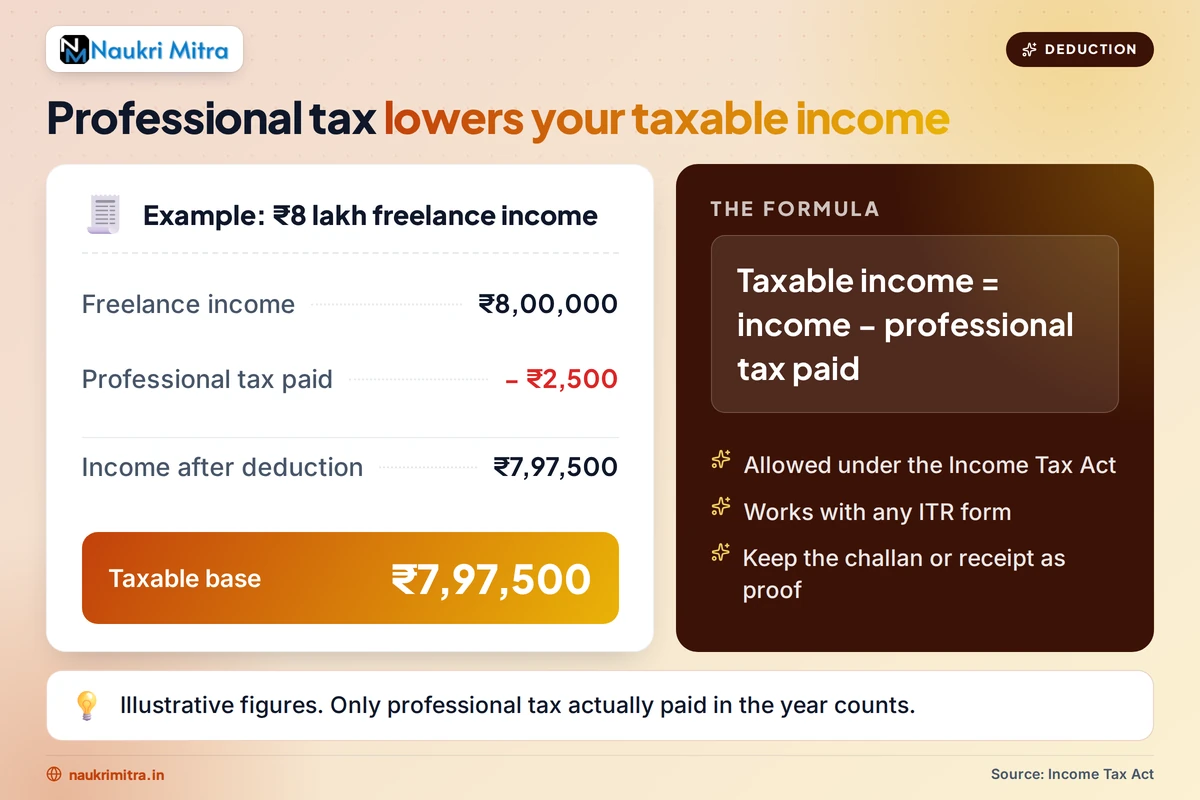
Yes. Professional tax paid during the financial year is allowed as a deduction from gross salary or professional income under the Income Tax Act when computing taxable income, regardless of which Income Tax Return form a freelancer uses. For freelancers filing under the presumptive taxation scheme or reporting income and expenses in detail, professional tax paid to the state is generally treated as a legitimate business expense or an allowable deduction, which modestly reduces overall income tax liability. Keeping the payment receipt or challan from your state's online portal is important, since it is the primary proof you would present if this deduction is questioned during an assessment.
Professional tax is a small but real line item in the compliance life of an Indian freelancer, and the biggest risk is the assumption that it does not apply simply because no one withheld it from a payment. If you are building a long-term freelance career, treat professional tax registration the way you treat GST registration or ITR filing — a short, mostly one-time task that prevents a compounding problem later. Many of the freelance bookkeeping, content writing, and web design roles freelancers take up today span multiple states and clients, making it even more important to know where you are actually based for tax purposes. If you are exploring more structured opportunities alongside your independent work, browsing current listings on Naukri Mitra is a good way to compare what is available in your city or domain.
Frequently Asked Questions
Is professional tax the same as income tax?
No. Income tax is a central government tax on your total annual income under Union Budget slabs. Professional tax is a separate, much smaller state-level levy on carrying on a profession, trade, or employment, capped at ₹2,500 a year under the Constitution, and the two are paid to different authorities.
Which states do not levy professional tax at all?
States including Delhi, Uttar Pradesh, Haryana, Rajasthan, Punjab, Himachal Pradesh, and Uttarakhand currently do not levy professional tax, though this list can change if a state introduces or repeals its professional tax act, so it should always be reconfirmed with current state notifications.
Do freelancers really need to register for professional tax themselves?
In any state that levies professional tax, yes. Since no employer is withholding it on a freelancer's behalf, the responsibility to register and pay falls entirely on the individual once they are "carrying on a profession" from that state.
What is the difference between PTEC and PTRC?
PTEC is the individual-level enrolment that lets a self-employed person, including a freelancer, pay their own professional tax. PTRC is the registration an employer needs to deduct professional tax from employees' salaries and deposit it with the state. A solo freelancer with no staff typically only needs PTEC.
What documents are needed to register as self-employed?
Most states ask for PAN, Aadhaar, proof of business address such as a rent agreement or utility bill, a passport-size photo, and bank account details, with some states also requesting proof of the profession, like a freelance invoice or contract.
Is there an exemption for freelancers with low income?
Several states exempt individuals below a specified income threshold, senior citizens above a certain age, and persons with specified disabilities, but the exact threshold is state-specific and should be verified on the relevant commercial tax department website rather than assumed.
What happens if a freelancer never pays professional tax?
Enforcement varies by state, but unpaid professional tax typically accrues interest and a late payment penalty once discovered, often during a GST registration check, trade licence renewal, or a routine data-matching exercise by the tax department.
Does professional tax apply if all my clients are outside my state?
Yes, generally. Liability is based on where you are established or registered as carrying on your profession, not on where your clients are located, so working remotely for out-of-state or international clients does not exempt you from your home state's professional tax.
Can a freelancer owe professional tax in two states after relocating mid-year?
It is possible, particularly when moving between two states that both levy professional tax, since liability can be prorated across the period spent in each location depending on how promptly you deregister from one state and register in the new one.
Is professional tax deductible when filing income tax returns?
Yes. Professional tax actually paid during the year is allowed as a deduction from salary or professional income under the Income Tax Act, which modestly lowers your overall taxable income regardless of which ITR form you use.
Sources: Karnataka Commercial Taxes Department – Professional Tax Schedule; Maharashtra GST Department – PTEC/PTRC Registration User Manual; Business Standard – Should Freelancers File Income Tax Returns?
.png)
.png)
.png)
Comments
Post a Comment