How to Invoice as a Freelancer in India | Naukri Mitra
A graphic designer in Pune once sent a Rs 45,000 invoice to a startup client with no invoice number, no payment due date, and a company name spelled from memory. Three months later, the client's new finance manager asked for "the original invoice on file" before clearing the payment, and the freelancer couldn't produce one that matched what she'd actually sent. The money came through eventually, but only after two awkward email threads and a delay she couldn't afford. Invoicing feels like paperwork until the day it isn't — and for India's freelancers, that day usually arrives when a client is slow to pay, a tax notice lands, or a bank asks for income proof on a loan application.
This guide walks through a practical freelancer invoice format India clients and tax authorities both accept, how to decide between a freelance invoice with or without GST, and what to include in a freelance invoice so it never gets questioned later. Whether you're taking your first client or tidying up years of inconsistent habits, the goal is the same: an invoice trail that protects you.
What Makes an Invoice Legally Valid in India
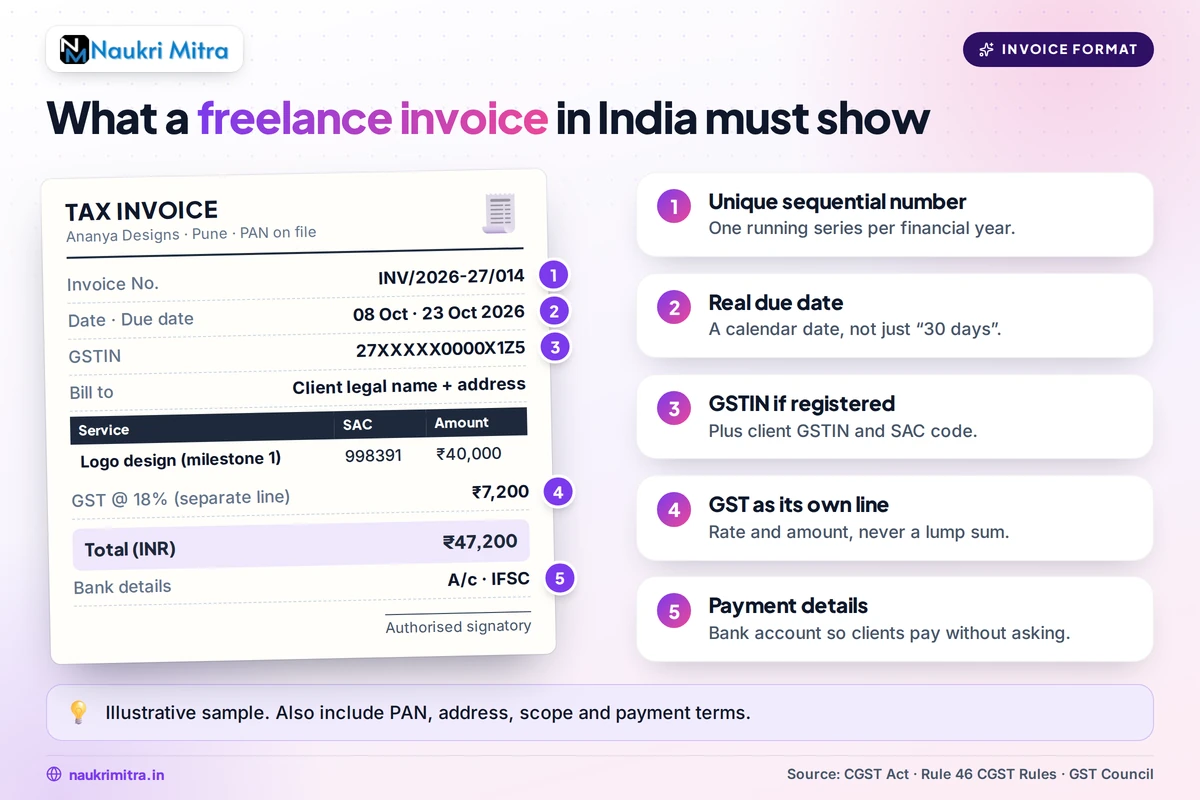
An invoice is a formal demand for payment, not a casual message that says "please pay." For it to hold up if a client disputes it, or if the Income Tax Department wants to verify your receipts, it needs a consistent set of fields: your full legal name and trade name, registered address, PAN, a unique invoice number, the invoice date, the client's name and billing address, a clear description of the service, the scope (hours, milestone, or deliverable), the rate and total, the currency, payment terms and due date, and your bank details. If you're GST-registered, your GSTIN, the client's GSTIN (if they have one), the HSN/SAC code, and the applicable tax rate and amount must also appear — this is essentially what to include in a freelance invoice, GST or not.
It helps to separate an invoice from a receipt early on. An invoice is a request for payment issued before or when money is owed; a receipt acknowledges that payment was actually received. You need both — the invoice to prove what was billed, and the receipt or a bank credit entry to prove it was paid. Keeping only one is a common gap that causes confusion during a tax query or client audit.
Freelance Invoice With or Without GST: Which Format Applies to You
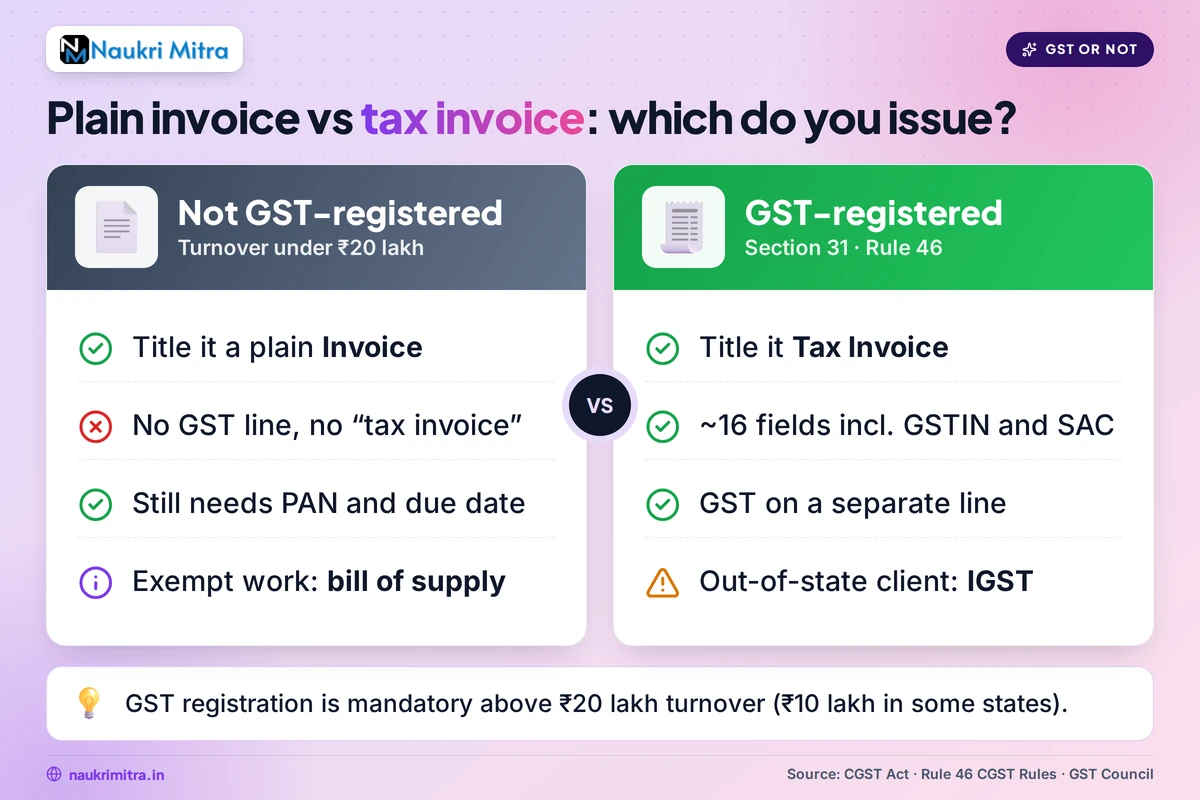
A service provider must register for GST once aggregate turnover crosses Rs 20 lakh in a financial year (Rs 10 lakh in a few special-category states), though many freelancers register voluntarily earlier because corporate and foreign clients often insist on a GSTIN before onboarding a vendor. Below the threshold and unregistered, you simply don't charge GST — the document should read as a plain invoice, not a "tax invoice," since that label without a GSTIN creates confusion.
Once registered, it becomes a tax invoice under Section 31 of the CGST Act, following the structure in Rule 46 of the CGST Rules, which the Central Board of Indirect Taxes and Customs sets out in detail — roughly sixteen mandatory fields, from the serial number format to the place of supply. GST should always sit as a separate line item, rate and amount, rather than a lump sum, because clients need that breakup for input tax credit and authorities expect it to reconcile against your GSTR filings. For out-of-state clients, output tax is typically IGST rather than CGST plus SGST, which changes the invoice structure even if the total rate looks familiar.
If you deal only in categories that are GST-exempt (rare for freelance services, but relevant for a handful of notified services), you'd issue a bill of supply instead — a lighter format with fewer mandatory fields since no tax is charged. The GST Council's flyer on tax invoices lays out exactly when each format applies and is a clean, official reference if you're unsure which bucket your work falls into.
Invoicing Foreign Clients vs Indian Clients
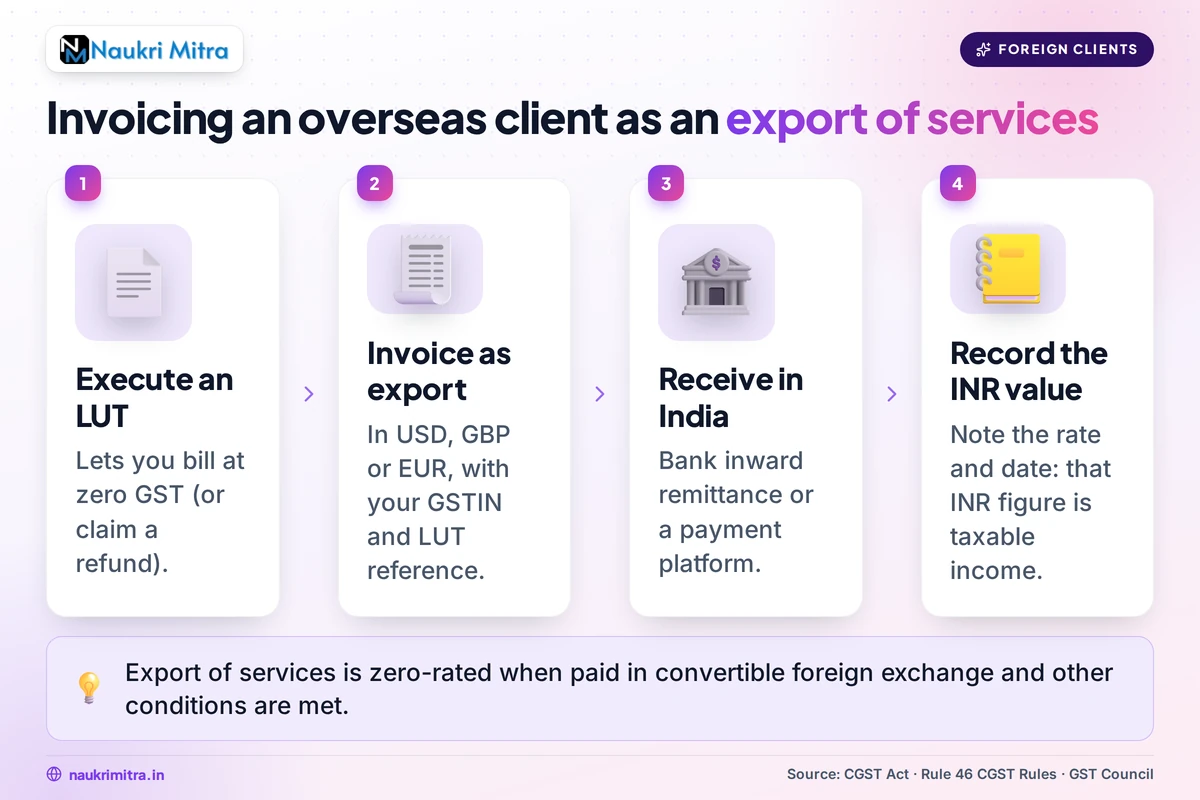
Exporting services to a client outside India changes a few things, even though the core fields stay similar. Under GST, supplying services to an overseas client generally qualifies as an "export of services" when payment is received in convertible foreign exchange and a few other conditions are met, and such supplies are typically zero-rated — you bill without charging GST, provided you execute a Letter of Undertaking (LUT) or follow the refund route after registering. The invoice should still mention your GSTIN if registered, note that the supply is an export, and reference the LUT where applicable. For an Indian client, the usual registered/unregistered rules apply, and you'll generally invoice in INR.
Most overseas clients prefer being billed in their own currency — USD, GBP, EUR — since it's easier for them to reconcile. There's no rule against invoicing in foreign currency, but it affects your tax computation at home: once payment lands in your Indian account (via an authorised remittance channel, a platform like Payoneer or Wise, or your bank's inward remittance process), it converts to INR at the prevailing rate, and that converted figure is your taxable income. Note the exchange rate and conversion date in your own records, even if the invoice itself shows the foreign currency, so your bookkeeping and bank credit advice line up cleanly.
Invoice Numbering That Stays Audit-Proof All Year
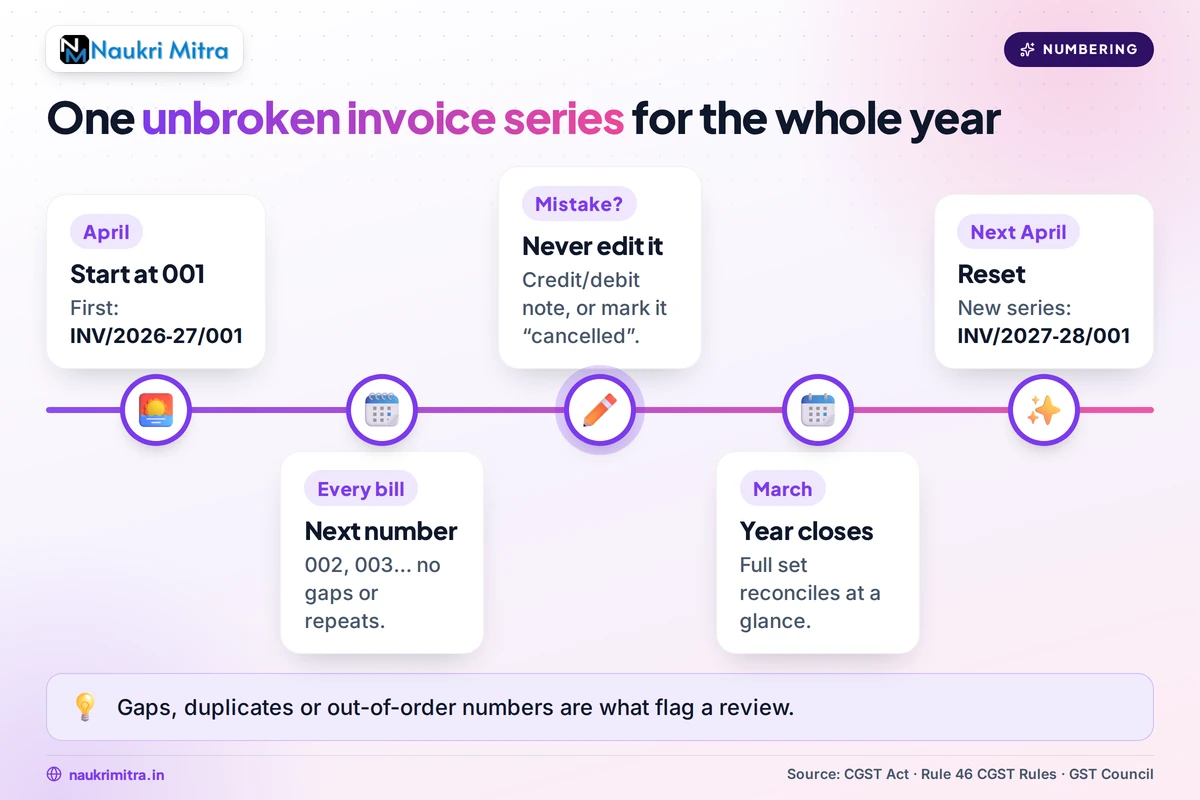
Sloppy invoice numbering — duplicate numbers, gaps, or numbers issued out of date order — is one of the fastest ways to raise a flag if your records are reviewed. The fix is simple: one continuous, sequential system for the full financial year. A common pattern is a prefix tied to the year followed by a running number, such as INV/2026-27/001, INV/2026-27/002, reset only when the year changes. This invoice number sequencing makes it obvious at a glance whether anything is missing, and it's exactly the consistency a tax officer or loan underwriter looks for.
Mistakes happen — a wrong amount, a typo, a service described incorrectly — and the right fix is never to delete or silently edit the original. If GST-registered, correct errors through a formal credit or debit note referencing the original invoice number, keeping the audit trail intact. If unregistered, cancel the original explicitly (mark it "cancelled," keep it on file) and issue a fresh one with the next number, noting which invoice it replaces. Reusing a number or quietly reissuing one with different figures is exactly the inconsistency that turns a routine check into a prolonged one.
Payment Terms, Advances, and Chasing Late Payments
Standard payment terms freelancer invoices in India use are "due within 15 days," "due within 30 days," or "due on receipt" — the clearer you are upfront, the fewer awkward reminders later. Spell out the due date as an actual calendar date rather than just "30 days," since the accounts team processes payments against the explicit date they see. If you charge a late fee, state the percentage and when it kicks in directly on the invoice or service agreement — a line like "overdue amounts attract 1.5% interest per month" is enforceable only if the client agreed before the work began, ideally in writing.
For advances, issue a separate receipt for the upfront amount, then a final invoice that references the advance and nets it off the total. Don't fold an advance silently into the final number — if a dispute arises, you want a document showing exactly when and how much was paid at each stage.
Chasing unpaid invoices is a skill freelancers build over time, and a simple tracker — a spreadsheet with invoice number, client, amount, due date, and status — catches overdue amounts before they're forgotten. A short, polite reminder a few days after the due date, followed by a firmer follow-up with the invoice reattached after two to three weeks, resolves most delays. For freelancers doing meaningful work for small and medium enterprises, MSME Samadhaan, the government's delayed-payment monitoring portal, helps registered micro and small enterprises recover dues stuck beyond 45 days — available once you've completed Udyam registration, which is free and entirely online. When chasing invoices becomes a recurring drain across many small clients, it's worth looking at dedicated help — accounts receivable roles exist precisely because this follow-up work eats into billable hours.
Digital Receipts and the Higher Section 44ADA Turnover Limit
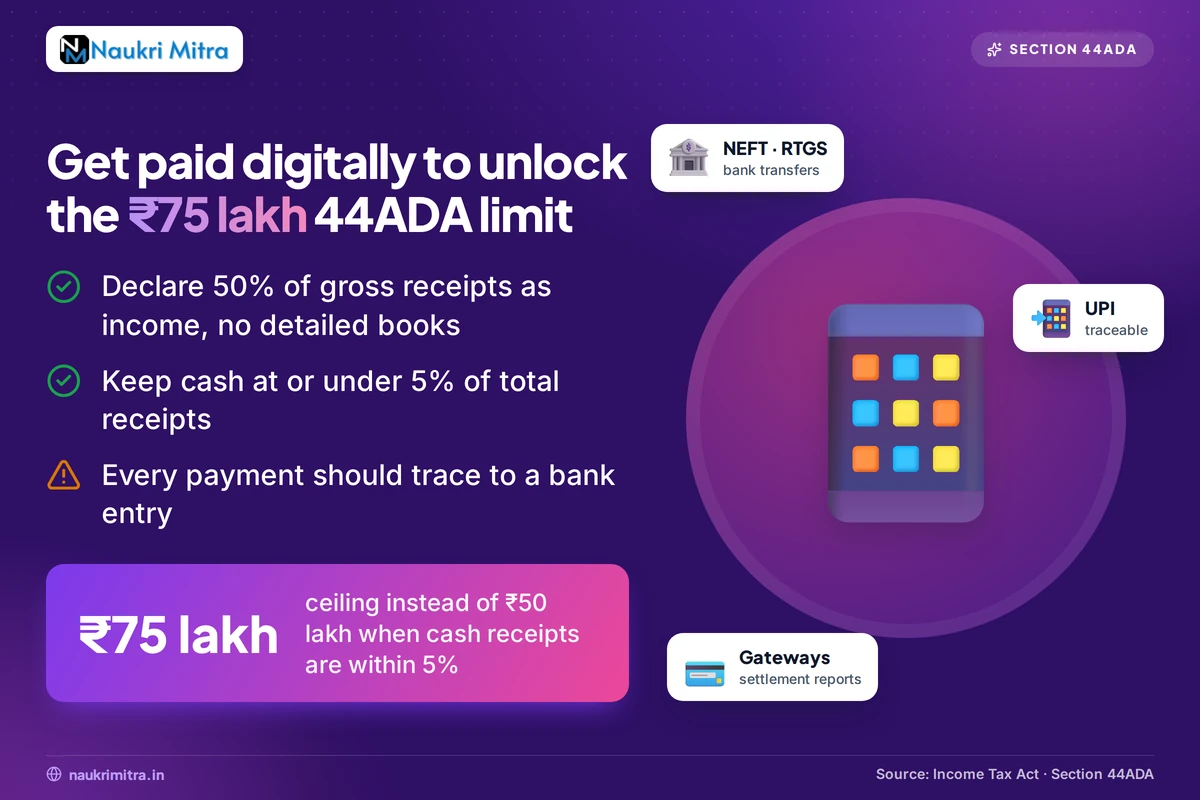
Most freelancers file under the presumptive taxation scheme in Section 44ADA, which lets eligible professionals declare 50% of gross receipts as taxable income without maintaining detailed books, up to a turnover ceiling. That ceiling rises to Rs 75 lakh instead of the standard Rs 50 lakh for freelancers whose cash receipts stay within 5% of total turnover — essentially, when most income arrives through traceable channels. The digital receipts 44ADA recognises are payments through banking channels — NEFT, RTGS, UPI, account transfers, bank-cleared cheques, or payment gateways — rather than physical cash deposited separately. To claim the higher limit, your bank statements, UPI history, and gateway settlement reports need to collectively show cash receipts stayed under that 5% threshold for the year, so keeping every payment traceable to a bank entry is what actually unlocks the extended ceiling.
A Bookkeeping System That Works for Freelancers With Multiple Clients
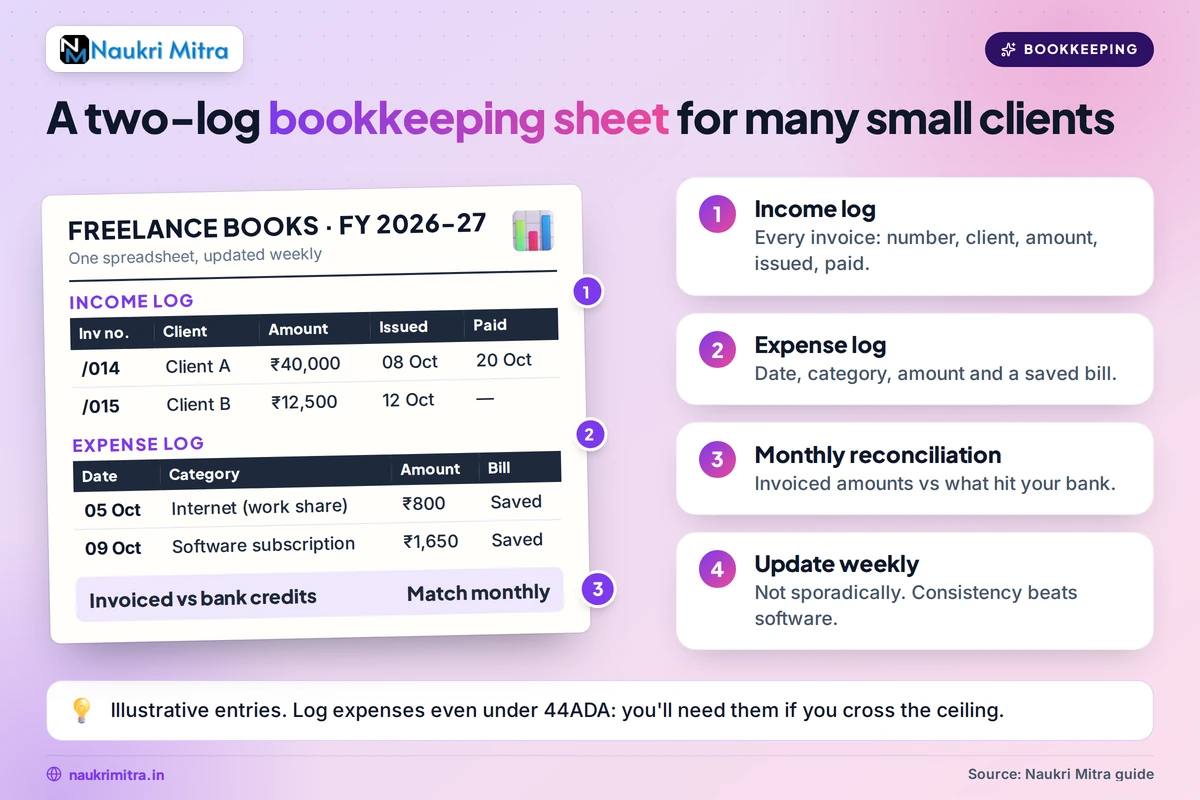
If you're juggling five or ten small clients a month, the question isn't which software to buy first — it's consistency. The simplest version of how to maintain accounts as a freelancer that survives a busy month looks like this: one running income log (every invoice raised, with number, client, amount, date issued, date paid), one running expense log (date, category, amount, a saved copy of the bill), and a monthly reconciliation matching what you invoiced against what actually landed in your bank account. A spreadsheet handles this well for most solo freelancers, and updating it weekly rather than sporadically is what keeps it usable. These bookkeeping tips for freelancers India apply whether you have two clients or twenty.
Free invoicing tools cover most freelancers comfortably when the client count is modest — basic templates, reminders, simple PDF generation. Paid software earns its cost once you're issuing GST-compliant tax invoices regularly, managing multi-currency billing, or need automated reminders and reconciliation across a high volume of smaller transactions. There's no fixed threshold — it's the point where manual invoicing starts costing more billable time than the subscription fee.
On expense tracking self-employed professionals often underestimate: even under presumptive taxation, where detailed books aren't mandatory, it's worth logging business expenses — internet and phone bills apportioned to work use, software subscriptions, a share of rent for a dedicated workspace, professional memberships, client travel, and equipment. These records matter even if you don't deduct them individually against 44ADA income, because they become essential the moment turnover crosses the presumptive ceiling, your declared income ratio gets questioned, or you later switch into regular books of account. When the volume gets genuinely hard to manage solo, bringing in dedicated support — a freelance bookkeeper or someone in a virtual tax preparer role — is a reasonable trade against the hours it would otherwise cost.
Why Clean Invoices Matter Beyond Tax Filing
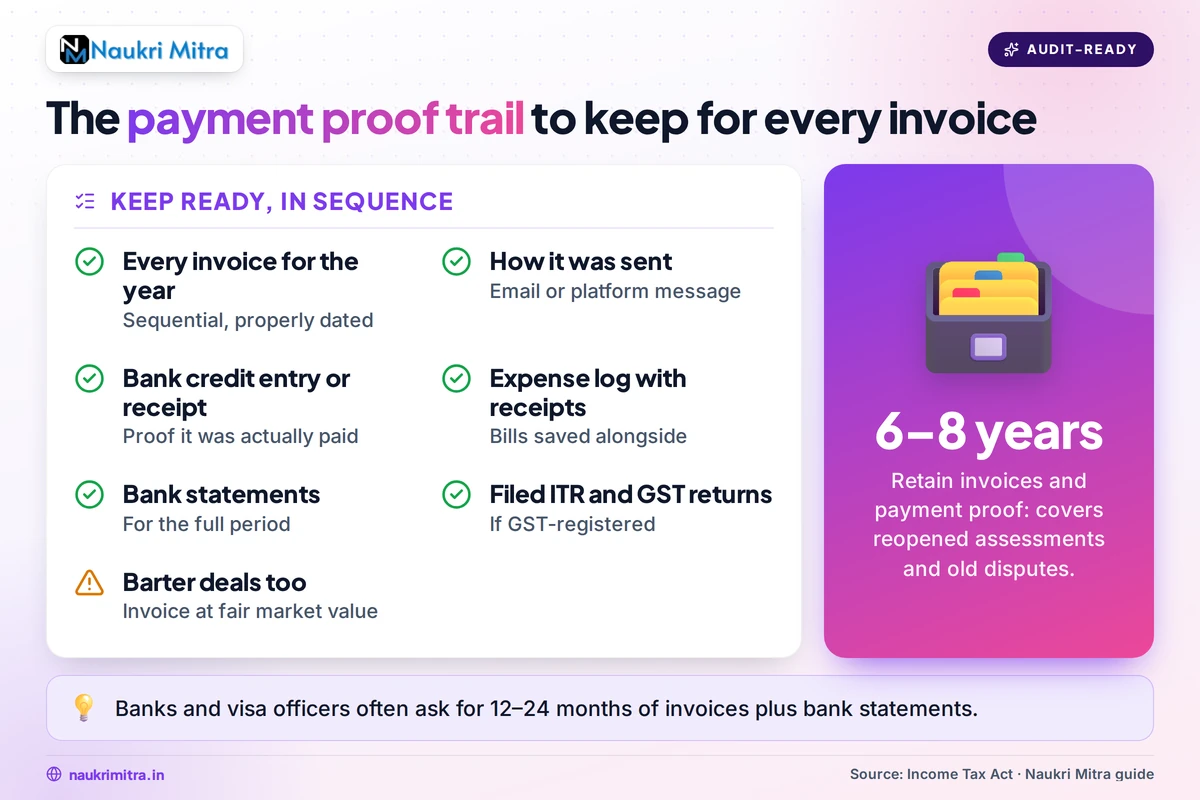
A consistent invoice and payment history does more than keep you compliant — it becomes your income proof for everything else. Banks evaluating a personal loan or a credit card application for a self-employed applicant typically ask for twelve to twenty-four months of invoices alongside bank statements, since there's no salary slip to point to. Visa applications for countries that scrutinise self-employment income — common for long-stay or freelance/digital-nomad visa categories — often ask for exactly this combination: invoices issued, proof of payment received, and a tax return that reconciles against both. Freelancers with clean, sequential, properly dated invoices sail through these checks; freelancers with inconsistent or missing records end up scrambling to reconstruct a year of transactions from memory and old email threads, which rarely goes smoothly under a deadline.
This is also where client payment proof documentation earns its keep in a dispute. If a client claims they never received an invoice, or disputes the amount owed, a clean record — the invoice itself, the email or platform message it was sent through, and the bank credit entry once paid — settles the question quickly. Retain invoices and the supporting payment proof for at least six to eight years, since that covers the limitation periods under which the Income Tax Department can reopen assessments in most circumstances, and it also covers you for any client-side audit query that surfaces years after the actual engagement ended.
Handling Barter, Mismatches, and Other Edge Cases
Not every freelance arrangement is settled in cash or bank transfer. If you've ever traded services — design work for a subscription, writing for equity, consulting for discounted software — that exchange still counts as income at its fair market value, and it still needs an invoice documenting what was provided and its estimated monetary worth, even though no money physically changed hands. Skipping this because "nothing was paid" is a common and risky shortcut; the tax department treats non-cash consideration as taxable income regardless of the form it arrives in.
Poor invoicing hygiene — unexplained gaps in invoice numbers, income reported in your return that doesn't match the GST returns you've filed, or bank credits that don't tie back to any invoice on record — is one of the more common triggers for an automated mismatch notice from the tax department, since much of this cross-checking now happens through data matching rather than manual review. Keeping your invoice register, GST filings, and bank statements in sync isn't just tidy practice, it's what keeps your name off that list. And if you are selected for scrutiny or an audit, the minimum paperwork you'll want ready at short notice is: every invoice issued for the year in sequence, matching payment proof for each, your expense log with receipts, your bank statements for the relevant period, and your filed tax return and GST returns (if registered) — organised well enough that a reviewer can reconcile the full year without needing you to go searching.
Building these habits early is far easier than retrofitting them under pressure. For freelancers exploring more structured finance-adjacent work alongside their own practice, or looking to formalise how they manage client billing, browsing opportunities through Naukri Mitra can be a useful way to see how businesses structure these roles, which in turn can sharpen how you run your own invoicing and accounts.
Frequently Asked Questions
How long should freelancers retain invoices and payment records?
At least six to eight years is the safe benchmark, since it covers the period during which tax assessments can typically be reopened, and it protects you if an old client resurfaces a payment dispute.
What's the difference between an invoice and a receipt, and when is each needed?
An invoice requests payment and is issued before or when it's due; a receipt confirms payment was actually received. You need both — the invoice as your billing record, and the receipt or payment confirmation as proof it was settled.
How do freelancers document bartered or non-cash compensation for tax purposes?
Issue an invoice reflecting the fair market value of the goods or service received in exchange, and declare that value as income, since non-cash consideration is still taxable.
How does poor invoicing hygiene increase the risk of a tax department mismatch notice?
Gaps in invoice numbering, income that doesn't reconcile with GST returns, or bank credits with no matching invoice are exactly the inconsistencies automated data-matching systems flag, which is what typically triggers a scrutiny notice.
What's the minimum paperwork a freelancer needs ready for a tax audit?
A complete, sequential set of invoices for the year, matching payment proof for each, an expense log with receipts, bank statements covering the period, and your filed income tax and GST returns.
Does an unregistered freelancer need a different invoice format than a GST-registered one?
Yes — an unregistered freelancer issues a plain invoice with no tax line and shouldn't call it a "tax invoice," while a registered freelancer must follow the Rule 46 tax invoice format, including GSTIN, HSN/SAC codes, and a separate tax breakup.
Should GST be shown separately or included in the total on a freelance invoice?
Always separately — show the base amount, the applicable GST rate, and the tax amount as distinct line items, since clients need this breakup for their own input tax credit claims and reconciliation.
What proof is needed to qualify for the higher Rs 75 lakh 44ADA limit?
Bank statements, UPI records, and payment gateway reports showing that cash receipts stayed within 5% of total turnover for the year — everything else needs to be traceable through a banking channel.
How should a wrongly issued invoice be corrected?
GST-registered freelancers correct errors with a credit or debit note referencing the original invoice; unregistered freelancers should mark the original as cancelled, keep it on file, and issue a fresh invoice referencing the replacement.
What's the simplest bookkeeping habit a freelancer with many small clients can start today?
A single income log and a single expense log, updated weekly rather than sporadically, with every invoice raised and every business cost recorded alongside its supporting bill or receipt.
Sources: GST Council — Tax Invoice and Other Such Instruments Under GST; CBIC — Rule 46 of the CGST Rules, 2017 (Tax Invoice); MSME Samadhaan — Delayed Payment Monitoring System, Ministry of MSME.
.png)
.png)
.png)
Comments
Post a Comment