From Side Hustle to Registered Business | Naukri Mitra
A client asks for a GST invoice. A bank wants "business proof" before approving your laptop loan. An overseas client insists the contract carry a company name, not your personal one. None of these moments arrive with fanfare — they just quietly signal that invoicing as "self" won't cut it for much longer, and that it might be time to convert freelancing into a registered business in India rather than keep operating off a personal bank account and a stack of ad-hoc invoices.
This isn't a universal rulebook, because every freelancer's situation is different — a part-time content writer billing ₹3 lakh a year has very different needs from a solo app developer billing ₹40 lakh across five enterprise clients. But the decision points, the paperwork, and the trade-offs are largely the same. This guide walks through exactly when a freelancer should register a company, what sole proprietorship actually means in practice, when an LLP makes more sense, and how to register a freelance business in India without over-engineering it.
The Moment Freelancing Stops Being a Hobby
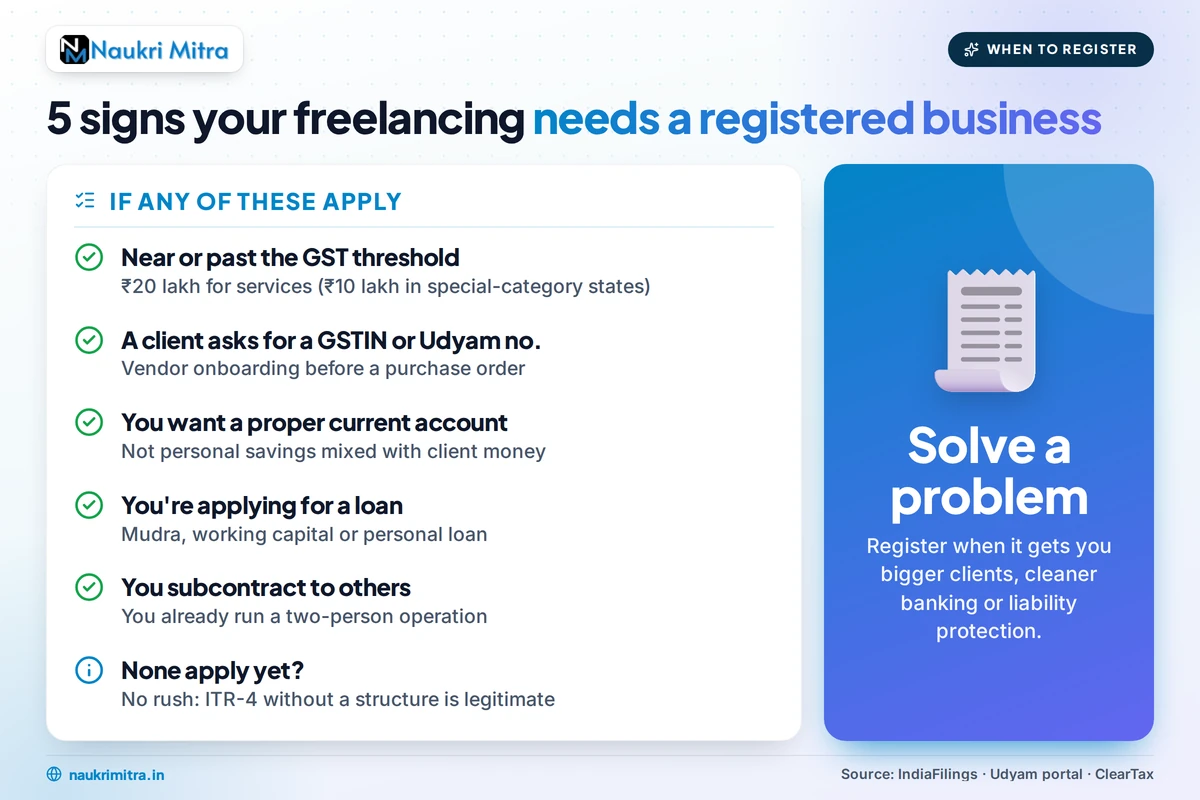
There's no single income figure written into law that says "register now." But a handful of practical signals tend to show up around the same time, and together they're a reliable cue.
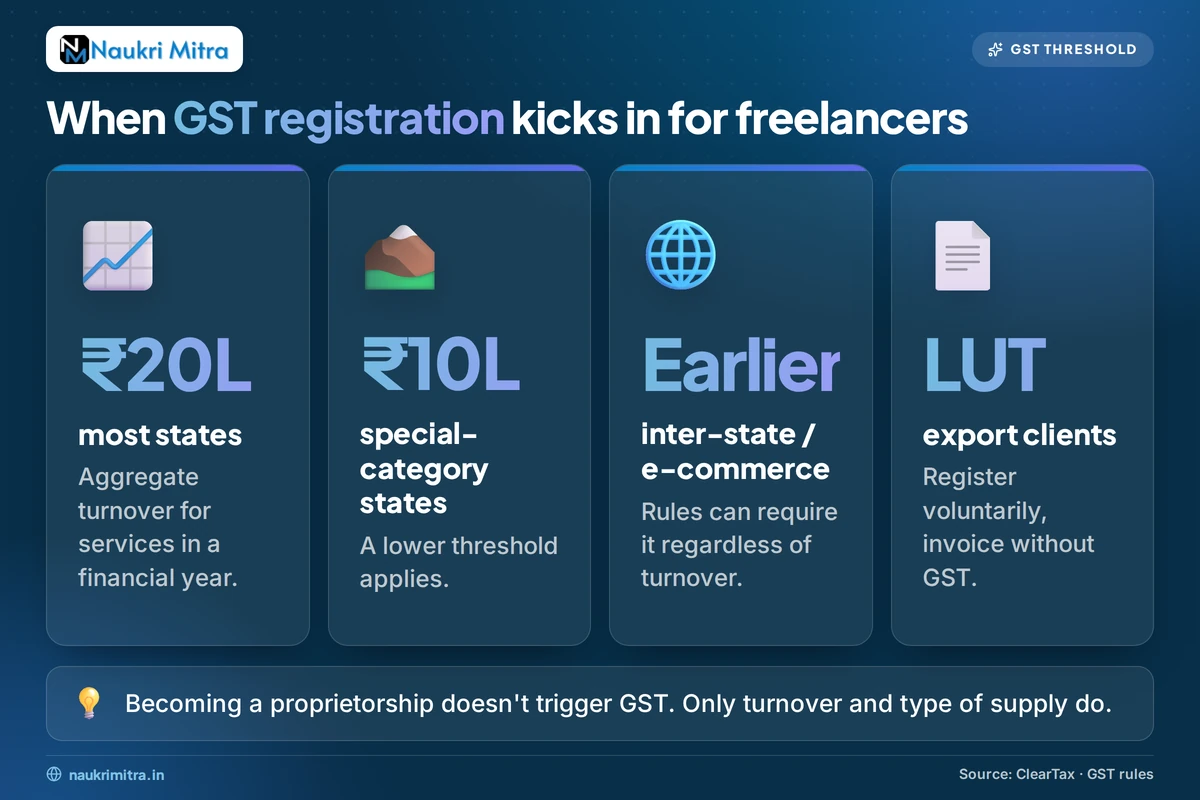
- You're approaching or have crossed the GST threshold (₹20 lakh turnover for services in most states, ₹10 lakh in special-category states), regardless of whether you've registered anything else.
- A client's procurement or finance team is asking for a GSTIN, a PAN under a business name, or an MSME/Udyam number before they'll onboard you as a vendor.
- You want a current account that isn't your personal savings account mixed with client payments and grocery spends.
- You're applying for a Mudra loan, a working-capital line, or even a personal loan where the bank wants to see "business continuity" proof.
- You've started subcontracting small pieces of work to another freelancer and effectively run a two-person operation already.
If none of these apply yet, there's genuinely no rush. Plenty of freelancers file ITR-4 under presumptive taxation for years without ever registering a formal structure, and that's a legitimate choice, not a mistake. Registration is a tool you pick up when it solves a specific problem — bigger clients, cleaner banking, or liability protection — not a badge you need to earn.
Freelancer vs Sole Proprietorship: What Actually Changes
Here's the part that surprises most people: a sole proprietorship is not a separate legal entity from you. There's no separate PAN, no separate legal personality, and — this is the big one — no limited liability protection. If a client has a dispute with your proprietorship, they are legally dealing with you personally, and your personal assets are exactly as exposed as they were when you were an unregistered freelancer invoicing under your own name.
So what does registering as a sole proprietorship actually buy you? Mostly legitimacy and logistics, not legal protection:
- A trade name you can invoice under, instead of your personal name.
- Eligibility for a GST number, Udyam/MSME registration, and, in applicable states, professional tax registration.
- A much easier path to a dedicated current account for freelancers, which most banks are reluctant to open purely against personal savings-account history.
- A cleaner paper trail for loans, visas, and larger client contracts that ask for "business proof."
What it doesn't buy you is a liability shield. For that, you need a structure that creates a genuinely separate legal entity — which is where an LLP or a private limited company comes in.
Sole Proprietorship vs LLP for Freelancers: Picking a Structure
This is usually where the real decision gets made, so it's worth being specific about sole proprietorship vs LLP for freelancers rather than leaning on generic startup advice meant for funded companies.
Why most solo freelancers start with sole proprietorship
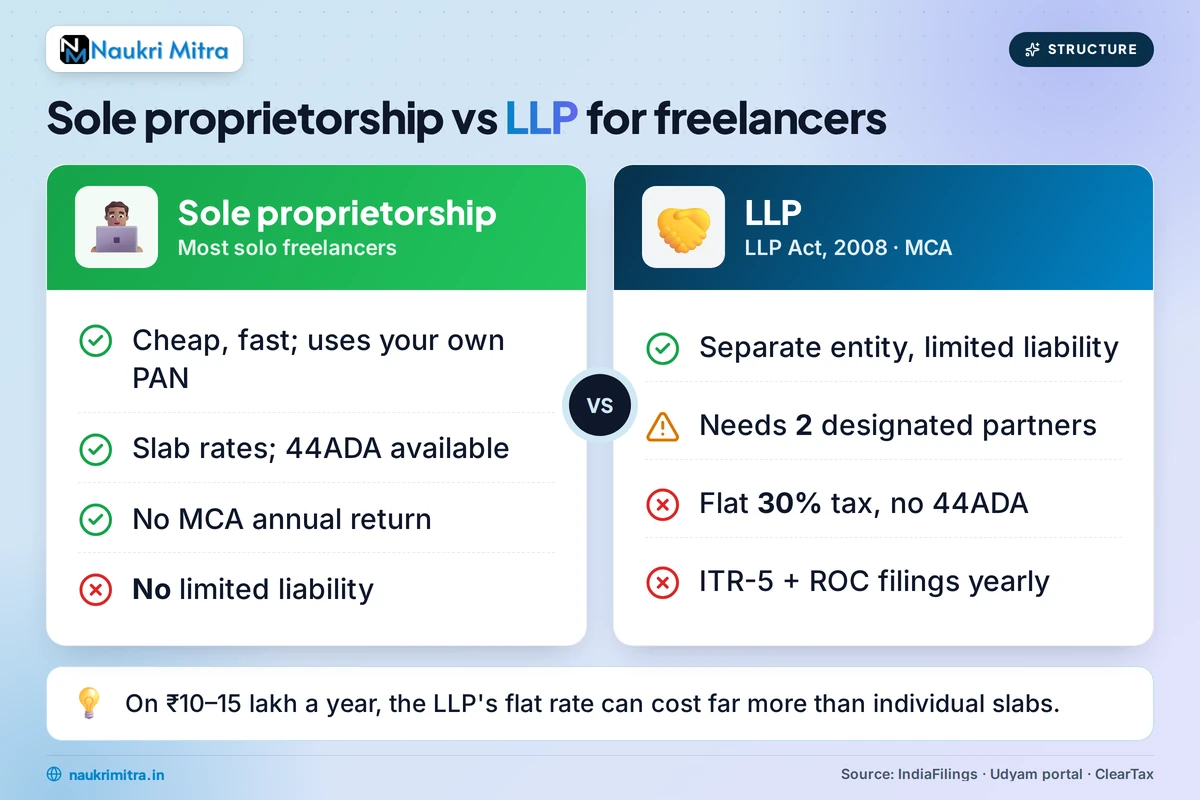
It's inexpensive (often free beyond optional GST/Udyam filing), fast to set up, and taxed exactly the way your freelance income already is — at your individual slab rate, with the option to use Section 44ADA presumptive taxation if your gross receipts stay within the prescribed limit and come largely through banking channels. There's no separate annual return to the Ministry of Corporate Affairs, no mandatory audit purely because of the structure, and no minimum compliance cost just to keep the entity alive.
Why some freelancers go straight to an LLP
An LLP (Limited Liability Partnership) is a genuinely separate legal entity registered with the Ministry of Corporate Affairs under the LLP Act, 2008. It gives designated partners limited liability protection — personal assets stay shielded from business debts and most claims arising from the LLP's activities, which matters if your freelance work carries real professional risk: software that could cause a client financial loss, or large contracts with penalty clauses. It makes sense when you have an actual co-founder (an LLP needs at least two designated partners, so a solo freelancer can't form one alone), when liability exposure genuinely worries you, or when you plan to formalise a small team.
The tax trade-off is real: an LLP pays a flat 30% tax on profits, plus applicable surcharge and cess, with no access to the lower individual slab rates or the 44ADA presumptive scheme that most solo freelancers currently benefit from. For someone earning ₹10–15 lakh a year, that flat rate can work out considerably more expensive than staying a sole proprietor on individual slabs. IndiaFilings' guide to business registration types in India is a useful reference before committing.
How to Register a Freelance Business in India as a Sole Proprietorship
Here's the practical, step-by-step version of how to register a freelance business in India as a sole proprietorship — it's less intimidating than it sounds.
- Pick a trade name. It can be your own name plus a descriptor ("Ananya Designs") or something entirely separate, as long as it isn't identical to an existing registered trademark.
- Use your existing PAN. A sole proprietorship doesn't get its own PAN — all income and filings still run through your individual PAN.
- Register for GST if your turnover requires it, or voluntarily if clients expect a GSTIN even below the threshold.
- Apply for Udyam registration, which is free, online, and based purely on Aadhaar and PAN — no documents to upload.
- Check your state's Shop and Establishment Act requirement. Many states exempt very small, home-run, single-person service practices, but this varies, so it's worth a quick check with your local municipal body or a local CA rather than assuming either way.
- Register for professional tax if you're based in a state that levies it on self-employed professionals — Maharashtra, Karnataka and West Bengal do, among several others, while a handful of states don't levy it at all.
- Open a current account in the trade name using whichever of the above documents your bank accepts as proof.
None of these steps individually takes more than a day or two once you have your documents ready, and most can be completed online without visiting a government office in person.
What LLP Incorporation Actually Costs and Takes
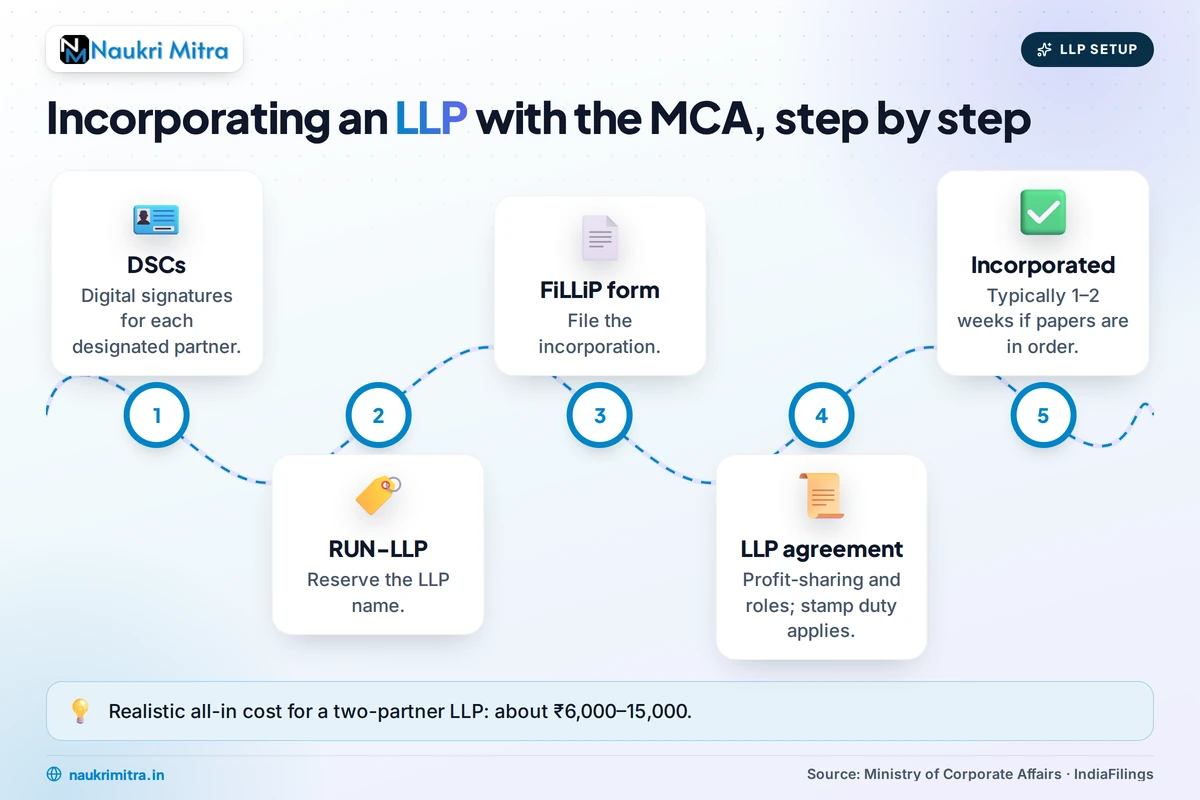
If you've decided an LLP fits your situation, the process runs through the Ministry of Corporate Affairs rather than a simple local registration. Broadly, you obtain Digital Signature Certificates for the designated partners, reserve a name through the RUN-LLP service, file incorporation through the FiLLiP form, and then draft and file an LLP agreement that spells out profit-sharing and responsibilities between partners.
Government fees for an LLP with a small capital contribution are modest, but adding Digital Signature Certificate costs, CA or company secretary fees, and state-specific stamp duty on the LLP agreement, the realistic all-in cost for a two-partner LLP often lands around ₹6,000–15,000. Turnaround is typically one to two weeks if your documents are in order, longer with name-approval rejections or resubmissions.
Udyam/MSME Registration: The Free Step Most Freelancers Skip
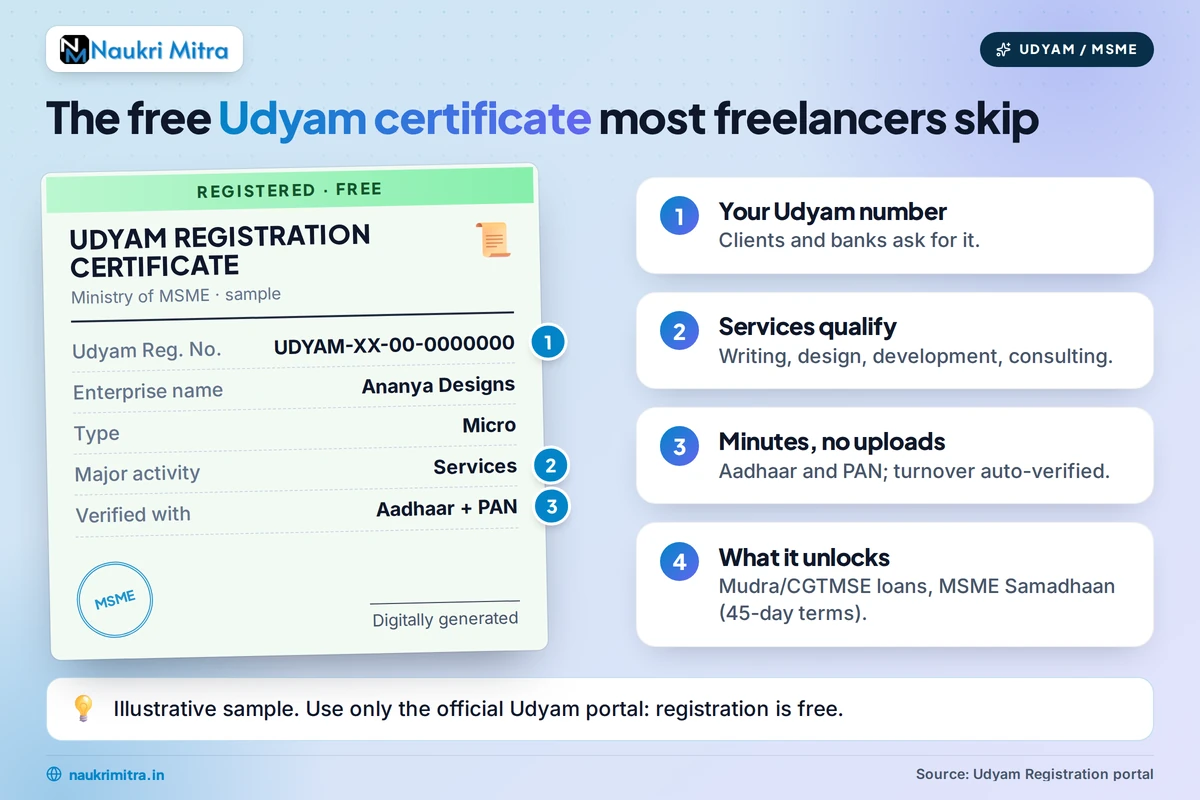
Whether you stay a sole proprietor or incorporate an LLP, Udyam registration MSME is worth doing early, and it costs nothing. Most freelance service categories — writing, design, development, consulting, bookkeeping, and similar — qualify as a "service enterprise" under the MSME definition, and registration takes a few minutes online using just your Aadhaar and PAN, with turnover and investment figures auto-verified against government databases.
The practical benefits are worth the ten minutes it takes: eligibility for collateral-free loans under schemes like Mudra and CGTMSE, a formal channel to recover delayed payments through the MSME Samadhaan portal (which caps payment terms for registered MSMEs at 45 days), and easier onboarding on vendor panels that prefer MSME status. The official Udyam registration portal is the only legitimate place to do this — it's free, and no private platform is authorised to charge for it.
GST Registration for Proprietorship: When It Actually Kicks In
A common confusion is thinking that registering as a sole proprietorship automatically means registering for GST. It doesn't — the two are independent. GST registration for a proprietorship, or for any other structure, is triggered by turnover and the nature of your supplies, not by whether you've formally named your business.
Most freelancers providing services need to register once aggregate turnover crosses ₹20 lakh in a financial year, or ₹10 lakh in special-category states, though inter-state supply and e-commerce rules can require registration earlier regardless of turnover. Freelancers exporting services to foreign clients often register voluntarily and file a Letter of Undertaking so they can invoice without charging GST. ClearTax's guide to GST registration lays out current thresholds and mandatory-registration categories in detail.
Switching from an informal freelancer to a sole proprietorship, by itself, changes nothing about this threshold. What changes is that once you do cross it, registering under a proprietorship trade name — with a current account and Udyam certificate already in place — tends to be a smoother process than scrambling to register everything simultaneously under pressure from a client query or a GST notice.
Money Matters: Current Accounts, Taxes, and Real Costs
Three practical questions come up constantly once freelancers start looking at registration seriously.
Can I get a current account without registering anything?
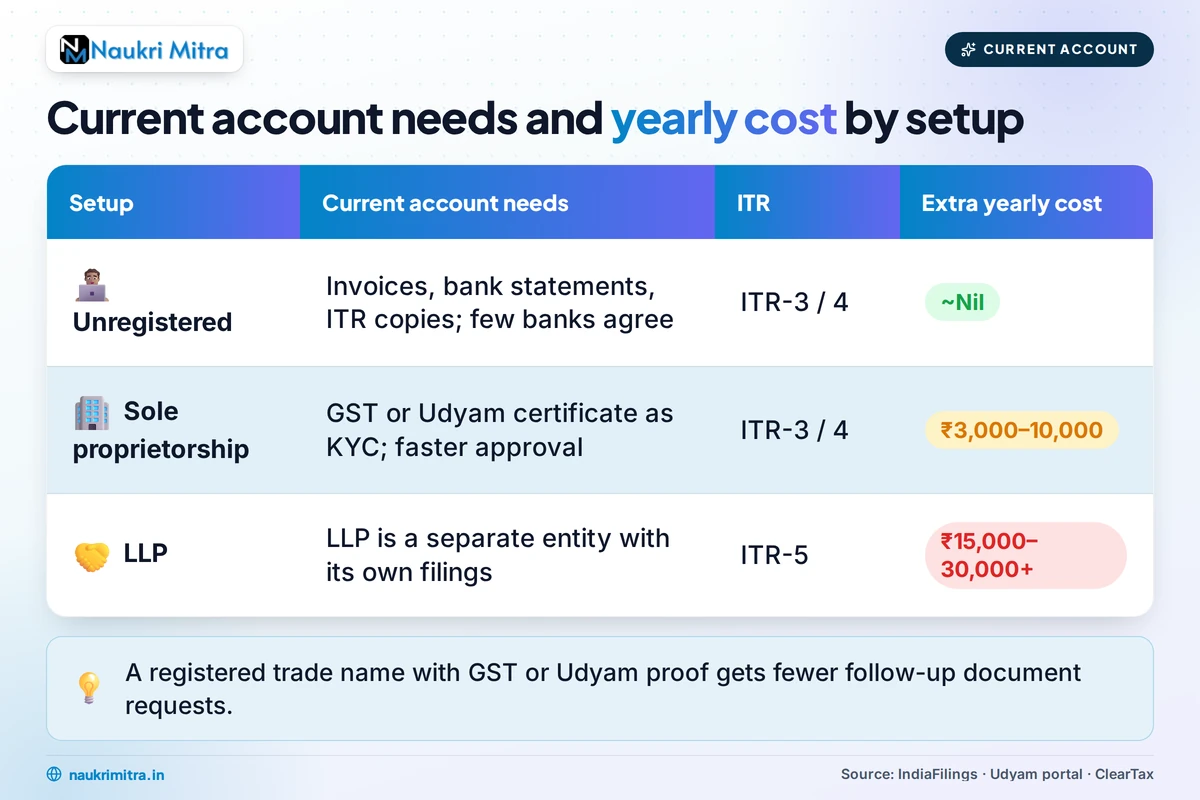
Sometimes, yes — a handful of banks will open a current account for an unregistered freelancer against invoices, bank statements, and ITR copies. But it's inconsistent and often involves more scrutiny than a registered structure needs. A current account for freelancers operating as a sole proprietorship, backed by a GST certificate or Udyam certificate as KYC proof, tends to get approved faster and with fewer follow-up document requests.
Does my ITR form change?
Not if you stay a sole proprietorship — you continue filing ITR-3 or ITR-4, and your proprietorship's profit is simply your personal income, taxed at your individual slab, or under presumptive taxation if eligible. An LLP is different: it must file ITR-5, pays flat tax on profits, and has to submit annual returns, plus a statement of accounts, to the Registrar of Companies every year, even in a year with zero activity.
What's the real annual cost difference?
Roughly speaking: staying unregistered costs effectively nothing extra; a sole proprietorship with GST and Udyam registration typically adds ₹3,000–10,000 a year if you pay someone to handle GST returns and professional tax; an LLP's compliance — ROC filings, DSC renewal, and CA/CS fees — usually runs ₹15,000–30,000 or more annually, regardless of how little it earns. This business registration cost comparison is the single biggest reason most solo freelancers don't jump straight to an LLP.
Growing Up: Converting a Proprietorship into an LLP or Pvt Ltd Later
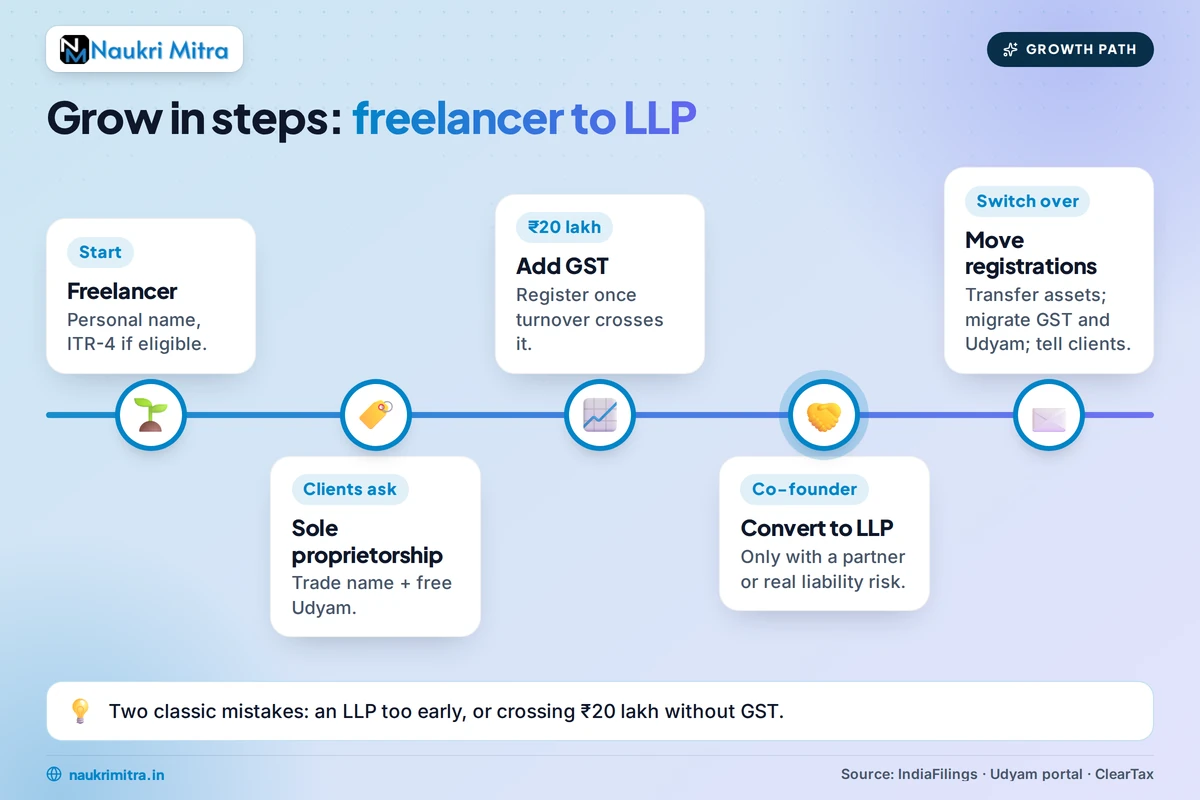
You don't have to get this right permanently on day one. A sole proprietorship can be converted into an LLP or a private limited company later, once revenue, team size, or client requirements justify the extra compliance. The process typically involves fresh incorporation of the new entity, a formal transfer of business assets and liabilities, often through a slump sale or business transfer agreement, closing out or migrating the old GST and Udyam registrations to the new entity's PAN, and formally notifying ongoing clients of the change in billing entity.
The most common mistakes run in both directions. Some incorporate an LLP far too early — as a solo operator with modest income — and carry ₹15,000–30,000 a year in compliance cost for a liability shield they didn't yet need. Others wait too long, crossing the GST threshold without registering and facing penalties once flagged. The middle path — a sole proprietorship with Udyam and GST in place, upgraded to an LLP only with a genuine co-founder or real liability exposure — works for most freelancers navigating this process in India.
Clients, Contracts, and Government Scheme Access
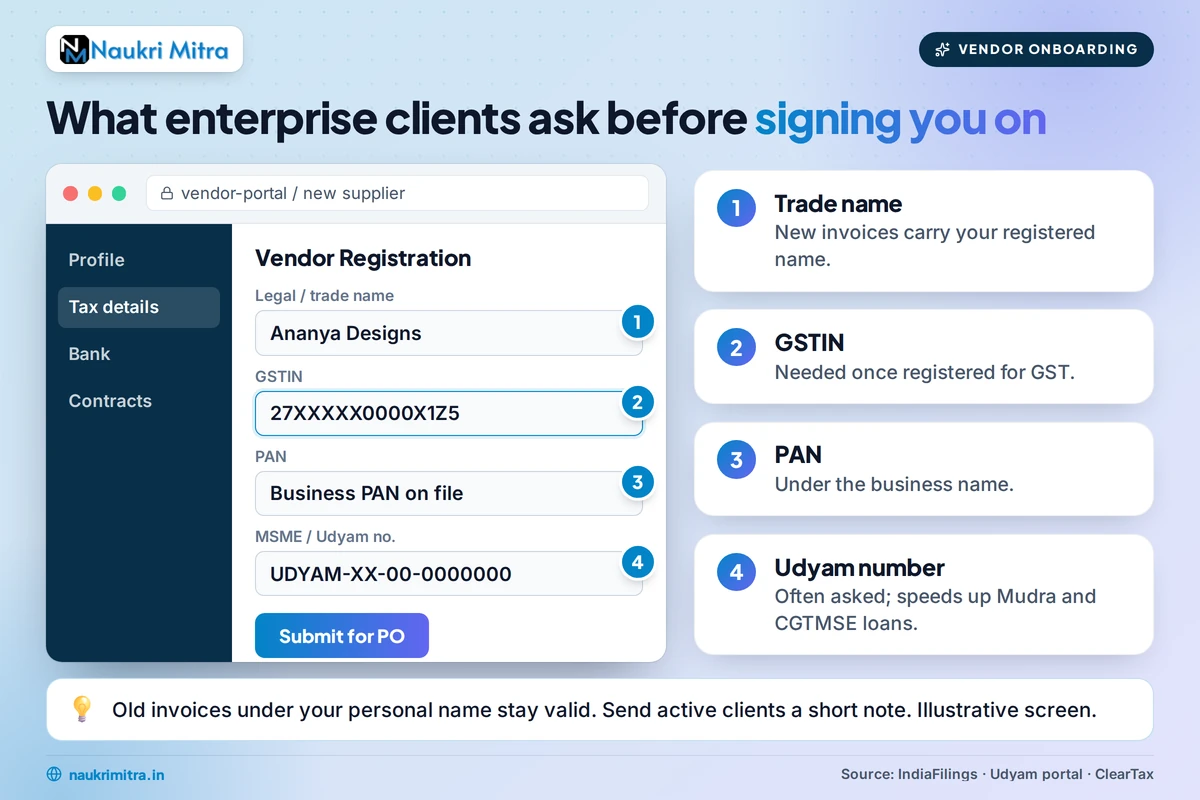
Registration changes how larger clients treat you, in ways that are easy to underestimate. Enterprise procurement teams increasingly run freelancers through the same vendor-onboarding checklist as any other supplier, wanting a GSTIN, a PAN under a business name, and sometimes an MSME/Udyam number before releasing a purchase order. Freelancers taking up roles like the freelance web designer or freelance social media consultant listings on Naukri Mitra, or the virtual small business bookkeeper category, often hit this wall first once a client turns out to be a mid-size company.
Existing contracts and invoices you've already issued under your personal name stay valid — you don't need to reissue old paperwork once you register. Going forward, though, new invoices should carry your registered trade name and GSTIN if applicable, and it's worth a short note to active clients explaining the switch so their accounts team updates vendor records without confusion over TDS certificates or payment references.
On the government side, Udyam-registered proprietorships and LLPs get a real edge: Mudra loan applications move faster with MSME proof attached, CGTMSE-backed collateral-free loans are tied to Udyam status, and several state subsidy schemes simply aren't open to unregistered individuals at all. If you're actively looking for freelance opportunities while sorting out this paperwork, browsing current listings on Naukri Mitra alongside your registration is worth doing in parallel.
Frequently Asked Questions
Do I need a Chartered Accountant to register as a sole proprietorship?
Not strictly — the basic steps, trade name selection, GST, and Udyam, can be done without professional help, especially Udyam registration, which is entirely self-service. Most freelancers only bring in a CA for GST return filing or if their state's Shop and Establishment process feels confusing.
What compliance burden comes with an LLP compared to staying a proprietorship?
An LLP has to file an annual return and a statement of accounts with the Registrar of Companies every year, maintain its Digital Signature Certificates, and typically needs a CA or company secretary's involvement for these filings, adding recurring cost even in a year with no business activity. A proprietorship has no equivalent mandatory annual filing purely because of its structure; its compliance is limited to whatever GST, professional tax, or income tax obligations apply regardless of entity type.
Should freelancers who collaborate regularly with one or two others consider an LLP?
If the collaboration is consistent, involves shared liability on client contracts, and is likely to continue for years rather than one project, an LLP partnership structure is often worth the extra compliance cost, since it formalises profit-sharing and shields each partner's personal assets from the others' professional mistakes.
What are the most common mistakes freelancers make when timing this decision?
Incorporating an LLP too early, before there's a genuine co-founder or real liability exposure, and crossing the GST threshold without registering on time are the two most frequent errors — one wastes money on unnecessary compliance, the other invites interest and penalties later.
What's the simplest registration path if I just want basic legal legitimacy without heavy compliance?
Free Udyam registration plus a sole proprietorship trade name, with GST added only once your turnover requires it, covers most of what smaller clients and banks ask for, without any of the recurring compliance that comes with an LLP or private limited company.
Can I open a business current account without any formal registration?
Some banks will, based on invoices, bank statements, and ITR history, but approval is inconsistent and documentation requests tend to be heavier than for a registered sole proprietorship with a GST or Udyam certificate on file.
Does registering change which ITR form I file or how much tax I pay?
As a sole proprietorship, no — you still file ITR-3 or ITR-4 and pay tax at your individual slab rate, or under presumptive taxation if eligible. An LLP is taxed differently, at a flat rate, which is a major reason most solo freelancers stay proprietors.
Is Udyam registration mandatory for freelancers, or just optional?
It's optional, not mandatory, but since it's free and takes minutes, there's little reason to skip it — the loan, payment-protection, and vendor-onboarding benefits are available only to those who've registered.
How soon can I start invoicing under my new registered business name?
As soon as your trade name, PAN mapping, and, if applicable, GSTIN are in place — typically within days for a proprietorship, since there's no waiting period once Udyam and GST registrations are approved.
Most freelancers don't need to decide between staying informal forever and incorporating immediately. The realistic path is incremental: register as a sole proprietorship when a client, a bank, or your turnover numbers make it necessary, add GST and Udyam as each becomes relevant, and only move to an LLP once there's a genuine reason — a co-founder, real liability exposure, or a scale of contracts that justifies the extra compliance. Treat each step as solving a specific problem, and this registration process stops feeling like a maze and starts feeling like what it is: paperwork catching up with a business you're already running.
Sources: IndiaFilings — Types of Business Registration in India; Udyam Registration — Official Government Portal; ClearTax — GST Registration Guide
.png)
.png)
.png)
Comments
Post a Comment