Retirement Planning for Freelancers (No PF) | Naukri Mitra
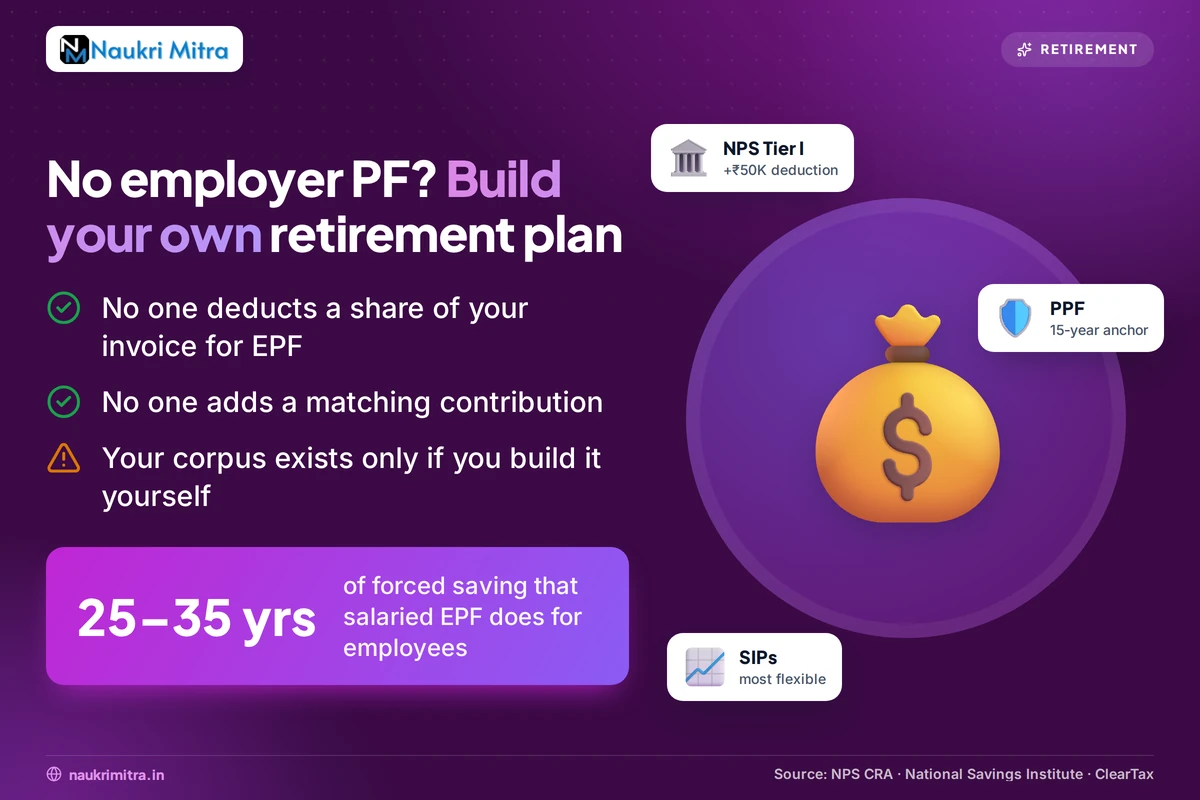
Ask a salaried friend when they last thought about retirement, and you'll probably get a shrug — their employer and the EPFO have quietly been doing it for them since their first payslip. Ask a freelancer the same question and you'll likely hear "I'll figure it out once work stabilises." That gap isn't a character flaw; it's structural. Nobody deducts a slice of a freelancer's invoice and parks it in a pension account, and nobody matches it. If you're a consultant, designer, developer, writer, or any other self-employed professional in India, your retirement corpus exists only if you build it yourself, on purpose, starting now. This guide covers why that gap exists, what tools actually close it, and how to make a retirement plan survive income that doesn't arrive in a straight line.
Why Freelancers Don't Get Employer PF
The Employees' Provident Fund is built around an employer-employee relationship. An employer deducts a fixed percentage of basic pay every month and contributes a matching share from its own side, with part of that routed to the Employees' Pension Scheme. A client paying your invoice isn't your employer in this legal sense — they owe you the invoiced amount, often minus TDS, and nothing more. ClearTax's guide to self-employed investment options puts it plainly: "self-employed individuals do not enjoy the security of the employee provident fund (EPF)," which is exactly why they need to actively choose and fund alternative long-term instruments themselves (source). Employer PF isn't just a savings account; it's a forced-savings mechanism compounding over 25-35 years. Without replicating that discipline on your own, a freelancer earning the same lifetime income as a salaried peer can retire with a far smaller corpus, not because they earned less, but because nobody saved on their behalf.
Can You Replicate an Employer Match?
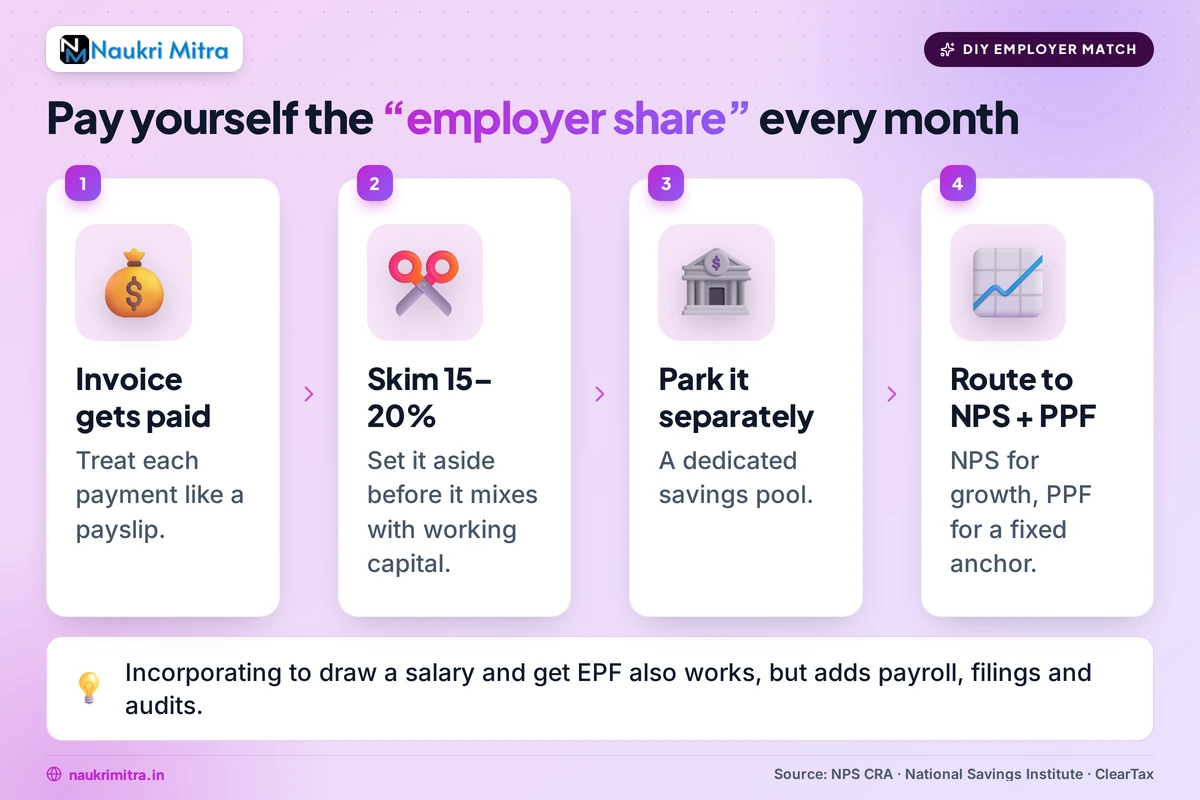
Some freelancers try to recreate the "employer contribution" effect by incorporating a private limited company or LLP and drawing a formal salary, which lets the company register under EPF and contribute on their behalf. This works, but adds real compliance cost — filings, payroll, audits — that usually only makes sense once billings are large enough to justify it. For most solo freelancers, a simpler substitute is self-discipline: routing an equivalent "employer share" into NPS or PPF yourself every month. NPS, being market-linked across equity and debt, has historically shown potential for higher growth over 20-30 years than PPF's fixed rate, but with year-to-year volatility PPF doesn't have. Neither is strictly "better"; they serve different roles in the same plan.
What About an Old EPF Account From a Salaried Job?
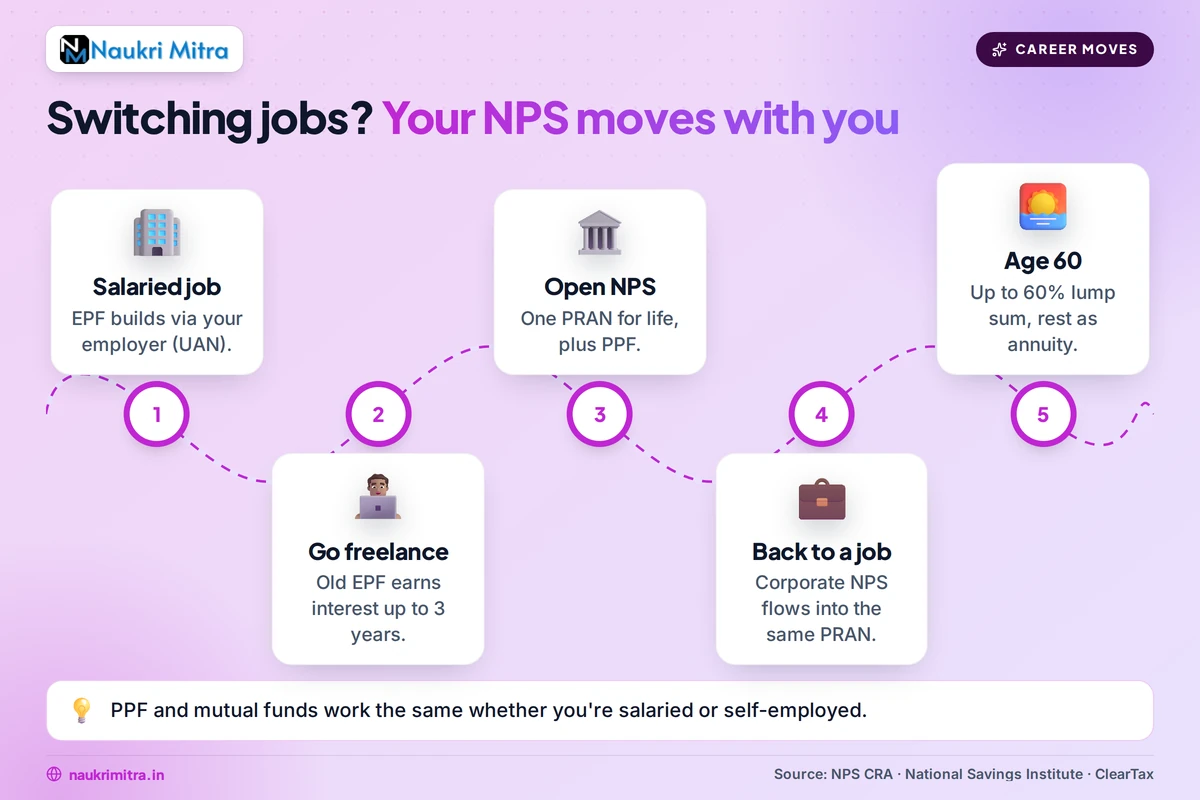
Many freelancers didn't start out self-employed — they moved from a salaried role, and still have an EPF account with a Universal Account Number sitting idle. You can't make fresh contributions without an active employer, but you don't have to withdraw it either. An existing balance keeps earning interest for up to three years after the last contribution before the account turns inactive, though the principal stays claimable even after that. Most freelancers are better off treating that old balance as one layer of their retirement base rather than cashing it out for near-term expenses, and building fresh savings on top of it through instruments designed for people without an employer.
NPS Tier I for the Self-Employed
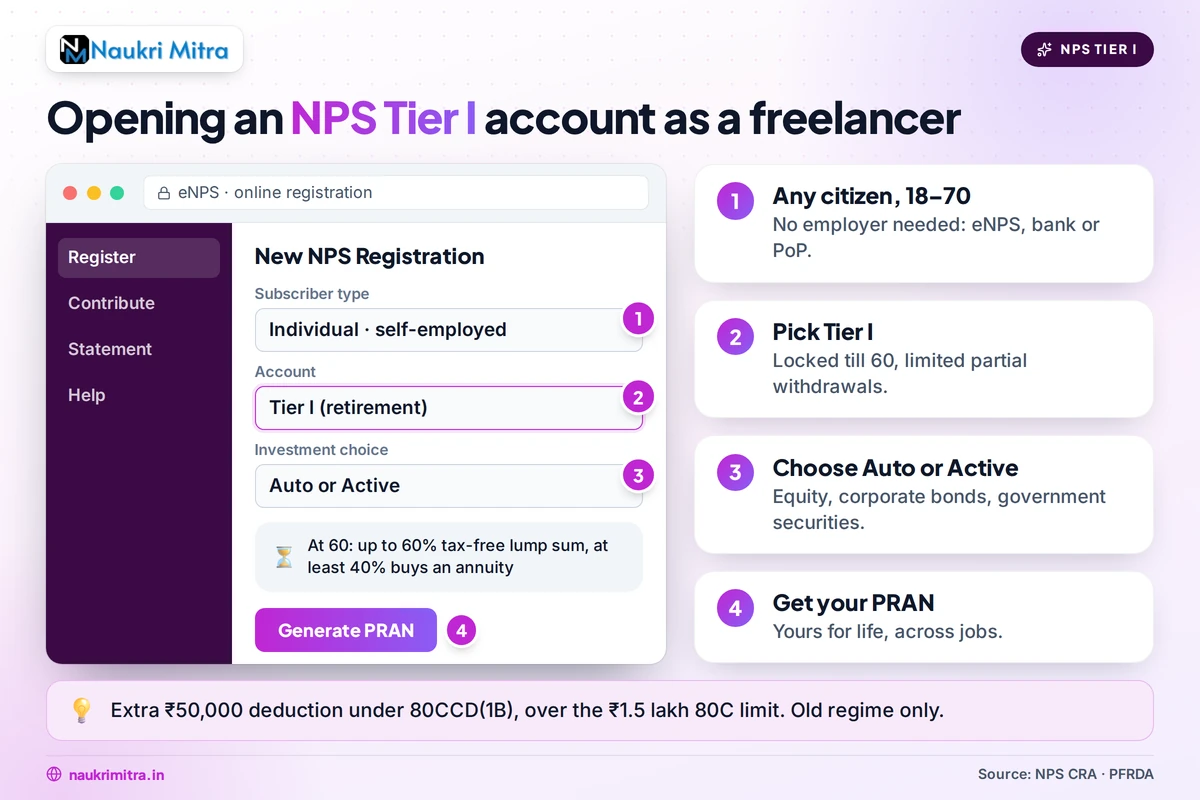
The National Pension System was originally built for government staff but was opened to every Indian citizen aged 18 to 70, including the self-employed. Any freelancer can open an NPS Tier I account — also written as a Tier 1 NPS account — directly through a bank, a point of presence, or online via the eNPS platform, with no employer sponsorship needed. Tier I is the core retirement account: contributions stay locked until age 60, barring limited partial withdrawals for specific needs like education or medical treatment, and the corpus is invested across equity, corporate bonds, and government securities under the Auto or Active investment choice. Because part of the money sits in market-linked instruments, returns are not fixed or guaranteed — your statement balance will move with the market, which is what gives it room to outpace inflation over a long horizon. A Tier II account can be opened alongside Tier I for flexible, no-lock-in savings, but it carries none of Tier I's tax advantages and shouldn't be mistaken for a primary retirement vehicle.
The 80CCD(1B) Deduction, Explained Precisely
This is the single most useful tax lever available to a freelancer saving for retirement. Under the old tax regime, Section 80CCD(1) lets any individual claim a deduction for NPS contributions up to 10% of gross total income for the self-employed, within the overall ₹1.5 lakh Section 80C ceiling. On top of that, Section 80CCD(1B) adds a separate deduction of up to ₹50,000 for NPS Tier I contributions, over and above that ₹1.5 lakh limit. The NPS Central Recordkeeping Agency's own page on tax benefits confirms this directly: "An additional deduction for investment up to Rs. 50,000 in NPS (Tier I account) is available exclusively to NPS subscribers under subsection 80CCD (1B)" (source). For a freelancer in the 30% bracket, fully using this limit can cut tax outgo by roughly ₹15,600 including cess, while building a retirement corpus. One caveat: this deduction applies only under the old tax regime, so it's worth running the numbers both ways before deciding where to route your savings.
How NPS Pays Out at Retirement
NPS doesn't hand you the entire corpus as a lump sum at 60. You can withdraw up to 60% as a tax-free lump sum, and the remaining at least 40% must buy an annuity from an insurer empanelled with the Pension Fund Regulatory and Development Authority. That annuity then pays a monthly pension for life, based on the option chosen and prevailing annuity rates at purchase — and this pension income is taxable in the year you receive it, worth factoring into post-retirement cash-flow planning.
PPF: The Fixed Anchor Freelancers Need
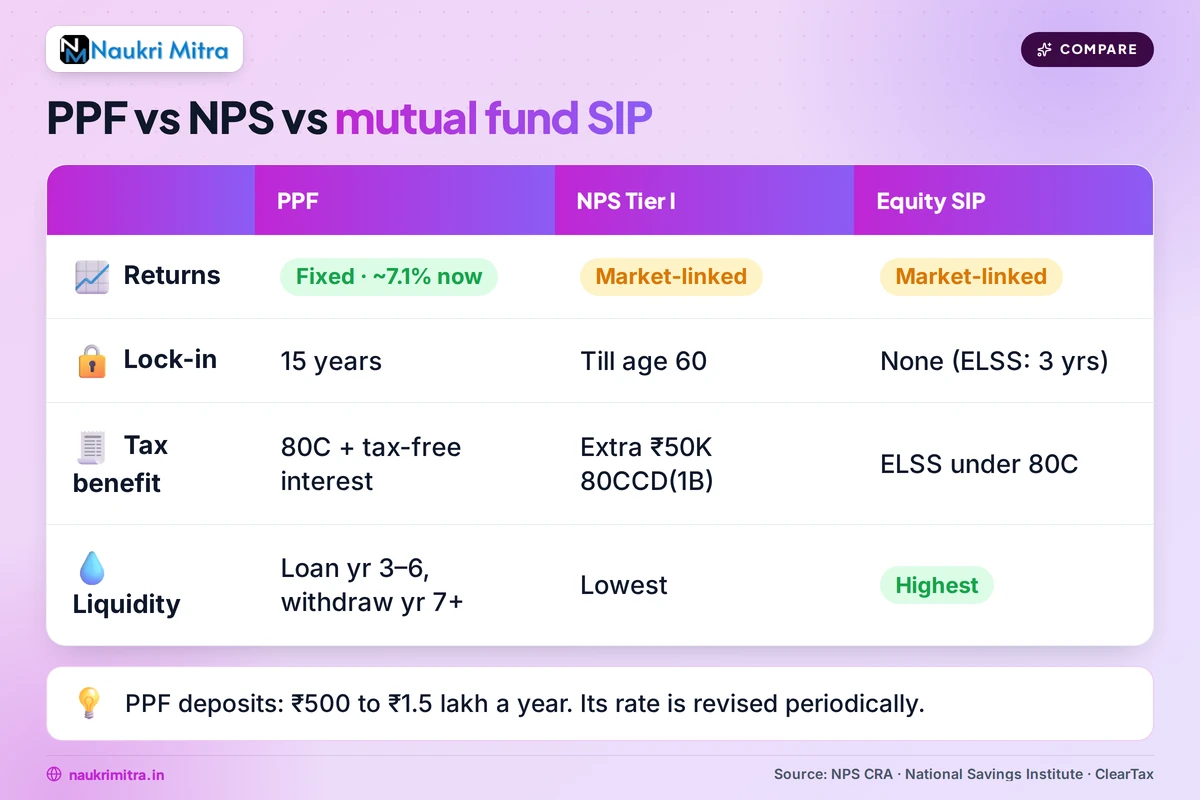
Where NPS brings growth potential, the Public Provident Fund brings something irregular-income earners genuinely need: a government-backed account that doesn't move with the market. Anyone can open a PPF account at a post office or authorised bank, deposit between ₹500 and ₹1.5 lakh in a financial year, and earn interest declared quarterly by the government, currently around 7.1%, though this is revised periodically and isn't fixed for the full tenure. The National Savings Institute, under the Ministry of Finance, states that a PPF account "matures on completion of fifteen complete financial years from the end of the year in which the account was opened," with contributions deductible under Section 80C and interest "free from Income Tax under Section 10" (source). A loan against the balance is available between the third and sixth years, partial withdrawals open up from the seventh year, and at maturity the account can be extended indefinitely in five-year blocks. That 15 year lock-in is often called a drawback, but for retirement planning specifically it's closer to a feature — it removes the temptation to dip in for non-retirement needs.
PPF vs NPS vs Mutual Fund SIPs: Picking the Right Mix
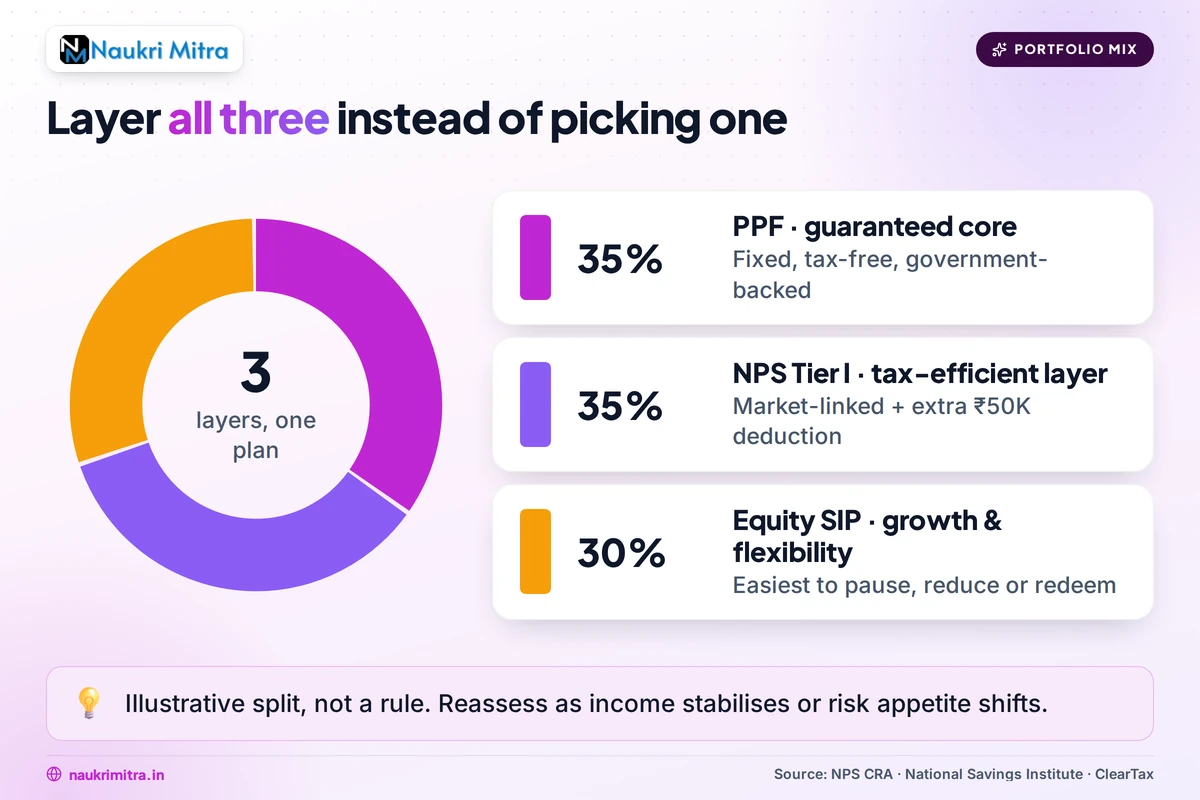
There's no single best answer — each instrument plays a different role, and most freelancers do better combining two or three rather than picking one exclusively. PPF suits the portion where you want certainty: a fixed, tax-free, government-backed return, though its ₹1.5 lakh annual ceiling means it can't carry your entire goal alone if you're earning well. NPS Tier I suits the portion where you're comfortable with market-linked risk in exchange for higher long-term growth potential, plus the extra ₹50,000 deduction PPF and mutual funds don't offer. Equity mutual fund SIPs, whether through an ELSS fund or a plain index fund, offer the most liquidity of the three — easier to pause, reduce, or redeem than PPF or NPS — but without the added NPS tax break and with full market risk and no annuity floor at the end. A reasonable structure layers all three: PPF for the guaranteed core, NPS for the tax-efficient market-linked layer, and an SIP for growth and flexibility, reassessed as income stabilises or risk appetite shifts.
Saving a Fixed Amount When Income Isn't Fixed
Rigid monthly SIP mandates often break under freelance cash flow — a strict auto-debit on the 5th of every month can bounce in a slow month. A sturdier habit is saving a percentage of each invoice the moment it lands, rather than a fixed rupee amount on a fixed date. Many planners who work with self-employed clients suggest routing 15-20% of every payment received into a separate account before it mixes with working capital, then making periodic lump-sum contributions into PPF, NPS, and mutual funds from that pool — monthly in a steady quarter, less often in a lean one. Most mutual fund platforms and the eNPS portal both allow flexible, non-fixed-date contributions, so you're not locked into a rigid calendar the way a traditional SIP mandate implies.
Emergency Fund or Retirement Savings First?
Emergency fund first, but not to the complete exclusion of retirement contributions. A freelancer without a cushion is one slow quarter away from breaking a PPF account early or pausing NPS altogether, which undercuts long-term compounding far more than a modest parallel contribution would. Build three to six months of essential expenses in a liquid instrument first, then scale up retirement savings as that cushion solidifies — while keeping even a token NPS or PPF contribution running during the emergency-fund phase, purely to preserve the habit and the tax benefit.
What If a Bad Year Hits Your Income?
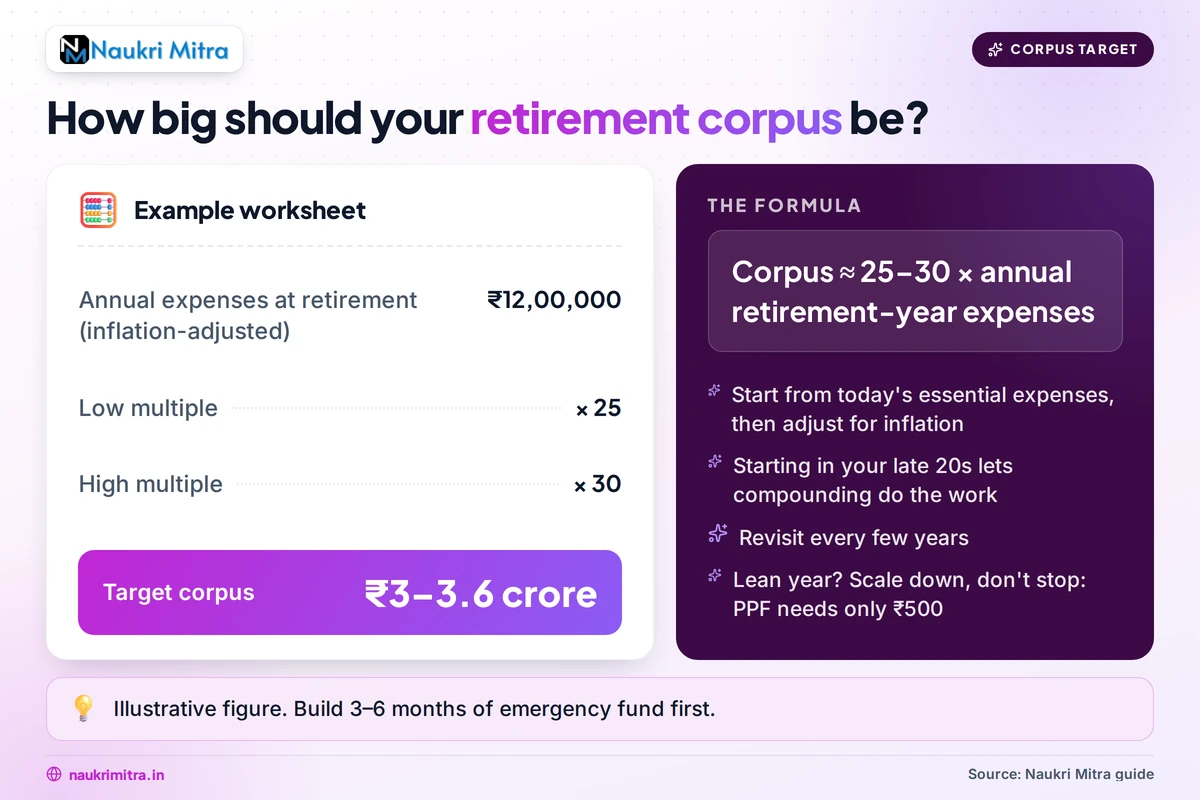
Indian retirement instruments have some built-in tolerance for this. A PPF account needs only ₹500 deposited in a financial year to stay active — miss even that, and it goes dormant but can be reactivated later for a small penalty per missed year, so one bad year doesn't permanently damage it. NPS Tier I similarly has a low minimum annual contribution to avoid dormancy, and falling short doesn't forfeit the corpus already built, though reactivation may carry a small charge. Mutual fund SIPs can simply be paused or reduced without penalty on most platforms. The goal is to scale down in a difficult quarter, not abandon the account altogether.
A Realistic Corpus Target by Age 60
There's no universal number — it depends on current age, expected expenses, inflation, and the lifestyle you want later — but a common starting framework is to estimate today's annual essential expenses, adjust for expected inflation over your remaining working years, and target a corpus that can sustain roughly 25-30 times your estimated annual retirement-year expenses, drawn down gradually. A freelancer in their late 20s or early 30s has the biggest advantage in retirement planning: time for compounding, so a modest, consistent contribution now typically beats a larger one started a decade later. Revisit this target every few years rather than setting it once, since both income and expected lifestyle tend to shift.
Is an Insurance Company Pension Plan a Substitute?
Insurance-linked pension plans are sometimes pitched to freelancers as an all-in-one answer, but it helps to separate insurance from investment first. These plans typically bundle life cover with an investment component, and the combined structure often means higher charges and lower effective returns than buying term insurance separately and investing the rest through PPF, NPS, or mutual funds. A cleaner approach is pure term life insurance for protection, particularly with dependents, and dedicated instruments for the retirement goal itself.
Healthcare Costs in Retirement Freelancers Often Skip
A salaried employee usually has employer-sponsored group health cover during working years — something a freelancer never had, so this isn't a new gap at retirement, it's an existing one that becomes more urgent. Without a group policy to fall back on, freelancers need independent health insurance throughout their working life, bought early while still relatively young, since premiums rise steeply with age and pre-existing conditions can restrict coverage later. Many planners recommend a separate, dedicated healthcare corpus distinct from the retirement corpus, specifically for premiums and out-of-pocket costs in retirement, since medical inflation in India has historically outpaced general inflation.
Moving Between Freelancing and a Salaried Job
None of this is wasted if your freelance phase eventually turns into a salaried role, or the reverse. PPF and mutual funds work identically regardless of employment status. NPS is specifically built to be portable — you keep the same Permanent Retirement Account Number for life, and if a new employer offers a corporate NPS arrangement, contributions can simply continue into the same account, potentially supplemented by employer contributions too. This portability is an underused advantage for careers moving between salaried and self-employed phases, increasingly common in India's job market. If navigating that transition, browsing current openings on Naukri Mitra is a reasonable starting point. Freelancers building a financial consulting or bookkeeping practice while keeping one foot in structured work may find postings like a freelance bookkeeper role, a virtual financial consultant position, or remote freelance recruiting work worth a look.
Common Mistakes Freelancers Make
The most frequent mistake isn't picking the wrong instrument — it's delaying the decision while waiting for income to "stabilise," a moment that rarely arrives cleanly. A second is treating retirement savings and tax-saving as the same exercise, buying whatever cuts the most tax without checking if it fits a 25-year horizon. A third is ignoring an old EPF account from a previous job, neither managing it nor counting it into the bigger picture. A fourth, especially relevant given irregular income, is abandoning an NPS or PPF account entirely after one weak quarter instead of simply reducing the contribution and continuing.
Combining NPS, PPF, and ELSS in One Portfolio
For freelancers comfortable layering instruments, a simple structure works: PPF for the portion where capital protection matters most, NPS Tier I for the portion where you want the extra 80CCD(1B) deduction alongside market exposure, and an ELSS fund for equity growth with a shorter three-year lock-in versus PPF's fifteen — useful if part of this money might eventually serve a medium-term goal. These don't fully compete for the same tax section: PPF and ELSS draw from the ₹1.5 lakh Section 80C ceiling, while NPS's additional ₹50,000 under 80CCD(1B) sits outside it, so a freelancer maximising all three in the old regime could, in principle, claim deductions on up to ₹2 lakh in a year through PPF or ELSS plus NPS combined, income and surplus permitting.
Frequently Asked Questions
Why don't freelancers get employer PF, and why does that matter?
EPF requires an employer-employee relationship where the employer deducts and matches a share of basic pay. A client is not an employer in this legal sense, so no deduction or match ever happens — a freelancer's corpus grows only if they build it themselves.
What is NPS Tier I and how does a freelancer open an account?
It's the primary, locked-in retirement account under the National Pension System, open to any citizen aged 18-70, including the self-employed. You can open one online via eNPS, or through a bank or point of presence, without an employer's involvement.
How much can a freelancer deduct under Section 80CCD(1B)?
Up to ₹50,000 in NPS Tier I contributions, over and above the ₹1.5 lakh Section 80C limit — available only under the old tax regime.
PPF vs NPS vs mutual fund SIP — which suits freelance income best?
PPF gives fixed, tax-free, government-backed returns with a long lock-in; NPS offers market-linked growth plus an extra deduction but locks funds till 60; SIPs are the most flexible but carry no added NPS-style benefit. Combining two or three usually works better than relying on just one.
Can an old EPF account from a salaried job be continued?
Not with fresh contributions, but an existing balance keeps earning interest for up to three years after the last contribution and stays claimable afterward, so it's usually best left as one layer of the overall retirement base.
How does NPS pay out at retirement?
Up to 60% can be withdrawn tax-free as a lump sum at 60, while at least 40% buys an annuity from a PFRDA-empanelled insurer that pays a monthly pension, taxable as income when received.
Should an emergency fund come before retirement savings?
Generally yes — three to six months of expenses in a liquid fund first, with retirement contributions scaled up once that cushion exists, rather than risking a forced early withdrawal from PPF or NPS during a cash crunch.
What happens if freelance income drops for a while?
PPF needs just ₹500 a year to stay active, NPS has a low minimum to avoid dormancy, and SIPs can be paused on most platforms without penalty — so a lean year calls for scaling down, not quitting.
What's a realistic retirement corpus target by 60?
A common framework targets roughly 25-30 times your estimated annual retirement-year expenses, adjusted for inflation and reviewed every few years as income and goals change.
What happens to NPS or PPF if a freelancer takes a salaried job later?
Both continue without disruption. PPF is independent of employment status, and NPS keeps the same PRAN for life, with a new employer's corporate NPS contributions able to supplement the same account.
Retirement planning as a freelancer isn't about finding one perfect product — it's about accepting early that the safety net salaried peers get automatically was never going to show up on its own, and building a deliberate, flexible replacement using PPF's certainty, NPS's tax efficiency, and the liquidity of mutual fund SIPs. True financial independence for a self-employed professional doesn't happen by accident; it happens through whatever amount is realistic this month, even a small one, with consistency mattering more than perfection — the freelancer who started at 28 with a modest monthly contribution typically ends up ahead of the one still waiting for a "better" year.
Sources: NPS Central Recordkeeping Agency — Tax Benefits under NPS; National Savings Institute, Ministry of Finance — Public Provident Fund Account; ClearTax — 6 Best Investment Options for Self Employed Individuals.
.png)
.png)
.png)
Comments
Post a Comment