PwD Job Search: Rights and Workplace Tips | Naukri Mitra
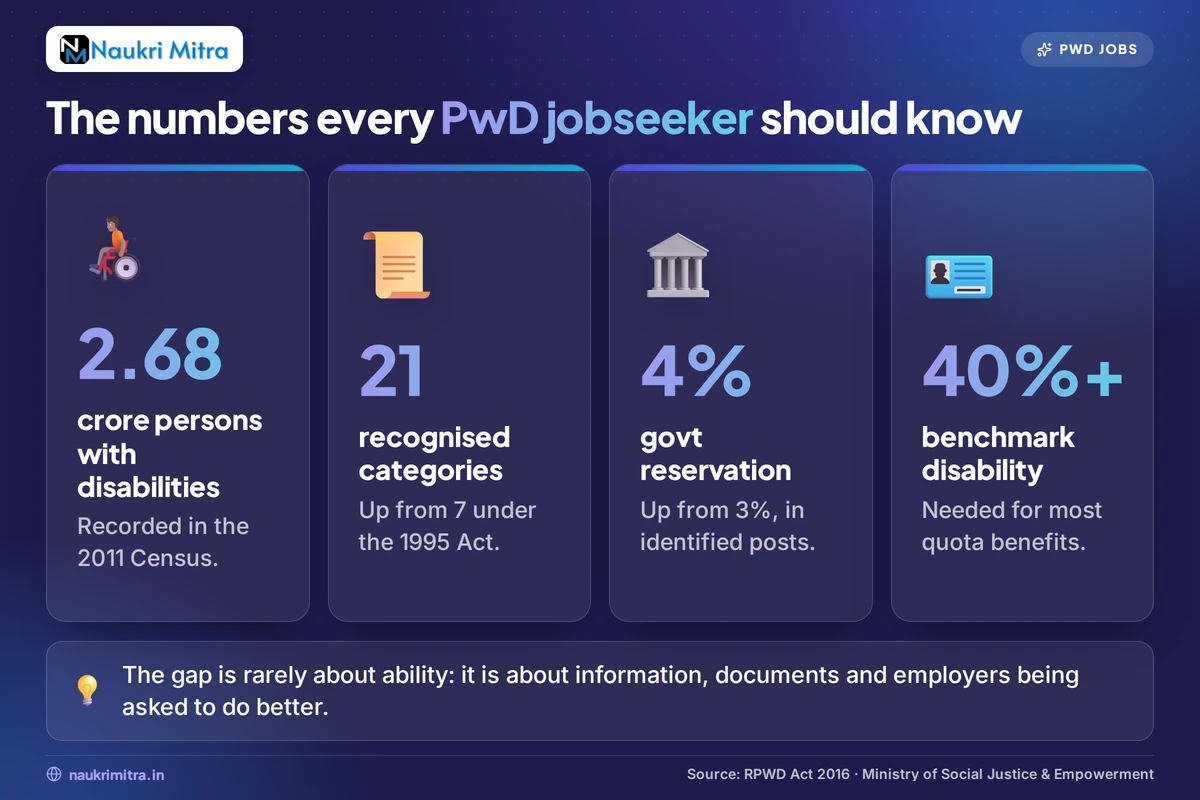
A candidate with a locomotor disability clears every round of a technical interview, only to be told at the offer stage that the office has no ramp and the role cannot be made "remote-friendly." Nothing about her skill was ever in question. This is the quiet, recurring pattern behind employment data for persons with disabilities in India: the gap is rarely about ability, it is about information, documentation, and employers who have never been asked to do better. The 2011 Census recorded roughly 2.68 crore persons with disabilities in the country, yet workforce participation among this group remains far lower than it should be. This guide walks through the paperwork, the law, and the practical workplace conversations that change outcomes for divyang employment seekers across India.
Understanding Your Legal Foundation: The RPWD Act 2016
Before applying anywhere, it helps to know what the law actually promises you. The RPWD Act 2016 (the Rights of Persons with Disabilities Act, 2016) replaced the older Persons with Disabilities Act of 1995. The old law recognised only seven categories of disability and set government job reservation at 3%. The RPWD Act 2016 expanded recognised disabilities to 21 categories, including conditions such as specific learning disabilities, acid attack survivors, Thalassemia, Hemophilia, and multiple sclerosis, and it raised the benchmark reservation figure to 4% in government establishments. It also introduced binding language around accessibility, equal opportunity policies, and penalties for discrimination, which the 1995 Act never had teeth for.
In practice, this means two things for a jobseeker. First, the certificate you hold must reflect the 2016 classification system, since older certificates issued under outdated categories sometimes need updating. Second, you qualify for most reservation and relaxation benefits only once your disability is assessed as a "benchmark disability," generally defined as at least 40% of a specified disability, certified by an authorised medical authority. Anything below that threshold may still entitle you to some protections against discrimination, but not necessarily to quota-based reservation.
Disability Certificate and UDID Card: What You Need and How to Get It
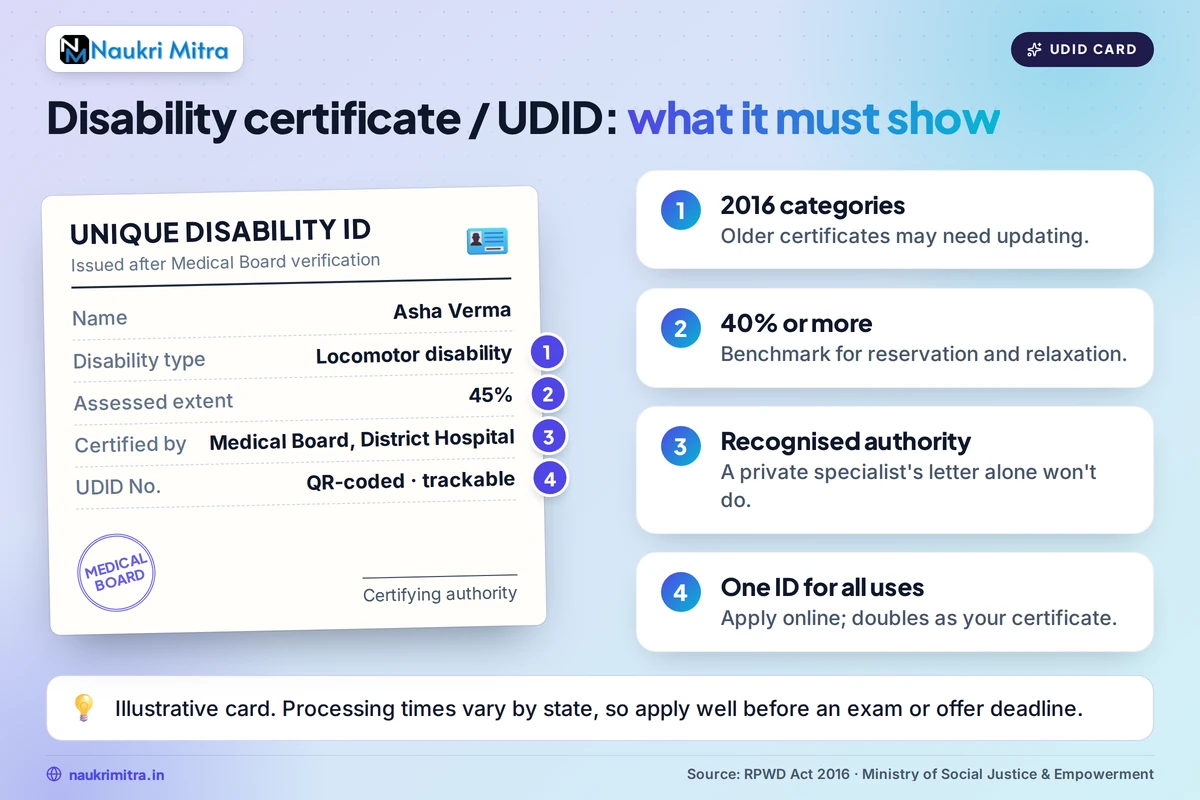
Most recruiters and government forms will ask for one of two documents: a disability certificate or a UDID card. Knowing how to get disability certificate for job in India applications starts at a government or government-authorised hospital. A Medical Board, usually set up at district hospitals, medical colleges, or designated Composite Regional Centres, examines the applicant and issues a certificate stating the disability type and percentage. You do not need a private specialist's letter alone; the certifying authority must be one the state government recognises for this purpose.
The Unique Disability ID, commonly called the UDID card, is a step beyond the paper certificate. It is a single, trackable identity document with a QR code, intended to replace the older practice of carrying multiple physical certificates for different purposes, from school admissions to railway concessions to job applications. You apply for it online through the national disability portal, upload your medical documents, and the application is forwarded to the nearest Medical Board for verification. Once approved, the UDID doubles as your disability certificate; it is not a separate or additional requirement, though many older certificates issued before the UDID system still remain legally valid until replaced. Processing times vary considerably by state, so applying well before you need the document for a job offer or exam deadline is a sensible precaution.
Government Jobs, Reservation and Age Relaxation
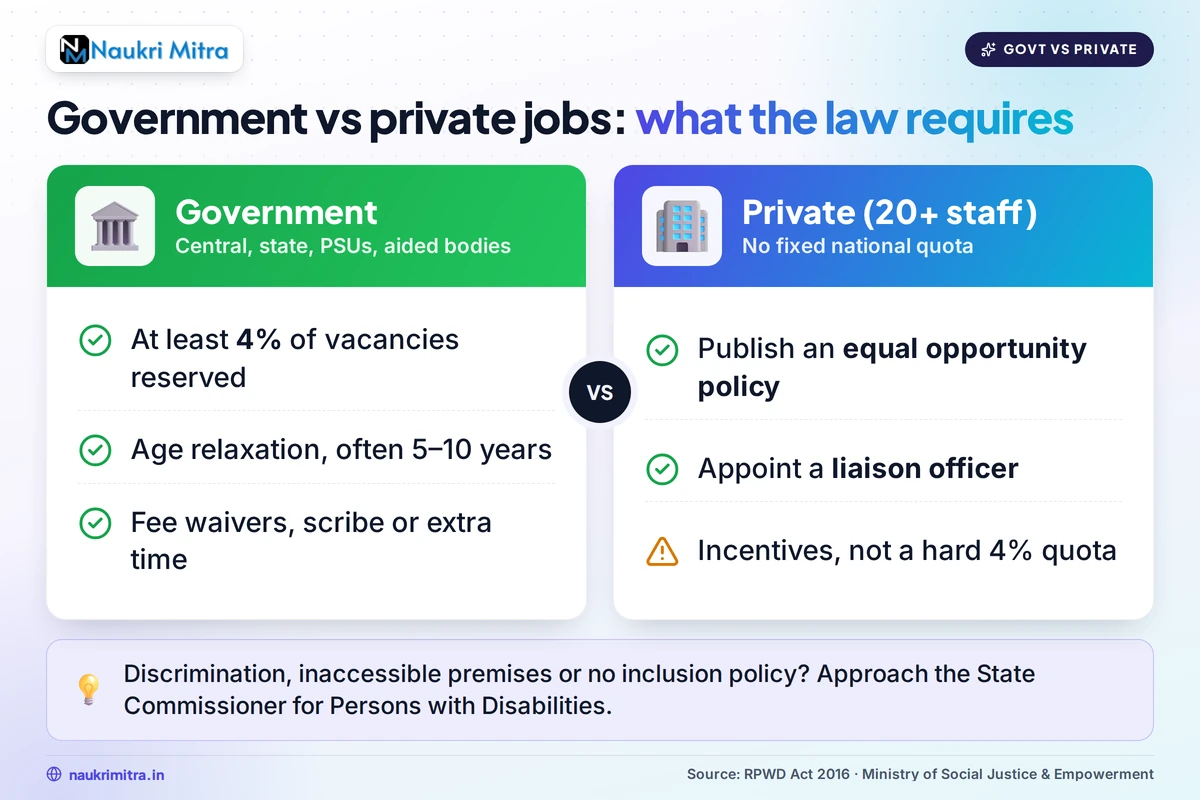
What jobs or sectors are legally required to reserve seats for PwD candidates? Under the RPWD Act 2016, every government establishment, including central and state government departments, public sector undertakings, and government-aided institutions, must reserve not less than 4% of vacancies in identified posts for persons with benchmark disabilities, distributed across categories such as blindness and low vision, deaf and hard of hearing, locomotor disability including cerebral palsy, and multiple disabilities including deafblindness. This is the basis of the 4% disability reservation you will see referenced in most government recruitment notifications, including SSC, banking, railway, and state public service commission exams.
Government exams also typically offer additional relaxations: extra age limit relaxation (commonly five to ten years depending on the post and category), relaxed qualifying marks in some recruitment exams, exemption from application fees in several boards, and the right to a scribe or compensatory time during written exams for candidates with certain disabilities, usually benchmarked against guidelines from the Department of Empowerment of Persons with Disabilities. These benefits are not automatic; you generally need to indicate your category at the application stage and submit your certificate or UDID card during document verification, so keeping both documents current and accessible before exam season matters.
Private Sector Employment: Reservation, Incentives and Reality
A frequent point of confusion is whether PwD reservation in private sector jobs works the same way as it does in government recruitment. It does not, at least not as a strict legal mandate. The RPWD Act 2016 encourages private employers to maintain an equal opportunity policy and, for larger private establishments, offers incentives rather than a hard quota when they employ persons with disabilities above a certain threshold of their total workforce. There is no uniform national law forcing every private company to reserve 4% of roles, though some states have proposed or discussed extending quota-style obligations to private employers in specific sectors, and individual companies voluntarily commit to inclusion targets well above the suggested benchmark.
What is legally mandatory for most sizeable private employers is different: establishments with 20 or more employees are required to formulate and publish an equal opportunity policy, appoint a liaison officer to handle recruitment and workplace facilities for employees with disabilities, and maintain records that are open to inspection by disability commissioners. So while a private company cannot be compelled to hire a fixed percentage of PwD staff the way a government department can, it can be held accountable for discriminatory hiring practices, inaccessible premises, and the absence of a stated inclusion policy, all of which are grounds to approach the State Commissioner for Persons with Disabilities.
Reasonable Accommodation: What Employers Must Provide
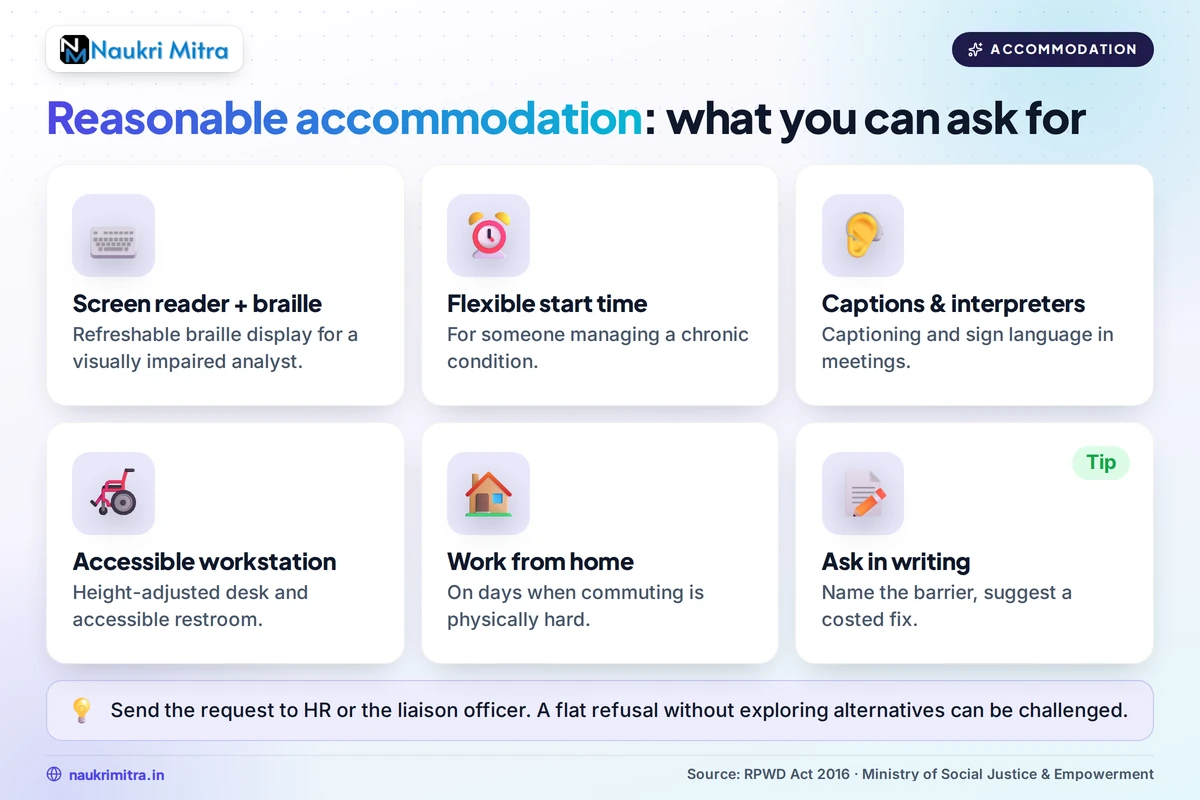
What is "reasonable accommodation" under the RPWD Act and how do I request it? Of all the reasonable accommodation disability rights workplace India conversations that come up during hiring, this is the one candidates ask about most. Reasonable accommodation refers to necessary and appropriate modification an employer must make, without imposing a disproportionate or undue burden on the organisation, so that a person with a disability can perform their job on an equal footing with others. This can mean a screen reader and refreshable braille display for a visually impaired data analyst, a flexible start time for someone managing a chronic condition, captioning and sign language interpretation for meetings, an accessible restroom and workstation height adjustment for a wheelchair user, or permission to work from home on days when commuting is physically difficult.
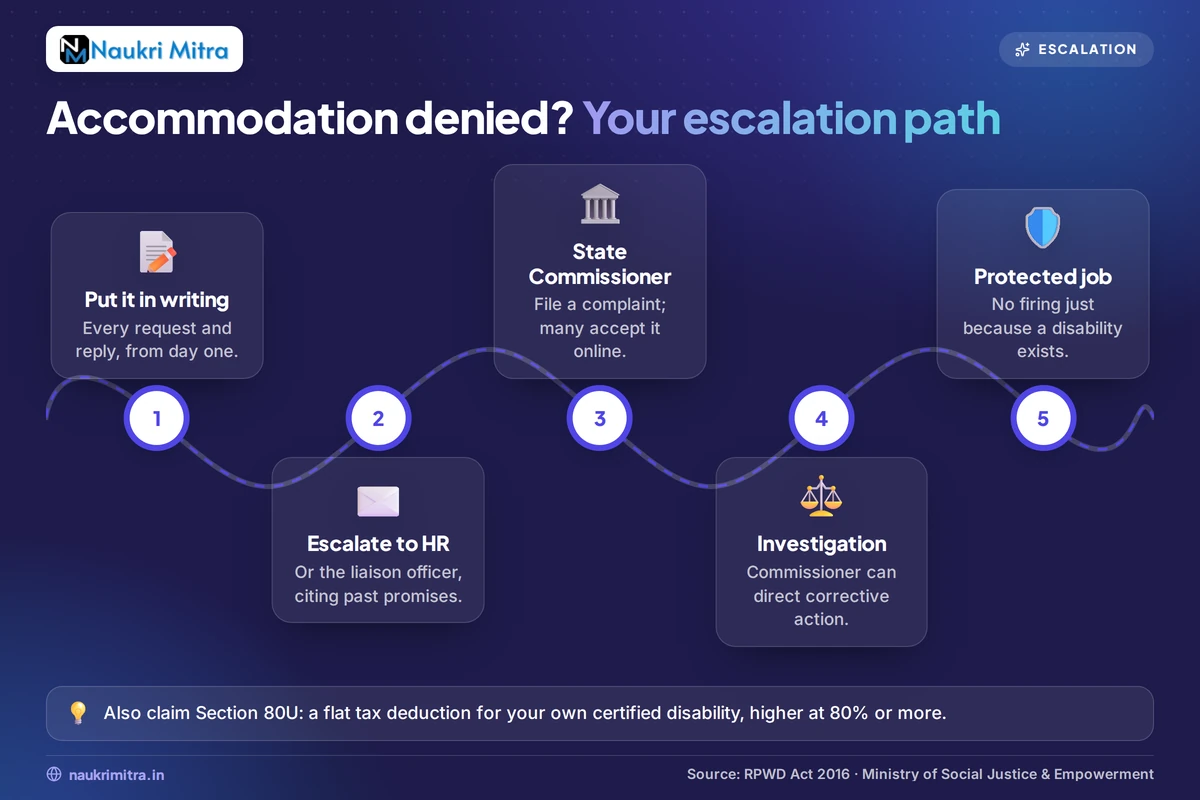
The most effective way to request workplace accommodation for disabled employees India wide is to raise it specifically and in writing, ideally during onboarding or as soon as a need becomes clear, rather than waiting until performance is affected. Address the request to HR or the designated liaison officer, describe the barrier in functional terms (what task is affected and why), and suggest a workable solution if you have one in mind. Employers are expected to engage in a genuine dialogue rather than a blanket refusal; an outright denial without exploring alternatives can be challenged.
How do I negotiate assistive technology or accessible infrastructure with an employer? Framing helps enormously here. Instead of only stating what is wrong with the current setup, come with a specific, costed, and achievable suggestion, whether that is a particular screen-reading software license, a sit-stand desk, or a modified shift schedule, since it is far easier for an employer to approve something concrete than an open-ended demand. If promised accommodations are not delivered after you join, document every request in writing, follow up with HR formally, and if the matter remains unresolved, you can escalate to the State or Chief Commissioner for Persons with Disabilities, who has the authority to investigate complaints of denial of reasonable accommodation under the RPWD Act.
Disclosure, Bias and Handling Difficult Interview Moments
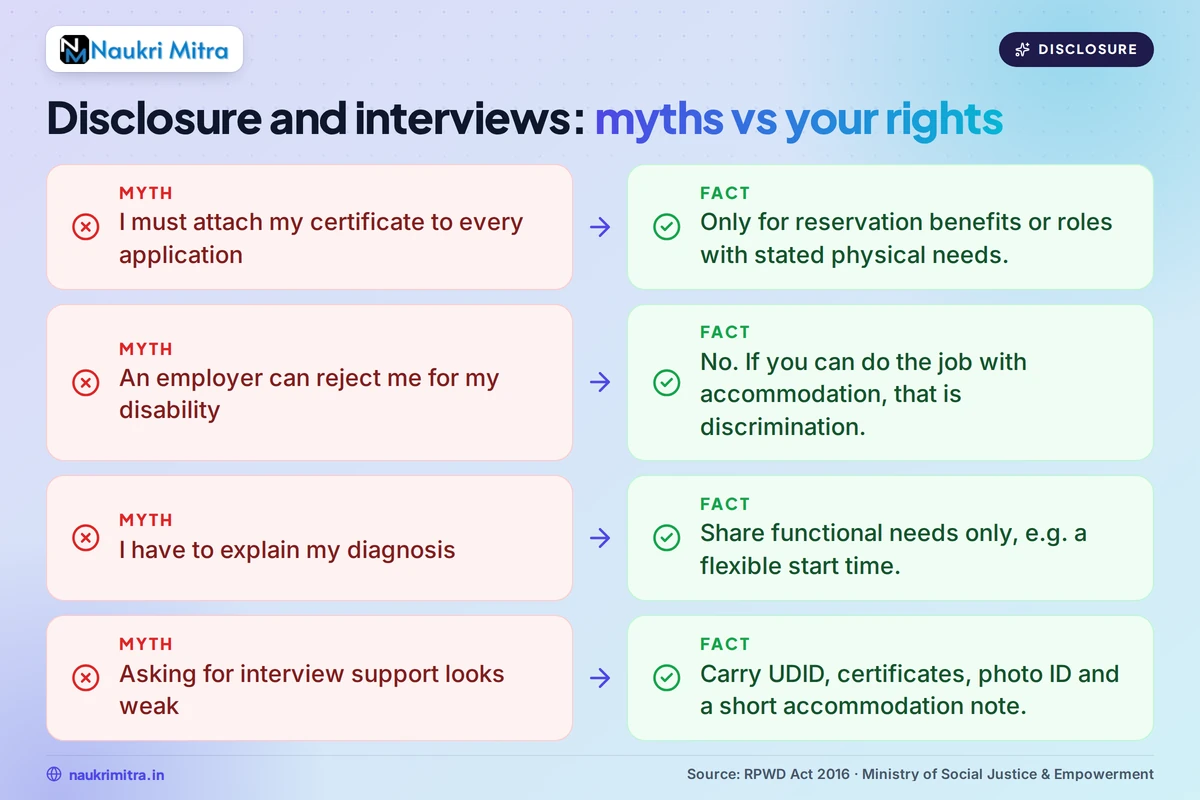
How do I disclose a disability in a job application without facing bias? There is no single correct moment to disclose, and the decision is entirely yours; a disability certificate is not legally required to be submitted with every private sector application unless you are seeking reservation-linked benefits or the role has specific physical or sensory requirements that need discussion. Many candidates choose to disclose once an offer is realistic, framing it around functional needs rather than a medical history: "I will need a flexible start time and a sit-down workstation" communicates far more usefully to an employer than a diagnosis ever could.
Can an employer legally reject me because of my disability? No. Rejecting a candidate solely on the basis of disability, where the person is otherwise qualified for the role and reasonable accommodation would allow them to perform it, amounts to discrimination under the RPWD Act, and such a complaint can be taken to the disability commissioner's office. The law does permit employers to assess whether a specific disability genuinely prevents performance of an essential job function after accommodation, but this must be a documented, functional assessment, not a blanket assumption.
What documents should I carry for the interview besides the disability certificate? Keep your UDID card or disability certificate, your educational and experience certificates, a government photo ID, and, where relevant, a brief note on any accommodation you may need during the interview itself, such as a sign language interpreter or extra time for a written test. Carrying this paperwork organised and ready signals preparedness rather than vulnerability.
How do I handle an interviewer who asks inappropriate questions about my condition? It is reasonable to redirect firmly but politely: acknowledge the question briefly, then steer the conversation back to your capability and the accommodation that supports it, for instance, "My condition is well managed with [specific support], and here is how I've handled similar responsibilities before." You are not obligated to share diagnostic detail, prognosis, or personal medical history; the relevant information for an employer is what support helps you perform the job well.
Where to Look: Inclusive Employers, Portals, NGOs and Remote Work
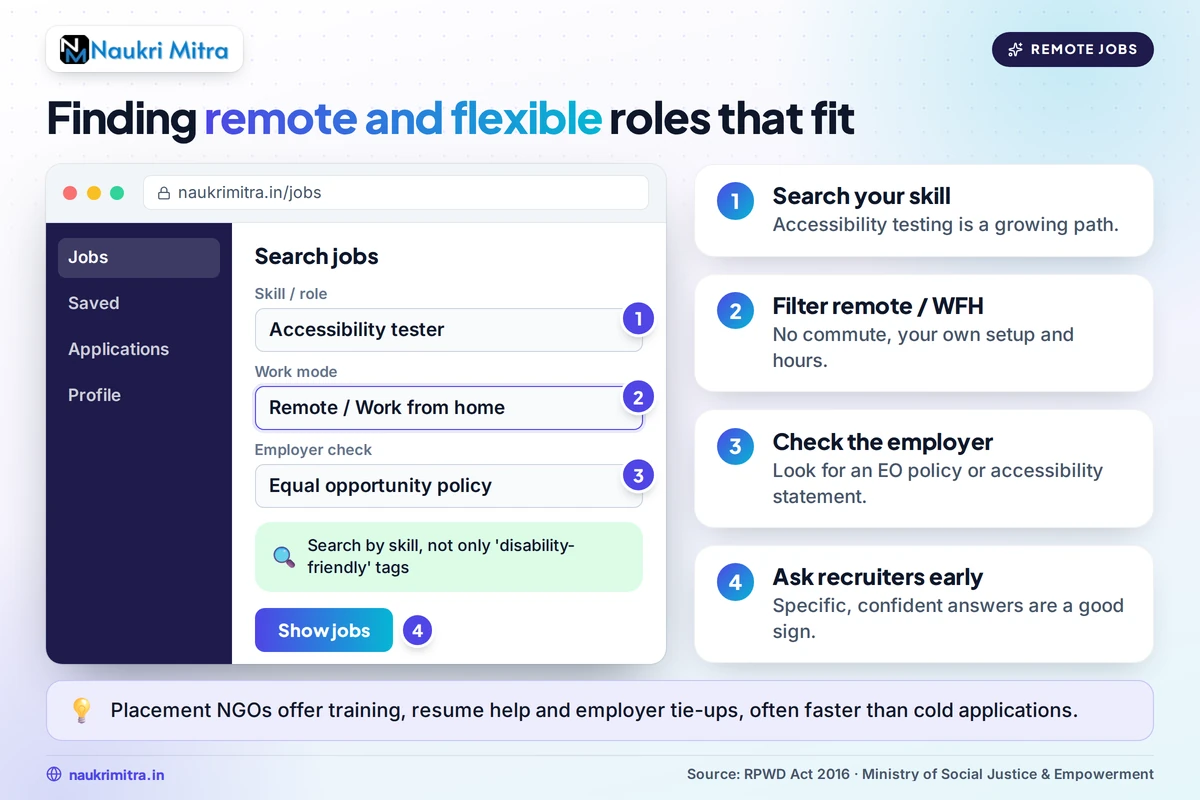
Which companies in India have strong disability-inclusive hiring programs? A number of large IT, banking, FMCG, and hospitality employers run structured disability hiring programmes, often in partnership with placement NGOs, and several publish annual diversity reports naming the proportion of their workforce with disabilities. Rather than relying on memory of which company announced what in a given year, the more reliable approach is to check a company's careers page for an explicit "equal opportunity policy" or "accessibility statement" and to ask recruiters directly during early conversations about accommodation practices; a company that answers specifically and confidently is usually one that has done this before.
Are there dedicated job portals for PwD candidates in India? Yes, several platforms focus specifically on connecting jobs for persons with disabilities India wide with inclusive employers, alongside general job portals like Naukri Mitra that list openings across functions and locations, including remote and flexible roles that are frequently well suited to candidates managing mobility, sensory, or chronic health considerations. Accessibility-focused roles themselves, such as accessibility testing and web accessibility consulting, are also a growing and genuinely accessible-friendly career path for many PwD candidates, since lived experience of navigating digital barriers is itself a professional advantage in that field; openings such as this remote accessibility tester role or this remote diversity and inclusion consultant position illustrate the kind of remote, flexible work increasingly available.
How do remote or WFH options help PwD candidates and how do I find them? Remote work removes commute barriers, lets a candidate control their physical environment including seating, lighting, and screen setup, and often allows flexible hours around medical appointments or energy-management needs. Search filters on most job portals now let you isolate "remote" or "work from home" listings directly; cross-referencing those with your skill set, rather than searching only for "disability-friendly" tags, usually surfaces a wider and more current set of openings.
What NGOs or placement agencies specialize in PwD employment in India? Several established organisations work specifically on disability employment, offering skills training, resume support, interview coaching, and direct employer tie-ups. These include disability-focused placement and advocacy organisations that have operated in India for decades, alongside newer technology-enabled hiring platforms built specifically around accessible job matching. Reaching out to one of these organisations, even informally, is often faster than applying cold to large companies.
Your Rights After Hiring: Termination, Tax Benefits and Protection
Can I be fired for a disability-related performance issue, and what are my rights? An employer cannot terminate an employee purely because a disability exists; termination must be based on genuine, documented performance or conduct issues, assessed only after reasonable accommodation has actually been provided and given a fair chance to work. If accommodation was promised but never delivered, and performance concerns follow, that sequence itself can become central to a wrongful termination complaint. Keep written records of every accommodation request, every response from the employer, and any performance feedback you receive, since this paper trail is what makes a complaint to the labour authorities or the disability commissioner credible.
Do PwD candidates get income tax benefits once employed under Section 80U? Yes. Under Section 80U of the Income Tax Act, an individual with a certified disability can claim a flat deduction from taxable income, with a higher deduction available for persons with severe disability (80% or more), regardless of the actual expenditure incurred. This is separate from Section 80DD, which applies to a taxpayer supporting a dependent with a disability rather than to the individual's own disability. Claiming it simply requires attaching a valid disability certificate while filing returns, and it is worth factoring into salary negotiations and personal financial planning once you are employed.
What recourse do I have if an employer denies promised accommodations after hiring? Start with a written escalation to HR or the liaison officer, referencing your original request and any prior commitment made. If that does not resolve the matter, a formal complaint can be filed with the State Commissioner for Persons with Disabilities, who is empowered under the RPWD Act to investigate deprivation of rights, including denial of reasonable accommodation, and can direct corrective action. Many state commissioner offices also accept complaints online, which shortens the time it otherwise takes to get a hearing scheduled.
None of this paperwork or legal detail should overshadow the simpler truth underneath it: a well-matched job, a clear accommodation conversation, and a workplace willing to adjust slightly are usually all it takes for skill to speak for itself. The system in India is imperfect and regionally inconsistent in how quickly certificates are processed or complaints are resolved, but the legal groundwork, from the RPWD Act 2016 to the UDID system to Section 80U tax relief, gives jobseekers more to stand on today than at any earlier point. Treat the certificate and the accommodation request as administrative steps, not as something to be apologetic about, and the job search itself becomes considerably more straightforward to navigate.
Frequently Asked Questions
What percentage of disability is needed to qualify for job reservations?
Most reservation and relaxation benefits require a "benchmark disability," generally assessed at 40% or more of the specified condition, certified by an authorised Medical Board.
Is a UDID card different from a disability certificate?
Not functionally. The UDID card is the newer, nationally trackable version of the disability certificate, carrying a QR code and replacing the need to hold multiple separate paper certificates for different purposes.
Can I apply for both government and private sector jobs with the same certificate?
Yes, a valid disability certificate or UDID card is accepted across government recruitment and most private sector hiring processes, though some private employers may additionally request a recent medical fitness note for specific physical roles.
Do I have to disclose my disability before an interview?
No, disclosure timing is your choice unless you are applying under a reservation category or the role has stated physical requirements that genuinely need prior discussion.
What should I do if an interviewer behaves inappropriately about my disability?
Redirect the conversation calmly toward your capability and the support that enables it, and note the incident in case you need to raise it with the company's HR or equal opportunity officer later.
Are age relaxations in government exams the same for every disability category?
No, relaxation periods and eligibility vary by exam notification and disability category, so always check the specific recruitment notice rather than assuming a standard rule applies everywhere.
Does working remotely affect my eligibility for reservation benefits?
No, remote or hybrid roles do not affect your eligibility for certificate-based benefits; reservation and tax provisions are tied to your certified disability status, not your work location.
Who do I contact if a private employer refuses reasonable accommodation?
Escalate in writing to HR first, and if unresolved, file a complaint with your State Commissioner for Persons with Disabilities, who has statutory authority to investigate such denials under the RPWD Act.
Can Section 80U be claimed along with other disability-related deductions?
Section 80U applies to your own certified disability, while Section 80DD applies separately to a dependent's disability; the two are not interchangeable but can both apply within a household if circumstances qualify.
Sources: Press Information Bureau, Ministry of Social Justice & Empowerment; International Bar Association, "Disability inclusion in the workplace: the evolving landscape in India"; National Centre for Promotion of Employment for Disabled People (NCPEDP), RPWD Act 2016.
.png)
.png)
.png)
Comments
Post a Comment