Should You Take Voluntary Retirement (VRS)? | Naukri Mitra
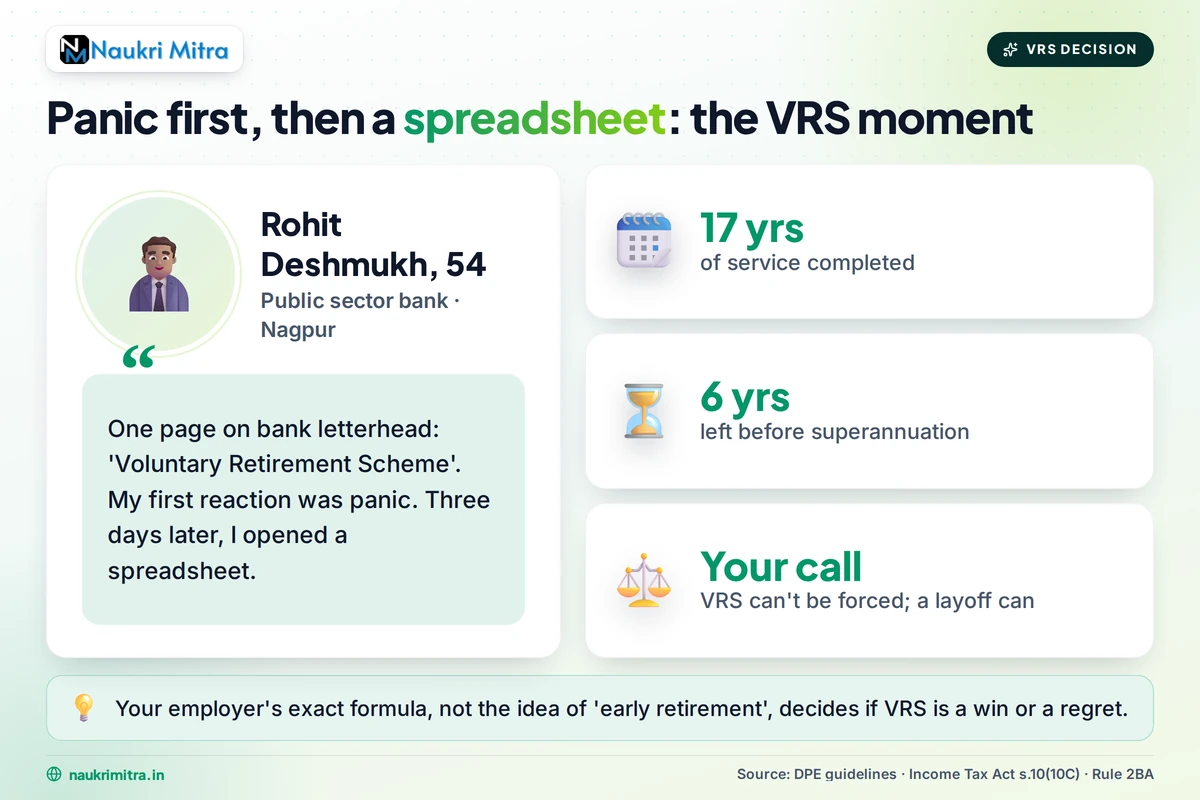
The envelope on Rohit Deshmukh's desk at a public sector bank branch in Nagpur didn't look like much — a single page on bank letterhead, the words "Voluntary Retirement Scheme" typed in bold near the top. He was 54, seventeen years into a career that still had six more to run before superannuation. His first reaction was panic. His second, three days later, was a spreadsheet. That spreadsheet — and the dozen half-finished questions scribbled in its margins — is roughly what this guide tries to answer for anyone staring at a similar letter: should I take VRS or not, and if the answer is yes, what happens in the months right after.
VRS is not one scheme with one rulebook. It is a basket of offers that public sector undertakings, nationalised banks, and a growing number of private employers use to reduce headcount without the legal friction of layoffs. The specific mechanics of your employer's offer — not the general idea of "early retirement" — are what decide whether signing that form turns into the best financial move of your career or a decision you quietly regret within eighteen months.
What VRS Actually Means, and Who Gets Offered It
A Voluntary Retirement Scheme is, by definition, a decision the employee is free to accept or refuse. An employer can design and propose it, but it cannot force an individual to sign. That single fact separates VRS from a layoff and from compulsory retirement, even though all three end a career earlier than planned.
In most public sector undertakings, VRS eligibility is modelled on Rule 2BA of the Income Tax Rules, which most PSU schemes voluntarily mirror even for employees who won't ultimately claim the tax exemption: completion of ten years of service, or attainment of 40 years of age, whichever comes first. Private companies are not bound by this rule and can set their own thresholds — some restrict VRS to employees above 45, others open it to anyone in a department being wound down.
A layoff or retrenchment, by contrast, does not need the employee's consent; it is governed by separate provisions under the Industrial Disputes framework, and the compensation is usually far smaller — typically calculated at about fifteen days' average pay for every completed year of service. Compulsory or "forced" retirement is different again: it is a disciplinary or administrative action taken against an employee, sometimes without any ex-gratia payment at all. If your employer frames an exit as VRS but there is no real choice to decline, you are not looking at a voluntary scheme — you are looking at a termination dressed up in gentler language, and that distinction matters for both your legal rights and your tax treatment.
The Ex-Gratia Math: How VRS Calculation Formula India Actually Works
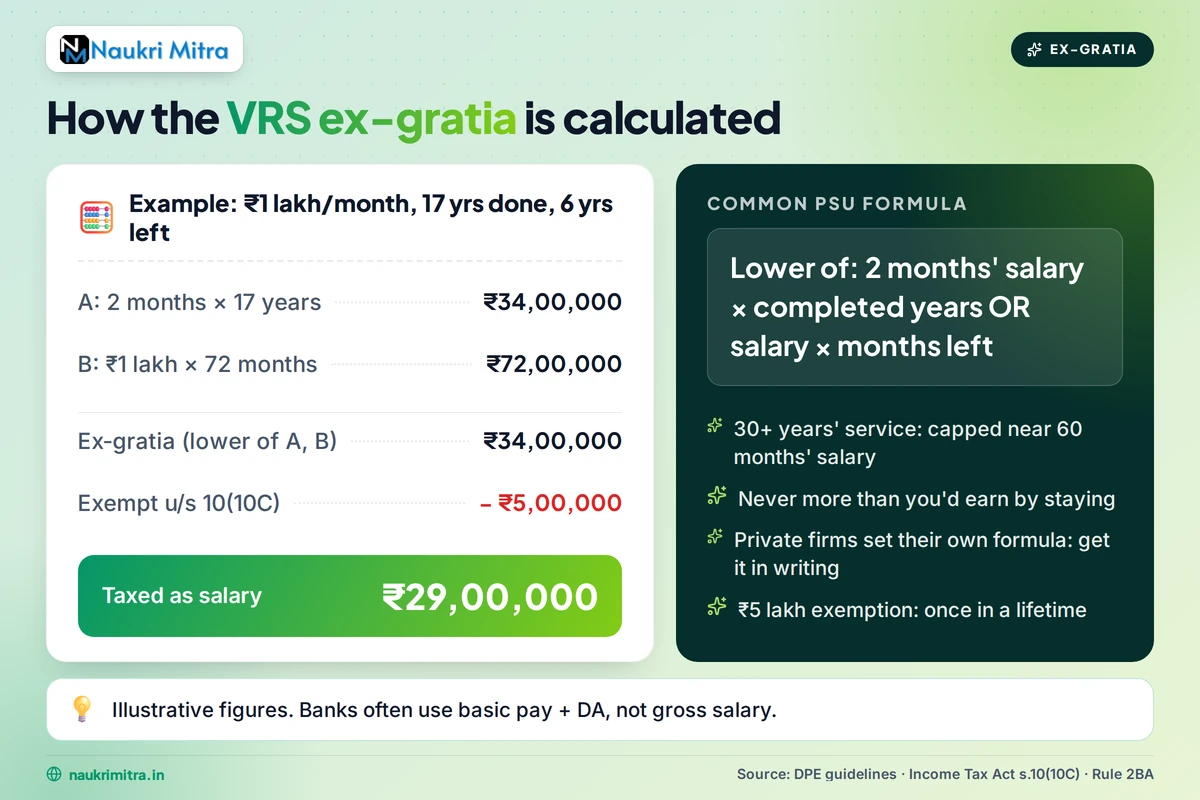
The ex-gratia payment is the headline number in any VRS offer, and it is calculated very differently depending on who is making the offer. Central public sector enterprises generally follow Department of Public Enterprises guidelines, under which a common formula pays an employee the equivalent of two months' salary for each completed year of service, or the employee's monthly salary multiplied by the number of months remaining until normal superannuation — whichever amount is lower. Employees who have already completed thirty or more years of service usually see this payout capped at around sixty months' salary, and it can never exceed what the employee would have earned had they simply stayed on until retirement.
Nationalised banks have historically used their own variant of this golden handshake arithmetic, often built around a multiple of basic pay plus dearness allowance rather than full gross salary, and PSU VRS scheme terms can also differ by sector — telecom, steel, and banking PSUs have each negotiated slightly different multipliers over the years in response to union pressure and the government's own fiscal targets for the exit package. A sample scheme document from a defence-sector public enterprise lays out this exact "two months per completed year, or balance months of service, whichever is less" structure in plain administrative language, which is worth reading if your own employer hasn't shared the fine print yet.
Private companies have no such template to follow. Some mirror the PSU structure loosely; others simply pay a notice-period buyout plus a severance multiple tied to CTC rather than basic pay, which can produce a very different — sometimes smaller — number for the same years of service. Always ask for the exact formula in writing before you compare any VRS offer against the alternative of simply continuing to work.
Tax on Your VRS Payout: What Section 10(10C) Exempts
This is where the calculation formula and the tax formula diverge, and the confusion causes real financial surprises. Section 10(10C) of the Income Tax Act exempts VRS compensation from tax, but only up to a ceiling of ₹5 lakh, and only once in an employee's working lifetime — if you have ever claimed this exemption in an earlier assessment year, even against a smaller payout from a previous employer, you cannot claim it again.
The exemption is also conditional on the scheme itself satisfying Rule 2BA: the compensation actually paid must not exceed three months' salary for every completed year of service, or salary multiplied by the remaining months of service, whichever is lower, and the vacated post must genuinely not be refilled. A detailed breakdown of this exemption is available in a widely cited explainer on Section 10(10C), and it is worth reading closely if your ex-gratia amount is well above ₹5 lakh, which is common for senior employees with fifteen or twenty years of remaining service left on the clock.
Whatever you receive above the exempt ₹5 lakh is taxed as salary income in the year you receive it, which can push an otherwise moderate earner into a much higher slab for that one year. Some employees are able to claim relief under Section 89 by spreading the tax impact across years, so this is a conversation worth having with a chartered accountant before you decide how — and whether — to accept the offer, not after the money has already landed in your account.
PF, Gratuity and Pension: What Survives the Exit
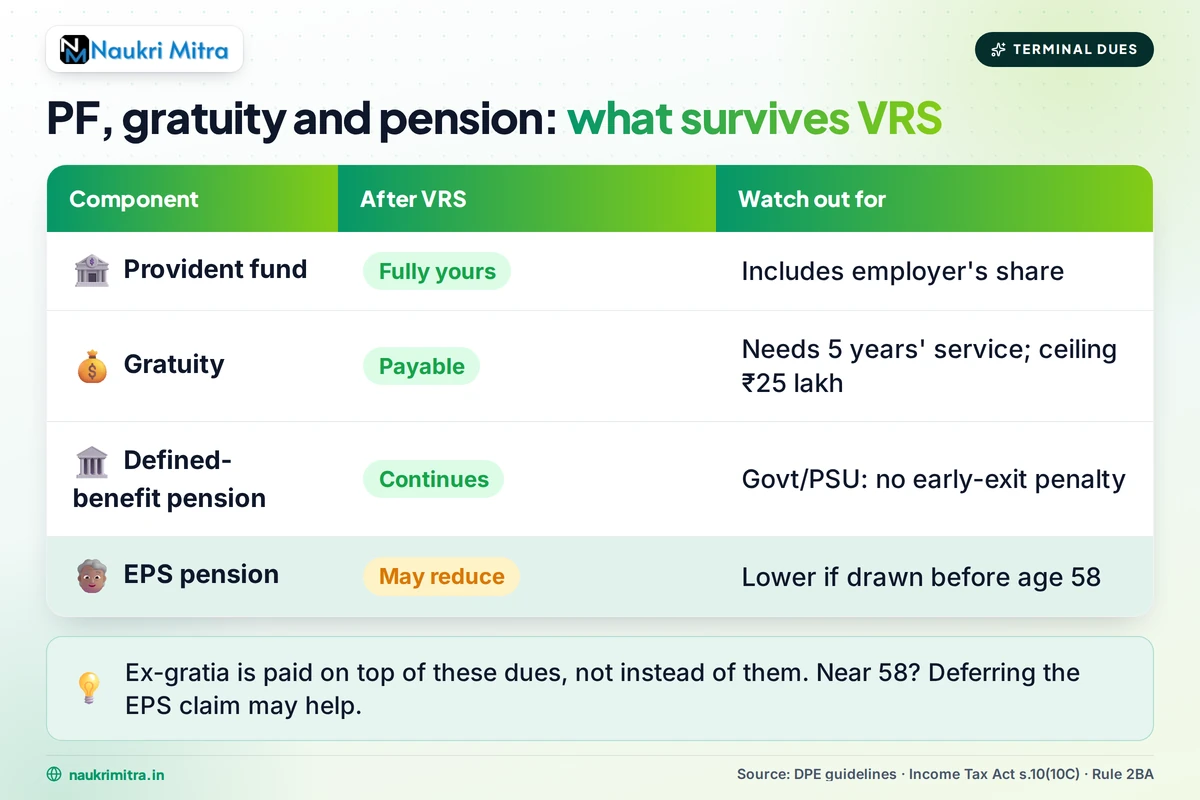
VRS ex-gratia is a separate payment from your terminal dues, not a replacement for them. Provident fund balances, including the employer's contribution, remain entirely yours regardless of how or why your employment ends. Gratuity, provided you have completed the statutory five years of continuous service, is payable on VRS exactly as it would be on normal retirement, subject to the current ceiling of ₹25 lakh for most employees.
Pension is the more complicated piece, and the answer depends heavily on which scheme covers you. Government and many PSU employees under the older defined-benefit pension structure typically continue to receive a pension calculated on their last drawn basic pay or average emoluments, without any penalty simply for retiring early under VRS rather than at the normal age — a useful guide to how pension and gratuity interact once VRS is taken walks through this calculation in detail, including how dearness relief is added on top. Employees under the Employees' Pension Scheme linked to EPF, by contrast, may see a reduced monthly pension if they draw it before age 58, since EPS pension is explicitly age-linked. If you're close to the EPS threshold, it is often worth checking whether deferring the pension claim by even a year or two, while still accepting the VRS exit itself, changes the monthly amount meaningfully.
Golden Handshake or Trap? The Real Voluntary Retirement Scheme Pros and Cons India
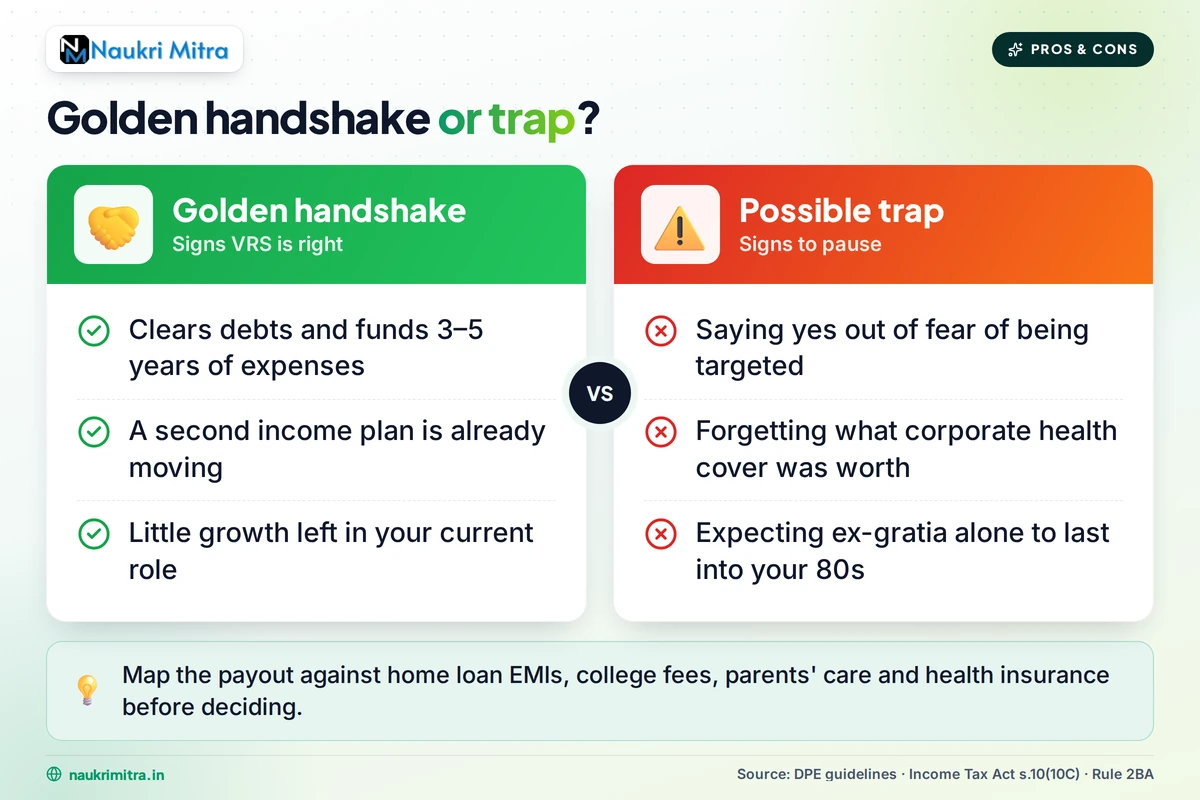
Every VRS offer looks generous on the day it's announced — a lump sum larger than most people have seen at once tends to do that. The honest voluntary retirement scheme pros and cons India picture only emerges once you map the payout against your actual obligations: an outstanding home loan with fifteen years left on it, a child entering engineering or medical college in the next two to four years, aging parents who may need expensive care, and your own health insurance, which almost certainly ends the day you stop being an employee unless you convert a group policy to an individual one quickly.
Signs that VRS is genuinely the right call include a compensation amount that comfortably clears your debts and funds at least three to five years of expenses, a credible second income plan already in motion, and a realistic sense that your current role has limited growth left in it anyway. Signs it may be a trap include accepting mainly out of fear that refusing will make you a target for the next round, underestimating how much a corporate health cover was actually worth, or assuming the ex-gratia amount alone — without pension, without a second income — is enough to carry you comfortably into your eighties. For most people in their late forties and fifties, VRS money by itself is rarely enough to fully retire on; it works best as a bridge that buys time to build a second income stream, not as a finish line.
VRS vs Continuing Job: A Decision Framework by Age and Life Stage
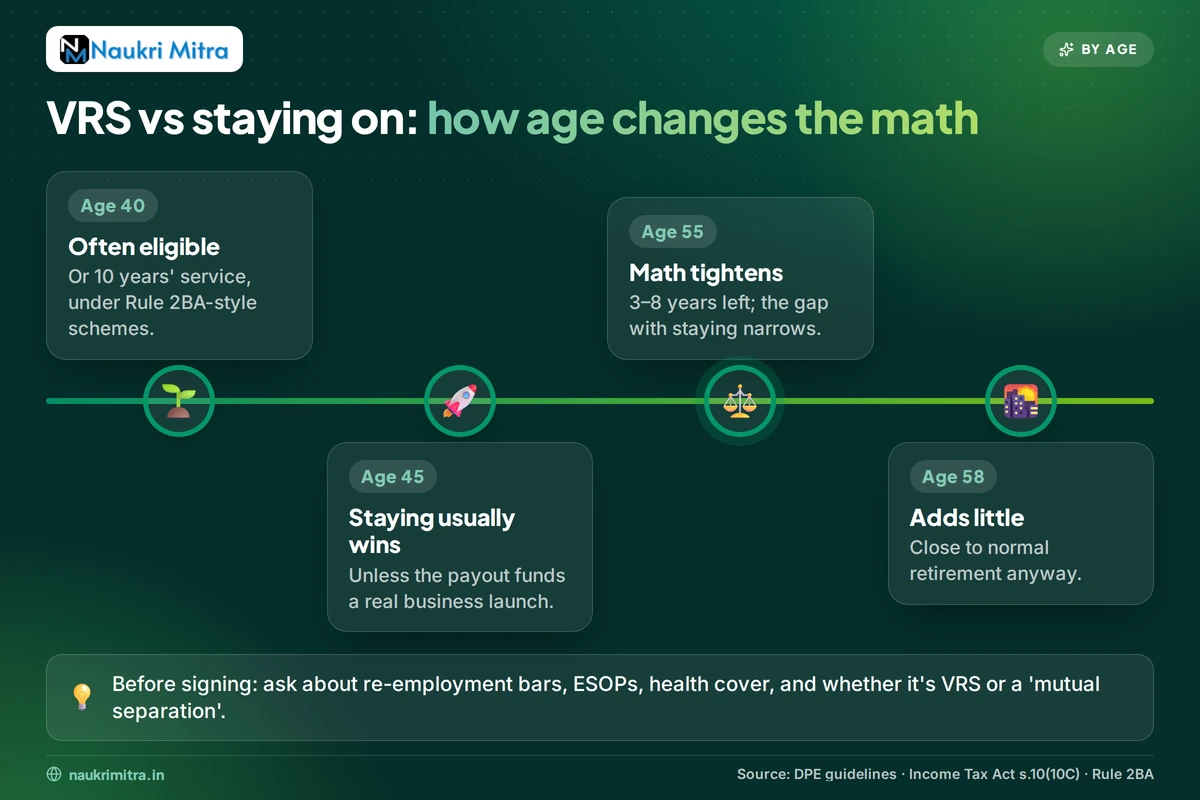
The VRS vs continuing job decision changes shape depending on where you are standing. At 45, with two decades of working life potentially ahead, the case for staying is usually stronger unless the ex-gratia is large enough to fund a genuine business or consulting launch — the opportunity cost of two more decades of salary and pensionable service is substantial. At 55, with three to eight years left before normal retirement, the math tightens considerably: the gap between what VRS pays now and what you'd earn by simply staying narrows, and continuing often wins unless the work environment itself has become untenable. At 58 or close to it, many employees find VRS adds little beyond what retiring normally would have given them anyway, except perhaps a slightly earlier start to pension.
Also weigh practical constraints that have nothing to do with the formula: an active home loan EMI that depends on a monthly salary, school or college fees due in the next admission cycle, and whether your employer imposes any cooling-off period before you can take another job, especially in the same industry or with a competitor. Many PSU and bank VRS schemes include a clause barring re-employment with the same organisation, and some extend that restriction to other PSUs in the same sector for a defined period — read this clause as carefully as the compensation clause, because it can quietly rule out your most obvious next move.
Before You Sign: Questions for HR and What You Can Negotiate
Before signing anything, ask HR for the exact ex-gratia formula in writing, the precise date your PF, gratuity and any pension will be settled, whether group health insurance continues for any transition period, and whether the offer is technically VRS or a "mutually agreed separation" — the two sound similar but can carry very different tax treatment and documentation, since a negotiated separation may not qualify for Section 10(10C) exemption at all.
Ask specifically about unvested ESOPs, deferred bonuses, or any long-term incentive payouts that are still in a vesting schedule — company policy on these at exit varies enormously, and some employers will accelerate vesting for VRS cases while others forfeit everything unvested on the exit date. There is often more room to negotiate than employees assume, particularly around the exact exit date (which can affect a bonus cycle or an increment that's due), the notice period buyout, and whether a reference letter or consulting retainer can be built into the same exit package. None of this is guaranteed, but asking costs nothing, and HR teams handling a VRS round are usually more flexible on edges of the package than on the core formula itself.
What to Do After Taking VRS: Building a Second Career
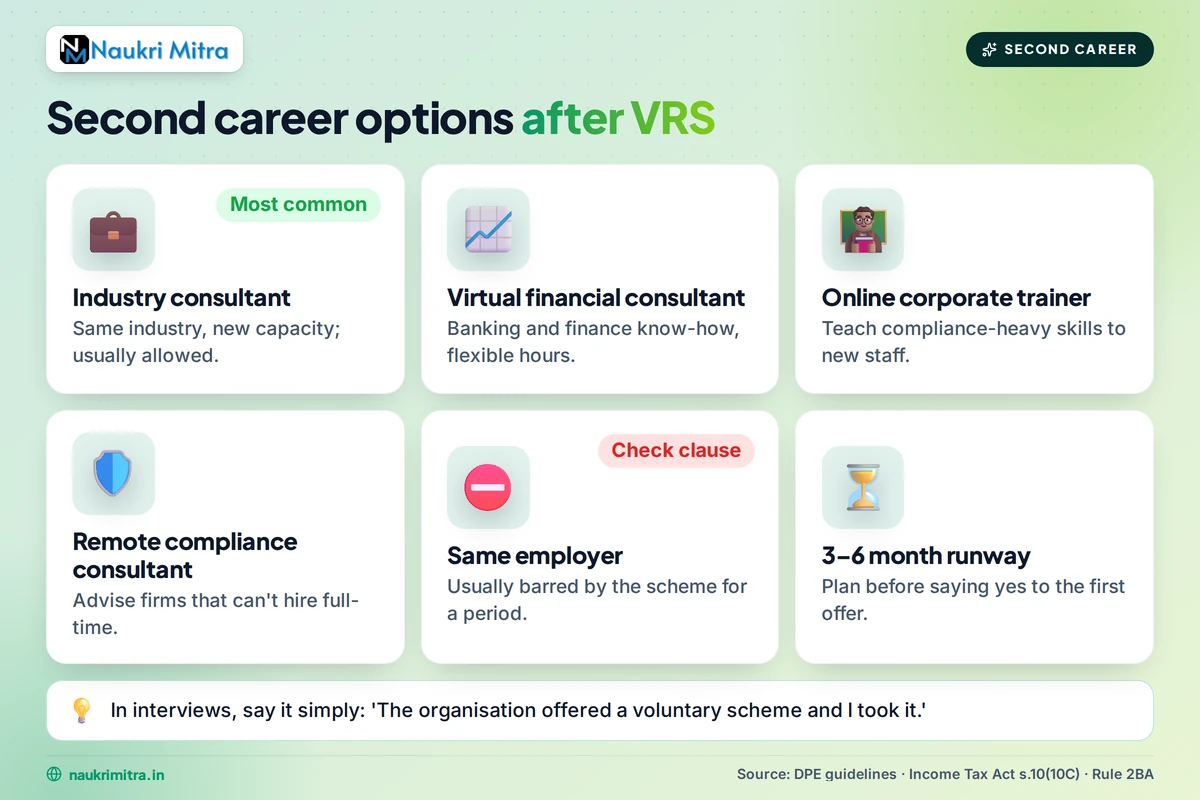
The honest answer to what to do after taking VRS career-wise is that it depends on how you frame the exit, both to yourself and to anyone you meet next. Rejoining the exact same company is usually barred by the scheme's own terms for some period, but rejoining the same industry in a different capacity — as a consultant, an advisor, or a part-time specialist — is common and often the most natural second career after VRS, since it lets you monetise two decades of domain knowledge without the politics of full-time employment.
People who take VRS from banking, finance, or operations backgrounds frequently move into roles such as a virtual financial consultant, an online corporate trainer sharing structured, compliance-heavy knowledge with younger employees elsewhere, or a remote compliance consultant advising smaller firms that cannot justify a full-time hire for the same expertise — each of these fits comfortably around a semi-retired schedule rather than demanding another forty-hour week. If you're exploring these kinds of part-time or consulting options, a general job portal like Naukri Mitra is a reasonable place to see what's currently being advertised in your city or domain before you commit to a direction.
In interviews or client conversations afterward, frame the VRS exit factually and briefly — "the organisation offered a voluntary scheme and I took it as a chance to apply my experience more flexibly" reads far better than an apologetic or defensive explanation, because in most sectors interviewers already understand that VRS rounds are routine and rarely reflect poorly on the individual who accepted one.
The First Six Months After VRS: A Practical Checklist
In the first weeks, confirm your PF transfer or withdrawal, your gratuity settlement timeline, and whether any pension claim needs to be filed actively rather than starting automatically. Convert or replace your health insurance immediately — don't leave this for "next month," since a gap in coverage right after leaving a job is exactly when claims tend to surface.
Separately estimate the tax due on the portion of your ex-gratia above the ₹5 lakh exemption and set that amount aside in a liquid instrument rather than spending against the full headline figure; nothing undoes the goodwill of a VRS decision faster than an unexpected advance-tax notice six months later. Finally, give yourself a defined runway — three to six months — before committing to a second career direction. The people who regret VRS most are rarely the ones who took time to plan; they're usually the ones who said yes to the first consulting offer out of anxiety rather than fit.
Frequently Asked Questions
Is VRS the same as a layoff? No. VRS requires your consent and typically pays a far larger ex-gratia amount; a layoff or retrenchment does not need your agreement and is governed by separate, usually less generous, compensation rules.
How much of my VRS payout is tax-free? Up to ₹5 lakh under Section 10(10C), and only once in your lifetime across all employers and all VRS events.
Will I still get a pension if I take VRS? If you're under a defined-benefit government or PSU pension scheme, usually yes, calculated on your last salary without an early-exit penalty. Under EPS-linked EPF pension, drawing before age 58 can reduce the monthly amount.
Can I rejoin my old employer after VRS? Almost never for the same organisation, due to the scheme's own re-employment bar; a different company in the same industry is usually permitted.
What happens to unvested ESOPs or bonuses if I take VRS? It depends entirely on your employer's policy — some accelerate vesting for VRS exits, others forfeit unvested amounts on the exit date, so get this confirmed in writing before signing.
Is there a cooling-off period before I can take another job? Many PSU and bank schemes include a defined restriction, sometimes extending to competitors or the same sector, so check your specific offer document rather than assuming a standard rule applies.
How is VRS different from a "mutually agreed separation"? VRS follows a formal, often company-wide scheme structure with defined eligibility and formula, while a mutually agreed separation is usually a one-off negotiated exit that may not qualify for the same Section 10(10C) tax exemption.
Is VRS money alone enough to retire on? For most people in their late forties or fifties, not entirely — it works better as a bridge funding a second income stream than as a complete retirement corpus on its own.
How should I explain a VRS exit in future job interviews? State it factually and briefly as a voluntary scheme you opted into, without over-explaining; most interviewers in India already understand VRS rounds are routine.
Sources: Bharat Dynamics Limited – Voluntary Retirement Scheme document; TaxGuru – Section 10(10C) exemption on voluntary retirement compensation; Indian Pay Calculator – Voluntary Retirement Scheme: Central Government Employee Guide.
.png)
.png)
.png)
Comments
Post a Comment