From Family Business to a Salaried Job | Naukri Mitra
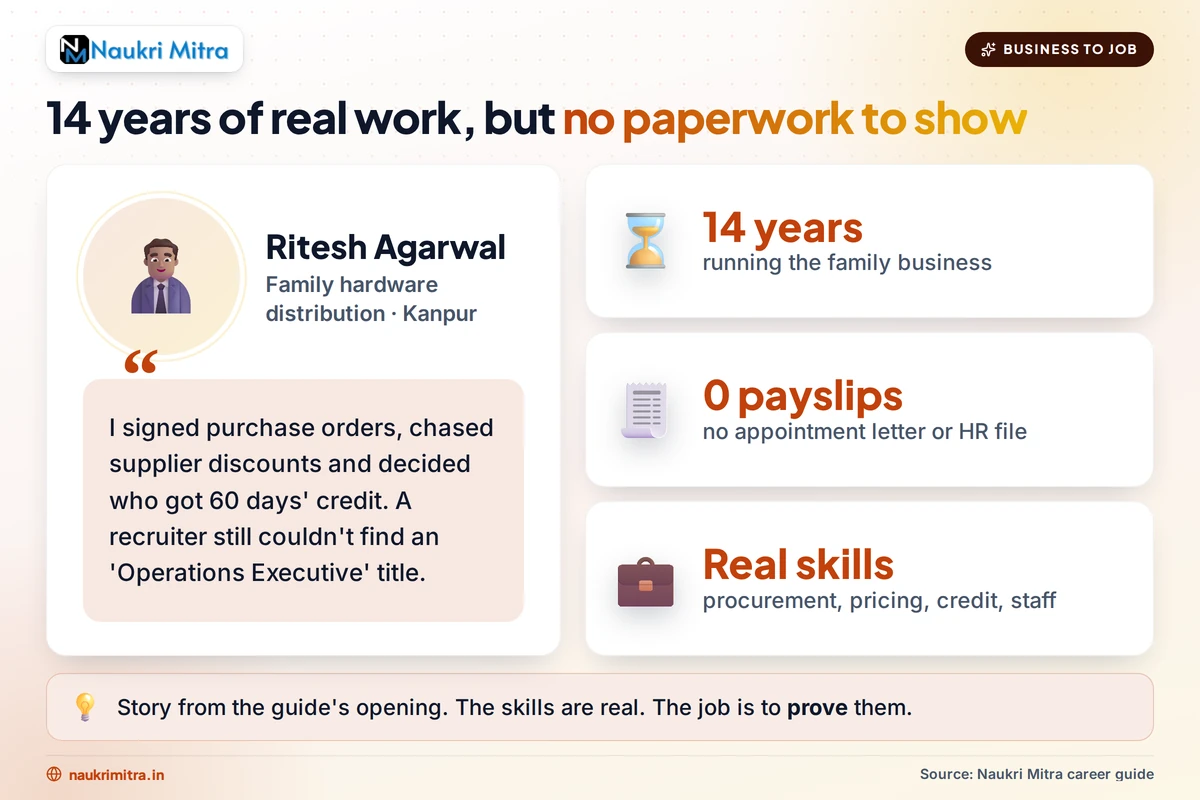
Ritesh Agarwal spent fourteen years signing purchase orders, chasing supplier discounts, and deciding which customer got sixty days of credit and which got none — all inside his family's hardware distribution business in Kanpur. When the business finally wound down last year, he found out fast that none of that counted for much with a recruiter scanning his resume for an "Operations Executive" title he had never actually held. There was no appointment letter. No payslip. No HR file with his designation typed neatly at the top. Just fourteen years of decisions that kept a business running.
This is the quiet crisis facing thousands of people across India who grew up inside a family shop, trading firm, or small manufacturing unit, and are now trying to work out how to get a job after family business India once that business shrinks, closes, or simply stops paying enough. The skills are usually real and often substantial. The paperwork to prove them, in almost every case, is not. This guide walks through what genuinely works — how to write the resume, what to say in an interview, how to think about salary, and what the first twelve months of a corporate job actually feel like when your previous one never came with an HR department.
Why This Transition Is Genuinely Harder Than a Normal Job Switch
A regular job switch involves comparing one set of KRAs to another. This one involves something closer to translation. Someone who ran — or helped run — a family business has usually touched procurement, pricing, staff management, customer disputes, and cash flow in a single working day, without anyone ever calling those things "functions." A corporate recruiter, by contrast, is trained to scan for titles, reporting lines, and measurable KPIs. The mismatch is real, and it shows up as doubt before it shows up as a rejection.
That doubt usually takes a specific shape: recruiters assume a candidate from a family business will leave the moment the business needs them back, treating the corporate job as a stopgap rather than a real move. This is worth naming honestly rather than ignoring, because the burden is on the candidate to show, through the interview and references, that the decision to step away was considered and final — not a temporary detour while waiting for festival-season sales to pick up again. It also matters whether the person actually ran the business — setting prices, hiring staff, negotiating with banks — or mainly helped out during peak hours; recruiters can usually tell the difference within a few pointed questions, so it helps to be precise about which one you were rather than inflating the role.
Building a Resume for Family Business Experience With No Payslips
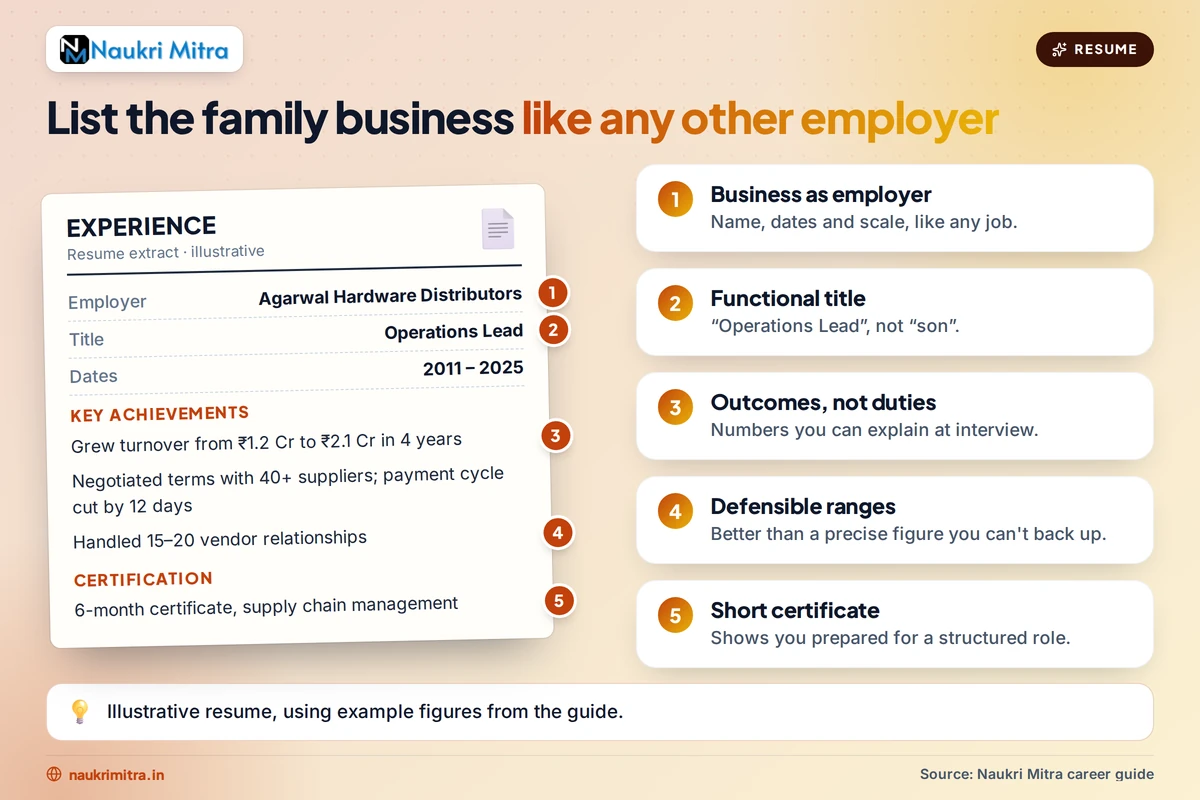
Most advice on writing a resume for family business experience India starts in the wrong place — by apologising for the gap in "formal" employment. A better approach treats the business itself as an employer entry, formatted exactly like any other job: business name, your functional title (not your family relationship — "Operations Lead," not "son"), dates, and a short description of the business's scale. If there's no appointment letter, that's fine; what recruiters actually want is specificity, not certification.
Inside that entry, write outcomes, not duties. "Managed the shop" says nothing. "Negotiated credit terms with 40+ suppliers and reduced average payment cycle by 12 days" says everything a hiring manager needs. This is also where revenue and growth numbers genuinely belong — if turnover grew from ₹1.2 crore to ₹2.1 crore over four years while you managed pricing and vendor relationships, that belongs on the resume as an achievement, stated plainly and without exaggeration, the same way any self-employed to salaried resume should present verifiable numbers rather than vague claims of "hard work" or "dedication." Where you lack hard numbers, use ranges you can defend if asked — "handled 15-20 vendor relationships" is more credible than a suspiciously precise figure you can't back up at interview. Indeed's own career guide on building a self-employed resume makes a similar point: list each business the way you would any job, and let a bulleted list of projects and client outcomes carry the weight instead of a title.
Translating Business Skills Into Language a Recruiter Recognises
The single biggest unlock in this kind of entrepreneurial to corporate transition is vocabulary, not substance. You already know how to do most of what a job description asks for; you just never called it that. Vendor negotiation becomes "procurement and supplier management." Keeping the shop's books becomes "P&L ownership and cash flow monitoring." Handling an angry customer becomes "escalation management and client retention." None of this is inflation — it's accurate translation, and recruiters specifically look for candidates who can do it, because it signals you'll adapt quickly to how corporate teams actually talk about work.
A short, credible certification helps close the remaining trust gap faster than almost anything else. This doesn't need to be a full MBA — a six-month certificate in supply chain management, digital marketing, or business analytics from a recognised institute does real work here, because it signals that you've deliberately prepared for a structured environment rather than drifting into one. Pair that with one or two measurable achievements from the business, and the resume starts reading like a career history instead of an explanation. A Forbes piece on entrepreneurs seeking corporate jobs flags the same hiring bias discussed above, and notes that candidates who can clearly translate their experience into applicable corporate skills do measurably better at easing recruiters' concerns.
Positioning Yourself: Entry-Level, Mid-Level, or an Industry Switch
How you position yourself depends heavily on age, the scale of the business you ran, and how transferable your sector actually is. Someone in their late twenties who helped out part-time for three years during college is realistically an entry-level or early-mid-level candidate, and should apply as one rather than over-claiming seniority. Someone in their late thirties who ran a ₹3-crore trading business for a decade, hired and fired staff, and dealt directly with banks has a legitimate claim to a mid-management role — but needs the resume and interview to prove it convincingly, since the title alone won't.
When switching from business to job India, it almost always pays to target a related industry first rather than starting from zero in an unfamiliar sector. Someone from a family electronics distribution business has a real edge applying to FMCG or electronics companies' sales and channel roles, where buyer relationships and regional market knowledge translate directly. This kind of focused business owner job search — picking two or three adjacent industries rather than applying everywhere — consistently outperforms a scattershot approach, because interviewers in a familiar sector ask fewer skeptical questions about whether you actually understand the work.
The Interview: Explaining Your Exit Without Sounding Disloyal or Evasive
Explaining family business in interview India situations usually comes down to one question asked in several forms: "Why are you leaving now?" The honest, confident answer is almost always better than a vague one. If the business genuinely couldn't support the family's needs anymore — rising competition, a market that moved online, succession disagreements — say that plainly, without blaming relatives or sounding bitter. Interviewers aren't looking for a perfect story; they're listening for whether you sound settled about the decision or still conflicted by it.
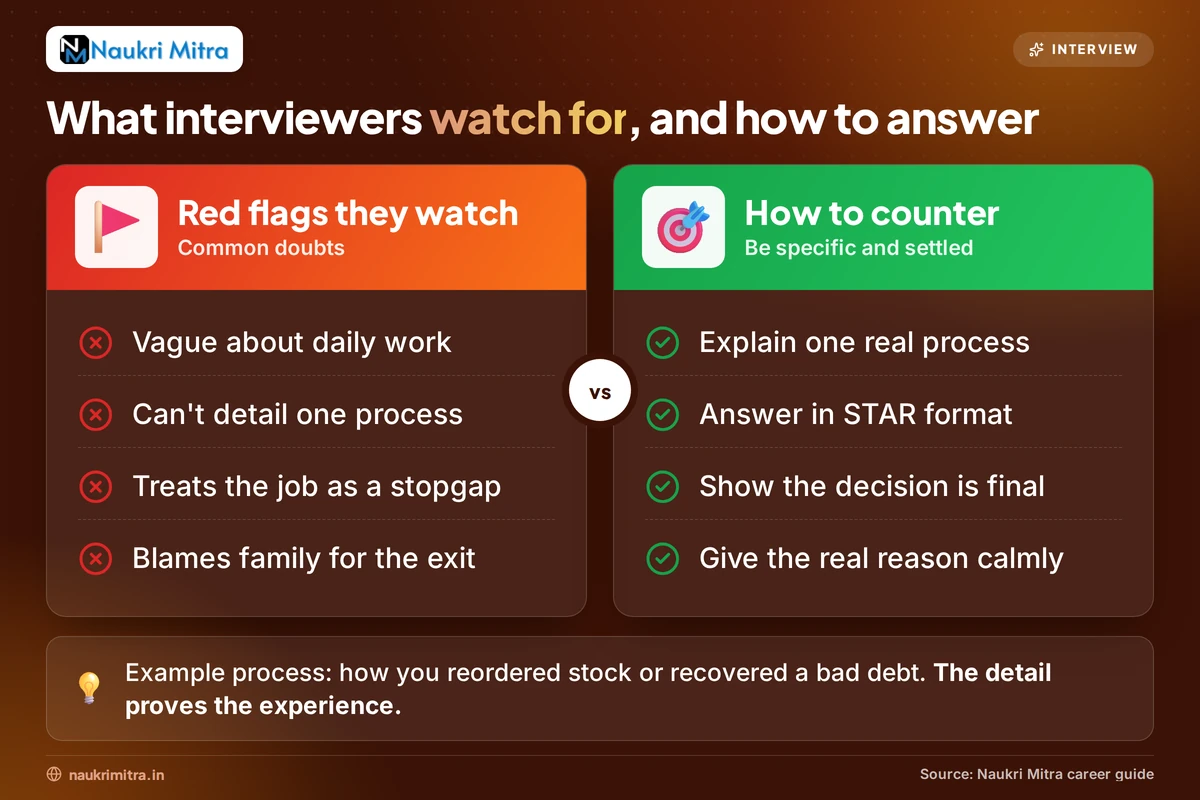
Interviewers evaluating business-to-corporate candidates are watching for a specific set of red flags: vague answers about what you actually did day-to-day, an inability to describe a single process in detail, and any sign that you see the corporate role as temporary. Counter all three directly. Describe one real process end-to-end — how you reordered stock, how you handled a bad debt, how you resolved a staff dispute — and let the detail itself do the work of proving the experience was real. Structuring that answer around the STAR interview method — situation, task, action, result — works especially well for non-traditional experience, since it forces a concrete narrative instead of a vague summary of "helping out." If there's genuine family pressure or guilt about stepping away from the business, it rarely helps to mention it in the interview itself, but it is worth resolving at home before you start job-hunting seriously, since half-hearted job searches driven by unresolved guilt tend to show up as hesitation in interviews.
Talking Money: Realistic Salary Expectations After Business Income
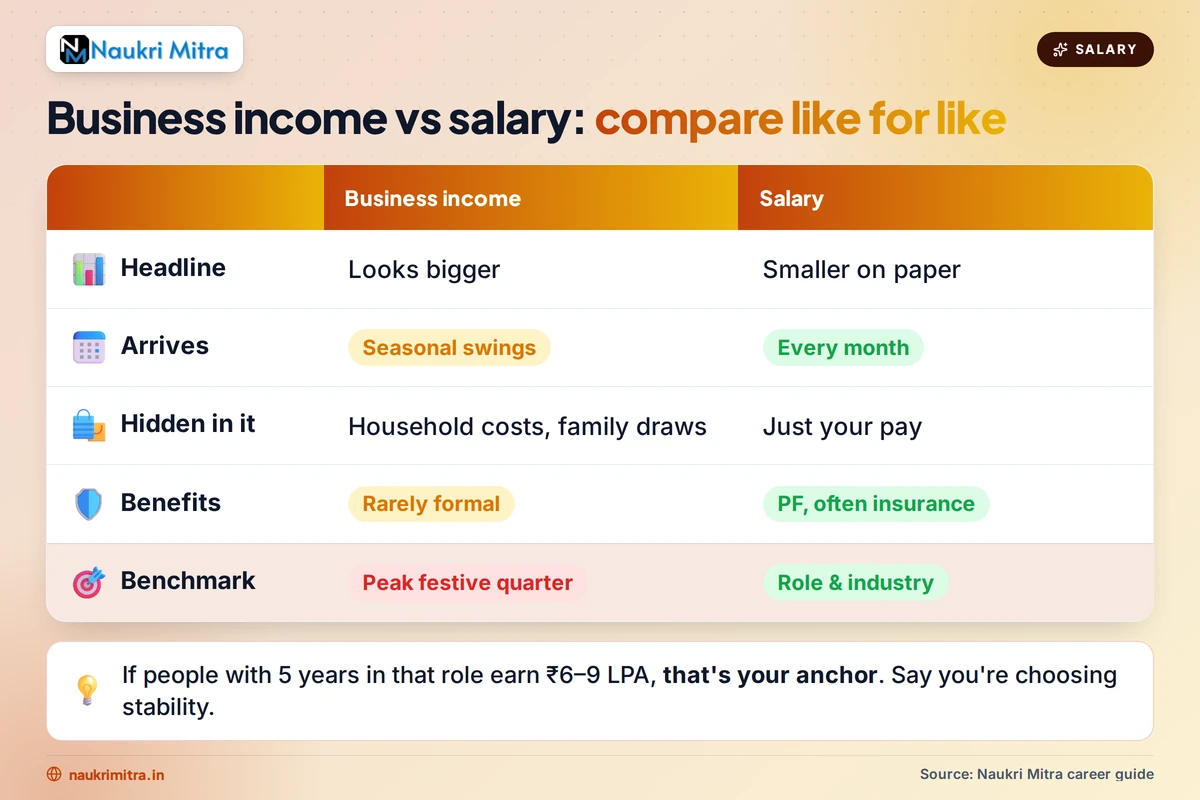
Business income and salary income don't map onto each other cleanly, and this trips up almost everyone making this move. Business "profit" often includes money that would, in a salaried context, be separate — a share of household expenses, informal family draws, seasonal swings. A fixed salary is smaller in headline terms but arrives predictably every month, with statutory benefits like PF and often health insurance attached, which a business rarely provided formally.
A realistic approach is to benchmark against the role and industry, not against your old business's best years. If comparable professionals with five years of relevant experience in that function earn ₹6-9 LPA, that's the anchor — not what the shop made in its peak festive quarter. It's also worth being upfront with recruiters that you're prioritising stability and structured growth over matching the ceiling of business income in year one; most hiring managers respect that framing far more than a candidate who seems anchored to an unrealistic number.
Background Verification When There's No HR File to Call
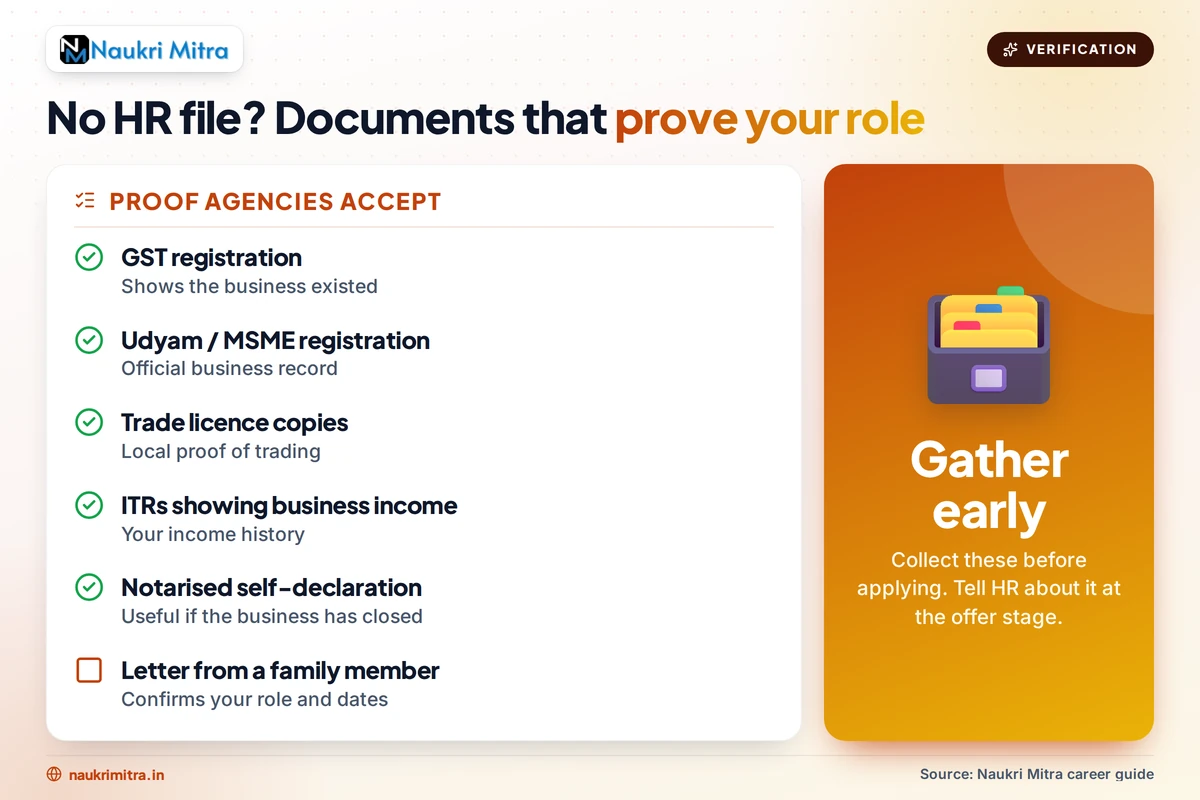
This is the practical worry almost everyone in this situation has but few ask about directly: what happens during background verification when the "employer" is a family business with no formal HR department? Most background verification agencies have a defined process for exactly this — they'll typically accept GST registration, Udyam/MSME registration, trade licence copies, income tax returns showing business income, or a notarised self-declaration as substitute proof, especially when the business has since closed.
Prepare these documents before you start applying, not after an offer letter arrives with a tight verification deadline. If the business is still registered under a family member's name, a simple letter from them confirming your role and tenure, even informally worded, carries real weight when attached to tax filings or GST records. Being upfront about this limitation with HR at the offer stage — rather than hoping it goes unnoticed — almost always goes over better than appearing to dodge the question later in the process.
Adjusting to Corporate Hierarchy, Documentation, and Office Culture
Running or co-running a business means being the final decision-maker. A first corporate job means reporting to someone, following a process you didn't design, and getting sign-offs for decisions you'd have made alone in thirty seconds at the shop. This adjustment is real, and underestimating it is probably the single most common mistake in this transition. Call it corporate culture shock if you like — the mild disorientation of email chains, calendar invites, and approval workflows replacing the direct, verbal decision-making of a family business.
A related friction point is designation mismatch: someone who ran every aspect of a business might be offered a mid-level executive title that feels like a demotion given the actual authority they held at home. It rarely is one — it reflects how corporate structures measure tenure and scope differently from business ownership. Accepting a title that undersells your real experience, for the first role, is usually the faster path to a stronger title in eighteen to twenty-four months, once you've built a track record inside that structure. The soft-skill gap worth preparing for in advance is formal documentation and written communication — minutes of meetings, structured email updates, status reports — since most family businesses run on verbal trust rather than paper trails, and that habit needs deliberate, early correction.
Networking Your Way In When Your Contacts Are Mostly Trade Relationships
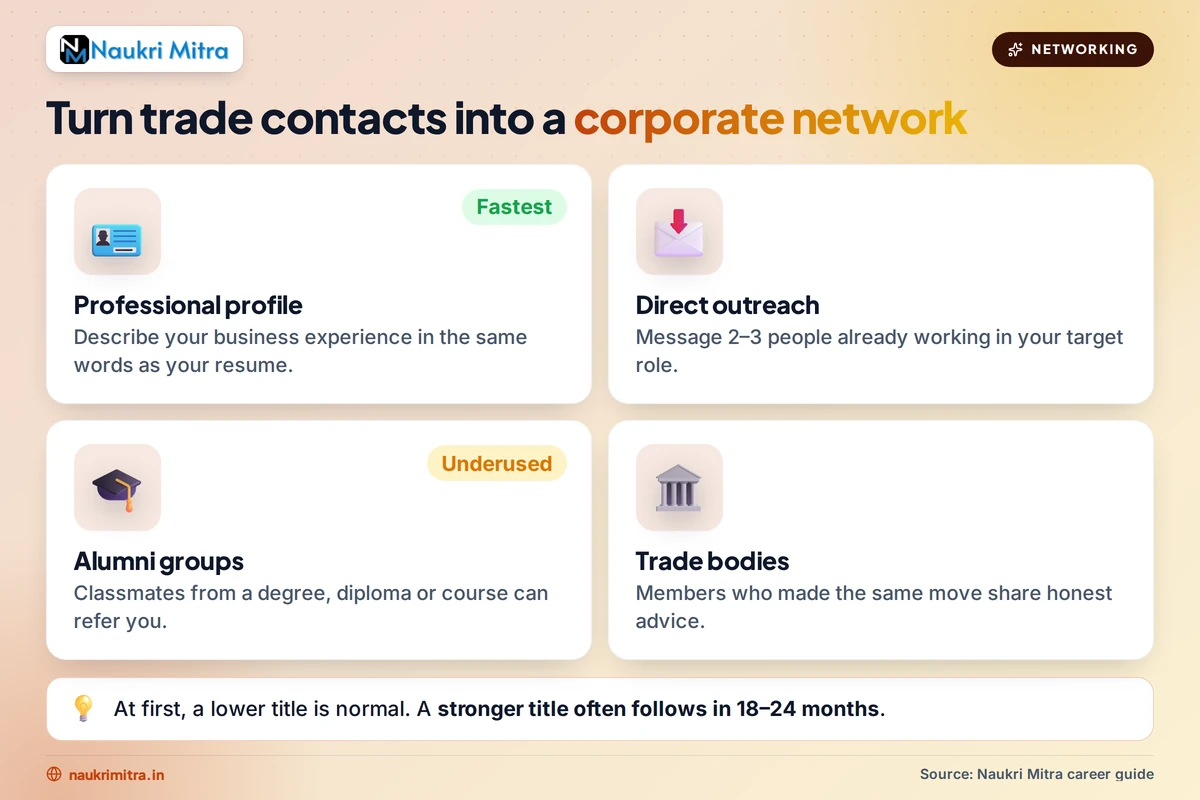
Most people from a business background have a strong network — of suppliers, distributors, and trade contacts — that simply doesn't map onto corporate hiring. Rebuilding this takes a deliberate, short-term push rather than years of patience. LinkedIn is the fastest lever: a clean profile with the translated version of your business experience, written using the same language as your resume, followed by direct outreach to two or three people already working in your target function at companies you'd consider.
Alumni groups from any diploma, degree, or recent certification course are usually underused but genuinely effective, since classmates already mid-career are often willing to refer or at least share an honest read on a company's hiring process. Local trade bodies and industry associations connected to your old business sector can also double as a bridge, since many of their members have already made a similar jump and are often generous with advice once asked directly.
A Realistic Roadmap and Timeline for the First Salaried Role
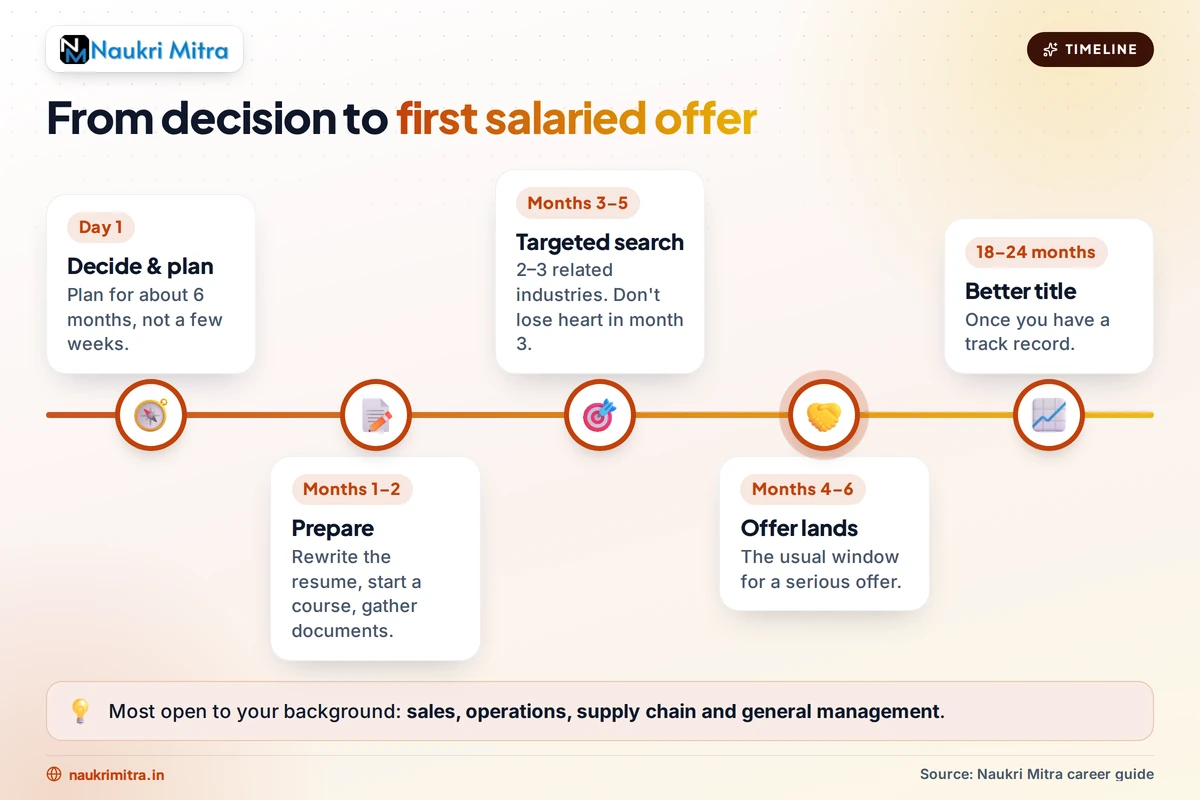
Most people underestimate how long leaving family business for corporate job India realistically takes, which causes unnecessary panic in month two. A workable timeline looks roughly like this: one to two months on resume rewriting, certification enrolment, and document gathering; two to three months of focused, targeted applications and interviews in adjacent industries; and, for most candidates without a strong existing professional network, a total window of four to six months before a serious offer lands. Faster is possible, especially in sales and operations roles where business backgrounds are genuinely valued, but planning around six months protects against the discouragement that derails many candidates by month three.
Sales, operations, and general management functions tend to be the most receptive to this background, since they value the comfort with ambiguity, customer handling, and numbers-driven decision-making that a business naturally builds. Roles like Operations Manager positions in Delhi, Business Development Manager roles, and Supply Chain Manager openings in Mumbai are worth scanning specifically, since they frequently list vendor management, P&L exposure, and team handling as core requirements — all territory a family business almost certainly covered. Browsing live listings on a job portal like Naukri Mitra regularly, rather than waiting for the resume to be "perfect," also helps calibrate expectations against what employers in your target function are actually asking for right now.
Frequently Asked Questions
Can I really list my family business as "work experience" without a formal appointment letter?
Yes. Treat it as an employer entry with a functional title, dates, and achievement-based bullet points, exactly like any other job. Lack of a formal letter doesn't disqualify the experience — vague, unspecific descriptions do.
What if I only helped out part-time and never really "ran" the business?
Be precise about this rather than inflating it. Position yourself honestly as having supported specific functions — customer handling, billing, inventory — and apply for roles at a level that matches that scope, typically entry to early-mid-level rather than management.
Will HR find out there's no formal payroll record and reject me outright?
Not automatically. Most background verification processes accept GST registration, trade licences, ITR filings, or a notarised self-declaration as alternative proof, especially once a business has closed. Flagging this upfront, rather than waiting to be questioned, tends to work better.
How do I answer "why did you leave the family business" without sounding disloyal?
State the practical reason plainly — reduced margins, market shift, a need for stable income — without criticising family members. A calm, specific answer reads as more credible than either an overly emotional one or a defensive one.
Should I mention the business's revenue numbers in my resume or interview?
Yes, if they're accurate and you can explain how they were achieved. Verifiable growth figures are among the strongest signals you can offer, since they show measurable impact rather than just activity.
What salary should I expect compared to what the business earned?
Benchmark against the role and industry you're entering, not your old business's income. A fixed salary will often look smaller on paper but comes with predictability and statutory benefits the business likely didn't offer.
Which industries are genuinely more open to hiring someone from a business background?
Sales, operations, supply chain, and general management roles tend to value this background most, since they reward comfort with ambiguity, vendor relationships, and numbers-driven decisions — all things a family business builds naturally.
Is an MBA necessary to make this transition work?
Not necessary, though a short, recognised certification in a relevant function — supply chain, analytics, digital marketing — meaningfully speeds up trust-building with recruiters who are otherwise evaluating an unfamiliar resume format.
How long should I realistically expect this transition to take?
Plan for roughly four to six months from decision to offer, covering resume preparation, certification, and a focused, targeted job search in one or two adjacent industries, rather than expecting results within a few weeks.
Sources: Forbes – "5 Tips For Entrepreneurs Seeking Corporate Jobs"; Indeed Career Guide – "9 Tips to Creating a Self-Employed Resume"; Harvard Business Review – "Use the STAR Interview Method to Land Your Next Job".
.png)
.png)
.png)
Comments
Post a Comment