Flexible Jobs If You Care for Aging Parents | Naukri Mitra
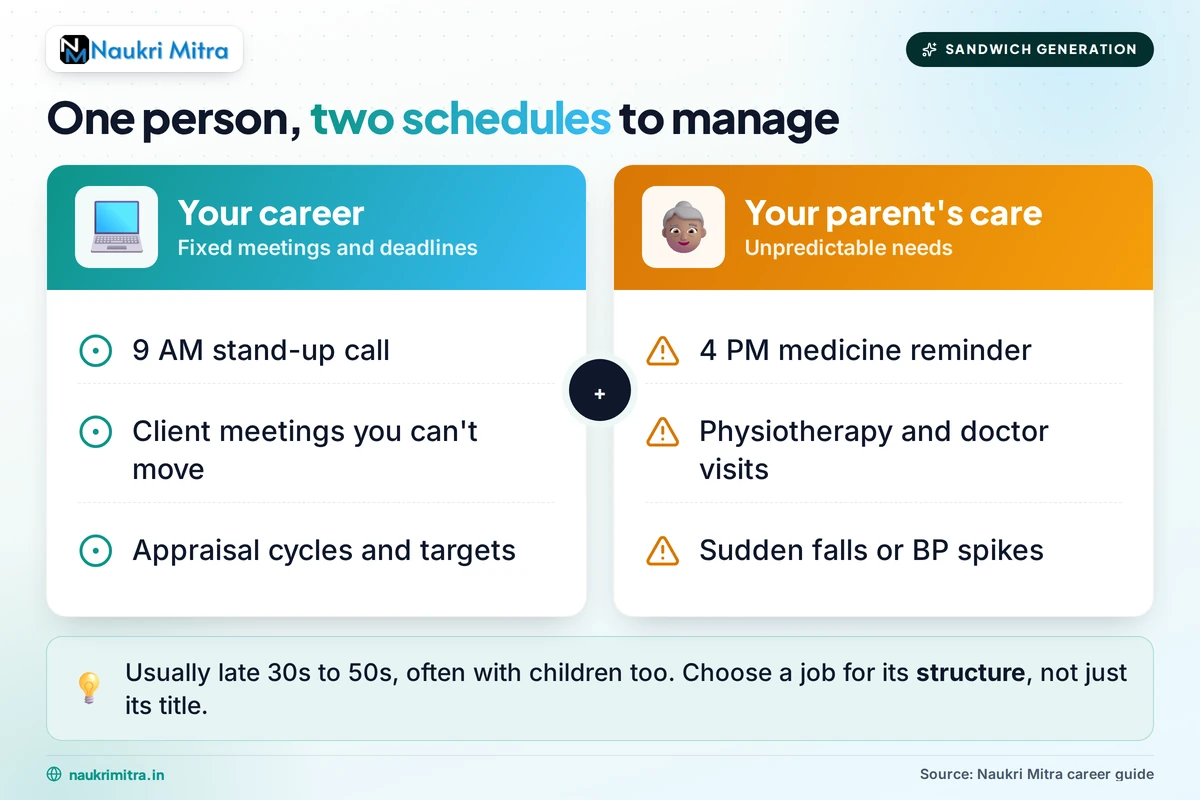
Somewhere between the 9 AM stand-up call and the 4 PM diabetes medicine reminder, a lot of working Indians quietly become project managers for two lives at once — their own career, and an aging parent's health, mobility and daily routine. Nobody hands you a handbook for this. You just start missing calls during your mother's physiotherapy session, or rescheduling a client meeting because your father's blood pressure spiked again. If this sounds familiar, you are not failing at either job. You are doing what is increasingly called "sandwich generation" work, and the good news is that the Indian job market finally has more genuine flexible options than it did even five years ago — you just have to know where to look and how to ask.
Understanding the Sandwich Generation Squeeze
The term sandwich generation describes adults — usually in their late 30s through 50s — who are simultaneously supporting aging parents and raising their own children, often while holding down a full-time job. In India, this squeeze is sharper than in many countries because formal eldercare infrastructure is thin, joint-family support systems are shrinking in cities, and most workplaces were never designed with caregiving in mind. A parent's fall, a sudden hospitalization, or a slow decline from a chronic condition does not wait for your appraisal cycle to finish. Research from Pew Research Center on caregiving adults found that people in their 40s face the steepest overlap between raising children and supporting aging parents, and while that data comes from the US, the underlying pressure — competing demands on time, money and attention — translates directly to Indian households, especially in nuclear-family setups in metros like Bengaluru, Pune and Gurugram.
For many people, the real question is not "can I manage both," but "what kind of job actually lets me manage both without quietly burning out or quietly getting managed out." That is where career options for sandwich generation India workers need to go beyond generic career advice and get specific about job structure, not just job title.
What Flexible Work Actually Looks Like
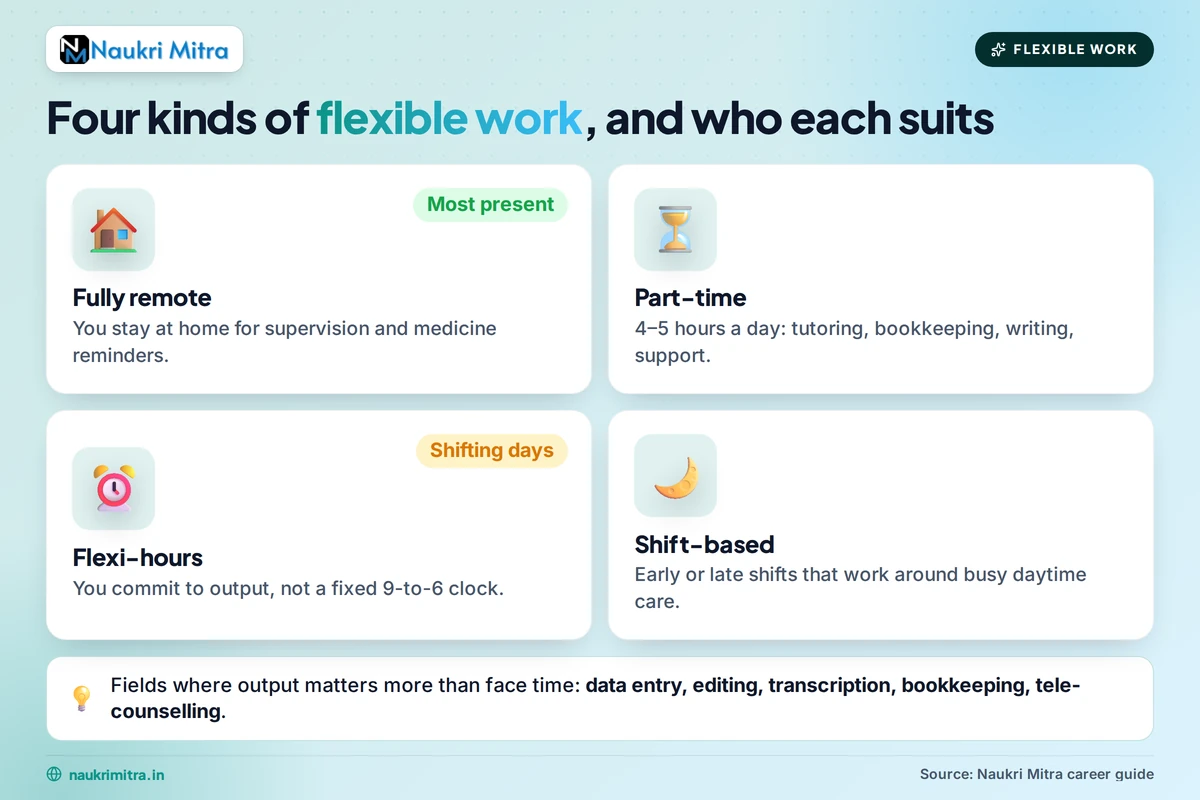
"Flexible" gets used loosely in job ads, so it helps to break it into categories you can actually evaluate. Fully remote roles let you be physically present at home, which matters enormously if your parent needs supervision, medication reminders or someone nearby during the day. Part time jobs while taking care of parents India seekers often consider include tutoring, bookkeeping, content writing, customer support shifts, and virtual assistance — roles that can be structured around four or five hours a day rather than a rigid eight. Flexi-hours jobs, where you commit to output or a loose time band rather than a 9-to-6 clock, suit caregivers whose daily schedule shifts depending on a parent's appointments or symptoms.
Shift-based work is another underrated option: some customer service and healthcare-adjacent roles offer early morning or late evening shifts, which can be arranged around a parent's more demanding daytime hours. If you're specifically hunting for work from home jobs for eldercare caregivers India has to offer, look at digital marketing, data entry, academic editing, transcription, virtual bookkeeping and tele-counselling — fields where output matters more than face time. Naukri Mitra lists several such positions, including work-from-home virtual assistant roles, remote customer service representative openings and content writing jobs you can do from home, all of which are reasonably common entry points for people managing eldercare alongside income needs.
What India's Labour Laws Actually Say About Caregiver Leave
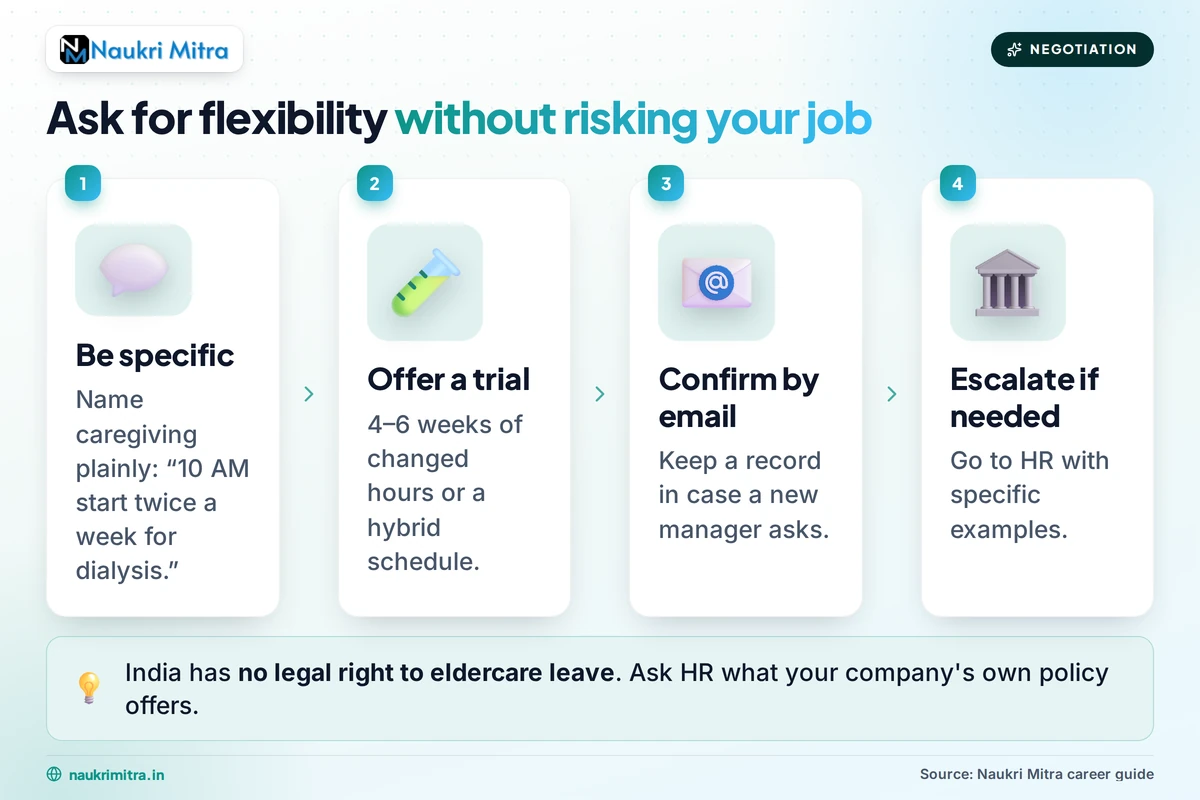
Here is the honest answer, without sugar-coating it: India does not currently have a dedicated statutory eldercare leave policy the way it has maternity leave under the Maternity Benefit Act. The labour codes passed in recent years, including the Code on Social Security, strengthen protections around provident fund, gratuity and occupational safety, but none of them create a legal entitlement to paid time off specifically for caring for an elderly parent. What exists instead is a patchwork: some companies offer "compassionate leave" for a few days during a medical emergency, some allow casual or earned leave to be used flexibly, and a small but growing number of large employers have introduced formal caregiver leave as a company policy rather than a legal mandate. Microsoft India, for instance, introduced a dedicated family caregiver policy giving employees paid leave to care for an immediate family member with a serious health condition — a move covered in detail by Microsoft's own newsroom, and one that other large employers have since referenced when designing their own eldercare leave policy frameworks.
Separately, the Maintenance and Welfare of Parents and Senior Citizens Act, 2007 places a legal duty on adult children to maintain their parents, and some states have used it to set up tribunals for disputes, but it does not touch employment leave at all — it is about financial maintenance, not workplace rights. In practice, this means your actual protection depends almost entirely on your specific employer's HR policy, not on a universal law, so it is worth asking HR directly whether any caregiver leave or family-care leave exists before you assume there is none.
How to Negotiate Flexibility Without Risking Your Job
Asking for flexibility feels risky, but framed correctly, it is usually a low-cost request for an employer who wants to retain you. Start with specifics rather than vague requests: instead of "I need more flexibility," say "I need to start at 10 AM twice a week because of my father's dialysis schedule, and I'll make up the hours in the evening." Managers respond better to concrete, boundaried asks than open-ended ones. If your role allows it, propose a trial period — four to six weeks of adjusted hours or a hybrid schedule — so your manager can see the arrangement works before it becomes permanent.
A compressed four-day week or a fixed work-from-home day is also worth proposing directly, citing caregiving responsibilities plainly rather than being vague about "personal reasons," which can sometimes invite more suspicion, not less. Document the arrangement in an email after any verbal agreement, so there is a record if a new manager later questions it. If a colleague or supervisor treats your caregiving as a performance liability — making comments about your "commitment" or sidelining you from projects — address it directly and calmly, and if it continues, escalate to HR with specific examples rather than a general complaint about attitude.
Freelancing and Consulting: Is Full Independence Worth It
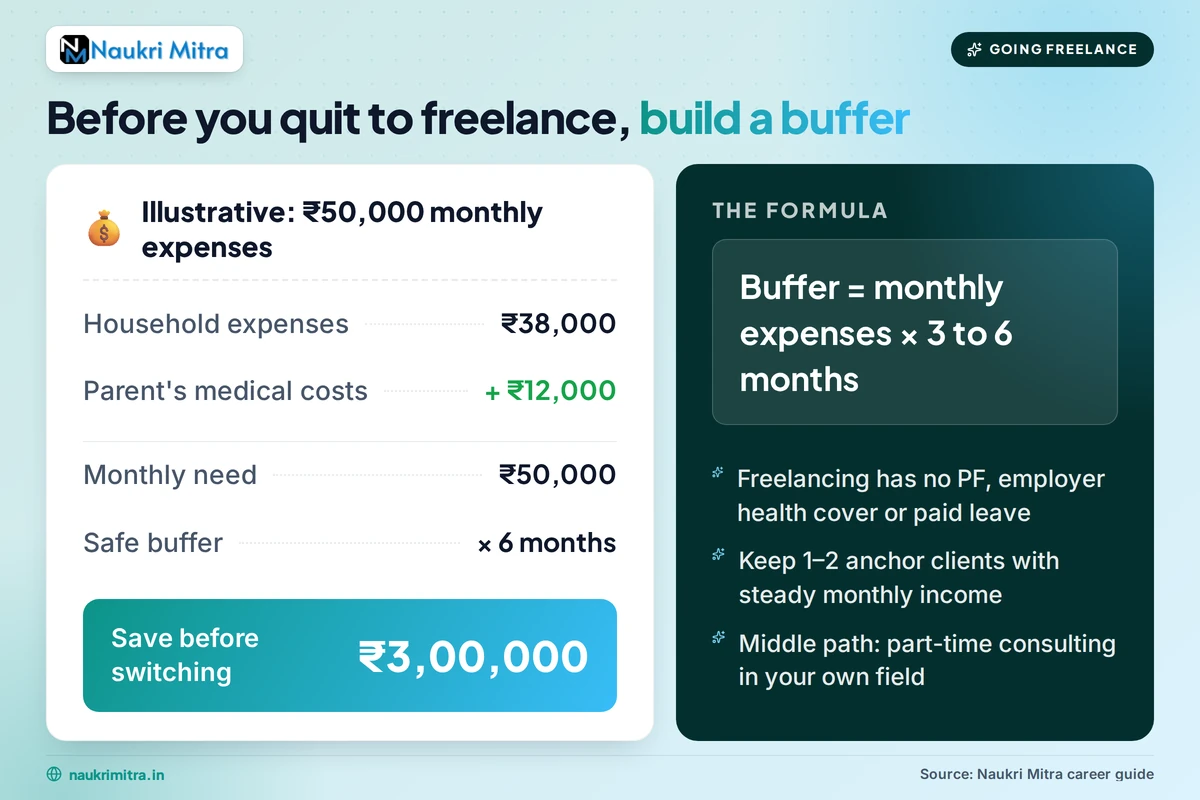
Many caregivers eventually ask whether they should abandon full-time employment altogether and freelance or consult instead. It can work beautifully for some people and badly for others, so weigh it carefully rather than jumping in in a moment of exhaustion. Freelancing gives you full control over your calendar, which is valuable when a parent's health is unpredictable, but it removes the safety net of a steady paycheck, employer health insurance, provident fund contributions and paid leave. If you go this route, build at least three to six months of expenses as a buffer before transitioning, and try to retain one or two anchor clients with predictable monthly income rather than relying entirely on project-based work.
A middle path that works for many people managing balancing job and elderly parent care India realities is part-time consulting in your existing domain — the same skills, fewer hours, less managerial overhead. If you were in marketing, HR or finance, for instance, small businesses often hire part-time consultants at a fraction of a full-time salary cost, which can work in your favour as a caregiver looking for fewer, well-defined hours rather than full severance from your field.
Financial Trade-Offs You Should Go Into With Open Eyes
It would be dishonest to pretend flexible work comes free. Part-time and remote roles in India typically pay anywhere from 40 to 70 percent of an equivalent full-time salary, depending on the field, and some also skip statutory benefits like provident fund or health insurance unless you are formally on payroll. Before accepting a lower-paying flexible role, calculate your actual monthly need, factoring in a parent's medical costs, which tend to rise rather than stay flat, and compare that honestly against the role's take-home pay rather than its headline number.
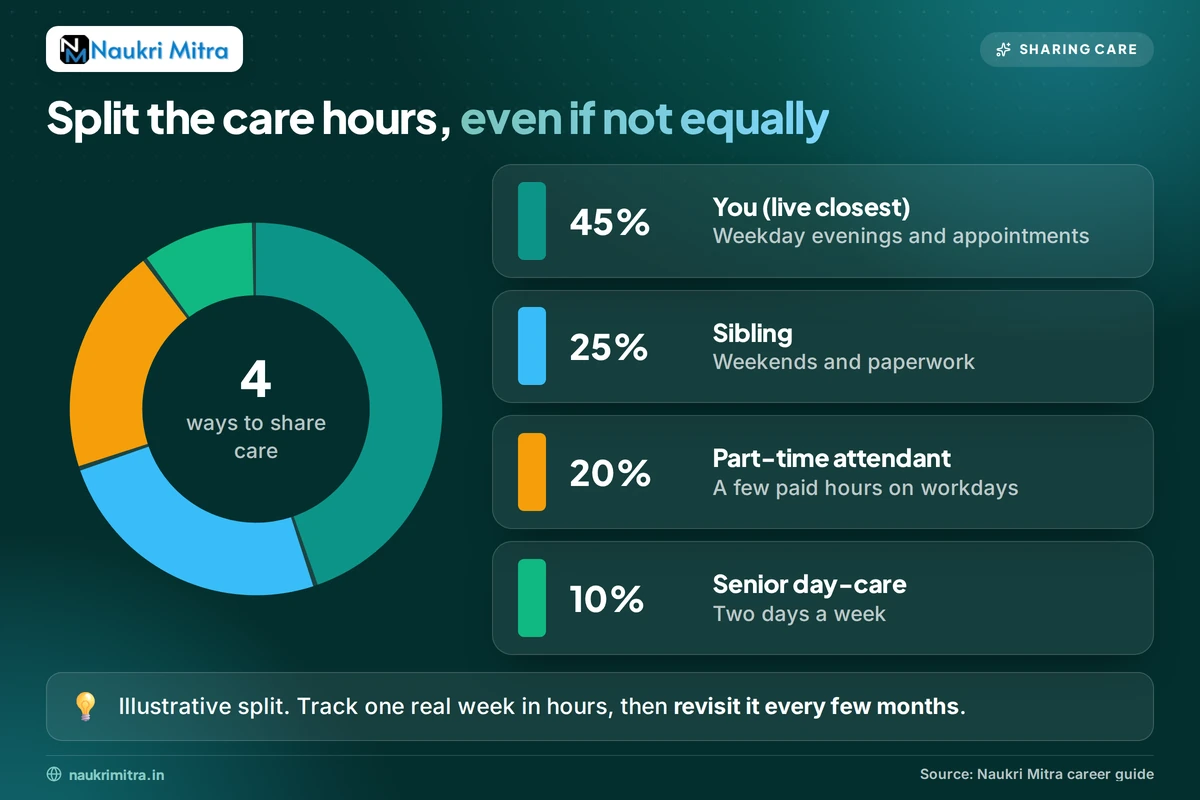
On the other side of the ledger, flexible jobs for people caring for elderly parents India seekers take on often save money indirectly — fewer missed appointments due to being unreachable at work, no need for full-time paid attendants if you can supervise during the day yourself, and lower commuting costs if the role is remote. If finances allow even a partial paid home-care arrangement — a part-time attendant for a few hours, or a day-care centre for seniors a few days a week — it can let you keep a higher-paying full-time role rather than stepping down income entirely, so it is worth pricing out local home-care options before assuming a pay cut is unavoidable.
Industries and Companies That Actually Accommodate Caregivers
Sectors built around digital output rather than physical presence tend to be the most genuinely accommodating: IT services, content and digital marketing, edtech, customer support, accounting and bookkeeping, and certain healthcare-adjacent roles like tele-counselling or medical transcription. Global and large Indian employers increasingly publish explicit caregiver-friendly policies — Harvard Business Review's reporting on workplace caregiving notes that a majority of employees across industries now carry some caregiving responsibility, pushing more companies to formalize flexible arrangements rather than leave them to individual managers' discretion. In India specifically, IT majors, BPOs and several consulting firms have begun experimenting with "core hours plus flexible edges" models, where a few overlapping hours are mandatory but the rest of the day is self-managed.
If you are actively searching, filter job boards for "remote," "hybrid" and "flexible hours" rather than relying on a company's general reputation, since policy on paper and practice on the ground can differ by team and manager. Remote work for caregivers works best when the role is explicitly output-based rather than hours-tracked, so ask directly during interviews how your work will be measured. Naukri Mitra's listings page is a reasonable starting point for browsing current openings across these categories.
Government Schemes, Tax Relief and Support Systems
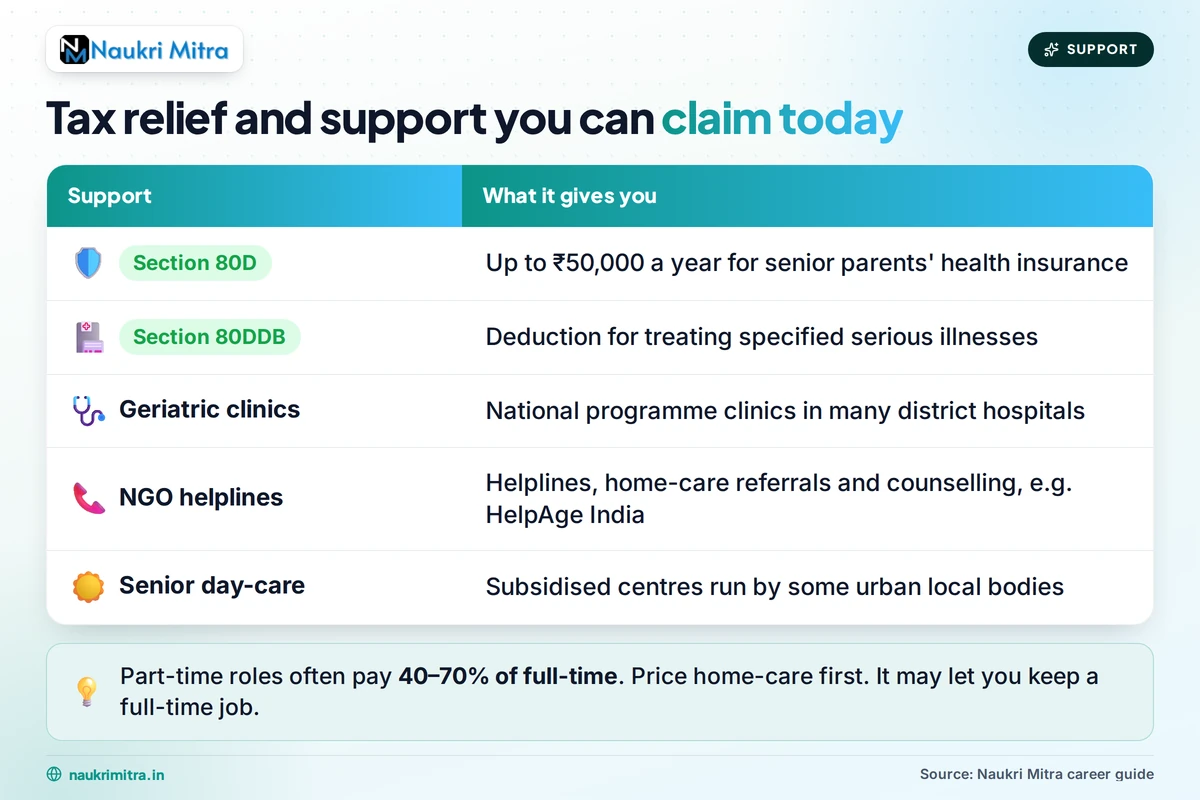
A few concrete reliefs exist even without a formal eldercare leave law. Under the Income Tax Act, Section 80D allows a deduction of up to ₹50,000 annually for health insurance premiums paid for senior citizen parents, and Section 80DDB permits deductions for medical treatment of specified serious illnesses in a dependent parent — both worth claiming if you are footing these bills alongside a reduced income. The National Programme for Health Care of the Elderly runs geriatric clinics in many district hospitals, which can reduce the frequency and cost of specialist visits if you register your parent there early rather than only during emergencies.
Several NGOs, including HelpAge India, offer helplines, home-care referrals and counselling specifically for families managing elderly care, and some urban local bodies run subsidized day-care centres for seniors. None of these replace a job that respects your time, but combined with even modest workplace flexibility, they can meaningfully reduce the hours you need to personally cover, which is often the real constraint rather than willingness to work.
Recognizing and Preventing Caregiver Burnout
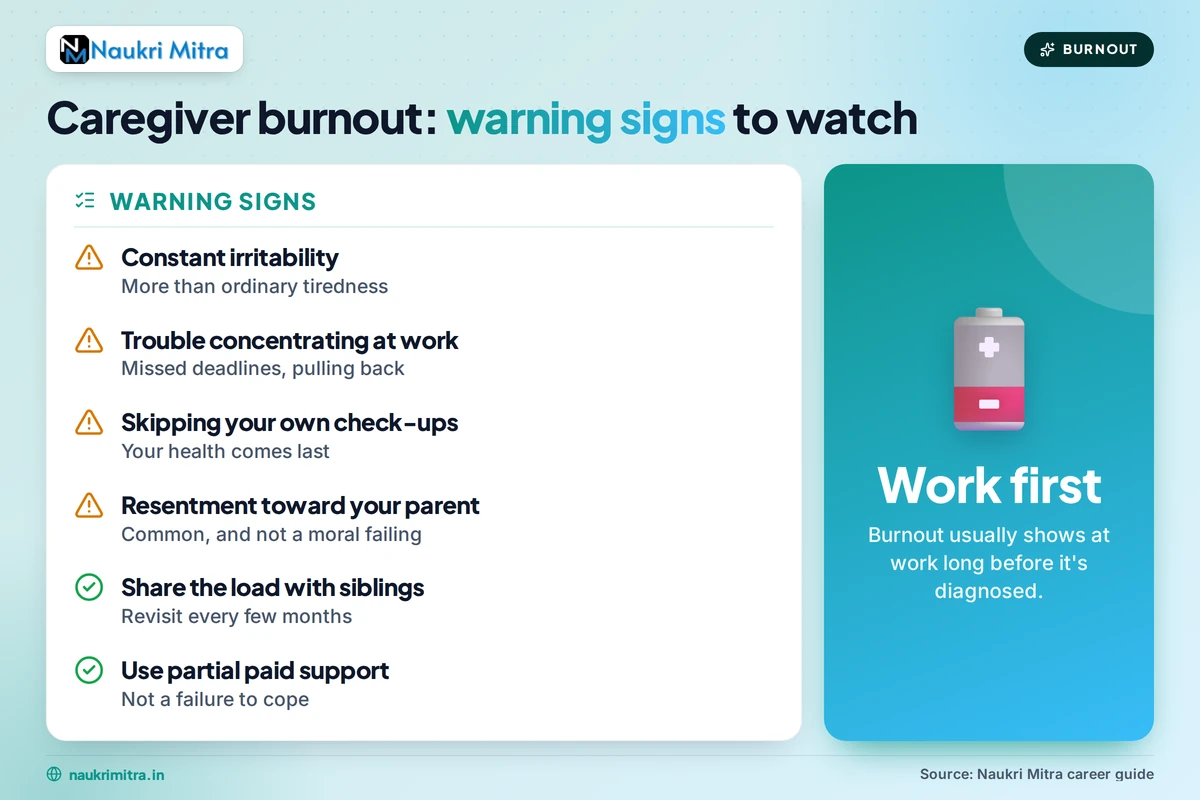
Caregiver burnout shows up as more than tiredness — persistent irritability, trouble concentrating at work, skipping your own medical check-ups, and a creeping sense of resentment toward the very parent you are caring for are all common warning signs, and none of them make you a bad person or a bad professional. Left unaddressed, burnout tends to show up at work first, through missed deadlines or visible disengagement, long before it shows up as a diagnosed health issue.
If you have siblings, an honest conversation about dividing responsibilities — even unevenly, based on who lives closer or has more flexible hours — prevents one person from silently absorbing everything while others assume it is "being handled." This does not have to be a one-time negotiation; revisit it every few months as both your job and your parent's needs change. If no sibling is available or willing, look seriously at partial paid support rather than treating that as a failure to cope alone; stretching yourself to the point of being unable to work at all serves nobody, including the parent you are trying to protect.
Staying Visible and Growing Your Career on Reduced Hours
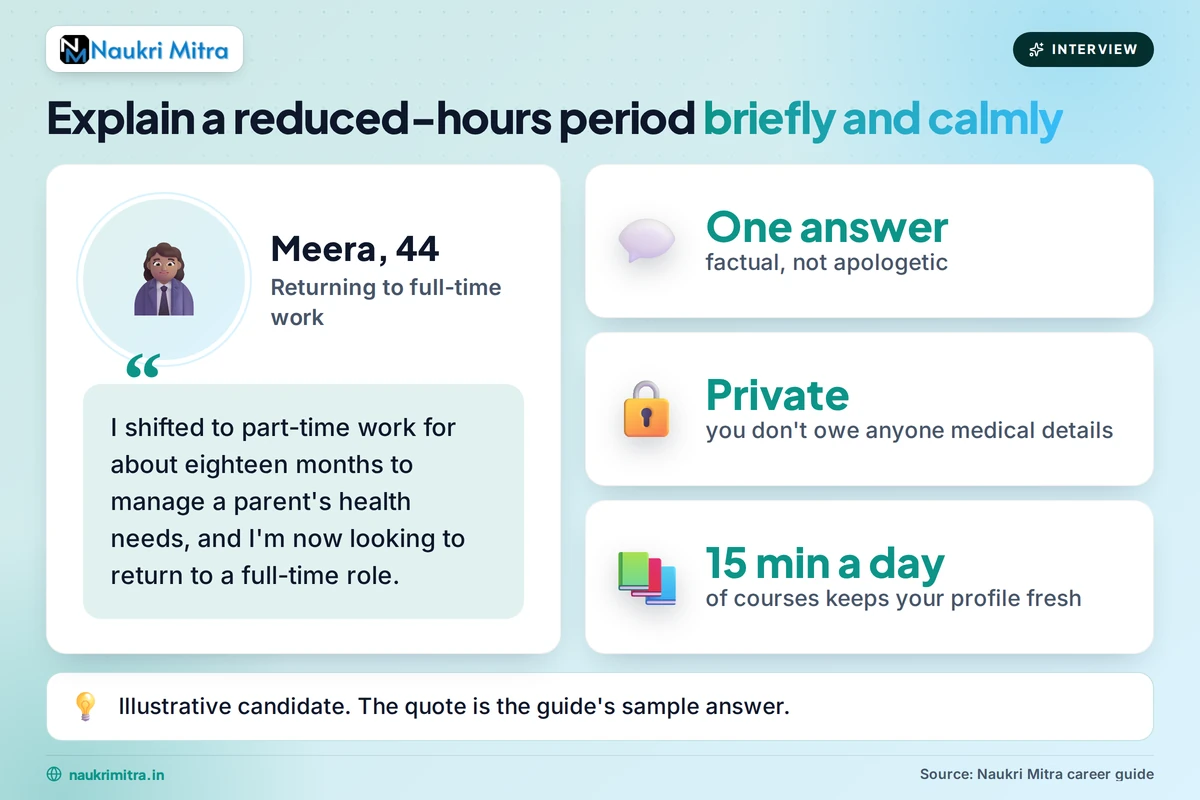
A quieter worry for many caregivers is career stagnation — the fear that stepping back to part-time or remote work now means being permanently sidelined later. To counter this, keep your output visible even on fewer hours: share progress updates proactively rather than waiting to be asked, volunteer for high-visibility but time-bounded projects rather than open-ended ones, and keep at least one professional skill actively updated through short online courses, even fifteen minutes a day, so your profile does not go stale while your hours are reduced.
When the time comes to explain a gap or a reduced-hours period in an interview, be factual and brief rather than apologetic: "I shifted to part-time work for about eighteen months to manage a parent's health needs, and I'm now looking to return to a full-time role" is a complete, respectable answer that most reasonable interviewers will accept without further probing. Avoid over-explaining medical details — you owe the interviewer context, not your family's private history.
Frequently Asked Questions
Is caring for an elderly parent at home the same as taking a professional paid eldercare job?
No. Being the professional caregiver for your own parent is unpaid family responsibility layered on top of your actual career, whereas a paid eldercare job — like a geriatric nurse or professional attendant — is itself the employment. The strategies in this guide are for people trying to hold a separate career while also caregiving, not for those seeking employment as a caregiver.
Should I turn down a promotion because of my caregiving responsibilities?
Not automatically. Ask specifically what the promotion changes in terms of hours, travel and on-call expectations before deciding, and consider negotiating a modified version of the role rather than refusing it outright — many promotions come with more autonomy over your schedule, not less.
How do I bring up caregiving responsibilities with a new employer during hiring, if at all?
You are not obligated to disclose it during interviews. If you need a specific accommodation, such as fixed start times, raise it once you have an offer or during final-stage negotiations, framed as a scheduling preference rather than a personal disclosure.
What's a realistic income expectation for part-time work compared to my current full-time salary?
Expect roughly 40 to 70 percent of your full-time equivalent pay for a genuinely part-time role in most white-collar fields, though specialized consulting can command a higher effective hourly rate even at reduced total hours.
Are there remote-first companies in India specifically known for hiring caregivers or older job seekers flexibly?
No major Indian employer markets itself specifically around hiring caregivers, but remote-first IT services firms, edtech platforms and content/digital marketing agencies tend to have the most structurally flexible roles, since output, not physical presence, is what's measured.
Can my employer legally deny a flexible work request related to eldercare?
Yes, in most private-sector roles, since there is no statutory right to flexible hours for eldercare in India. Approval depends on your specific employer's policy and your manager's discretion, which is why framing the request with clear boundaries matters so much.
Will working reduced or flexible hours affect my provident fund and gratuity eligibility?
If you remain on formal payroll with PF deductions, your contributions continue proportionally, but true freelance or contract-based flexible work generally has no PF or gratuity coverage, so check your specific employment classification before assuming continuity.
What should I do first if I'm overwhelmed and don't know whether to quit, go part-time, or push through full-time?
Map out your parent's actual daily care needs in hours, not feelings, for one week before deciding anything. Many people overestimate the hours required and under-explore partial paid support, which can make a full-time role more sustainable than it first appears.
How do I find flexible or work-from-home listings specifically, rather than sifting through all job ads?
Use filters for "remote" and "work from home" directly on job portals, and check niche listing pages — Naukri Mitra maintains dedicated work-from-home job categories that are usually faster to browse than filtering a generic search.
Caring for an aging parent while holding down a career is not a side project you squeeze into gaps — it is real, demanding work layered onto other real, demanding work, and it deserves to be treated that way, both by employers and by you. The flexible job market in India is still catching up to this reality, but it has moved further than most people realize, and with the right combination of job structure, honest financial planning and a willingness to ask directly for what you need, it is possible to hold onto both your career and your presence for your parent without quietly sacrificing either.
Sources: Microsoft India – Family Caregiver Leave announcement; Harvard Business Review – "Your Employees Are Also Caregivers"; Pew Research Center – Sandwich generation data.
.png)
.png)
.png)
Comments
Post a Comment