Leaving Academia for an Industry Job | Naukri Mitra
Somewhere between the third round of thesis revisions and a postdoc extension no one wants to talk about, a quiet thought shows up for a lot of Indian researchers: what if the lab isn't the endpoint? It rarely arrives as a dramatic exit. It looks more like scrolling job listings at 1 a.m., wondering whether a decade of pipetting, coding simulations, or archival research means anything to a hiring manager who has never read a journal article. It does mean something — but almost none of it transfers in its current form. What a PhD to industry job transition India actually looks like is less about proving you're smart enough, and more about translation: making what you built in a university legible to people who've never set foot in one.
This isn't a motivational piece about "following your passion" outside academia. It's a practical look at what changes when a researcher trades campus for a corporate badge — the resume rewrite, the salary reset, interview questions built to catch out people who've spent too long in seminar rooms. If the phrase leaving academia for corporate job India describes exactly what's been looping in your head lately, here is what that first year tends to look like, based on how hiring actually works at Indian and India-facing companies.
Why "Overqualified" Is Often Industry Code for Something Else
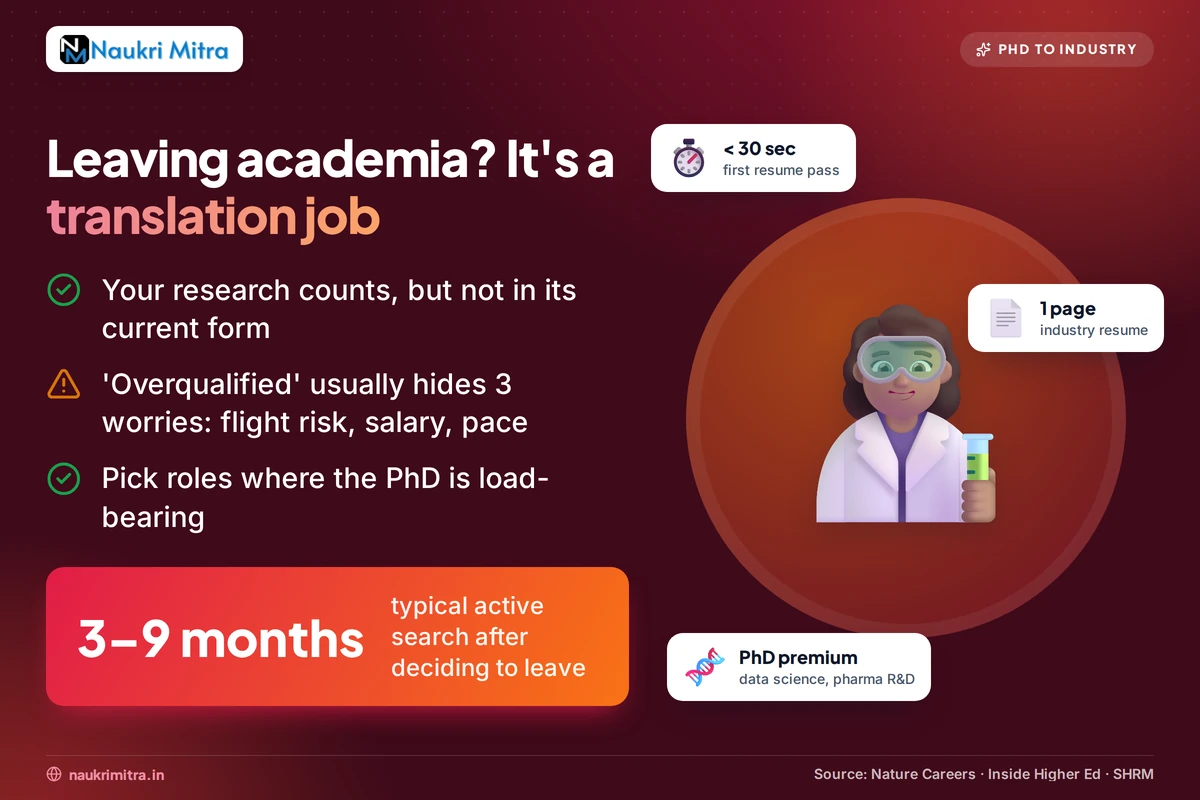
The rejection that stings most is usually the vaguest one: "we feel you're overqualified for this role." Recruiters rarely mean your intellect is the problem. They mean three narrower things: they're unsure you'll stay once something more senior-sounding appears, they suspect your salary expectations are anchored to years of seniority rather than years of commercial experience, and they're not confident you can operate at the pace of a quarter-driven business after a multi-year grant cycle. This is the practical shape of PhD overqualified job search friction, and it's solvable — but only if you address it directly instead of hoping your publication list will speak for itself.
There's a related, messier idea sometimes called the "PhD premium" versus "PhD penalty" in Indian hiring. In research-heavy roles — data science, applied AI, pharma R&D, biostatistics — a doctorate is a genuine premium; it signals you can handle ambiguity and design rigorous experiments. In generalist roles like sales or entry-level consulting, the same degree can read as a penalty: companies worry you'll be bored, overpaid relative to the role, or gone within a year. The fix isn't hiding the PhD; it's choosing roles where the degree is load-bearing, and foregrounding the applied, team-based parts of your research over the solitary, theoretical parts. Nature's careers desk covers this well in a piece on concrete steps PhD-holders should take before applying.
Turning a Forty-Page Thesis Into a One-Page Resume
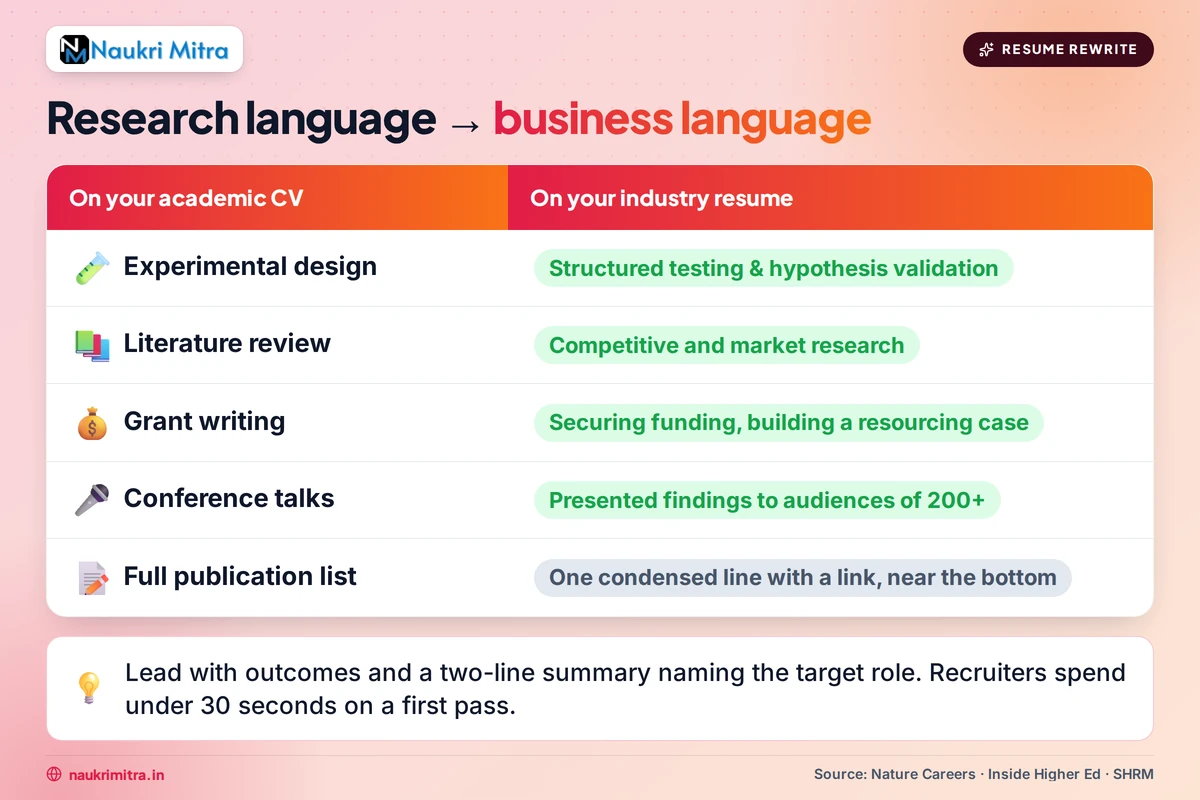
Nothing exposes the academia-industry gap faster than a CV. Academic CVs are inventories: every publication, poster, and grant, listed in full across six or eight pages, reverse-chronological by submission date. Recruiters at most Indian companies spend under thirty seconds on a first resume pass. Open with "Dissertation: A Comparative Study of..." and you've likely lost them before reaching your actual skills. Building the kind of PhD resume for private sector India roles actually reward starts with inverting the whole document: measurable outcomes at the top, a tight two-line summary stating the target role in plain words, and a "Research Experience" section written like project descriptions, not an abstract.
Concretely, "designed and executed a longitudinal study examining X under conditions Y" becomes "designed and ran a multi-stage study (n=450) with full ownership of methodology, analysis, and reporting; findings informed three downstream decisions." Publications still matter, but belong near the bottom, condensed to a line with a link, not spelled out APA-style. Conference talks become "presented findings to audiences of 200+," which reads as public speaking and stakeholder communication. The real skill is translating research language into business language: "experimental design" becomes "structured testing and hypothesis validation," "literature review" becomes "competitive and market research," and "grant writing" becomes "securing funding and building a resourcing case" — all honest, just stripped of jargon that means nothing outside a department seminar.
Where Indian Companies Actually Hire PhDs
The honest answer to "how to get industry job after PhD India" questions starts with knowing where demand actually sits, because it isn't evenly distributed. Pharmaceutical and biotech firms such as Biocon, Dr. Reddy's, and Syngene, along with multinational R&D centres in Hyderabad and Bengaluru, hire life-sciences PhDs directly into research and regulatory roles. Government and quasi-government labs — DRDO, CSIR's constituent institutes, and ISRO — continue absorbing STEM doctorates into the kind of applied R&D roles India relies on but that sit closer to industry timelines than pure academic research, making them a useful bridge if a full corporate jump feels abrupt.
Beyond lab-to-lab moves, there's a far wider set of non-academic jobs for PhD holders India offers that rarely surface in a literature search but absorb plenty of transitioning researchers: data science and analytics at IT firms and startups, UX and product research, strategy consulting, policy roles at think tanks, patent analysis, and market research. A biostatistics PhD can move into a data analyst role with a short SQL refresher; a social sciences PhD can often step directly into user research or research-analyst work. To see what these roles look like day to day, postings for a data analyst role in Bangalore, a market research analyst position in Bangalore, or a content writer opening in Bangalore are a reasonable benchmark for the skills employers actually want.
The Stipend-to-CTC Shock: Setting Realistic Salary Expectations
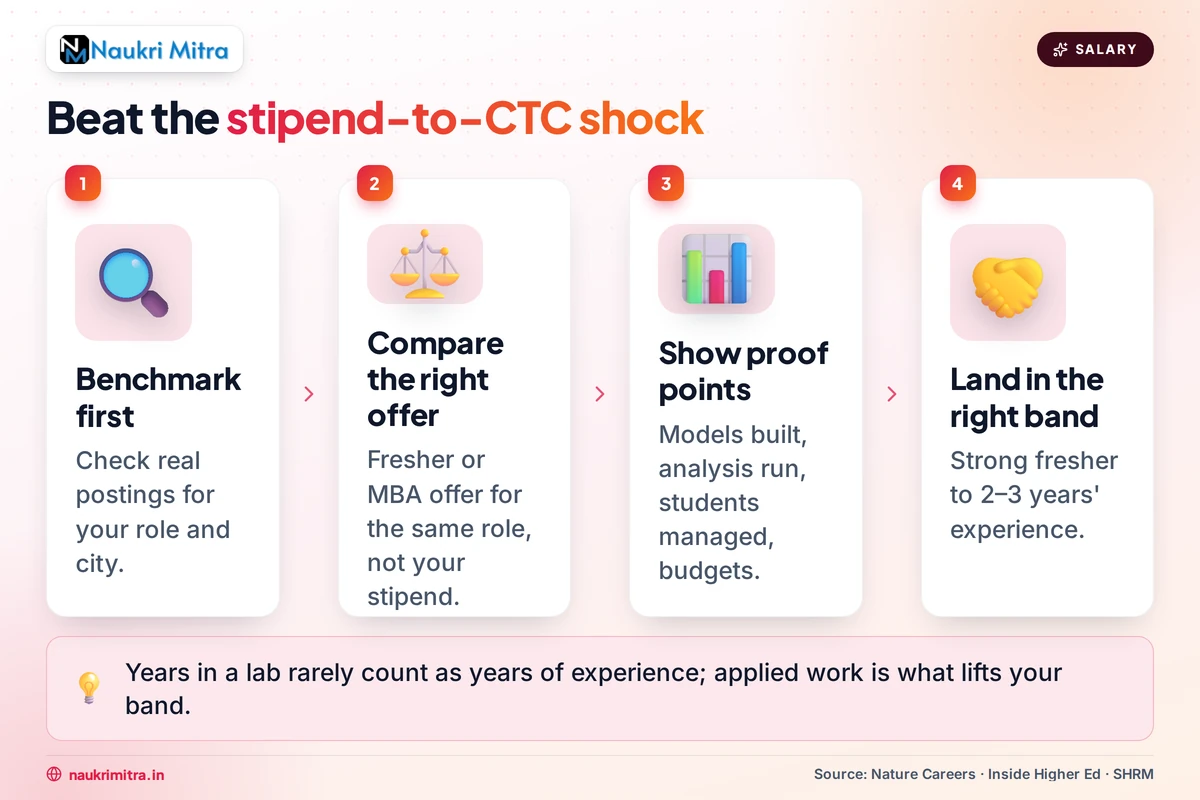
This is where well-prepared candidates stumble, emotionally more than practically. After years on a fellowship or postdoc stipend that barely covered rent, even an average industry offer can look enormous — which is exactly the trap. The comparison that matters isn't stipend versus CTC; it's your offer versus what a fresher with a master's degree, or an MBA graduate, is offered for the same role at the same company. A PhD without directly relevant industry experience should generally expect a package somewhere between a strong fresher offer and a two-to-three-year-experience package, not a senior-level number just because of years spent in the lab.
Closing the salary gap between academic stipend expectations and industry offers is partly negotiation and partly framing. If your research involved building models, running statistical analysis, managing junior students, or handling a budget, say so explicitly during compensation talks — these are proof points that justify a band above "fresh graduate." Don't expect years-of-PhD to automatically convert into years-of-experience credit; most Indian employers weigh applied experience far more than tenure in a lab. A realistic approach is benchmarking a few actual job postings in your target function and city before the first interview, so your number is anchored to market data, not to what felt fair relative to a stipend.
Do You Need a Certification Before You Apply?
Sometimes, and usually a smaller dose than people assume. A short data science or product management certificate won't erase years of academic signalling by itself, but it does two useful things. It gives recruiters a concrete, recent credential that signals you've been actively building toward this move rather than defaulting to it after a stalled academic search. And it forces you to build a small portfolio of applied work — a dashboard, a model, a user research write-up, a short case study — that you can actually walk an interviewer through.
That portfolio matters more than the certificate itself. The strongest evidence you can bring to an interview isn't a transcript; it's two or three concrete artefacts that show applied thinking: a documented code repository if you're going technical, a short case memo for consulting or strategy, or a sample research report with a clear "so what" for market or UX research. Build these before applying seriously, not after a rejection convinces you that you need "more proof." They also solve a narrower, very real problem: closing the academia industry resume gap where your experience section technically lists relevant skills but nothing concrete an interviewer can probe.
Building a Network When Your Contacts Are All Academics
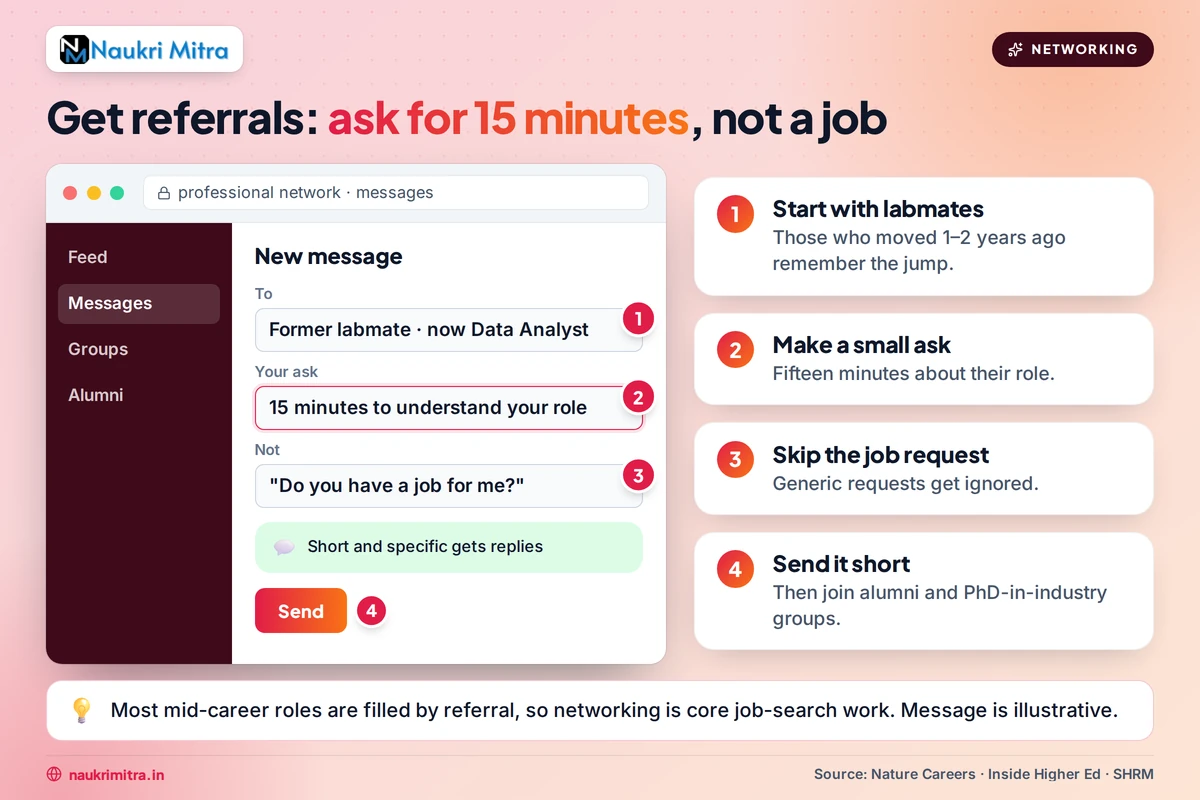
Most academic networks are built for citations and collaborations, not job referrals, and that becomes obvious the moment you start applying. Industry hiring, especially for mid-career entries like a transitioning PhD, leans heavily on referrals rather than cold applications through a careers portal. The practical starting point is closer than it feels: former labmates and classmates who made this jump a year or two ago remember exactly how disorienting it is, and tend to be the most receptive audience you have. A short, specific message asking for fifteen minutes to understand their role — not a job outright — gets answered far more often than a generic connection request.
University alumni groups, LinkedIn communities built around "PhDs in industry," and informational chats with people one step ahead of you on this path are disproportionately useful compared to general networking events. Christopher Caterine, a classics PhD who left a university teaching role and wrote a widely discussed guide on this transition, makes a point echoed across most academia-to-industry accounts: most mid-career roles are filled by referral rather than open application, which makes relationship-building a core job-search task, not an afterthought.
Interview Day: Framing Your PhD Without Sounding Like a Seminar
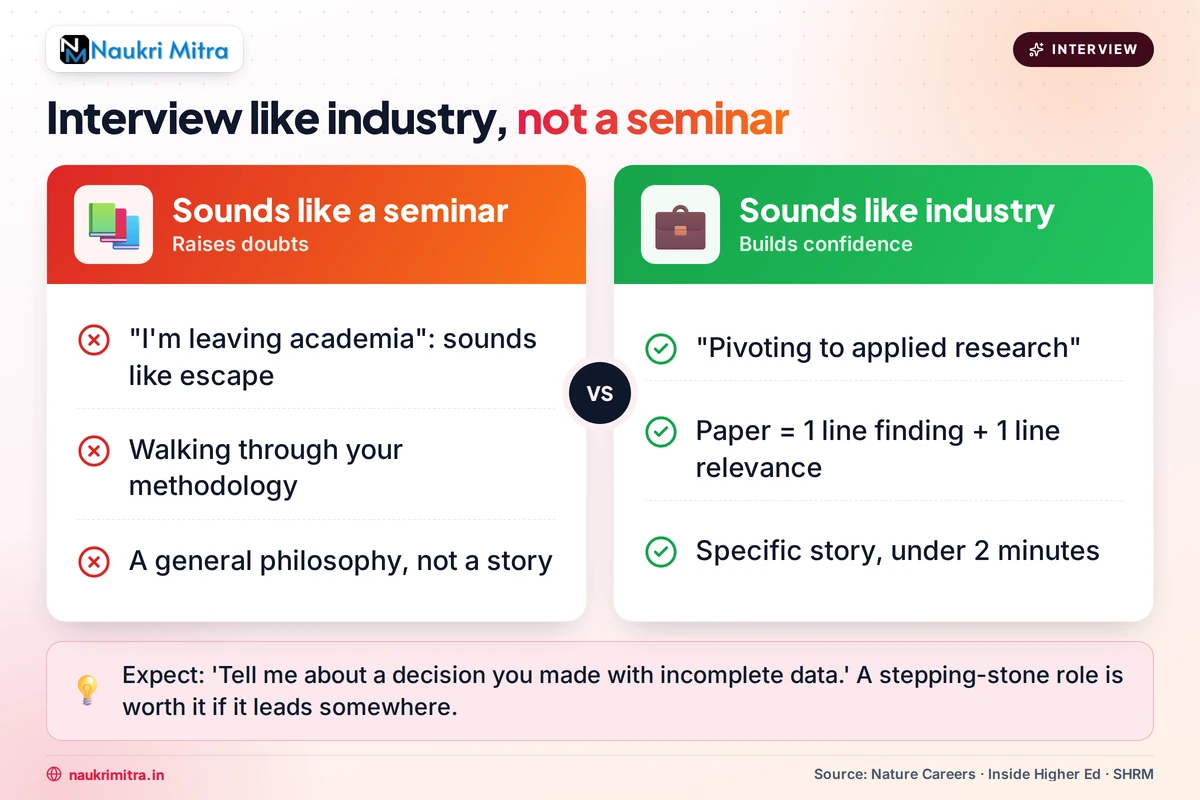
Industry interviewers, especially at fast-moving companies, are often quietly testing one thing: can this person operate without the long runway academia gave them? Expect questions probing comfort with ambiguity, shifting priorities, and shipping something imperfect on a deadline rather than refining it for another six months. "Tell me about a decision you made with incomplete data" or "describe a project where the goalposts moved midway" are common versions of this test. Answer with a specific story, not a general philosophy, and keep it under two minutes.
There's also a framing choice worth making before you walk in: do you describe this as "leaving academia," or as "pivoting to applied research"? Both are honest, but they land differently — the first can sound like escape, which invites a "will you jump again" worry; the second frames the same decision as intentional. Use whichever is true for you, but be conscious the words you choose shape how the interviewer reads your motivation. On publications, keep it short: name the contribution in one sentence, state the real-world relevance in another, and move on — interviewers want proof you can simplify complex work, not the methodology.
How Long This Actually Takes, and Whether a "Lesser" Role Is Worth It
There's no single honest number, but researchers who make this move successfully describe a window of roughly three to nine months of active searching after deciding to leave — longer if the target function, say consulting or product management, is unrelated to their research domain, shorter for an adjacent technical role like data science from a quantitative PhD. The variance mostly comes down to how early you start building the translated resume and portfolio described earlier, rather than starting the search only after submitting a thesis.
On the harder question — is it worth taking a role that feels like it undervalues your PhD just to get a foot in the door — the honest answer is usually yes, with one condition: take it if it's a genuine stepping stone toward the function you actually want, and skip it if it's just "a job" with no path forward. A PhD who takes a junior data analyst role at a company with a strong data science team, planning to move internally within eighteen months, is making a calculated trade. One who takes any available desk job just to stop the anxiety usually ends up searching again within a year anyway.
STEM vs Humanities, and Coming Back From a Postdoc Abroad
The path looks different by discipline. STEM PhDs, particularly in computational fields, chemistry, and engineering, generally have a more direct runway into analytics and technical consulting, because the hard skills map obviously onto job descriptions. Humanities and social sciences PhDs face a steeper translation problem on paper, but often undersell genuinely scarce skills — rigorous qualitative research, long-form writing, and synthesising unstructured information — that are in real demand in user research, policy, think tanks, and content strategy. The work here is less about acquiring new skills and more about naming the ones you already have in terms a recruiter searches for.
For researchers returning to India after a stint abroad, the research scientist to industry or postdoc to corporate move carries an extra layer: recalibrating to Indian salary bands, which are typically lower in absolute terms than US or European offers even at comparable seniority, rebuilding a local network largely from scratch, and being ready to explain a multi-country academic trajectory concisely rather than chronologically. Returning postdocs sometimes overindex on international pedigree in interviews; Indian hiring managers care more about what you can do for their team in the next two quarters than about the prestige of the lab you left.
Surviving (and Negotiating) Your First Year in Industry
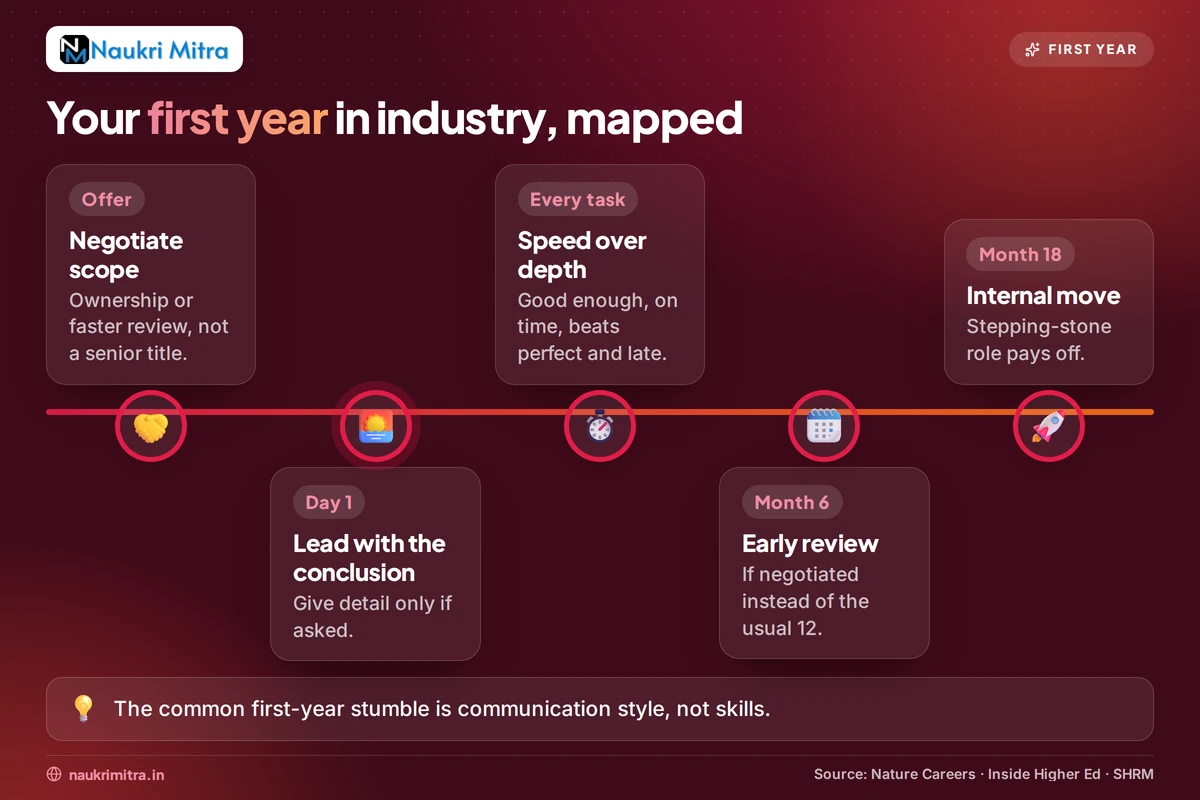
The most common first-year stumble isn't a skills gap, it's a communication-style mismatch. Academic training rewards hedging and exhaustive thoroughness; most businesses reward concise recommendations delivered on time, even if imperfect. New hires from academia often over-deliver on depth and under-deliver on speed, which can show up as a lukewarm first performance review despite genuinely strong analytical work. The fix is leading with a conclusion, then offering supporting detail only if asked — the inverse of how a thesis defence works.
On designation, it's reasonable to negotiate based on the complexity of work you'll own and the people you'll influence, not purely on years of research experience. A hiring manager will generally resist a senior title with no direct reports or budget ownership just because you spent years earning a doctorate; they'll be far more receptive to negotiating scope, project ownership, or a faster promotion review, say at six months instead of twelve, tied to demonstrated performance. SHRM's recent talent-trends research notes that even amid hiring slowdowns, employers are still actively competing for candidates who can demonstrate applied, immediately usable skills — exactly the positioning a well-prepared transitioning PhD can credibly claim.
None of this requires abandoning what you built in academia — it requires repackaging it for an audience with different defaults for how evidence gets presented. Researchers who make this move smoothly treat the job search like a small research project: they gather data on what roles actually pay, test their resume and pitch through informational chats before the stakes are high, and revise based on what lands. If you're actively applying, it's worth regularly browsing current openings on the Naukri Mitra homepage to keep an up-to-date sense of what roles and skills your city actually demands, rather than planning around outdated assumptions about what "industry" wants from a PhD.
Frequently Asked Questions
Will a hiring manager assume I'm a flight risk because of my PhD?
Some will, especially for generalist roles. Reduce this by explaining, briefly and specifically, why this function and company fit your longer plan rather than leaving them to guess.
Do I need a certification before applying for my first industry role?
Not always, but a short, targeted course paired with one or two portfolio projects meaningfully strengthens an application where your resume shows no applied, non-academic evidence of the skill.
What salary should I realistically expect compared to a fresher or MBA graduate?
Expect a band closer to a strong fresher or someone with two to three years of applied experience, unless your research directly overlaps with the role's technical requirements, in which case you can push higher.
How do I explain my publications in an interview without sounding academic?
State the finding in one plain sentence, its practical relevance in a second, and stop. Interviewers are assessing your ability to simplify, not testing your methodology.
Should I say I'm "leaving academia" or frame it differently?
Framing it as moving your research into a faster-moving, applied setting generally lands better than language implying you're escaping research altogether.
How long does a typical academia-to-industry transition take in India?
Most successful transitions take roughly three to nine months of focused searching — shorter for closely adjacent technical roles, longer for a complete functional change like consulting.
Do DRDO, CSIR, or ISRO count as a middle step between academia and private industry?
Yes. For many STEM researchers these government and quasi-government R&D roles are a genuine bridge, offering more applied, deadline-driven work than a university lab while still valuing deep domain expertise.
Is a humanities or social sciences PhD at a disadvantage moving into industry?
Not fundamentally, though the translation work differs; qualitative research, synthesis, and long-form communication are genuinely scarce skills, valuable in user research, policy, and content-strategy roles once reframed.
What's the biggest adjustment in the first year of an industry job after a PhD?
Leading with a short, confident conclusion instead of exhaustive caveats, and getting comfortable delivering good-enough work on deadline rather than a perfect answer late.
Can I negotiate a senior title based on my years of research experience?
Usually not on tenure alone; it's more productive to negotiate scope, team influence, or a faster review cycle than to push for seniority that doesn't match your applied experience yet.
Sources: Nature Careers, "Three actions PhD-holders should take to land their next job"; Inside Higher Ed, "Author discusses his book on leaving academia"; SHRM, "Uncertain Economy Adds to Recruitment Challenges".
.png)
.png)
.png)
Comments
Post a Comment