Finding a Job After Retirement in India | Naukri Mitra
Sixty is not a closing bell anymore. Walk into any co-working space in Pune or Bengaluru on a Tuesday afternoon and you will likely spot a silver-haired professional on a video call, advising a startup on compliance or mentoring a 26-year-old product manager. Retirement in India used to mean a gold watch, a garlanded farewell photo, and a long stretch of unstructured mornings. For a growing number of retirees, it now means a second innings — shorter hours, lower stress, and work chosen on their own terms rather than imposed by a boss thirty years younger.
This guide is built around the practical question of how to find a job after retirement India, without wasting months chasing dead ends or falling for a scam that preys on exactly this moment in life. We will walk through the government's own registration system, the sectors genuinely hiring older workers, how to fix a resume that has not been touched in decades, and the money questions — pension, tax, EPS — that trip up almost every retiree who takes up paid work again.
Retirement Is a Comma, Not a Full Stop
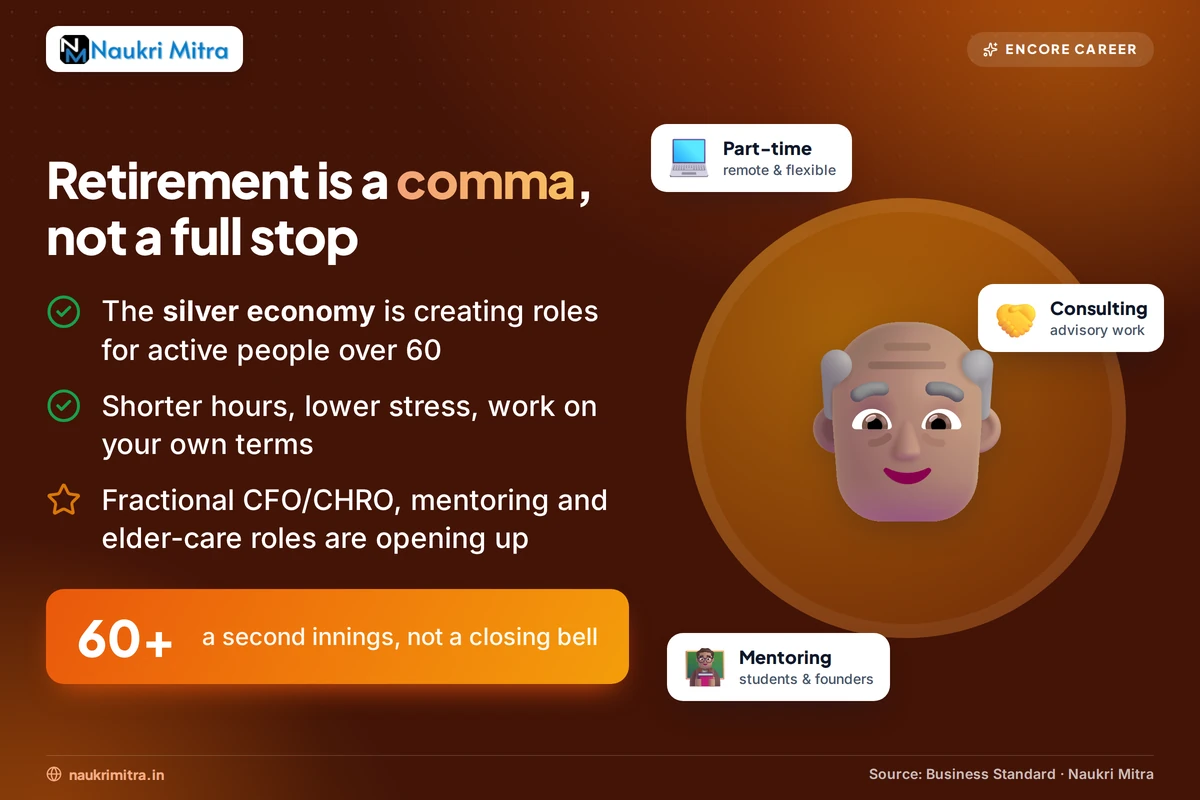
Economists now talk about India's "silver economy" — the cluster of jobs, services, and consumer demand created by a fast-growing population of healthy, active people over 60. It covers everything from senior living management and elder-care coordination to part-time teaching, consulting, and advisory board seats. Companies have realised that a 63-year-old former bank manager or a retired school principal brings judgment, patience, and domain knowledge that a fresh graduate simply has not had time to acquire yet.
Retiree re-employment is quietly becoming normal rather than exceptional in urban India, and a useful way to think about this stage is the idea of an "encore career" — a deliberately chosen second act that may pay less than your peak salary but gives you purpose, structure, and a reason to set an alarm. A Business Standard column on India's ageing population makes exactly this case: many seniors are "perfectly healthy and willing to engage in some kind of productive work," and businesses that tap into this group — through fractional CFO or CHRO roles, mentoring programmes, or elder-focused services — are sitting on what the piece calls a potential "second demographic dividend." That shift in framing, from dependency to contribution, is exactly what is opening doors that did not exist for your parents' generation.
Register on the SACRED Portal First
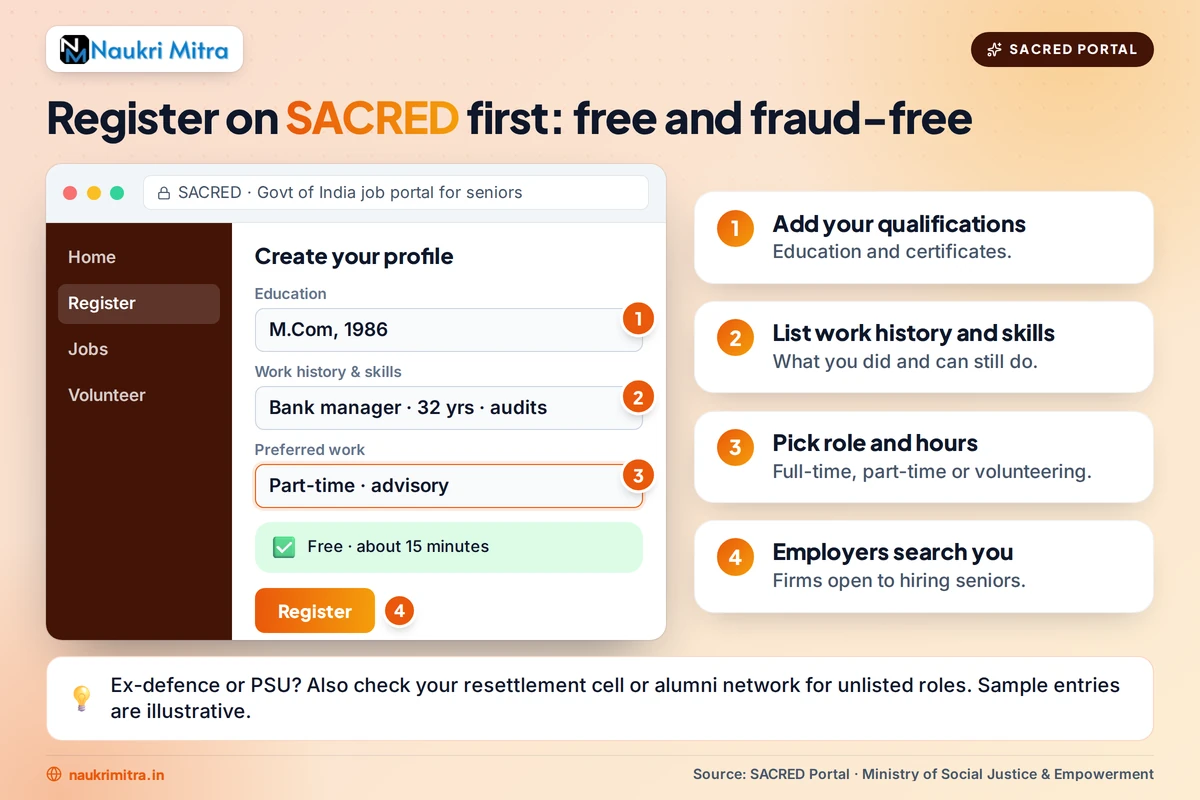
Before you start cold-emailing former colleagues, do the one administrative task that costs nothing and takes fifteen minutes: complete your SACRED portal senior citizens registration on the Government of India's official job portal for seniors, run by the Ministry of Social Justice and Empowerment. SACRED — Senior Able Citizens for Re-Employment in Dignity — exists specifically to connect retirees with employers who are open to hiring older candidates, and it also lists volunteering and part-time opportunities alongside full-time ones.
To use the SACRED job portal, you create a profile with your education, work history, skills, and the kind of role or hours you want, and employers who are specifically looking to hire seniors can search that database. It is not glamorous and the listings skew toward banking, security, teaching, and administrative roles, but it is a free, fraud-free starting point — something that matters a great deal once you understand how many scams specifically target job-seeking older citizens, which we will get to later. Retired defence personnel and PSU employees should also check their own service's resettlement or empanelment cells; the Directorate General of Resettlement for ex-servicemen and similar PSU alumni networks often circulate consulting, security-advisory, and project-management assignments that never reach public job boards, and your old employer's HR or welfare association is usually the fastest way to find them.
Which Jobs Actually Hire People Above 60 in India
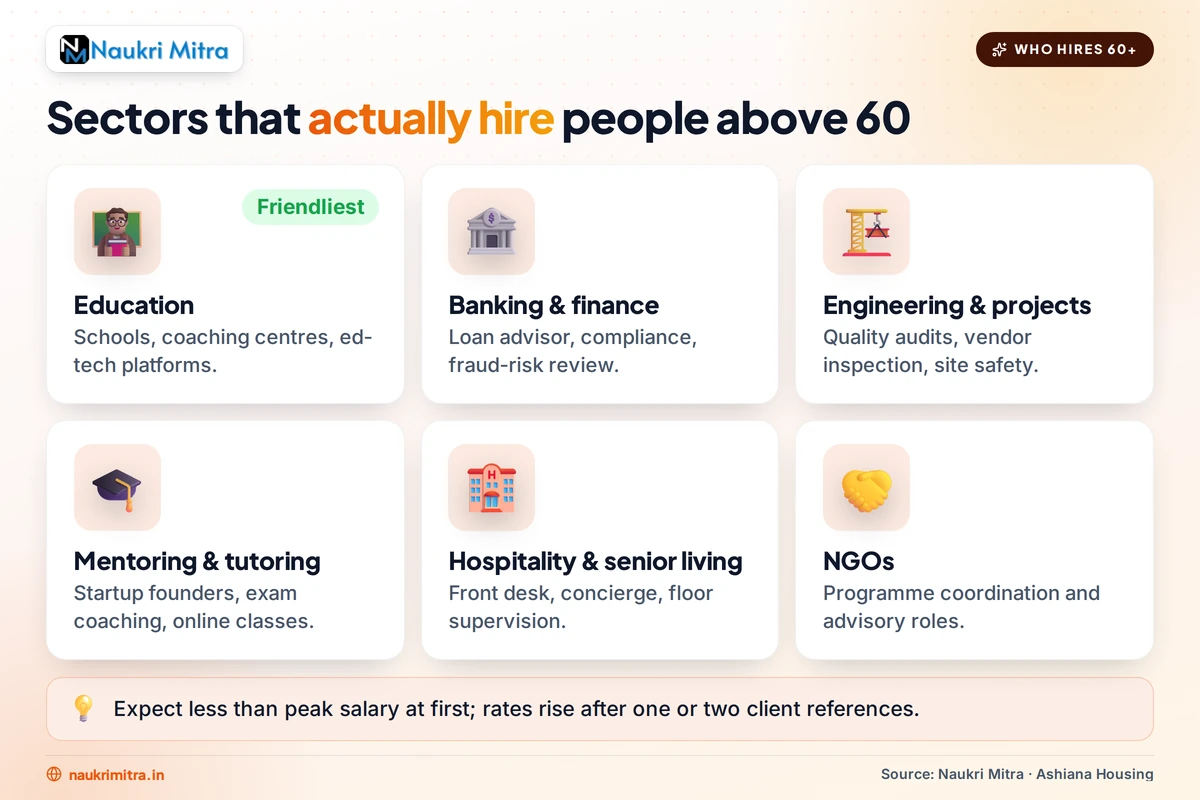
If you are looking for jobs for retired persons India, the honest answer is that some sectors are far more open than others. Education is probably the single friendliest field: schools, coaching centres, and ed-tech platforms regularly hire retired teachers, principals, and subject-matter experts for part-time classes, exam coaching, and curriculum review. Retired bankers and finance professionals find steady work as loan advisors, compliance consultants, or fraud-risk reviewers, since regulators value experience over youth here. Retired engineers and project managers often move into quality audits, vendor inspection, or site-safety consulting for smaller firms that cannot afford a full in-house senior hire.
Mentoring and tutoring deserve a special mention because they consistently rank among the best careers for retirees in India when stress tolerance and schedule flexibility matter more than income. A retired professional can mentor startup founders through formal programmes, coach students for competitive exams, or run subject-specific online classes for a few hours a week. If tutoring appeals to you, browsing online tutoring openings across subjects is a reasonable way to see what schedules and pay ranges are realistic before committing. Hospitality, retail floor supervision, front-desk and concierge roles at senior-living complexes, and NGO programme coordination round out the list of sectors that tend not to flinch at a candidate's age. A roundup from Ashiana Housing on jobs for senior citizens after retirement adds a few more worth considering, including property management, blogging, and sports coaching, alongside specialised retiree-hiring platforms that now exist specifically to place experienced candidates.
On pay, be realistic rather than discouraged: most post-retirement roles pay a fraction of a peak-career salary, especially in the first year, because you are usually trading income for flexibility. Part-time consulting assignments often pay by the hour or per deliverable, while structured roles like tutoring or advisory retainers may offer a modest fixed monthly amount. Treat the first assignment as a foot in the door rather than a final number — rates tend to rise once you have one or two client references.
Full-Time, Part-Time, or Consulting — Choosing Your Format
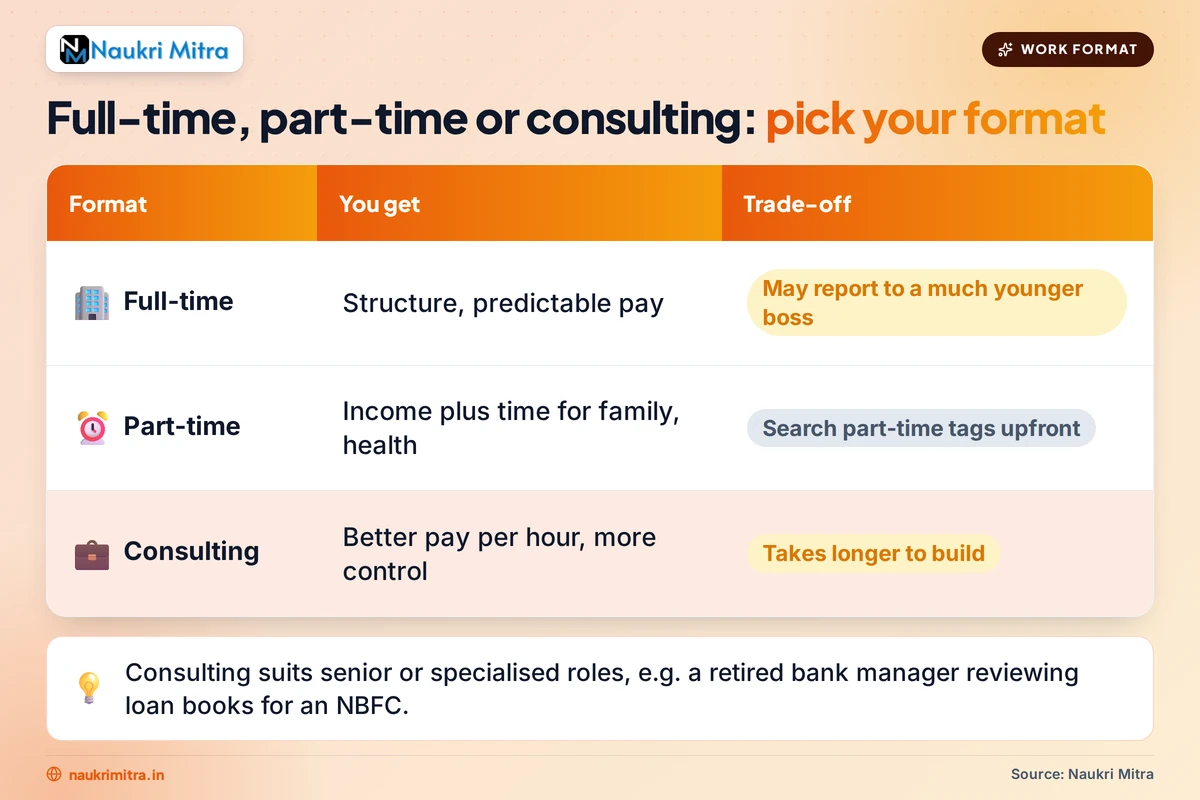
Before you apply anywhere, decide what shape of work you actually want. A full-time job gives structure and a predictable pay cheque but can feel like a step backward if you are reporting to a much younger manager with little patience for your experience. Part time work for senior citizens India has grown considerably because it suits both sides: employers get experienced help without a full salary commitment, and retirees get income without sacrificing travel, grandchildren, or health routines. If your calendar needs to stay flexible, actively search for roles tagged part-time rather than hoping a full-time employer will informally accommodate you later — it rarely works out that way.
Post-retirement consulting is the other major route, and it tends to suit people who held senior, specialised, or client-facing roles. Instead of applying for a "job" in the traditional sense, you position yourself as an independent advisor — a retired HR head doing policy and compliance consulting, a retired bank manager reviewing loan books for an NBFC, a retired factory manager auditing safety processes for two or three smaller clients. This path takes longer to build but usually pays better per hour and gives you more control over your time. If you want a sense of what structured advisory and career-guidance work looks like day to day, reviewing listings such as virtual career development advisor positions is a useful benchmark, even if you eventually negotiate your own independent terms. For a lighter, administrative starting point that many retirees use to re-enter the workforce gently, part-time virtual assistant roles require minimal retraining and let you test remote work habits before committing to anything heavier.
Rebuilding Your Resume, LinkedIn, and Network
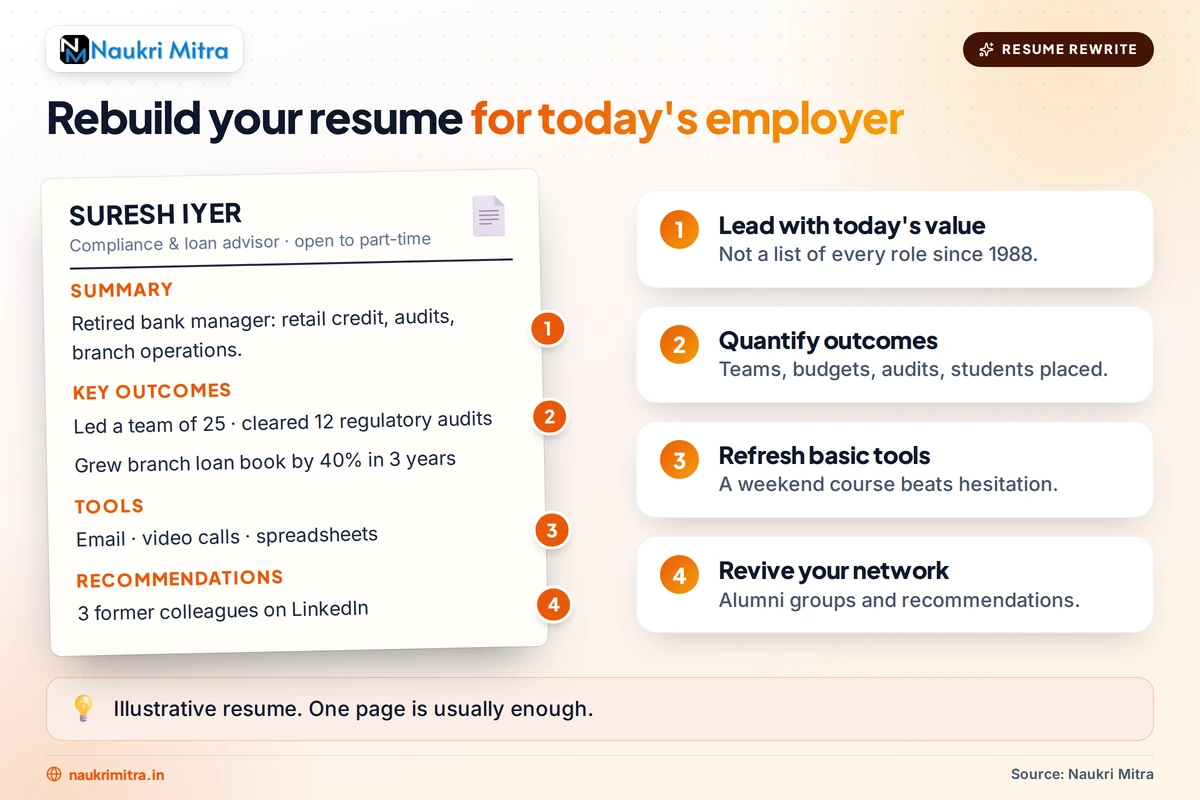
If your resume was last updated when you were applying for your current job twenty years ago, treat the rewrite as a project, not a touch-up. Drop the chronological list of every role since 1988 and instead lead with a short summary of what you can do for an employer today — the industries you understand, the problems you have solved, and the specific outcomes you achieved. One page is usually enough. Quantify wherever you can: teams managed, budgets handled, audits cleared, students placed. Recruiters scanning dozens of applications respond to numbers far more than to job titles alone.
LinkedIn deserves real effort even if you have never used it seriously. Upload a clear, recent photo, write a headline that states what you are looking for now rather than your old designation, and ask two or three former colleagues for recommendations — a few credible endorsements do more for your credibility than a long list of connections. Rejoin alumni groups from your old company or college; this is also the fastest way to rebuild a professional network that has gone quiet since you stopped commuting to an office every day. Many retirees land their first post-retirement assignment not through a job portal but through a former colleague who remembered they were looking.
On skills, be selective rather than trying to learn everything at once. If your target role involves video calls, spreadsheets, or basic presentation software, invest a weekend in a short refresher course rather than assuming you will pick it up on the job — interviewers notice hesitation with basic tools quickly. You do not need to become a coder or a social media expert; you need enough comfort with email, video conferencing, and a spreadsheet to not slow down a younger team.
Handling Age Bias in Interviews
Age bias is real, but it is rarely stated out loud — it shows up as a vague "we're looking for someone who can grow with the role long-term" or a hiring manager who seems surprised you are comfortable with technology. The best response is to address the unspoken concern directly and briefly: mention that you are specifically seeking a part-time or fixed-term arrangement, that you are comfortable reporting to a younger manager, and that you have deliberately kept your skills current. Confidence without defensiveness tends to work better than over-explaining.
It also helps to interview a company as much as it interviews you. A firm that has clearly thought through how to use experienced part-time talent — flexible hours, remote options, clear scope — is a better long-term fit than one that seems unsure why they even called you in. If an interviewer's questions feel inappropriate or entirely focused on your age rather than your capability, it is a reasonable signal to keep looking rather than push harder for that particular role.
Money Matters: Pension, Tax, and Realistic Pay
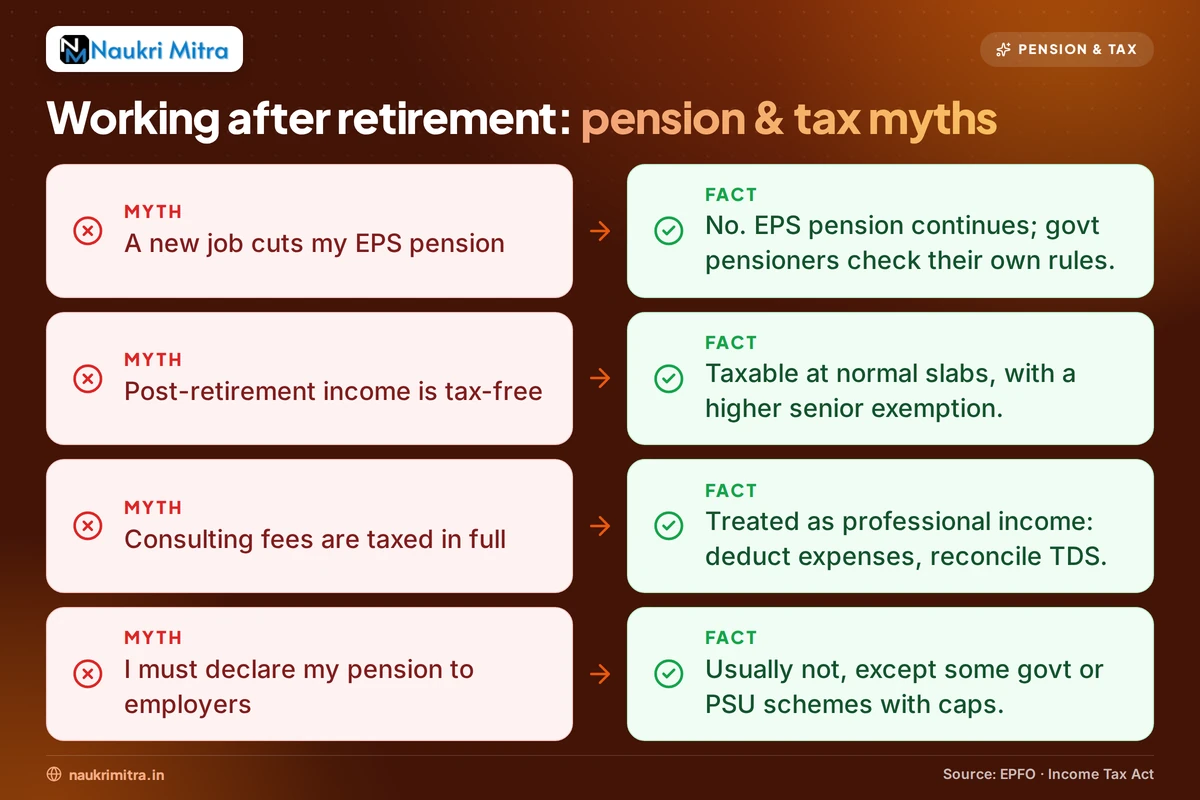
A question almost every retiree eventually asks is how taking up paid work affects their pension. If you were covered under the Employees' Pension Scheme (EPS) through EPFO, your monthly EPS pension is not reduced simply because you take up new paid work, whether salaried or consulting — EPS pension and post-retirement earnings are treated separately, though it is worth confirming your specific case with EPFO or a financial advisor if your pension involves commutation or a government service pension with its own re-employment rules, since central and state government pensioners sometimes face different conditions on taking up further government or PSU work.
On tax, income earned after retirement — salary, consulting fees, or honorarium — is taxable under the normal income tax slabs applicable to senior citizens, which do carry a higher basic exemption limit than for younger taxpayers. Consulting income is usually taxed as professional income, which means you can also claim related expenses before arriving at taxable profit, and clients paying you professional fees above a threshold will typically deduct TDS, which you reconcile at the time of filing your return. Keep basic records of payments and expenses from day one rather than scrambling at tax-filing time.
Whether or not to disclose your pension income to a prospective employer depends on context: for a salaried role, it is not usually required information and has no bearing on your eligibility, though for certain government re-employment or empanelment schemes you may be specifically asked to declare it as part of eligibility rules. When in doubt, read the specific application form rather than assuming one rule applies everywhere — some senior citizen employment exchange listings and PSU empanelment schemes do have income or pension caps attached to them, so check before applying rather than after.
Protecting Yourself from Job Scams Targeting Seniors
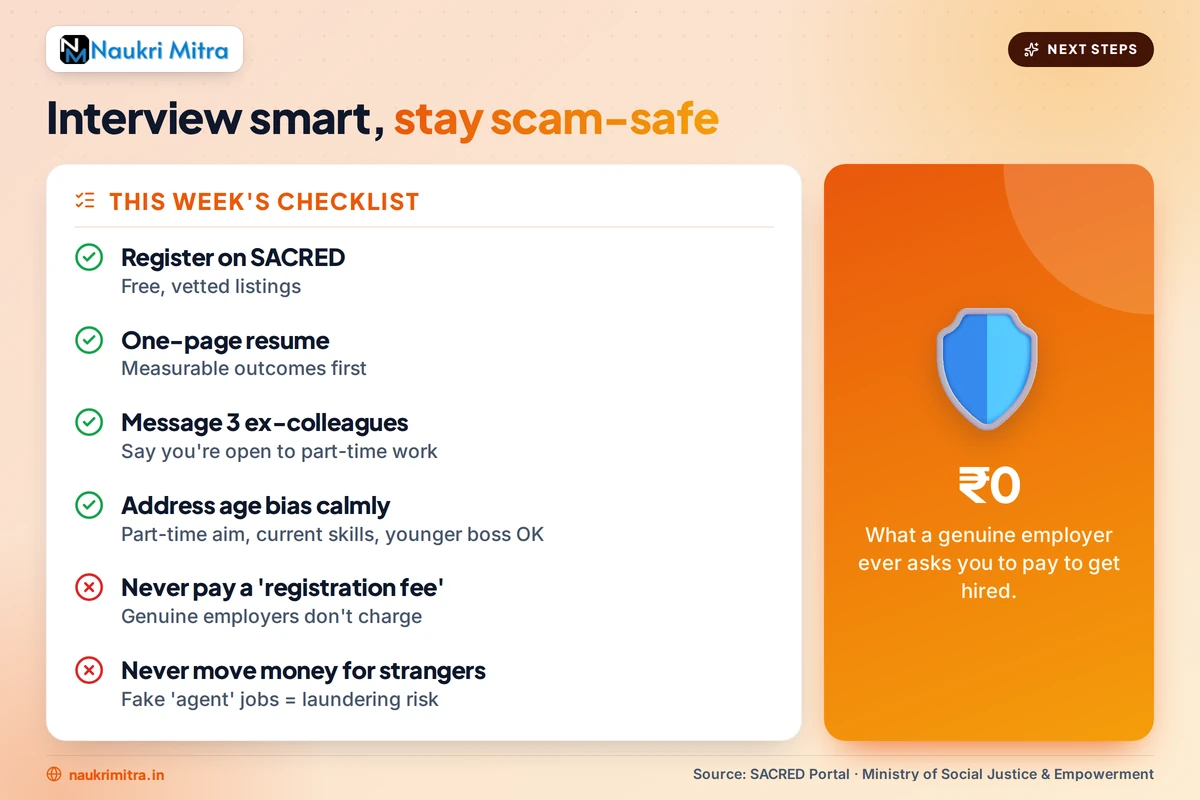
Unfortunately, the same qualities that make retirees attractive to legitimate employers — savings, trust, and time on their hands — also make them a favourite target for fraud. Common scams include "registration fee" job offers that ask for money upfront before any interview, work-from-home data-entry schemes that never actually pay, and fake courier or banking "part-time agent" roles that ask you to receive and forward money, which can expose you to money-laundering liability without your knowledge. A genuine employer does not ask a candidate to pay to be hired, and a genuine part-time job does not require you to use your own bank account to move money for strangers.
Stick to recognised channels — your own professional network, verified portals, and government platforms such as the SACRED portal, where listings are vetted rather than posted anonymously — and treat any offer that promises unusually high pay for unusually little work as an immediate red flag. If something feels rushed, secretive, or dependent on moving money quickly, step away and verify independently before responding further.
Where to Start This Week
Pick two or three concrete actions rather than trying to fix everything at once: register on SACRED, rewrite your resume to one page with measurable outcomes, and reach out to three former colleagues to say you are open to part-time or consulting work. You can browse current openings and compare pay expectations across sectors on Naukri Mitra, which lists part-time, remote, and consulting roles alongside traditional full-time positions. Momentum matters more than perfection here — the first small assignment almost always leads to the next one.
Frequently Asked Questions
What is the SACRED portal and how do I register on it?
SACRED is the Government of India's official portal that matches senior citizens with employers open to hiring them, run by the Ministry of Social Justice and Empowerment. Registration is free: you create a profile with your qualifications, work history, and preferred work type, and employers search that database directly.
Do I need to disclose my pension income to a prospective employer?
For most private-sector salaried or consulting roles, no — your pension has no bearing on your eligibility and employers rarely ask. Some specific government re-employment or empanelment schemes do ask you to declare it, so always check the application form for that particular opportunity.
Will taking a new job affect my EPS or pension payout?
Generally no — an EPS pension through EPFO continues independently of any new salaried or consulting income you take up afterward. Government service pensioners should separately confirm re-employment conditions with their specific pension department, as rules can differ there.
Can I work part-time while still drawing a pension, and are there restrictions?
Yes, in most cases, especially for EPS and private pension income, which is unaffected by subsequent earnings. A small number of government and PSU re-employment schemes do carry income or pension-linked caps, so it is worth checking the specific scheme's rules before applying.
What's a reasonable salary expectation for a post-retirement role?
Expect roles to pay noticeably less than your peak-career salary, particularly in the first assignment, since you are typically trading income for flexibility and lighter hours. Part-time and consulting work is often priced hourly or per project, and rates tend to improve once you have a couple of client references behind you.
What tax implications apply to income earned after retirement?
Salary, consulting fees, or honorarium earned after retirement is taxable under normal income tax slabs, with a higher basic exemption available to senior citizens. Consulting income is generally treated as professional income, letting you deduct related expenses, and clients may deduct TDS that you reconcile when filing your return.
How do retired defence or PSU employees find post-retirement empanelment opportunities?
Most defence and PSU organisations maintain resettlement cells, alumni associations, or empanelment lists specifically for retired staff, and these often circulate consulting, advisory, or security roles that never appear on public job boards. Staying in touch with your former department's welfare or HR association is usually the fastest route to these listings.
What is "silver economy" employment, and which companies hire for it?
It refers to the growing cluster of jobs and services built around India's active, older population — senior living management, elder-care coordination, mentoring programmes, and fractional leadership roles among them. Senior-living developers, ed-tech platforms, consulting firms, and specialised retiree-hiring platforms are among the employers actively building in this space.
What non-traditional income options like mentoring or tutoring suit retirees?
Mentoring startup founders, coaching students for competitive exams, running subject-specific online tuition, and volunteering with NGOs in an advisory capacity are all realistic options that trade a full salary for flexible, low-stress hours. Many retirees start here precisely because the time commitment is easy to control.
Sources: SACRED Portal, Ministry of Social Justice and Empowerment, Government of India; Business Standard, "Ageing challenge & opportunity: How active seniors can fuel economic growth"; Ashiana Housing, "11 Best Jobs for Senior Citizens After Retirement".
.png)
.png)
.png)
Comments
Post a Comment