Salary Not Paid? Your Legal Options | Naukri Mitra
A Pune-based marketing executive once told a labour lawyer a simple fact: her salary had been late by four to seven days every single month for a year, and each time HR had an excuse ready before she even asked. She never complained, because she assumed unpaid or delayed wages were a grey area with no real legal teeth. They are not. Salary is not a favour an employer extends when cash flow allows — it is a statutory obligation with fixed deadlines, a named authority to approach, and a time limit within which you must act. If your pay hasn't landed on time, or hasn't landed at all, this guide walks through exactly what the law says and what you can actually do about it.
When Must Your Employer Legally Pay You?
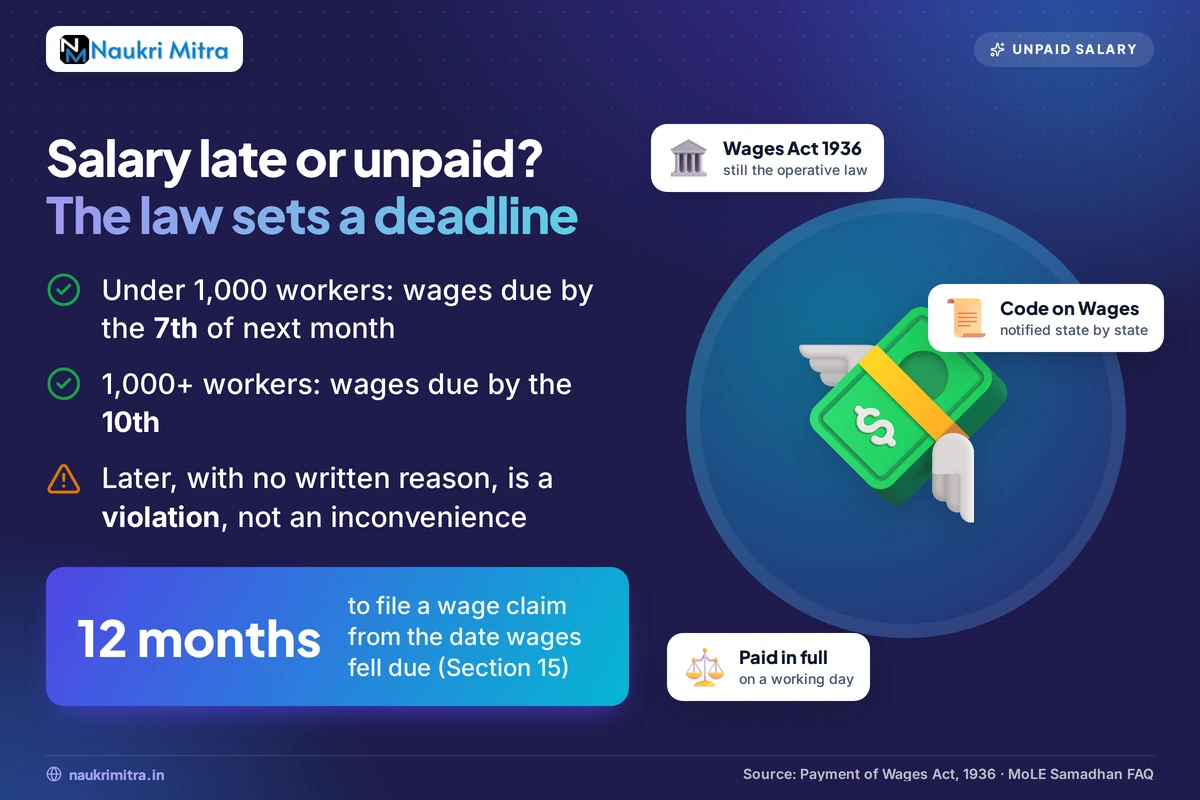
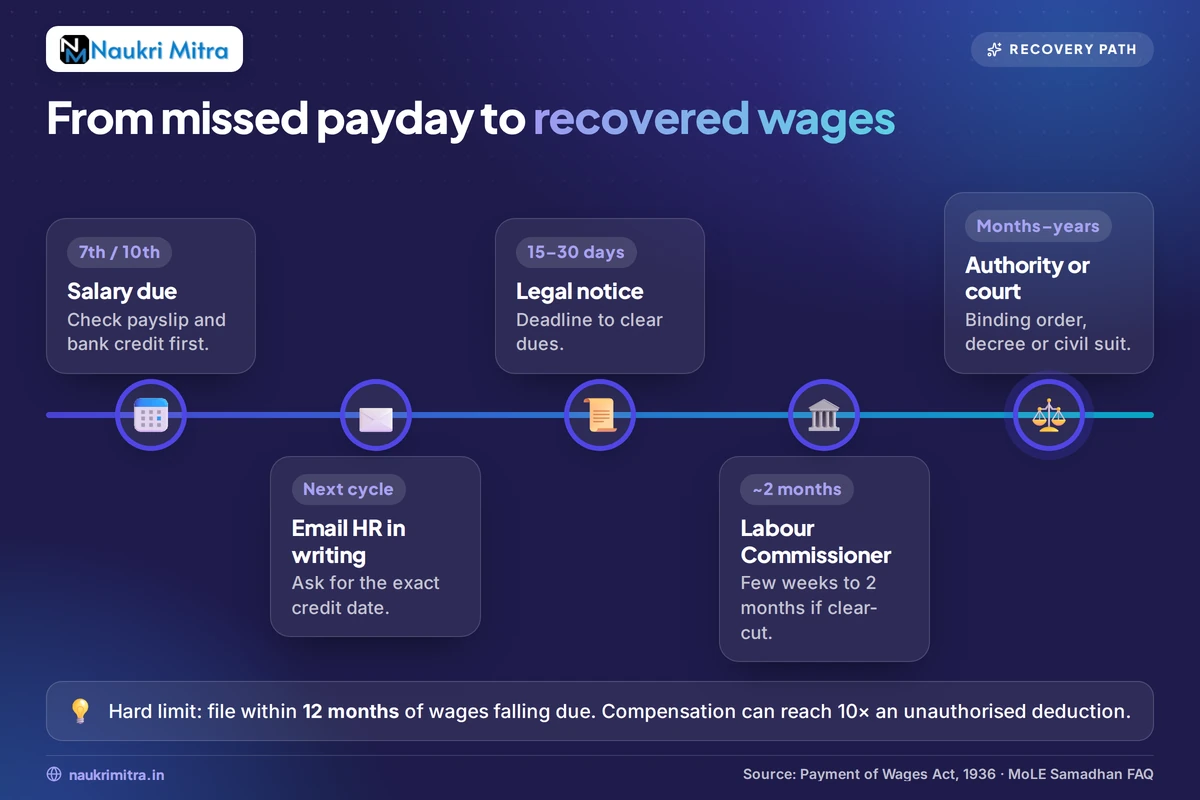
The central law governing wage payment timelines in India is the Payment of Wages Act, 1936, which applies to most establishments where employees earn wages below a notified ceiling (periodically revised, and currently covering the large majority of salaried workers in factories, shops, and commercial establishments). Under this Act, an employer with fewer than 1,000 workers must disburse wages by the 7th of the following month, and establishments with 1,000 or more employees get until the 10th. Wages must also be paid in full, without unauthorised deductions, and on a working day.
A newer framework, the Code on Wages, 2019, has been passed by Parliament and consolidates the Payment of Wages Act along with the Minimum Wages Act, the Payment of Bonus Act, and the Equal Remuneration Act. Its rules have been notified in stages across states, and once fully operational it will apply payment-timeline protections more uniformly, including to many white-collar and higher-earning employees who currently fall outside the Payment of Wages Act's wage ceiling. Until your state has formally notified and implemented the relevant Code rules, the older Payment of Wages Act, along with your state's Shops and Establishments Act, remains the operative law for most wage-delay disputes. In practice, this means: whichever law covers you, a delay beyond the 7th or 10th of the month — with no written justification — is already a violation, not just an inconvenience.
Your First Move When Salary Isn't Credited
Before any legal step, there's a practical sequence worth following. First, check your bank statement and payslip generation date — sometimes delays are genuine processing errors rather than deliberate withholding. Second, write a polite but clear email to HR or your reporting manager asking for the exact date of credit, and keep this in writing rather than only on chat apps that auto-delete. Third, start collecting your paper trail immediately: appointment letter, past payslips, Form 16 or Form 16A, attendance records, bank statements showing (or not showing) credits, and any WhatsApp or email acknowledgment of dues. This evidence becomes essential the moment you escalate beyond HR, whether that's a legal notice, a Labour Commissioner complaint, or a court filing.
If the company gives a vague "soon" with no written commitment for more than one payment cycle, that is the point to stop waiting informally and start building a formal file. Employees sometimes hesitate because they're mid-job-search or worried about reputational fallout; neither is a reason to let a wage claim go stale, since Indian law does impose a limitation period on how long you can wait before filing.
Sending a Legal Notice for Unpaid Salary
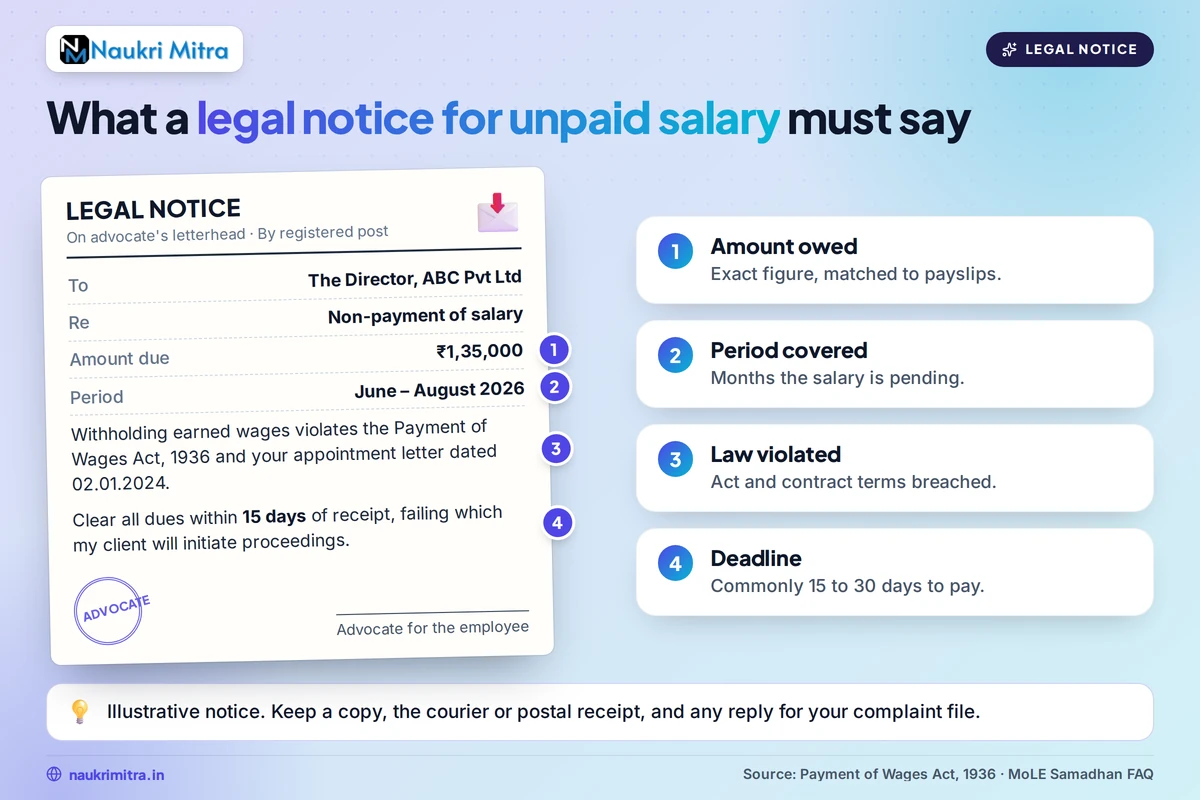
A legal notice for unpaid salary is often the fastest way to get an employer's attention without immediately triggering a government complaint. It's a formal letter, typically drafted by an advocate on their letterhead, that states the amount owed, the period it covers, the legal provisions violated, and a deadline (commonly 15 to 30 days) to clear dues before further action is taken. Many employers settle at this stage simply because a lawyer's letterhead signals that the next step is official.
You don't strictly need a lawyer to send one — a well-drafted letter sent by registered post or email, referencing your appointment letter and the dues owed, can also serve as documented proof that you demanded payment. However, a notice from a practising advocate carries more weight and is usually worth the modest cost, especially if the outstanding amount is significant or the employer has a pattern of ignoring employee complaints. Keep a copy of the notice, proof of delivery (courier receipt, read receipt, or postal tracking), and any reply received — all of this strengthens a subsequent Labour Commissioner or court complaint.
Filing a Complaint With the Labour Commissioner
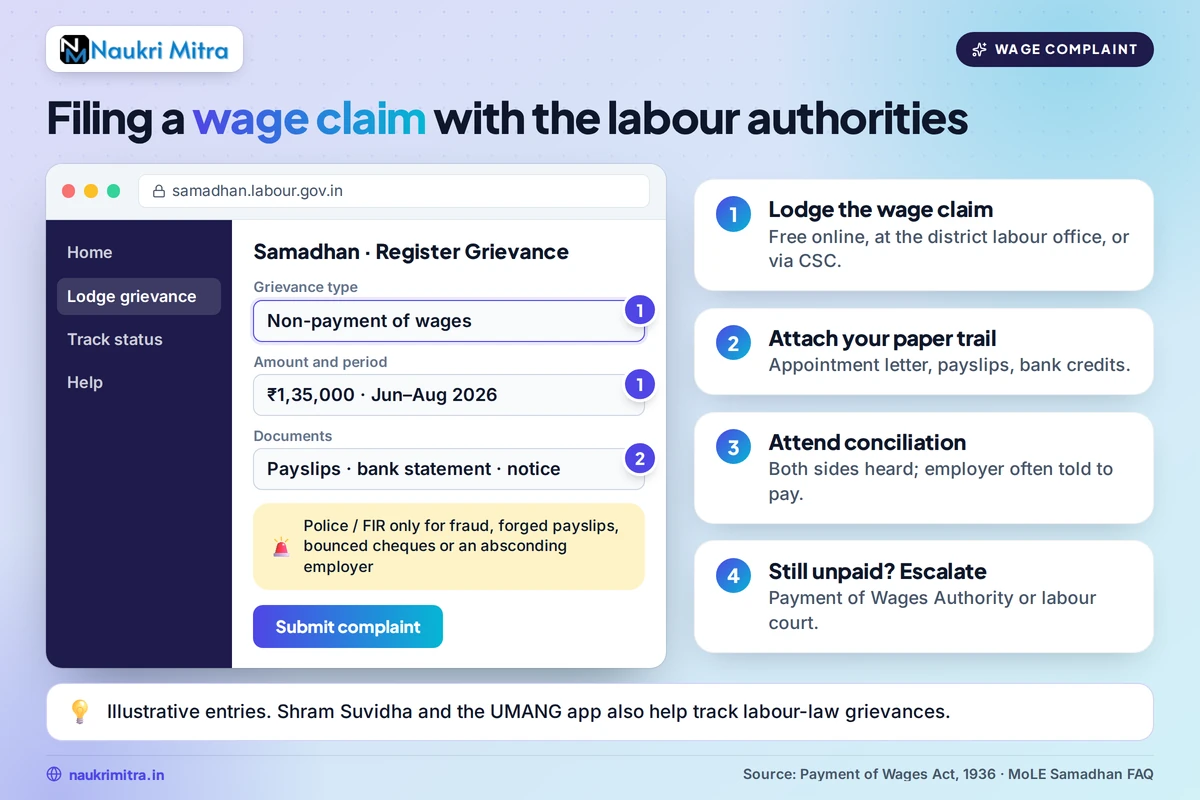
The Labour Commissioner is the government authority responsible for enforcing labour laws, including wage payment rules, within a state or region. Every state has a Labour Commissionerate with jurisdiction over establishments located there, and most districts have a local labour office or Assistant Labour Commissioner where a wage complaint can be physically filed. To approach them, you (or a lawyer, or an authorised trade union representative acting on your behalf) submit a written application — commonly called a wage claim — stating the amount due, the period, and attaching your supporting documents.
Two online channels make this easier than it used to be. The Union government's Shram Suvidha portal is a unified platform where labour inspections, registrations, and certain grievances connected to central labour laws can be tracked and, in some states, filed online. Separately, the Ministry of Labour & Employment runs the Samadhan portal, built specifically as a grievance redressal system where an employee can lodge a complaint about unpaid wages, delayed dues, or other labour-law violations and track its status online, through the UMANG app, or via a nearby Common Service Centre for a nominal fee. You can review how the Samadhan portal's grievance process works directly on the Ministry's own FAQ page before filing.
Once a complaint is registered, the Labour Commissioner's office typically calls both parties for a conciliation hearing, reviews the documents, and tries to resolve the dispute — often resulting in the employer being directed to pay within a set period. If the employer still refuses to comply after this stage, the matter is usually referred further, either to a Payment of Wages Authority empowered to pass a binding order, or to a labour court for formal adjudication.
Can Your Employer Withhold Salary Citing "Pending Clearance"?
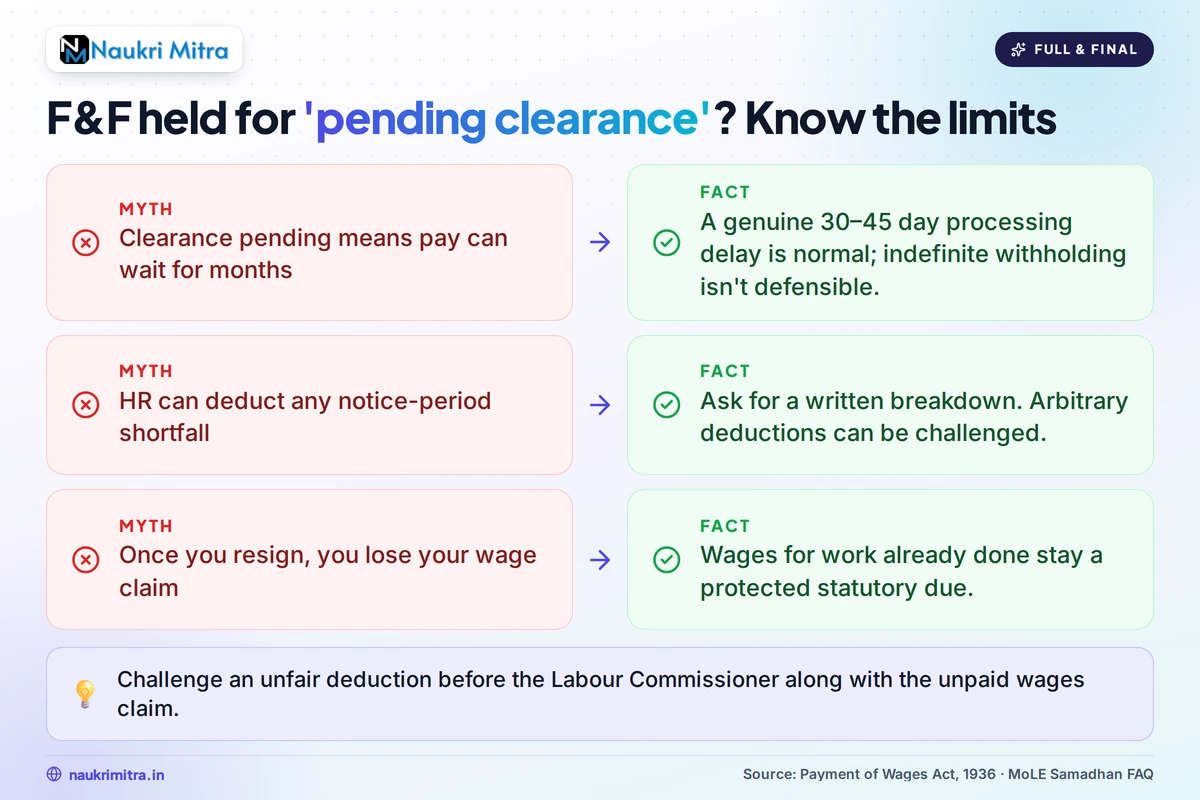
This is one of the most common disputes after resignation. Employers often delay full and final settlement citing exit formalities, asset returns, or a "clearance in process" status, sometimes stretching this out for months. While a brief, genuine delay for clearance (say, 30 to 45 days, as many HR policies state) is generally accepted practice, an indefinite or unexplained withholding of earned wages — money for work already performed — is not legally defensible. Earned salary for days worked cannot be held hostage to notice-period disputes, pending dues reconciliation, or unresolved exit paperwork beyond a reasonable timeframe.
If your employer is adjusting your final settlement against an alleged notice-period shortfall, ask for a written breakdown of the calculation. You're entitled to see exactly how the final number was arrived at. If the deduction seems arbitrary or disproportionate, that itself can be challenged before the Labour Commissioner alongside the core unpaid-wages claim. The process and evidence requirements are the same whether the dispute arose while you were employed or after you resigned — what matters is that wages for work actually performed remain a protected statutory due in both situations.
If the Employer Ignores the Labour Department: Labour Court and Civil Court
When an employer simply disregards a Labour Commissioner's notice or conciliation order, the dispute escalates. Under the Payment of Wages Act, the designated authority (often a judicial officer or senior labour official) can itself pass a binding order directing payment, along with compensation. Where conciliation fails under the Industrial Disputes framework, the matter can be referred for labour court wage recovery proceedings — a more formal, court-like process where both sides present evidence and a judgment is issued, which is then enforceable like any other court decree, including through attachment of the employer's property if payment still isn't made voluntarily.
For employees whose salary exceeds the wage ceiling that the Payment of Wages Act currently applies to — a situation common among mid-to-senior IT, managerial, and other white-collar professionals — the more direct route is often a civil suit for recovery of dues, since the employment relationship itself constitutes a valid contractual claim enforceable in a civil court. Courts have also recognised unpaid wages as a legitimate debt owed by a company, reinforcing that employees aren't left without recourse simply because their compensation sits above a particular statutory threshold. One Madhya Pradesh High Court full-bench ruling, for instance, held that unpaid wages qualify as a company's debt in the same sense as any other outstanding liability — a principle discussed in detail in this LiveLaw report on the judgment. In short: your options don't evaporate because you earn more than the Act's cutoff; they simply shift from the labour-law track to the civil or company-law track.
Can You File a Police Complaint for Unpaid Salary?
Generally, non-payment of salary by itself is treated as a civil and labour-law matter, not a criminal offence, so a straightforward delay doesn't usually justify an FIR. However, if there's an element of deliberate deception — for example, an employer who collected your work, issued fabricated payslips, promised payment while secretly planning to shut the business and vanish with employee dues, or bounced cheques issued toward your salary — that conduct can cross into criminal territory. A bounced salary cheque can be pursued under the cheque-dishonour provisions of the Negotiable Instruments Act, and clear intent to cheat can support a criminal complaint for cheating and breach of trust under the applicable penal provisions.
As a rule of thumb: approach the Labour Commissioner first for a routine wage-recovery dispute, since that's the specialised, faster, and more employee-friendly forum built exactly for this purpose. Reserve a police complaint or FIR for situations involving fraud, forged documents, bounced salary cheques, or an employer who is actively evading contact and disappearing with dues — scenarios where criminal intent, not just financial delay, is evident.
What If the Company Has Shut Down or the Owner Is Untraceable?
This situation complicates recovery but doesn't eliminate your rights. If the company has filed for formal insolvency proceedings, employee dues (including unpaid wages up to a certain period) are typically treated as a priority claim under the waterfall mechanism in insolvency law, meaning workers and employees are often paid ahead of many other unsecured creditors, though after secured creditors and resolution costs. You would need to file your claim with the resolution professional or liquidator handling the case, usually within a notified timeline, using your employment proof and salary records.
If the company hasn't formally entered insolvency but has simply stopped operating and the directors are unreachable, a Labour Commissioner complaint can still be filed against the registered entity, and in parallel, you can explore whether the directors have other active businesses or assets against which a civil decree could later be enforced. Keeping every document — appointment letter, payslips, bank statements, and any correspondence — becomes even more critical here, since these records may be the only proof of your claim if company records become inaccessible.
Limitation Period, Interest, and How Long Recovery Takes
Under Section 15 of the Payment of Wages Act, a wage claim generally must be filed within twelve months from the date the wages became due, though the authority has discretion to condone delay if you can show sufficient cause for not filing earlier — a prolonged illness or active settlement negotiations, for instance. This is exactly why letting a dispute sit unresolved for a year or more is risky: waiting too long can genuinely cost you your legal remedy.
On compensation, the authority hearing your claim isn't limited to ordering just the unpaid amount. For claims involving unauthorised deductions, it can direct compensation up to ten times the deducted sum. For delayed wages specifically, the authority may award further compensation, generally running into a few thousand rupees depending on the facts, over and above the principal amount owed — a meaningful incentive against employers who treat late payment casually. As for timelines, a Labour Commissioner-level conciliation can often resolve a straightforward, well-documented claim within a few weeks to a couple of months; a referred labour court case, or a civil suit for higher-value or white-collar claims, typically takes considerably longer, often many months to a few years, depending on the backlog in that jurisdiction and whether the employer contests the claim.
Should You Resign or Keep Working While Pursuing a Claim?
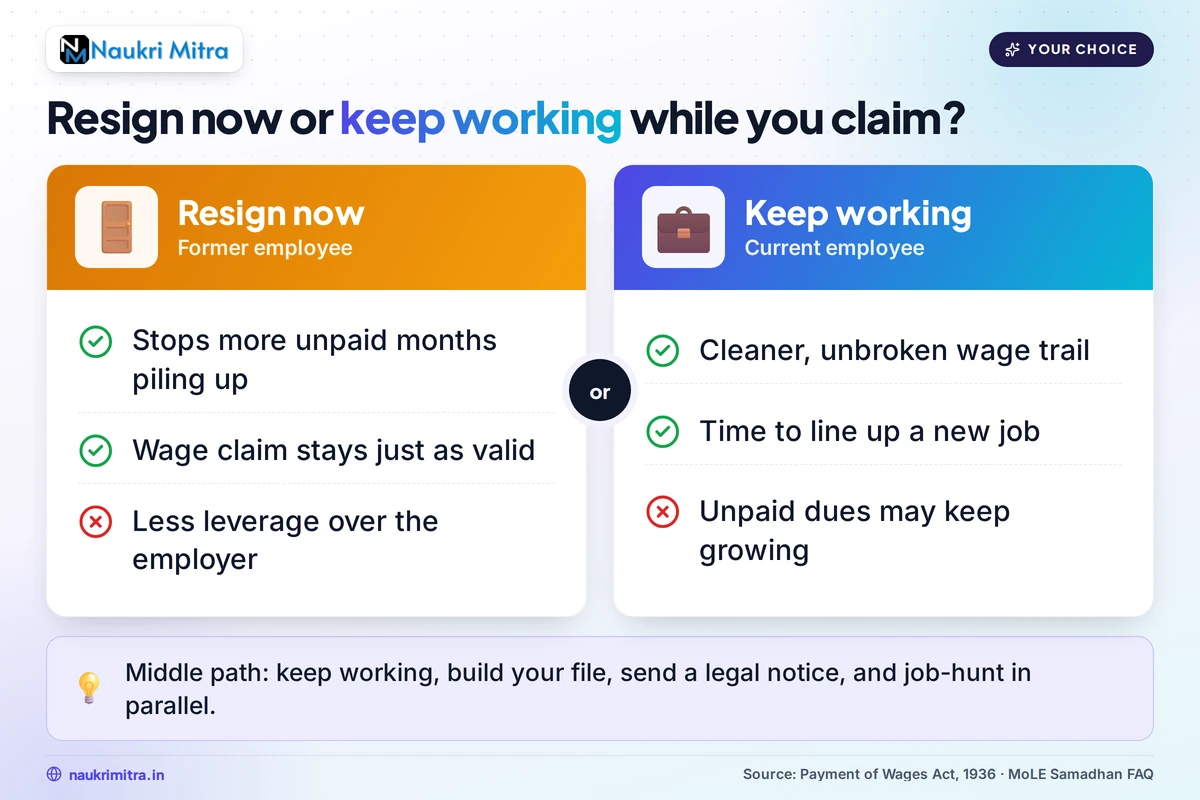
There's no single right answer, but a few practical considerations help. If you resign immediately, you lose leverage over ongoing cooperation from the employer but you also stop the bleeding if the workplace is otherwise untenable, and you're free to pursue your dues as a former employee — which is just as legally valid as pursuing them as a current one. If you stay, you continue accruing a verifiable, uninterrupted wage trail, which can make your evidence cleaner, but you also risk further non-payment accumulating. Many employees choose a middle path: continue working while quietly building their document file and issuing a legal notice, then decide on resignation once a new opportunity is secured or once it's clear the employer has no genuine intention of paying regularly.
Whatever you decide, don't let an employer's delay tactics stop you from actively job-hunting in parallel — a reliable employer and timely pay are not negotiable extras, and platforms like Naukri Mitra can help you line up verified opportunities while your wage dispute runs its own course.
Frequently Asked Questions
1. What does the law say about when salary must legally be paid?
Under the Payment of Wages Act, employers with fewer than 1,000 employees must pay wages by the 7th of the following month, and larger establishments by the 10th. Delays beyond this without written justification are a violation.
2. Which law applies to me — the Payment of Wages Act or the Code on Wages?
The Payment of Wages Act (plus your state's Shops and Establishments Act) remains the primary operative law in most states today. The Code on Wages will eventually broaden coverage once fully notified across all states, but until then, check which framework your state's rules currently enforce.
3. Do I need to pay to file a complaint with the Labour Commissioner?
No — filing a wage complaint directly with the Labour Commissionerate or through the Samadhan portal is free. Only Common Service Centre assistance involves a small nominal fee.
4. Is there a time limit to file a wage claim?
Yes. Claims under the Payment of Wages Act should generally be filed within twelve months of the wages becoming due, though delay can sometimes be condoned for valid reasons. Don't wait indefinitely.
5. Can I claim interest or compensation along with my unpaid salary?
Yes. The authority can award compensation over and above the principal amount, particularly for delayed payment or unauthorised deductions, as provided under Section 15 of the Act.
6. What if my company has shut down and the owner is untraceable?
If insolvency proceedings have begun, file your dues claim with the resolution professional or liquidator, since employee wages generally rank high in the repayment priority order. If not, you can still file against the registered entity and pursue enforcement against any traceable assets later.
7. Should I go to the Labour Commissioner or file an FIR for cheating?
Start with the Labour Commissioner for ordinary non-payment or delay. Reserve a police complaint or FIR for cases involving clear fraud, forged payslips, bounced salary cheques, or an employer deliberately absconding with dues.
8. Do IT and other white-collar employees above the wage ceiling have the same protection?
The Payment of Wages Act's direct protections currently apply up to a notified wage ceiling. Employees earning above that can still recover dues through a civil suit for breach of contract, and courts have recognised unpaid wages as a legitimate debt owed by the company regardless of salary level.
9. Can my employer withhold my full and final settlement indefinitely citing clearance?
No. A short, genuine processing delay is normal, but earned wages for work already performed cannot be withheld indefinitely under the guise of pending clearance or notice-period disputes.
10. Should I resign before or after pursuing legal action for unpaid salary?
Both current and former employees can file a wage claim; the legal remedy itself doesn't change. The decision should be based on your financial situation, workplace conditions, and whether you have another opportunity lined up, rather than on any requirement to resign first.
Sources: Section 15, Payment of Wages Act, 1936 — IndianKanoon; SAMADHAN Portal FAQs, Ministry of Labour & Employment; LiveLaw — MP High Court Full Bench on unpaid wages as company debt.
.png)
.png)
.png)
Comments
Post a Comment