How to File a POSH Complaint at Work | Naukri Mitra
Most people who eventually need the POSH process never think about it until the week they actually do. The shock of an incident is one problem. The second, quieter problem is not knowing what happens next: who you are supposed to write to, how much detail belongs in that first email, and whether there is a clock already running on your case without your knowledge. This guide walks through exactly that — how to file a POSH complaint against colleague conduct, a manager, or even a client, and what the internal committee complaint procedure actually looks like once you have pressed send.
The Sexual Harassment of Women at Workplace (Prevention, Prohibition and Redressal) Act, 2013 — usually shortened to the POSH Act 2013 — is the law that governs this entire process in India. It is not vague guidance; it sets out specific timelines, a defined complaint format, and a structured inquiry that every covered employer is legally bound to follow. Knowing the process in advance does not make the situation easier emotionally, but it does remove a great deal of unnecessary confusion at a time when confusion is the last thing anyone needs.
What the POSH Act Actually Covers
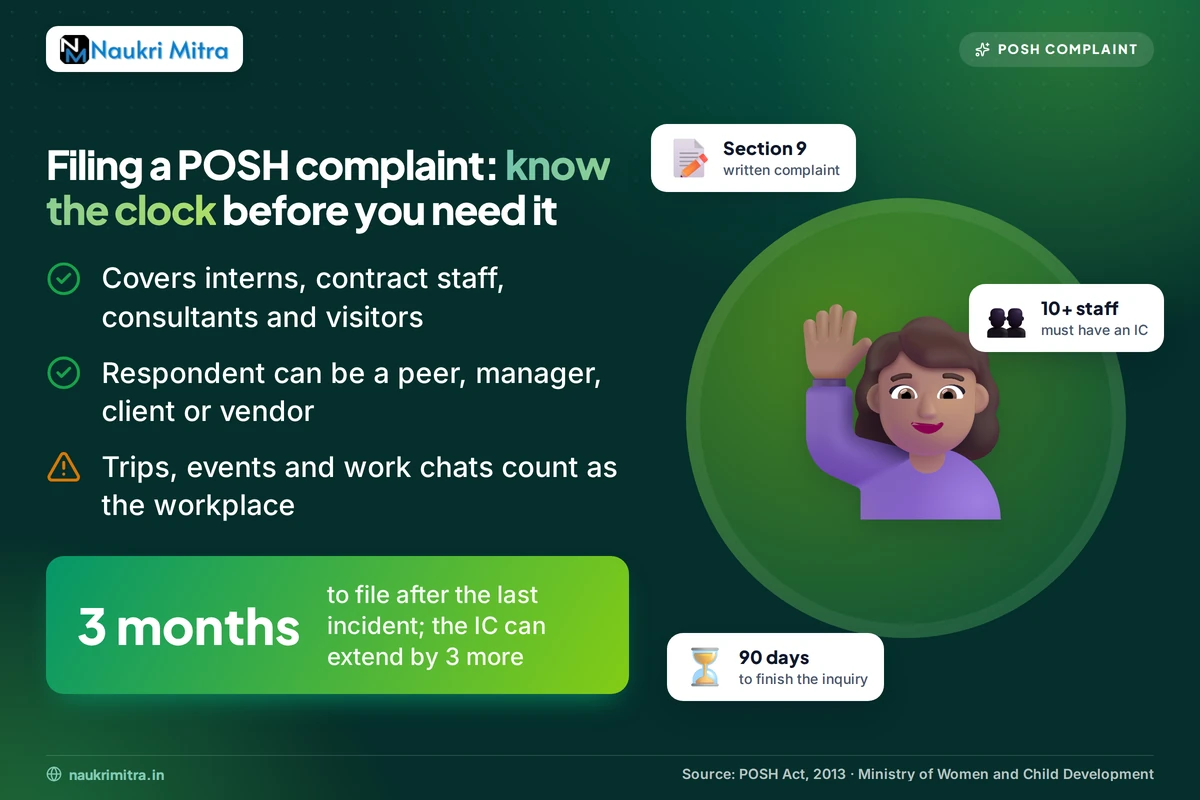
Sexual harassment under the Act is defined broadly and deliberately so, covering unwelcome physical contact, a demand or request for sexual favours, sexually coloured remarks, showing pornography, or any other unwelcome physical, verbal or non-verbal conduct of a sexual nature. It also extends to situations where submission to or rejection of such conduct is used, implicitly or explicitly, to affect someone's employment, create a hostile work environment, or humiliate them in a way that affects their health or safety. The conduct does not need to happen inside office walls — it is equally covered if it happens on an official trip, at a work-related event, during a client visit, or over official communication channels such as email or a work chat group.
On the question of how to report sexual harassment at workplace India requires of its employers, the law is specific about who can complain. Only a woman can file a complaint as an "aggrieved woman" under this particular statute, and that protection extends well beyond regular employees — it covers interns, trainees, contract and daily-wage workers, consultants, and even a woman visiting the workplace for client or business reasons. The person the complaint is against, called the respondent, can be anyone — a colleague at the same level, a senior manager, a client, a vendor, or a third party the complainant interacts with because of her work. If the complainant is unable to make a complaint herself due to physical or mental incapacity or death, a legal heir or another authorised person may do so on her behalf.
Does Your Workplace Have an Internal Committee (IC)?
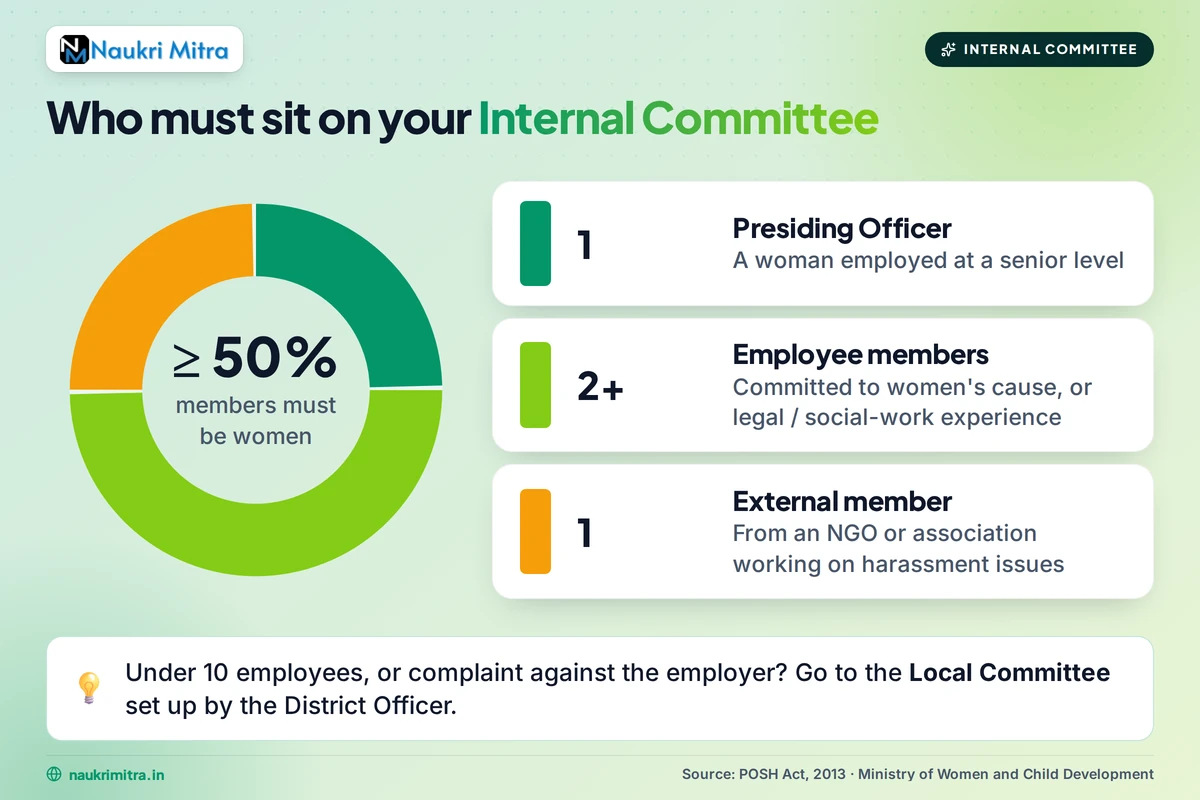
Every employer with 10 or more employees is legally required to constitute an Internal Committee (IC), sometimes still called an Internal Complaints Committee, at each office or branch. This is not optional, and it is not something that can be delegated informally to HR without a proper structure. The law prescribes exactly who must sit on it: a Presiding Officer who is a woman employed at a senior level, at least two employees from among staff who are committed to the cause of women or who have relevant legal knowledge or social work experience, and one external member from an NGO or association familiar with issues relating to sexual harassment. At least half the total members must be women, and the external member's presence is meant to reduce internal bias and pressure on the committee.
To find out who sits on your company's IC, start with your HR policy document, the employee handbook, or the company intranet — most organisations are required to display IC composition and contact details prominently, including on noticeboards. If none of this is available, ask HR directly; refusing to share this information is itself a compliance failure on the employer's part. If your workplace has fewer than 10 employees, or if the complaint is against the employer himself, there is no requirement for an in-house IC. In that situation, you approach the Local Committee constituted by the District Officer at the district level, which exists precisely to handle complaints from smaller establishments, domestic workers, and situations where an internal body would be inappropriate or compromised.
Despite this structure being in place since 2013, compliance gaps remain common across sectors. The Supreme Court has repeatedly pulled up employers and institutions for failing to properly constitute Internal Committees, directing government bodies to verify compliance and publish IC details more transparently. If your organisation cannot produce evidence of a properly constituted committee when asked, that failure does not stop you from filing a complaint — it simply means your first step may be the Local Committee instead.
Writing and Filing Your POSH Complaint: Format and Timeline
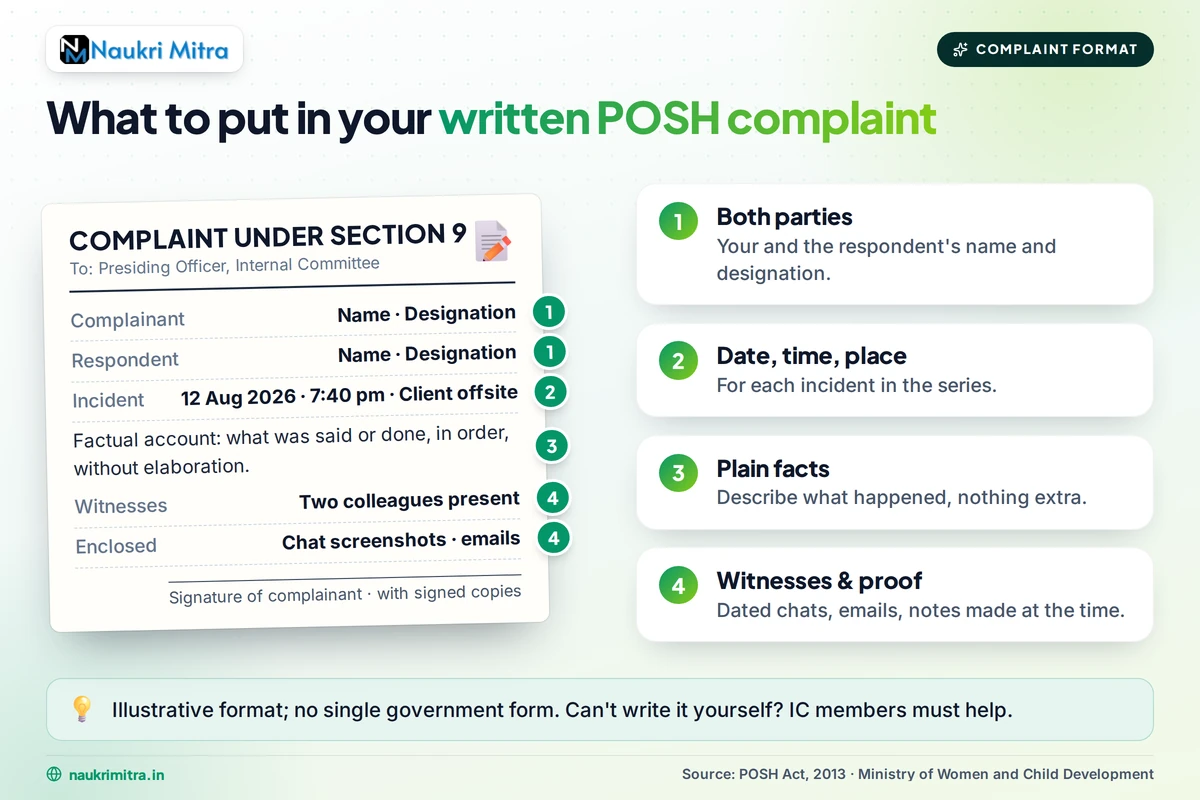
The POSH act complaint process step by step India follows begins with a written complaint, as required under Section 9 of the Act. If you are unable to write it yourself for any reason, the Presiding Officer or any IC member is obligated to provide reasonable assistance to help you put the complaint in writing. There is no single mandatory government form, but a usable complaint should include your name and designation, the respondent's name and designation, the specific date(s), time and location of each incident, a factual description of what happened without unnecessary elaboration, and the names of any witnesses, along with supporting material such as screenshots, emails, or messages if available. Most committees ask for the complaint along with a few signed copies, so it is worth checking your company's specific IC policy for its preferred format before submitting.
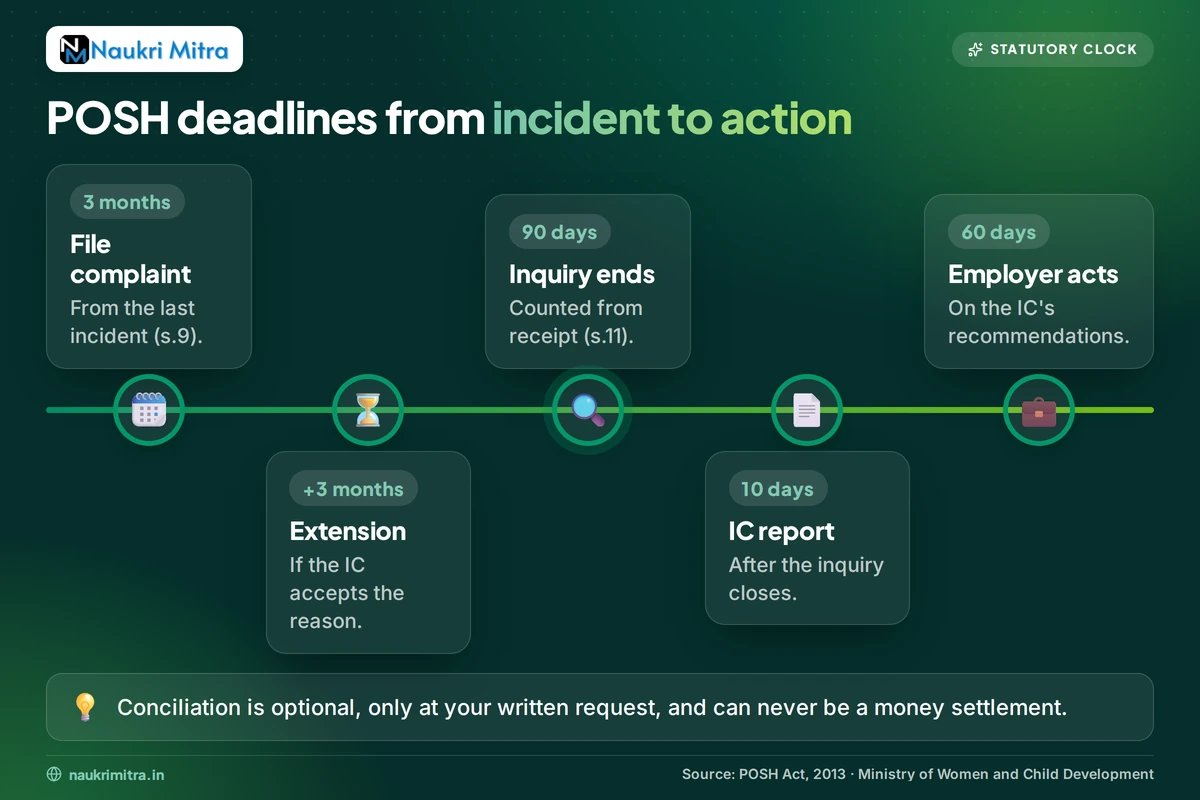
Under Section 9 of the POSH Act, 2013, the complaint should ordinarily be made within three months of the date of the incident, or, in case of a series of incidents, within three months of the last incident. The IC has the discretion to extend this period by another three months if it is satisfied that circumstances prevented the woman from filing earlier — this could include fear of retaliation, being unaware the IC existed, or being on medical leave. This means the realistic outer limit in most situations is six months, though filing as soon as reasonably possible always strengthens a case, since memory and evidence both degrade with time.
Evidence that meaningfully strengthens a complaint typically includes dated and timestamped chat logs or emails, call or message records referencing the incident, any contemporaneous notes you made at the time, and names of colleagues who witnessed the conduct or to whom you mentioned it shortly after. None of this is mandatory to file a complaint — the IC is required to conduct its own inquiry regardless — but a complaint supported by concrete material is generally easier for a committee to act on quickly and confidently.
What Happens After You File: The Internal Committee Complaint Procedure
Once a complaint is received, the internal committee complaint procedure workplace rules set out under the Act move fairly quickly on paper. Before beginning a formal inquiry, the IC may attempt conciliation at the complainant's written request, though this cannot involve a monetary settlement and is entirely optional — you are never obligated to accept it. If conciliation is not pursued or fails, the IC proceeds to a formal inquiry, during which both parties are given an opportunity to be heard, present witnesses, and respond to evidence, broadly following principles of natural justice rather than strict courtroom procedure.
On the question of POSH complaint timeline and outcome, Section 11 requires the inquiry to be completed within 90 days from the date the complaint was received. Once the inquiry concludes, the IC must submit its inquiry report within 10 days of completing the inquiry, and the employer is then required to act on the recommendations within 60 days of receiving that report. In practice, delays do happen — committees are often part-time volunteers juggling this alongside regular jobs — but these statutory outer limits give you a concrete basis to follow up in writing if your case appears to be stalling.
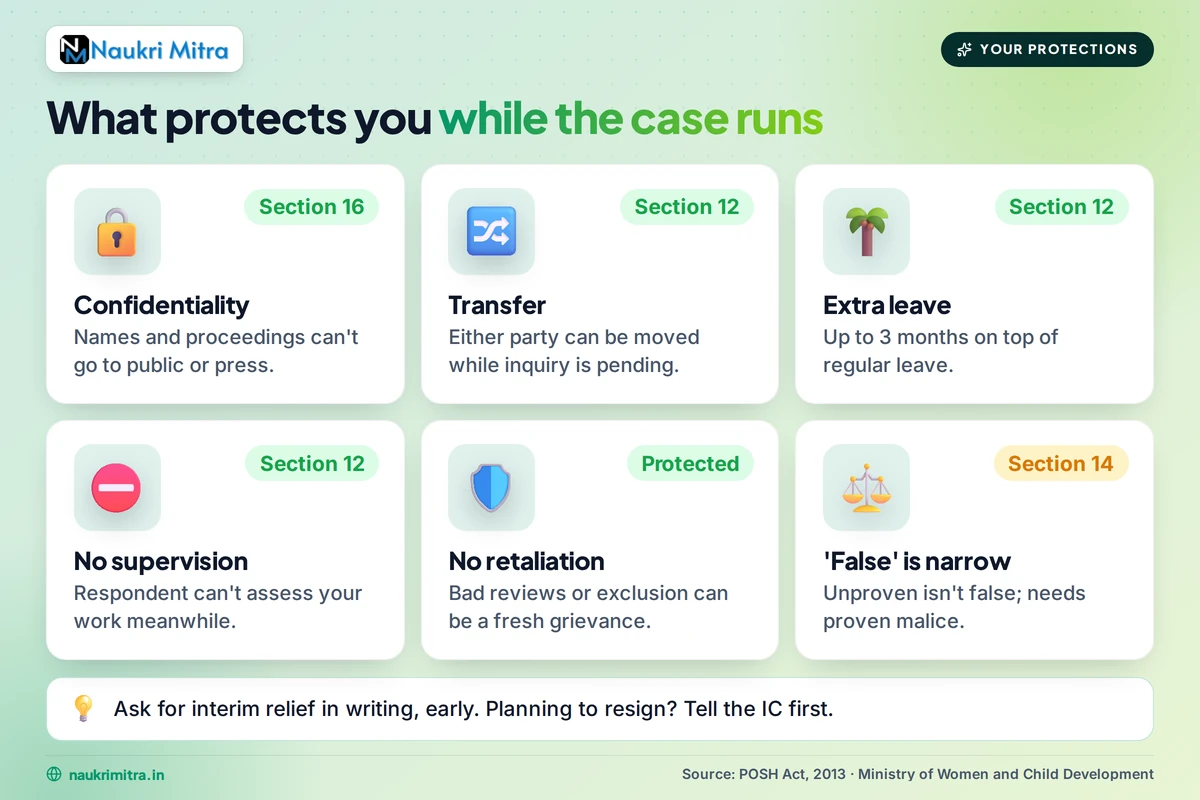
Confidentiality is a legal obligation, not a courtesy, under Section 16 of the Act. The identity of the complainant, the respondent, witnesses, and any details of the inquiry proceedings or recommendations cannot be published, communicated, or made known to the public, press, or media. A breach of this confidentiality requirement can itself attract a penalty under the service rules applicable to the person responsible. While you are entitled to request that your complaint be handled with maximum discretion within the organisation, a limited and necessary sharing of facts with the respondent and relevant witnesses is unavoidable as part of a fair inquiry.
You are also entitled to request interim relief under Section 12 while the inquiry is still pending, without waiting for a final outcome. This can include a transfer of either the complainant or the respondent, granting the complainant leave of up to three months in addition to her regular entitlement, or restraining the respondent from supervising the complainant's work or writing her performance assessments during the inquiry period. These requests should be made in writing to the IC as early as possible, since they are meant to reduce ongoing discomfort, not to serve as an afterthought.
Special Situations: Manager, Vendors, and the SHe-Box Portal
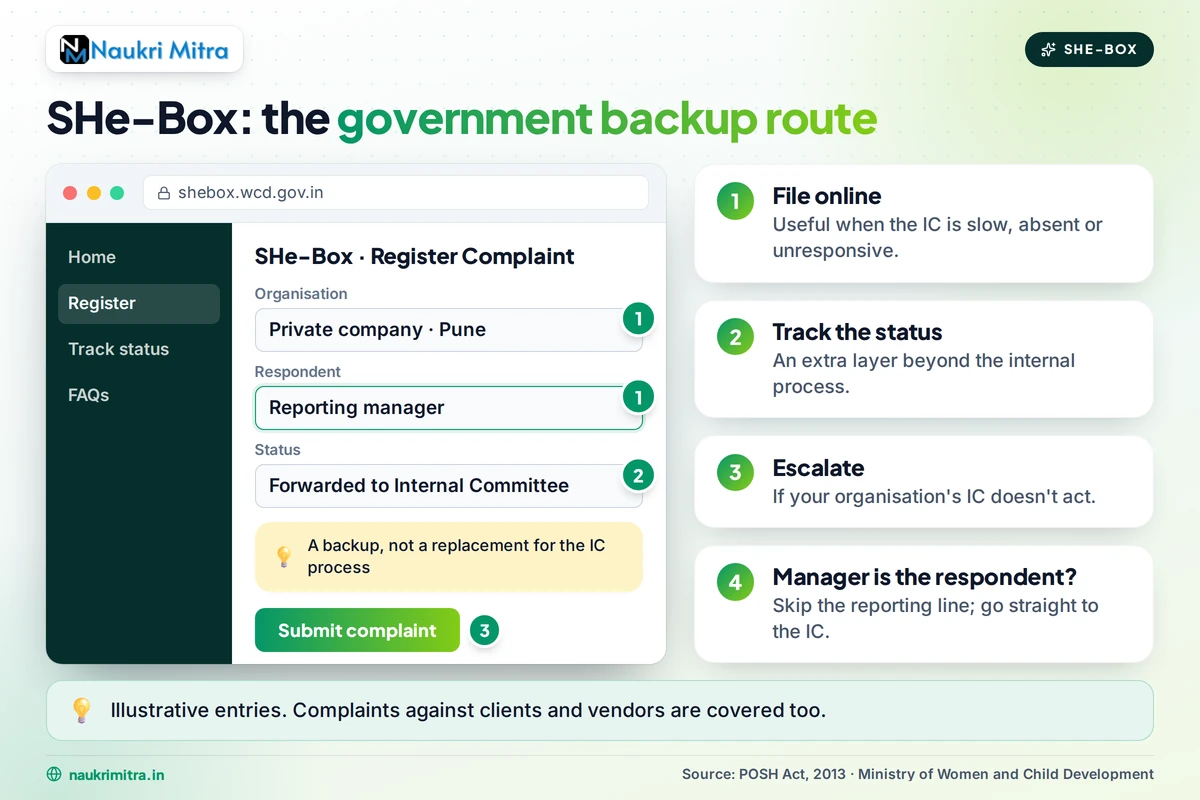
If the respondent is your own manager or a senior leader, you are not required to route your complaint through that reporting line — you go directly to the IC, bypassing your usual chain of command entirely. Seniority of the respondent has no bearing on the IC's jurisdiction to inquire into the matter, though in practice some employees understandably feel more comfortable approaching the external member of the committee first in such cases. If the respondent is the employer himself, or the most senior person in a small establishment where no independent IC can realistically function, the complaint goes to the Local Committee instead.
A complaint can also be filed against a client, vendor, or any third party encountered because of your work, even though that person is not your organisation's own employee. The employer is still obligated to provide assistance, support the complainant in filing a police complaint if criminal conduct is involved, and take appropriate action within its own sphere of control, such as restricting that vendor's access to the premises.
The Ministry of Women and Child Development's SHe-Box portal offers a centralised, government-run alternative route, particularly useful for employees of the central government or when a complainant wants an additional layer of tracking beyond the internal process. It allows a complaint to be filed online, monitored for status, and escalated if an organisation's own IC is slow, absent, or unresponsive. It is not meant to replace the IC process for most private-sector employees, but it is a genuinely useful backup when the internal system is not functioning as it should.
Protection Against Retaliation, and What If a Complaint Is Found False
The Act explicitly prohibits victimisation of a woman for having filed a complaint, participated in an inquiry, or supported someone else's complaint as a witness. Any adverse action taken against a complainant because of the complaint — a sudden poor performance review, exclusion from projects, denial of a promotion, or informal ostracism — can itself be raised as a separate grievance with the IC or employer, and is taken seriously precisely because retaliation discourages future complaints across the organisation.
On the question of false complaints, Section 14 of the Act is often misread. It does not mean that an inquiry which does not fully uphold a complaint automatically makes that complaint "false." Action against a complainant for a malicious complaint can only follow if the inquiry specifically finds, with clear supporting reasons, that the complaint was made with knowingly false or malicious intent — not merely that the evidence was insufficient to prove the allegation. This distinction matters, because conflating an unproven complaint with a false one would discourage genuine complainants from coming forward at all, which defeats the purpose of the law.
If you are considering resigning while your case is still under inquiry, it is worth informing the IC in writing before doing so. Resignation does not automatically end a pending inquiry, and in many cases committees continue the process to its conclusion regardless of the complainant's continued employment, particularly where findings may affect the respondent's record or future interim relief requests. Speaking with the IC beforehand simply avoids any ambiguity about whether your complaint remains active.
After the Inquiry: Appeals, Compensation, and the Police or Court Route
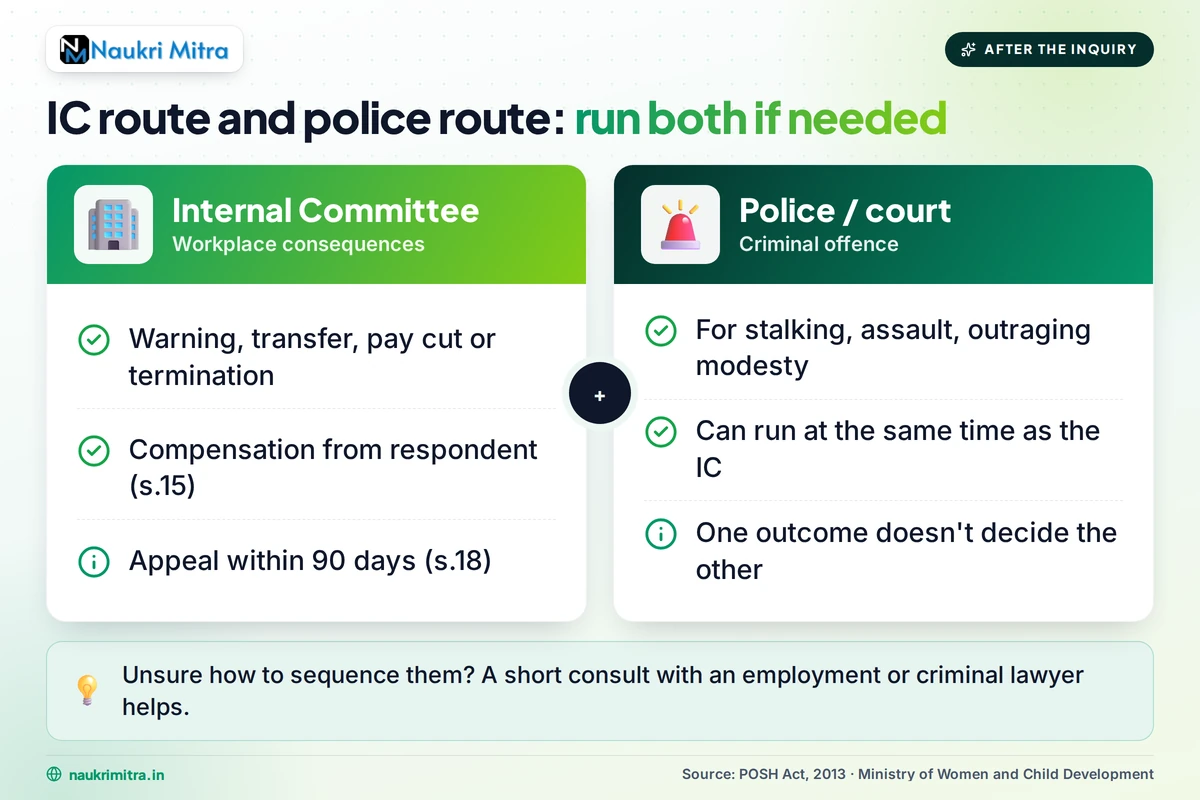
Either party who is dissatisfied with the IC's recommendations can appeal, under Section 18, to the court or tribunal specified under the applicable service rules, or, where no such rules apply, as prescribed under the Act's rules — typically within 90 days of the recommendations being communicated. This appeal right runs both ways: a complainant unsatisfied with the outcome and a respondent who disputes the findings both have access to it.
Where the IC's inquiry supports the complaint, Section 15 allows it to recommend compensation to be paid by the respondent, calculated with reference to factors such as the mental trauma, pain, suffering and emotional distress caused, the complainant's loss in career opportunity, medical expenses incurred, the respondent's income and financial status, and the feasibility of such payment in a lump sum or instalments. This is separate from any disciplinary action against the respondent, such as a warning, transfer, salary deduction, or termination, as per the employer's own service rules.
Filing with the IC does not prevent you from also approaching the police, particularly where the conduct amounts to a criminal offence such as stalking, outraging modesty, or assault under the applicable penal law. Many employees choose to pursue both tracks simultaneously — the IC process addresses the workplace relationship and internal consequences, while a criminal complaint addresses the offence itself, and a finding or outcome in one does not automatically determine the other. If you are unsure which route, or combination of routes, suits your situation, a brief consultation with a lawyer experienced in employment or criminal law before you file can help you sequence things sensibly.
Understanding this process in advance is, in itself, a form of protection — it means you are not learning the rules for the first time under stress. And if you are currently evaluating new opportunities and want to work at organisations that take these obligations seriously, you can browse verified listings and employer profiles on Naukri Mitra, India's job portal, where checking a company's stated workplace policies is as reasonable a part of your research as checking the role and the salary.
Frequently Asked Questions
What counts as sexual harassment under the POSH Act?
Unwelcome physical contact, a demand for sexual favours, sexually coloured remarks, showing pornography, and any other unwelcome verbal, non-verbal or physical conduct of a sexual nature, whether at the workplace or at a work-related event.
Who can file a complaint — only women, or anyone?
Only a woman can file as the "aggrieved woman" under this specific law, though she can be an employee, intern, contract worker, consultant, or a visitor to the workplace. The respondent can be anyone, regardless of gender or seniority.
Is there a time limit to file after an incident?
Three months from the incident, or the last incident in a series, extendable by another three months at the IC's discretion for sufficient reason.
What if my company has fewer than 10 employees, or no IC at all?
You approach the Local Committee set up by the District Officer, which handles complaints from smaller establishments and situations where an internal committee doesn't exist or is inappropriate.
How long does the inquiry take once I file?
The IC must complete its inquiry within 90 days, submit its report within 10 days after that, and the employer must act on recommendations within 60 days of receiving the report.
Can I request confidentiality, and what if it's breached?
Yes, confidentiality is a statutory requirement under Section 16, not optional courtesy. A breach can attract a penalty under applicable service rules against whoever disclosed the information.
What if the person I'm complaining about is my manager?
Seniority doesn't matter — you go directly to the IC regardless of the respondent's position, bypassing the usual reporting chain entirely.
Can I go to the police instead of, or alongside, the IC?
Yes. The IC process and a criminal complaint are separate tracks that can run simultaneously, and pursuing one does not prevent or replace the other.
What happens if my complaint is found to be false?
Action under Section 14 only follows if the inquiry specifically finds malicious intent with clear reasons — an unproven complaint alone is not treated as a false one.
Can I appeal the IC's decision?
Yes, under Section 18, either the complainant or the respondent can appeal the recommendations, generally within 90 days of being communicated, to the court or forum specified under applicable rules.
Sources: The Sexual Harassment of Women at Workplace (Prevention, Prohibition and Redressal) Act, 2013 — India Code; LiveLaw — Supreme Court directions on POSH Act enforcement; Press Information Bureau, Ministry of Women and Child Development — SHe-Box portal launch.


Comments
Post a Comment