Placement Agency Scams: Red Flags to Know | Naukri Mitra
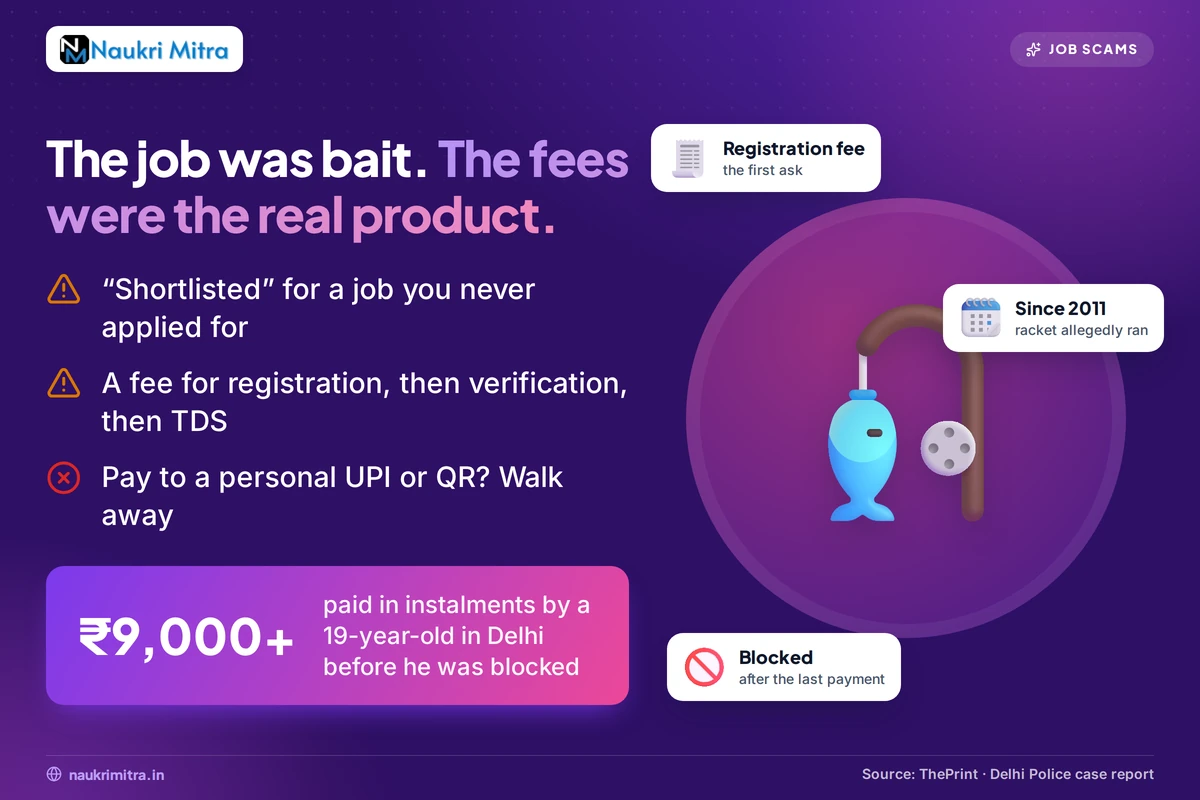
A nineteen-year-old in Delhi applied for a delivery job through an app called JOB HAI in mid-2025. A recruiter from an outfit calling itself Treasure Find Solution messaged him on social media, invited him for a quick interview, and then asked for a "registration fee," followed by charges for "document verification," "agreement processing," and even TDS — a pile of what scammers loosely label registration processing charges, all before any actual job began. He paid over Rs 9,000 in instalments through QR codes before the recruiter blocked his number. When Delhi Police eventually raided the racket's Nirman Vihar office, they found it had allegedly been running variations of the same scheme since 2011. It is a pattern that repeats across cities and platforms, and it is why so many job seekers now search for how to identify a fake placement agency scam before they hand over a single rupee.
If you have ever been asked to pay before you have even been formally offered a role, or you are evaluating a consultancy that reached out to you out of nowhere, this guide walks through the real red flags, what the law actually says about agency fees, how to verify a firm before you engage with it, and what to do if you have already lost money.
Is It Legal for a Placement Agency to Charge Job Seekers a Fee?
This is probably the single most common question job seekers have, and the honest answer is: it depends on the state, the sector, and how the fee is charged. In India, there is no single central law that uniformly governs every private placement agency. Several states — Punjab, Haryana, Delhi, Karnataka, and a few others — have their own Private Placement Agencies (Regulation) Acts that require an agency to register with the local labour department, display a registration number, and follow prescribed limits on what they can charge and when. For overseas recruitment, particularly hiring for Gulf countries, agents must hold a valid Registration Certificate issued under the Emigration Act, 1983, and are supervised by the Protector General of Emigrants.
What this means practically is that a licensed, registered agency can legally charge a service fee in many cases — but the fee is usually meant to be charged after a confirmed offer, is capped by state rules, and must be backed by a receipt and a registration number the agency is willing to show you. An agency that demands payment before any interview has concluded, that cannot produce a registration certificate, or that routes payment only to a personal UPI ID rather than a business account, is operating well outside any legitimate framework — whether or not it calls itself "registered."
It is also worth knowing that charging job seekers under false pretences — promising a job that does not exist, or collecting money for a position that was never real — amounts to cheating and criminal breach of trust under India's criminal law (now the Bharatiya Nyaya Sanhita, which replaced the IPC in 2024). So even where a service fee itself might be permissible, the deception used to extract it usually is not.
The Registration Fee and "Processing Charges" Scam Pattern
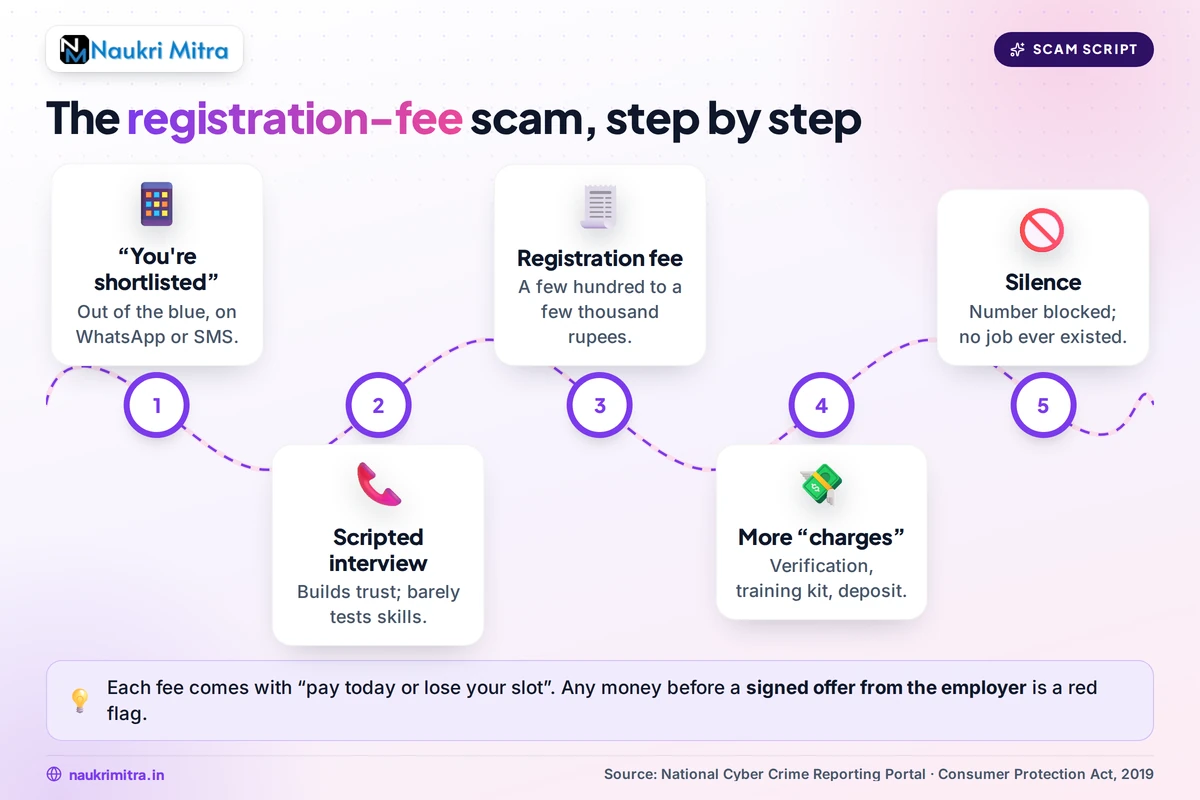
Almost every placement consultancy fraud follows a near-identical script, and once you have seen it once, it becomes easy to spot. It typically runs in stages. First, you are contacted unexpectedly, often through WhatsApp, Telegram, Instagram, or a bulk SMS, with a message claiming you have been "shortlisted" for a role you never applied for. Next comes a brief, often scripted phone or video interview that barely probes your actual skills — because the interview exists only to build trust, not to assess you. Then, once you sound interested, the fee requests begin: a "registration fee" of a few hundred to a few thousand rupees, followed by "document verification charges," "training kit fees," "background verification fees," or even fake "security deposits" that are promised to be refundable but never are.
Each fee is small enough on its own that victims rationalise paying it — a mistake scammers count on. Once you pay the first amount, a new charge invariably appears, often framed as urgent ("your slot will be cancelled if not paid today"). This is precisely the pattern the Naukri.com Security Centre, which maintains a dedicated resource on fake job trends in India, flags as one of the clearest indicators of a scam: legitimate employers and agencies do not fund their hiring process by collecting money from candidates in small, escalating instalments.
The simplest rule that protects you from this entire category of fraud: a placement consultancy asking for money before job confirmation, in any form, before you hold a signed offer letter from the actual employer, should be treated as a serious warning sign, not a formality to get past.
Red Flags That Give Away a Fake Placement Consultancy
Beyond the fee pattern itself, a handful of smaller signals tend to show up together whenever a consultancy is not what it claims to be.
- Unsolicited contact with vague job details. You receive a message about a "great opportunity" with a well-known brand, but the role, location, and salary are oddly generic.
- No verifiable office address. The address listed is a residential flat, a coworking space with no company signage, or simply does not exist when you search it.
- Pressure and urgency. You are told the opening will close "today" or that another candidate is "waiting" if you do not pay immediately — a classic pressure tactic designed to stop you from thinking it through.
- Payment only through personal accounts. Money is requested via a personal UPI handle, a Paytm number, or cash, never through a company bank account or an official invoice.
- Salary that is too high for the role and experience level. A fresher being offered a package well above market rate for minimal work is a near-universal bait tactic.
- No written contract or appointment letter upfront. Everything happens over chat, with no formal documentation until after money changes hands.
- Claims of a tie-up with a major company that the company itself has never heard of. Scammers frequently invoke recognisable brand names — large e-commerce firms, delivery platforms, or IT companies — to borrow credibility, while having no actual contract with that employer. If a consultancy claims to be hiring on behalf of a specific brand, you can and should verify this independently by contacting that company's official HR or careers page rather than trusting the consultancy's word.
Fake Interview Calls and Forged Offer Letters — How to Spot Them
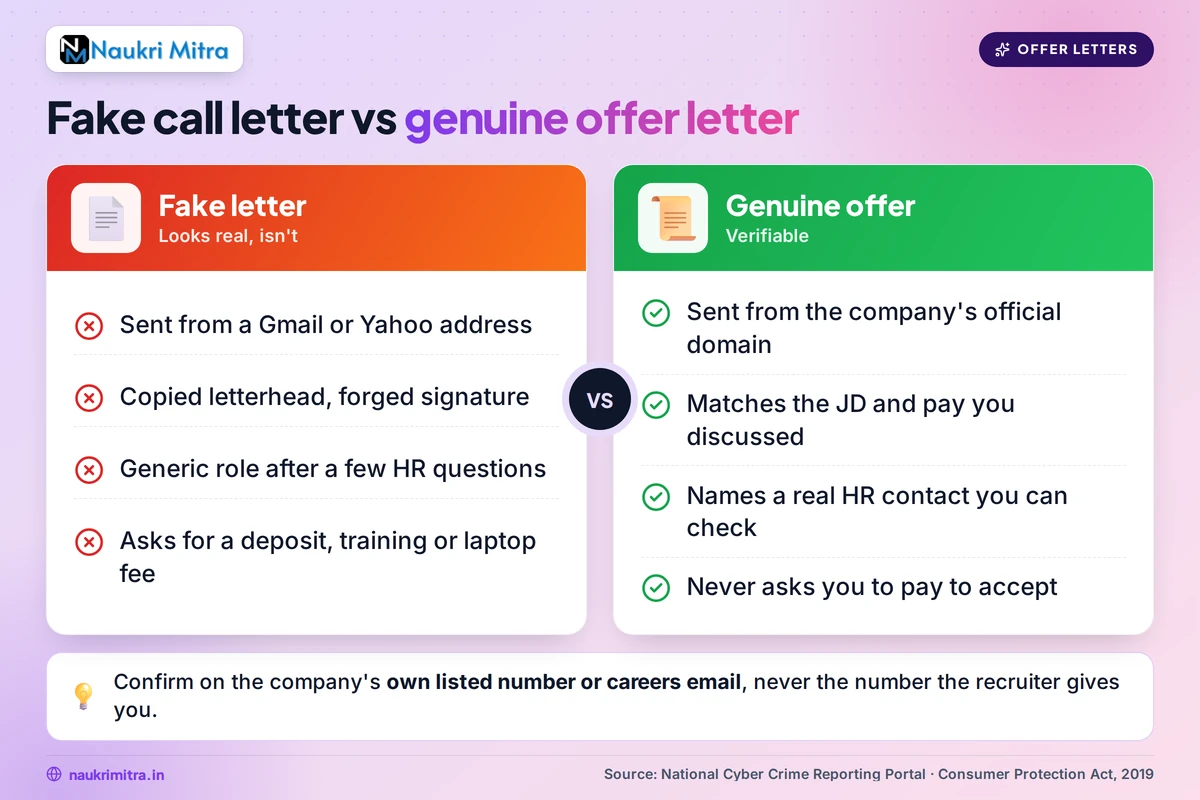
One reason these scams work on educated, cautious people is that the fake documentation has genuinely improved. Scammers now produce offer letters with company letterheads lifted from real corporate websites, forged signatures, QR codes that lead nowhere useful, and employee ID formats that mimic the real company's numbering style. Fake interview calls, and the fake interview call letter that sometimes follows them by email, run on a similar logic: a caller uses a company-sounding name, references a job portal you actually applied on (which is where they likely scraped your number and resume from), and asks a handful of generic HR-style questions before declaring you "selected."
A genuine offer letter from an established employer will typically carry a few features that are hard for scammers to fully replicate: it is sent from the company's official domain email address rather than a Gmail or Yahoo account, it references the exact job description and compensation structure discussed during a real interview process, it names an actual reporting manager or HR contact whose details can be verified on LinkedIn or the company website, and it never asks you to pay money as a condition of accepting the offer. If an "offer letter" arrives attached to a demand for a security deposit, training fee, or laptop/equipment charge before your joining date, treat it as fabricated until proven otherwise.
The safest practice, regardless of how convincing the call or letter looks, is to independently call the company's listed official number or write to its published careers email and confirm the offer exists in their system — never rely solely on a number the "recruiter" gives you, since that number can simply be answered by the same scammer.
Genuine Staffing Firm vs Scam Operation — How to Verify Before You Engage
Verifying an agency does not require specialised investigative skills — it mostly requires patience and a willingness to ask direct questions a legitimate firm will answer without hesitation.
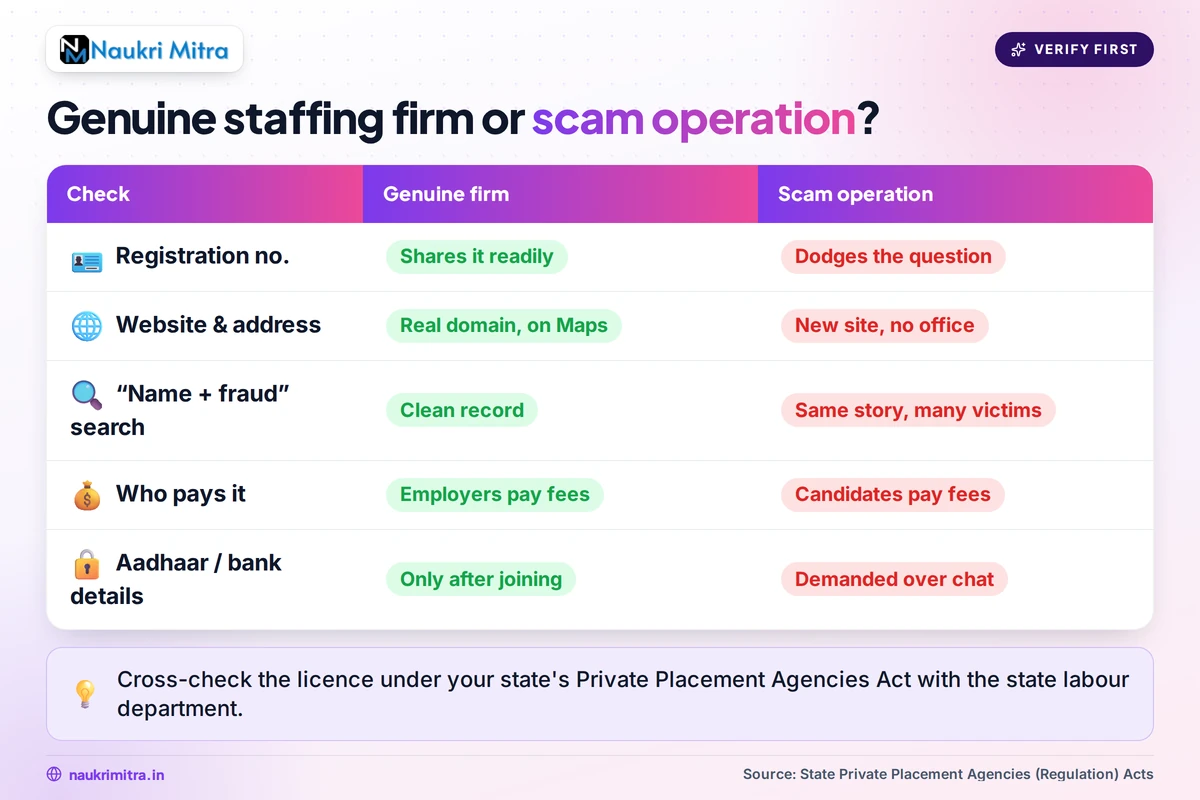
Start by asking for the agency's registration or licence number under the relevant state Private Placement Agency Act, and cross-check it with the state labour department if a public registry is available. A real, licensed staffing agency will not be reluctant to share this. Next, check the company's digital footprint: a working website with a real domain (not a free blogspot or a site registered days ago), a physical address you can locate on Google Maps, and consistent details across its LinkedIn page, Google Business listing, and Ministry of Corporate Affairs record if it is a registered company.
Search specifically for the agency's name alongside words like "complaint," "fraud," or "scam." Consumer forums, local Facebook groups, Reddit threads, and review sections on Google Maps and Justdial frequently surface patterns of past victims describing near-identical experiences — if three or four strangers describe the exact same "registration fee then silence" sequence, that is not a coincidence.
A genuine staffing firm earns its revenue primarily from employers who pay for successful placements, not from candidates paying to be considered. It will have multiple live job openings across different employers rather than one too-good-to-be-true vacancy, its recruiters will have verifiable profiles with a consistent work history, and it will never ask for your Aadhaar number, bank account details, or net banking credentials before you are actually onboarded with a real employer — a basic KYC document shared after joining is normal; the same document demanded over chat before any formal process is not.
Government Portals and Direct Hiring — Safer, Free Alternatives
A large share of placement agency fraud exists because job seekers feel they need a middleman to access opportunities. In most cases, you do not. Government employment exchanges and the National Career Service portal list verified public and private openings at no cost, and applying directly through a company's own careers page bypasses the agency layer entirely — removing the single point where scams typically insert themselves. Established job portals that verify employer accounts before allowing them to post are also considerably safer than responding to a cold WhatsApp message or an unsolicited call, since reputable platforms have processes to flag and remove fake listings when they are reported. You can browse verified job listings directly on Naukri Mitra without ever needing to route an application through a third-party consultancy.
Freshers and first-time job seekers are disproportionately targeted precisely because they are less familiar with how a real hiring process unfolds and are often anxious to land their first role quickly. A few precautions help: never pay for a "training certificate" that a company insists you buy from a specific vendor before joining, be sceptical of any job that claims to be "work from home, no experience needed, high salary" for unskilled tasks, always loop in a parent, mentor, or placement cell before transferring money anywhere related to a job offer, and keep a habit of screenshotting every chat, call log, and payment receipt from the moment contact begins.
You've Already Paid and the Agency Has Gone Silent — What Now
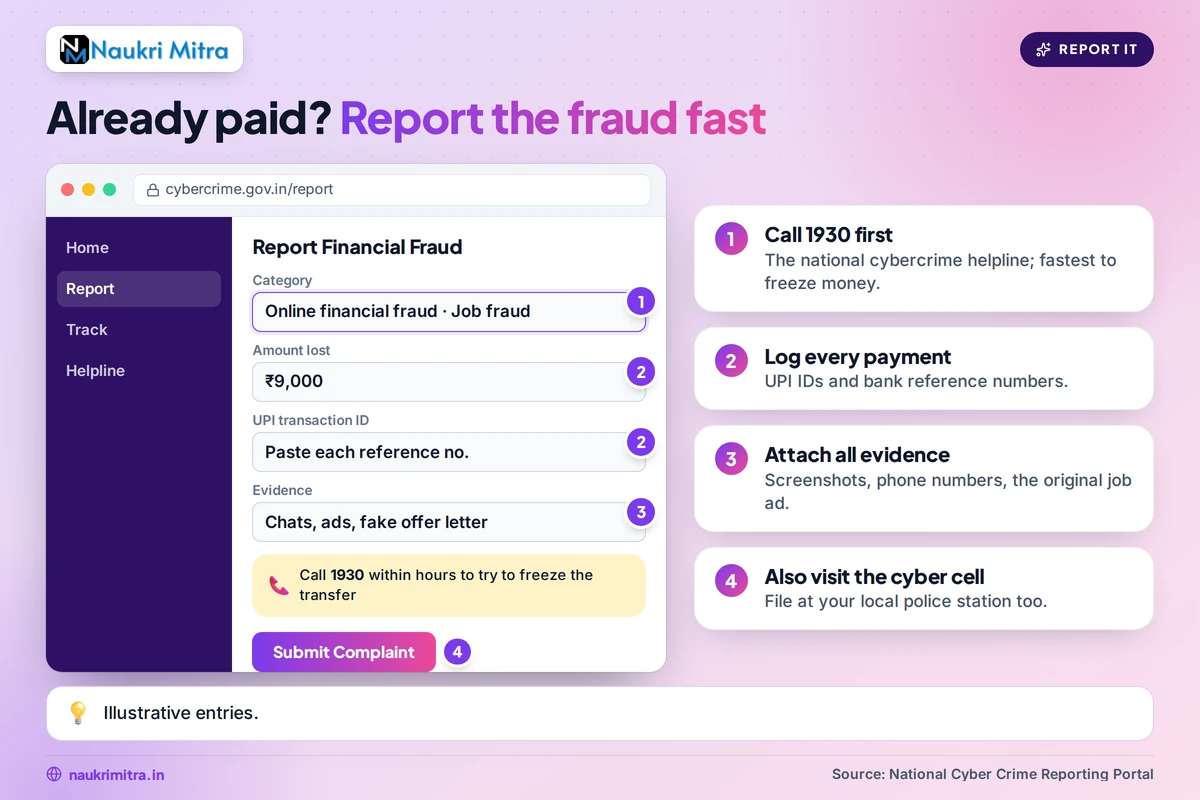
If you have paid money and the "recruiter" has stopped responding, changed their number, or blocked you, act quickly rather than assuming the money is simply gone. Start gathering every piece of evidence: screenshots of chats, the phone number and any name used, UPI transaction IDs or bank reference numbers, the job advertisement or message that started contact, and any documents like the fake offer letter.
Report the incident on the Government of India's National Cyber Crime Reporting Portal, which is built specifically to handle financial fraud and online cheating complaints, including recruitment fraud of this kind. You can also call the national cybercrime helpline number 1930, which is linked to the same system and is often faster for freezing a fraudulent transaction if you report within the first few hours. Alongside the cyber complaint, file a report at your local police station's cyber cell — most metro cities now have dedicated cyber crime cells that handle exactly this category of fraud — and if the amount involved is meaningful, you can separately pursue a consumer complaint against the agency for deficiency in service.
Can You Actually Recover Your Money Through a Consumer Court?
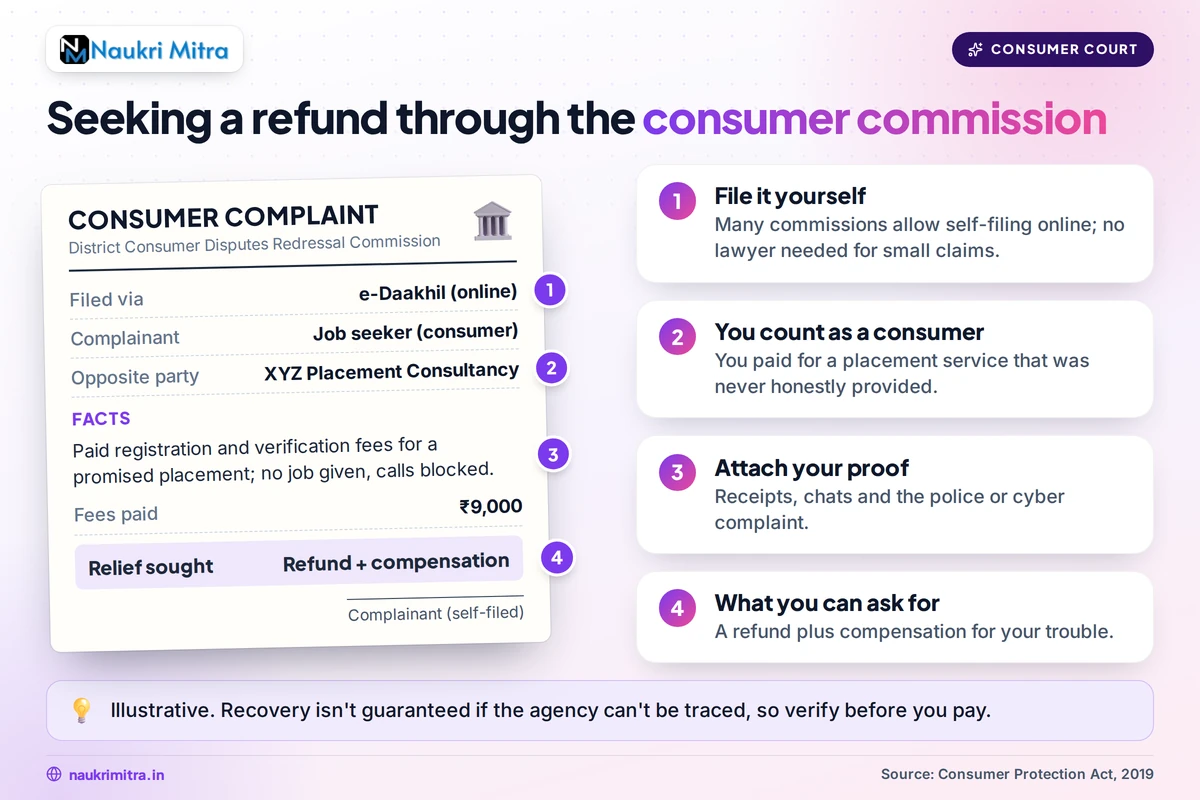
Job seekers who pay a fee in exchange for a promised placement service can generally be treated as "consumers" under the Consumer Protection Act, 2019, since money was paid for a service that was never rendered honestly. This opens the door to filing a complaint before the local District Consumer Disputes Redressal Commission, which can direct the agency to refund the amount paid along with compensation for the trouble caused, without you needing a lawyer for smaller claims — many commissions allow self-filed complaints, including online filing through the national e-Daakhil portal.
That said, recovery is not guaranteed and realistically depends on whether the agency or its operators can actually be traced and whether they have identifiable assets or a registered business entity worth pursuing. Many scam operations deliberately use untraceable numbers and shell "agencies" with no real registered office precisely to make this step difficult, which is exactly why prevention — verifying before you pay anything — remains far more reliable than recovery after the fact. Still, filing both a police/cyber complaint and a consumer forum case creates an official record, increases the pressure on repeat offenders, and has, in various documented cases, led to arrests when enough victims report the same operation together, as happened when Delhi's cyber police eventually traced and acted on the JOB HAI racket after a cluster of similar complaints.
A Quick Checklist Before You Engage Any Consultancy
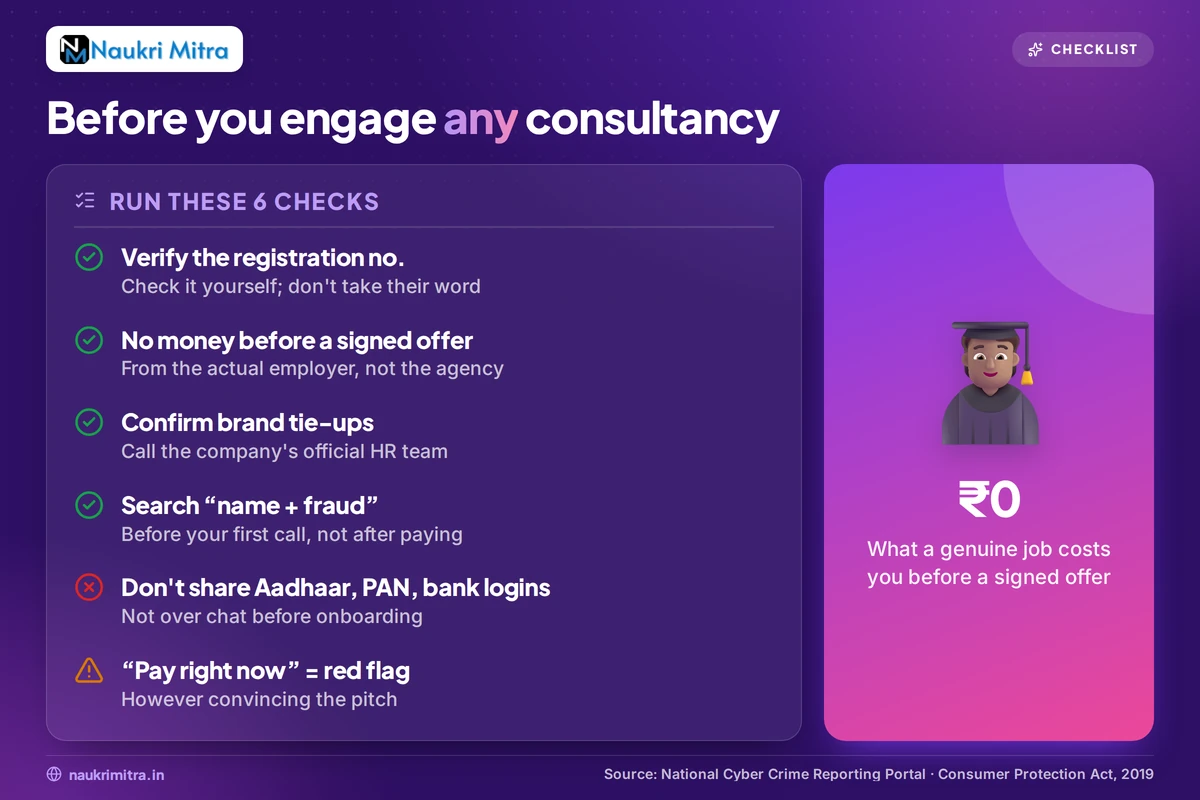
Keep this short list handy the next time an unfamiliar "recruiter" reaches out:
- Ask for the agency's registration number and verify it independently rather than taking their word for it.
- Never transfer money before you hold a signed offer letter from the actual hiring company, not the consultancy.
- Confirm any claimed brand tie-up by contacting that company's official HR team directly.
- Avoid sharing Aadhaar, PAN, or bank login details over chat before a formal onboarding process begins.
- Search the agency's name with "complaint" or "fraud" before your first call, not after your first payment.
- Treat urgency and pressure to "pay right now" as a red flag in itself, regardless of how convincing the rest of the pitch sounds.
Frequently Asked Questions
Is it legal for a recruitment agency to charge job seekers at all?
In several Indian states, a registered agency can legally charge a limited, disclosed fee, usually after a confirmed placement, under that state's Private Placement Agency Act. An unregistered entity charging upfront "processing" fees before any real offer is not operating legally, regardless of what it calls the charge.
What is the most common scam pattern used by fake placement consultancies?
A registration fee followed by a series of smaller "processing," "verification," or "training" charges, each introduced after the last one is paid, with the promised job never materialising once contact stops.
How can I verify if an agency is genuinely licensed?
Ask for their registration number under the relevant state Act, check their business listing, registered address, and online reviews, and look for a consistent digital presence rather than a single WhatsApp number and a vague website.
Should I ever pay before receiving a signed offer letter?
No. A legitimate hiring process does not require you to pay before an offer is confirmed in writing by the actual employer, not just the consultancy claiming to represent them.
Are placement agencies allowed to ask for my Aadhaar or bank details upfront?
Not before a real onboarding process begins. Basic KYC is normal after you join an employer; the same documents demanded over chat before any formal offer is a clear warning sign.
Where should I file a complaint if I have been scammed?
Report it on the National Cyber Crime Reporting Portal or call helpline 1930, file a report with your local police cyber cell, and consider a parallel consumer forum complaint for a refund.
Can I actually get my money back?
Sometimes, particularly if you report within hours so the transaction can potentially be frozen, or through a consumer forum order if the agency can be traced. Recovery is not guaranteed, which is why verifying an agency before paying matters more than recovering money after.
Are government job portals a safer alternative to paid consultancies?
Yes. Government employment exchanges, the National Career Service portal, and verified job listing sites let you apply directly without routing money or personal data through an unverified middleman.
What should freshers specifically watch out for?
Unsolicited "shortlisted" messages for jobs never applied to, mandatory paid "training kits" before joining, and pressure to decide or pay within hours — all common tactics aimed at candidates with limited hiring experience.
Placement agency fraud keeps evolving, but the underlying trick rarely changes: create urgency, borrow credibility from a real brand, and collect money in small enough amounts that each one feels reasonable on its own. Slow down, verify independently, and treat any payment request before a signed offer as the clearest signal to walk away.
Sources: National Cyber Crime Reporting Portal (cybercrime.gov.in); ThePrint, "Delhi: Cyber-enabled job fraud racket busted; one arrested, hunt on for others" (theprint.in); Naukri.com Security Centre on fake job trends (company.naukri.com).
.png)
.png)
.png)
Comments
Post a Comment