Non-Compete Clauses: Valid in India? | Naukri Mitra
A Bangalore engineer we spoke to while researching this piece had already signed her offer letter with a new company when an email landed in her inbox from her soon-to-be-former employer's legal team. It warned that joining a "competing organisation" within twelve months would violate a non-compete clause buried on page fourteen of her appointment letter. She nearly rescinded her acceptance before asking the one question most Indian employees never get around to asking until it is too late: is that clause even legally valid? The short answer, repeated by Indian courts for more than four decades, is almost always no. The fuller answer is more layered than a one-line clause in an HR template suggests, and it matters for anyone who has ever signed an offer letter without reading the fine print.
What Section 27 of the Indian Contract Act Actually Says
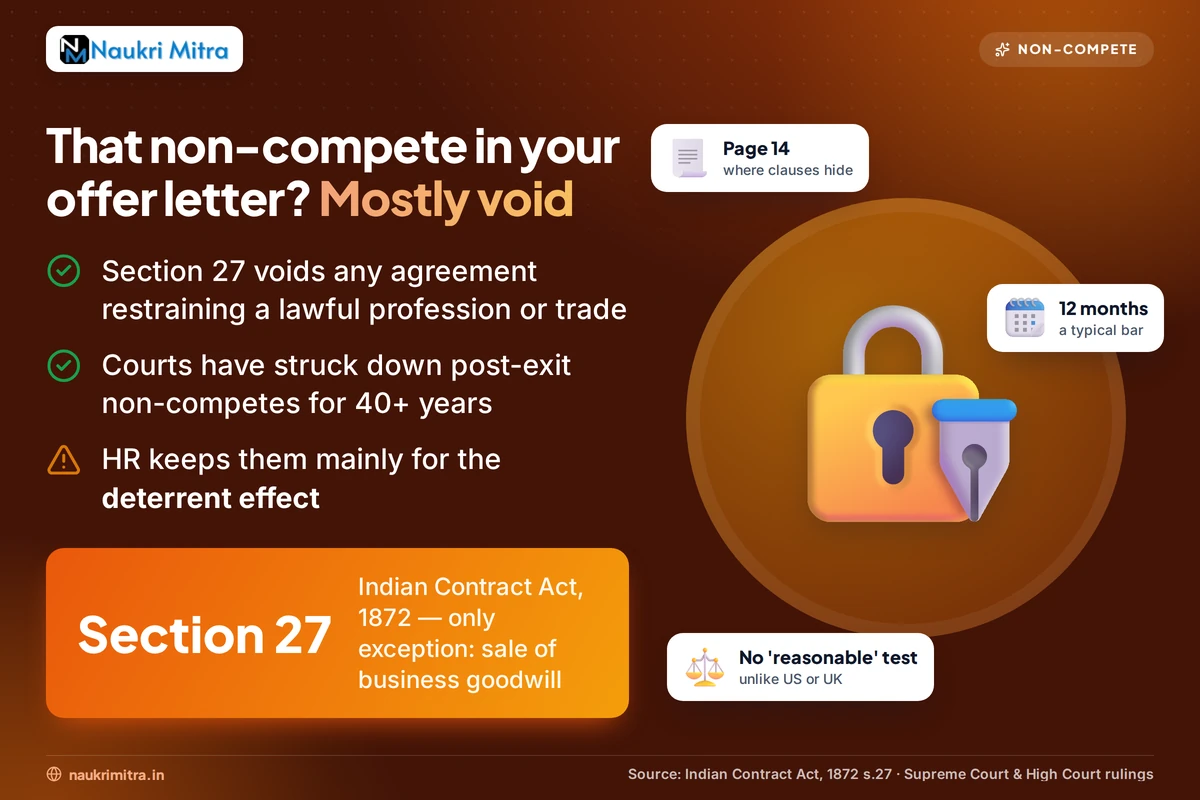
Every discussion of restrictive covenants in Indian employment contracts eventually comes back to one sentence. Section 27 of the Indian Contract Act, 1872 states that "every agreement by which anyone is restrained from exercising a lawful profession, trade or business of any kind, is to that extent void," with a narrow exception carved out for the sale of goodwill of a business. Unlike the United States or the United Kingdom, where courts weigh whether a restraint of trade is "reasonable" in duration, geography and scope before enforcing it, Indian law takes a far more absolute position. If a clause restrains someone's right to work after a contract ends, it is void under Section 27 almost regardless of how narrowly it is drafted.
This single provision is why HR departments across India still insert non-compete clauses into offer letters even though lawyers on both sides generally know they carry little weight once an employee's service has actually ended. The clause survives in contracts mainly because it has a deterrent effect — many employees simply assume it is enforceable and decline a competing offer out of caution, which is precisely the outcome the clause was drafted to produce, whether or not a court would actually uphold it.
Non-Compete During Employment vs After You Resign
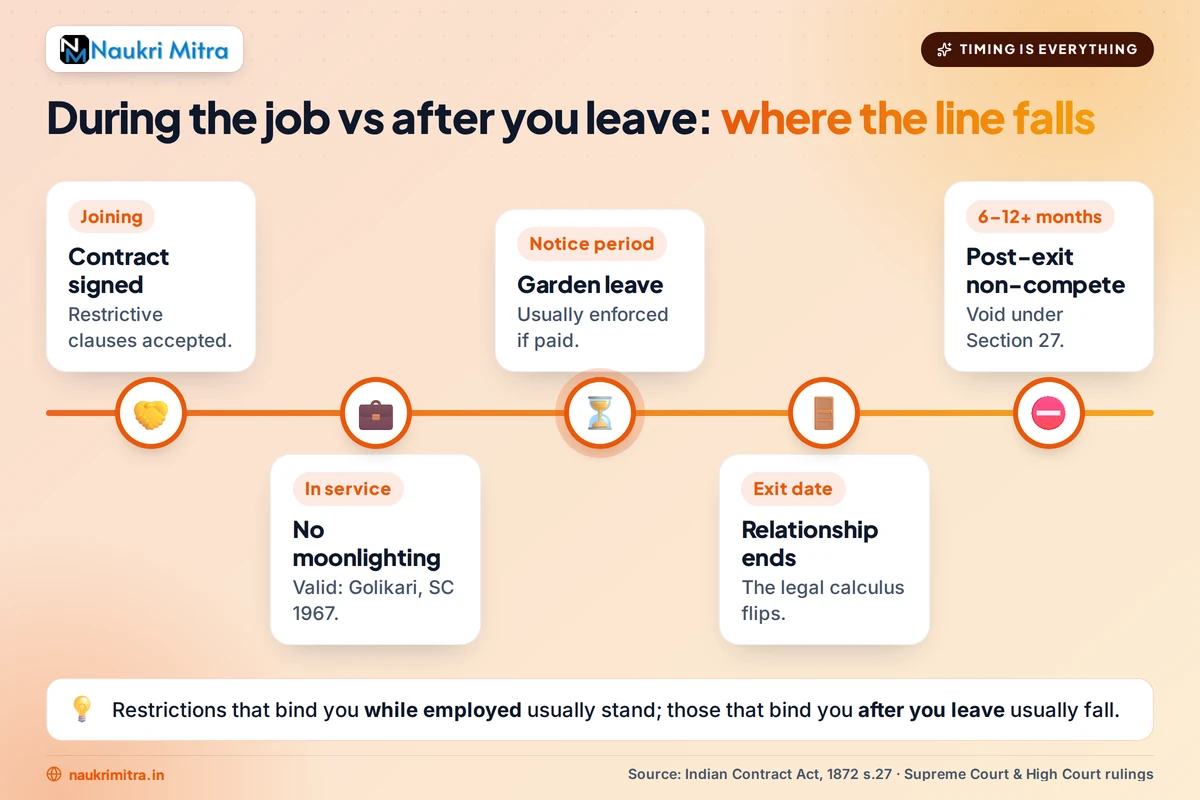
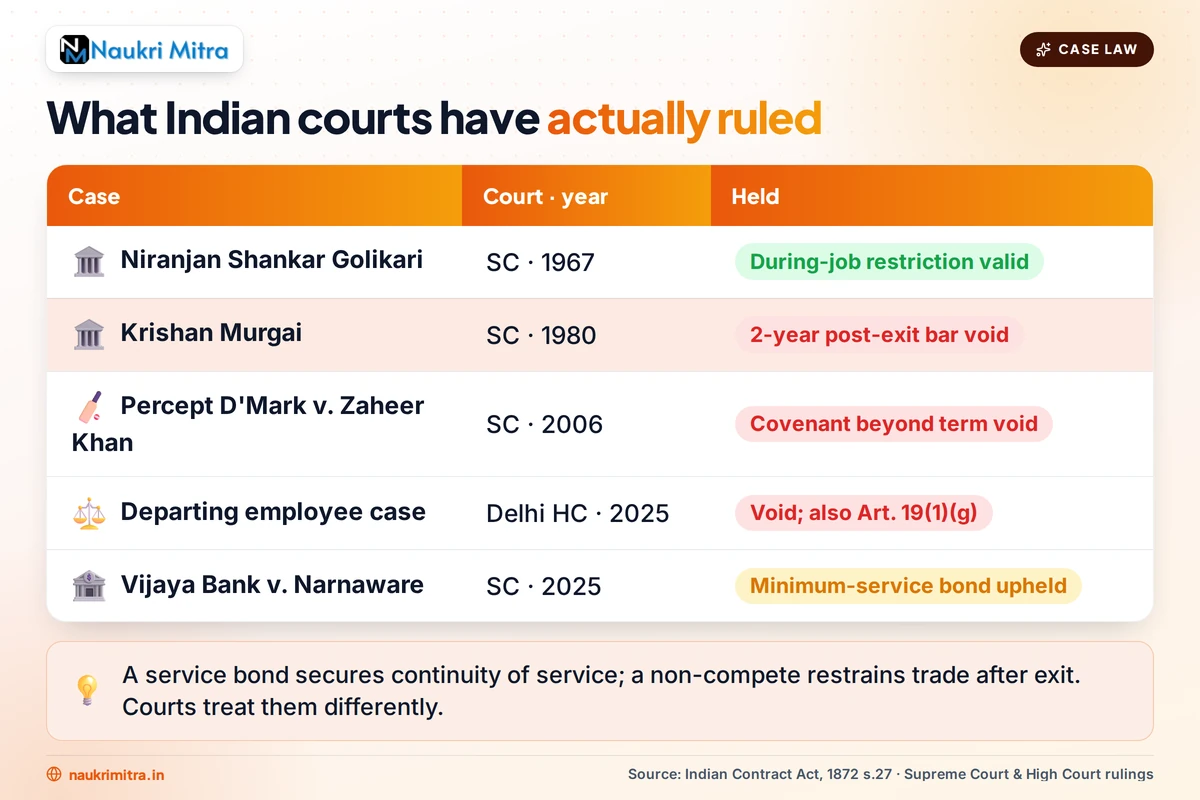
The single most important distinction in this entire area of law is timing. Indian courts draw a sharp line between restrictions that operate while you are still employed and restrictions that try to bind you after you have left. A clause that says you cannot moonlight for a competitor, take up a second job, or consult for a rival firm while you are still on the payroll is generally valid and enforceable — your employer is entitled to your undivided loyalty and working time during the subsistence of the contract. This principle goes back to the Supreme Court's 1967 ruling in Niranjan Shankar Golikari v. Century Spinning and Manufacturing Co. Ltd., which upheld a restriction operating strictly during the term of employment.
The moment the employment relationship ends, the calculus flips. A post-termination restriction — a clause that tries to stop you from joining a competitor, starting a rival business, or working in the same industry for six months, a year, or longer after you resign — is treated as a restraint of trade and is void under Section 27 in the overwhelming majority of reported cases. So when someone asks whether a non-compete clause is valid in India after resignation, the honest answer is that courts have consistently struck down exactly this kind of post-termination restriction, while almost always upholding restrictions that apply only during active employment, including reasonable notice-period or garden-leave conditions.
What Indian Courts Have Actually Ruled
This is not a theoretical reading of one section of a 150-year-old statute — it is a position Indian courts have reaffirmed repeatedly, including in recent years. The foundational case is the Supreme Court's 1980 decision in Superintendence Company of India (P) Ltd. v. Krishan Murgai, where an employee had agreed not to carry on a similar business within Delhi for two years after leaving the company. The Supreme Court held that this negative covenant, operating after the end of service, amounted to a restraint of trade and was void under Section 27, rejecting the argument that a "reasonable" restriction should be allowed to survive post-employment the way it can during employment.
The Supreme Court revisited the theme in Percept D'Mark (India) Pvt. Ltd. v. Zaheer Khan (2006), holding that a negative covenant extending beyond the term of a contract is void and unenforceable, and refusing to injinct the cricketer from working with a rival agency after his contract with Percept had lapsed. More recently, the Delhi High Court addressed the issue squarely in a 2025 ruling involving a departing employee and his new employer, holding that post-service restrictive covenants in employment contracts — restrictions that operate only after the employment ends — are unenforceable under Indian law and also fall foul of the constitutional right to practise any profession or carry on any trade under Article 19(1)(g). A detailed account of that reasoning, including how it builds on the earlier Varun Tyagi v. Daffodil Software line of cases, is available in LiveLaw's report on the Delhi High Court ruling.
Not every recent judgment goes the same way on every type of clause, though, and that nuance matters. In 2025, the Supreme Court in Vijaya Bank v. Prashant B. Narnaware upheld a minimum-service bond that required an employee to pay liquidated damages for resigning early, reasoning that the bond operated to secure continuity of service rather than restrain the employee's trade after leaving, and so did not fall foul of Section 27 in the same way a post-termination non-compete would. Courts have also cautioned that even a valid-looking restriction has to be read narrowly and tied to its actual stated scope rather than stretched to cover situations it never contemplated — a point explored in a detailed Bar and Bench analysis of how Indian courts interpret restrictive covenants.
Non-Compete vs Non-Solicitation vs Confidentiality — What's Actually Different
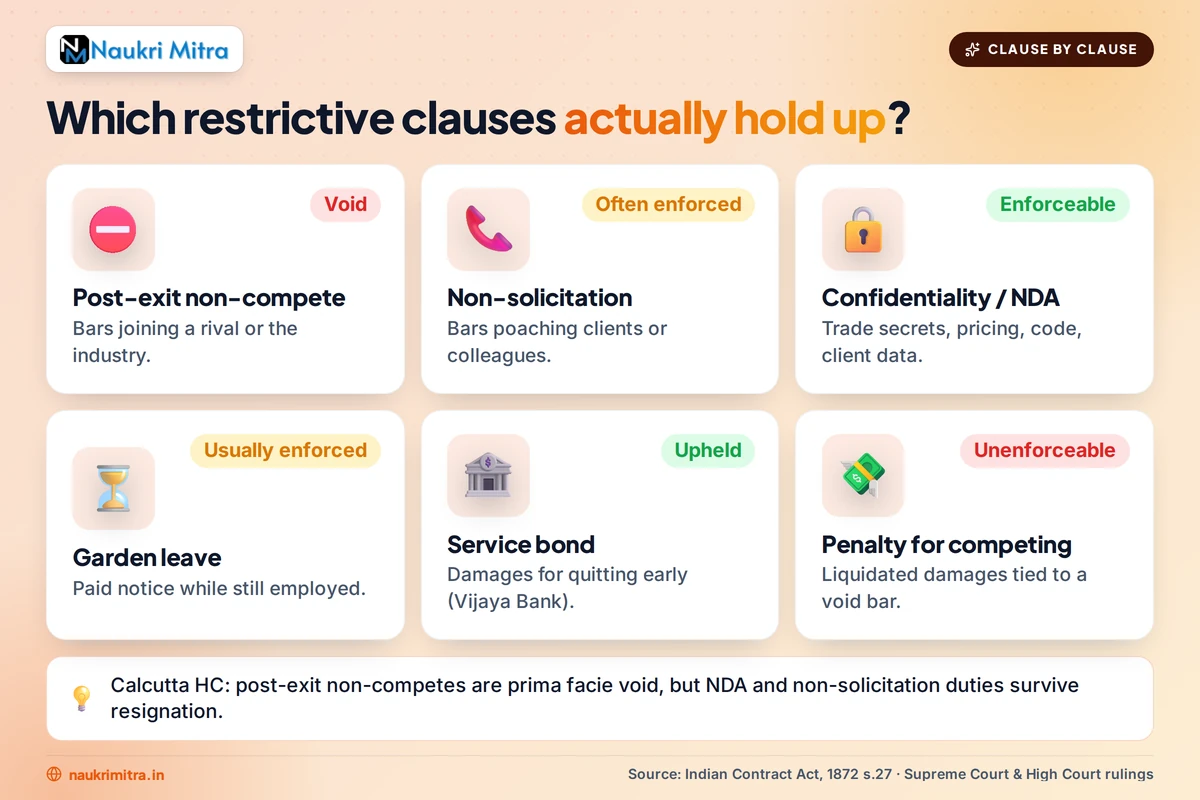
One of the most common sources of confusion is treating every restrictive clause in an offer letter as a single, equally unenforceable category. They are not. A non-compete clause tries to stop you from working in the same industry or for a competing employer altogether, and that is the type of clause Section 27 is most hostile to once your employment has ended. A non-solicitation clause is narrower: it does not stop you from joining a competitor, but it does try to stop you from actively poaching your former employer's clients, vendors, or colleagues for a defined period. Indian courts have generally been more willing to enforce reasonable non-solicitation clauses than blanket non-compete clauses, because they protect a specific, legitimate business interest rather than blocking your entire ability to work.
Confidentiality obligations sit in a different category altogether. An NDA clause after leaving a job in India is generally enforceable, because it does not stop you from working anywhere — it only stops you from disclosing or misusing information that genuinely qualifies as confidential, such as trade secrets, pricing models, source code, or client data. A Calcutta High Court ruling on this exact point reaffirmed that post-termination non-compete restrictions remain prima facie void under Section 27, while confidentiality obligations and non-solicitation covenants aimed at protecting trade secrets and business interests remain enforceable — for the fuller reasoning, see this LiveLaw report on the Calcutta High Court's ruling. In short: non-compete clause enforceability in India for employees is weak after resignation, but your confidentiality and non-solicitation obligations generally survive and can be enforced through an injunction or a damages claim even after you have left.
Can Your Employer Actually Sue You or Block the New Job?
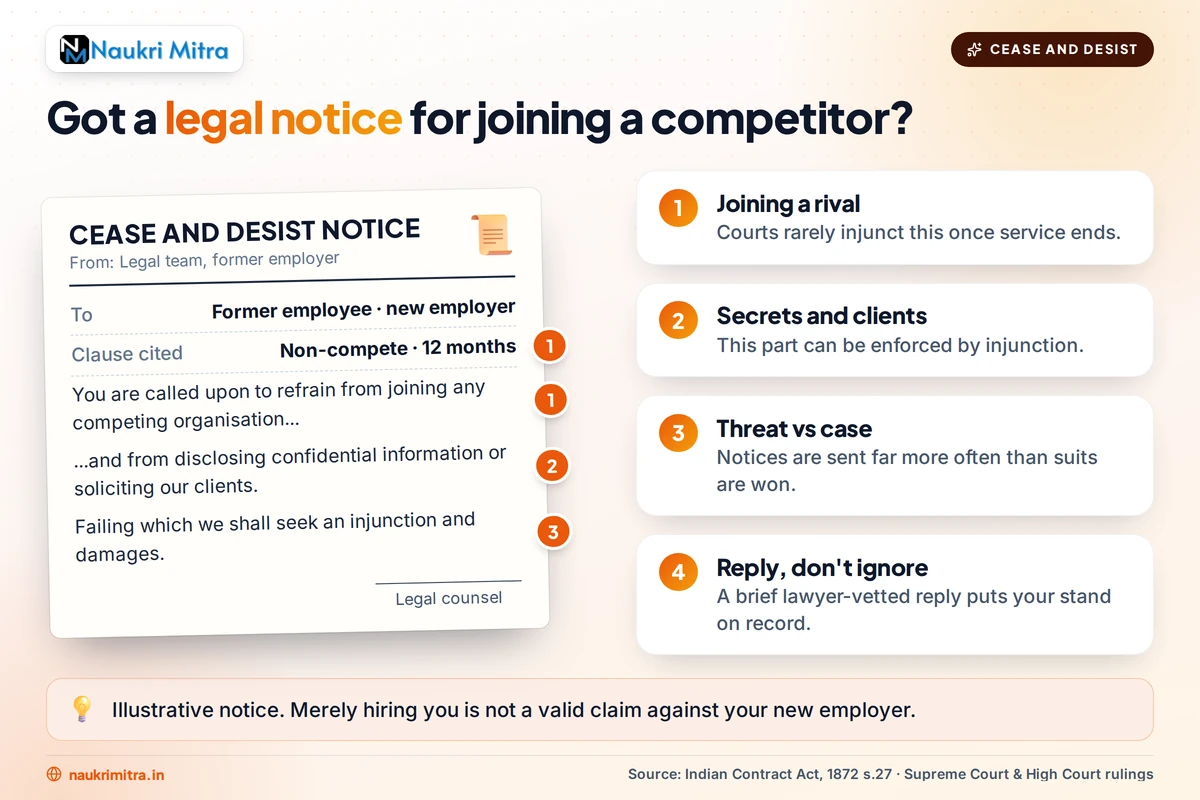
Technically, your former employer can file a civil suit and ask a court for an injunction against you or your new employer. Whether a company can stop you from joining a competitor in India through such a suit is a different question, and the practical answer is that courts rarely grant this kind of injunction once your employment has genuinely ended, because doing so would mean enforcing a restraint of trade that is void under Section 27 in the first place. What a court can and sometimes does grant is an injunction protecting specific confidential information or stopping active solicitation of clients, which is why employers increasingly draft "non-compete" clauses more carefully as confidentiality or non-solicitation provisions to improve their odds in court.
This dynamic plays out constantly in India's IT and technology sector, where engineers routinely move between competing product companies and service providers. If you are a software engineer in Bangalore weighing an offer from a direct competitor, it helps to know that the threat in a legal notice is usually stronger than the underlying case — companies send cease-and-desist letters as a deterrent far more often than they actually litigate them to a final injunction, because the odds of winning a post-termination restraint case are stacked against them under settled Supreme Court precedent. You can browse current openings, including software engineer jobs in Bangalore, without assuming a non-compete clause alone can legally block you from accepting one.
It is also worth knowing that even if the underlying restrictive clause is void, that does not automatically shield you from every consequence. A former employer can still pursue a separate, genuinely valid claim — for breach of confidentiality, for actual client poaching, or for recovery of a lawfully structured bond — even while the broad non-compete language itself is unenforceable. And your new employer can, in theory, be named in such a dispute if the former employer alleges the new company induced you to breach confidentiality obligations, though simply hiring someone who was once bound by an unenforceable non-compete is not, by itself, a valid cause of action against the new employer.
Garden Leave, Senior Executives, and Other Grey Areas
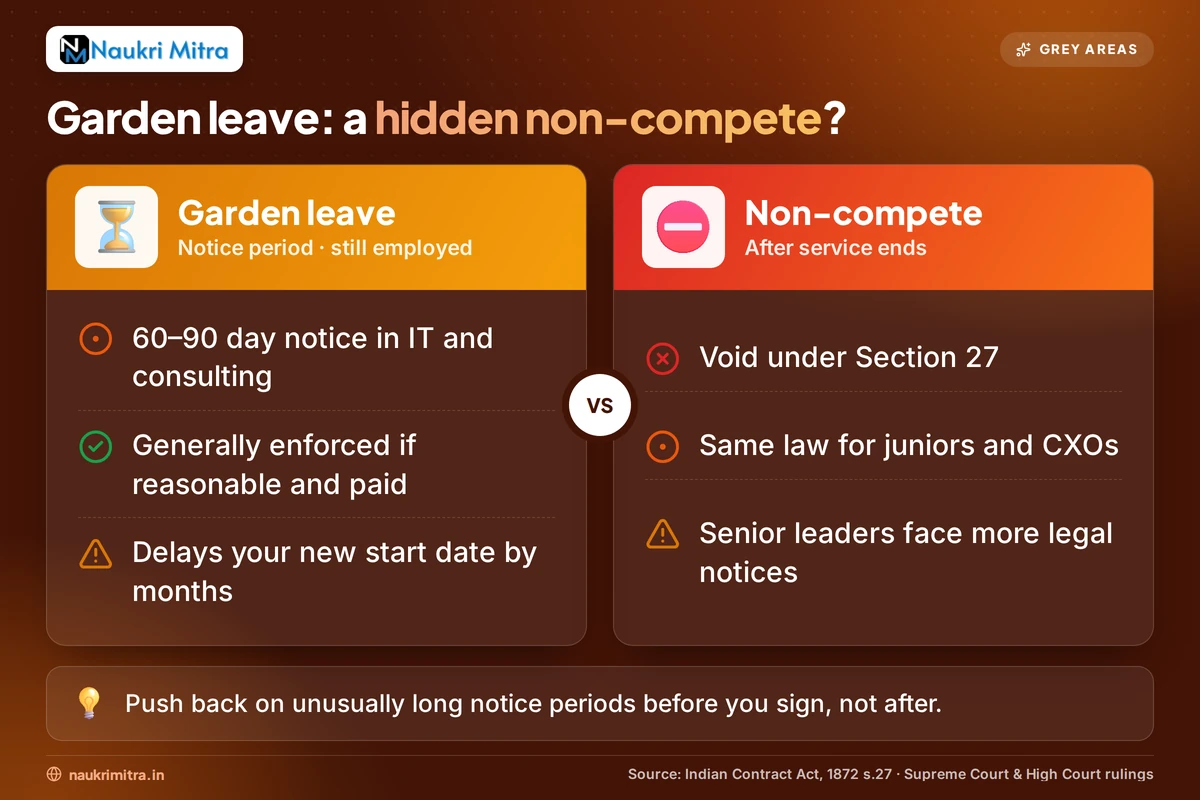
Garden leave clauses, common in IT and consulting firms, require a departing employee to serve out a long notice period — sometimes 60 or 90 days — during which they are relieved of duties but remain technically employed and barred from joining a new employer. Because garden leave operates during the subsistence of employment rather than after it formally ends, it sits in a legally different bucket from a classic non-compete, and courts have generally been more willing to enforce it, provided the notice period itself is reasonable and the employee continues to be paid. In practice, though, a garden leave clause can function very much like a hidden non-compete, since it effectively delays your start date with a new employer by months, which is exactly why candidates should push back on unusually long notice periods during offer negotiations rather than assume garden leave is automatically fair.
Seniority also changes how these disputes tend to play out, even though the statutory position under Section 27 does not formally distinguish between a junior employee and a C-suite executive. In practice, companies are far more likely to actually litigate against senior executives, sales leaders, and key account managers who join a direct rival, because the commercial stakes and the risk of genuine client or trade-secret leakage are higher. A junior employee moving to a competitor rarely attracts a lawsuit, while a senior executive with access to strategy, pricing, and key relationships is more likely to receive a serious legal notice, even though the underlying post-termination non-compete clause remains just as void under the law regardless of seniority.
You've Got a Cease-and-Desist Notice or Your F&F Is Being Withheld — Now What?
Receiving a legal notice alleging you violated a non-compete clause is unsettling, but it is rarely the end of the story. First, do not ignore it entirely — a reasoned, lawyer-vetted reply, even a brief one, puts on record that you are aware of the claim and disagree with it, and prevents the company from later arguing that your silence amounted to an admission. Ignoring a cease-and-desist notice altogether does not usually make the underlying claim stronger, but it can make the dispute drag on longer and may encourage the company to escalate to a formal suit or an application for an injunction, so a prompt, professional response is almost always the better path.
It is fairly common for employers to withhold full and final settlement amounts, citing an alleged non-compete breach as justification. This practice sits on shaky legal ground: withholding earned wages, provident fund dues, or gratuity because of a disputed and likely unenforceable restrictive covenant is generally not defensible, and employees have successfully challenged such withholding before labour courts and in civil suits. If your F&F settlement is being held up this way, a written demand referencing the voidness of post-termination restrictions under Section 27, followed by a formal complaint if the amount is not released, is usually the most effective route. As for liquidated damages clauses that specify a fixed penalty for "breaching" the non-compete, these generally cannot be enforced either, because a penalty clause attached to a void restriction is itself unenforceable — a distinction the Supreme Court drew in the Vijaya Bank case when it separated a legitimate service bond from an impermissible restraint of trade.
What to Check Before You Sign — Negotiating Your Offer Letter
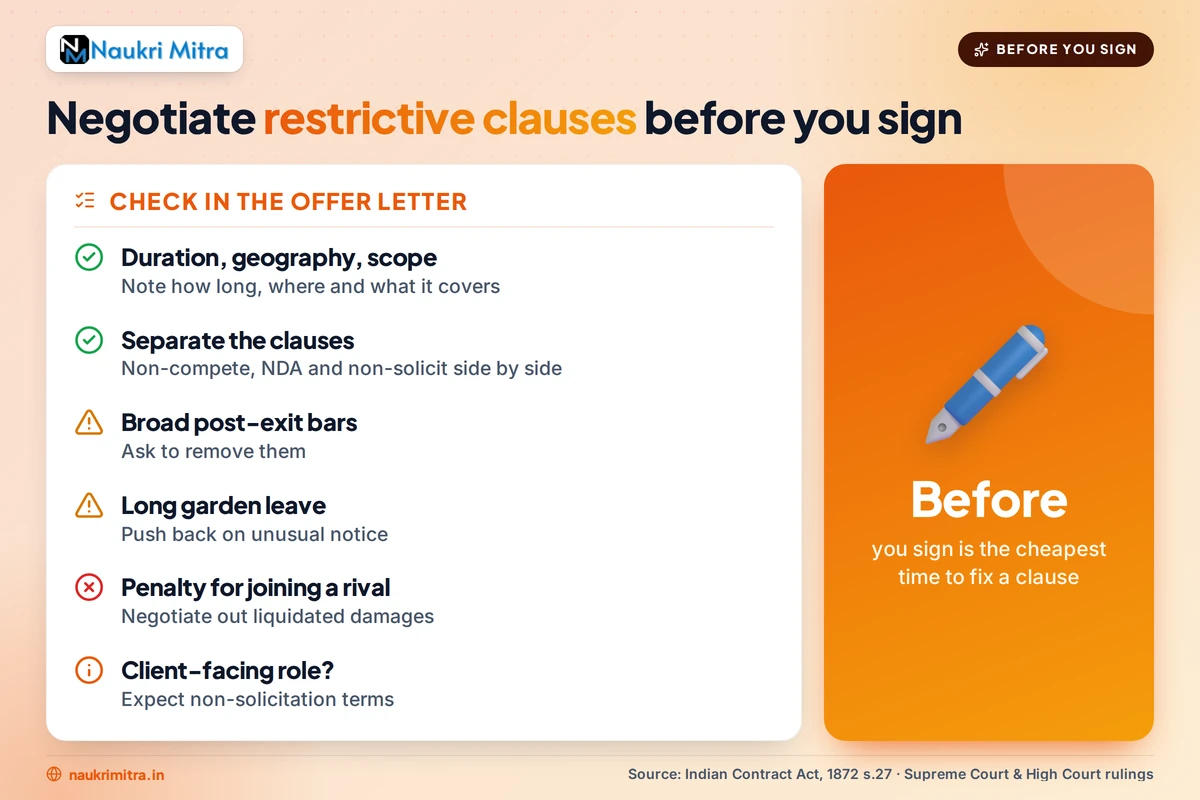
The best time to deal with a non-compete clause is before you sign, not after a dispute lands in your inbox. Read the restrictive covenants section of every offer letter carefully, and note the duration, the geography, and the scope of the restriction — the length and breadth of the clause still affect how aggressively an employer is likely to pursue you. If the clause blends a non-compete with confidentiality and non-solicitation language in one dense paragraph, ask HR or a lawyer to separate out exactly what you are agreeing to, since the enforceable parts and the unenforceable parts often sit side by side in the same clause.
Where possible, try to negotiate out overly broad post-termination restrictions, unusually long garden leave periods, or liquidated damages tied to joining a "competitor," especially if your role does not involve genuine access to trade secrets or strategic client relationships. For job seekers exploring roles where non-solicitation terms are especially common — client-facing and quota-driven positions — it is worth factoring this into offer comparisons, including when evaluating sales jobs in Delhi and similar client-facing roles where employers tend to rely more heavily on non-solicitation terms than outright non-competes. You can also browse verified listings and compare offer terms across companies on the Naukri Mitra job portal before deciding which offer, and which set of restrictive clauses, is worth accepting.
Frequently Asked Questions
Is a non-compete clause valid in India after resignation?
Generally no. Once your employment ends, a clause restraining you from working for a competitor is treated as a restraint of trade and is void under Section 27 of the Indian Contract Act in the overwhelming majority of cases, as the Supreme Court held as far back as 1980 and as High Courts have reaffirmed since.
Can a company legally stop me from joining a competitor in India?
Not through a post-termination non-compete clause alone. A company can still pursue genuine confidentiality or non-solicitation breaches, but courts rarely injunct an employee from simply joining a rival employer once service has ended.
What does Section 27 of the Indian Contract Act say about non-competes?
It declares void any agreement restraining a person from exercising a lawful profession, trade, or business, with a narrow exception for the sale of business goodwill — and Indian courts apply this strictly to post-employment restraints.
Are NDA and confidentiality clauses enforceable after I leave my job in India?
Yes, generally. Unlike a non-compete, a confidentiality agreement does not block you from working anywhere; it only restricts disclosure or misuse of genuinely confidential information, which is why it typically survives resignation.
Is a non-solicitation clause treated differently from a non-compete clause?
Yes. Non-solicitation clauses, which stop you from poaching former clients or colleagues, are viewed more favourably by courts than blanket non-compete clauses, because they protect a narrower and more specific business interest.
Can my employer withhold my full and final settlement over an alleged non-compete breach?
This is common in practice but legally questionable. Earned wages, PF, and gratuity generally cannot be withheld on the basis of a disputed and likely unenforceable restrictive covenant.
What happens if I ignore a cease-and-desist notice alleging I breached my non-compete?
It is better to respond, even briefly, through a lawyer. Ignoring it does not strengthen the company's case, but it can allow the dispute to escalate or go unanswered on record.
Does a non-compete clause apply differently to senior executives versus regular employees?
The statute does not distinguish by seniority, but companies are far more likely to actually litigate against senior executives and client-facing leaders with access to sensitive strategy or relationships than against junior staff.
Can liquidated damages be claimed even if the restrictive clause itself is unenforceable?
Generally not. A penalty tied to breaching a void restraint is itself unenforceable, though a separately valid service bond, as upheld in the Vijaya Bank case, can still be enforced on its own terms.
Can my new employer be dragged into a dispute over my old employer's non-compete clause?
It is possible if the former employer alleges the new company induced a breach of confidentiality, but merely hiring someone bound by an unenforceable non-compete is not, by itself, a valid claim against the new employer.
Sources: LiveLaw — Delhi High Court on post-termination restrictive covenants; Bar and Bench — enforceability of non-compete clauses; LiveLaw — Calcutta High Court on non-compete versus confidentiality.
.png)
.png)
.png)
Comments
Post a Comment