No Experience Letter? Company Has Closed | Naukri Mitra
Picture this. You clear three interview rounds, the offer mail lands in your inbox, and two days later a verification agency writes to ask for your last employer's HR contact. You call the old number and it is switched off. You open the maps app and the office is now a showroom. The company you worked for during the best two years of your career has simply vanished, and so has the person who would have signed your experience letter.
Whether your problem is a relieving letter not available company shut down or a full set of missing papers, take a breath, because this situation is far more common than it feels, and hiring teams know it. Startups fold, small firms wind up quietly, and entire businesses get struck off the register. Recruiters and verification agencies have routines for exactly this case. This guide walks through what those routines look like, which papers carry weight, and how to present your history calmly so the offer stays safe.
What a background check really wants to confirm
An experience letter is only a convenient shortcut, and proof of employment when company no longer exists is a question verification teams answer by weighing several records together. What the new employer truly wants to know is simple: did you work at the named company, in the named role, between roughly the dates you claimed, and did you leave on acceptable terms? Anything credible that answers those four questions can do the job when the usual paperwork is missing.
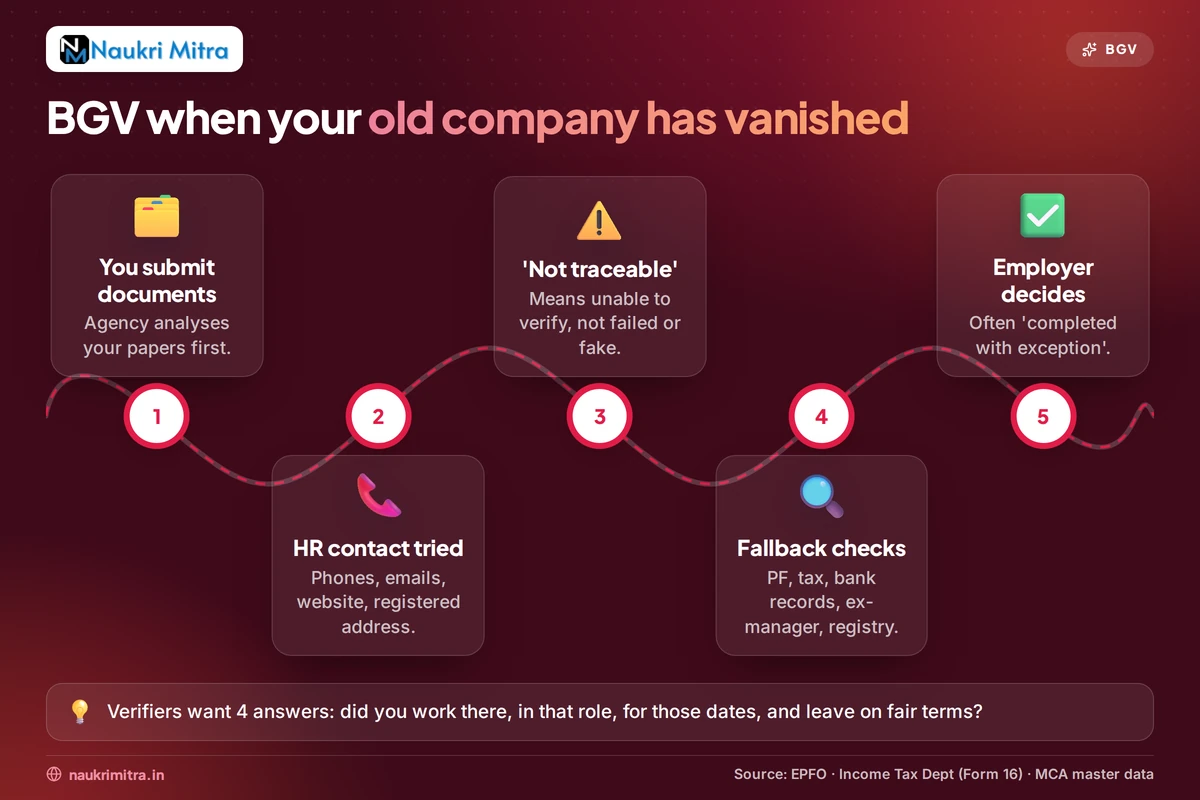
During the background verification BGV stage, an agency normally asks you for documents, then contacts the previous employer's HR to match them. One Indian verification firm describes its employment check as document analysis first, followed by HR confirmation, with provident fund records and the former reporting manager used as alternative channels when HR cannot be reached. You can read how that process is laid out in this OnGrid explainer on employment verification. The takeaway is reassuring: unreachable HR is a known scenario with a known fallback, not an automatic failure.
What happens when the previous employer is untraceable
In practice the agency tries the listed phone numbers and emails, checks whether the website and registered address still work, and then reports the attempt as "unable to verify" or "employer not traceable". That label is not the same as "failed" or "fake". It simply invites your new employer to decide whether other proof is enough, and this is where your own consistent documents do the talking.
How agencies treat a defunct employer
Policies differ, but the usual pattern is a documentary trail that does not depend on the dead company: provident fund, tax and bank records. Some agencies also approach a former manager with the client's permission, or confirm the entity existed through company registry data. Think of this as an alternative to experience letter for background verification that the agency chooses, not you, so ask your recruiter which route they follow.
Documents that can substitute for an experience letter
If you are wondering how to get experience letter if company closed down, the honest answer is that you often cannot, but you can build a bundle of papers that proves the same facts. Think in layers: government-generated records are strongest, then documents the employer issued during your tenure, then human confirmation. A solid bundle mixes all three.
- Government or regulator records: EPFO service history and passbook, income tax records, and the Annual Information Statement on the tax portal.
- Employer-issued papers from your tenure: appointment letter, salary slips, Form 16, any increment or promotion letter, ID card photographs, and official emails.
- Money trail: bank statements showing monthly salary credits with the company name in the narration.
- Human confirmation: a written statement from a former manager or colleague, plus your own signed declaration.
Nobody expects every item. Two or three strong, consistent records beat a dozen weak ones. Make a one-page timeline listing the company name, designation, joining date, last working day, and last drawn salary, and make every document match it, because mismatched dates raise questions, not the absence of a letter.
Does the appointment letter or LinkedIn count?
Your appointment letter is genuinely useful because it records the company's legal name, your designation, the joining date, and often the salary structure, all issued by the employer at the time. It proves how you started, though not when you finished. LinkedIn is different. A profile is self-reported, so on its own it is weak evidence. Treat it as supporting colour, never as the main proof.
Using your PF passbook and UAN employment history
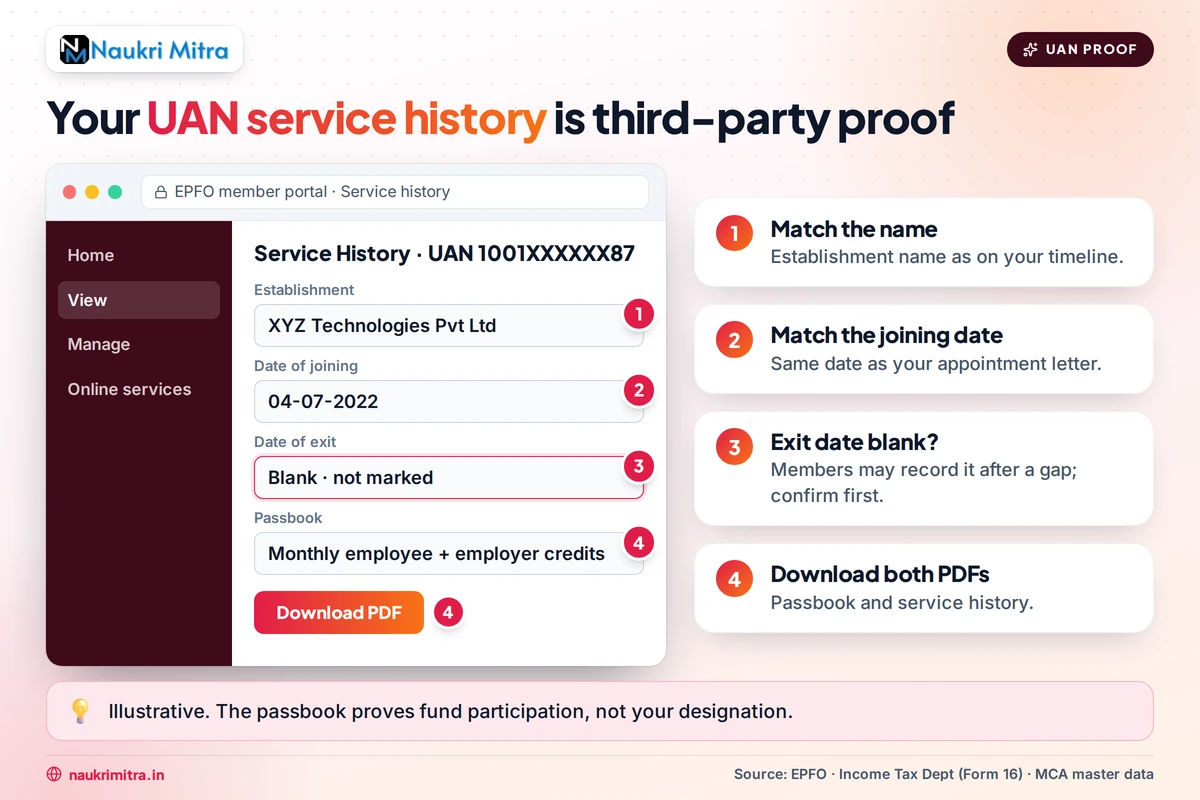
For anyone whose employer deducted provident fund, the Employees' Provident Fund Organisation record is usually the single most useful third-party proof. Log in to the member portal with your Universal Account Number, and you can view your PF passbook and your service history, which list the establishments where contributions were credited.
So, can your EPFO or UAN passbook serve as proof of employment history? In most verification workflows, yes, as strong supporting proof, but understand its limits. One payroll-company support guide points out that these records are historical evidence of fund participation rather than an employment certificate in themselves, and the portal lets you download both the passbook and the service history as PDFs. The passbook does not show your designation, and the date of exit is only as accurate as what the employer or you recorded.
Getting the most out of your UAN employment history
Check that the establishment name and date of joining match your timeline. If the date of exit is blank because the employer never marked it, the EPFO portal has historically allowed members to record their own exit date after a minimum gap following the last contribution. Rules and portal menus change, so confirm the current option on the portal or with the EPFO helpline before relying on it.
Form 16, salary slips and bank statements as BGV proof
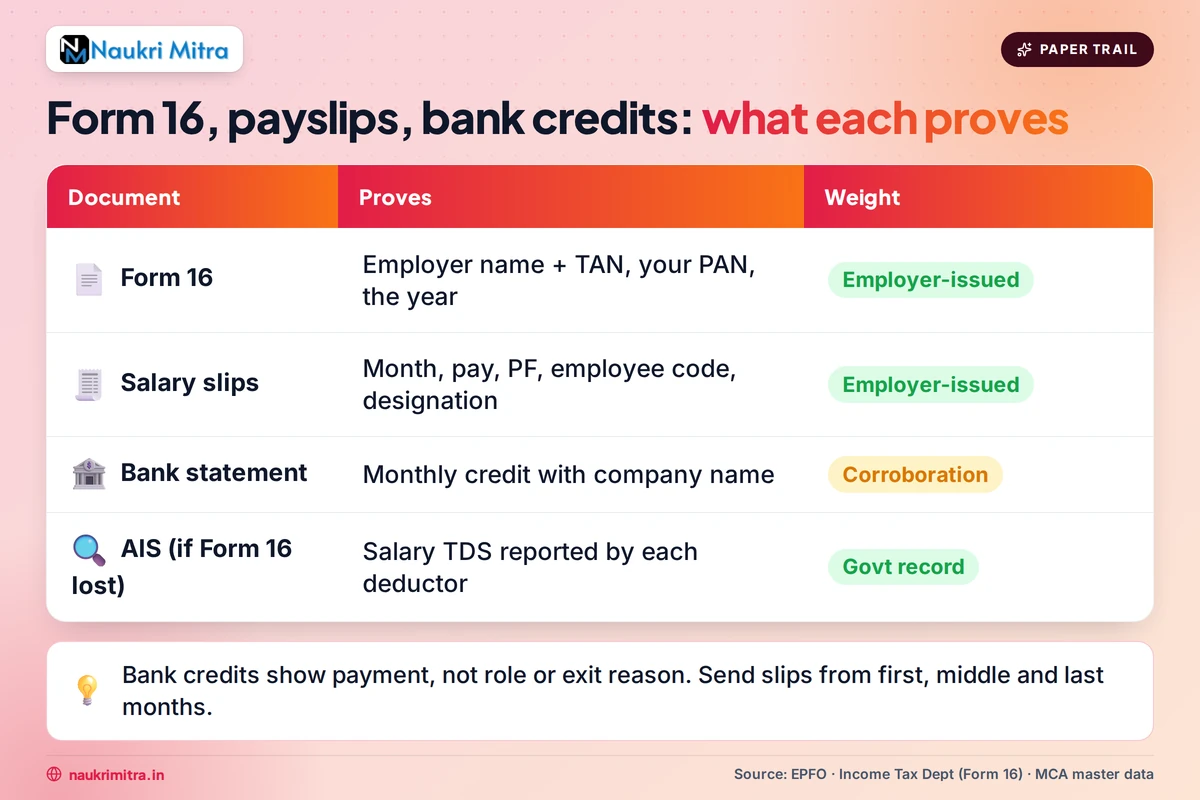
Many candidates ask how to use Form 16 or salary slips as BGV proof instead of a letter. The logic is straightforward. Form 16 is the certificate an employer issues for tax deducted at source on salary, and the Income Tax Department describes it on its page about Form 16 as a TDS certificate on salary. Because it carries the employer's name and tax deduction account number along with your PAN and the financial year, it ties you to that employer for a specific period.
If you have lost your copies, the Annual Information Statement on the income tax portal lists salary TDS reported by each deductor, which helps show which employer reported your income in a given year.
Payslips show the month, gross pay, deductions, provident fund, and often your employee code and designation. Slips from your first, middle and last months give a verifier a clear picture.
Bank statements showing salary credits
Can bank statements showing salary credits work as proof of employment? Yes, as corroboration. A statement that shows a regular monthly credit with the company's name in the narration backs up the payslips and the PF entries. Its weakness is that it shows payment, not designation or reason for leaving. Download it from official net banking or get a stamped branch copy, and consider masking unrelated transactions, though policies on redaction vary.
Check whether the company was struck off or is only silent
Before you tell anyone the company has closed, confirm what actually happened. It may have been wound up, struck off, merged into another company, or simply stopped responding while still legally alive.
Looking up the company on MCA records
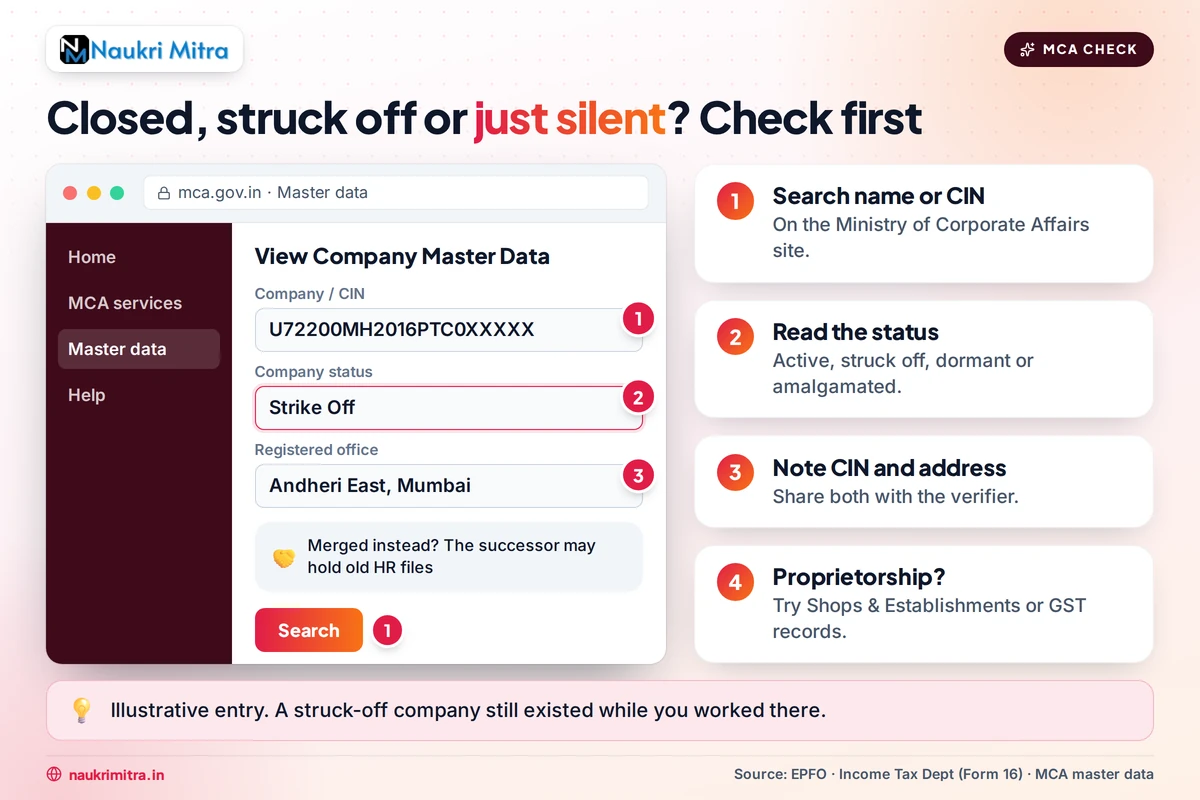
To check if a company was officially struck off, use the Ministry of Corporate Affairs website. Its master data service lets you search by company name or Corporate Identification Number, and the result shows a company status such as active, struck off, dormant, or amalgamated. A clear walk-through of the steps is available in this guide on how to check if a company is struck off by MCA. Note the CIN and registered office address for the verifier.
A struck-off company still existed during your employment, and the registry record confirms it. Restoring one through the National Company Law Tribunal is a heavy route, rarely worth it for a letter. Merged companies are different: the successor often holds the old HR records and may confirm your tenure.
If the company exists on paper but no one responds
A company showing as active but unreachable is common among small private firms. Try the registered office address, the directors' emails from registry filings, and any mobile number you still hold. Send one polite written request by email and a copy by speed post, and keep the tracking receipt. If nobody answers, that trail shows a genuine effort, which many verifiers value.
Does Shops and Establishment registration help?
It can, in some cases. Most commercial businesses register under their state's Shops and Establishments law, and the certificate often names the owner or partners and the address. For proprietorships and partnerships, which never appear in the company registry, this registration, along with GST records, may be the only way to learn who owned the business. Online availability depends on the state, so do not assume it.
When you cannot reach any former HR or colleague
Losing touch with HR is the usual story after a closure, but remember that HR is only one of several people who saw you work. A former reporting manager, a senior from another department, a client, or even a vendor you dealt with can describe your role and period of work. Old email threads, WhatsApp groups and LinkedIn connections will show who can confirm your tenure.
Can former colleagues or managers issue a verification letter?
They can write one, and many verifiers accept it as supplementary evidence, especially when it comes from a person who was your manager. It works best when it is short and factual. A good letter states the writer's full name, designation at the time, the company's legal name, your designation, your joining and leaving dates, and a line on the nature of your work. It should include the writer's current employer, phone number and email so the agency can reach them. A colleague's letter is supporting evidence, not an official certificate, and acceptance depends on the new employer's policy.
Can you self-declare and get it independently verified?
Self-declaration helps but is never enough alone. Write a signed statement of your employment details and attach the documents that support it; the independent verification comes from third-party records such as provident fund, tax and bank entries. Every date in it must agree with the other papers, because mismatches with the PF record turn a harmless gap into a red flag.
Affidavits, notarisation and what employers accept
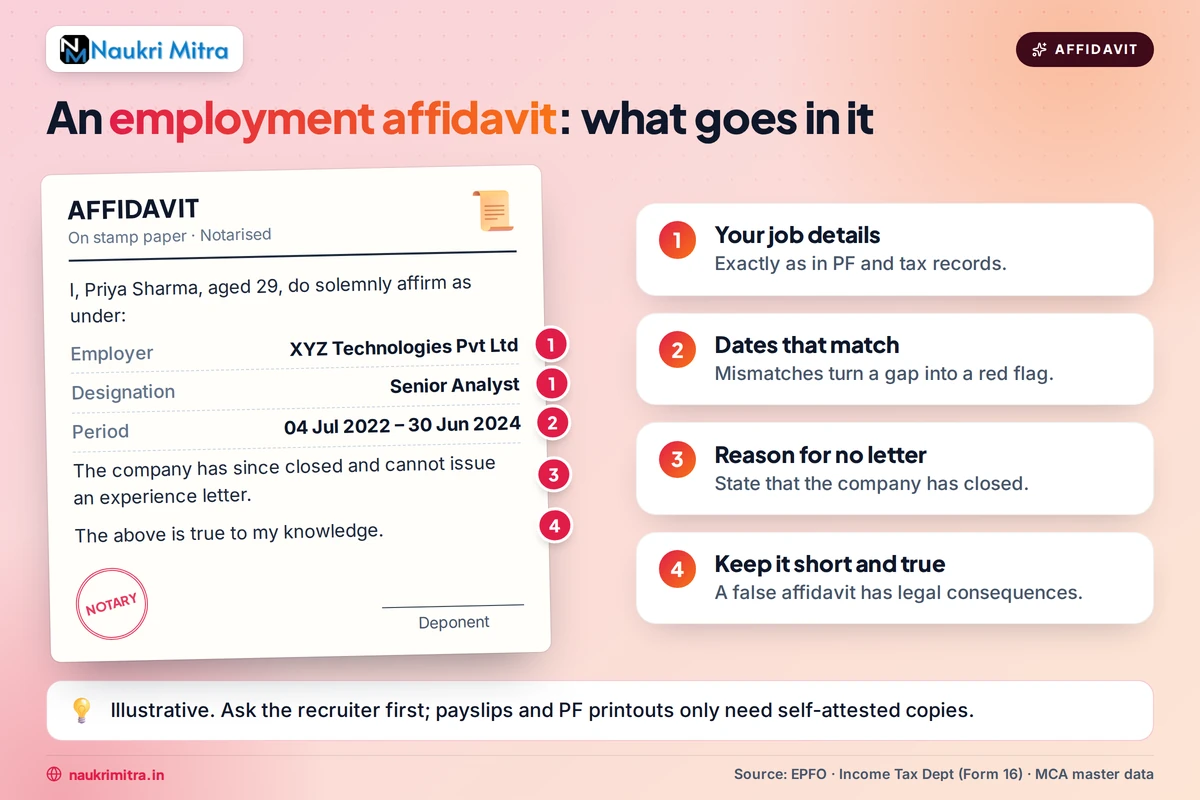
Do new employers accept an affidavit in place of a missing letter? Sometimes, and it depends entirely on the employer and the verification vendor. An affidavit is a sworn statement made on stamp paper and notarised or attested before an authorised officer, in which you state your employment details and declare that the company has closed and cannot issue documents. Some employers keep a format ready; others take it only as a last resort. Ask the recruiter first so you do not spend money on stamp paper they will not use.
Should documents be notarised?
Generally you do not need to notarise original records such as PF printouts or payslips. A self-attested copy, with your signature and the words "true copy of the original", is the more common requirement. Notarisation is typically reserved for statements you create yourself, like the affidavit or a declaration. Follow the employer's own document checklist.
Keep any affidavit short and true, because a false one can carry legal consequences.
Is there a legal way to make a defunct company issue documents?
It is difficult and often not worth the effort for a letter alone. No single central law compels every private employer to issue an experience letter, though some establishments covered by standing orders or state rules must give a service certificate on separation. Check whether yours did before building an argument on it.
If you have unpaid wages or provident fund dues, the position is different. You can approach the state labour authorities or use the EPFO grievance system, and a recorded complaint becomes a dated document linking you to the employer. If the promoters are known, a lawyer's notice asking them to certify your employment sometimes works. Take legal advice first, because the right step depends on the company's form, its registry status, and whether liquidation or insolvency is under way. In that case the liquidator may hold the records.
When the offer depends on a BGV that cannot be completed
This is the scenario that causes the most anxiety: a conditional offer that says employment is subject to satisfactory verification, and one employer on your list cannot be verified. Here is a calm way to handle it.
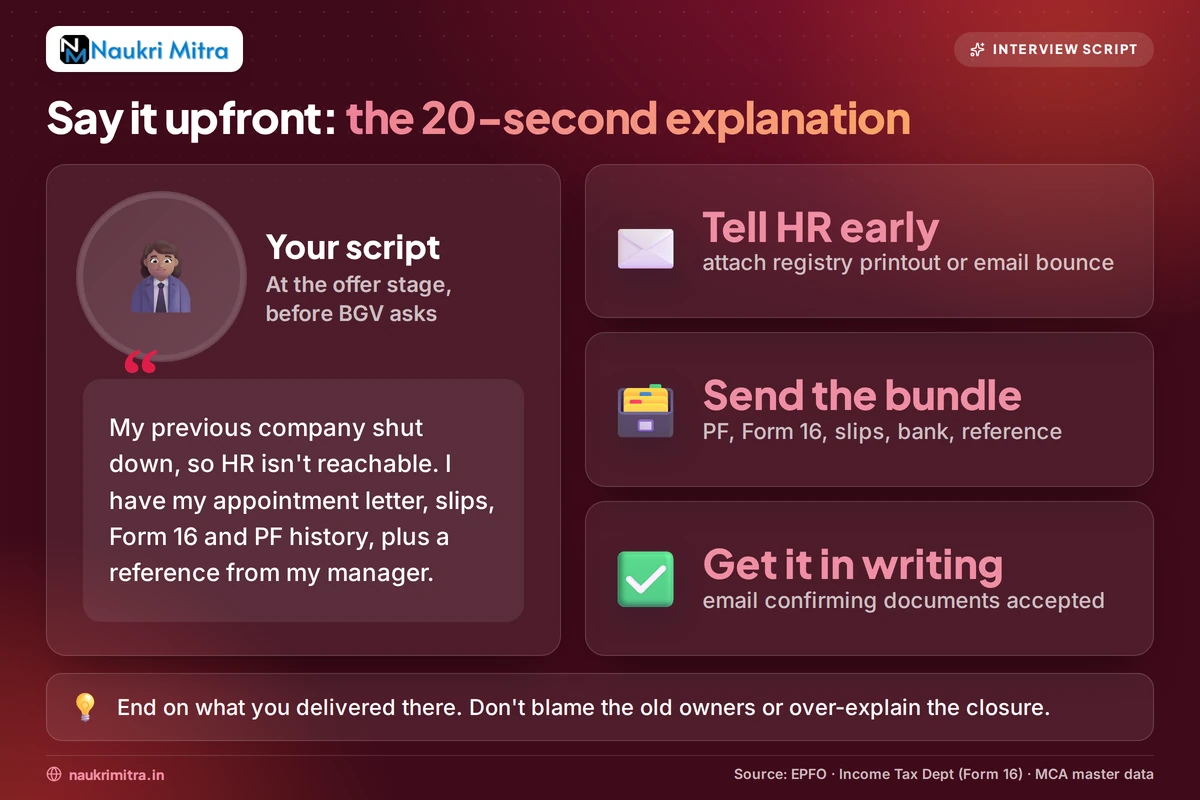
- Tell HR early. Do not wait for the agency to report the gap. Write to the recruiter as soon as you know the company has closed.
- Attach evidence of closure. The registry status printout, a news report, or an email bounce record shows the problem is real.
- Submit the alternative bundle. PF record, Form 16, payslips, appointment letter, bank statements, and any reference letter.
- Ask what they will accept. Some companies approve an exception; others ask for a particular document.
- Get the decision in writing. A short email confirming that the alternate documents are accepted protects you if the joining date approaches.
Most verification reports allow a result like "completed with exception", which means minor gaps were noted but the overall profile is accepted. The final call belongs to the hiring company, and a candidate who reports the issue first and supplies a clean bundle is treated far more favourably than one who stays silent.
How to explain it in an interview, and what to say upfront
The core worry for most candidates is company closed how to prove past employment for new job without sounding evasive. The answer is to lead with facts and offer evidence before anyone asks.
If you anticipate trouble, say so at the offer stage, not after the agency writes. A short, steady explanation works best, and you can use it nearly word for word:
"My previous company shut down in [month, year], so the HR team is not reachable and I could not get a relieving letter. I have my appointment letter, salary slips, Form 16 and my PF service history, and I can share a reference from my former manager. I will gladly sign a declaration."
It is factual, names the proof, and offers cooperation. Avoid blaming the old owners or over-explaining the closure, since interviewers read tone as much as content. In an interview, add one line on what you delivered there, so the story ends with your work, not the closure.
If you are still searching for your next role and want openings you can apply to directly, browse fresh listings on Naukri Mitra, and keep your documents ready so that verification does not slow you down later.
What to collect from every job before you leave
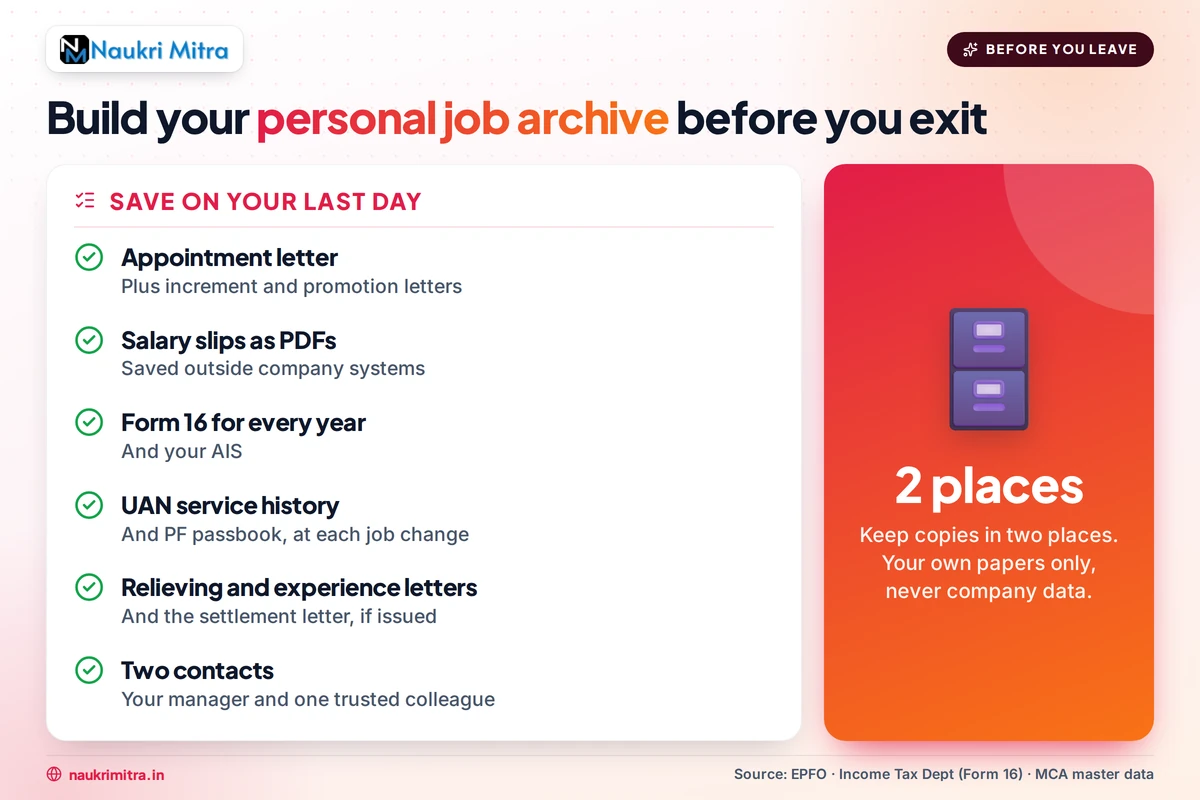
The cheapest fix is prevention. Companies shut down faster than people expect, and the weeks after a closure are chaotic. Whenever you resign, or whenever a workplace starts to look shaky, build a small personal archive. Ideally, it holds the following:
- Your appointment letter and any increment or promotion letters.
- Salary slips in PDF, saved outside the company's systems.
- Form 16 for every year, plus your Annual Information Statement.
- Your UAN service history and PF passbook, downloaded at each job change.
- Relieving, experience and settlement letters, if issued.
- The name and contact details of your manager and one trusted colleague.
Do this on your last working day, not months later, because email accounts and payroll portals get switched off soon after a company winds down. Store copies in two places, and save only your own personal employment documents, never confidential company data.
Frequently asked questions
1. Will a new employer reject me because the company closed?
Usually not. Verification teams meet closed employers regularly. What matters is early disclosure and consistent proof.
2. Is an affidavit enough on its own?
Rarely. It works best alongside provident fund and tax records. Confirm with the recruiter before preparing one.
3. Can I fix a missing exit date in my PF record?
The portal has allowed members to update their own exit date under certain conditions. Check the current menu or call the EPFO helpline first.
4. What if my company merged into another firm?
Write to the successor company's HR or legal team with your employee details. They may hold the old files and confirm your tenure.
5. Do I need to notarise payslips and Form 16?
Typically no. Self-attested copies are the norm. Notarisation is mainly for affidavits and declarations.
6. How long should I keep employment documents?
For as long as you work, since loans, visas and job changes may need them. Keep digital copies in two places.
7. What if my documents show a different company name?
Companies rebrand. Check the registry for the former name and add a line to your cover note explaining the change.
8. Is it wise to claim experience I cannot prove?
No. Fabricated or inflated employment can lead to offer withdrawal or termination later. Disclose honestly and rely on what you can evidence.
Sources: OnGrid employment verification | Income Tax Department, Form 16 | InstaFinancials, MCA struck-off check
.png)
.png)
.png)
Comments
Post a Comment