Company Shut Down? Claim PF and Gratuity | Naukri Mitra
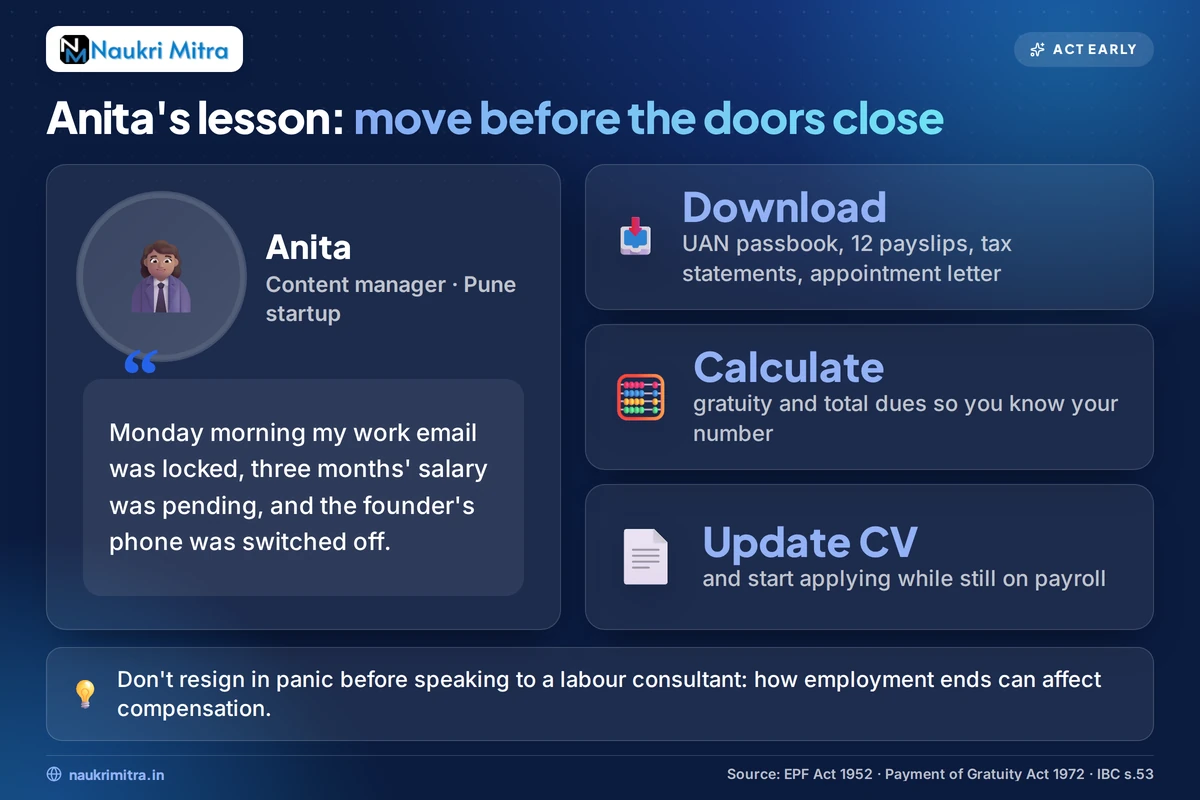
Anita, a content manager in Pune, opened her laptop on a Monday morning and found her work email locked. The co-working desk her startup rented carried a printed notice: operations suspended until further notice. Three months of salary were pending, HR was not picking up, and the founder's phone was switched off. That night she typed "company shut down how to get PF money" into a search bar and got a pile of conflicting forum answers.
If you are in a similar spot, most of what you have built up is more protected than it feels right now. Your provident fund sits with the Employees' Provident Fund Organisation, not with your employer. Gratuity has a legal recovery route. Even a full insolvency has a defined order in which employees are paid. The catch is that every type of dues follows a different process, and each one is slow and document-heavy. This guide takes them one by one.
What Happens to Your EPF Balance When the Employer Shuts Down Without Notice?
The money already deposited against your Universal Account Number (UAN) stays where it is. The EPFO holds it, and the employer's closure does not freeze, cancel or reduce it.
What a sudden closure does disrupt is the paperwork around your exit. Normally the employer records your date of exit on the portal and sometimes attests your form. A company that has vanished can do neither. Most delays after a shutdown therefore come from a missing exit date, unverified KYC, or a mismatch in name or date of birth. The money itself is rarely the problem.
The part that can genuinely be at risk is any contribution the employer deducted or owed but never deposited. That needs a different remedy, covered further down.
How to Claim PF If Company Closed India: Step by Step
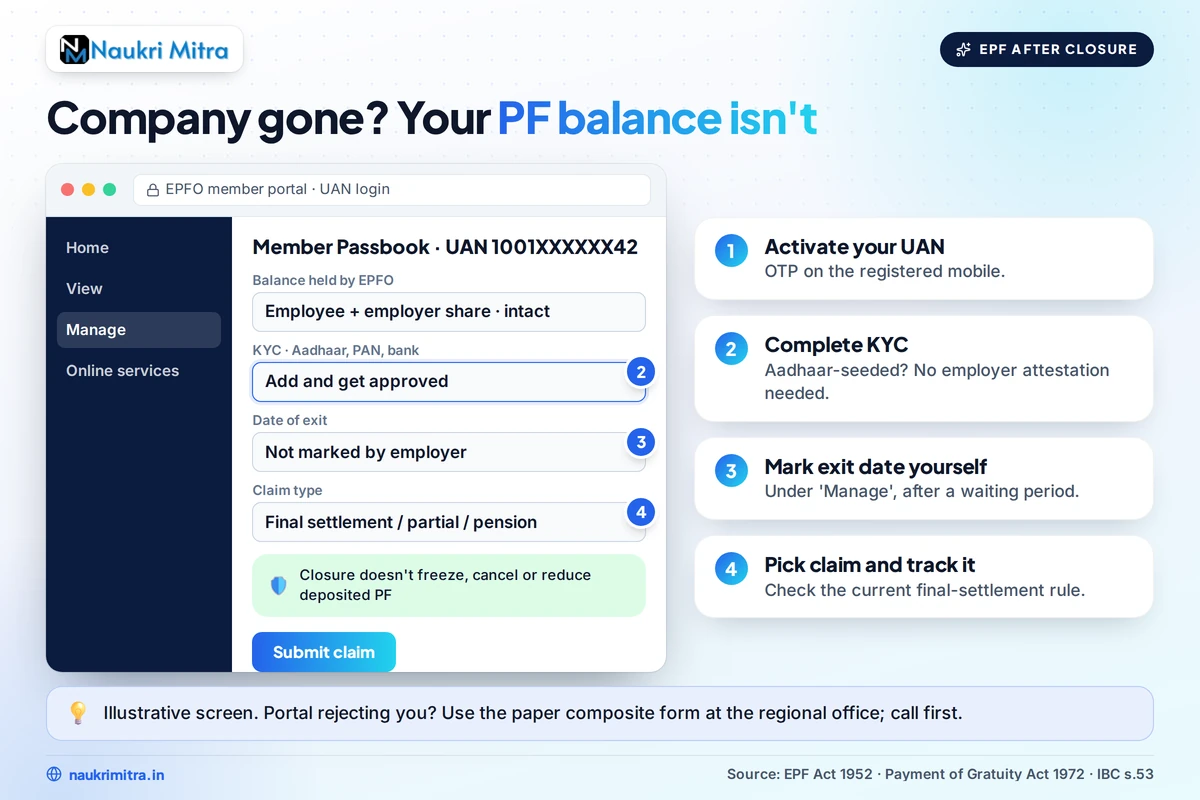
For most people, the cleanest route is the online claim on the EPFO member portal. Subscribers whose Aadhaar and bank account are seeded with the UAN can file directly, without the employer's attestation. The EPFO introduced this through a composite claim form that merged the old Forms 19, 10C and 31, as its press release of 21 February 2017 on claims without employer attestation explains. The process has been refined since, so treat the portal's current screens as the final word.
- Activate your UAN if you have never logged in. You need the registered mobile number for the OTP.
- Complete KYC. Aadhaar, PAN and bank details should be added and approved. Approval used to depend on the employer, which is exactly the problem in a shutdown.
- Mark your exit date. The portal lets a member record it personally when the employer has not, after a waiting period. Look under the "Manage" menu.
- Pick the claim type. Final settlement, partial withdrawal and pension are separate options. The conditions for final settlement have been revised in recent years, so check the current rule first.
- Submit and track the claim number online.
If Aadhaar is not seeded or the portal keeps rejecting you, a paper EPFO claim with the non-Aadhaar composite form goes to the regional office. That form traditionally needs attestation. Some regional offices have accepted a bank manager or gazetted officer when the employer is gone, but practice varies, so call before you travel.
Can You Withdraw PF Even If the Company Stopped Filing Returns?
Yes, for whatever is credited in your account. Missing returns do not block withdrawal of balances already deposited. They only mean the defaulted months will be absent from your passbook, and you cannot withdraw money that never arrived.
How Do You Check If Your Employer Actually Deposited PF or ESI?
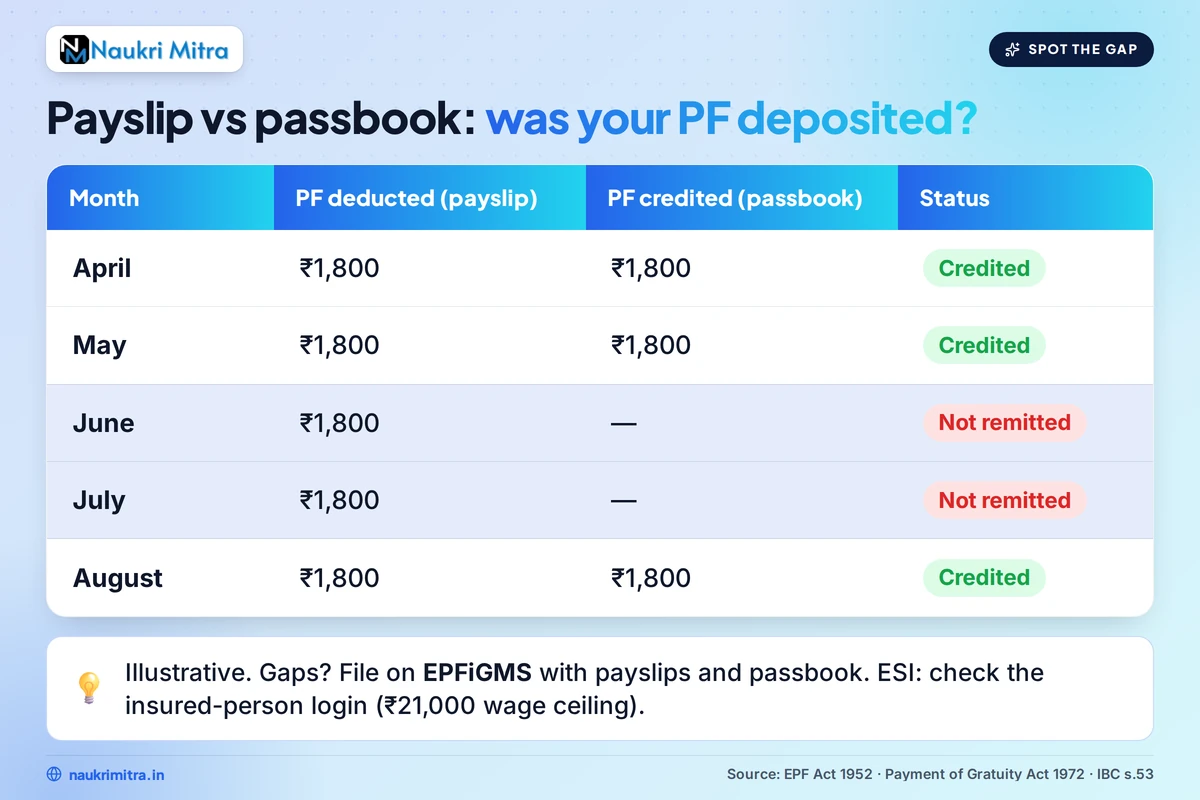
Do not wait for a crisis. Log in to the member passbook and compare it with your payslips month by month. A healthy passbook shows an employee share and an employer share credited a few weeks after each salary month. A gap means the money was deducted but not remitted, or never deducted at all.
For the Employees' State Insurance scheme, the insured person login on the ESIC portal shows contribution history. If your wage was within the ceiling, which stood at Rs 21,000 a month at the time of writing, your employer should have enrolled you. Missing ESI months matter because they affect medical cover and unemployment relief.
Build a three-column sheet: month, PF deducted on payslip, PF credited in passbook.
What If PF Was Deducted From Your Salary but Never Deposited?
This is the most serious default. The employee's share is money held in trust, and keeping it is an offence under the EPF and Miscellaneous Provisions Act, 1952. The Act lets the EPFO inquire into dues, levy interest and damages, and recover the amount, including by attaching bank accounts and property. Section 11 also gives these contributions a priority claim over most other debts.
Recovery runs against the employer and can take long. Employer default has generally not been treated as a reason to deny the member the benefit, but credit to your account may follow the inquiry. Report early and keep every payslip.
How Do You File an EPFO Complaint Against a Defaulting Employer?
Use EPFiGMS, the EPFO's online grievance system. Register, choose the grievance type (non-remittance of contributions is a standard category), enter your UAN and establishment details, and upload payslips and the passbook. You get a registration number to track. If the reply is poor, write to the Regional PF Commissioner and send a copy to the Labour Commissioner.
Employer Bankrupt, Gratuity Not Paid: What Should You Do?
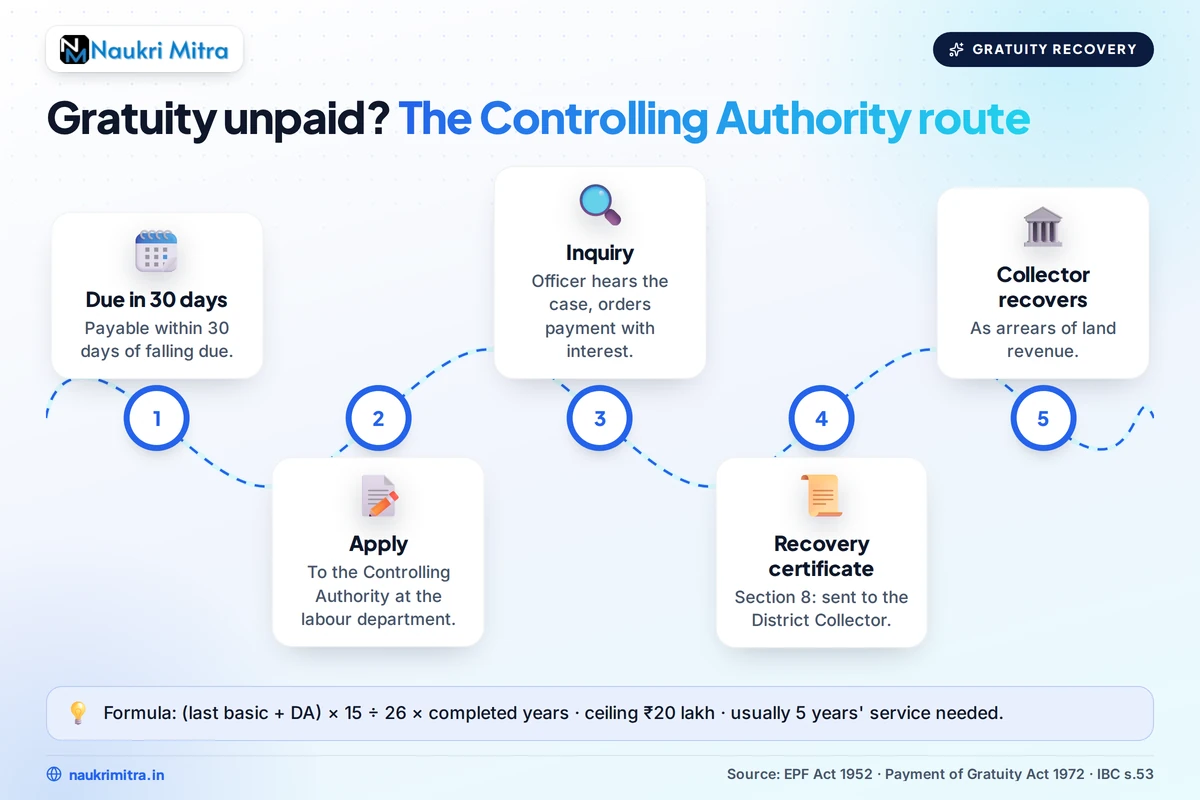
People who search "employer bankrupt gratuity not paid what to do" often assume the money is gone. It is not, though recovery needs steady follow-up. The Payment of Gratuity Act, 1972 is unusually employee-friendly on enforcement. Gratuity is generally payable within 30 days of falling due. If the employer does not pay, you apply to the Controlling Authority, usually an officer of the state labour department, who can hold an inquiry and order payment with interest.
If the employer still defaults, Section 8 allows a recovery certificate to the District Collector, who collects the dues as arrears of land revenue. A Gujarat Labour Department clarification, reported in this explainer on gratuity recovery through the Collector, notes that the employer must first get a reasonable chance to show cause. For a closed business that notice can be a hurdle, so give the authority every address, email and phone number you hold for the directors.
The standard formula is last drawn monthly basic plus dearness allowance, times 15, divided by 26, times completed years of service. A statutory ceiling applies, Rs 20 lakh at the time of writing, so check the latest notification.
What Happens to Unpaid Gratuity If the Company Is Insolvent?
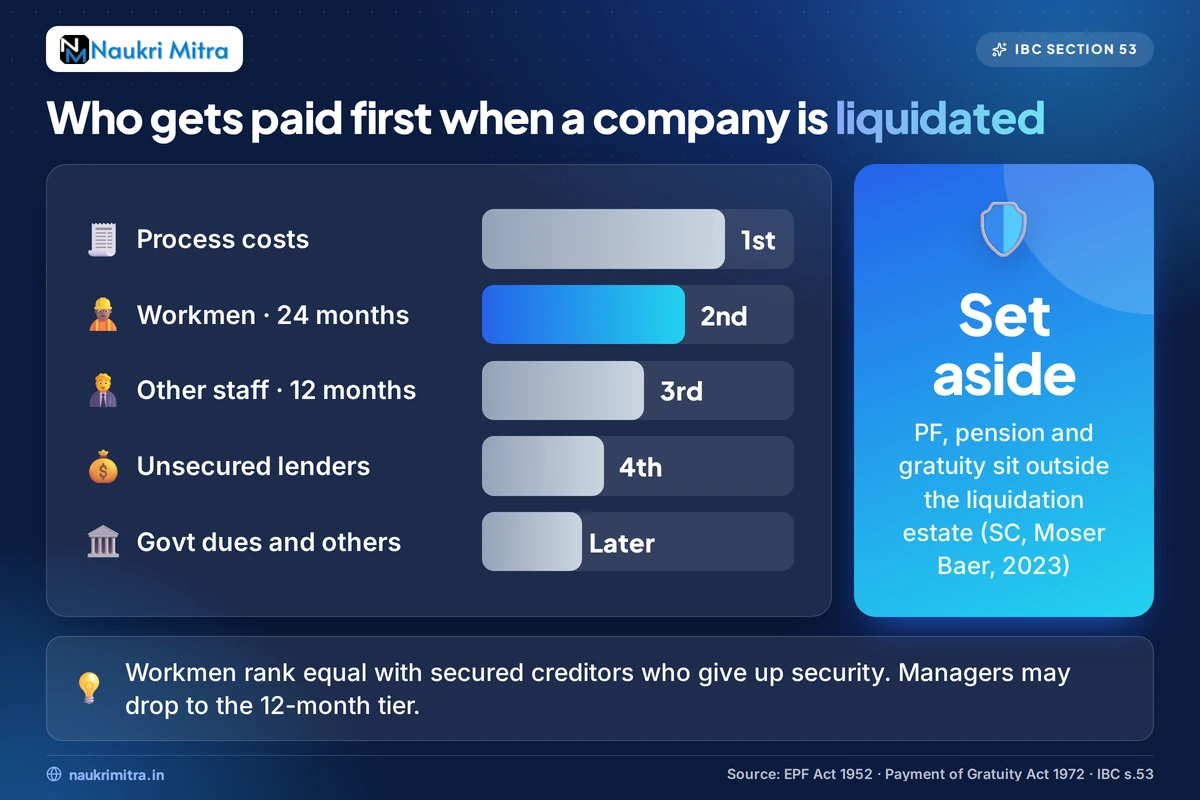
Once insolvency begins, a moratorium stops most recovery actions, so a pending application may stall. The Supreme Court's 2023 ruling in State Bank of India v. Moser Baer Karamchari Union held that provident fund, pension and gratuity dues are not part of the liquidation estate. A summary is in this SCC Online report on PF and gratuity dues in liquidation. In plain terms, these dues are meant to be paid from funds set aside for them and not to compete with banks in the payment queue.
What stays unclear is the position when the employer never funded those accounts. Legal commentators have flagged ambiguity here, especially after the new Code on Social Security, so expect close scrutiny. File anyway, in writing, and keep the acknowledgement.
Can You Claim Gratuity Without Five Years of Service If the Company Shuts Down?
Under the 1972 Act the five-year rule applies to retirement, resignation and termination, and is relaxed only for death or disablement. A shutdown does not automatically waive it. The labour codes, however, were brought into force on 21 November 2025, and the Code on Social Security reduces the qualifying period to one year for fixed-term employees. Transitional rules are still evolving, so ask a labour officer which regime covers your exit date.
Employee Rights When Company Goes Into Liquidation: The Payment Order
The Insolvency and Bankruptcy Code IBC decides who gets paid first, so it is worth understanding. There are two stages. The corporate insolvency resolution process, or CIRP, tries to rescue the business. If that fails, the company is liquidated and its assets sold. Section 53 then sets the waterfall of payments.
In simplified order, the costs of the process come first. Next are workmen's dues for the 24 months before liquidation began, ranking equally with secured creditors who give up their security. Then come wages and dues of other employees for 12 months, followed by unsecured financial creditors, government dues and the rest. Workmen's dues borrow their meaning from the Companies Act and include wages, retrenchment compensation and certain provident fund and gratuity amounts. Confirm the current wording with a lawyer, as amendments and rulings keep reshaping the details.
Where Do Workmen's Dues Rank in the IBC Liquidation Payment Order?
Second, right after process costs, which is a strong priority. The catch is the word "workmen". Managers and many higher-paid supervisors may not qualify, so their pay falls to the next tier with only a 12-month window. Even that beats being an ordinary creditor.
Can You Claim Dues Through the NCLT Insolvency Process?
Yes, though you do not usually file at the National Company Law Tribunal yourself. The Tribunal appoints an insolvency professional, and employees send claims to that professional. The Tribunal steps in over disputes, such as a rejected or reduced claim. Starting the case is another matter, since the minimum default for a creditor to initiate it is Rs 1 crore. An individual employee rarely triggers it. Banks or large vendors usually do.
What Is a Resolution Professional or Liquidator, and How Do You File a Claim?
A resolution professional runs the company during CIRP in place of the board. A liquidator takes over if the company is wound up. Both are licensed insolvency professionals. Look for the public announcement in newspapers and on the Insolvency and Bankruptcy Board of India website, which names the professional, an email address and the last date for claims.
Employees file a proof of claim in the prescribed form for workmen and employees, with documents. If you cannot calculate an amount exactly, an estimate can be filed and corrected later. A recognised union or authorised representative can file for many workers together, which saves time.
Is There a Deadline to Submit Claims During the CIRP Process?
Yes. The public announcement sets a last date tied to the professional's appointment. Late claims have been entertained in some cases until the creditors' committee approves a resolution plan, but never rely on that leniency. In liquidation, claims are typically due within about 30 days of the order. Check the notice and file early.
Unpaid Salary Company Shut Down India: What Can You Recover?
Pay you have already earned is a legal debt. If you earn within the wage limit under the Payment of Wages law, you can approach the designated authority. Otherwise your routes are an insolvency claim (if a process is on), a civil suit, or a complaint to the labour department.
What Happens to Unpaid Salary and Notice Pay If the Company Shuts Suddenly?
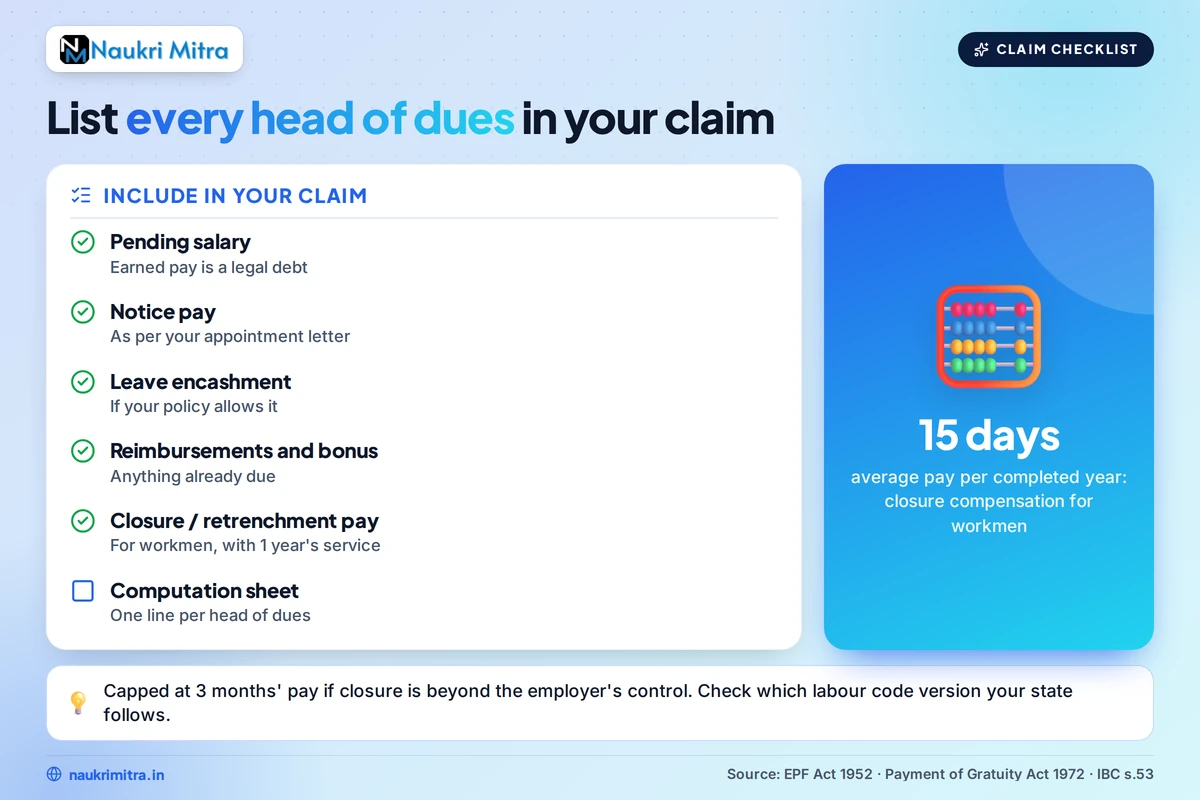
List everything in your claim: pending salary, leave encashment if your policy allows it, notice pay per your appointment letter, reimbursements, bonus due, and closure or retrenchment compensation. Under the Industrial Disputes framework, closure compensation for workmen in larger establishments is based on 15 days' average pay per completed year, usually needing a year of continuous service, with a three-month cap where closure is beyond the employer's control. The Industrial Relations Code is now in force, so check which version your state follows.
What If Only One Branch or Office Shuts Down?
If the company continues elsewhere, your employer still exists and stays fully liable. A branch closure is not an insolvency. You can ask for relocation, retrenchment compensation, notice pay and full settlement. Do not sign a "full and final settlement" letter unread, and record any objection to a transfer in writing. A live company can receive a legal notice, which usually makes recovery quicker than against a defunct one.
Can Company Directors Be Held Personally Liable for Unpaid Dues?
A company is a separate legal person, so directors are not liable for its debts by default. There are exceptions. Under the EPF Act, people in charge of an establishment can be prosecuted for not depositing deducted contributions. The insolvency law lets a resolution professional or liquidator seek orders against directors who carried on business to defraud creditors. A director who gave a personal guarantee or undertaking in your appointment letter may also be liable on that basis. A lawyer's notice and a complaint to the Registrar of Companies create pressure and a record, though neither guarantees payment.
What Documents Prove Your Claim as an Employee Creditor?
Insolvency professionals and the Controlling Authority do not take your word. Build a folder before office email disappears:
- Offer letter, appointment letter and revision letters
- Payslips and bank statements showing your last credits
- EPFO passbook, UAN and ESIC insurance number
- Form 16 copies and tax portal statements
- Emails or chats where management acknowledged dues or promised dates
- ID card, attendance records and any closure notice
- A computation sheet showing each head of dues
Save only documents about your own employment and pay, not confidential business data.
How Do You Get Form 16 or Employment Proof From a Company That No Longer Exists?
Start with the income tax portal. Your Annual Information Statement and Form 26AS show tax deducted by the employer's TAN and can support your return. In insolvency, ask the resolution professional to issue documents. For employment proof, combine the UAN passbook, payslips, bank credits and the offer letter. New employers and verification agencies usually accept that bundle, and a former senior colleague can add a supporting letter.
Is There Any Government Fund or Scheme for Employees of Collapsed Startups?
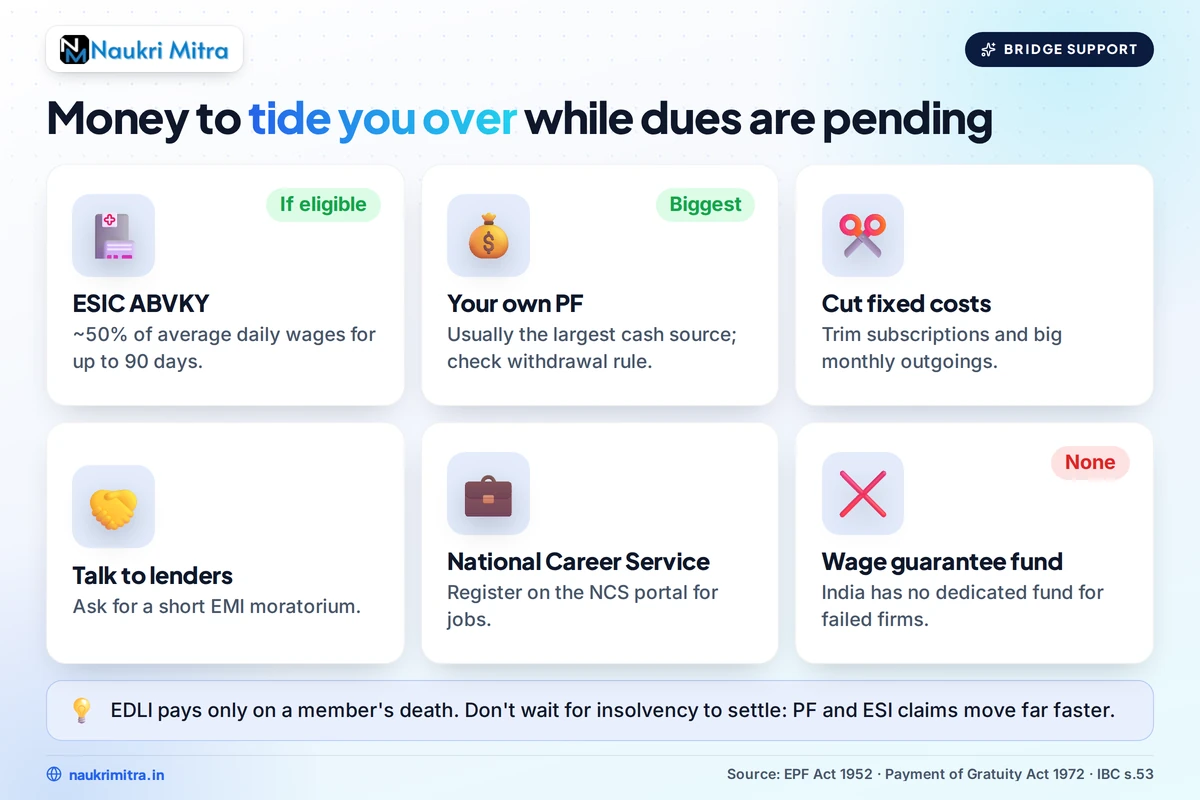
India has no dedicated wage guarantee fund for employees of failed companies. The nearest protections are the statutory ones above: PF with priority status, gratuity recovery and workmen's dues. The EPFO's Employees' Deposit Linked Insurance pays only on a member's death.
What Financial Support Exists While Dues Are Pending?
Some options exist, though modest. ESIC's Atal Beemit Vyakti Kalyan Yojana offers about 50 percent of average daily wages for up to 90 days to eligible insured persons who lose a job. Contribution conditions apply and the scheme's validity has been extended in stages, so verify on the ESIC site. For most people the largest source of cash is their own PF corpus, through a withdrawal permitted by the rule at the time. Beyond that, cut fixed costs, talk to lenders about a short moratorium and register on the National Career Service portal.
How Long Does Insolvency Resolution Take Before Employees Get Paid?
The Code targets 330 days for a CIRP, including litigation. Real cases often run longer, and liquidation adds more time while assets are valued and sold. Plan for a year or two at the optimistic end, longer with appeals. PF and ESI processes are far quicker and should not wait for the insolvency outcome.
What Should You Do the Moment You Hear Rumours the Company May Close?
- Download your UAN passbook, the last twelve payslips, tax statements and appointment letter.
- Confirm your UAN is active with Aadhaar, PAN, bank and mobile verified.
- Check that PF and ESI were actually deposited for each recent month.
- Calculate your gratuity and total dues so you know your number.
- Keep written records of payment promises. Emails and messages count.
- Do not resign in panic before speaking to a labour consultant, since how employment ends can affect compensation.
- Update your CV and start looking while you are still on payroll.
When you are ready for the next role, Naukri Mitra lists openings across cities, which helps you avoid a long gap while claims move through the system.
Frequently Asked Questions
1. Is my PF safe if my company shuts down?
Yes. Deposited contributions sit in your EPFO account, not in the company's assets. Only contributions never deposited are at risk.
2. Can I claim PF without my employer's signature?
Often yes. With Aadhaar, bank account and UAN linked and verified, the online claim needs no attestation. Otherwise approach the regional EPFO office.
3. Where do I complain if PF was deducted but not deposited?
File a grievance on EPFiGMS with payslips and the passbook, and write to the Regional PF Commissioner.
4. How do I recover gratuity from a closed company?
Apply to the Controlling Authority. If the order is ignored, a recovery certificate can go to the District Collector under Section 8.
5. How do I claim as an employee in insolvency?
Watch for the public announcement, then send the prescribed proof of claim and documents to the resolution professional or liquidator before the deadline.
6. Can directors be sued for my unpaid dues?
Not automatically. Personal liability arises in cases such as EPF offences, fraudulent trading or personal guarantees.
7. Will I get Form 16 if the company has closed?
Use your tax portal statements, and in insolvency ask the resolution professional to issue it.
8. Is there a government scheme for unpaid salary?
No dedicated fund exists. ESIC unemployment relief and your own PF withdrawal are the usual short-term supports.
9. Should I hire a lawyer?
For small claims, EPFO and labour department routes cost little. For large dues or insolvency claims, a short consultation helps. This post is general information, not legal advice.
Sources: EPFO press release on composite claim form | SCC Online on PF and gratuity dues in liquidation | Lexplosion on gratuity recovery under the Payment of Gratuity Act
.png)
.png)
.png)
Comments
Post a Comment