Fake Overseas Job Offers: Spot the Scam | Naukri Mitra
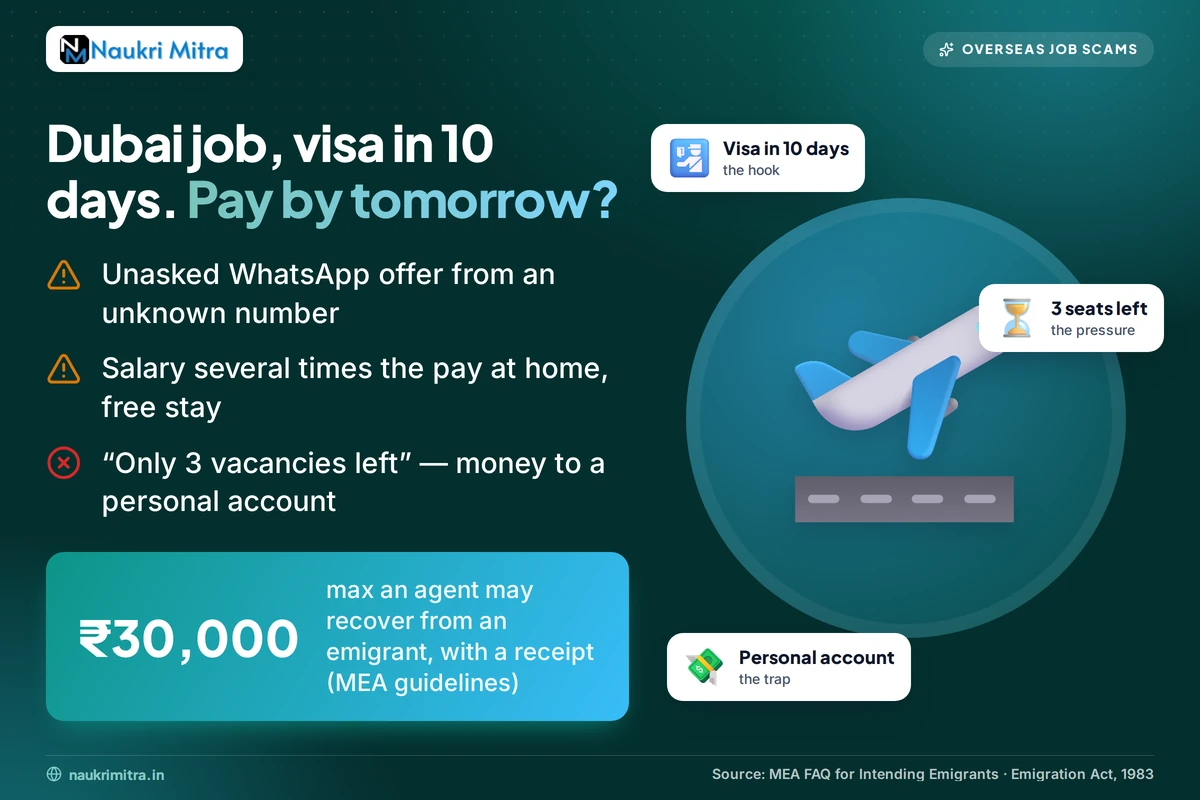
The message usually arrives late in the evening, on WhatsApp, from a number nobody in the family recognises. It offers a warehouse supervisor post in Dubai, a salary several times what the job pays at home, free accommodation and a visa "in ten days." There is one condition: the registration money must reach a personal account by tomorrow, because only three vacancies remain. Every year, families across India send that money, and some later learn that the job, the company and the visa never existed. In the worst cases, the person who boarded the flight did not land in an office at all.
This guide explains how these offers are built, how to test them, what Indian rules say about fees, and what to do if you have already paid. If you have typed fake overseas job offer scam India how to identify into a search bar, treat the sections below as a checklist to run before a single rupee or document leaves your hands.
The common patterns behind fake overseas job offers
Fraudulent overseas recruitment follows a few scripts. A typical Gulf job scam visa fraud India case begins with an advertisement promising a high salary for work that needs little experience: driver, helper, cleaner, security guard, hotel staff, caregiver or "data entry operator." The salary is slightly too good, the visa too fast, and the deadline always today.
The same script is reused for Canada, Germany, Poland, Australia and the United Kingdom, because Indian workers genuinely do migrate there, which makes the pitch believable. The scammer says employers are sponsoring workers and a "work permit processing" fee will secure a place. Often the agent returns with a second demand for a medical, an embassy fee or a "bond."
Look for these signs together rather than in isolation:
- The offer reached you unasked, through a message or a stranger's call.
- The agent talks about visas and tickets but cannot show a registration certificate.
- Payment is requested into a personal account or wallet, never a company account with a proper receipt.
- You are told to keep the arrangement quiet, or to say you are travelling as a tourist.
- The employer's name is missing or changes between conversations.
How scammers make visas and offer letters look real
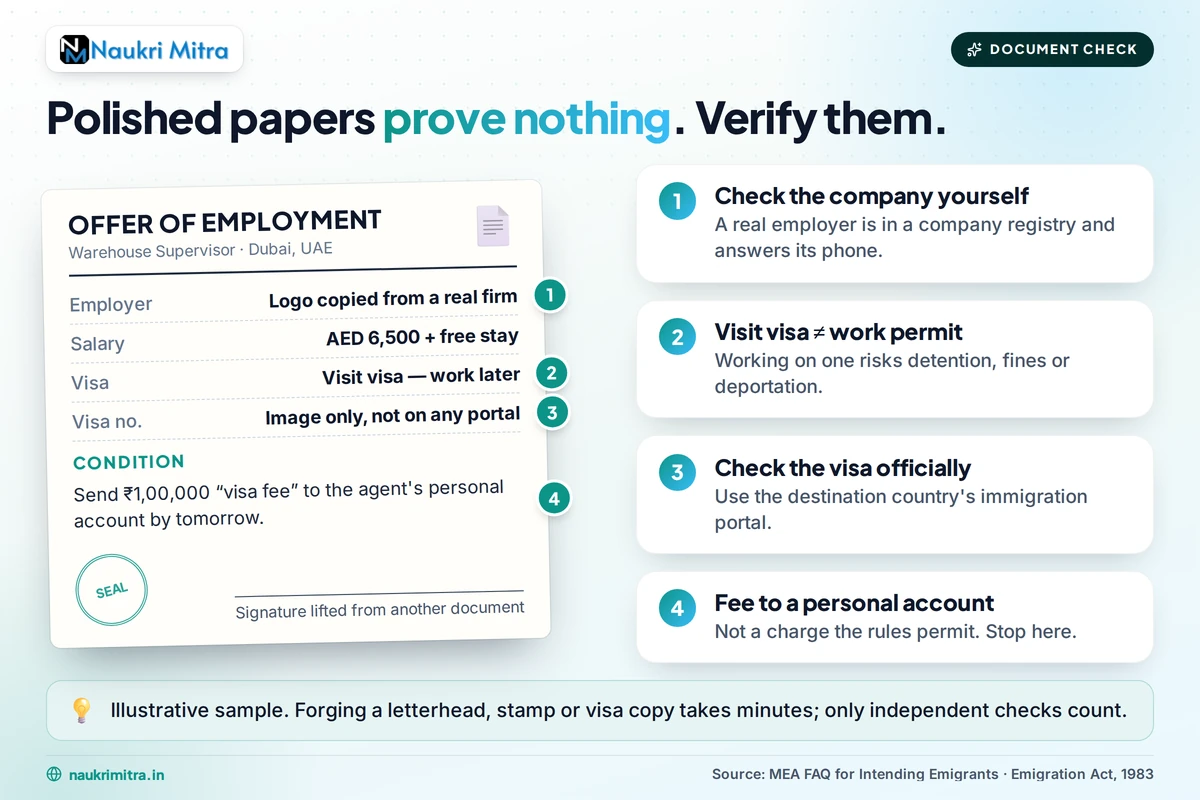
Many victims say the same thing afterwards: "the papers looked genuine." Forging a letterhead, a stamp or a visa copy takes minutes with ordinary editing software. Fraudsters copy the logo and address of a real company, lift a signature from a genuine document, and attach a visa image with a plausible number.
A convincing document is therefore not evidence of anything. What matters is whether it can be verified independently of the person who sent it. A real employer exists in a company registry, has a working phone line, and will confirm that it made the offer. A real visa can usually be checked on the destination country's official immigration portal.
Be careful with a "visit visa" sold as a way to get a job later. A visitor permit does not authorise employment in most countries, and a worker found on one can face detention, fines or deportation, with no employer to take responsibility.
What the e-Migrate portal is and how it helps
The Ministry of External Affairs runs the e-Migrate portal as the official system for overseas employment. Registered recruiting agents, foreign employers and workers who need emigration clearance are meant to be on it. For an ordinary job seeker, its most useful feature is the public list of registered recruiting agents. The ministry's FAQ for intending emigrants says to check the agent's details on the portal and to contact the foreign company directly to confirm the job.
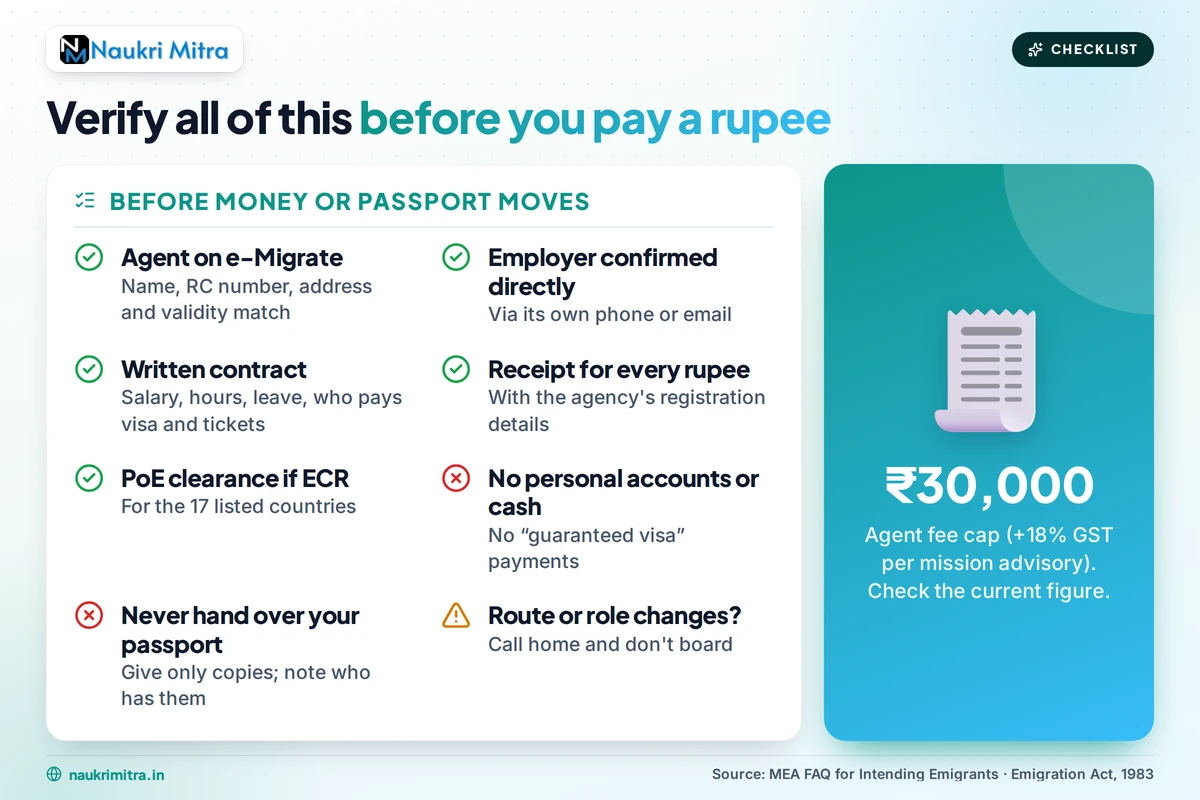
Before you share a passport copy, search for the agency's exact name and compare the registration number, address and validity with what the agent has told you. If the name is missing, or the agent says "we work through a registered partner," ask for that partner's name and run the same search.
Do you need Protector of Emigrants clearance?
Under the Emigration Act, 1983, certain workers must obtain clearance from the Protector of Emigrants PoE before leaving India for employment in specified countries. The ministry lists ten such offices across India. The clearance exists to protect workers: it requires a verified employer and a contract, and creates an official record of where you are going.
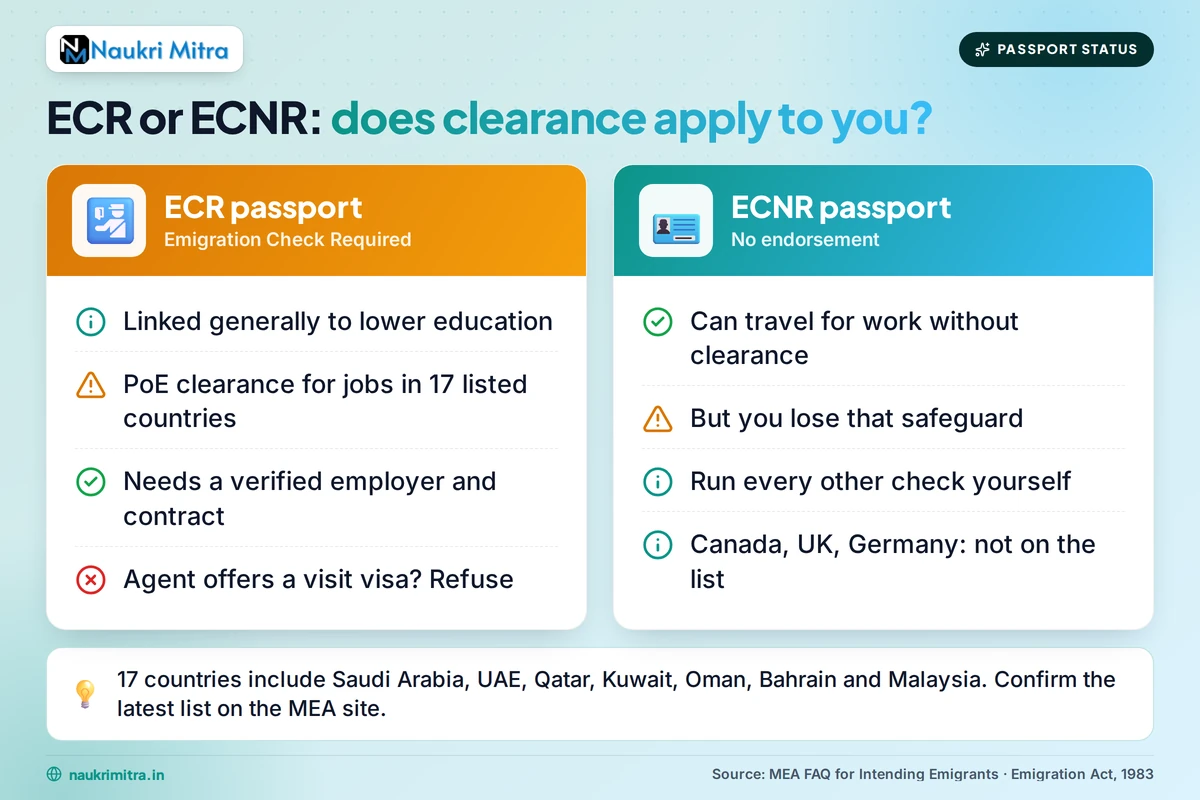
Searches such as emigration clearance required countries job scam usually lead to the same answer: the requirement applies to a defined list of countries, which the ministry currently puts at 17, including Saudi Arabia, the UAE, Qatar, Kuwait, Oman, Bahrain, Iraq, Jordan and Malaysia. Lists can change, so confirm the latest version on the MEA website rather than relying on a forwarded message or an agent's word.
Popular destinations such as Canada, the United Kingdom, Germany and Australia are not on that list. Fraudsters sometimes twist this: "no clearance is needed, so no official check is needed either." That turns one rule into an excuse to skip every other check. The absence of a clearance requirement does not make an offer safe.
ECR and ECNR passports and why they matter
An ECR passport is marked "Emigration Check Required." A passport without that endorsement falls in the ECNR category. In general, ECR status is linked to lower educational qualification, although the ministry sets the exact categories, so read the current rules or ask the passport office if unsure.
Your ECR ECNR passport status decides whether you must go through clearance when travelling for work to a listed country. An agent who skips clearance for an ECR holder may send you on a visit visa instead, which carries the legal and safety risks described earlier. If you hold an ECNR passport, you may travel without clearance, but you also lose that safeguard, so the other checks in this guide matter even more. Ask the agent to say in writing which category applies to you and why. A genuine recruiter answers quickly.
How to check that a recruiting agent is licensed
To confirm that an international recruiting agent is officially licensed in India, take these steps:
- Ask for the registration certificate number and the name exactly as it appears on it. Under the ministry's guidelines, an agent needs a Registration Certificate to carry on overseas recruitment, valid for five years before renewal.
- Search for that name in the list of active recruiting agents on the e-Migrate portal.
- Compare the address and validity date with what you were given. Be wary of agents who operate only through messaging apps.
- Ask which foreign employer the vacancy belongs to, and request the demand letter or contract in writing.
A valid overseas recruitment license does not guarantee honest behaviour, but registration at least gives you a name to complain against and an authority that can act.
What fees an agent can legally charge
The ministry's guidelines state that the charges a recruiting agent may recover from an emigrant shall not exceed ₹30,000, and that the agent must issue a receipt for every amount collected. An advisory circulated by Indian missions abroad describes the cap as ₹30,000 plus 18 per cent GST. Rules are revised from time to time and some worker categories are treated differently, so check the current figure on the MEA website before paying.
If an agent asks for a lakh or more as a "visa fee," that is not a service charge the rules permit. Any request that you pay "the employer's share" deserves a hard look.
Should you ever pay upfront?
Do not pay for "processing," a "file charge," a "seat booking" or a "guaranteed visa" to a personal account, and never pay in cash without a printed receipt carrying the agency's registration details. The only payment worth considering is one the rules allow, made against a receipt to a verified agent, after you have verified the employer. Anyone saying the visa will be cancelled unless you pay in the next few hours is applying pressure, and a legitimate agency does not need to.
How to verify the offer with the foreign employer
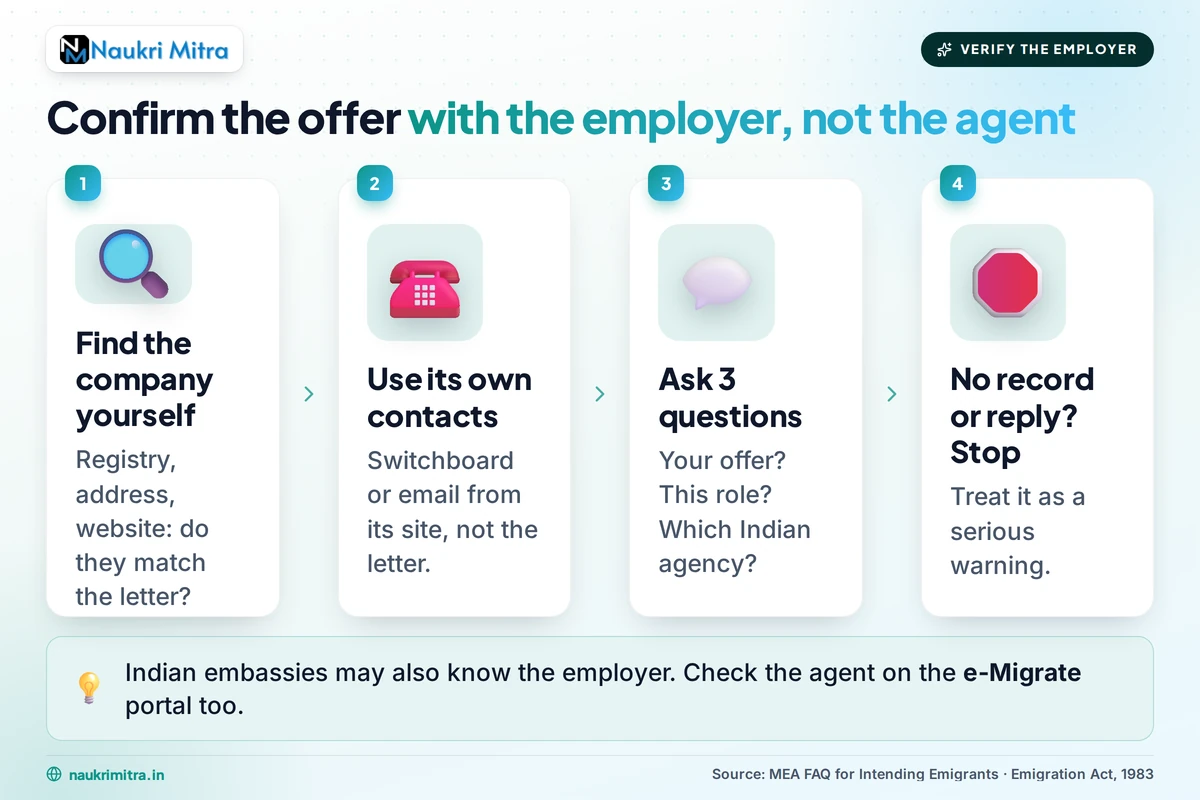
This section explains how to verify international job offer is genuine without depending on the agent at all. Find the company yourself: search for its name, registered address and official website, and compare these with your offer letter. Then find a switchboard number or general enquiries email on the company's own site, never the one printed on the offer. Ask three plain questions: did you issue this offer, is this the correct position, and which agency are you working with in India?
If the company has no record of you, or never replies, take that as a serious warning. Indian embassies may also say whether an employer is known to them.
What a genuine offer letter should contain
A proper appointment letter or contract is specific. It should include:
- The employer's full legal name and address, with a named contact person.
- Your exact job title, duties and place of work.
- Salary in a stated currency, payment method, overtime rules and deductions.
- Working hours, weekly rest, leave and contract length.
- Who pays for the visa, travel, medical tests and return ticket.
- Accommodation, food and termination terms.
Compare the letter with what the agent told you, point by point. A mismatch in salary, duties or location often means the real job, if it exists, is not the one advertised. Do not sign a different contract on arrival.
Interview red flags: odd calls and strange requests
Real employers conduct interviews that look like interviews. Be suspicious when:
- There is no interview, or only a short chat on a messaging app before an offer.
- The "interviewer" asks about your bank balance or whether you can travel without telling anyone.
- The camera is "broken," or the background does not look like an office.
- You are asked to share a one-time password or install screen-sharing software.
- You must pay or send a passport copy before any assessment of your skills.
- The role changes mid-conversation, for instance from a hotel job to "customer support."
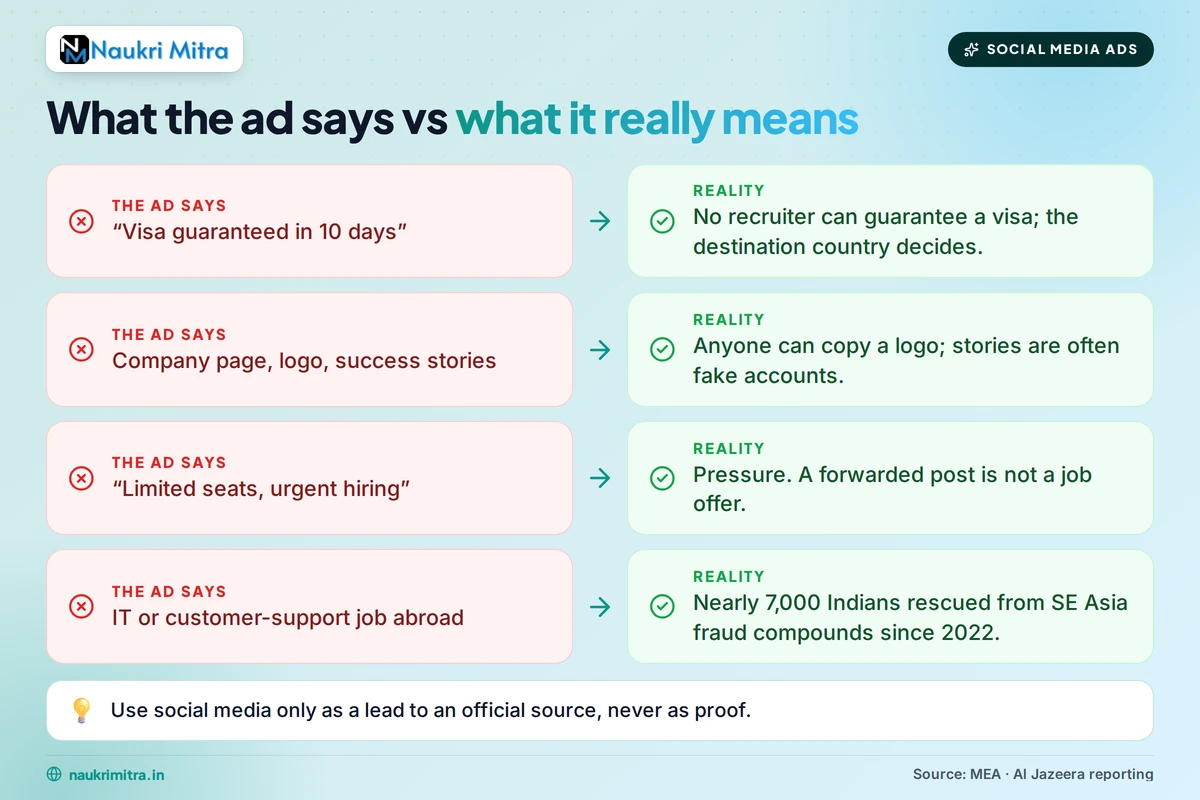
The last point matters most for Southeast Asia, where offers described as IT or customer-service work have led to forced labour in online fraud operations. Al Jazeera reported in 2022 that around 130 Indian workers were rescued from Myanmar, Laos and Cambodia after being lured through social media advertisements, with agents in Dubai, Bangkok and Indian cities involved. India's foreign ministry said they were held captive and made to commit cyber fraud. Later reporting quoted government figures of nearly 7,000 Indians rescued from the region since 2022, with the minister acknowledging that the number still stranded is unknown.
WhatsApp, Facebook and Instagram ads for jobs abroad
Social media is a good place to find information and a poor place to find an overseas employer. Anyone can create a page with a company's logo, and "success stories" are often fake accounts. A forwarded post saying "limited seats, urgent hiring" is not a job offer.
Treat social media as a first contact that can lead you to an official source, never as proof. If you are pushed to a private messaging app by someone with no landline or office address, step back.
The risk of landing abroad with no job waiting
The financial loss is the milder outcome. A worker who finds no employer at the airport may have no legal right to work, no accommodation and no money to return. The person who meets them may take their passport "for registration" and pass them to a contractor who pays far less than promised, or nothing at all. In the most serious cases, as the Southeast Asia reporting shows, people are held against their will and pressured to commit crimes. After arrival, your options narrow, so every check belongs before you travel.
Can your passport and documents be misused?
Yes. A passport copy, Aadhaar card, bank details and photographs can be used to open accounts, obtain SIM cards or apply for loans. An original passport kept by an agent can be held back until you pay more. Give only copies, and record what you gave to whom. If a passport is taken or misused, report to the police, inform the passport office, and tell your bank if financial details were shared.
If you have already paid and suspect fraud
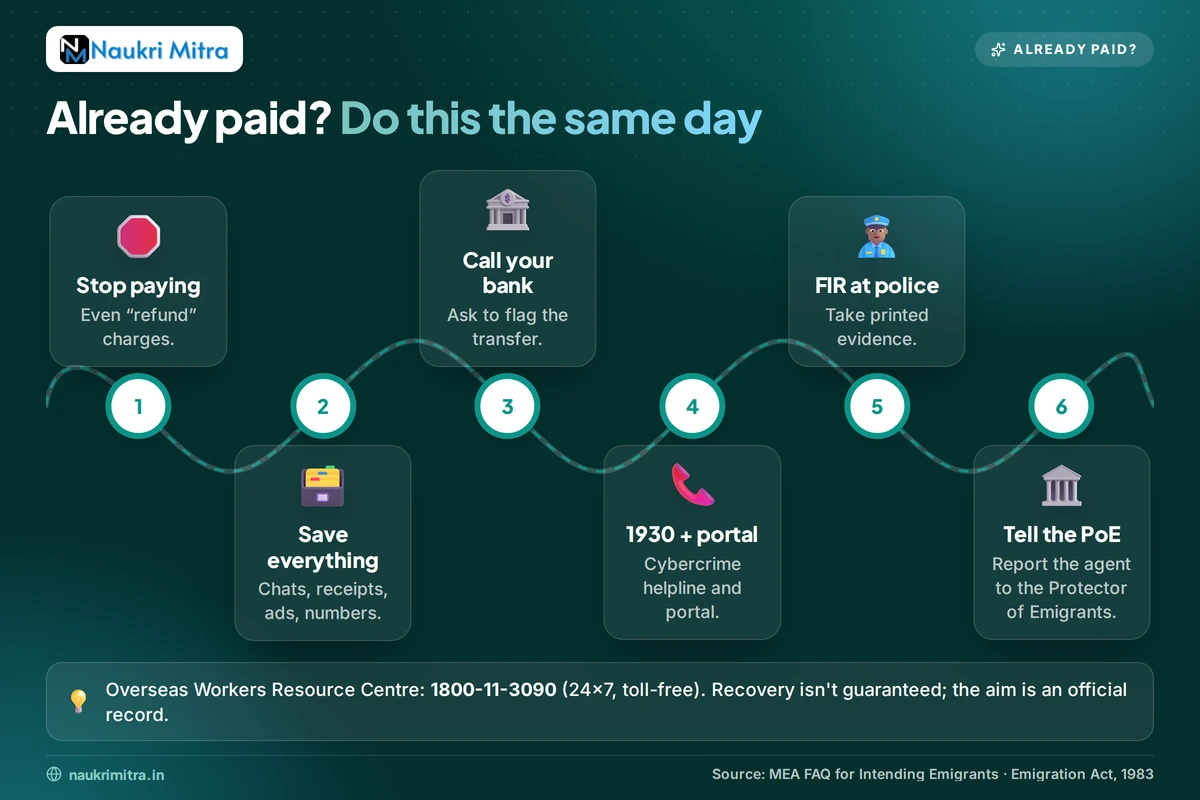
Do not wait for the agent to "sort things out." Move through these steps the same day:
- Stop sending money, including "refund processing" charges.
- Save everything: chats, call logs, receipts, screenshots of advertisements, the offer letter, phone numbers and account details.
- Call your bank at once and ask whether the transfer can be flagged. Speed matters for online payments.
- Call 1930, the national cyber fraud helpline, and file a complaint on the national cybercrime portal.
- Ask your local police station to register an FIR, taking printed evidence.
- Report the agent to the nearest Protector of Emigrants office.
Recovery of money is never certain, and nobody can promise it. The aim is an official record.
Where to file a complaint and which helplines exist
Filing an overseas recruitment agent fraud complaint India has several routes, and you can use more than one at once:
- Cybercrime portal and 1930: the National Cyber Crime Reporting Portal accepts financial fraud complaints, and 1930 is the helpline for reporting them quickly.
- Police: ask for an FIR at your local station or the district cyber cell. Cheating and forgery can be registered under criminal law.
- Protector of Emigrants: complaints against recruiting agents, including unregistered ones, can be raised with the office responsible for your area.
- Overseas Workers Resource Centre: the MEA lists a 24-hour toll-free number, 1800-11-3090, and a landline, +91-124-2341002.
State the date, amount, agent's name, phone numbers and account used, and attach copies of every document.
Can the Indian embassy help after arrival?
Indian missions abroad assist nationals in distress, including workers who have been cheated or stranded. They may help with contacting local authorities, emergency documents and, in suitable cases, return travel. Save the contact details of the nearest mission before you leave. Be realistic, though: an embassy cannot force a foreign employer to pay or overrule local immigration law. If someone is being held against their will, contact the mission and the family's local police immediately with the address, phone numbers and any names.
What families should tell relatives who want to work abroad
Families are often the first line of defence. Agree on a few rules before any money moves:
- Nobody pays or hands over a passport until the agent is verified and the employer has confirmed the offer directly.
- The traveller shares location and contact numbers after arrival, and has the address of the Indian mission.
- If a destination changes or a surprise stopover appears, the traveller calls home and does not board.
Shame stops many victims from speaking up. Make it clear that anyone can be deceived.
How a genuine overseas staffing process differs from a scam
A legitimate process has a clear order. The foreign employer has a demand for workers, the registered agent holds an approved arrangement with it, and candidates are shortlisted through a real selection. You receive a written contract before paying anything permitted, the agent issues a receipt, clearance is arranged where it applies, and you can verify each step with an authority outside the agency.
A scam reverses that order. Money comes first, polished documents come later, the pace is rushed, and the agent discourages independent checks. A genuine recruiter talks about contracts and rights; a fraudster talks about seats and deadlines. Real processes survive verification, and fake ones fear it. For jobs within India too, no genuine employer charges you to be considered, whether you browse openings at Naukri Mitra or elsewhere.
Frequently asked questions
1. How can I tell quickly whether an overseas job offer is a scam?
Check three things: the agent's registration on the e-Migrate portal, the employer's direct confirmation, and whether the payment requested fits the rules. If any fails, do not proceed.
2. Is it safe to pay a visa fee to a recruiting agent?
The ministry limits the service charge an agent may collect and requires receipts. A large "visa fee" or "ticket advance" paid to a personal account is a red flag.
3. What is a MEA advisory on fake job offers?
The ministry and Indian missions periodically issue a MEA advisory warning about fraudulent overseas recruitment and urging job seekers to use registered agents only.
4. Does a Canada or UK job offer need emigration clearance?
Neither appears on the ministry's current list of 17 countries, but scams for these destinations are common. Verify everything independently.
5. What if the agent says the visa is "guaranteed"?
No recruiter can guarantee a visa, because the decision belongs to the destination country's authorities.
6. Where can I get help in my own language?
The Overseas Workers Resource Centre toll-free number, 1800-11-3090, is listed by the ministry as a 24-hour service in several languages.
7. Can I get my money back after being cheated?
Sometimes, particularly where a bank can freeze a recent transfer, but it is never guaranteed. Report within hours, preserve evidence, and file with the cybercrime portal, the police and the PoE office.
8. My relative is abroad and cannot be reached. What should we do?
Contact the nearest Indian mission and your local police at once, giving the agent's details, the employer's name, the last known location and the passport number.
Sources: MEA FAQ on Issues of Intending Emigrants; Al Jazeera, Indian workers rescued from digital job scams in Southeast Asia; National Cyber Crime Reporting Portal, filing a complaint.
.png)
.png)
.png)
Comments
Post a Comment