Forced to Resign? Know Your Rights | Naukri Mitra
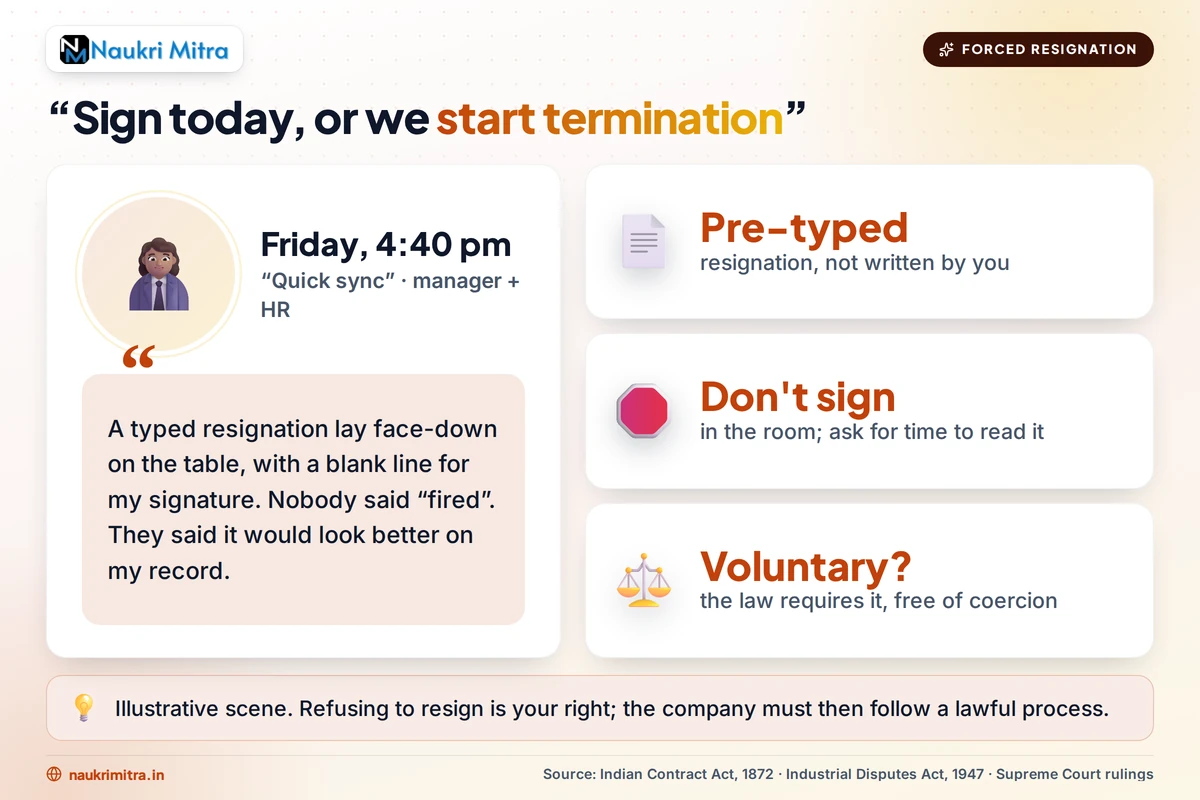
The calendar invite says "Quick sync," sent at 4:40 on a Friday afternoon. You walk into a small meeting room and find your manager, someone from HR you have met twice, and a printed page lying face-down on the table. It is a resignation letter, already typed, with a blank line for your signature. Nobody says "fired." They say "this will look better on your record." Then comes the line that makes your stomach drop: sign today, or the company will start a termination process.
If that is where you are, slow down. Signing in that room is rarely your best move, and Indian law gives you more room than HR usually admits. This guide explains forced resignation rights India what to do in plain language: what you can say, what you should never sign, and how to protect your gratuity, notice pay and next job. For openings once things settle, browse fresh listings on Naukri Mitra. This is general information, not legal advice, and the right step depends on your contract, role and state.
What a Forced or Coerced Resignation Really Means
A resignation is meant to be your own decision. A coerced resignation breaks that idea: through threats, pressure or deliberately unbearable conditions, the employer leaves you no real choice. On paper it looks like your decision. In reality it was theirs.
India has no single statute titled "forced resignation," but the principle is settled. The Supreme Court has said a resignation must be a voluntary surrender of service, free from coercion or duress. Contract law points the same way: under the Indian Contract Act, 1872, consent obtained by coercion or undue influence makes an agreement voidable at the option of the affected party. An involuntary resignation can therefore be challenged, although the burden of showing the pressure usually falls on you.
Courts look at facts, not labels. A manager saying "your performance is poor, think about your future" is not automatically coercion. A manager who denies you a copy of the letter and says "sign now or you will never work in this industry again" is much closer.
Can HR Legally Threaten Termination to Get a Voluntary Resignation?
Here is the nuance. An employer may say it is considering termination if it has a genuine ground and follows its process. What crosses the line is a false or exaggerated threat used as leverage, such as threatening a police complaint, spreading an allegation, or denying a relieving letter unless you sign.
Many people describe their situation as HR exit pressure, and the phrase fits because the pressure is usually soft: repeated meetings, a changed seat, removed accounts, a hint that "everyone has already agreed." None of this is illegal alone, but together it forms a pattern, and patterns are what courts notice. If you are typing HR pressuring me to resign legal options into a search bar, start by noting each incident with a date.
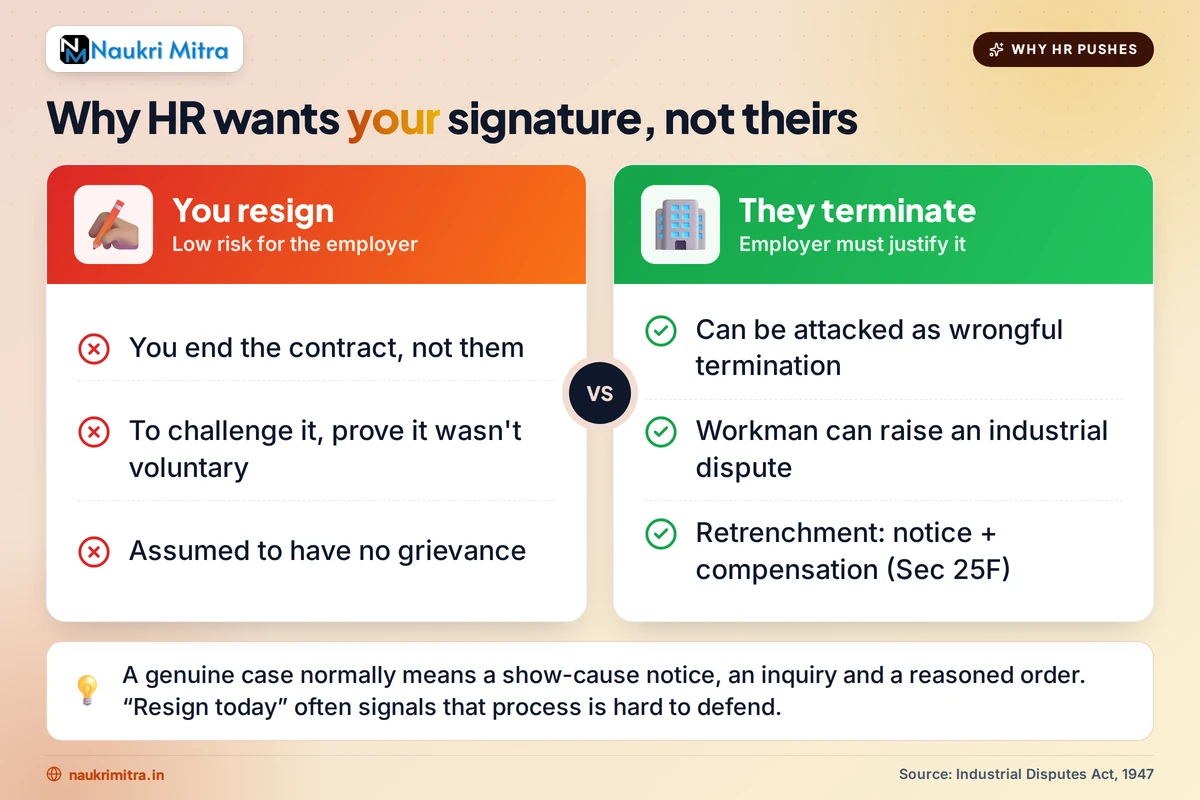
Where there is a company asking to resign or face termination, remember the option it rarely mentions: a proper process. If the company truly had grounds, it would normally issue a show-cause notice, hold an inquiry and pass a reasoned order. A demand to resign "today" often suggests that process would be hard to defend.
Being Pushed to Resign vs Being Terminated
The practical differences are larger than they look.
- Who ends the contract. In a termination, the employer ends it and must justify it. In a resignation, you end it.
- Your ability to challenge. A termination can be attacked as wrongful termination if it breaches the contract, standing orders or natural justice. A resignation is harder to attack because you must first prove it was not voluntary.
Why Companies Prefer You Resign Instead of Terminating You
A resignation costs the employer far less risk. A termination invites disputes: a workman under the Industrial Disputes Act, 1947 can raise one through conciliation and the labour court, and retrenchment carries notice and compensation duties under Section 25F. A terminated employee may also talk, post online or approach a regulator, whereas a person who signed a neat letter is assumed to have no grievance.
Can You Simply Refuse to Resign, Even With a PIP?
Yes. No law obliges you to resign because HR asks. You can decline politely and stay employed until the company follows a lawful process. That may be uncomfortable, but refusal is your right.
The complication is the performance improvement plan PIP. A PIP is legitimate when it has measurable goals, a fair timeline and real support. It becomes a problem when it is a formality with impossible targets. Warning signs include goals never set before, two weeks to deliver a quarter's work, no feedback meetings, and a PIP issued soon after you complained, took medical leave or asked for a raise.
If you are placed on one, do not sign a resignation "to save your name." Ask for targets in writing, answer each point by email, record what you delivered and request the promised support. If you meet the goals, the company has no clean basis to remove you. If not, it may terminate you, but then it must own that decision.
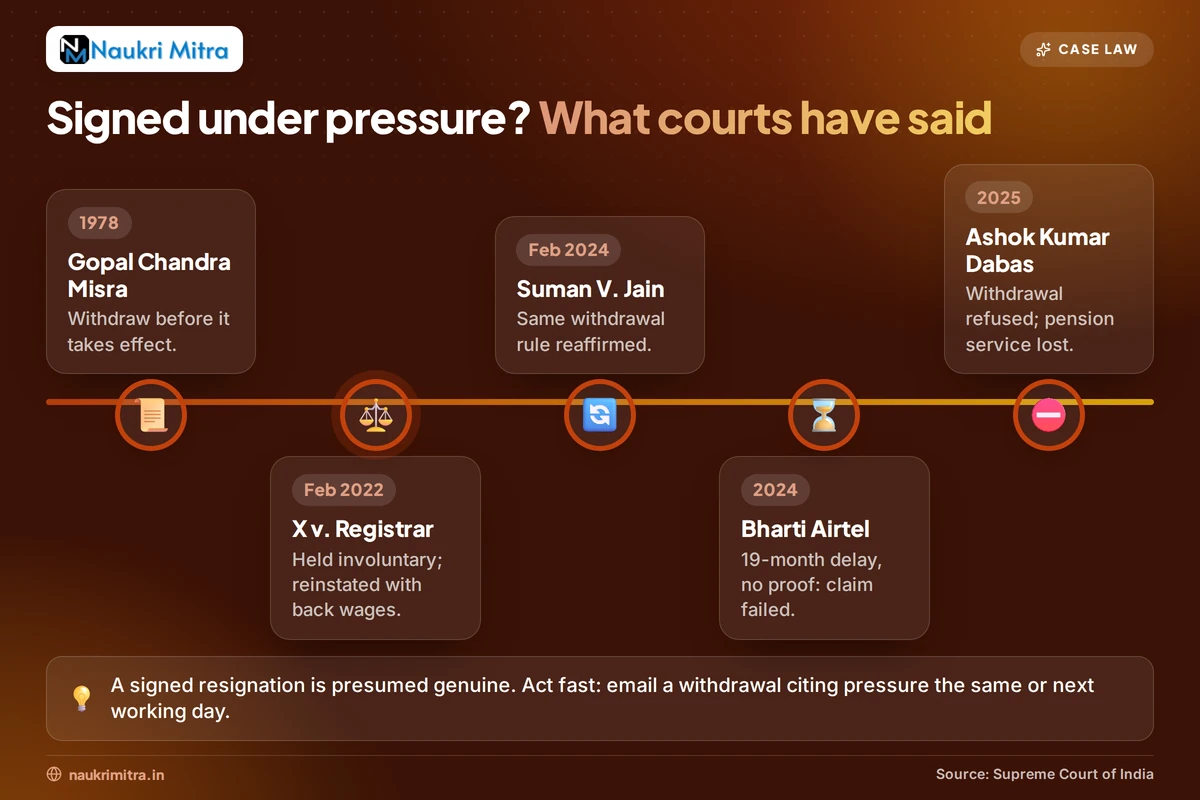
The Supreme Court's 2024 ruling in Bharti Airtel Ltd v. A.S. Raghavendra (2024 INSC 265) is a useful reality check. A senior manager resigned in 2011 citing unfair performance ratings and, about 19 months later, claimed it was forced. The Court held he was not a workman under Section 2(s) of the Industrial Disputes Act, found no credible evidence of coercion, and observed that an employee cannot dictate terms to the employer. The lesson: low ratings alone, a voluntary-sounding letter and a long delay can sink a claim.
Is a Resignation Signed Under Pressure Legally Valid?
It is valid on its face but can be challenged. The law presumes a signed resignation is genuine until you show otherwise, and the question is whether your will was overborne.
The leading modern authority is X v. Registrar, High Court of Madhya Pradesh, decided by the Supreme Court on 10 February 2022. A woman judicial officer was transferred from Gwalior to a distant posting after her requests for an extension and a nearer station, needed for her daughter's schooling, were refused. She resigned, and it was accepted within two days. The Court held the resignation was given in frustration and compelling circumstances, treated it as involuntary, and directed reinstatement with back wages.
Two cautions apply. She was a judicial officer, so a private-sector employee should not assume the same outcome. And the Court examined the surrounding circumstances closely, including how fast the resignation was accepted.
Can You Withdraw a Resignation Given Under Duress?
People ask "can I withdraw resignation given under pressure India" the same evening they sign. The honest answer is: sometimes, and speed matters most.
A resignation that takes effect in the future, such as after a notice period, can generally be withdrawn at any time before it becomes effective, unless a contract or rule says otherwise. The Supreme Court restated this in Suman V. Jain v. Marwadi Sammelan in February 2024, relying on Union of India v. Gopal Chandra Misra (1978) 2 SCC 301. Once it has taken effect, withdrawal usually needs the employer's agreement.
- Email a written withdrawal the same day or next working day, stating that the resignation was submitted under pressure.
- Keep the tone calm and factual, and avoid accusations you cannot prove.
- Ask for written acknowledgement, and if the company says it accepted, ask when and how.
- Keep reporting for work and keep proof that you did.
Withdrawal can fail. In Ashok Kumar Dabas v. Delhi Transport Corporation (2025 INSC 1404), an employee who resigned after almost 30 years later tried to withdraw, and the corporation refused. The Court held that resignation, unlike retirement, forfeits past service for pension under the applicable rules. The case concerned pension, but it shows why delay is dangerous.
What to Say, and Not Say, in the Meeting
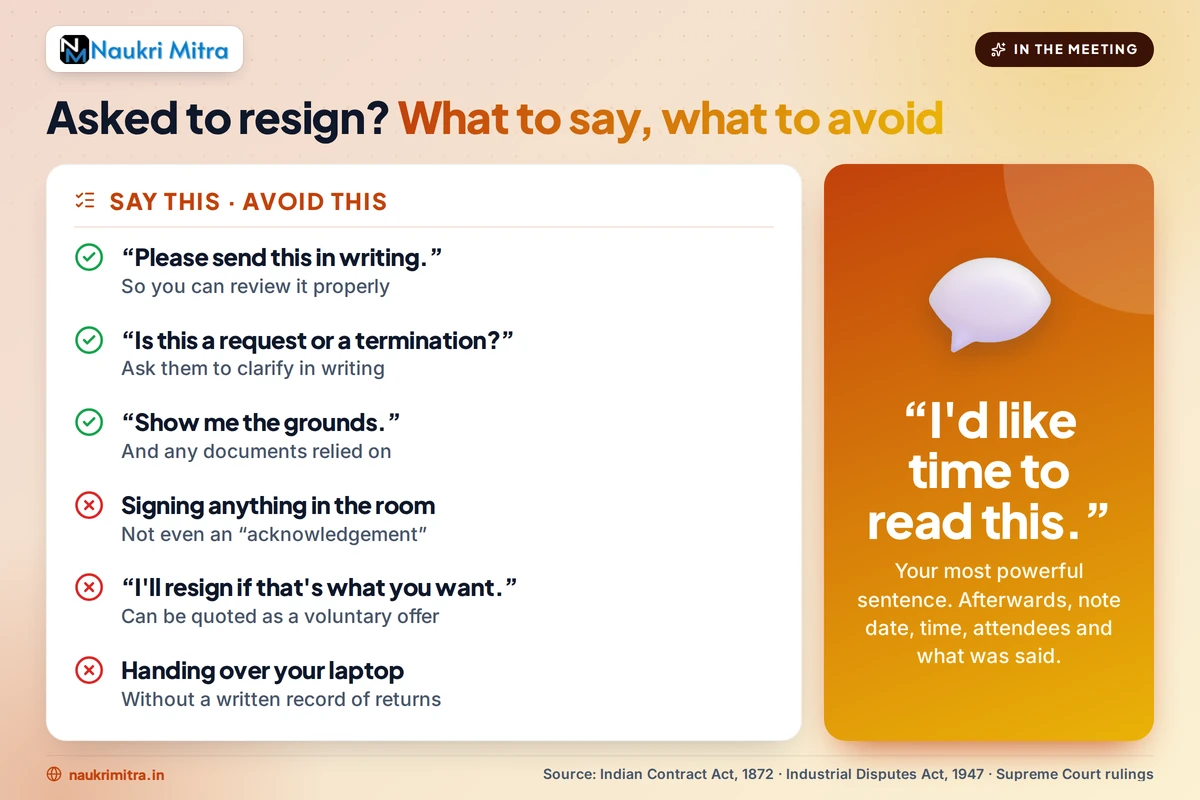
The most powerful sentence you have is: "I would like time to read this in full and think." You need not argue or negotiate on the spot.
Worth saying:
- "Please send this in writing so I can review it."
- "Is this a request, or is the company terminating my employment? Please clarify in writing."
- "I would like to see the grounds and any documents relied on."
Worth avoiding:
- Signing anything in the room, even an "acknowledgement."
- Saying "I will resign if that is what you want," which can later be quoted as a voluntary offer.
- Handing over your laptop without a written record of what you returned.
Afterwards, write down the date, time, attendees and what was said, then email yourself a copy.
Resign or Let Them Terminate You: Which Protects You Better?
There is no universal answer. It depends on your evidence, finances and priorities.
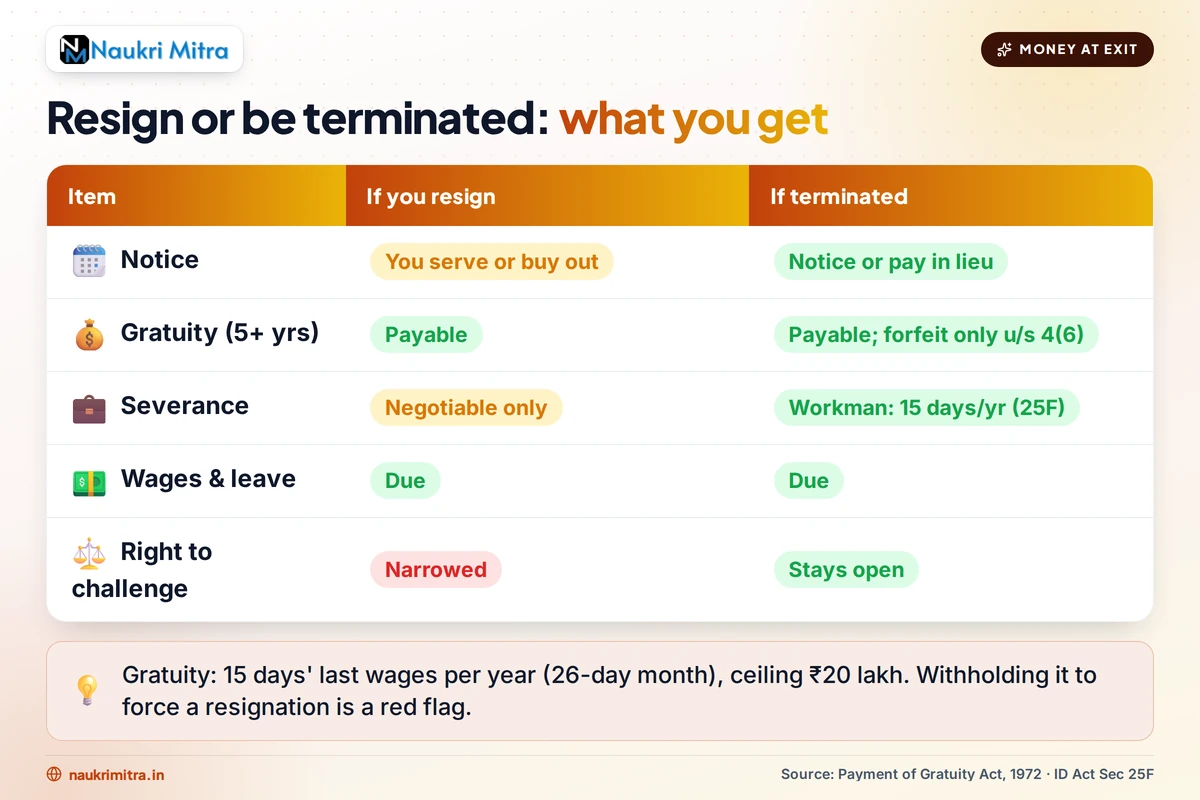
Notice and severance. If you resign, you usually owe the contractual notice or a buyout. If the employer terminates you without cause, it generally owes notice or pay in lieu as the contract provides. Retrenchment of a workman attracts statutory compensation of fifteen days' average pay per completed year under Section 25F, plus notice. Severance beyond that is mostly negotiation, not entitlement.
References. A resignation with a clean relieving letter is usually easier for background checks, while a termination letter citing misconduct is harder to explain. You can often negotiate the wording of either as part of an exit settlement.
Your right to challenge. Termination leaves the door open to dispute, and resignation narrows it. A settlement with a full and final release will probably end any further claim.
Does Voluntary Resignation Affect Gratuity?
Under the Payment of Gratuity Act, 1972, gratuity is payable on resignation after five years of continuous service, with an exception for death or disablement. The formula is fifteen days of last drawn wages per completed year, on a twenty-six-day month basis, subject to a ceiling of Rs 20 lakh. The Supreme Court confirmed in the Dabas case that gratuity survives resignation even when pension does not.
Forfeiture is narrow. Section 4(6) allows it only where the employee was terminated for an act causing damage or loss to the employer's property, for riotous or violent conduct, or for an offence involving moral turpitude in the course of employment. An employer cannot defeat gratuity by calling the exit "voluntary," and a threat to withhold it unless you resign is a red flag. India is also consolidating its labour laws into new codes, so ask a lawyer whether the older Act or the newer code governs your exit.
Earned wages and leave are generally due on either path, and the final settlement should be itemised in writing.
What Documentation Should You Gather?
If you suspect you are being pushed out, build a file quietly and lawfully:
- Your appointment letter, contract, amendments and employee handbook.
- Appraisals, appreciation emails and client feedback that contradict a poor-performance claim.
- Emails and messages addressed to you about the PIP, targets, meetings and the resignation request.
- Any complaint you made, with dates, and a timeline written as events happen.
Be careful about what you copy. Forwarding confidential client data to a personal account can hand the company a genuine ground for action. Stick to your own employment records and messages addressed to you.
Can You Record HR Conversations?
India has no general rule barring you from recording a conversation you are part of. The Supreme Court held in 1972, in R.M. Malkani v. State of Maharashtra, that a tape-recorded conversation can be admissible if relevant, audible and proved authentic. Electronic records now also need the certificate required under Section 63 of the Bharatiya Sakshya Adhiniyam, 2023, which replaced Section 65B.
There are risks. Company policy may prohibit recording, giving it a disciplinary pretext, and a court may give little weight to an edited or unclear recording. A follow-up email is often safer: "As discussed today, you asked me to resign by Monday, failing which a termination process would begin. Please confirm." A reply, or even silence, can be telling. Take legal advice before relying on covert recordings.
Constructive Dismissal in India
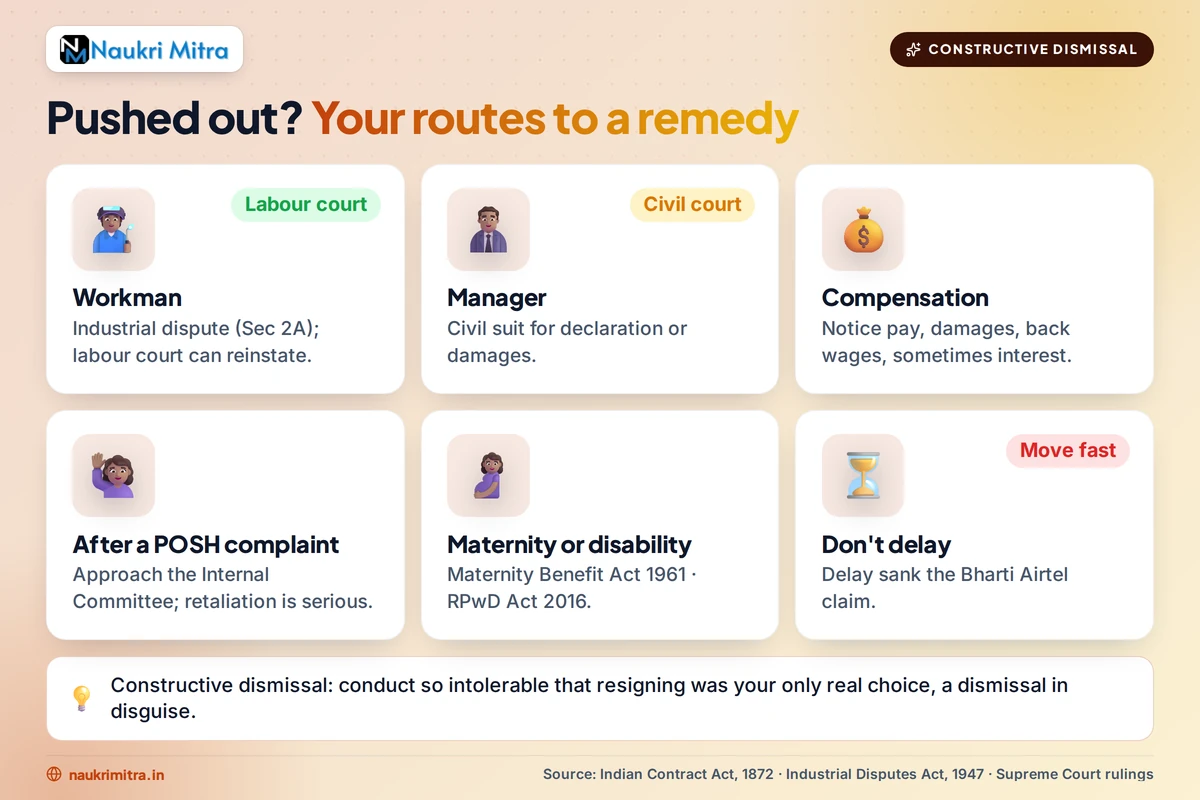
Constructive dismissal describes employer conduct so intolerable that resigning is your only real choice, so the resignation is treated as a dismissal in disguise. India has no dedicated statute for it, yet discussions of constructive dismissal India employee rights draw on the case law above, which treats an involuntary exit as employer-initiated.
For a workman, a forced resignation can be raised as an industrial dispute, since Section 2A of the Industrial Disputes Act treats certain terminations as individual disputes. Labour courts have granted reinstatement with or without back wages, and compensation. For managers outside the workman definition, as the Bharti Airtel ruling shows, the route is usually a civil suit for a declaration or damages, and courts are generally reluctant to compel an employer to take back a person under a private contract of service.
Can You Claim Compensation for Unfair Termination?
In principle, yes, but you must prove the resignation was not voluntary or that the termination breached your contract or law. Compensation depends on facts: notice pay, damages for breach, back wages if reinstated, sometimes interest. Delay weakens credibility, which hurt the employee in Bharti Airtel, so move promptly.
Negotiating a Better Exit Instead of Just Resigning
Sometimes leaving is sensible, but on terms you choose. If HR has already decided, the real conversation is the price of a quiet exit. You can ask for:
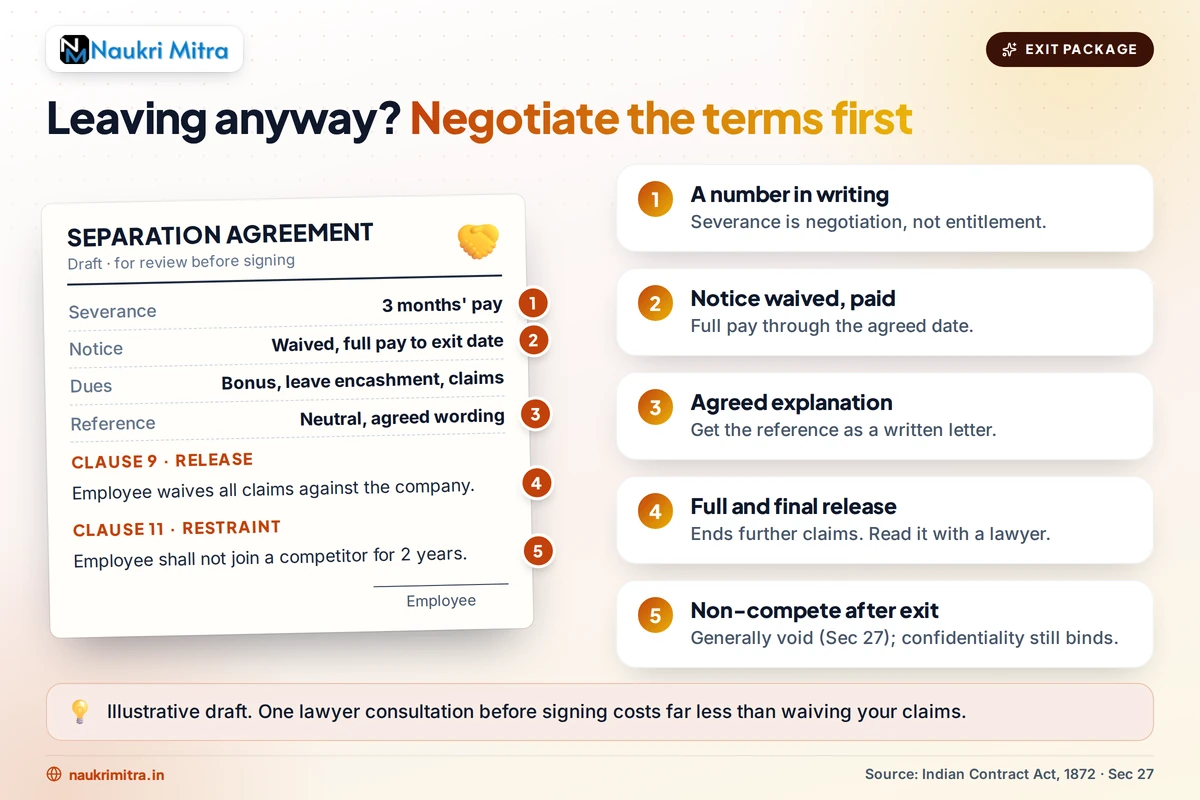
- Severance of a few months' pay, with a number in writing.
- Waiver of notice with full pay through the agreed date.
- Pending bonus, variable pay, leave encashment and reimbursements.
- A neutral reference and an agreed explanation for your departure.
Do this by email, and read every clause before signing. Watch non-disparagement terms and waivers of all claims, which can be very wide. Under Section 27 of the Contract Act, post-employment restraints on trade are generally void in India, though confidentiality duties can still bind you.
Discrimination, Harassment and Retaliation
If the push to resign follows a harassment complaint, a pregnancy announcement, a disability disclosure or a wage complaint, your options expand.
- Under the Sexual Harassment of Women at Workplace Act, 2013, you can approach the Internal Committee, and retaliation for complaining is serious in itself.
- The Maternity Benefit Act, 1961 bars dismissal of a woman because of her absence on maternity leave.
- The Rights of Persons with Disabilities Act, 2016 prohibits discrimination against employees with disabilities.
A forced resignation may then be one part of a larger claim. An employment lawyer can tell you whether the right forum is a labour court, a civil court, a high court writ for certain employers, or a statutory committee.
Lawyer, Probation and Reference Checks
Should You Consult a Lawyer Before Signing?
Yes, ideally before you sign a resignation, settlement, release or "voluntary separation" form. One consultation costs far less than a mistake that waives your claims. Bring your contract, timeline and drafts, and ask about the effect of any release, the right forum and the limitation period.
Does Probation Change Your Rights?
Probation weakens your position but does not erase it. Employers generally have wider freedom to end probationary employment on short notice, as your appointment letter states. Even so, probation cannot cover discrimination, retaliation or breach of statute, and your dues remain payable. Your leverage is smaller, so focus on a clean exit, a fair reference and full dues.
How Do You Handle Reference Checks?
Recruiters mostly want your dates, designation and rehire eligibility. Stay factual and brief.
- Pick a neutral explanation, such as "the role was restructured," and use it consistently.
- Offer references you trust, such as former managers, peers and clients, alongside HR.
- If a settlement includes an agreed reference, get it as a written letter.
- Never lie about why you left. Say less, not something false.
Update your resume while achievements are fresh and start searching before your notice ends.
Frequently Asked Questions
1. Is it illegal for HR to ask me to resign?
Asking is not illegal on its own. Threats, false allegations, withheld dues or unbearable conditions can be, and a resignation obtained that way can be challenged.
2. Do I have to resign if I am put on a PIP?
No. A PIP is a chance to meet stated goals, not an order to leave. Respond in writing and document your work.
3. What if I already signed the letter?
Act quickly. Send a written withdrawal saying it was given under pressure, keep your evidence and consult an employment lawyer, since delay is often held against employees.
4. Will I get gratuity if I am forced to resign?
With five years of continuous service, gratuity is generally payable on resignation. Forfeiture is allowed only in the narrow cases in Section 4(6).
5. Can I get notice pay or severance?
If you resign, you normally serve or buy out notice. If the company terminates you, notice or pay in lieu usually applies as per contract. Extra severance is mostly negotiable.
6. Is a recorded conversation valid evidence?
It can be, if relevant, clear and proved authentic with the required certificate. It may also breach company policy, so get advice first.
7. How do resignation and termination differ on my record?
A termination can show cause and complicate background checks. A resignation looks neutral but weakens a wrongful termination claim.
8. Which court can I approach?
A workman may raise an industrial dispute before labour authorities. Other employees often go to a civil court, and some complaints go to statutory committees.
Sources: IndiaCorpLaw, X v. Registrar, MP High Court; Verdictum, Bharti Airtel v. A.S. Raghavendra; IndiaLaw, Resignation vs Retirement and Gratuity Rights.
.png)
.png)
.png)
Comments
Post a Comment