Contract Staff: Do You Get Equal Pay? | Naukri Mitra
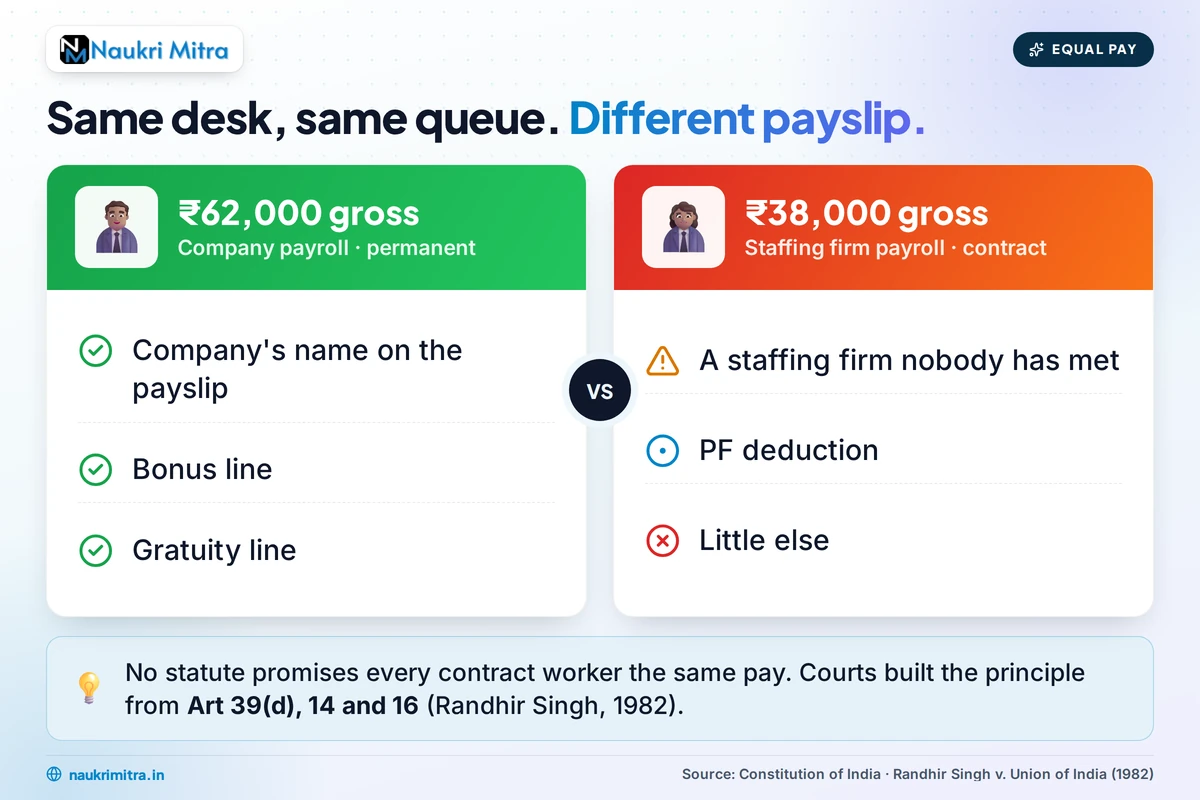
Picture two desks side by side in a Bengaluru support centre. Same queue, same targets, same manager giving feedback. One payslip carries the company's name and shows Rs 62,000 gross, with a bonus and a gratuity line. The other carries the name of a staffing firm nobody has met and shows Rs 38,000, with a PF deduction and little else. Anyone typing equal pay for equal work contract employee India into a search bar is usually describing this exact scene, and the honest answer is more layered than "yes, the law guarantees it" or "no, that is how contracts work." This guide separates what courts have decided, what the labour codes now say, and what you can do next.
Does Indian Law Guarantee Equal Pay for Equal Work to Contract Employees?
No single sentence in any statute says every contract worker must earn what a permanent colleague earns. What exists is a constitutional principle that courts turned into enforceable rights, plus narrower statutory rules. Article 39(d), a Directive Principle, tells the State to secure equal pay for equal work for both men and women. The Supreme Court read it with Articles 14 and 16 in Randhir Singh v. Union of India (1982), and the idea grew from there.
The practical catch is where it bites hardest. Constitutional claims work most cleanly against the State and public bodies. Against a private company, your tools are the written contract, the wage and contract-labour statutes, and proof that the arrangement disguises permanent employment. Many articles on contract employee rights India same work different pay skip this distinction, and it explains why similar workers get different outcomes.
The wage statute is also narrower than the slogan. The Code on Wages, 2019 prohibits wage discrimination for the same work or work of similar nature, but its express ground is gender. Employment status is handled through other routes, covered below.
Contract, Fixed-Term and Permanent: What Differs in Law?
Permanent employee. Hired directly, with no end date, and entitled to the full statutory set plus company policy benefits.
Agency or contract employee. Your legal employer is a contractor or staffing firm, while you work for another company. Wages, PF and ESI are the contractor's duty, with the company that engages the contractor (the principal employer) carrying back-up liability in many situations.
Fixed-term employee. Hired directly by the company for a stated period. Under the Industrial Relations Code, fixed-term employment is now a defined category, and the Government's summary says these workers are to receive benefits equal to permanent workers in the same role, including leave, medical cover and social security, with gratuity after one year instead of five.
The real dividing line is who employs you. A fixed-term worker can compare herself with permanent staff of the same employer. An agency worker's employer is a third party, which complicates both pay comparison and regularisation.
What Has the Supreme Court Decided on Contract Workers' Pay?
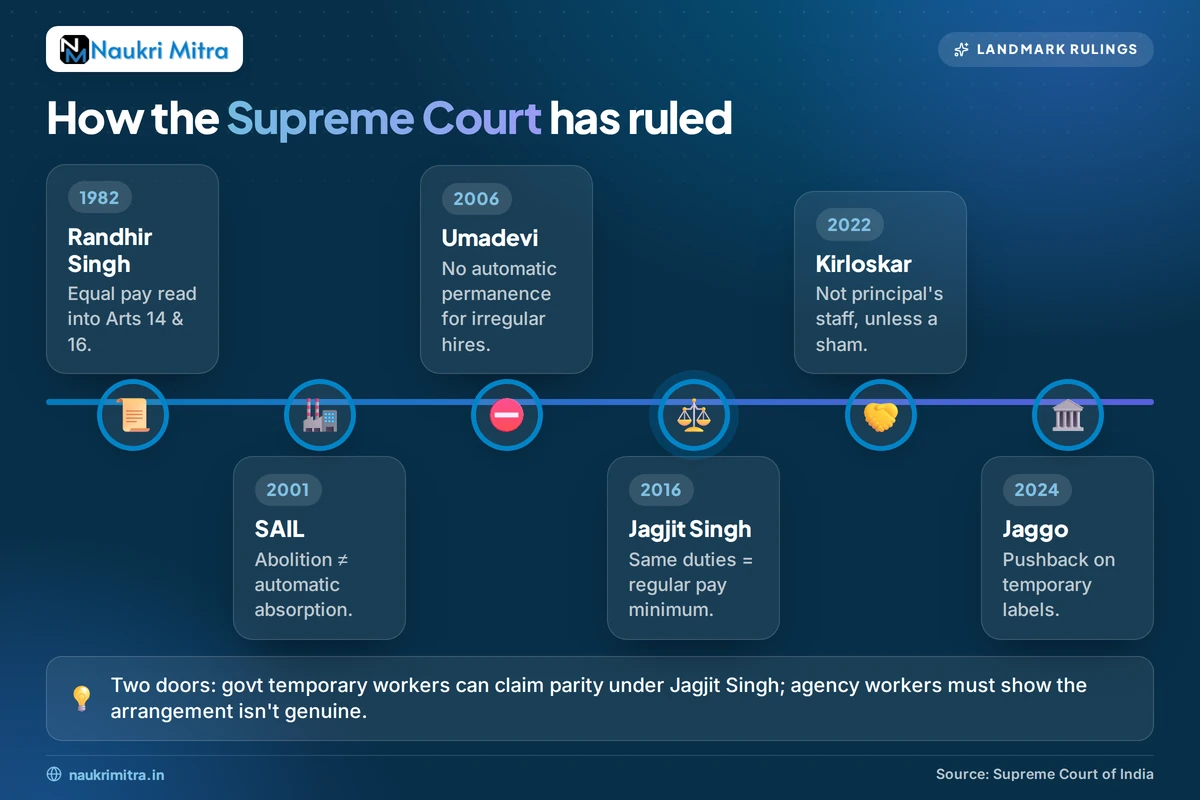
State of Punjab v. Jagjit Singh (2016). Justices J.S. Khehar and S.A. Bobde held that equal pay for equal work is a clear and unambiguous right of every employee, regular or temporary. Temporary workers doing the same duties as regular staff on corresponding posts can claim wages at the minimum of the regular pay scale. The claimant must show the duties are truly the same, the comparison must be within the same establishment and service hierarchy, and real differences such as qualification, merit, seniority or higher responsibility can justify different pay.
Secretary, State of Karnataka v. Umadevi (2006). A Constitution Bench ruled that irregular appointments to government posts create no right to permanent absorption, while permitting a one-time exercise for long-serving workers in sanctioned posts. Employers cited it against almost every regularisation claim. Later decisions, including Jaggo v. Union of India (2024) and a bench ruling reported in August 2026 on Goa public works labour society workers, show the Court pushing back on temporary labels for long-running permanent work.
SAIL v. National Union Waterfront Workers (2001). A five-judge bench held that when government abolishes contract labour in an activity under Section 10 of the contract labour law, absorption by the principal employer does not follow automatically.
Kirloskar Brothers v. Ramcharan (2022). Contractor workers are not the principal employer's employees unless a prohibition notification exists or the arrangement is found to be a sham.
So there are two doors. A temporary worker in a government body has a strong parity route under Jagjit Singh. An agency worker anywhere faces a harder question: is the arrangement genuine?
Can Contract Staff Get Same Benefits as Permanent Employees?
Mostly they get the statutory minimum, not the full package.
- PF and ESI. Statutory, so they apply where coverage thresholds are met. The contractor registers you and deposits contributions.
- Bonus. Depends on a wage ceiling and at least 30 working days in the year. Eligible contract workers claim it from the contractor.
- Gratuity. Normally five years of continuous service with the same employer. Agency staff who move between contractors can lose continuity. Fixed-term employees qualify after one year.
- Leave and encashment. Comes from your contract, policy and state shops or factories law. Encashment is not universal, so read the leave clause.
- Allowances and perks. Insurance top-ups, variable pay and ESOPs follow employer policy, and agency workers are often left out.
Statutory items are yours by right. Discretionary perks depend on your agreement, unless a court or labour authority finds the arrangement was a sham.
What Is Sham Contractualization, and How Do You Spot It?
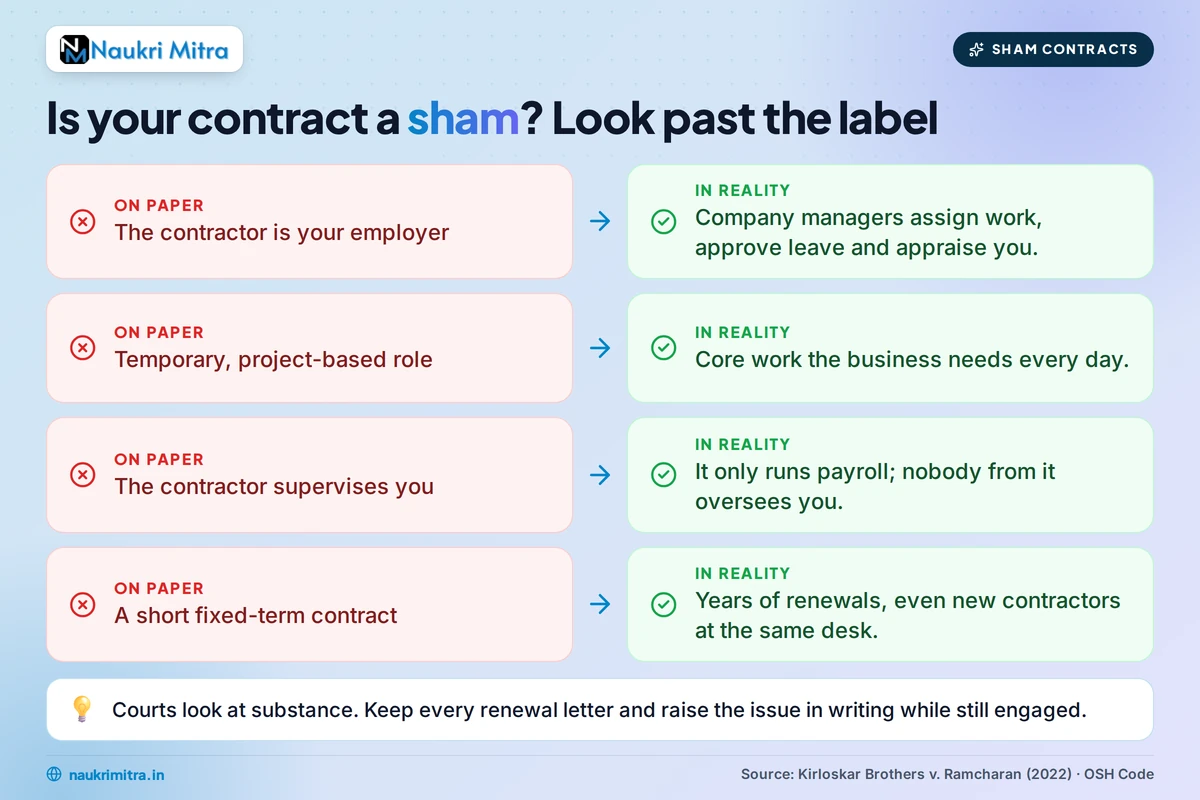
Sham contractualization means a company routes its own regular workers through a contractor only to avoid permanent-employee duties. The contractor is a paper layer and real control sits with the company. Courts look at substance. Warning signs:
- The company's managers assign work, approve leave, set shifts and appraise you.
- You do core work the business needs every day.
- The contractor has no role beyond payroll, and nobody from it supervises you.
- You have served for years through renewals, even switching contractors at the same desk.
- Permanent staff do identical work under the same supervisor.
The new Occupational Safety, Health and Working Conditions Code restricts contract labour in core activities, subject to listed exceptions. A finding of sham can mean you are treated as the company's direct employee, though courts keep this exception tight.
Can You Demand Permanent Status After Years of Contract Work?
You can ask, argue and, in the right case, litigate. You cannot automatically demand it, because length of service alone does not convert a contract role. Helpful factors include continuous work in a permanent-nature role, proof of company control, vacant sanctioned posts (for public bodies) and a finding of sham. For private firms the argument turns on the sham test; for government bodies it turns on Umadevi and the later decisions softening it. Many workers lose ground by delaying: keep every renewal letter, note when your duties changed, and raise the issue in writing while you are still engaged, because a dispute raised years after you leave is harder to prove.
What Does the Contract Labour Law Protect, and Who Pays Your Dues?
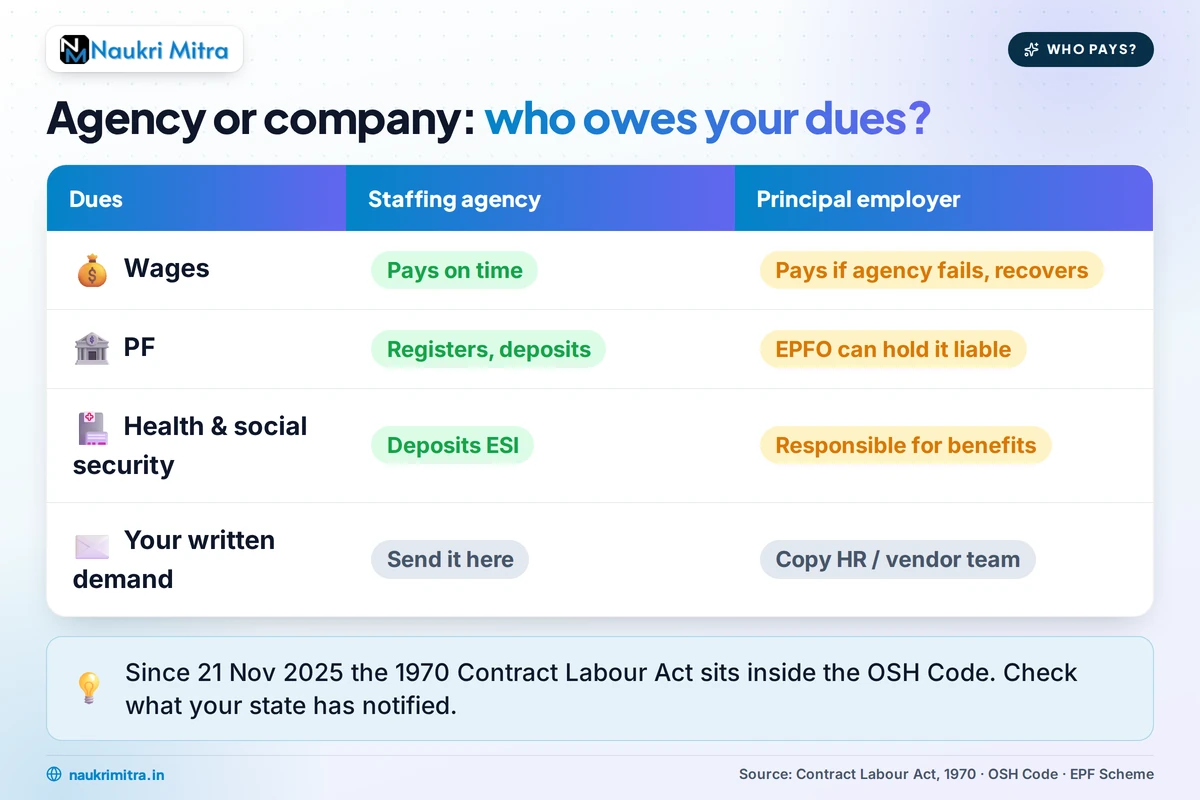
The Contract Labour (Regulation and Abolition) Act, 1970, often shortened to the Contract Labour Regulation Act, required licences for contractors and registration of the principal employer. It set welfare duties such as canteens, rest rooms, drinking water and first aid, and made the contractor pay wages on time. Importantly, the principal employer had to pay if the contractor failed, then recover the amount. The central rules also addressed parity: where contract workers did the same or similar work as regular workmen, wages were to match, and otherwise the Chief Labour Commissioner could fix them.
Since 21 November 2025 the four labour codes are in force, and the 1970 Act has been subsumed into the OSH Code. Reporting indicates the contractor threshold moved from 20 to 50 workers. Rules have rolled out in stages, so check what your state has notified.
On who pays: primarily the agency, as legal employer. But the Government's summary says principal employers carry responsibility for health and social security benefits of contract workers, and the EPF Scheme lets EPFO hold the principal employer responsible for contributions and recover from the contractor. Send your written demand to both the agency and the company's HR or vendor-management team. A demand citing the principal employer's liability tends to speed things up.
What If the Agency Deducts PF or ESI but Does Not Deposit It?
This is a serious offence rather than an accounting slip. First check: read your EPFO passbook and ESIC account. If months with a payslip deduction show no contribution, collect payslips and bank statements. Then escalate: write to the agency listing months and amounts, copy the principal employer, and file a complaint on the EPFO grievance portal or with the nearest EPFO or ESIC office. EPFO can levy damages and interest on defaulters. Do not wait for resignation, since gaps in PF history affect pension and withdrawal later. Also keep a monthly habit of screenshotting your passbook; it takes two minutes and gives you dated evidence if the agency later claims it paid on time.
Can a Contract Employee Be Terminated More Easily?
Usually, yes. Permanent employees get a longer procedural shield, including notice, misconduct enquiry and, for eligible workers, retrenchment compensation. Contract workers rely on the agreement, and non-renewal on expiry is generally not retrenchment. It is not a free pass, though. Mid-term termination without the notice or reason stated in your agreement can support a claim for notice pay, and a termination that punishes you for complaining about unpaid PF can be challenged.
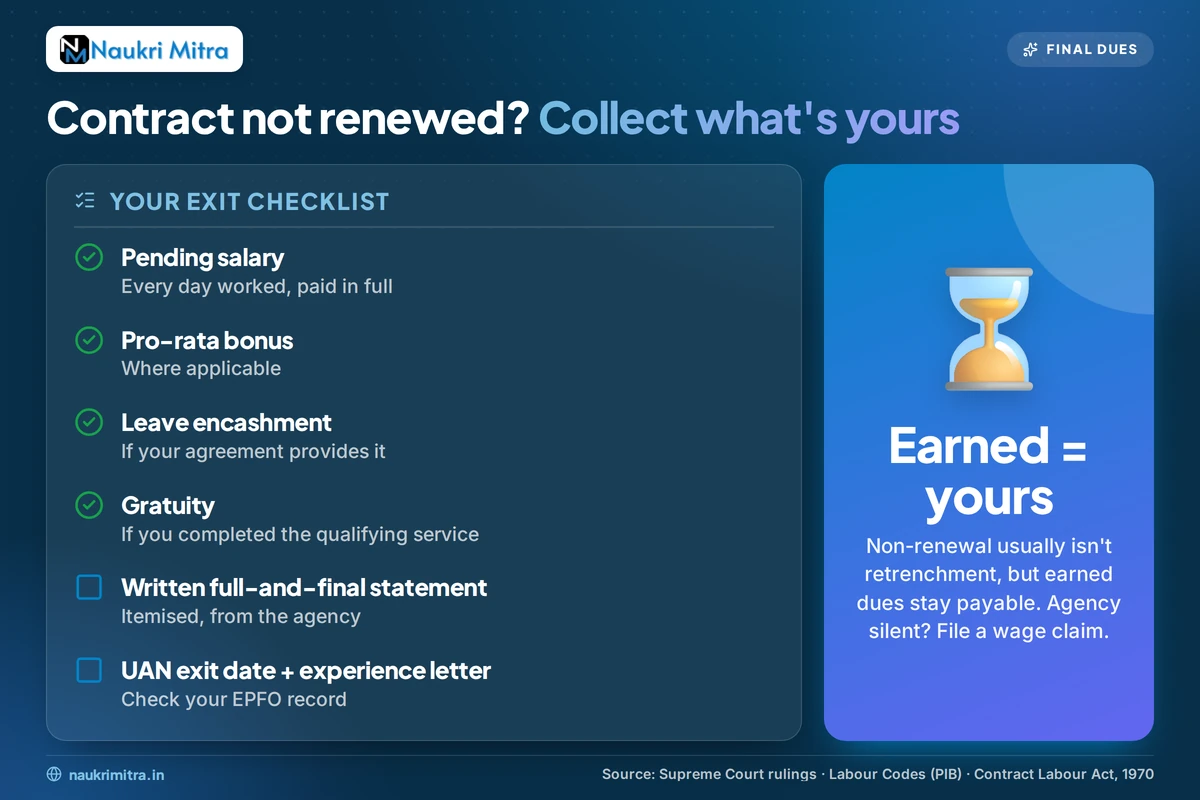
Anyone reading up on temporary worker rights India labour law will notice the same theme everywhere: the written contract and the facts of your work matter more than the label on your offer letter. When a contract simply is not renewed, what you have earned stays yours: pending salary, pro-rata bonus where applicable, leave encashment if your agreement provides it, and gratuity if you qualified. Ask for a written full-and-final statement, confirm your UAN shows an exit date and request an experience letter. If the agency goes silent, treat it as a wage claim.
How Does the Code on Wages, 2019 Change Equal-Pay Protection?
Readers hunting for Code on Wages equal pay contract workers India answers should know the headline is real but the text is narrower. The Code merges the Payment of Wages Act, Minimum Wages Act, Payment of Bonus Act and Equal Remuneration Act. The Government's release on the labour codes describes it as making equal pay for equal work mandatory, but the non-discrimination clause (Section 3) is framed around gender. What changes concretely:
- Floor and minimum wages apply to everyone, including agency staff.
- Wage coverage is broader than under the old Payment of Wages Act ceilings.
- Time limits for wage payment and rules on deductions apply across establishments.
- Written appointment letters stating wages and social-security entitlements are expected, giving you proof for later disputes.
The Code lifts the floor and improves paperwork, while a parity claim against a permanent colleague still rests mostly on court-made principles and sham-contract arguments. Procedures may vary by state.
What to Check Before Accepting a Staffing-Agency Role
- Employer identity. The name on the appointment letter, payslip and PF registration should match.
- PF and ESI. Ask for UAN activation and the ESIC number within the first month.
- Term and renewal. Is the role tied to a client project, and what if the client ends it?
- Notice, penalties and bonds for both sides.
- Benefits in writing, compared with the client's permanent staff in the same role.
- Conversion clause. Is there a path to the client's payroll, or does a non-solicitation clause block it?
- Agency record. Ask current staff whether salary and PF arrive on time.
If a direct permanent offer and an agency offer pay similarly, the permanent role usually wins on security and gratuity continuity.
How to Negotiate Conversion to Permanent Employment
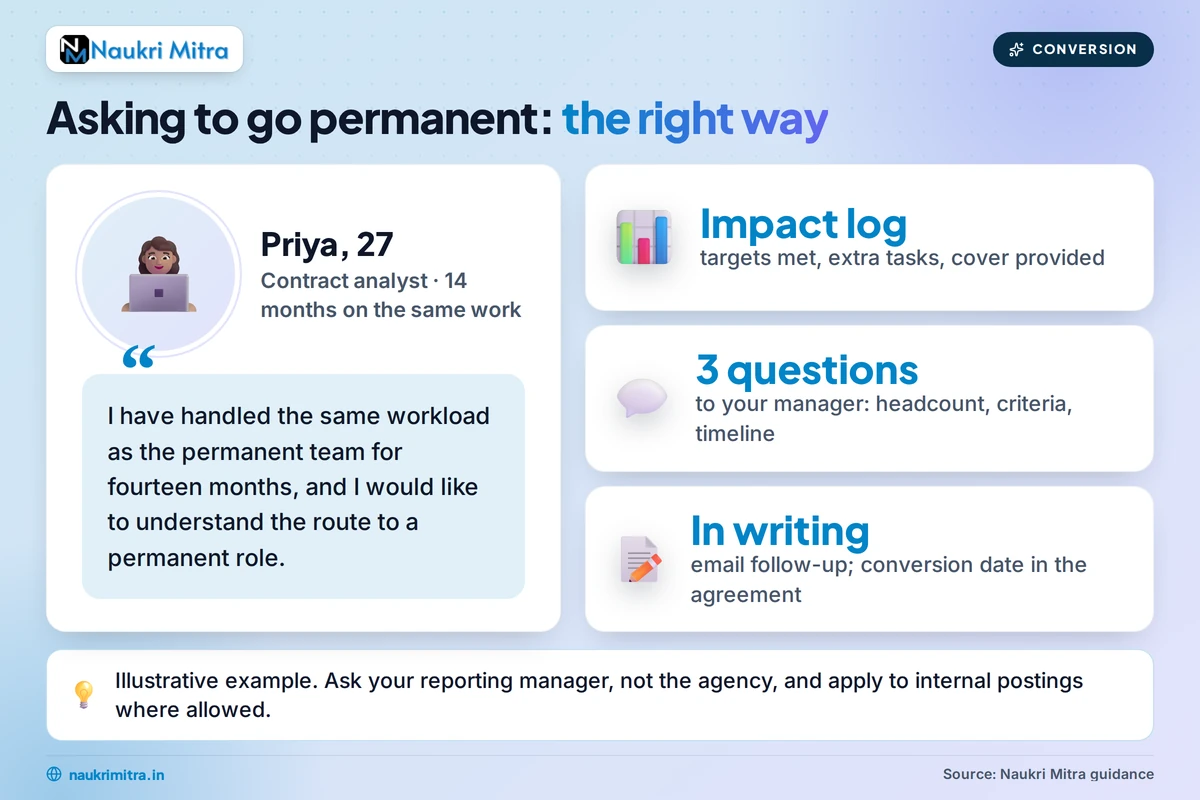
Conversion is a business decision, so treat it as one. Build a record of your impact: targets met, tasks beyond your description, and cover you provided for permanent colleagues. Ask your reporting manager, not the agency, three questions: is there headcount, what are the criteria, and what is the timeline. Follow up by email for a written trail. Apply to internal postings where contract staff are allowed, because a formal application beats a hint. If you are promised conversion after a set period, ask for it in the agreement, since a date in writing is worth more than reassurance in a corridor. A simple opening line works well: "I have handled the same workload as the permanent team for fourteen months, and I would like to understand the route to a permanent role." It is factual, it is not a threat, and it invites a reply you can file.
What If a Permanent Employee in the Same Role Earns Far More?
First rule out legitimate reasons: experience, qualifications, grade, location, performance and joining date. Jagjit Singh itself accepts such distinctions. A gap with no such basis is your opening. Options, softest to firmest:
- Raise it internally with a pay-band comparison and ask for a written explanation.
- Seek a revision of your agreement or conversion to the permanent band.
- If the employer is a public body, consider a representation followed by a writ petition on the Jagjit Singh principle, with a lawyer's help.
- If the arrangement looks like disguised permanent employment, raise a dispute through the labour authority or a union.
- If the gap is linked to gender, invoke the Code on Wages non-discrimination provision.
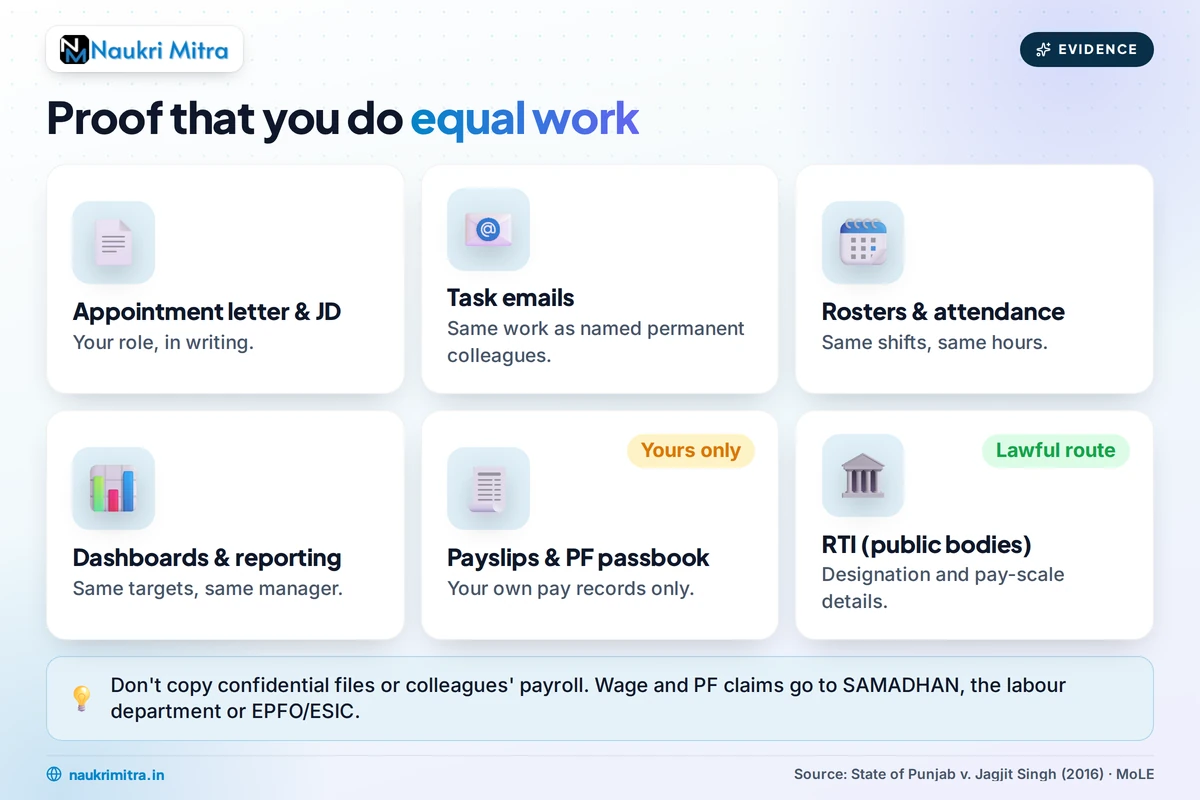
Courts need proof, not impressions. Gather your appointment letter and job description, emails assigning you the same tasks as named permanent colleagues, rosters and attendance records, performance dashboards, reporting lines, and your own payslips and PF passbook. Do not copy confidential files or colleagues' private payroll data. For government bodies, an RTI application is a lawful way to get designation and pay-scale information.
Can You File a Labour Department Complaint?
Yes. Unequal pay alone is hard to win in a labour office, but unpaid wages, missing PF, sub-minimum pay and sham contracts are fair game. The Ministry of Labour and Employment runs the SAMADHAN portal, where workers can file wage-related claims and industrial disputes without a lawyer. Conciliation officers try to settle them and, failing that, can refer them to a labour court. Private-sector workers generally approach the state labour department, while central-sphere establishments fall under the Chief Labour Commissioner (Central). Attach your appointment letter, payslips, bank statements and written demands, and expect weeks to months. For PF and ESI defaults, use the EPFO and ESIC grievance channels in parallel.
How Does This Apply to IT and BPO Staff on Third-Party Payroll?
A software engineer or voice-process executive on a staffing firm's payroll resembles the opening scene. Your agreement is with the vendor, while the client has a commercial contract with the vendor. First, many labour statutes apply by wage ceiling or by whether you count as a worker, so higher-paid specialists may fall outside some protections. Second, state shops and establishments laws often cover IT and BPO units for leave, hours and termination. Third, PF, ESI where applicable, gratuity and wage-payment duties apply whatever the industry label.
When comparing options, browse software engineer roles in Bangalore and call center jobs in Bangalore, and check in each listing who the actual employer is. More openings and career guides are on Naukri Mitra.
Frequently Asked Questions
1. Is a contract worker entitled to the same salary as a permanent employee?
Not automatically. Courts support parity where duties and establishment are genuinely the same, particularly against public employers, but differences in qualification, experience or grade can justify a gap.
2. Does the Supreme Court recognise equal pay for temporary employees?
Yes. In Jagjit Singh (2016) it held that temporary employees doing the same duties may claim at least the minimum of the regular pay scale.
3. Are agency employees entitled to PF and ESI?
Yes, subject to coverage thresholds. The agency must register you and deposit contributions, and the principal employer can be held responsible if it does not.
4. Do fixed-term employees get gratuity?
Under the Government's summary of the new codes, they become eligible after one year of service rather than five. Confirm how your employer applies it.
5. Can the company I work at be pursued for my agency's non-payment?
In many situations yes, with a right to recover from the contractor. A written demand to both parties is the usual first step.
6. Is non-renewal of a contract illegal termination?
Generally no, since expiry is usually not retrenchment. Mid-term termination, retaliation or breach of notice terms can still be challenged.
7. Can I be forced to sign a fresh contract every year?
Short repeated contracts are common and not banned outright. Back-to-back renewals for permanent-nature work are one marker courts weigh in sham-contract disputes.
8. Where do I complain if wages or PF are withheld?
Use the SAMADHAN portal or the state labour department for wage claims, and EPFO or ESIC grievance channels for contribution defaults.
9. Should I get legal help?
For a simple wage or PF default you can often proceed alone. For regularisation, parity or sham-contract claims, consult a labour lawyer, since outcomes depend on facts and state rules. This article is general information, not legal advice.
Sources: SCC Online: State of Punjab v. Jagjit Singh (2016); PIB: Government Makes the Four Labour Codes Effective; Ministry of Labour and Employment Annual Report 2024-25.
.png)
.png)
.png)
Comments
Post a Comment