Whistleblower at Work: Are You Protected? | Naukri Mitra
Picture a Tuesday afternoon in the finance team of a mid-sized manufacturer. You are reconciling vendor payments and notice that three invoices from one supplier share an address with a firm owned by your department head's brother-in-law. The amounts are small, but the pattern is hard to ignore, and one question lands immediately: if you speak up, who protects you? This guide explains whistleblower protection India employee rights as they work today, covering where the law is firm, where it is thin, and what to do before you send a single email.
Is There a Specific Law Protecting Private-Sector Whistleblowers in India?
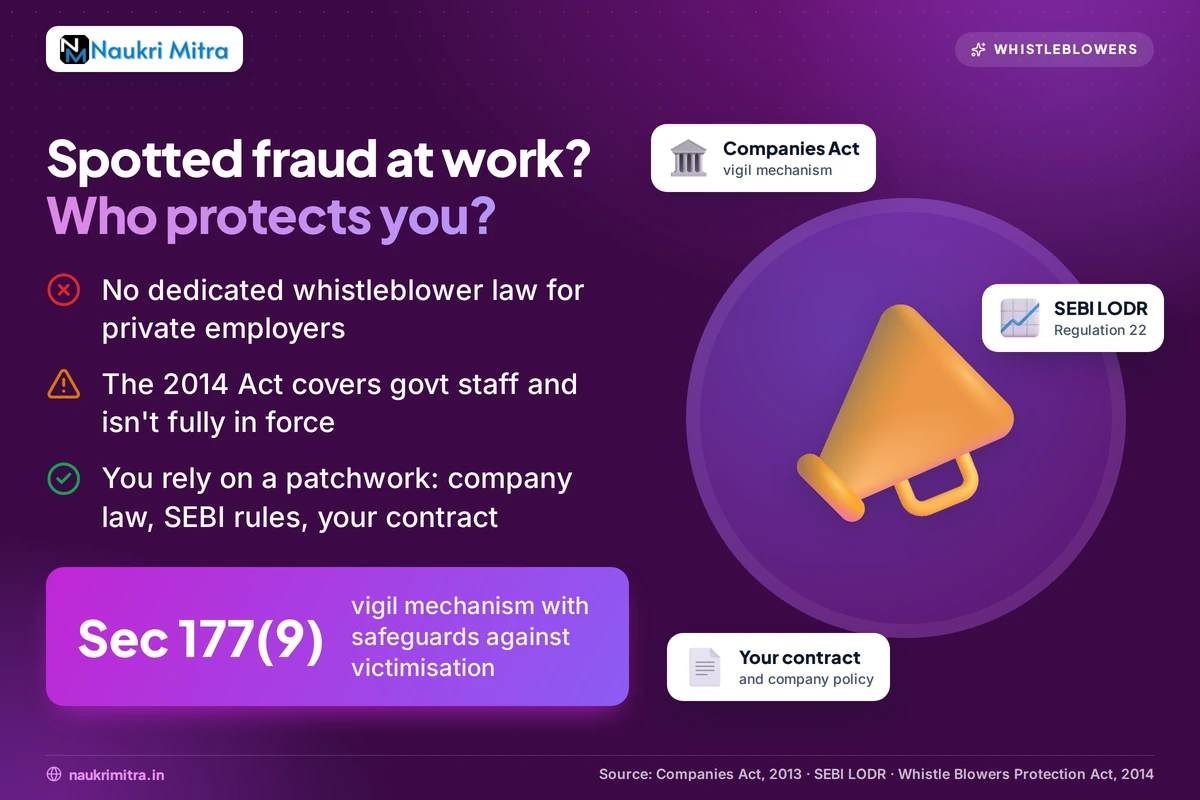
Not a dedicated one. India has a statute with "whistle blowers" in its title, but it was written for public servants and has never been fully brought into force. Law firms that advise on workplace investigations describe the position plainly: there is no specific whistleblowing law that applies to private employers. What a private-sector employee gets instead is a patchwork of company law, securities regulation, criminal law and general employment principles.
That patchwork is not useless. A listed company must run a channel for concerns, and the rules say it needs safeguards against victimisation. But the protection sits inside governance rules, not inside a statute giving you a personal right to sue for being punished. In a private company, your safety is mostly policy, regulation and your own preparation.
Does Protection Differ for Government and Private-Sector Employees?
Yes, sharply. The Whistle Blowers Protection Act, 2014 received assent in May 2014 and covers people in government service and bodies funded by government. It names a competent authority, such as the Central Vigilance Commission for central employees, to receive disclosures about corruption or wilful misuse of power. That authority must conceal the complainant's identity, victimisation is barred, and revealing the identity is punishable.
The catch is commencement. Section 1(3) says the Act starts on a date the Central Government will notify, and commentators have long noted it has not been operationalised in full. An amendment bill from 2015 also lapsed in the Rajya Sabha. So even government employees lean mainly on older administrative arrangements, such as the 2004 resolution that named the Central Vigilance Commission as the agency for protected disclosures.
A private-sector employee sits further out, because the 2014 Act does not reach private companies at all. The Prevention of Corruption Act, India's main anti-bribery law, targets public servants and, since the 2018 amendment, commercial organisations whose associated persons bribe officials. It creates offences, but it is not a safety net for the person who reports them.
What Is a Vigil Mechanism Under the Companies Act, and Which Companies Must Have One?
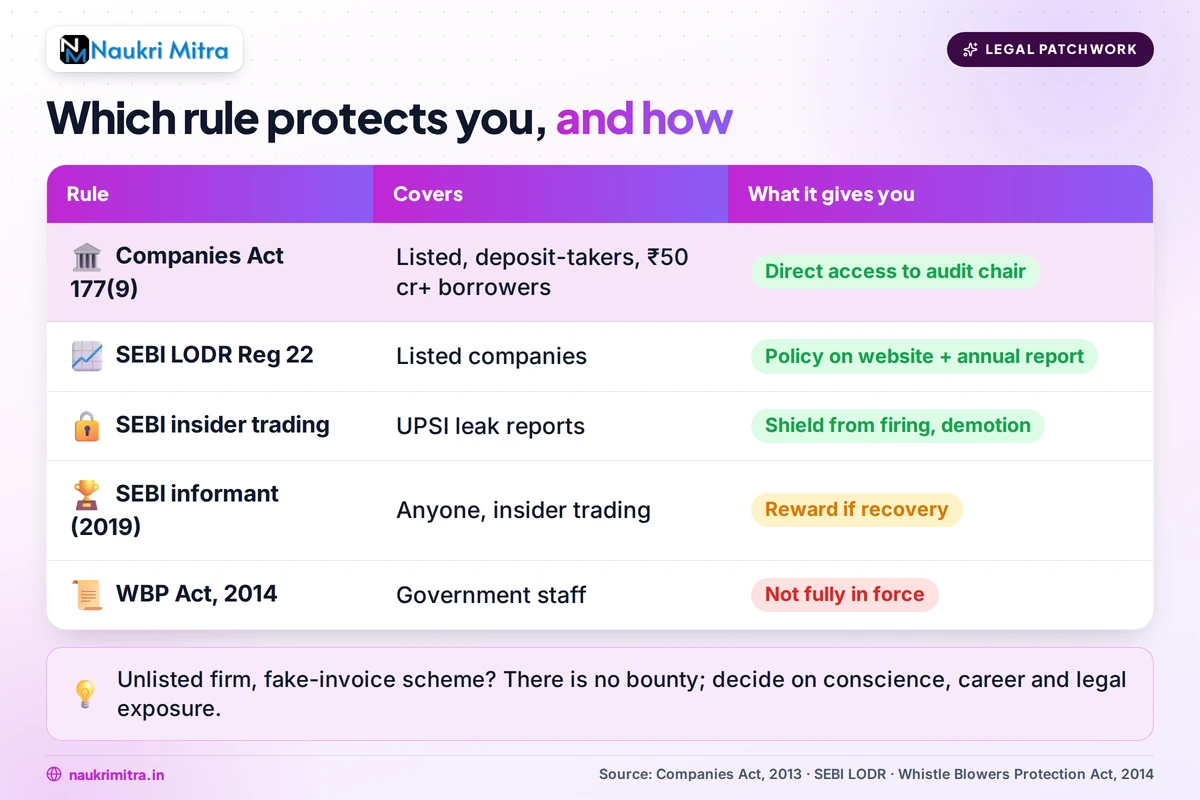
Section 177(9) of the Companies Act, 2013 requires certain companies to give directors and employees a way to report genuine concerns. The related rules name three groups: every listed company, companies that accept public deposits, and companies that have borrowed more than fifty crore rupees from banks and public financial institutions. Confirm the current rule text, since thresholds can be amended.
The Companies Act vigil mechanism must include safeguards against victimisation of anyone who uses it, and, in appropriate or exceptional cases, direct access to the chairperson of the audit committee. That second clause matters most when senior people are involved. A company without an audit committee nominates a director for the role. Readers who ask about vigil mechanism company law India employee rights should also know the audit committee can act against repeated frivolous complaints, so the system guards against abuse as well as retaliation.
What Protection Exists for Reporting Financial Fraud at a Listed Company Under SEBI LODR?
Listed companies carry an extra layer. Regulation 22 of the Listing Obligations and Disclosure Requirements regulations repeats the vigil mechanism duty and adds disclosure: the policy appears on the company website and its working is described in the annual report. A well-drafted SEBI LODR whistleblower policy names who receives complaints, what timelines apply and how identity is protected.
SEBI's insider trading regulations add a policy for leaks of unpublished price sensitive information, and require codes of conduct to protect employees who report such violations from discharge, termination, demotion, suspension, threats or harassment. That is one of the clearest statements of retaliation protection available to private employees, though it covers insider trading, not every workplace fraud.
Is There Any Financial Reward for Reporting Fraud, Like Programs in Other Countries?
Only in a narrow case. The United States pays large rewards for securities fraud tips; India has nothing equivalent across the board. SEBI's informant mechanism, effective December 2019, lets any person file a Voluntary Information Disclosure form with its Office of Informant Protection about insider trading, and a reward may follow if the information leads to a recovery above a set threshold. Amounts and conditions are fixed by SEBI's rules, so read the current regulation before expecting anything.
If you are reporting a fake-invoice scheme at an unlisted company, there is no bounty. Treat whistleblowing here as a decision about conscience, career and legal exposure, not income.
What Happens If I Report Fraud at My Company India: Can You Be Fired or Retaliated Against?
This is the question behind most searches. There is no single answer, but a framework helps. First, an employer can end employment under the contract, and a termination labelled "restructuring" or "performance" is hard to disprove. Second, if the company is listed and you used the proper channel, a termination soon after the complaint is easier to question, because the policy itself promises protection from victimisation. Third, if you count as a "workman" under industrial relations law, labour-court routes exist. Managers and supervisors, which most office whistleblowers are, often cannot use them and must rely on their contract and civil courts.
So can you be legally fired? In practice yes, if the employer can plausibly offer another reason. Can the firing be challenged? Often, but the burden of showing the link falls on you, and the process is slow.
What Legal Remedies Exist If You Face Demotion or Termination?
- Internal escalation: the audit committee chairperson can act if it finds victimisation.
- Regulator complaint: relevant where the retaliation relates to a listed company's policy or an insider trading report.
- Civil suit or arbitration: for wrongful termination or breach of contract; slow but real.
- Labour authorities: mainly if you qualify as a workman.
- Writ petition: available against government bodies and public sector undertakings, rarely against a private firm.
Expect months or years, and plan your finances accordingly. An employment lawyer can tell you which door fits your facts.
What Should You Document Before Raising a Whistleblower Complaint?
Preparation is where most people lose ground. Before you tell anyone, build a record that is factual and calm.
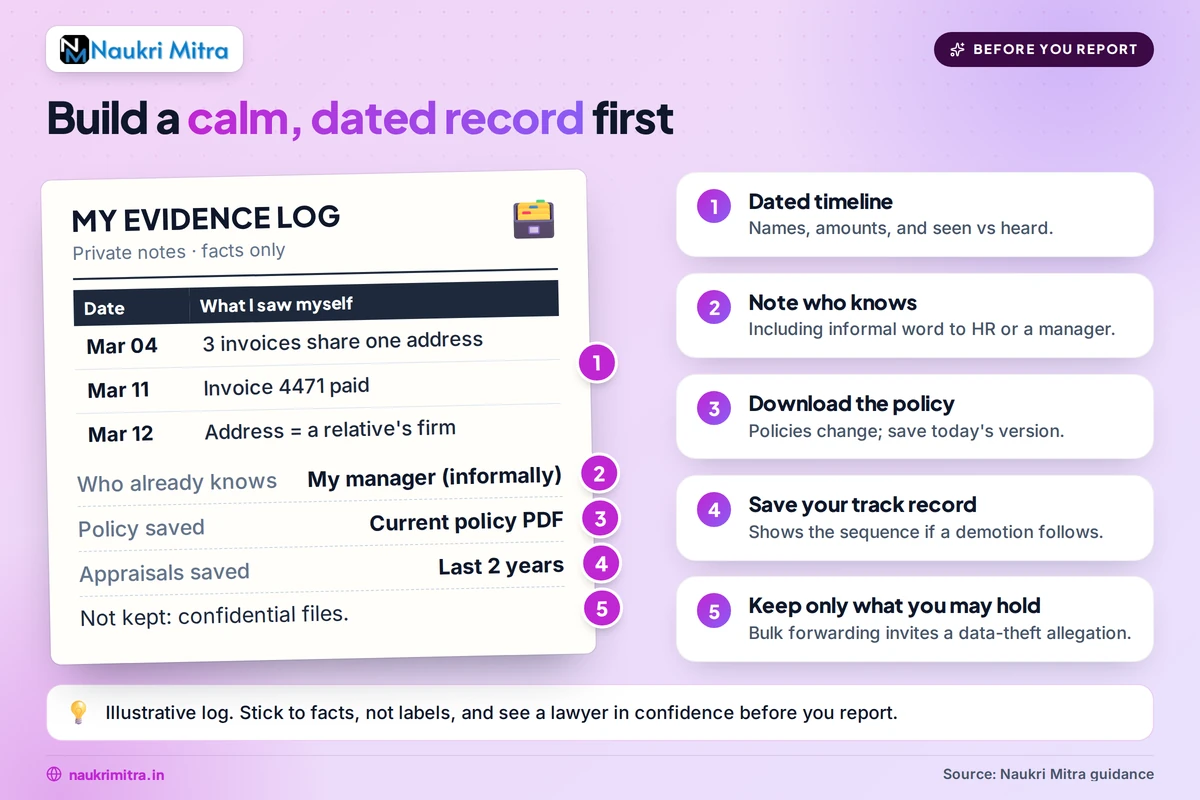
- Write a timeline with dates, names, amounts, and what you saw yourself versus what you heard.
- Keep only what you may legitimately hold. Do not bulk-forward confidential files to a personal account, because that hands the company a counter-allegation of breach or data theft.
- Save your performance record: appraisals and appreciation emails show the sequence if a demotion follows.
- Note who already knows, including any informal word to a manager or HR.
- Download the current policy, since policies change.
Stick to facts. "Invoice 4471 was paid to a vendor whose registered address matches an employee's relative" is stronger than calling someone a fraudster.
Can You Consult a Lawyer Confidentially Before Deciding to Report?
Yes, and it is one of the smartest moves available. Conversations with your own lawyer are protected by professional confidentiality, and consulting one does not make you a whistleblower in the company's eyes. A short meeting can clarify whether your facts amount to an offence, what the policy actually promises, and what your contract says about confidentiality and notice. Bring the policy, your employment agreement and your timeline.
Report to the Company's Ethics Hotline or an External Regulator: What Is the Difference?
An internal ethics hotline is the company's own channel, often run by a third party so reports are logged outside the organisation. It offers speed and a chance of a quiet fix, but the company controls the investigation, so an unwelcome finding may be softened. An external regulator, whether SEBI, the corporate affairs ministry or a law enforcement agency, sits outside company control. A complaint there can trigger a real inquiry, but it escalates the situation permanently, and your employer will usually work out who sent it.
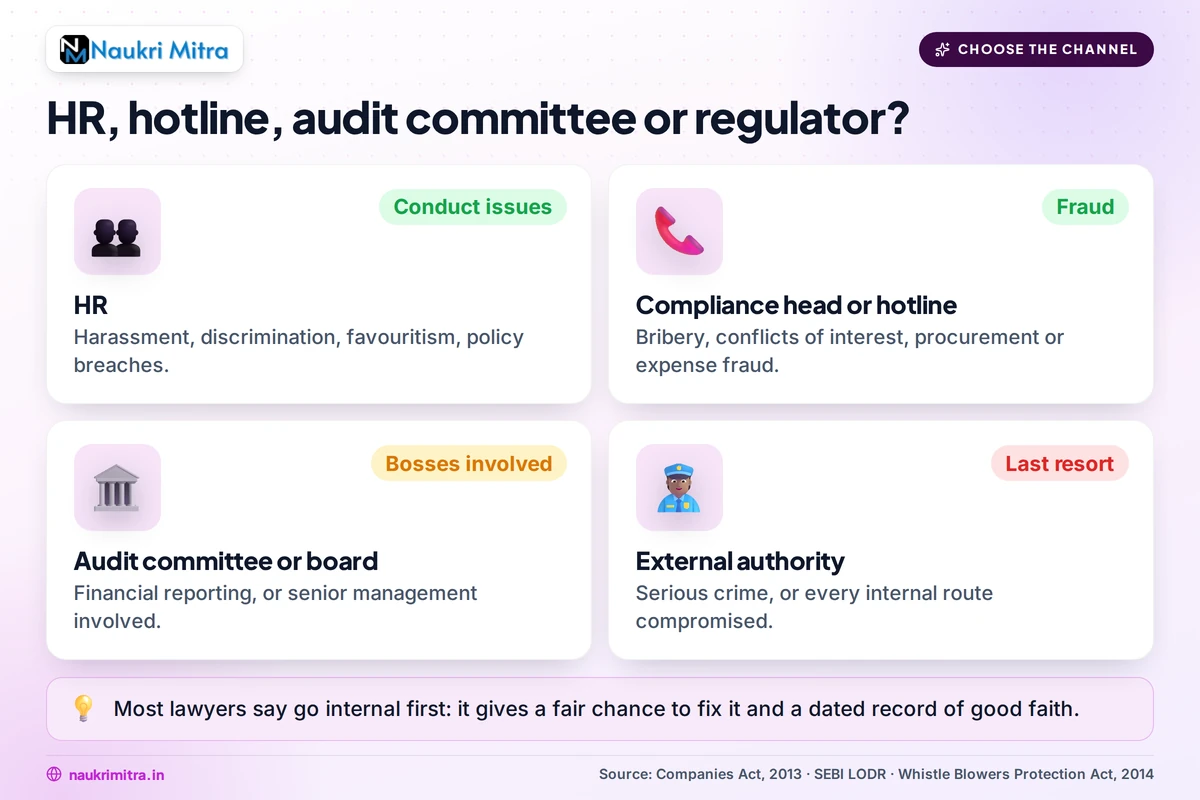
Most lawyers lean towards reporting internally first, for three reasons: it gives the company a fair chance to correct the problem, it creates a dated record of good faith, and retaliation after an internal report is easier to argue as victimisation. Exceptions exist. If evidence may be destroyed, if the wrongdoers control the channel, or if the matter is plain crime such as bribery or forgery, going outward earlier can be justified. Take advice before approaching police.
HR, the Board or Audit Committee, or an External Authority: How Do You Choose?
- HR: harassment, discrimination, favouritism and policy breaches.
- Compliance head or hotline: bribery, conflicts of interest, procurement and expense fraud.
- Audit committee or board: financial reporting concerns or senior management involvement.
- External authority: serious crime, regulatory violations, or when every internal option is compromised.
A report that never went inside can look like an effort to damage the company, so show you made a sensible internal attempt where it is safe to do so.
Is It Safe to Report Misconduct to HR in India?
Many employees start with the question is it safe to report misconduct to HR India teams actually handle well. It depends on the misconduct. HR suits harassment, bullying and policy breaches. It is a weaker choice for financial fraud or leadership wrongdoing, because HR reports into the same management and owes its first duty to the employer. A mature HR team will route a fraud complaint to compliance, legal or the audit committee; a less mature one may warn the person you named. If you go to HR, put the concern in writing and ask for acknowledgement. A verbal chat leaves no record.
What If the Misconduct Involves Your Own Manager or Senior Leadership?
This is the hardest version, and the direct-access clause was designed for it. Skip your manager. Use the hotline, write to the compliance officer, or approach the audit committee chairperson if the company is covered by Section 177. Independent directors are your most meaningful audience because they are not part of the executive team. Avoid casual conversations with colleagues, since informal talk travels quickly and can reach the person you are worried about before your complaint is formally received.
Can You Report Anonymously, and How Protected Is That Anonymity?
Most hotlines accept anonymous reports. The practical issue is whether you stay anonymous. If only three people could see those invoices, a complaint that mentions them points to you whatever the form says. Anonymous complaints also carry a credibility cost, since investigators cannot ask follow-up questions. SEBI's informant process lets you start through a legal representative, with identity disclosed later and before any reward is paid. So the better strategy is often confidential rather than anonymous: your name is known to a small, trusted channel and protected from everyone else. If you go anonymous, remove details only you could know and use a device and account that are not tied to work.
Can Whistleblowing Affect Your Future Job Prospects or References?
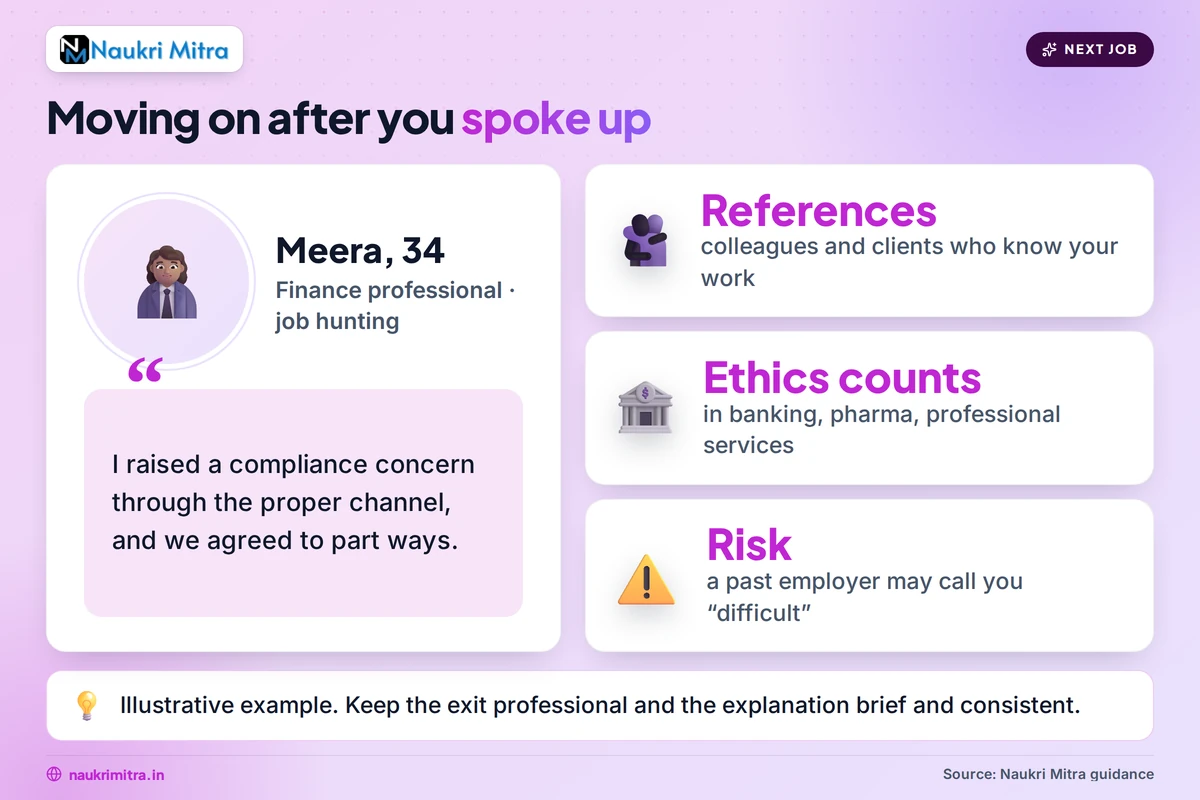
It can, and pretending otherwise does not help. Hiring in India runs substantially on references and networks, and a former employer may call you "difficult" without ever mentioning the complaint. On the other hand, employers in compliance-sensitive sectors such as banking, pharma and professional services often see an ethical record as a plus. Keep your exit professional, line up references from colleagues and clients who know your work, and describe the departure briefly: "I raised a compliance concern through the proper channel, and we agreed to part ways." If this experience points you towards integrity-led work, roles in compliance analysis or audit in Mumbai are examples where it counts.
Do Startups and Large Listed Companies Offer Meaningfully Different Protections?
Yes. A large listed company has legal duties: a vigil mechanism, an audit committee, shareholder disclosure and SEBI oversight. Those structures give you something to point to. A startup usually has no such obligation unless it takes deposits or crosses the borrowing threshold, and there may be no audit committee, only founders and a few investors. A small team can sometimes fix things fast if the founder is willing, but the founder may be the problem. Investors can then be a useful route, since investment agreements often include governance covenants.
How Long Does an Internal Whistleblower Investigation Typically Take?
There is no statutory timeline for private employers. Some policies target a few weeks for an initial review, while a complex financial matter involving forensic accountants and external counsel can run for months. A fair expectation is acknowledgement within days, a preliminary view within weeks, and a final outcome that may take much longer. Ask for the timeline when you file, keep dated notes, and if the process drifts, send a polite written follow-up to the audit committee chairperson.
Can You Still Whistleblow After Resigning or Being Terminated?
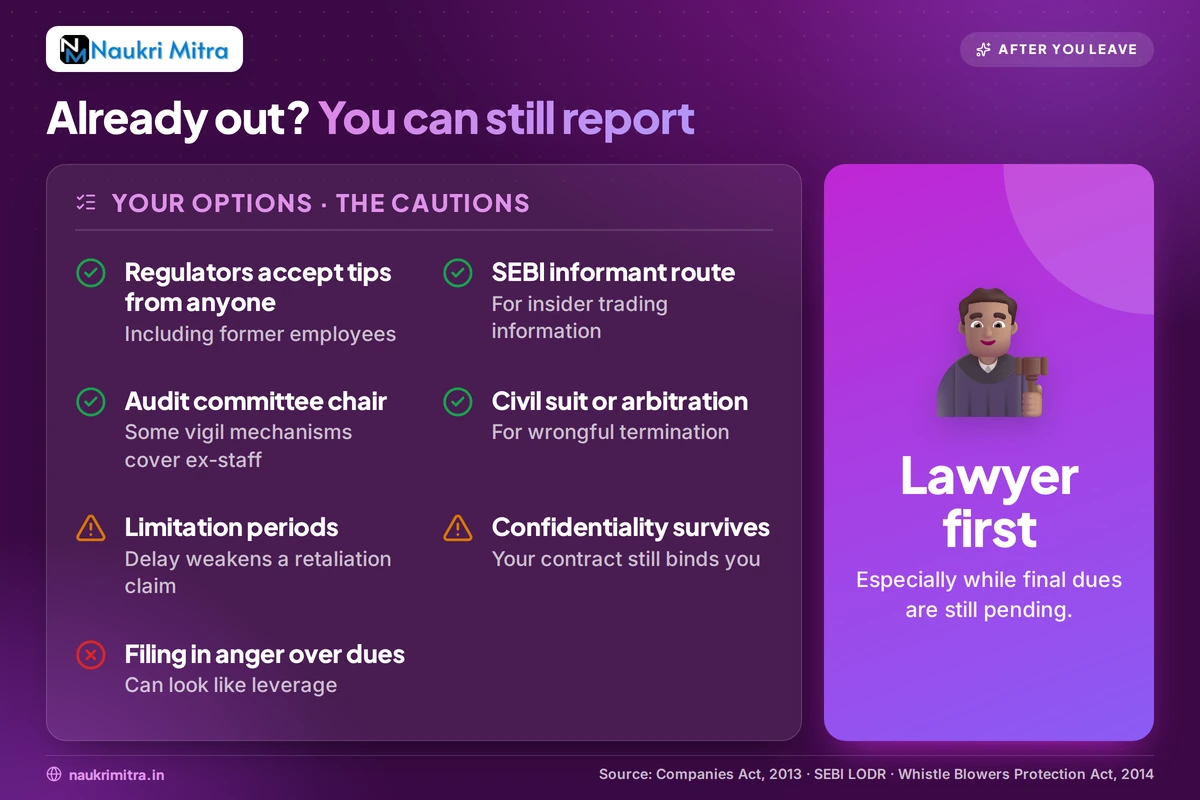
Generally yes. Most vigil mechanisms cover directors and employees, some extend to former staff, and regulators accept information from anyone, including under SEBI's informant route. Two cautions apply. Civil claims have limitation periods, so delay can weaken a retaliation case. And confidentiality duties in your employment agreement survive your exit. Speak to a lawyer first, especially while final dues are pending, because a complaint filed in anger during a dispute can look like leverage.
What Do Real Indian Whistleblower Cases Suggest You Should Expect?
The record is sobering and varied. Satyendra Dubey, an engineer with the National Highways Authority of India, wrote about corruption in a road project and was murdered in 2003. In 2005 Manjunath Shanmugam, an Indian Oil officer, was killed after sealing a petrol pump selling adulterated fuel. Both cases involved public-sector work, and both shaped the debate that led to the 2004 resolution and the 2014 Act.
In the corporate world, anonymous complainants alleged in 2019 that senior Infosys executives were pushing aggressive accounting. The audit committee, with outside law firms, reviewed the claims and reported in January 2020 that it found no evidence of financial impropriety or executive misconduct, and the US securities regulator later closed its inquiry without action, according to media reports. The lesson is twofold: a well-run company will investigate through formal channels, and an anonymous tip with few verifiable details may never produce a finding.
What Is the Realistic Risk-Reward of Whistleblowing in an Indian Corporate Setting?
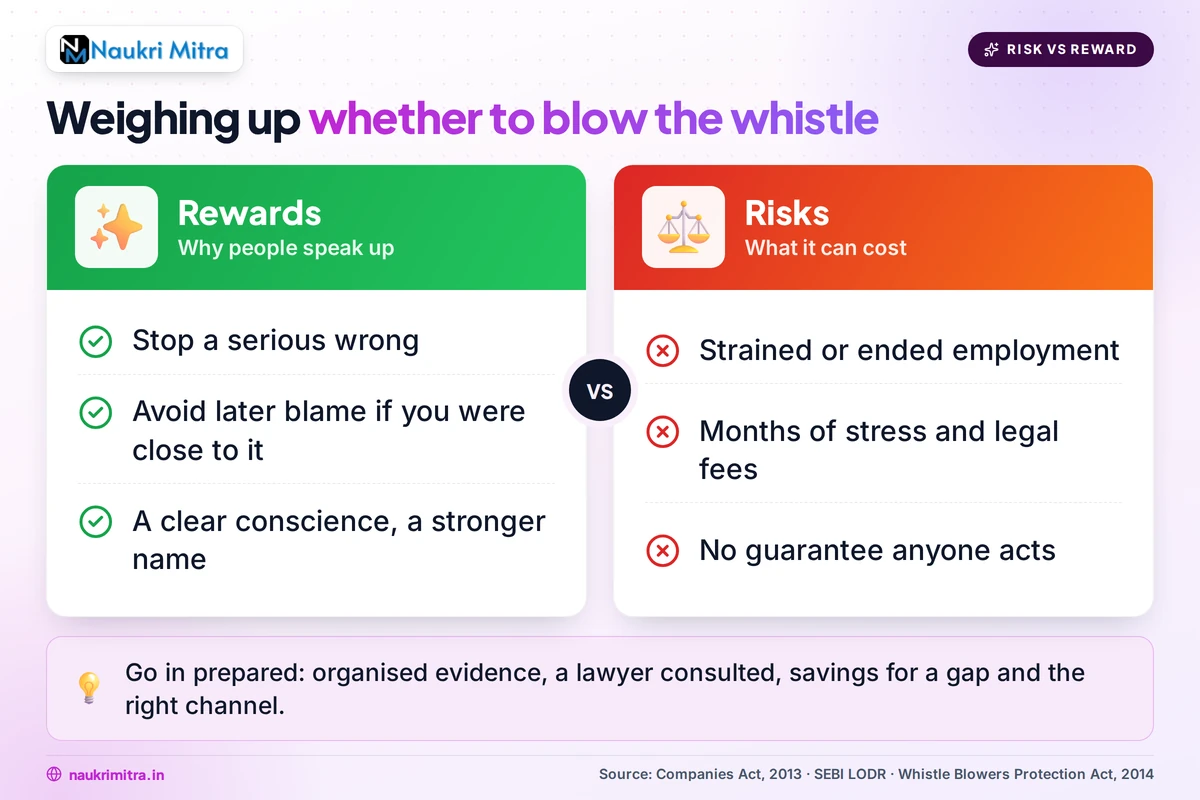
The rewards are stopping a serious wrong, protecting yourself from later blame if you were close to it, a clear conscience, and in regulated sectors sometimes a stronger professional name. The costs are strained or ended employment, months of stress, legal fees, a contested reference, and no guarantee that anyone acts. Policies on employee protection for reporting corruption company staff can offer on paper do not guarantee good application. That does not mean staying silent. It means going in prepared, with organised evidence, a lawyer consulted, savings for a gap and the right channel chosen. A weak complaint is harder to repair than a strong one is to file.
Frequently Asked Questions
1. Is there a specific law for private-sector whistleblowers in India?
No dedicated law exists. Protection comes from the Companies Act, SEBI regulations, criminal law and your contract. The 2014 Act targets public servants and has not been fully brought into force.
2. Which companies must have a vigil mechanism?
Listed companies, companies accepting public deposits, and those with bank or institutional borrowings above the prescribed limit, currently fifty crore rupees. Check the current rule text.
3. Can my employer fire me for reporting misconduct?
It can try, but a termination tied to a good-faith complaint can be challenged, especially where a vigil mechanism is mandatory. Proving the link is the hard part.
4. Is anonymous reporting safe?
It lowers visibility, but small details can still identify you, and anonymous tips are harder to investigate. Confidential, named reporting to a limited channel is often preferred.
5. Should I tell HR first?
For conduct issues, yes. For financial fraud or senior involvement, the compliance head, hotline or audit committee chairperson is usually better.
6. Is there a reward for reporting fraud in India?
Only through SEBI's informant mechanism for insider trading that leads to a recovery. Other workplace fraud carries no formal reward.
7. Can I report after leaving the company?
Yes. Regulators accept information from former employees. Watch limitation periods and continuing confidentiality duties.
8. How long will an investigation take?
No legal timeline applies to private companies. Simple matters may close in weeks and complex financial cases in months. Ask for a schedule in writing.
9. Will whistleblowing hurt my next job search?
It can, mainly through informal references, though some sectors value ethical conduct. Keep your exit professional and describe it neutrally.
10. Can I speak to a lawyer in confidence first?
Yes. Discussions with your own lawyer are confidential, and doing this before reporting is advisable.
This article is general information, not legal advice; laws and thresholds change, so check current texts or consult an employment lawyer. For more practical career guidance and verified job listings, visit Naukri Mitra.
Sources: Whistle Blowers Protection Act, 2014 (Legislative Department, Government of India); Whistleblowing in India: Are We There Yet? (Nishith Desai Associates); Vigil Mechanism and Whistleblower Policy under Section 177(9) (Sansa Legal).
.png)
.png)
.png)
Comments
Post a Comment